You are currently browsing the yearly archive for 2008.
“In the Cards” is a 24 minute TV short story from the series Tales from the Darkside (January 27, 1985). The official description is, “A tarot reader who attracts business by giving out only good predictions finds herself stuck with a new deck of cards—one which makes terrible predictions come true.” Warning: it’s hoaky and may not be how we like to envision the cards—pandering to too many fears, superstitions and stereotypes, but it’s rare to see a story centered this thoroughly on Tarot. This “horror” story is in three segments. Watch Part 1 below. Click here for Part 2 and Part 3. Thanks to Kalessin for telling me about it.
Is prediction what tarot reading is all about? What if it is not to learn that a particular thing is going to happen but, rather, to explore later what those cards can teach us about what does happen? What if the reading is simply to make us spiritually or psychologically aware of what’s really important and significant in life events—to wake us up to how the outer and the inner reflect each other in a meaningful way?
As an example, I’ll describe a very powerful experience a group of us had in one of my classes (permission granted to tell this story). I had proposed an experiment in prediction. Each member of the class was to draw a Major Arcana card to signify the most significant archetype that would be functioning over the following week. They were then to draw two Minor Arcana cards that would describe the situation that archetype would function within—giving us the particular circumstances and literal details. As a group we made predictions that would be evaluated the following week. (Without reading any further you may want to look at the three cards below and think what prediction you would make.)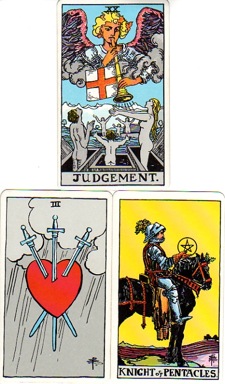
The cards Heidi drew from the RWS deck were Judgment, Three of Swords, and Knight of Pentacles. Knowing that Heidi’s father had recently died, we predicted that her feelings of grief for her father would be strongly triggered but would result in some kind of awakening or acceptance of her loss. She told us she would be going to his home three hours away to tie up his financial affairs and we warned that going through his papers would probably be very difficult.
When we gathered the following week Heidi told us that the reading had referred to a very specific dangerous and traumatic event. Given that the assignment was prediction, she wondered (as did we all) why no one had been able to warn her so she could have avoided it.
She had gone to the bank to close her father’s accounts when a man with a gun came in to rob the bank. As the robber waved his gun around, Heidi dropped to the floor in fear for her life. The robber even stepped on her shoulder when he took money from that cashier’s window. To add to it all, he had taken a bank deposit box withdrawal slip containing the address of her father’s house.
When a customer stupidly ran after the robber, Heidi had held and comforted his young daughter, assuring her that her father would be all right (although she couldn’t know that) and that the robber wouldn’t return.
She felt that Judgment referred to her fear for her life. Heidi had faced the thought that she might be meeting her maker. The Three of Swords was her terror and anguish, and the Knight of Pentacles was the robber (jumping in a getaway car with the money), as well as herself (traveling to the bank to deal with money issues). He might even have been the “hero” who tried to stop the robber from getting away. And, of course, it was her father leaving her.
The archetypal images in the Judgment card include a guardian angel, a “wake up call,” emergence from some kind of “boxed” thinking, and a child and parents. Something about being a child to a parent appeared to be breaking into consciousness. Having just lost her father, plenty of early childhood issues were being triggered in Heidi. She was able to be both guardian angel to a terrified child and the child herself.
Heidi also noted that, like in the movie Roshamon, everyone’s judgment varied. Each person at the scene described the robber differently (the three swords crossing each other). And, while most people turned in only a few lines of written description to the police, she had written at least a page and a half, even while realizing that her own judgments might be coloring what she said. Judgment would never mean the same thing to her again!
The strangest thing Heidi found was that she was left with a tremendous fear of revolving glass doors leading outside, and she remembers having had this fear when she was younger—although we didn’t have time in class to explore that. The revolving metal holding the glass was like the metal of the three crossed swords. Of course, death itself is a painful doorway—especially to those left behind on the other side. In essence, Heidi had been robbed of her father, but she ended up assuring a little girl (as well as the child within herself) that both her father and she would be all right. Would it have served her as well to have avoided the situation all together?
Everyone in class agreed that they could never have predicted a bank robbery from the cards Heidi had drawn. However, looking back on the incident, we saw how perfectly they describe the robbery. Much more importantly, they indicate how Heidi was affected and point to unconscious complexes that were triggered by the events. An experience she’ll never forget also became a rich vein of personal alchemical gold that Heidi will be able to mine for years, using the cards in the reading as guides to layers of healing.
So, is tarot best at prediction (since it is too often a hit-or-miss proposition), or is it more ideal for reliably exploring the deeper significance of whatever does happen?
Thought you all would want a look at one of the newest self-published decks, The Whispering Tarot by Elizabeth [Liz] Hazel, author of the excellent Tarot Decoded: Undertanding and Using Dignities and Correspondences. I love the deck name as I was strongly impressed by a fantasy novel (The Destiny Dice by David Bischoff) in which rune stones decided among themselves who would answer the reader’s question. When the reader reached into the runebag, the chosen rune would leap into the reader’s hand. The rune then would whisper it’s message to the reader, even arguing with him. The particular rune’s personality and style of communication was a significant part of the message. This deck reminds me very much of that story.
This is a bright, sunny, playful and very usable deck with a pagan/nature spirit slant. Printed by Playing Cards R Us, it is poker-size with black borders, shuffling nicely and perfect for small hands. Though some of the pictures are quite detailed, the use of a fine point pen for drawing makes the images distinct. The pen and ink drawings were then colored with prismacolor markers. It comes in a two-part custom box (nice touch!).

While the Golden Dawn and Rider-Waite-Smith deck were among Liz’s major influences (especially the astrological attributions), this is no clone, but a fresh, original deck. Magical creatures abound: Zephers (wind-spirits), dragons, mermaids, water faeries, harpies and more. Additionally, there are regular animals like snakes, dolphins, birds, horses, cats and even an elephant. Birch trees characterize the Wands suit. Pentacles utilize geometry and people in their environment to get the message across. The card backs have an unusual art nouveau/celtic knot design (based on a color palette from 1895).
I emailed Liz with a few questions and comments that I’d like to share with you.
ME: I’ve had the most amazing experience—in reading after reading I received all four suits and a Major Arcana card among the seven cards in the spread! This is incredibly rare but seems to say that the deck is looking at things from every angle. There’s also a sense of blessing and unity about it.
LIZ: As far as I know, this is the only tarot deck that’s ever come with a blessing charm on it (it’s on the sign & number card). The charm refers to the North Node (Dragon’s Head). The whole project was a Goddess offering, so I’m glad to hear that it conveys a blessing/unity. Am glad I changed the name to Whispering Tarot – it was an inspired choice, and I was amazed/thrilled no one else had ever used that name for a deck.
ME: What was the initial inspiration for this deck?
LIZ: My stubborn, determined & picky Taurus rising! I wanted a deck with everything I find pleasing in tarot, and with nothing I find displeasing. I wanted Kings and Queens to look in love with each other, not angry or constipated looking, or on the verge of divorce. I wanted pip designs that clearly conveyed the divinatory meanings. I also wanted specific production features like the custom two-part box. Looks nicer, lasts longer. I wanted no numbers or specific attributions on the Major Arcana, so the reader could choose. Basically, the deck was a big Venus-driven “gimme.”
ME: I can see Rider-Waite-Smith/Golden Dawn elements but so much more—what are your other major influences? Can you give me an example of one or two cards that diverge greatly from the RWS/GD and why?

LIZ: Here’s some brief summaries for changes: Magician: No table, no clothes. He has the raw elements in play around him. The dragon rises along his arm in 3.5 curls – the unfolding of kundalini. Yummy no-frills symbolism. The Magician reappears in the Judgment card. Hierophant: The guru levitates half-way between heaven and earth, and is surrounded by animal totems, a more Buddhist and shamanic image. Less paternalistic, intolerant & dogma-bound; more spiritual intermediary, gentle advisor or spiritual counselor. More astrology related, too. Eclipse: Switched the title/image to distinguish between The Moon card and the moon-attributed High Priestess. An early DM [divinatory meaning] for The Moon is eclipses. Frankly, eclipses are WAY weirder & scarier than a plain old moon. An eclipse is much more distinctive symbolism, and a lot more in tune with the DM’s. 4 Swords: The guy is in the meditation asana, and levitating over a maze. His calm demeanor suggests he’s in a good frame of mind to see the big picture and figure out puzzles. Of course, it could also indicate a dead person’s soul rising from a house. I like the gentle ambivalence, and the card is peaceful in spite of the clashing green-orange colors. I’m tweaking Waite’s nose here.
ME: Anything else you’d like my readers to know?
LIZ: I considered depth and distance perspective a lot when designing these cards. Distant vistas, like in the 2 of Wands, suggest that more is out there, or that the meaning involves the greater world. Cards with close or compact perspective take the reader into what might be a more intense, narrow, or claustrophobic situation. In a few cases, I deliberately changed the historic (RWS) perspective. For example, in the 7 of Pentacles, the guy sitting at the chair looks pretty miserable or tired of waiting; but the door is open, and the pentacles lead out into the world. The old man & bush image is a dead bore.
I didn’t hesitate to chuck RWS symbolism, Masonic, and Christian symbolism and other authority figures out of my third floor window, and that was rather the point as well as my greatest delight. My greatest influence as an artist comes from the Golden Age of Illustration artists: Arthur Rackham, Edmund Dulac, Kay Nielsen, the Robinson brothers, Beardsley, Harry Crane, William Morris, and Charles Rennie Macintosh, to name a few.
The deck is pan-spiritual, and is divested of cryptic symbolism tied to Waite’s blinds. In the act of pleasing myself (and believe me, it’s a monster ego stroke to do readings with my own deck) I hope I’ve created a deck that will please other readers.
This is a deck created by a long-time student and experienced practitioner of both tarot and astrology. It shows in the book where traditional meanings are modified by an awareness of the modern concerns that come up in psychic fairs and other public venues. Liz’s original spreads will help you address the practical needs of most querents.
Copies of The Whispering Tarot and Liz’s book about the deck will be available from Jeanette Roth (TarotGarden) at LATS and BATs and Archon. Liz Hazel says she hopes to have enough sales to merit a second printing but, “not signed & numbered, never again!!!” Collectors will want to jump on this first edition, which can be ordered directly from Liz here.
You’ve probably heard the phrase “Tarot is a Mirror of the Soul.” Certainly any reading can be examined from this perspective, giving you an ever-changing kalidescopic view of the self and your concerns. Here, though, is a fun way to make the Major Arcana your own. This personal process (it’s not a spread as you’d normally think of it) provides a way to view a deep reflection of your Soul-Self that probably won’t change much until (or unless) you do.
Take out your favorite Major Arcana deck—the one that speaks most expressively to you. Arrange the Major Arcana in order from the card you like and admire the most to the one you find the scariest and most fearful. Take one card which fits the least into your personal sequence and put it aside.
Next, keeping the cards in the order you’ve just determined, lay your Major Arcana out in three rows of seven cards as shown in the diagram below. Put the one card that “fits least” in the single position at the top.

Now comes the fun part. Examine each three-card column such that the top card in a column indicates your Ideals, the bottom card is its Shadow, and the middle card Mediates between these two. The mediating card can be seen as that which makes it possible for the Ideal and Shadow to relate to each other.
For instance, if you have the Sun as your Ideal and the Tower as its Shadow with Justice mediating, then Justice helps each to see that the other is necessary for a just balance. On the other hand, if Temperance is the Ideal and Death its Shadow, and the Wheel of Fortune mediates, then the Wheel reminds you that Temperance’s mixture of elements has to include the season of Death as part of its cycle.
Look at these cards in terms of how you handle and respond to situations. When you are striving for an Ideal, how can you integrate its Shadow? When you are annoyed or afraid, how can you call on your positive Ideal? Use the mediating card as a practical key to this integrative process.
How does the card you placed at the very top, the one that “didn’t fit,” seem to comment on all the others or, perhaps, lend an overall theme to the whole?
Do it once, save the results somewhere where you will “stumble” upon them in 6 months or a year. Re-order the Major Arcana of the same deck again (from the ones you like most to the ones you find most scary and disturbing) and see where your sequence has stayed the same as last time and where it’s changed.
Let me know how this works for you.
Here’s a little walk down memory lane. These cards are from London – late 1970 or early ’71, printed in a magazine called Gear of London and designed by Barry Josey. Obviously they are based on the works of Aubrey Beardsley. If anyone has any more information on this deck or the magazine, please let me know.
Update: I received an email from the artist Barry Josey (love the internet!). Finding that his art could not support him, he went back to his profession as an architect and also left the tarot behind, but hopes to return to art when he retires. Here he explains how the deck came about:
“Initially, the cards were set out as a poster style calendar, and then they were intended to be printed as packs. At the time, I knew nothing of Tarot, but had to immerse myself albeit briefly to get a starting point for the drawings. Beardsley was ‘in’ at the time and because I could approximate the style, Gear asked me to prepare the cards. The drawings were black and white only, and it had been my intention that they be printed on a single buff or similar pastel colour. Gear disagreed and printed them in the rather garish primary colours you see before you.”

Here’s another example of the art of Barry Josey—an illustration for a play by Jean Genet.
The Hermetic Order of the Golden Dawn introduced what I consider the most extensive and elegant set of correspondences among the tarot and other magical systems. Here is a permutation I hadn’t seen before. It’s from The Magical Writings of Ithell Colquhoun edited by Steve Nichols. Colquhoun was an artist, magician and the biographer of MacGregor Mathers (Sword of Wisdom-o.p.). Magical Writings contains over a hundred pages of text on the Major Arcana (material on the last five cards added by Steve Nichols), plus reproductions of pages from Colquhoun’s tarot notebooks. It’s a treasure-trove for the discerning reader.
THE PLANETARY TRIPLICITIES – based on correspondences to the planets and the signs they rule.
MERCURY: Magus, Lovers, Hermit (Mercury, Gemini, Virgo)
MOON: Priestess, Chariot, Hanged Man (Moon, Cancer, Elemental Water)
VENUS: Empress, Hierophant, Justice (Venus, Taurus, Libra)
SUN: Sun, Strength, Judgment (Sun, Leo, Elemental Fire)
MARS: Tower, Emperor, Death (Mars, Aries, Scorpio)
JUPITER: Wheel, Temperance, Moon (Jupiter, Sagittarius, Pisces)
SATURN: World, Devil, Star (Saturn, Capricorn, Aquarius)
(Fool = Elemental Air)
These groupings can be very handy in a reading where the occurrence of two or three cards from one of the triplicities indicates a strong influence by that planetary energy. Mythically, it suggests the presence of that God/dess messing around in one’s life.
“What I’m after isn’t flexible bodies, but flexible brains. What I’m after is to restore each person to their human dignity.”
Moshe Feldenkrais wrote a book called The Potent Self: A Study of Spontaneity and Compulsion. In his “Awareness through Movement” classes (the Feldenkrais Method) you can discover where you body has become inhibited and thus lacks a full range of movement. Using Feldenkrais’ techniques you can eventually regain most or all of that potential. For instance, if you ever broke a leg, your body compensated for the injury. After healing, your body may have become unconsciously habituated to some of that compensation, limiting your range of motion. In his book, Feldenkrais draws parallels with how the same thing occurs in our minds and attitudes. If you were told to always be polite, then you no longer have a full range of possible responses, so it may be difficult to say no. If you feel inhibited asking for what you really want, then your potency is compromised.
Use this spread, which is based on recommendations in The Potent Self, to explore inhibitions and impotencies of which you may not be fully aware. Be playful when interpreting the cards, looking for literal clues as well as puns and metaphors in the cards you draw. This is a wonderful spread to use with the Osho Zen Tarot, though any deck will work. Read all cards as if they were upright but explore a full range of the card’s possibilities. For instance, the Sun ranges from joy to burn out.
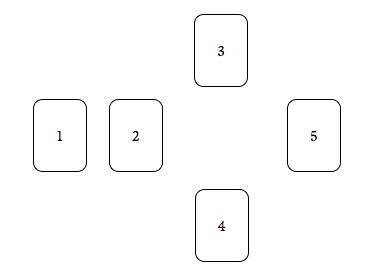
Shuffle the deck making sure you will obtain reversed cards. Cut and restack in a new order. Turn over cards from the top until you get to the first reversed card. Put this in Position 1.
Card 1: Where am I feeling impotent or inhibited? This describes the situation or issue where your full potential is restricted.
Briefly shuffle all cards except that in Position 1. Spread them face down in a fan on the table. Use your intuition to select cards for the remaining positions from anywhere in the fan.
Card 2: What is inhibiting the proper function and thus causing the impotency? Note: this may have been an appropriate response in the past but is now merely a compensatory habit.
Card 3: What will come from becoming more potent? Brainstorm as many possibilities as you can, including difficult ones.
Card 4: What will come from not becoming more potent, that is, staying the same or getting worse? Include the absolutely worst case scenario suggested by this card.
Card 5: What action is needed? What kinds of things does this card suggest that you do? Pick one and do it.
The U.S.A. has a new Poet Laureate, Kay Ryan. And, she tells everyone she started her career by writing poems about tarot cards.
This is from an interview in the Marin Independent Journal:
Ryan decided to pursue writing seriously after having an epiphany while bicycling up the Rocky Mountains while on a 4,000-mile, cross-country bicycle trip in 1976. When she returned home, she set to work. She began using a deck of Tarot cards as an exercise, forcing herself to write a poem about the subject of whichever card she drew at random. Some of the subjects were harder than others.
“Death, I’ve never minded that so much,” Ryan says. “Love, I minded because it’s just so icky, so overdone. I just didn’t want to touch it.”
And here’s from Tulsa World:
“Still shying away from difficut themes, Ryan assigned herself a task: She would get out a pack of tarot cards, turn one card over every day and write a poem from it. ‘So I had to start dealing with these abstractions like love, death, the wheel of fortune.'”
But Kay’s not the only one to use Tarot to inspire poetry. I taught a couple of workshops for the International Women’s Writing Guild conference retreat in California and I sometimes have my classes write tarot haiku. In my first book, Tarot for Your Self, I included tarot poems by Robert Creeley, John Weiners, Diane Wakoski, Diane DiPrima, Judy Grahn and Philip Lamantia and quoted poet Aethelaid Eldridge, who gave his student a tarot deck, saying, “Here, every good poet should know the Tarot inside and out.”
To learn quite a bit more about tarot and poetry, read this fascinating conversation between poets Alice Notley and CAConrad at PhillySound: new poetry. The tarot discussion begins almost halfway down with Notley’s description of a tarot reading by Ted Berrigan in 1969. It continues with Notley’s telling us how she’s used tarot cards in writing classes, inspired by a class Michael McClure taught at the Naropa Institute. The article goes into lots more about Conrad’s and Notley’s use of tarot. Here’s my favorite quote from Notley:
“I’m not an expert in the deck at all. My interest lies somewhere near a sense that words are like tarot cards, and that a poem manipulates unpredictable depths with its words. . . . I like the tarot because it works like poetry and because you don’t really have to ‘believe in’ anything. It’s there to be used. The symbols are remarkably durable and beautiful; they float out to encompass all kinds of meanings.”
Check out my earlier posts on tarot and poetry, here, here and here. And, thanks to The Tarot Channel where Eva Kay Ryan’s tarot connection.
When I lived in San Francisco I was privileged to meet several members of what was then known as the Holy Order of MANS (in which MANS stands for “Mysterion, Agape, Nous, Sophia,” Greek for mystery, love, mind, and wisdom). I became interested in their organization, both because of the tremendous sincerity and integrity of the members I met and because of their study of tarot as a Christian mystery. They adopted the Waite-Smith Tarot as modified by Paul Foster Case and Jessie Burns Parke, added their own layer of modifications to the deck, and then wrote a set of explanatory books that are thoughtful revisionings of Case’s text.
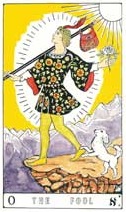
The Holy Order of MANS was founded in 1968 by visionary Earl Wilbur Blighton (formerly an electrical engineer) as a monastic order of esoteric, Rosicrucian Christianity dedicated to charity (Raphael Shelters) and their missionary work in 49 states. The order grew rapidly during San Francisco’s hippie era, when members served selflessly to help those in need. My sense is that they followed as closely as they could the model of the earliest Christian churches. Additionally, women could be ordained as priests. As Blighton expressed it in their statement of purpose:
“I care not what doctrine you have or have decided on. But while the world argues over the theological discussions of doctrine, sin, apostolic succession and others, we will remove from the people their problems and give unto them the ray of hope and reality which our Lord Jesus commissioned us to carry forth as Christians and disciples of the Word and the works and the Light and the love of God.”
With Blighton’s death in 1974 there was a prolonged power struggle among Blighton’s wife and others for leadership over the 3,000 members. The new director focused on a more conservative, repressive and less metaphysical path, eventually joining with a defrocked priest from the Russian Orthodox Church. Since 1988 it has splintered into many groups including the Science of Man in Oregon, which was led by Blighton’s wife, Ruth, until her death in 2005.
But their own deck and books were not the extent of the tarot connection. In 1975, at a judo tournament, science fiction author,  Piers Anthony, met and became friends with a brother from the original Order. Anthony was intrigued by their unique mix of Gnostic Christianity, co-ed communalism, and Tarot. Out of this came a character who would appear in several novels: Brother Paul of the Holy Order of Vision. Anthony also created an imaginary deck called the Animation Tarot, having a hundred cards in five suits. By September of 1977 he had a 250,000 word manuscript that no one wanted to publish. Members of the real order were told not to read the manuscript or speak with him, which he regretted, since the novel stemmed in significant part from his admiration of their operation. Anthony reluctantly agreed to splitting the book into a trilogy: God of Tarot, Vision of Tarot and Faith of Tarot. Jove then stopped publishing science fiction and the next two volumes were published by Berkeley (1980). It wasn’t until 1987 that the novel appeared in one volume (NY: Ace). It’s an interesting novel, although I remember it seeming rather incoherent in places—perhaps because I read it as each volume of the trilogy came out.
Although the Holy Order of MANS deck and books owe much to Case’s BOTA materials, there are plenty of additional insights to make them well worth obtaining, especially for those who are interested in a metaphysical Christian approach to the tarot symbols. The revised books, Keystone of the Tarot and the more detailed, Jewels of the Wise, and their color-it-yourself Major Arcana deck are still available here.
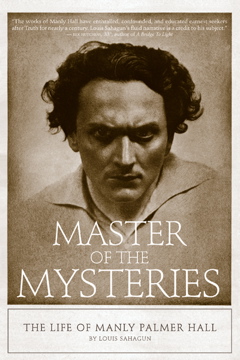
Last night I went to a lecture and book signing by Louis Sahagun, author of a biography of Manly Palmer Hall called Master of the Mysteries. Sahagun is a journalist at the Los Angeles Times and was working night duty on September 2, 1990 when the call came in that Hall had died at 89 years of age. Knowing nothing about the man, Sahagun looked him up in the files, finding little until he got back to the 1930s and 40s when he stumbled onto stacks of clippings. He wrote a brief obituary that didn’t begin to touch on the accomplishments of this internationally known metaphysician and occult scholar who eventually was a victim of extreme elder-abuse and probable murder.
Sahagun became fascinated by Hall’s story, was given access to several archives, interviewed dozens of people who had known Hall, and examined the police and medical reports on what is still an open suspicious-death investigation.
Hall is of interest to those of us in the Tarot world for his creation of what’s known as the Knapp-Hall Tarot deck, first published in 1929 by artist J. Augustus Knapp, illustrator of two of Hall’s first books, including the famous The Secret Teachings of All Ages (the latest edition is in its 16th printing).
I’ll leave you to read the fascinating details of the book from this article in the L.A. Times or listen to this podcast interview with Sahagun.
I want to talk here about the conversation I had with Louis Sahagun about the cult status of spiritual teachers. During his research Sahagun discovered an amazing but flawed human being—someone who married disastrously, fell behind the times and finally succumbed to the machinations of a conman. Despite this, Sahagun felt that he had found a man of immense talents and great personal integrity who warned against putting teachers on a pedestal. It is apparent that Hall’s scholarship left something to be desired (he had only a 6th grade education but a photographic memory), but it’s hard for many to accept that Hall could have been less than perfect. Sahagun was struck by the number of followers who seemed to do nothing with their lives but slavishly espouse the teachings. On the other hand, hundreds of people—mostly in the arts—creatively integrated Hall’s metaphysical principles into their work—making it their own. These included such diverse people as an L.A. mayor, a governor of California, Elvis Presley and Bela Lugosi.
Personally, I’ve been struck by the number of people who discover lies, misconduct or incorrect facts in the lives and work of their heroes and respond by either completely rejecting the teacher and work or by rejecting any evidence of a problem. Typical is a comment about the book from someone who regularly attended Hall’s lectures: “I wasn’t aware of any controversy surrounding Mr. Hall’s death either…. It was natural causes—and I suppose natural causes for an author to claim controversy.” This person has no desire to examine the evidence before claiming that the biographer must be lying.
When writing my biography of four original members of the Hermetic Order of the Golden Dawn, Women of the Golden Dawn: Rebels and Priestesses, I believed it vitally important to examine their flaws as well as their strengths. How are we to learn from someone’s story if we don’t see how that person navigated the difficulties of life? How can we evaluate a work if we aren’t willing to explore what’s true and what isn’t and what ‘works’ and what doesn’t? It’s important to realize that everyone is human. Just before I completed the biography, an acquaintance sent my text involving a different spiritual teacher, now deceased, to that person’s organization. I received a phone call asking me to remove quotes from letters that included accusations of an affair with someone he later married. It was felt this might harm the public perception of him as a great and good man. I ask, how are we ever to develop discrimination if we believe that spiritual teachers are somehow more perfect than the rest of us or that everything they write is Divine Truth?
The way I see it, there are three unacknowledged magical “initiations.” The first is when we come across a teaching or practice and have to determine if it contains a truth or way to which we want to commit ourselves. The second initiation is when we discover we’ve been betrayed by ‘lies’ and we have to decide to leave or continue the work. The third initiation is when we discover that the lie itself contains a greater truth. The second initiation is betrayal and until we have confronted betrayal and moved through it we will never encounter the third initiation. We experience these three initiations all the time, although a fourth is proposed that takes us beyond the world of truth and lies.
 Mary K. Greer has made tarot her life work. Check here for reports of goings-on in the world of tarot and cartomancy, articles on the history and practice of tarot, and materials on other cartomancy decks. Sorry, I no longer write reviews. Contact me
 Mary K. Greer's Tarot Blog
Recent Comments