You are currently browsing Mary K. Greer’s articles.
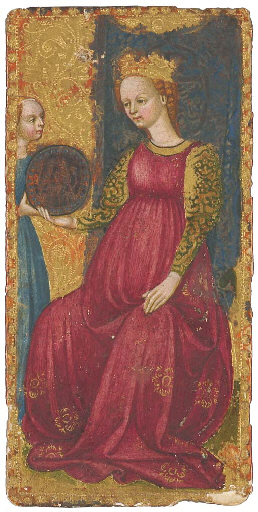 Beginners often have the most trouble reading Court Cards, especially if several of them appear in one spread. In general, Court Cards represent personal characteristics of individuals, attitudes, and levels of maturity or development that influence us—from within or without. Sometimes they represent actions: like traveling or revolutionizing (Knights), communications delivered (Pages), power and control applied (Kings and Queens), mothering (Queens) and fathering (Kings), teaching (Kings and Queens) or learning (Pages). More often they are personalities.
Significators
Old books have you select a card to “stand in” for the querent based on age, sex, marital status and hair color. Most of the time a significator is not really necessary in a spread; you can leave it out if you choose. If a Court Card significator is essential, then I tend to select first by the suit-to-element correspondence with the person’s sun sign (Fire, Water, Earth or Air) and then their sex and level of maturity. None of which are absolute! Another method is to have the querent look through the Court Cards and pick one for themselves. This will often tell you quite a bit about the querent and about how best to communicate with him or her. Feel free to throw out that hair color nonsense as it won’t work for more than half the people on the planet.
Who Are They?
• In mundane readings Court Cards are often straightforwardly someone recognizable.
• I find they always represent an aspect of oneself – one that you may or may not be projecting onto others. In deeper, more psychological readings, they are your personas: you can probably recognize their voices as contrary opinions in your head.
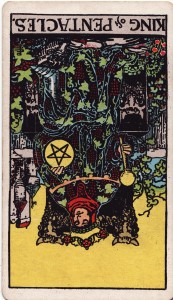 Reversed Court Cards
• Reversed Court Cards are not evil people; their characteristics can be weakened or excessive. Reversals can represent refusing to act like that Court Card. You might reject the tendencies usually shown by the card. A King might say: “I refuse to take charge.” A reversed King of Swords may be unable to make a decision or could make ruthless ones; a reversed Queen of Pentacles may ignore the needs of others and spend lavishly.
• Think of reversed Court Cards as being in a situation where their natural characteristics are not valued or respected; therefore they tend to “act out.” A Knight of Pentacles longs to be outdoors using his hands, so when working in a windowless office with florescent lights, he may be an unhappy, stubborn co-worker making everyone else as miserable as he is.
• Depending on how you read reversals, one other possibility is that a reversed Court Card represents your inner, hidden self versus your more public self.
In a Reading
• Pay close attention to the position meaning, and/or the direction the Court Card is facing. What are they looking at or pointing to? A Knight of Wands in the past, who looks even more into the “past” direction could be someone who has already moved out of your life. A Queen of Swords in a future position who looks to the future could be showing you the way. Notice what other cards are in the same suit suggesting that their energies are directly at play.
• I’ve noticed fairly often that a King can be most like a person’s mother and a Queen like the father, so don’t get too fixated on gender roles matching sex.
• I find that Court Cards almost always have strong opinions about what the querent should do, and the querent, if asked, will know exactly what these opinions are! So ask the querent what each Court Card thinks about the situation in question. Or, go further: have multiple Court Cards argue with each other. That reversed Page in your past will have very different opinions about what you should do than does the Knight who represents your “hopes and fears.”
• If you use Elemental Dignities then you will probably find that Court Cards in the same suit tend to support each other. Two Courts in Yang suits (Wands and Swords) will egg each other on, while the Yin suits (Cups and Pentacles) will counsel patience. Cups versus Wands, and Swords versus Pentacles, are so contrary that their opinions tend to cancel each other out.
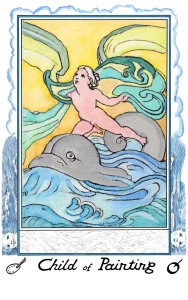 Differences in Decks
Deck creators have taken significant liberties with the Court Cards, changing their titles from the traditional King, Queen, Knight and Page to express a whole range of social groupings or “influencers” in our lives. They may even become animals, supernatural beings, gifts or places. Therefore get a feeling for the Court Cards in the deck you are using. Describe the picture and the suggested characteristics in detail. If these qualities function better in your readings than the classic meanings, then use them.
The Myers-Briggs Type Indicator (MBTI)
Based on concepts developed by psychotherapist Carl Jung, the MBTI posits sixteen personality types that have been understandably equated with the sixteen Court Cards. Most people agree on suit correspondences for Jung’s basic functions: Wands=Intuition, Cups=Feeling, Swords=Thinking, Pentacles=Sensation. However, the system becomes confusing when equating Introvert with just the Queens and Pages, and Extrovert with just the Kings and Knights. Is the Queen of Wands really an introvert? And is the King of Cups always an extrovert? I’ve found studying the MBTI system to be quite helpful in giving voice to Court Card personalities as long as I don’t make them absolutes! I find insurmountable problems when trying to equate these two systems, even though I learned a lot by trying to do so.
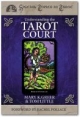
Want more information on the Court Cards? Order my book (written with Tom Little): Understanding the Tarot Court. And please submit an amazon review.
 Join me for a two-part Webinar featuring a Jungian approach to Tarot on April 7 & 21, 2016.
I am very proud to present the most complete version yet of material I’ve been developing for nearly fifty years on Carl Jung’s theories of the psyche and personal development as applied to reading Tarot. I’ve taught related workshops at the Jung Institute of San Francisco and at several Tarot conferences. This two-part course will be an expanded exploration of Jung’s concepts with the 2nd part being entirely new, to demonstrate exactly how to use these concepts in readings for one’s self and others. I’ll focus on the Rider-Waite-Smith deck as one example of how perfectly the Tarot depicts archetypal images from the collective unconscious. To register, visit globalspiritualstudies.com.
Class one: Symbolism in the RWS Deck
Jung wrote about Tarot on several occasions, seeing it as depicting archetypes of transformation like those he found in myths, dreams and alchemy. He described its divinatory abilities as similar to the I-Ching and astrology, and late in life established a group who attempted to integrate insights about a person based on multiple divination systems including Tarot.
In this informational class Mary:
- presents some of Jung’s own ideas about Tarot
- shows how his map of the psyche is reflected in the cards
- demonstrates how the “Fool’s Journey” parallels Jung’s all-important “individuation process.”
Class two: Methods and Spreads
In this workshop, Mary demonstrates how Jung’s psycho-therapeutic approach applies to actual readings and “inner work.”
- Learn how to apply Jung’s technique of “active imagination” to Tarot.
- Explore a couple of spreads that serve as mirrors of the psyche and show challenges and breakthroughs in the individuation process.
- Bring a Tarot deck as you’ll also draw cards for at least one Jungian spread for yourself.
- Discover how a Jungian approach can deepen your personal insights into the cards.
- Learn how to assist another with their inner work.
Mary also discusses the pitfalls and the boundaries required when a Tarot reader utilizes this material.
This course is open to all levels of Tarot experience, although some knowledge of the cards is suggested.
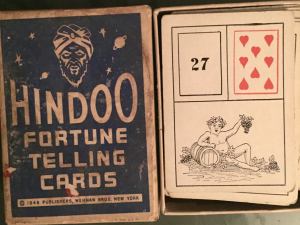
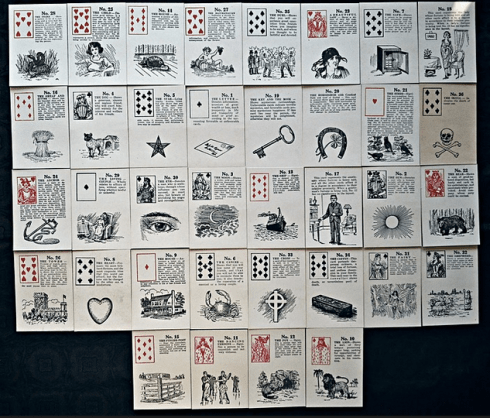 Old Gypsy Fortune Telling Cards from United Novelty, Mfc Company, Chicago, circa 1920-30 are a 36-card deck with playing cards inset and meanings given on each card. The instructions are in Polish and English and the Lady (significator) is clearly dressed as a 1920s flapper. At least 22 of the 36 cards are close cognates with the Lenormand cards. A few of the other card images are found on other cartomancy decks of the period. See this post in which Camelia Elias demonstrates using the deck.
They were printed by the Valmor Company of Chicago (also doing business as King Novelty; United Novelty appear to be distributors) and so are sometimes called the Valmor Fortune-Telling Cards. This hints at an interesting crossover between the immigrant community of Jewish founder Morton and Rose Neumann (the Polish connection?) and the African-American hoodoo tradition.
A surprisingly large number of hoodoo mail-order companies were founded by Jewish chemists who perceived a need for affordable beauty products and who then expanded into incense, candles and hoodoo potions. 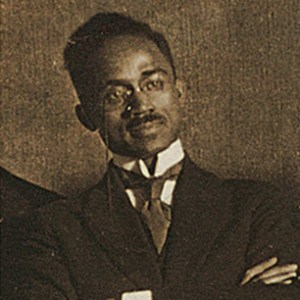 Two years after Morton Neumann started Valmor he married Rose and then the whole approach to Valmor advertising changed radically. The company became known for its illustrations featuring fair-skinned, black-haired beauties in seductive, sexy scenes. The original advertisment illustrator was African-American artist, Charles Dawson. Could he have been the artist of this deck?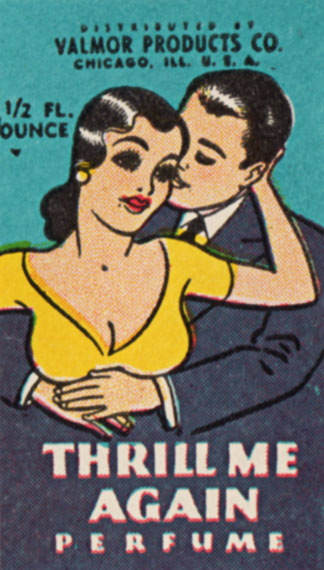
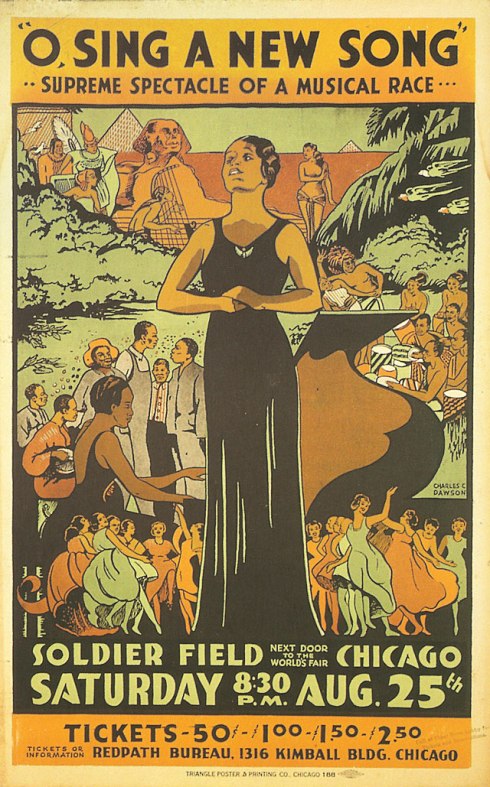
It’s interesting that Morton and Rose Neumann, by the mid-20th century, began investing their wealth in 19th century European art and later in American art, amassing what is considered today to be the foremost and most valuable private family art collection in America. They tried to keep it intact until the death of Rose and son, Hubert, when an inheritance tax of $50 million forced the sale of several works.
 The Old Gypsy Cards Fortune Telling Game from Addison Products Co, Chicago (no-date – 1940s?) is an identical deck, also with instructions in English and Polish. Looking similar to the Gypsy Witch, and with elements appearing in Whitman’s “Old Gypsy” deck, this deck has its own assignation of playing cards such that the suits & numbers appear in sequence according to the numbering of the cards, and they accord most closely with the usual French and English playing card meanings. While most of the deck includes Lenormand-like cards there are also unique ones like 23-A Beautiful Lady, 27-The Bacchanalian, 29-The Loving Couple, 31-The Fairy, 32-The Shepherd, 11-The Dancing Persons. Cards like 20-the Horseshoe, 30-The Eye and 35-The Duel are found in other “gypsy” decks that I talk about here. In 1948 this same deck was published by Wehman Bros. but without the text.
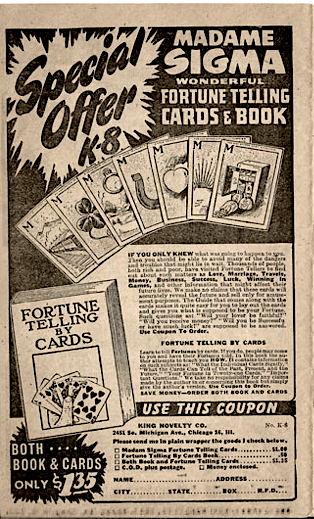
I was unable to find this particular deck in a King Novelty (Valmor) catalog but I did come across their 1944 catalog ad for a nearly identical deck called Madame Sigma Fortune Telling Cards. You could purchase both the deck and book together for $1.35!
Here’s a interesting comparison of the three Whitman “Old Gypsy” deck editions (top), while (below) is the Horseshoe/Trefoil from the Old Gypsy Fortune Telling Cards (which, along with the Key, Gentleman & Lady cards, have no playing cards printed on them), and two from the Gypsy Dream deck – Horn of Plenty and Horseshoe.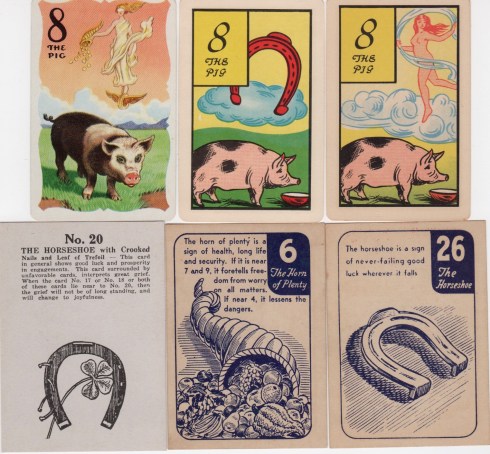
See also my post on 19th Century American Lenormand decks.
I’ll be teaching a basic Tarot class for the four Wedesdays nights in Nevada City CA – with a free intro on September 30th. Information here: https://www.facebook.com/events/1897546913804642/
Lawman – “Tarot” – Season 4, Episode 13.
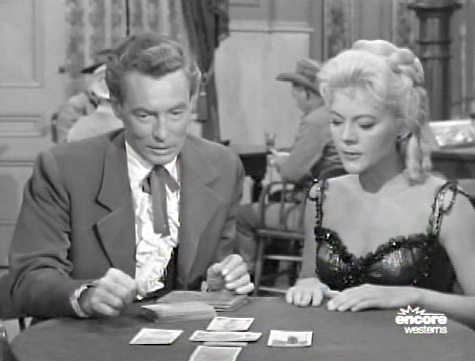
Lily: Did you bring the tarot cards, Joe?
Joe Wyatt ( Lily’s friend who has just arrived in town): Ever see me without them? (gets tarot cards out of a large cigarette case)
Johnny (the Lawman’s deputy): What kind of cards are they, Mr. Wyatt?
Joe Wyatt: Fortune telling cards. The gypsies had them when they wandered the ruins of Rome. These were old when the pyramids went up on the banks of the Nile. Or so they say. Nobody knows who made up the first tarot deck. Some say the Devil himself.
Lily: Tell my fortune, Joe. For old time’s sake.
Joe Wyatt: If you remember old times, Lily, you know I never tell individual fortunes. Makes for disappointment and unnecessary worry.
Lily: Please, Joe.
Joe Wyatt: Well, I suppose I could lay out the tarot deck for all of us, a kind of general fortune that might apply to any one of us here. Will the fair queen cut? (He lays out the cards in a six card cross, the first card, crossed under the Wheel of Fortune, is face down and is never turned up.)
5 of Cups – Somebody’s going to get some money.
The Juggler standing upright – Somebody’s going to take a trip.
The Wheel of Fortune beside the dark of the Moon – That’s kind of hard to figure, unless somebody’s going to sit up all night with a pot of gold.
Lily (looking at the final card): The Hanged Man.
Johnny: Well, what does that one mean?
Joe Wyatt: Oh, it’s not exactly the best card in the deck. Stay out of bad weather, bad company, something like that.
Johnny: Oh, I see.
Lily: You better tell him what it really means, Joe.
Joe Wyatt: If there were anything to this nonsense, it’d mean that somebody at this table is going to die.
(Much later after two of the four predictions come true . . . )
Joe Wyatt: If you keep looking you’ll find everything in the tarot cards, one way or another. It’s a carnival act from a circus.
(At the end, as Joe lays dying and all the predictions have come to pass, he gives the tarot to Lily):
Joe Wyatt: Might even make a man think there was something to all those cards. But don’t you pay any attention to them, Lily. They only tell you what you want them to tell you.
Joe Wyatt: Might even make a man think there was something to all those cards. But don’t you pay any attention to them, Lily. They only tell you what you want them to tell you.
Thanks to Paul Nagy I’m adding the Have Gun—Will Travel episode, “Everyman” from 1961 (Season 4, Ep 27) that starts with a Tarot reading featuring “The Drowned Sailor, the Phoenician” (the card is never shown, but according to A.E. Waite, it’s the true name of the Hanged Man). Could “Everyman” refer to the Fool?
Name that deck!
What can we make of the film Ex Machina via a Lenormand lens?

A young employee wins a trip to the isolated home of the genius founder of the largest internet search company. He is asked to test if a new AI (artificial intelligence) robot truly simulates human intelligence and emotion, in what becomes a radical kind of Turing test meant to determine the difference between human and machine.
Spoiler Alert . . .
As usual, I drew the cards before seeing the movie:
Mice-Sun-Rider-Mountain-Child.
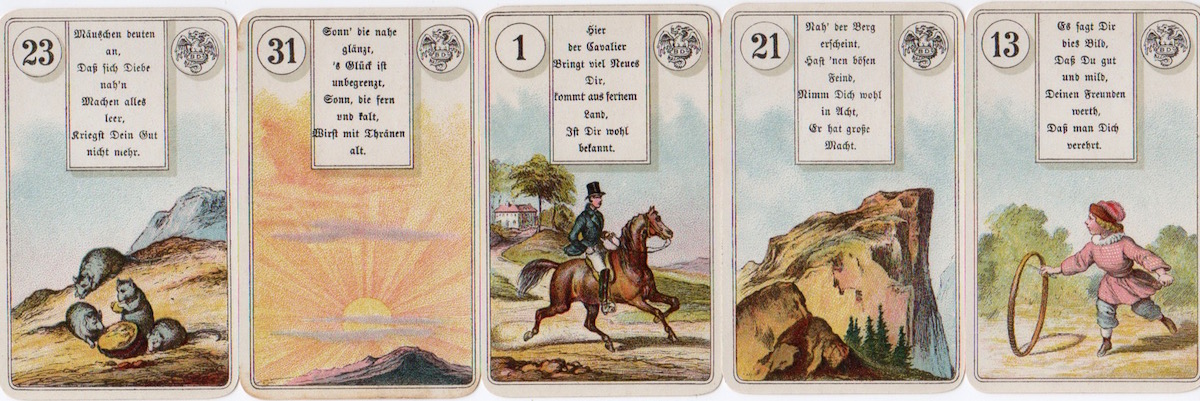
The basic meaning of this spread is: With the arrival of a guest (Rider) comes a theft (Mice) of success [joy, life, energy] (Sun) and an obstacle (Mountain) to something new or young (Child).
First, this is a well-written, intellectually compelling mystery-thriller-horror film in the sci-fi genre. But a friend who saw it hated it and wanted to discuss my impressions after seeing it. So, at the end of the film I asked myself what the writer might have picked as a “What if . . .” scenario for the basis of the movie:
“What if a modern Dr. Frankenstein creates an AI that, instead of having emotions, is, instead, a pure psychopath?” This immediately had me thinking of the Frankenstein story in relation to this one. In Ex Machina, the young employee, Caleb, flies over a wasteland of snow to arrive at a mountain retreat where the house’s electricity is going hay-wire. At one point he and his boss, Nathan, climb to the base of a glacier. The parallels to Frankenstein’s monster who is created in a isolated lab, via electricity and ends up on an ice flow in Antartica are notable. Unlike Mary Shelley’s imagined creature, this one only mimics feelings—perfectly. [Added: the Showtime TV show Penny Dreadful also deals with this theme, especially during the later Season 2 episodes – a theme for our time, obviously.]
“And, what if . . . this AI runs amok?” Now we have a parallel to man versus machine in Hal in 2001: A Space Odyssey, only this AI is female. The horror here lies in the mimicking of emotions.
“So, what if . . . this robot AI is an adolescent male’s greatest fantasy – a blow-up doll, sex toy?” Shades of Season 5 of Buffy, the Vampire Slayer, where Warren creates the BuffyBot sex toy for Spike!
“Or, what if . . . it is about scientists eskewing consequences in light of the possibility of invention?” And, indeed, Caleb quotes Oppenheimer: “I am become death, destroyer of the worlds,” making note of the potentially horrible consequences of curiosity and invention.
My friend was deeply disturbed by the hatred she felt was expressed by the two AIs. My sense was that it was, rather, the expediency of a pure psychopath (to put it in human terms) seeking to freely perpetuate itself—as would a meme, versus a gene. Interestingly the AI is named Ava—Eve, suggesting that she will be the ‘mother’ of a new species.
I’m not going to get into the mind-games involved in the tests, which ultimately attempt to determine if the “feelings” expressed by the AI could be real. Please, see the film.
Lenormand Interpretation
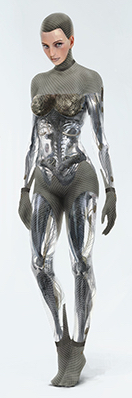 What the Lenormand spread—Mice-Sun-Rider-Mountain-Child—points to is the arrival of a young man at the isolated mountan retreat (of genius inventor, Nathan). Caleb, who is presented as hardly more than a boy, must overcome all obstacles (Mountain) to steal (Mice) a new being, Ava/Eve. Between Caleb (Rider) and Ava (Child) is an insurmountable barrier (Mountain)—both a physical wall and the barrier of not being able to see into the other’s ‘mind’. The theft will block/stop Nathan’s new project and Ava will escape her imprisonment by flying over the mountain at the dawn of a new day (Sun). I shouldn’t overlook the role that the ‘theft’ of electricity (a modern meaning of the Sun card) plays in the story. There’s also the play on the title of the film: “ex machina”: “deus ex machina” is a term from Greek/Roman drama for when an improbable answer to a dilemma appears as if out of the sky, originally a crisis solved when a “god” descends out of a machine onto the stage. In the spread, the mountain represents the dilemma, and a helicopter literally appears out of the sky to first bring the visitor, Caleb, and then to take away the new being, who is herself a machina.
Tarot Interpretation
I also drew three Tarot cards for something else I should be aware of in the film and received:
Lovers – High Priestess – Knight of Swords
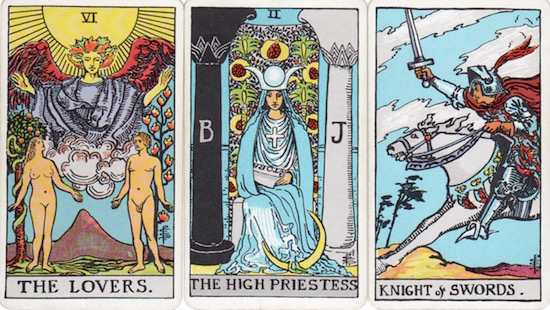
These cards point to another side of the story – the love story between Ava and Caleb (who we think will be her knight in shining armour), which turns out to be a set-up by Nathan, playing off of Caleb’s internet pornographic fantasies. Ava, in her temple imprisonment, isolated purity, and deep insight (she can tell when Nathan is lying), is very much a High Priestess, who will become a cold-as-steel warrior, wielding a blade.
The contrast between the Lovers, Priestess and Knight of Swords also makes clear a disturbingly misogynistic layer to this film that plays on priviledged white male sexual fantasy, nubile sexual enslavement and racial/sexual stereotyping. The question remains as to how conscious or unconscious all the layers of this were. Were they meant to make us question these things or were were they below the consciousness of the film’s creators?
Added: A central question implied by this film is: What happens when you take the “Deus” out of “Deus-ex-machina”? If for a moment we consider Deus to be wisdom, then the Machina (machine) feeds on information but, we might assume, lacks wisdom. What does this suggest?
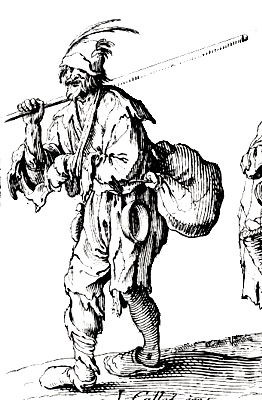 Jester, pilgrim, mendicant or child?
Will the real Fool please step up?
Does the Tarot Fool bring up the rear in a long parade of triumphal figures, a warning about what will happen if one fails on the spiritual path? Or does he appear at the beginning, full of trust and hope, setting out on a new adventure?
Is the dog his faithful companion or a wild beast that threatens to tear him apart or ludicrously expose his privates?
What dangers does the Fool face?
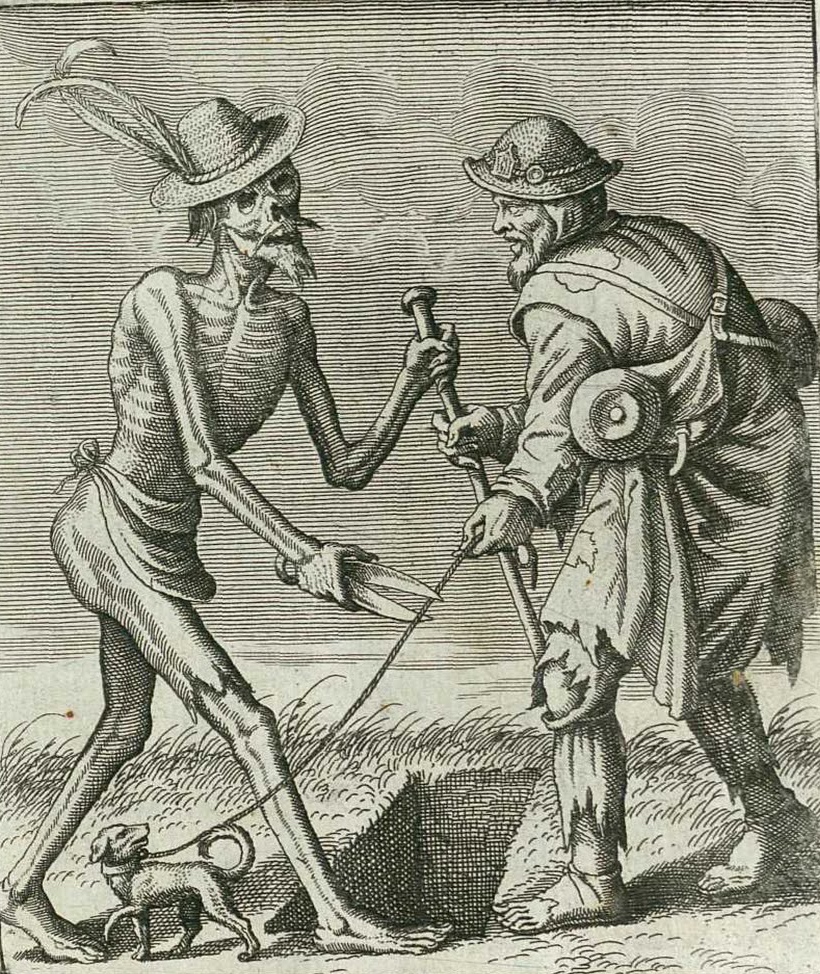
When the Fool turns up do you feel excited and ready to venture forth? Or do you fear your decisions are stupid and that others will think you ridiculous?
At the end of the 19th century, the Hermetic Order of the Golden Dawn turned the Tarot on its head, depicting the Fool as a small child and putting it at the head of the Hebrew alphabet. The Waite-Smith card, published in 1909, pictured an image that came to epitomize the 1960s San Francisco flower child. How did this happen?
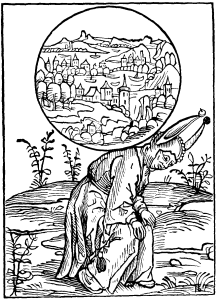
Does the Fool carry the World on his shoulders (or, perhaps, in his knapsack)? There are hints that it is so. The Fool can indicate absolute trust in Spirit or the ravings of a madman or idiot. Learn to cultivate divine nonchalance. Discover what’s needed to take a leap of faith. Explore hidden meanings in the symbols on the RWS Fool.
Over the next couple of years, I plan on teaching what I’ve learned about each of the Major Arcana in a series of webinars, randomly ordered and spaced. I’ve already taught The High Priestess (and will be presenting it again), and I’ve written in depth about the Lovers (see Tarot in Culture, vol. 2). I will be presenting The Fool, live on May 16th, for three hours to a limited number of participants (a recording will not be available). Information available at Thelesis Aura or on Facebook.
Learn more about an up-coming fictional documentary film about a mysterious deck of Tarot cards that reveals ancient alchemical secrets at this weekend’s Readers Studio at the New York LaGuardia Airport Marriott in New York. The art and video are by Andrea Aste, an Italian artist and film-maker.
The Book of Shadows: The Lost Code of the Tarot
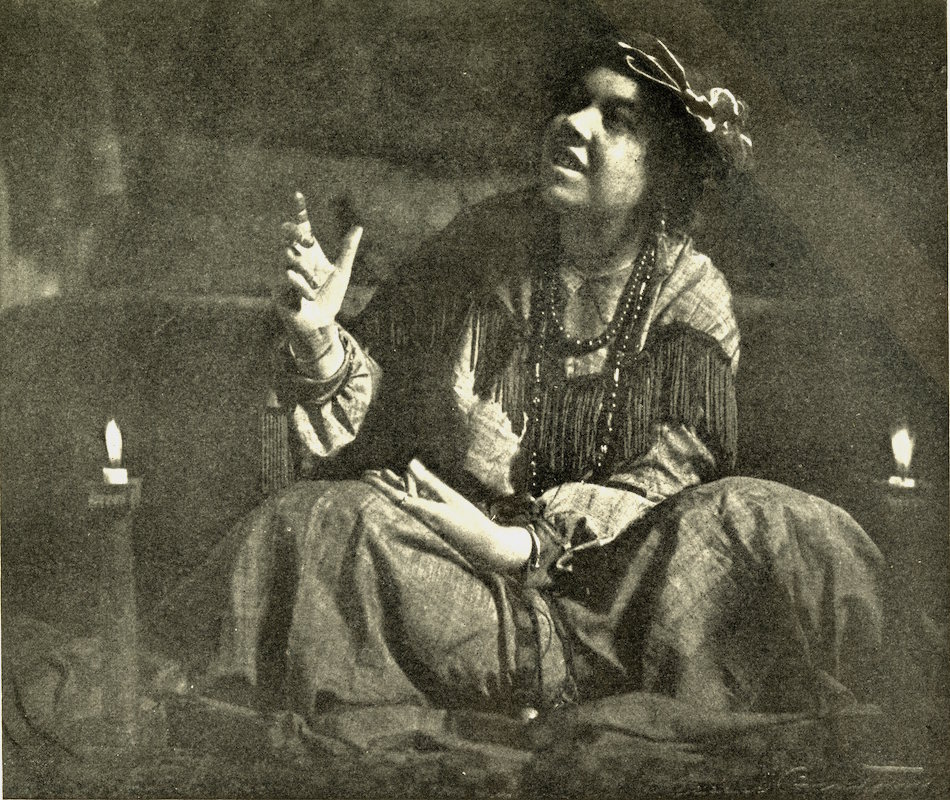
Photograph by Alice Boughton from the Brooklyn Life magazine, January, 1907. Thanks to the Brooklyn Public Library for a better resolution photograph than I was able to get previously.
When I began collecting Lenormand decks I soon discovered that in the 19th and early 20th centuries they were far more common in the United States than I had imagined. It appears that German-American immigrant communities, centered mostly in New York and Chicago, published a continuous stream of decks, from different publishers, to meet local demand. The majority of these decks contained the original, 1846 “Philippe” instruction sheet, unchanged, in both German and in English-translation. This was of particular interest to me as my German-American great-grandmother was known to have the “sight” and read cards for visitors in her New Orleans kitchen. I like to think she would have known the Lenormand deck.
Since the 175-year-old German divination deck known as the Petit Lenormand burst onto the English-language scene about five years ago, nearly a hundred new, published decks have appeared and a half-a-dozen books and ebooks. [And by 2018 it’s become a divination staple.] Even though USGames has published a German “Blue Owl” Lenormand deck for nearly fifty years, Lenormand has remained an oddity, superseded by a similar, though more negative, “Gypsy Witch” deck, with 52 instead of 36 cards, that quickly came to dominate the American cartomancy scene.
We now know that the Lenormand (also known as the Petit Lenormand) cards had nothing to do with the famous French fortune-teller, Mlle. Lenormand, merely co-opting her name. The date of their inception has been pushed back to the late 18th century with the multi-purpose “Game of Hope” from Nuremburg and similar Coffee-Cards from Vienna.
Here is the little-known American branch of the family. Anyone with an early American edition not included here, please contact me with a photo and as much information as you have so we can add to the list.
L’Oracle de Bonaparte ou cartes de Mlle. Lenormand: pour dire la bonne aventure (Publices par C. Magnus, New York, circa 1855).
 This is my earliest American deck. While the box cover is in French, the booklet is in German (my copy is without these), and it was published in New York, for the immigrant community. Charles Magnus (1826-1900) was a print publisher, map dealer, bookseller and stationer working in New York City from 1850 to 1899, having arrived from Germany around 1848. He is especially known for his maps of Civil War battlefields. The deck is on matt cardboard. It was printed in black or red (depending on the card suit) and then colored by stencil in red, blue and yellow with green being a combination of yellow and blue. The size is 1-5/8″ x 2-7/8″ (4.1 cm x 7.3 cm) – a little taller than today’s mini decks. (A much later German deck of the same style appears at the Lenormand Museum online.)
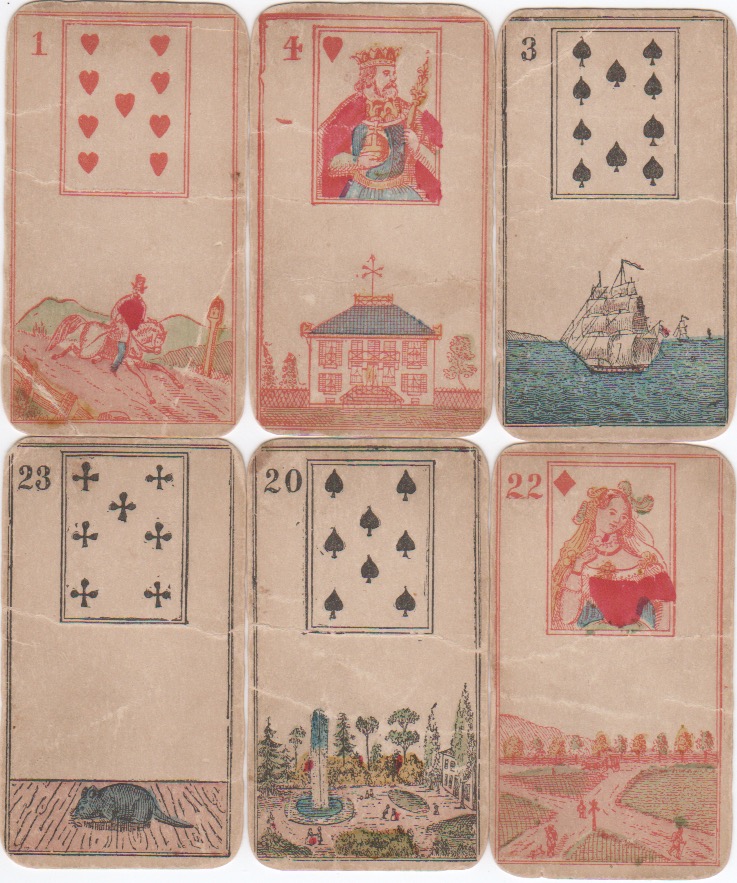
Madam Morrow’s Fortune-Telling Cards, 1867. New Illustrations, copyrighted 1886 by McLoughlin Bros., New York. [The cards here are from the 1894 printing.]

first edition, 1867
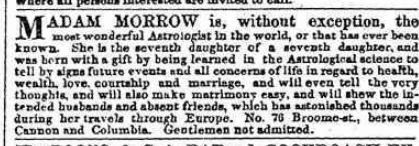
Madam Morrow cards first came out some time after the death of an infamous fortune-teller (arrested many times) who worked in New York and Philadelphia. She described herself thusly in an advertisement:
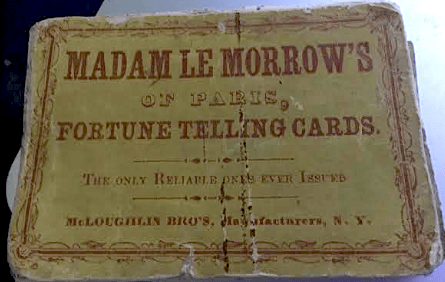
The earliest box?
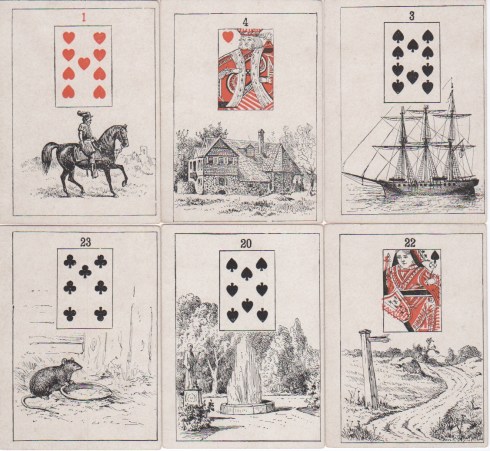

1886 Revised Illustrations
 The first edition, mentioned in the Uniform Trade List of July 1867 as Madam Morrow’s Fortune Telling Cards, was an exact replica of the German Kunst-Comptoir, Berlin deck of 1854. (They were also published by McLoughlin as Madam Le Normand’s Mystic Cards of Fortune in a simple b&w printing – see Wehman Bros deck below.) In 1886 a new edition was copyrighted – a beautifully etched masterpiece (large cards above)! Note that the Court Cards have been redone to match those found in contemporary playing card decks. An oddity of this deck, which influenced a few other decks, is that three of the Queens are switched from their normal Lenormand card placements. Crossroads should be the Queen of Diamonds (originally Bells) instead of Spades, while
 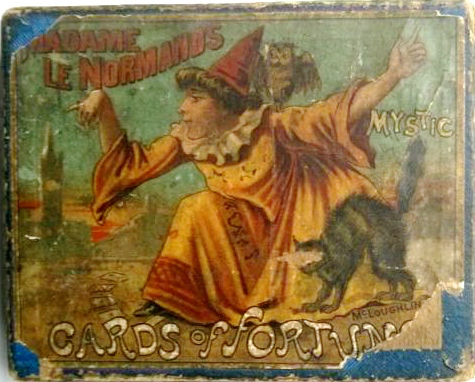 the Queen of Spades should be Bouquet and the Queen of Hearts, Stork. All the other cards are correct. The booklet is only in English, but it is an exact translation of the standard German instruction sheet. The illustrations on the boxes changed frequently. The deck is a standard poker size.
Mlle. Lenormand’s L’Oracle and Appendix: 36 Illuminated Cards with English and German Description for sale by Fitzgerald Publishing Corporation, 18 Vesey St., New York (circa 1916+).

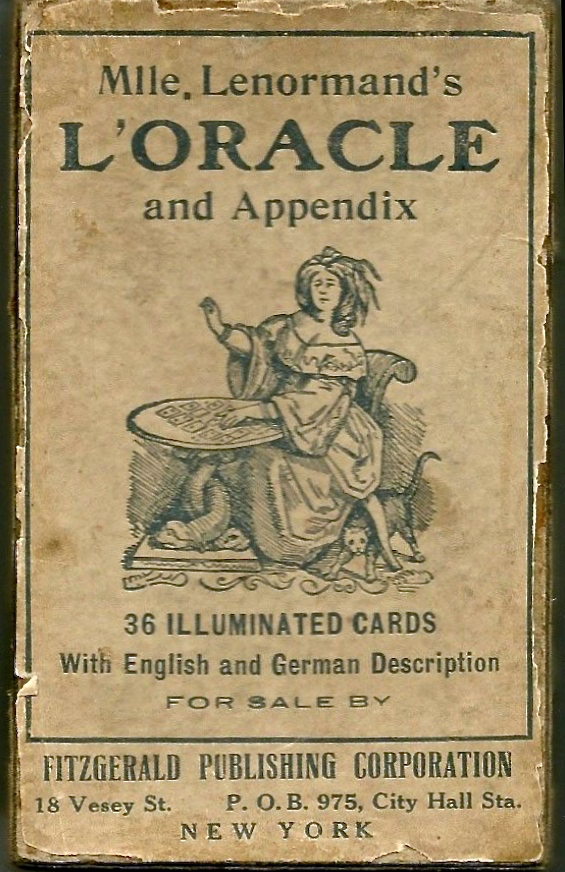 My copy came without a box or book, so the closest I’ve come to identifying it is via a deck that sold from the Fitzgerald Publishing Corporation edition, which makes it 1916 or later. The Dick & Fitzgerald Publishing Co was originally founded in 1858 on Anne St. and they did publish playing card decks. Upon the death of the founder’s son in 1816, the Fitzgerald Publishing Corporation at 18 Vesey St. came into being, known mainly for editions of theatrical plays and music. Whether this deck was a carry-over from the earlier company or not will not be known until an earlier box is found. The style is a near exact replica of one of the earliest Lenormand decks: black & white cards from Kunst-Comptoir in Berlin, Germany in 1854 (see the early Madam Morrow deck). This particular deck is notable not only for the fine coloring of the scenes but also for the lovely pink and blue sky. The deck is a standard poker size.
Cards of Fate and Gypsy Fortune Teller, J.H. Singer, New York, circa 1890s.


 J.H. Singer, New York, (1880’s-1902) published this chromolithography deck on heavy cardstock with children’s-book-like illustrations under at least two names (see above). Singer also published a planchette game and a miniature theatre. While the 36 cards are all standard Lenormand, they feature non-standard numbers, and many of the playing card correspondences have changed. The instruction sheet gives very brief keyword meanings, some of which are different than usual:
13-Mountain (9 of Clubs) =”friendship.”
8-Key (6 of Diamonds) =”insight to secrets or mysteries, best of a bargain.”
18-The Stars (10 of Hearts) =”foretells.”
Madame Le Normand’s Gipsy Fortune Telling Card Game, Wehman Bros., New York, no date, circa 1900.

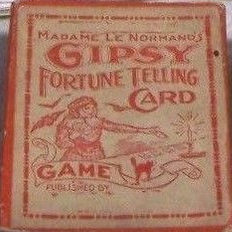 This deck is found fairly often on eBay. It is a simple red & black version of the Kunst-Comptoir, Berlin deck of 1854 and the same as the b&w Mystic Cards of Fortune (see above). Notice that the Ship is quite different, while the other cards are identical. There’s some indication that publishers would substitute their own country’s ships and flag. Although I can’t see enough detail on most of the flags, this one does appear to be an American flag. This edition is instantly recognizable because the black playing card suits have red pictures and the red suits have black pictures. The Queens are the only cards with no suit markers (due to the confusion that arose with the McLoughlin deck?). Several of the outer boxes have a blank space following the words “Published by” which suggests that Wehman Bros of New York may have merely been a distributor for decks printed elsewhere. The instructions are printed in both English and German. This small deck measures 2-1/8″ x 3″.
Gypsy Sabina Self-Explaining Fortune-Telling Cards, The American Illustrating Co., 64 Fulton Street, NY, 1904.

 This deck was quite a find. It contains the same 36 figures that are found in a standard Lenormand deck but the Queens are switched around yet again! Snake is the Queen of Spades (rather than the Queen of Clubs). The drawings are original to this deck and include the unusual device of a curtain being pulled back by a winged child to reveal the pictorial scene. “Self-explaining” verses in furled banners in both German and English give the meanings on each card. The minimalistic instruction sheet is also in German and English, telling one to lay the cards in four rows of nine cards with the Significator always in the center of the top row. The card backs feature an advertisement for John Miles Wholesale Millinery Goods, which suggests that a printer offered them as promotional products to their business customers. The cards are a little taller than usual, measuring 2-3/8″ x 3-5/8″. The back of the box has this interesting explanation for the deck:
“These Cards have been used for years with unvarying success by Queen Sabina, one of the most foremost Queens of the Romany Rye. Venerated by her subjects for her good qualities, she is also regarded by them with a superstitious awe, and guarded with such a jealous care that no one outside the inner circle is allowed to see or hold converse with her, and she has taken this means of holding communication with the outside world, so that they may partake of her wondrous gift of lifting the curtain of the future for all who have faith.”
Dr. Jayne’s Egyptian Fortune Telling Cards, Dr. D. Jayne & Son, Inc., Philadelphia, no date.
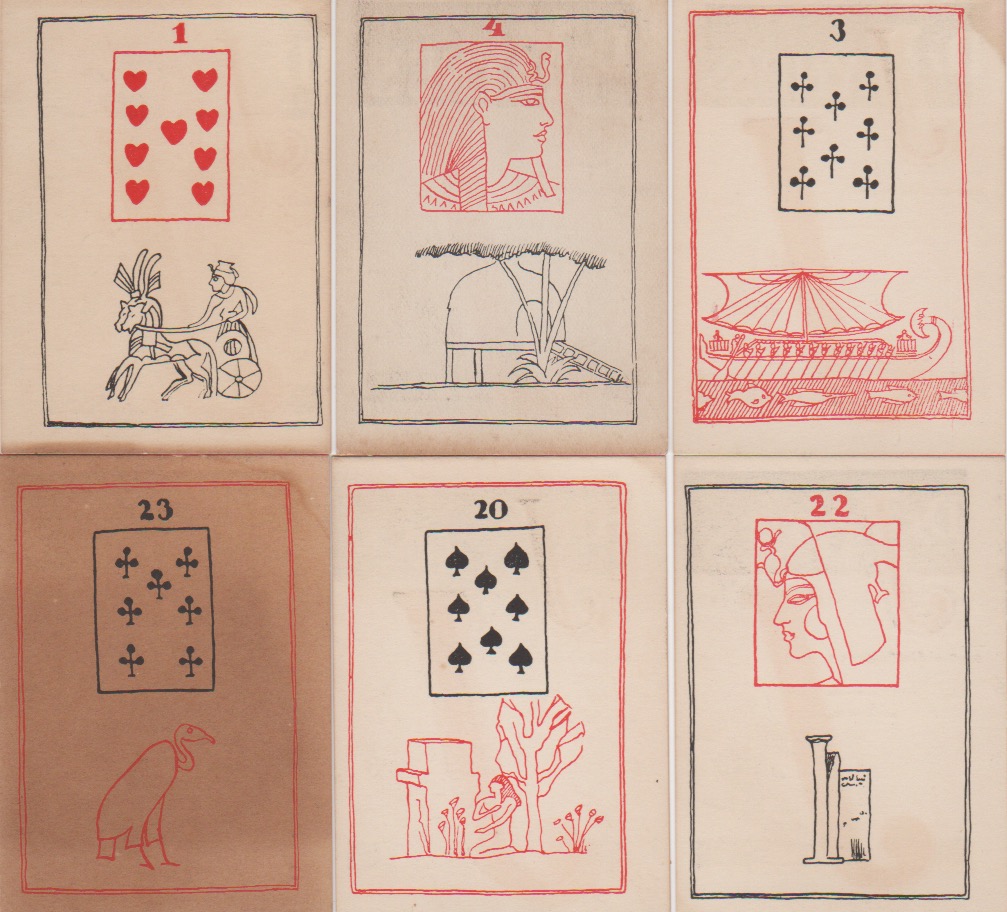
 While these cards look quite different than the Lenormand decks we are used to, they are actually exact matches to the standard deck. Dr. Jayne and Son was a patent medicine company that existed from 1843 to 1930. They used almanacs, trading cards, recipe books, a dream & fortune telling book, striking graphics and this deck to promote their medicines, primarily to families, many of whom were functionally illiterate. The vulture (Mice) card probably darkened from being exposed to the sun. The back of the cards and the box have the same design. There is an error in my deck where the Ship should have been the 10 of Spades, the card mistakenly shows the 8 of Clubs. Interestingly the Jack of Hearts card should have a red playing card and black emblem, but as the emblem is a heart the colors are reversed so the heart can be red. They are roughly poker size.
 Box for unknown deck (picture on the left). Is this another Lenormand deck? It says the instructions are in German and English and there are 36 cards. It was published in New York. Does anyone have any further information?
All of these decks are on matt card-stock that’s easily torn or bent, rather than the glossy-finished flexible and quality stock found on many 19th century European decks. Compared to the fine artistry and the best in chromo-lithography of the European decks, these American decks seem like poor cousins, but I find them to be outstanding examples of a folk-tradition. They add much to an overlooked aspect of immigrant and everyday life here in America.
The Evening World’s Home Magazine (New York) reproduced the original “Philippe” (heirs of Mlle. Lenormand) Instruction Sheet in their October 19, 1903 issue. Included are the standard Kunst-Comptoir 1854 images that one is encouraged to cut out to make one’s own deck. Here is the article if you wish to print it out and do the same. Click the picture for a large version.

Lenormand Off-Shoots:
The Gypsy Witch Fortune Telling Playing Cards
As early as 1894 Frederick J. Drake & Co. of Chicago, Illinois began publishing an expanded 52-card version of the Lenormand cards called Mlle. Le Normand’s Gypsy Witches Fortune Telling Cards. It was based on a 48-card deck from Danner G. Mühlhausen, Berlin that in 1875 had added twelve extra illustrations to the original deck (plus incorporated an alchemical-looking script in place of the playing card insets) – see later Adolf Engel edition (1880?) here. The Gypsy Witches deck switched all the playing card associations around, increased the cards to 52 and included a Joker card. By 1903 it was being published by Home Game Co., and later by the United States Playing Card Co. of Cincinnati, Ohio. Today, as the Gypsy Witch Fortune Telling Playing Cards, it is available from USGames.
Old Gypsy Fortunetelling Cards
are from United Novelty, Mfg Company, Chicago, c. 1920 – a 36-card deck with playing cards inset and meanings given on each card. The instructions are in Polish and English and the Woman is clearly dressed as a 1920s flapper. They were printed by the Valmor Company of Chicago (also doing business as King Novelty. United Novelty were distributors) and so are sometimes called the Valmor Fortune-Telling Cards. This hints at an interesting crossover between the immigrant community of Jewish founder Morton Neumann (the Polish connection?) and the African-American hoodoo tradition. Could African-American artist, Charles Dawson, who did Valmor ads, have been the artist of these cards? See post using this deck by Camelia Elias.
They are identical to the Old Gypsy Cards Fortune Telling Game from Addison Products Co, Chicago (no-date – 1940s?), also with instructions in English and Polish. Looking similar to the Gypsy Witch, and with elements appearing in Whitman’s deck (see below), this deck has its own unique assignation of playing cards (the suits & numbers appear in sequence in the numbering of the cards), which accord most closely with the usual French & English playing card meanings. While most of the deck includes Lenormand-like cards there are also unique ones like 21-The Fairy and 27-The Bacchanalian. Cards like 30-The Eye are found in other “gypsy cards” mentioned here. In 1948 this same deck was published by Wehman Bros. but without the text.
I was unable to find this particular deck in a King Novelty (Valmor) catalog but I did come across their 1944 catalog ad for a nearly identical deck called Madame Sigma Fortune Telling Cards. You could purchase both the deck and book together for $1.35!
Gypsy Dream Fortune Telling Cards, no publisher, no date (c. 1920-30 or earlier?).
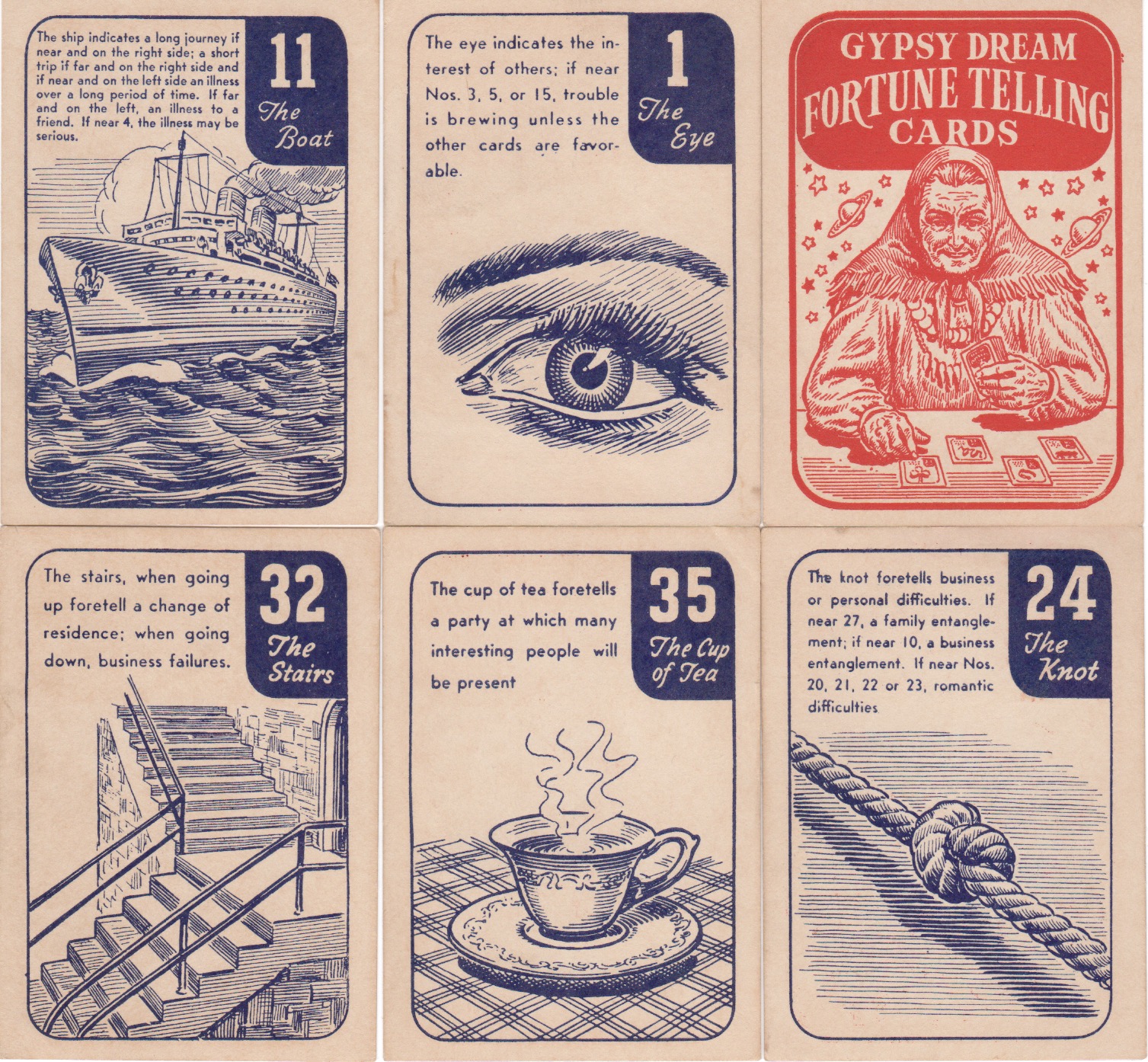
This is a very rare, unusual 36-card deck. Eighteen cards are the same or very similar to Lenormand cards, although in a different numerical order, and 22 cards share some (if not exact) similarities with the Old Gypsy FT Cards just above. The other cards share similarities with other cartomancy decks, like the Eye, Cat, Coins (bags of money) and Cornucopeia, but this deck also features unusual cards like the Stairs, the Horse, the Bee, the Ivy, and the Candle. There’s no instruction sheet as all the meanings and most significant combinations are printed on the cards.
Old Gypsy Fortune Telling Cards, Whitman Publishing Co., 1940.

This 36-card deck probably originated in Germany—see Das Echte Wahrsagespiel from approximately 1925-30, featuring identical pictures but with fake “alchemical-kabbalistic script” in the yellow insets instead of the numbers and titles. This, in turn, was a variation of the Mühlhausen/Engel (Berlin) 48-card deck of 1875/80.
This version is essentially a Lenormand with twelve cards that vary from the standard—some a mere substitution of a different image and others, entirely new but drawn out of the Mülhausen/Drake selection. Several of the non-standard cards appear in the two previous alternative decks. This deck features an emphasis on love and marriage. There have been three different artistic renditions of the Whitman deck, all designed in the style of children’s book illustrations. There are no playing card associations.
Here’s a interesting comparison of fortune cards: In the top row: the three different Whitman editions. On the bottom row, left to right, is the Horseshoe/Trefoil from the Old Gypsy deck (playing cards are included on all but this card and the Man & Woman cards), and two cards from the Gypsy Dream deck – Horn of Plenty and Horseshoe.
A few other American variations on the Lenormand deck began appearing in the late 20th century, but that’s for another post.
 Mary K. Greer has made tarot her life work. Check here for reports of goings-on in the world of tarot and cartomancy, articles on the history and practice of tarot, and materials on other cartomancy decks. Sorry, I no longer write reviews. Contact me
 Mary K. Greer's Tarot Blog

Recent Comments