You are currently browsing the category archive for the ‘Major Arcana’ category.
Here’s a little walk down memory lane. These cards are from London – late 1970 or early ’71, printed in a magazine called Gear of London and designed by Barry Josey. Obviously they are based on the works of Aubrey Beardsley. If anyone has any more information on this deck or the magazine, please let me know.
Update: I received an email from the artist Barry Josey (love the internet!). Finding that his art could not support him, he went back to his profession as an architect and also left the tarot behind, but hopes to return to art when he retires. Here he explains how the deck came about:
“Initially, the cards were set out as a poster style calendar, and then they were intended to be printed as packs. At the time, I knew nothing of Tarot, but had to immerse myself albeit briefly to get a starting point for the drawings. Beardsley was ‘in’ at the time and because I could approximate the style, Gear asked me to prepare the cards. The drawings were black and white only, and it had been my intention that they be printed on a single buff or similar pastel colour. Gear disagreed and printed them in the rather garish primary colours you see before you.”

Here’s another example of the art of Barry Josey—an illustration for a play by Jean Genet.
The Hermetic Order of the Golden Dawn introduced what I consider the most extensive and elegant set of correspondences among the tarot and other magical systems. Here is a permutation I hadn’t seen before. It’s from The Magical Writings of Ithell Colquhoun edited by Steve Nichols. Colquhoun was an artist, magician and the biographer of MacGregor Mathers (Sword of Wisdom-o.p.). Magical Writings contains over a hundred pages of text on the Major Arcana (material on the last five cards added by Steve Nichols), plus reproductions of pages from Colquhoun’s tarot notebooks. It’s a treasure-trove for the discerning reader.
THE PLANETARY TRIPLICITIES – based on correspondences to the planets and the signs they rule.
MERCURY: Magus, Lovers, Hermit (Mercury, Gemini, Virgo)
MOON: Priestess, Chariot, Hanged Man (Moon, Cancer, Elemental Water)
VENUS: Empress, Hierophant, Justice (Venus, Taurus, Libra)
SUN: Sun, Strength, Judgment (Sun, Leo, Elemental Fire)
MARS: Tower, Emperor, Death (Mars, Aries, Scorpio)
JUPITER: Wheel, Temperance, Moon (Jupiter, Sagittarius, Pisces)
SATURN: World, Devil, Star (Saturn, Capricorn, Aquarius)
(Fool = Elemental Air)
These groupings can be very handy in a reading where the occurrence of two or three cards from one of the triplicities indicates a strong influence by that planetary energy. Mythically, it suggests the presence of that God/dess messing around in one’s life.
I haven’t looked at much recent tarot poetry, but the web turns out to be a wonderful place to explore it. Here’s a few sites that offer something different or intriguing:
At heelstone.com’s poetry site you’ll find Tarot Poems by Mike Timonin, with Art by Cindy Duhe, presented in a very tarot-appropriate way. Click on the rapidly changing tarot card images and you’ll be taken to a poem determined by the shuffle. Want another card and poem? Shuffle the deck again.
You’ll also find a poem by Michael Gerald Sheehan for every card at Moon Path Tarot.
Tarot Poems by Donna Kerr from her book of poetry Between the Sword and the Heart.

Tarot Poetry by Rachel Pollack.
Here is one of the oldest tarot poems in existence: a sonnet by Teofilo Folengo, appearing in his 1527 work Caos del Triperiuno written under the pseudonym Merlini Cocai. The work includes a series of poems representing the individual fortunes of various people as revealed by cards dealt them. The summary sonnet below mentions each of the 22 Trump cards, which I’ve referenced by their number to the right of the line on which they appear. It helps to understand that Death is female in Italian, la morte, and Love (Cupid) is male. Love claims that although Death rules the physical body, Love never dies and therefore death is but a sham.
Love, under whose Empire many deeds (6, 4)
go without Time and without Fortune, (9, 10)
saw Death, ugly and dark, on a Chariot, (13, 7)
going among the people it took away from the World. (21)
She asked: “No Pope nor Papesse was ever won (5, 2)
by you. Do you call this Justice?” (8 )
He answered: “He who made the Sun and the Moon (19, 18 )
defended them from my Strength. (11)
“What a Fool I am,” said Love, “my Fire, (0, 16)
that can appear as an Angel or as a Devil (20, 15)
can be Tempered by some others who live under my Star. (14, 17)
You are the Empress[Ruler] of bodies. But you cannot kill hearts, (3)
you only Suspend them. You have a name of high Fame, (12)
but you are nothing but a Trickster.” (1)
Translated by Marco Ponzi (Dr. Arcanus) with help from Ross Caldwell, members of Aeclectic Tarot’s TarotForum, and by comparisons with the translation found in Stuart Kaplan’s Encyclopedia of Tarot, Vol II, p. 8-9 (read the discussion here). The first picture is from a 1485 Triumph of Death fresco on the wall of a Confraternity Chapel in Clusone, Italy. It depicts Death as an Empress before whom all others bow. The second picture is from Savonarola’s Sermon on the Art of Dying Well, published circa 1500.
See the translation of one of Folengo’s fortune-telling sonnets at taropedia – here.
Added: Check out the poetic concept of rhyme applied to visual aspects of the tarot in Enrique Enriquez’s article on “Eye Rhyme.”
As an update to my earlier post on Carl Jung and Tarot, I just received a paper from the Jung Institute library in New York. It contains brief notes Hanni Binder took of Jung’s descriptions, in German, when he spoke to her about the Tarot cards. A friend of hers made a literal translation into English, typing it onto large file cards. What follows is Jung’s verbal description of the Major Arcana. They are based on cards from the Grimaud Tarot de Marseille, which he felt most closely contained properties he recognized from his reading of alchemical texts. I have corrected obvious errors in language, but kept these changes to a minimum. My own comments are in brackets [ ].
If you are familiar with Jung’s core concepts you’ll find several of them referred to directly or indirectly: Self, Shadow, extraversion, intraversion, conscious, unconscious, fate, center, inflation, compensation, sacrifice, etc. Notice also his interest in what’s held in the right and left hands as indications of masculine/active or feminine/passive (I prefer ‘receptive’) energies. These notes are simplistic but were obviously only meant to be a starting place for further exploration.
ADDED: Japanese tarotist, Kenji, discovered that Jung’s descriptive text comes almost directly from Papus’ Tarot of the Bohemians (thank you, Kenji). However, Jung seems to have added several keywords from his own psychological lexicon as I noted above. Comparing these two texts will clarify what ideas Jung added.
1 The Magician
The Magician has, in the right hand, a golden ball, in the left a stick [wand]. The hat makes an eight [infinity sign]. The bearing of the hand shows right activity, left passivity. Sign of force, stability, self. He has all the symbols before him.
2 The High Priestess
Sitting Priestess. She wears a veil. On her knees is a book. This book is open. She stands in connection with the moon. Occult wisdom. Passive, eternal woman.
3 The Empress
Empress with wings. In the right hand she has an eagle, in the left a scepter. She has a crown with 12 stones. Eagle as a symbol of soul and life. Feminine activity. Fruitfulness, goddess.
4 The Emperor
Emperor sitting in profile. In the right hand he is holding the scepter. He wears a helmet with 12 stones. The legs are crossed. Will, force, reality, duty, brightness.
5 The Hierophant
The Hierophant leans on a three fax[sic – triple?] cross. The two columns are standing on the right as law, on the left liberty. Two men are kneeling before him: one is red, the other black. Will, religion, fate [faith?], Self, center.
6 The Lovers
The young man stands in a corner where two streets come together. The woman on the right has a golden garland on her head. The woman on the left is wreathed with a vine. Beauty, cross-road, way inward or outward.
7 The Chariot
Conqueror with coronet. He has three angle [right angles on his cuirass]. In his hand is a scepter. Arrow and weapon arm [right hand?]. Actively going toward his fate. He has a goal, achieving victory. Activity, extraversion. Inflation.
8 Justice
Sitting woman with a coronet. In the right hand she has a sword, in the left, a balance [scales]. Compensation between nature and the force of a man. Justice, compensation. Conflict with the law.
9 The Hermit
An old man walks with a stick [staff]. Wisdom as symbolized by the lamp. Protection with the overcoat. Cleverness, love, introversion. Wisdom.
10 Wheel of Fortune
Sphinx holding a sword. Wheel symbolizing endlessness. Finger as a sign of command. Human being as ball [circumference?] of the wheel of fortune. Luck/misfortune.
11 Strength
A young girl opens the mouth of a lion. The girl has the sign of vitality on her hat. Liberty, strength.
12 The Hanged Man
The hands of this man on in back. The eyes are open. The right leg is crossed. On the right and left a trunk of a tree. Turning back [enantiodromia?], powerless, sacrifice, test, proof. Face against the sky.
13 Death
A skeleton in a field with heads and fingers. Death and regeneration. The Ego should not take [the] place, the Self has to take [the] place. New standpoint, liberation, end.
14 Temperance
Young girl pours water from one jug in the other. The sun gives the liquid of life from a golden in[to] a silver jug. Movement, consciousness, natural growth.
15 The Devil
The right hand of the Devil is raised to the sky, the left points to the earth. Two persons are under him. He holds the torch as a sign of black magic. Fate, Shadow, emotion.
16 The Tower
Burning tower. Hospital, prison, struck by lightning. Sacrifice.
17 The Star
A naked woman spills water from two jugs. Around the girl are seven stars. The Self shines, stars of fate, night, dreams. Hope. The Self is born in the stars. Union with the eternal.
18 The Moon
In the middle of a field is a dog and a wolf. A crayfish comes out of the water. It is night. The door to the unconscious is open. The crayfish likes to go the shore. The light is indirect.
19 The Sun
Two naked girls. The sun shines on the children. Drops of gold fall on the earth. The Self is ruling the situation. Consciousness. Enlightenment.
20 Judgement
An angel with fiery wings, an open grave in the earth. Birth of the Self. Inspiration, liberation.
21 The World
Naked woman, her legs are crossed. In the four corners we have the angel, the lion, the bull and the eagle. Completion, finishing. In the world but not from the world.
0 The Fool
A man who doesn’t take care on his way. Beginning and end. The fool has no home in this world; the home is in heaven. Dreamer, mystic side.
Masculine cards:
Wands = Libido [sexual drive]
Swords = Spiritual force
Feminine cards:
Pentacles = Material
Cups = Feeling
Added note on the Four Suits: Jung obviously failed to link the four suits to his four psychological types or functions, based on the quaternity of elements and humors. However, with the “Feminine” suits he came close, calling Cups Feeling, while Pentacles as Material is close to Sensation. Most people link Intuition with Wands and Thinking with Swords. Jung’s most succinct explanation of his psychological types can be found in Man and His Symbols (highly recommended reading for anyone interested in a Jungian approach to tarot):
- Sensation tells you that something exists (through the senses).
- Thinking tells you what it is (its definition).
- Feeling tells you whether it is agreeable or not (its value).
- Intuition tells you whence it comes and where it is going (its possibilities).
Once upon a time in a far away land, an American heiress named Mary Wallace Shillito lost her beloved sister. In her grief she wandered the world until she came to the Salève mountains of France where she fell in love with the exquisite view. She vowed to build a sanctuary there and dedicate it to her sister. Several years later she met Assan Faride Dina, a part-Hindu part-French native of the then-British island of Mauritius (which lies off the southeast coast of Africa). He was an astronomer and engineer with an interest in Assyriology and occult metaphysics. They married and together built Le Château des Avenières, which they decorated with sphinxes, mythological figures, grottos and underground pools with the symbol of Mercury.
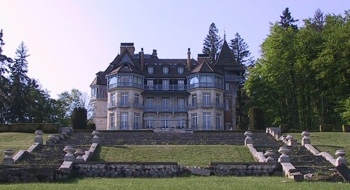
But, the most magnificent and mysterious room of all was the chapel, in which the walls were covered with mosaic tarot cards in the tradition of the Tarot de Marseille while blending in the occult mysteries of the Oswald Wirth Tarot.
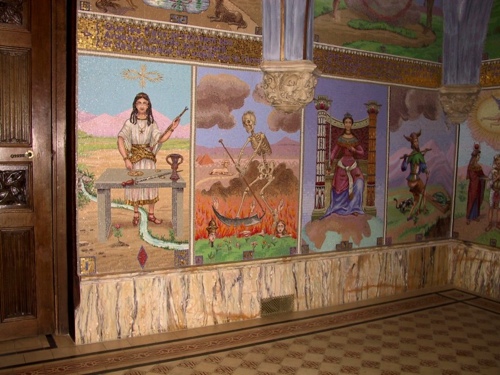
Take a journey through this magnificent occult chapel where you can view all 22 Major Arcana and read the stories of Mary Shillito and Assan Dina here. You may also want to visit the website of the Hotel Le Château des Avenières where you can schedule a stay and visit the chapel. Personally, I’m dreaming of the day when a tarot conference will take place there. Is anyone willing to off-set some of the costs of such a fabulous event? Let me know. I also found some mentions of the the Chapel here Schwaller de Lubicz by H. Dossier and Emmanuel Dufour-Kowalski.
 Mary K. Greer has made tarot her life work. Check here for reports of goings-on in the world of tarot and cartomancy, articles on the history and practice of tarot, and materials on other cartomancy decks. Sorry, I no longer write reviews. Contact me
 Mary K. Greer's Tarot Blog
Recent Comments