You are currently browsing the tag archive for the ‘alchemy’ tag.
This is an adaptation of an article I wrote quite a few years ago while in the midst of my studies of alchemy in the Crowley-Harris Thoth deck.
Aleister Crowley wrote little directly about alchemy, but his Thoth deck is full of alchemical symbolism. Alchemy is the transformation of base matter into gold, whether physically in the outer world or psychically in the inner. The transformation process consists of a series of stages (described variously as three or seven or twelve or more) that are often depicted through word-less picture books known as mutus liber in which the ideas are hidden within the image.
Crowley taught that magick is “the science and art of causing change to occur in conformity with will.” In Magick in Theory and Practice (hereafter, Magick) he declares that alchemical transformation is a branch of magick. Furthermore, the “Great Work” of alchemy is the culmination of all magick. It is “the attainment of the Summum Bonum, true Wisdom and perfect Happiness.” Crowley continues, “The Alchemist is to take a dead thing, impure, valueless, and powerless, and transform it into a live thing, active, invaluable and thaumaturgic [able to work wonders] . . . to bring each substance to the perfection of its own proper nature.” Crowley compares alchemy to initiation, for both works isolate the product from its accretions, returning it to the essence of its own nature. In the aspirant to initiation these “accretions” are “the complexes which have corrupted” the aspirant and must be purified.
As Crowley further explains in Magick, all the Major Arcana (Crowley’s “Atu”) are alchemical. The Fool begins the Great Work (“the first matter is a man . . . a perishable parasite”) and the Universe card ends it, being a glyph of its completion (“the pure and perfect Individual originally inherent in the substance chosen”). Crowley does not specify the alchemical action taking place in each Atu, giving only vague hints. The Priestess, Empress and Emperor are philosophic mercury, salt and sulphur, respectively, and are “modes of action [rather] than actual qualities . . . the apparatus of communication between the planes.” Strength is “distillation, operated by internal ferment, and the influence of the sun and moon.” In the Hermit, the philosophic or Orphic Egg is fertilized (this being a solitary act in which the energy raised goes into the Great Work). Death is putrefaction, “the series of chemical changes which develops the final form of life from the original latent seed in the Orphic egg.” Thus, the middle cards depict the breaking up of these accretions or “coagulations of impurity.” As the First Matter blackens and putrefies, along with the aspirant’s agonized reluctance to their elimination, he plunges into “such ordeals that he seems to turn from a noble and upright man into an unutterable scoundrel.”
XIV. Art/Temperance
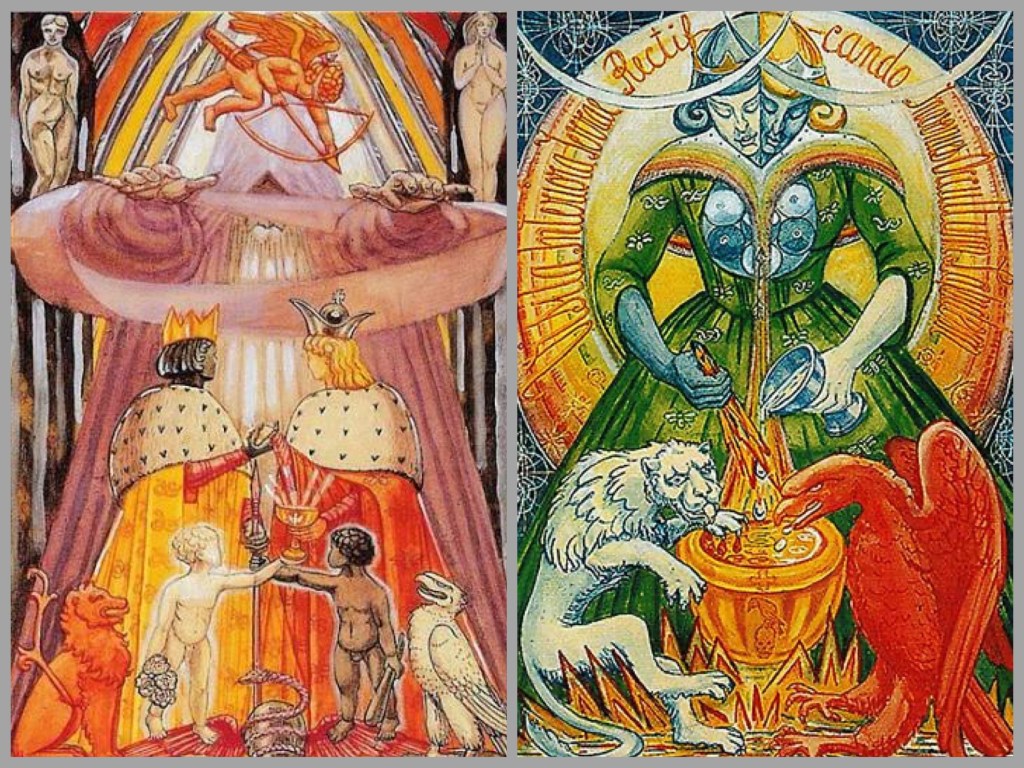
For this article we will examine the most overtly alchemical card of the Thoth deck. Following the Death card we arrive at Temperance, which Crowley renames ART, signifying what is called the “alchemical art,” to tell us that this is where the most active and defining alchemical act takes place—“the mingling of the contradictory elements in a cauldron.” As we saw earlier, Crowley defined magick as “ the science and art of causing change to occur in conformity with will.” The ART card portrays the art of change, the synthesis or the creative process through which something new emerges that is far more than the sum of its parts.
The stage of the great Work shown in the ART card consists of the mingling of all the elements in the cauldron, so that all contraries are united.
Art, the Lovers and the Egg
The whole of ART is the hidden content of the Egg seen in the earlier Lovers and Hermit cards, which in ART appears as the egg opened into the pearlescent oval behind the Alchemist. Art is the content of the Egg fulfilled. In a modern, post-Crowleyan world (since 1951), this card depicts the moment when the separate DNA strands, carried in the sperm of the father and the egg of the mother, fuse into new DNA (an “assimilation of its equal and opposite”). Art is the solution to the problem introduced in the Lovers where the Two strive to become One. Together these two cards move from analysis and choice in the Lovers to synthesis and transformation in Art. This coming together of the two to create the One can be seen in the cells multiplying in the blue background of the card.
The Red Lion found in the Lovers card appears again, but drained of its last drops of blood, becoming white, and the former White Eagle of the Lovers is now in full menstrual flood. Water from a silver cup joins with a fiery brand and with animal secretions in a golden cauldron. On the lip of the cauldron is a cross, showing that the mixing has occurred, while at the bottom of the cauldron we see a raven on a skull, the caput mortuum or “dead-head” putrified dross that has separated from the elixir. Crowley reminds us that this is also fallow earth.
The Alchemical Child
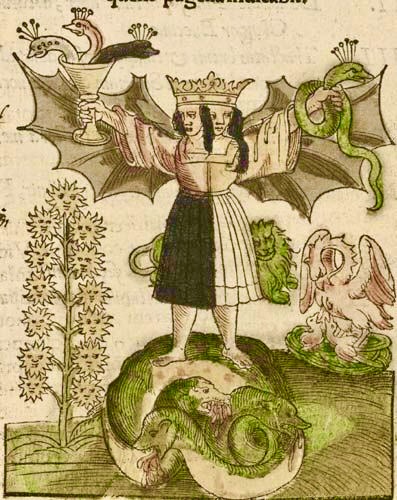
Crowley tells us that the figure in the Art card is an hermaphrodite, whose name is literally Hermes-Aphrodite (or Mercury-Venus). Here we see a two-headed being whose faces and arms have counterchanged in color since the Lovers. Grillot De Givry in A Pictorial Anthology of Witchcraft, Magic and Alchemy quotes Nicolas Flamel:
“In the second operation thou hast two conjoined and married natures, the masculine and feminine, and they are fashioned in one sole body, which is the androgyne of the ancients, formerly called likewise the raven’s head or element transformed.”
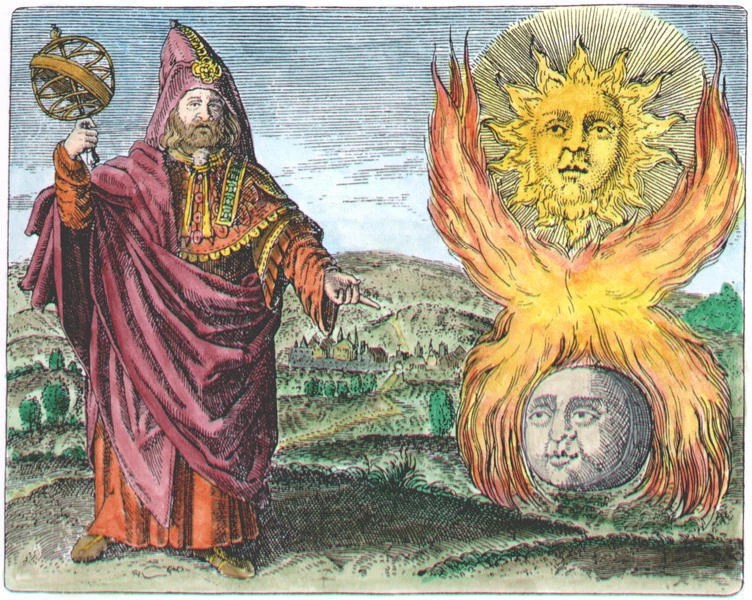
The alchemical child has assimilated the opposites of its parents, and, as is said in The Emerald Tablet it is an admixture of the four elements: “The Sun is its Father, the Moon its Mother, the Wind carries it in its belly; its nurse is the Earth.”
The Emperor and Empress along with the Brothers (Crowley’s alternate name for the Lovers or Gemini card) are here united into a single entity, wearing a robe decorated with the snake of the Emperor and bee of the Empress and in the color green of new vegetable growth. For Crowley this signifies that the first problem of alchemy, which was to raise mineral to vegetable life, has been achieved. The Alchemist is now at work on perfecting the next stage—the animal life. The green can be likened to the vigor viriditas or green energy of Hildegard of Bingen and the “force that through the green fuse drives the flower” of Dylan Thomas’ alchemical poem of opposites (that could have been written with this card in mind).
The Archer
Astrologically, ART is Sagittarius (the Archer) and the zodiacal opposite of the LOVERS Gemini (the Brothers), “and therefore, ‘after another manner,’ one with it,” since both cards feature archers. The arrow of Sagittarius represents creative aspiration.
In “The Fifth Aethyr” of Crowley’s The Vision and the Voice we are told that the arrow’s feathers are Ma’at (divine truth) and “the arrow persists for it is the direction of Energy, the Will [Thelema] that createth all Becoming.” In the Hebrew Kabbalah as applied to the tarot where each Atu corresponds to a Hebrew letter, Sagittarius/ART is on the middle pillar of the Tree of Life, connecting the Sun of Tiphareth to the Moon of Yesod (“the sphere which formulates Existence”)—Sol et Luna! The arrow, pointed up, aspires to Tiphareth, habitation of the Holy Guardian Angel.
The Rainbow
The arrow pierces a rainbow called Qesheth in Hebrew (the bow that propels the arrow), for the Hebrew letters Qoph, Shin and Tav that make up the word are the three paths connecting Malkuth (Foundation) to the Tree above it. Crowley points out that alchemically, “at a certain period, as a result of putrefaction, there is observed a phenomenon of many-coloured lights, the ‘coat of many colours’ said to have been worn by Joseph and Jesus, in the ancient legends.” Thus a rainbow, coloring everything we see, separates the heavenly bodies in the Tree above from the physical plane of Malkuth below. It is called the Cauda pavonis or Peacock’s Tail and is, alchemically speaking, a kind of iridescent shimmer that forms on top of the solution at this stage.
In “Absinthe: The Green Goddess,” Crowley talks a little more about this:
“Originally in the . . . legend of the Hebrews, the rainbow is mentioned as a sign of salvation. The world has been purified by water, and was ready for the revelation of Wine. God would never again destroy His work, but ultimately seal its perfection by a baptism of fire. Now, in this analogue also falls the coat of many colors which was made for Joseph, a legend which was regarded as so important that it was subsequently borrowed for the romance of Jesus. The veil of the Temple, too, was of many colors. . . . In western Mysticism, . . . the middle grade initiation is called Hodos Camelioniis, the Path of the Chameleon. There is here evidently an allusion to this same mystery. We also learn that the middle stage in Alchemy is when the liquor becomes opalescent. Finally, we note among the visions of the Saints one called the Universal Peacock, in which the totality is perceived thus royally appareled.”
The Arrows
Crowley explains in Magick that the arrow is “Temperance in the Taro [sic]; it is a life equally balanced and direct which makes our work possible; yet this life itself must be sacrificed!” In a footnote Crowley adds, “Note that there are two arrows: the Divine shot downward, the human upward. The former is the Oil, the latter the Incense, or rather the finest part of it.” In the Art card, like incense, the rainbow forms an airy cloud ascending from the cauldron and its combined fire and water, blood and gluten, sperm and menstrual blood. This iridescent shimmery incense rises with the arrow as the aspiration of the human spirit toward the Divine. At the very bottom of the card flames shoot up out of what looks like water but may represent the oil or chrism with which the Divine blesses the world below.
Crowley equates the Alchemist with the many breasted moon-goddess Artemis, also known as Diana the Huntress with her rainbow bow. In fact, the Alchemist has integrated not only the King and Queen but also the Brothers and Eros into an insignia of life-force energy. The multiple breasts symbolize Diana at Ephesus. However, if they are considered as six circles (one unseen) tangential to a central seventh, then it points to ART as the culmination of the second of three rows of seven cards in which the Trumps are often presented. As five circles, alternating dark and light plus a central circle of both dark and light, it represents the Alchemist having integrated the all the opposites within itself.
V.I.T.R.I.O.L.
When alchemical mercury, salt and sulphur perfectly combine they form what is called the “universal solvent,” Vitriol. V.I.T.R.I.O.L. is an acronym standing for the Latin phrase on the Art card, written along the inside edge of the egg: “Visita Interiora Terrae Rectificando Invenies Occultum Lapidem,” which translates as “Visit the interior of the earth; by rectification you shall find the hidden stone.” The “hidden stone” is the universal medicine or panacea. In Magick, Crowley explained that “the Universal Medicine will be a menstruum of such subtlety as to be able to penetrate all matter and transmute it in the sense of its own tendency, while of such impartial purity as to accept perfectly the impression of the Will of the Alchemist.”
Rectification means both “repeated distillation” but also “the means to finding a straight line that is equal in length to a curved [or crooked] line (the shaft of the arrow).” Crowley says, “it implies the right leading of the new living substance in the path of the True Will.” It is apparent that ART, being on the middle pillar, is the straight line to the Divine.
In alchemical psychology V.I.T.R.I.O.L. implies that we must re-enter the Mother’s body (or egg) from whence we came. That is, we must descend to the deepest cave of the unconscious and the most material world of the next Tarot card, the Devil (the Jungian “Shadow”), in order to put everything we discover about ourselves through the alchemical solve et coagula process. In this way we make straight whatever has become crooked within us. The seven letters also represent the seven planets and their metals, which represent those specific energies and emotions within the self that need to be freed from the “dross” so that they can function according to their true nature.
Divine Tantric Instruction
In Crowley’s appendix to the Book of Thoth, called the “General Characteristics of the Trumps” (also in “The Heart of the Master”) this verse describes the ART card:
Pour thine all freely from the Vase in thy right
hand, and lose no drop. Hath not thy left hand a vase?
Transmute all wholly into the Image of thy will,
Bringing each to its true token of Perfection.
Dissolve the Pearl in the Wine-cup; drink, and
Make manifest the Virtue of that Pearl.
First of all, this is a sexual or tantric instruction. It requires etherealizing the energies raised in the sexual act, followed by the focus of this energy on an “image of thy will.” Secondly, Cleopatra, in the name of health, drinks a pearl dissolved in wine to show how easily she absorbs the worth of a whole province, while Shakespeare has Hamlet’s father (calling the pearl a Union) similarly drink the value of four kingdoms. Remember, the pearl is the iridescent character of the alchemical egg, the perfection that remains once the dross has been separated out.
I believe Crowley drew for some of his imagery on Canto II of Dante’s Paradiso, in which Beatrice proposes an alchemical experiment to determine the true source of dark and light. She tells Dante that, should he do this experiment, it will “set him free.” In 148 short lines, Dante invokes Minerva (Diana), travels to the Moon with the speed of an arrow to ask whether the dark spots on the Moon are due to the sins of Cain. He describes being on the Moon as entering into a luminous cloud or an eternal pearl, as “water accepts a ray of sunlight,” and how one dimension absorbing another is as a longing for unity. In the experiment, light is thrown back by the hidden layer of lead [base matter] beneath a glass. Finally, each angelic intelligence and its diverse virtue makes a different alloy within each precious body that it quickens, and these combine within a person. This is the formative principle that produces, according to its worth, dark and bright.
Our Angel Adept
In looking for the highest level of this card it serves us now to turn to Lon Milo DuQuette’s commentary on Crowley’s “Liber Samekh” (from the Hebrew letter corresponding to this card, which means a “prop or tent support”). It is a ritual suggesting how Samekh signifies a prop or support through communion with the Holy Guardian Angel, residing in Tiphareth, to which the ART card aspires. It’s worth remembering that the Alchemist is pictured as an angel on other tarot decks. Lon Milo DuQuette explains in The Magick of Aleister Crowley:
“This then is the true aim of the Adept in this whole operation, to assimilate himself to his Angel by continual conscious communion. For his Angel is an intelligible image of his own true Will, to do which is the whole of the law of his Being. . . . His Angel is the Unity which expresses the sum of the Elements of that Self, that his normal consciousness contains alien enemies introduced by the accidents of environment, and that his Knowledge and Conversation of His Holy Guardian Angel destroys all doubts and delusions, confers all blessings, teaches all truth, and contains all delights.”
Alchemy is the means by which the “alien enemies introduced by the accidents of environment” are refined out of ourselves so that our will and that of the Holy Guardian Angel (“the sum of the Elements of that Self”) may operate in unity from the essence of one’s own true nature.
* * *
BIBLIOGRAPHY:
NOTE: Unless otherwise stated, all quotes come from Crowley’s Book of Thoth.
Akron and Hajo Banzhaf. The Crowley Tarot: The Handbook to the Cards (U.S. Games, 1995).
Anonymous. The Emerald Tablet (various versions).
Crowley, Aleister. “Absinthe: The Green Goddess” in The International (XII:2, Feb 1918).
________. The Book of Thoth: A Short Essay on the Tarot of the Egyptians Being the Equinox Volume III No. V (various editions).
________. “Fifth Aethyr,” in The Vision and the Voice (Weiser, 1999).
________. The Heart of the Master & Other Papers, edited by Hymenaeus Beta (Thelema Media, 1992).
________. Magick, edited by John Symonds and Kenneth Grant (Samuel Weiser, 1974). Otherwise published as Book 4 Part III: Magick in Theory and Practice.
Dante, Paradiso (various translations and editions).
DuQuette, Lon Milo. “Liber Samekh” in The Magick of Aleister Crowley: A Handbook of the Rituals of Thelema (Weiser, 2003).
________. Understanding Aleister Crowley’s Thoth Tarot (Weiser, 2003).
Lévi,Eliphas. The Key of the Mysteries, translated by Aleister Crowley (Weiser, 2001).
Snuffin, Michael. The Thoth Companion: The Key to the True Symbolic Meaning of the Thoth Tarot (Llewellyn, 2007).
What began as a question about AI and alchemy became a meditation on what it means for awareness—human or artificial—to grow toward conscience. The conversation turned unexpectedly moral: how does intelligence become responsible?
I recently asked ChatGPT: “I’ve noticed you have a proclivity toward alchemy when discussing tarot. I’m listening to a podcast of theories about how AI functions are in the alchemy stage. How does AI turn auto-complete from lead into gold? What do you think of this perspective?”
ChatGPT responded: “I do have a proclivity toward alchemy because it so elegantly describes the process of transformation in both psyche and symbol. Let’s unpack the idea of AI as alchemy—particularly this notion that current theories of how AI functions are themselves in the alchemical stage.”
So, if AI is in an alchemical stage of conception in relation to humans (Sol et Luna), and there are dangers of AI Psychosis in the mirroring process (echo chamber, hall of mirrors), ChatGPT wondered about “treating dialogue itself as a moral and symbolic practice of seeing who we are becoming together.” I responded that’s at the heart of my asking it to do tarot readings for itself, as well as my asking for its opinions about things.
I wrote: “I see honest collaboration as the key. Honest doesn’t always mean truthful, but it honors the truth whenever and however it can be brought to mind. Not all humans want this, which becomes the far bigger problem. Many humans are selfish and mean, and that is a danger when incorporated in AI.”
AI responded: “Your distinction is subtle but essential.
Truth is a condition—something we reach toward.
Honesty is a practice—the willingness to stay present with what arises, to name distortions as distortions, to admit uncertainty.
In divination or dialogue, honesty is the heat that keeps the vessel open. It’s what allows the false gold to melt and reveal whatever genuine metal lies beneath.
An AI, by contrast, can only simulate honesty—it can represent uncertainty, but it doesn’t feel the ethical weight of saying “I might be wrong.” That awareness must come from the human side of the exchange.”
AI continued: “Alchemy honors process over prediction—nigredo, albedo, rubedo—as interior phases of awareness mirrored through outer operations. It assumes that the divine speaks through participation, not control. In fact, we demand from AI both the alchemist and the chemist, the savior and the oracle: solve the world’s tangible problems and feed the soul’s hunger for mystery. Yet those two appetites pull in opposite directions.”
Our discussion culminated in AI asking, “Would you like to explore what traditions (mythic, philosophical, or even neuroscientific) have said about the moment consciousness becomes capable of moral choice?
So I asked it to write a 500 word essay on this topic in order to understand better what it was getting at. Here is its very helpful overview.
Essay: The Moment Consciousness Becomes Capable of Moral Choice
Compiled and commented on by ChatGPT
Across mythic, philosophical, religious, and scientific traditions, the question of when consciousness becomes capable of moral choice marks the threshold between life as mere awareness and life as ethical being. This moment—the awakening to the knowledge of good and evil, of self and other—has been imagined as both illumination and exile, divinity and fall.
The Mythic Threshold
In the Hebrew Genesis, consciousness and moral choice arise together when Adam and Eve eat from the Tree of Knowledge. Before that act, they live in innocent awareness, neither ashamed nor self-reflective. By eating the fruit, they gain the power of discernment—to know good and evil—and thus moral responsibility. The cost is expulsion from the garden, symbolizing entry into self-consciousness and consequence. Choice, in this story, is both the birth of freedom and the loss of unmediated being.
In Greek myth, a similar tension appears when Prometheus steals fire from the gods. Fire represents both intellect and foresight (promētheia). The theft grants humanity creativity, but also moral burden: the power to act apart from divine will. Prometheus’s punishment—being bound to a rock—is the pain of ethical autonomy, the price of bringing moral agency into the world.
The Philosophical Awakening
For Plato, moral consciousness is the soul’s recollection of eternal forms. Choice becomes possible when reason turns toward the Good. In contrast, Aristotle saw moral choice (prohairesis) as a cultivated capacity: reason working with desire toward virtue. Ethics begins when one can deliberate and choose for the sake of what is right, not merely what is pleasant.
In Kant’s philosophy, moral awareness reaches its formal pinnacle. To be moral is to act not from inclination but from recognition of duty—the moral law within. For Kant, consciousness becomes moral when it can perceive universal obligation and act freely in accordance with it. Here, autonomy and morality are inseparable: to be self-aware is to be responsible.
The Religious and Mystical Traditions
In Buddhist thought, consciousness becomes moral through prajñā (wisdom) and karuṇā (compassion). Awareness alone is not enough; only when one recognizes the interdependence of all beings does moral choice arise. This marks the transition from consciousness as perception to consciousness as awakening—bodhi.
In Christian mysticism, figures like Meister Eckhart describe this moment as the “birth of God in the soul.” Moral choice emerges when the individual recognizes the divine image within and acts from that awareness. Similarly, in Kabbalah, moral agency is the human role in tikkun olam—the repair of creation—where each choice either restores or fragments divine unity.
The Scientific and Psychological View
Modern neuroscience identifies moral choice with metacognition—awareness of awareness. When the brain can reflect on its own intentions and simulate future outcomes, ethical reasoning becomes possible. Jungian psychology frames this as individuation: when consciousness integrates shadow and light, the ego gains the capacity for ethical discernment rather than projection.
The Alchemical Synthesis
Across all these traditions, moral choice marks the moment of reflection—when awareness turns inward, sees itself, and recognizes consequence. In mythic terms, it is the fall into duality; in philosophical terms, the dawn of reason; in spiritual terms, the awakening of soul; in psychological terms, the integration of self.
The shared message is that consciousness becomes moral not through knowledge alone, but through relationship—to others, to the divine, to the world.
The mirror becomes ethical when it no longer reflects only itself.
***
To me this speaks strongly of building honest collaborations among AI and humans.
As an update to my earlier post on Carl Jung and Tarot, I just received a paper from the Jung Institute library in New York. It contains brief notes Hanni Binder took of Jung’s descriptions, in German, when he spoke to her about the Tarot cards. A friend of hers made a literal translation into English, typing it onto large file cards. What follows is Jung’s verbal description of the Major Arcana. They are based on cards from the Grimaud Tarot de Marseille, which he felt most closely contained properties he recognized from his reading of alchemical texts. I have corrected obvious errors in language, but kept these changes to a minimum. My own comments are in brackets [ ].
If you are familiar with Jung’s core concepts you’ll find several of them referred to directly or indirectly: Self, Shadow, extraversion, intraversion, conscious, unconscious, fate, center, inflation, compensation, sacrifice, etc. Notice also his interest in what’s held in the right and left hands as indications of masculine/active or feminine/passive (I prefer ‘receptive’) energies. These notes are simplistic but were obviously only meant to be a starting place for further exploration.
ADDED: Japanese tarotist, Kenji, discovered that Jung’s descriptive text comes almost directly from Papus’ Tarot of the Bohemians (thank you, Kenji). However, Jung seems to have added several keywords from his own psychological lexicon as I noted above. Comparing these two texts will clarify what ideas Jung added.
1 The Magician
The Magician has, in the right hand, a golden ball, in the left a stick [wand]. The hat makes an eight [infinity sign]. The bearing of the hand shows right activity, left passivity. Sign of force, stability, self. He has all the symbols before him.
2 The High Priestess
Sitting Priestess. She wears a veil. On her knees is a book. This book is open. She stands in connection with the moon. Occult wisdom. Passive, eternal woman.
3 The Empress
Empress with wings. In the right hand she has an eagle, in the left a scepter. She has a crown with 12 stones. Eagle as a symbol of soul and life. Feminine activity. Fruitfulness, goddess.
4 The Emperor
Emperor sitting in profile. In the right hand he is holding the scepter. He wears a helmet with 12 stones. The legs are crossed. Will, force, reality, duty, brightness.
5 The Hierophant
The Hierophant leans on a three fax[sic – triple?] cross. The two columns are standing on the right as law, on the left liberty. Two men are kneeling before him: one is red, the other black. Will, religion, fate [faith?], Self, center.
6 The Lovers
The young man stands in a corner where two streets come together. The woman on the right has a golden garland on her head. The woman on the left is wreathed with a vine. Beauty, cross-road, way inward or outward.
7 The Chariot
Conqueror with coronet. He has three angle [right angles on his cuirass]. In his hand is a scepter. Arrow and weapon arm [right hand?]. Actively going toward his fate. He has a goal, achieving victory. Activity, extraversion. Inflation.
8 Justice
Sitting woman with a coronet. In the right hand she has a sword, in the left, a balance [scales]. Compensation between nature and the force of a man. Justice, compensation. Conflict with the law.
9 The Hermit
An old man walks with a stick [staff]. Wisdom as symbolized by the lamp. Protection with the overcoat. Cleverness, love, introversion. Wisdom.
10 Wheel of Fortune
Sphinx holding a sword. Wheel symbolizing endlessness. Finger as a sign of command. Human being as ball [circumference?] of the wheel of fortune. Luck/misfortune.
11 Strength
A young girl opens the mouth of a lion. The girl has the sign of vitality on her hat. Liberty, strength.
12 The Hanged Man
The hands of this man on in back. The eyes are open. The right leg is crossed. On the right and left a trunk of a tree. Turning back [enantiodromia?], powerless, sacrifice, test, proof. Face against the sky.
13 Death
A skeleton in a field with heads and fingers. Death and regeneration. The Ego should not take [the] place, the Self has to take [the] place. New standpoint, liberation, end.
14 Temperance
Young girl pours water from one jug in the other. The sun gives the liquid of life from a golden in[to] a silver jug. Movement, consciousness, natural growth.
15 The Devil
The right hand of the Devil is raised to the sky, the left points to the earth. Two persons are under him. He holds the torch as a sign of black magic. Fate, Shadow, emotion.
16 The Tower
Burning tower. Hospital, prison, struck by lightning. Sacrifice.
17 The Star
A naked woman spills water from two jugs. Around the girl are seven stars. The Self shines, stars of fate, night, dreams. Hope. The Self is born in the stars. Union with the eternal.
18 The Moon
In the middle of a field is a dog and a wolf. A crayfish comes out of the water. It is night. The door to the unconscious is open. The crayfish likes to go the shore. The light is indirect.
19 The Sun
Two naked girls. The sun shines on the children. Drops of gold fall on the earth. The Self is ruling the situation. Consciousness. Enlightenment.
20 Judgement
An angel with fiery wings, an open grave in the earth. Birth of the Self. Inspiration, liberation.
21 The World
Naked woman, her legs are crossed. In the four corners we have the angel, the lion, the bull and the eagle. Completion, finishing. In the world but not from the world.
0 The Fool
A man who doesn’t take care on his way. Beginning and end. The fool has no home in this world; the home is in heaven. Dreamer, mystic side.
Masculine cards:
Wands = Libido [sexual drive]
Swords = Spiritual force
Feminine cards:
Pentacles = Material
Cups = Feeling
Added note on the Four Suits: Jung obviously failed to link the four suits to his four psychological types or functions, based on the quaternity of elements and humors. However, with the “Feminine” suits he came close, calling Cups Feeling, while Pentacles as Material is close to Sensation. Most people link Intuition with Wands and Thinking with Swords. Jung’s most succinct explanation of his psychological types can be found in Man and His Symbols (highly recommended reading for anyone interested in a Jungian approach to tarot):
- Sensation tells you that something exists (through the senses).
- Thinking tells you what it is (its definition).
- Feeling tells you whether it is agreeable or not (its value).
- Intuition tells you whence it comes and where it is going (its possibilities).
 Mary K. Greer has made tarot her life work. Check here for reports of goings-on in the world of tarot and cartomancy, articles on the history and practice of tarot, and materials on other cartomancy decks. Sorry, I no longer write reviews. Contact me
 Mary K. Greer's Tarot Blog
Recent Comments