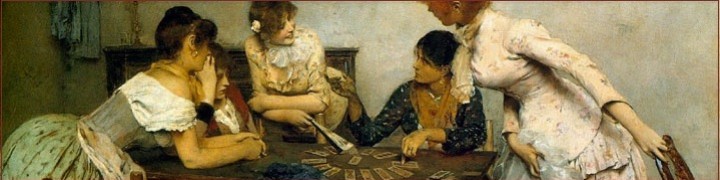
In preparation for the July 2026 Omega Institute tarot workshop, “Wisdom of the Tarot,” I have been posting on Facebook multiple versions of Minor Arcana cards from 21st century tarot decks for comparison. I ask if any keywords or phrases work equally well for all the different decks – one of the themes for the upcoming workshop (stay tuned). My latest example was the 6 of Swords. [It should be noted that the vast majority of new decks are at least loosely based on the Rider-Waite-Smith (RWS) pictures.]
According to the Hermetic Order of Golden Dawn source works and their theory of numbers (c. 1888), derived, in part, from the Kabbalistic Tree of Life, the 6 of Swords, is found on the central sephira of Tiphareth (associated with the Sun). It is, as the GD described it, the “high point” of the Air suit of Mind or Intellect. Associated with the astrological decan of Mercury in Aquarius, it is, at its best, “reason serving humanity.” Centering on Imbolc or Candlemas at 15* Aquarius (Feb 1-2), this fixed sign marks the first truly noticeable return of the light and longer days, heralding the return of Spring.
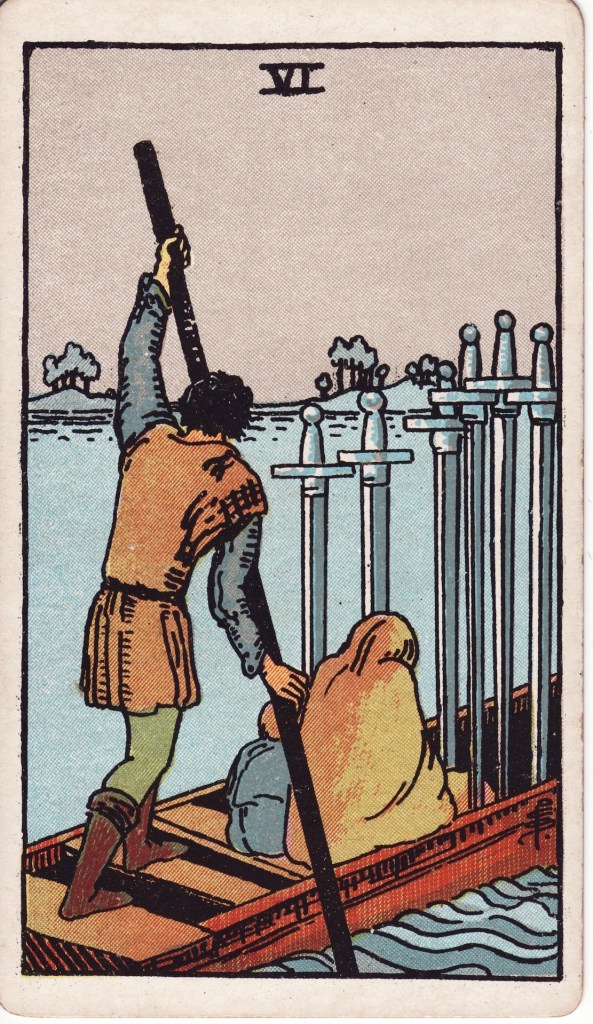
Pamela Colman Smith illustrated this by picturing people we could assume to be a mother and child in a boat poled by a ferryman moving away from rough and into smooth waters. Potential landfall can be seen in the distance. The figures face right, heads bowed so we don’t see their faces. Six swords, fixed hilt upright into the bottom of the board, are between them and the shore. Whether the swords are a barrier for protection or a threat is unsure.
Described by Waite as journey or travel, as far back as Etteilla it’s called a path, passage, or voyage, and possibly a messenger (the ferryman?). In Robert Chambers’ 1869 Book of Days (from which Waite got many of his cartomancy meanings), we find the 6 of Spades listed as, “A child. To the unmarried a card of caution.” Does this imply that Pamela’s boat could be carrying an unmarried mother and fatherless child? The Queen of Spades in this source is called a widowed woman. (Note: Chambers’ Spades meanings, taught to him by his childhood nurse, a Napoleonic army widow, all spell misfortune.)
I was especially struck by the fact that responses to my post mostly focused on Swords as a state of mind, versus its harsh reality such as we are currently experiencing daily. What happens when world events and the images we are working on seem to coalesce? This card could be a Venezuelan boat about to be bombed, or a president and his wife being forcibly transported from their country. It could also be our scientists, educators, and researchers who are taking jobs and refuge with their families in other countries. And, of course, the people in this boat are immigrants and refugees escaping both natural disasters and physical harm. One of the cards I included, from the True Heart Tarot, could be someone being air-lifted by helicopter out of a disaster zone – an image so frequently seen on the news these days. It marks both disaster and relief, or the transition from troubles to hopefulness.
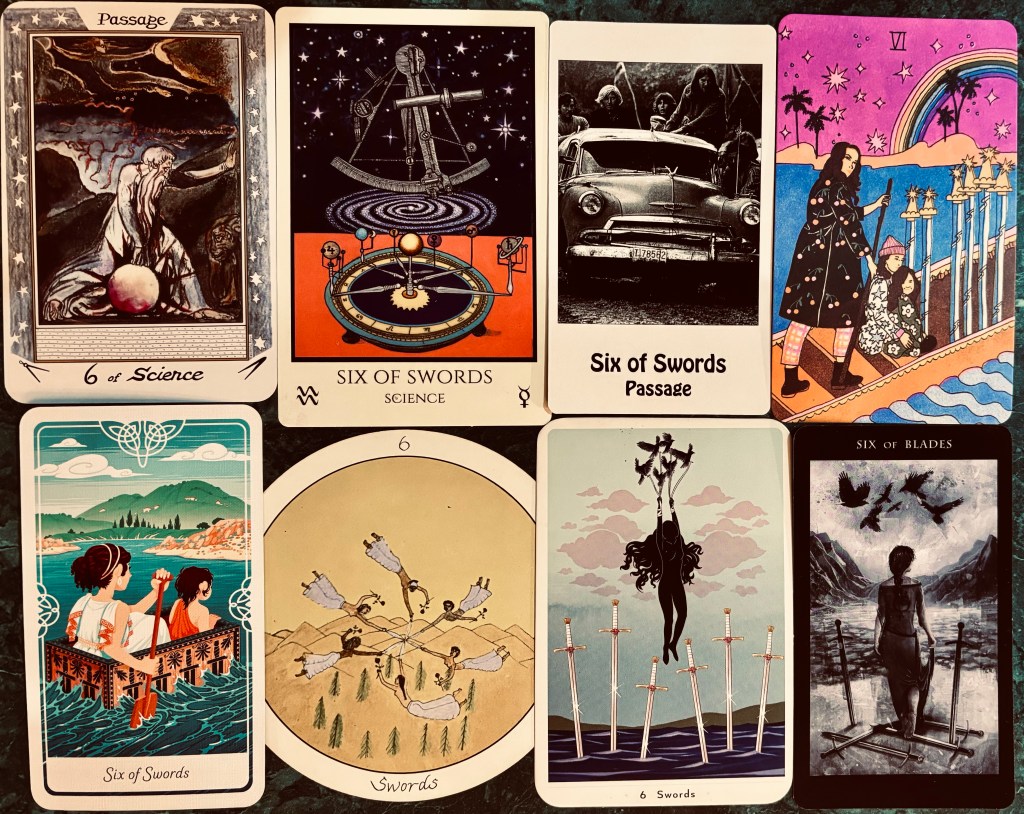
So let’s explore this card a little further. To complicate the issue, we have Aleister Crowley’s keyword: “Science.” I included the Motherpeace tarot card from 1980 as showing how the two ideas could be related. Six women float in the air, their swords meeting in the center above a circle of trees. Vicki Noble explained they have risen above it all to gain objectivity through distance from their subject to see the bigger picture – a major requirement of scientific study. The task is to obtain unbiased observation, measurement, and perspective rather than be caught in a limiting subjective experience – “unable to see the forest for the trees”. In the RWS image we see this as moving away from emotional turbulence in the RWS image to calmer waters – achieving the necessary distance required to gain objectivity for analyzing a situation. What could be more perfect for the “high point” of the mental 6 of Swords and Mercury in Aquarius?
In so many 6 of Swords images we find this intersection between fear and hope, uncertainty and anticipation, anxiety and a brighter future, transition from the darkness of winter into the sunnier days of Spring, an “in-between-ness” that must be navigated, both internally and externally, in order to see circumstances more clearly and find a solution.
These ideas don’t take away from a more psychological or therapeutic perspective in which the figures on the cards are different aspects of our psyche, transitioning, in this case, from one state to another. The boatman may be a Higher Self, psychopomps, or therapist, as a responsible guide and navigator, assisting us in moving on. Our masculine, feminine and child selves are all in it together. The boat is our bridge over troubled waters or any mental crossing. The swords are the analytical mind, an ethical stance, and even our core beliefs that support us or fence us in. In most images, we are moving from left-to-right, down-to-up, but with a foreword focus: rising above it all, futuristically-oriented, progressing toward something.
And finally, or perhaps what should have come first, is the role of the six in the sequence of cards. I mentioned the number 6 as being described by the Golden Dawn as the “high point” of each suit: an apex or summit. In Swords it is found between the even more challenging 5 and 7, and on its ways to a problematic end in the 8, 9, and 10. But, let’s just look at these central three Aquarian cards. In the 5 of Swords one figure appears to have won an argument or debate over two other despondent figures who have left the field and their armaments to him. Readers like to warn, “he won the battle but maybe not the war.” Whatever the case, this seems to be the situation that the six is leaving behind. The 7 of Swords could be what occurs after landing on the distant shore.
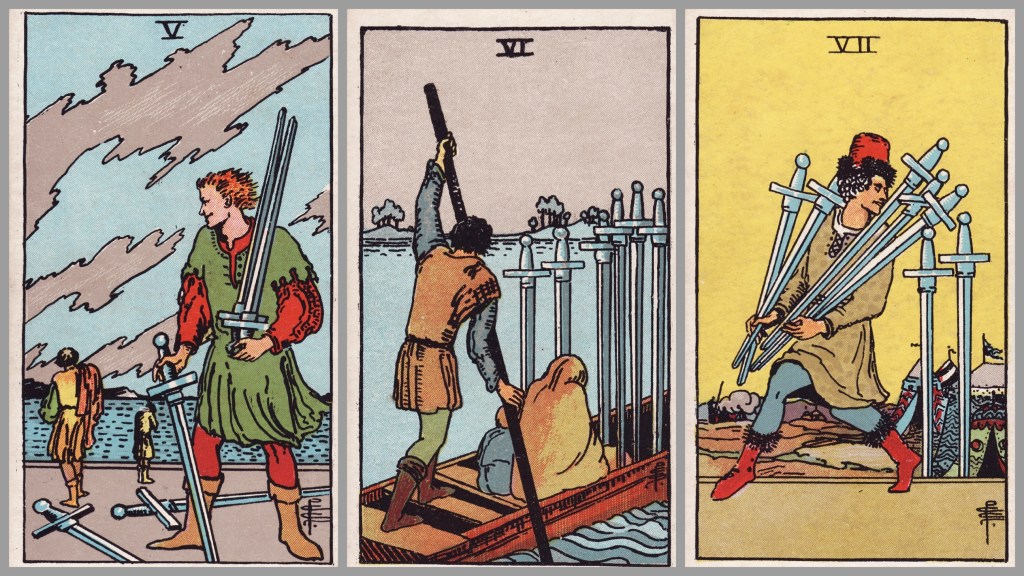
In my imagination, I call the 7 of Swords the “James Bond 007 card”. Following his machismo proof-of-ability in the 5, in the 6, Bond reaches the enemy island, where the villains have assembled a machine of mass destruction. In the 7, he strategically disarms it, winning the day. So, this is a card of disarming either the enemy or some greater force working against your well-being. Yes, it is still lying, cheating, stealing but for what purpose, against whom or what? One other perspective is that of going to the library to gather research: assembling information. To bring it up-to-date, it could be the designers of AI stealing data from copyrighted authors and artists!
Maybe it’s time for pure swordness to move on to another suit? Enough for now. Be sure to share your perspectives in the comments.
 Mary K. Greer has made tarot her life work. Check here for reports of goings-on in the world of tarot and cartomancy, articles on the history and practice of tarot, and materials on other cartomancy decks. Sorry, I no longer write reviews. Contact me
 Mary K. Greer's Tarot Blog
5 comments
Comments feed for this article
January 6, 2026 at 2:23 pm
Renatembell
Mary, I loved this. So much great and beneficial perspective and insight.
When I look at this card and where I am currently in life, for me personally it speaks to me of my desire to transition into retirement, clinging to worry (mainly about health insurance as I’m not yet eligible for Medicare and everything feels so chaotic right now), and the child I hold on to is the ‘nest egg’ and perhaps the hope of a new chapter ahead of me. Is the ferryman the Dweller on the Threshold, my ego, or my Soul? Which is guiding me? Must be careful and not rush.
January 7, 2026 at 7:06 am
earthquakedazzling77f00ff835
I love this analysis. The Six of Swords turns up for me when there is an option to leave (or at least get prolonged respite from) an ugly situation. I like your James Bond narrative for five through seven. My own interpretation, of the Five of Swords as a public battle and the Seven of Swords happening secretly behind the scenes, kind of fits.
Sometimes I see the Seven of Swords as being a direct consequence of the Six of Swords. If you are able to leave the fray safely and intact (Six of Swords), then the ‘enemy’ is left behind with no means to cause you harm (Seven of Swords). So, a strategic disarming of sorts.
Etteilla’s reversed meaning for Six of Swords is ‘declaration’. Which does feel like the opposite of quietly slipping away from conflict.
‘Detachment’ seems to me a good overarching word for the Six of Swords.
January 10, 2026 at 5:10 pm
Mary K. Greer
Renatembell,
A transition into retirement is a situation perfect for this card. While I hear that you are concerned over money and health, the boat is moving steadily toward the shore ahead. The swords suggest your concerns are more in your head. Why don’t you try a written dialogue with the ferryman? – I recommend hand writing. Give yourself 12-15 minutes to write back and forth, non-stop (don’t correct anything), with the ferryman. Ask him all the questions you can in the time given, and write the first thing he might say, without your thinking about it. Be silly and playful.
[My first attempt at a response seems to have disappeared.]
Mary
January 10, 2026 at 5:17 pm
Mary K. Greer
Earthquakedazzling,
Your comparison of the 5 and 7 of Swords fits for me. Thanks for pointing out that Etteilla meaning of ‘declaration’ for the 6 of Swords as potentially dangerous versus a quiet leaving is also a good one. I wonder about ‘detachment’ as the figures are taking their swords with them. I sometimes see them as their core beliefs that they aren’t necessarily leaving behind, resulting in the difficulties that lie ahead in that suit. It’s hard to let go of unconscious beliefs and attitudes when you don’t even realize you have them. Thanks for responding.
Mary
January 19, 2026 at 1:11 pm
Christiana C. Gaudet
Thank you for sharing this, Mary! Brilliant! Here is my simple take on the Six of Swords, one of my favorite cards.
From the perspective of the Waite tradition, we often think of the Six of Swords as sailing toward smoother waters. In the fortune-telling tradition, this card is said to predict travel across water, presumably by boat or plane.
It is from Crowley’s keyword for this card, ‘Science’, that I came to my current understanding of the Six of Swords. If you look at the image in the Waite deck, you will see that the swords are being carried in a way that is physically impossible. They seem to be floating independently of the boat and the water. Here is what I think is happening.
The boat is floating on the water of emotion, as the swords of clarity hover within. Clarity is what moves us forward here. Science takes us away from watery emotions and leads us forward with clarity and the power of the mind.
So when I interpret this card, I often speak of smoother sailing ahead, but only if the logical mind is steering the boat.