You are currently browsing the category archive for the ‘Book/Story/Poetry Reports’ category.
 Half Asleep in Frog Pajamas by Tom Robbins (1994) is about the transformative quest of materialist commodities broker, Gwen Mati, in the days immediately following a stock market crash. It is literally a Fool’s Journey—told in the second person present tense as if it were a tarot spread explained by a reader. Indeed, one of the characters in the book is Gwen’s tarot reader.
In this excerpt the Fool appears in Robbins’ inimitable style: Read the rest of this entry »
“A gypsy told me once I was a fool. The fool who sought the fool.” So says, Ethan Gage, hero of a pair of fast-moving historical adventure novels filled with the kinds of things we tarotists find intriguing: occult manuscripts, ciphers, Freemasons, Kabbala, Templars, hidden rooms beneath the Great Pyramid and Solomon’s Temple, gypsies, tarot, an evil magician and a priestess of Isis and, of course, the Book of Thoth. It’s a heady mix, especially when you set a fast-talking American fool with a tomahawk down in an Egypt and Levant besieged by Napoleon Bonaparte, and then add historic battle scenes, man-eating crocodiles and impossible escapes. Ah, the things you didn’t know about history! Read the rest of this entry »
 Dan Pelletier consulted the tarot before heading from his home in Seattle to New York to train for a new job. The cards told him he would come home a changed man. On the second morning of training he got an overwhelming urge to go out for a cigarette. The training was on the 61st floor of Twin Tower 2 and it was 9/11. Dan watched others die while he inexplicably escaped the falling debris, beginning an odyssey that, soon after, led to his leaving the financial industry to follow his heart and do what makes him feel whole. Dan is now co-owner with Jeannette Roth of Tarot Garden, Inc., a shop and information site dedicated to helping you find the tarot decks that interest you. He’s been reading tarot for over thirty years and credits some kind of other-worldly sense with guiding and saving his life more than once. As Umbrae, he frequently posts on Aeclectic’s tarotforum. Read the rest of this entry »
When does a traveler stand concurrently at both the beginning and the end of his journey . . . ready to embark, yet puzzled by the dust of travel already on his shoes?
from The Last Days of Madame Rey: A Stephan Raszer Investigation by A. W. Hill.
The answer can be found in the comments section. Don’t look until you think you’ve got the answer.
Went to hear Coleman Barks read poetry last night. It was food for the soul! I was especially struck by the first poem he read—“The Water You Want”—from Rumi. It began
“Someone may be clairvoyant, able to see the future, and yet have very little wisdom,”
which, of course, caught my attention.
The poem speaks of a man who sees water in a dream and, still in the dream, convinces others to follow him toward this mirage, when all along he is sleeping next to a river of pure water (ultimately no further than the blood in his veins). This points up how we live in a dream, and we are advised to:
“Give up subtle thinking, the twofold, threefold multiplication of mistakes. Listen to the sound of waves within you.”
To me this speaks of the paradox inherent in reading tarot, where we miss seeing the, often simple, import; we miss the sound of waves within. Nevertheless, I sometimes let myself wander in the dream, drawn by a mirage or two or three. In the case of The Best Cities for Singles reading, I even encouraged several people to wander along with me. Yet, there is a point when I wake to the rhythmic pulse of the water within (of which such poetry serves to remind me).
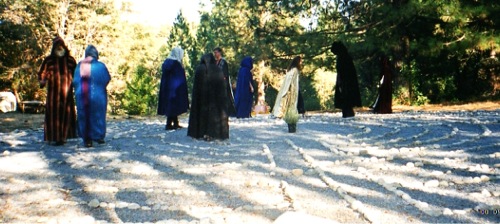
Without the dream and without the peregrinations, I may never have come to know the pure water for what it is. The tarot takes me through a labyrinth, a winding in and out, back and forth, to reach a center that is no further than the next heartbeat, yet known all the better for the journey to it. Yes, I lie next to the water I want, but I value it more for having followed the mirage, and knowing that, too, for what it is. Photo: Walking a Chartres-style labyrinth with friends.
 Scholarly-oriented readers will appreciate a paper on Tarot by Inna Semetsky called “Simplifying Complexity: Know Thyself…and Others” in Complicity: An International Journal of Complexity and Education, 2008, Vol. 5, No. 1 (click on the title and it will download as a pdf). Dr. Semetsky is a Research Academic with the Institute of Advanced Study for Humanity, University of Newcastle, Australia who has been writing scholarly papers on tarot for many years. Drawing on semiotics, systems theory, and ideas about meaning and synchronicity (among others), she posits that Tarot “can be considered an education tool contributing to our learning and, respectively, the evolution of the human mind situation in the larger, both cultural and natural, context.”
In relation to my earlier post on Arcana in the Adytum, I found Semetsky’s description of arcanum to be especially interesting:
Arcanum (or arcana, plural) . . . is the ever present potential catalyst . . . that, when actualized and brought to consciousness, elicits transformations at the levels of thoughts, affects, and actions so that an individual becomes fruitful and creative in his/her possible endeavours. If and when discovered – that is, made manifest at the level of conscious awareness – it becomes a powerful motivational force to facilitate a change for the better at the emotional, cognitive, and/or behavioral levels and thus to accomplish important educational and ethical objectives.
Semetsky also talks about reading tarot as pattern-recognition and the identifying of probabilities of what is likely to happen rather than making fixed predictions. You can read her academic profile here, find more of her publications here and listen to her talk about tarot on La Trobe Philosophy Radio show here.
The discerning reader will want to compare this paper with a response by James Anthony Whitson (same link above) who appeals to Wittgenstein to determine whether it is even seemly to be “effing . . . the ineffable.” (Love that technical jargon!)
Thanks to Jean-Michel David and the latest issue of the Association for Tarot Studies (ATS) Journal for drawing attention this article.
The Hermetic Order of the Golden Dawn introduced what I consider the most extensive and elegant set of correspondences among the tarot and other magical systems. Here is a permutation I hadn’t seen before. It’s from The Magical Writings of Ithell Colquhoun edited by Steve Nichols. Colquhoun was an artist, magician and the biographer of MacGregor Mathers (Sword of Wisdom-o.p.). Magical Writings contains over a hundred pages of text on the Major Arcana (material on the last five cards added by Steve Nichols), plus reproductions of pages from Colquhoun’s tarot notebooks. It’s a treasure-trove for the discerning reader.
THE PLANETARY TRIPLICITIES – based on correspondences to the planets and the signs they rule.
MERCURY: Magus, Lovers, Hermit (Mercury, Gemini, Virgo)
MOON: Priestess, Chariot, Hanged Man (Moon, Cancer, Elemental Water)
VENUS: Empress, Hierophant, Justice (Venus, Taurus, Libra)
SUN: Sun, Strength, Judgment (Sun, Leo, Elemental Fire)
MARS: Tower, Emperor, Death (Mars, Aries, Scorpio)
JUPITER: Wheel, Temperance, Moon (Jupiter, Sagittarius, Pisces)
SATURN: World, Devil, Star (Saturn, Capricorn, Aquarius)
(Fool = Elemental Air)
These groupings can be very handy in a reading where the occurrence of two or three cards from one of the triplicities indicates a strong influence by that planetary energy. Mythically, it suggests the presence of that God/dess messing around in one’s life.
The U.S.A. has a new Poet Laureate, Kay Ryan. And, she tells everyone she started her career by writing poems about tarot cards.
This is from an interview in the Marin Independent Journal:
Ryan decided to pursue writing seriously after having an epiphany while bicycling up the Rocky Mountains while on a 4,000-mile, cross-country bicycle trip in 1976. When she returned home, she set to work. She began using a deck of Tarot cards as an exercise, forcing herself to write a poem about the subject of whichever card she drew at random. Some of the subjects were harder than others.
“Death, I’ve never minded that so much,” Ryan says. “Love, I minded because it’s just so icky, so overdone. I just didn’t want to touch it.”
And here’s from Tulsa World:
“Still shying away from difficut themes, Ryan assigned herself a task: She would get out a pack of tarot cards, turn one card over every day and write a poem from it. ‘So I had to start dealing with these abstractions like love, death, the wheel of fortune.'”
But Kay’s not the only one to use Tarot to inspire poetry. I taught a couple of workshops for the International Women’s Writing Guild conference retreat in California and I sometimes have my classes write tarot haiku. In my first book, Tarot for Your Self, I included tarot poems by Robert Creeley, John Weiners, Diane Wakoski, Diane DiPrima, Judy Grahn and Philip Lamantia and quoted poet Aethelaid Eldridge, who gave his student a tarot deck, saying, “Here, every good poet should know the Tarot inside and out.”
To learn quite a bit more about tarot and poetry, read this fascinating conversation between poets Alice Notley and CAConrad at PhillySound: new poetry. The tarot discussion begins almost halfway down with Notley’s description of a tarot reading by Ted Berrigan in 1969. It continues with Notley’s telling us how she’s used tarot cards in writing classes, inspired by a class Michael McClure taught at the Naropa Institute. The article goes into lots more about Conrad’s and Notley’s use of tarot. Here’s my favorite quote from Notley:
“I’m not an expert in the deck at all. My interest lies somewhere near a sense that words are like tarot cards, and that a poem manipulates unpredictable depths with its words. . . . I like the tarot because it works like poetry and because you don’t really have to ‘believe in’ anything. It’s there to be used. The symbols are remarkably durable and beautiful; they float out to encompass all kinds of meanings.”
Check out my earlier posts on tarot and poetry, here, here and here. And, thanks to The Tarot Channel where Eva Kay Ryan’s tarot connection.
When I lived in San Francisco I was privileged to meet several members of what was then known as the Holy Order of MANS (in which MANS stands for “Mysterion, Agape, Nous, Sophia,” Greek for mystery, love, mind, and wisdom). I became interested in their organization, both because of the tremendous sincerity and integrity of the members I met and because of their study of tarot as a Christian mystery. They adopted the Waite-Smith Tarot as modified by Paul Foster Case and Jessie Burns Parke, added their own layer of modifications to the deck, and then wrote a set of explanatory books that are thoughtful revisionings of Case’s text.
The Holy Order of MANS was founded in 1968 by visionary Earl Wilbur Blighton (formerly an electrical engineer) as a monastic order of esoteric, Rosicrucian Christianity dedicated to charity (Raphael Shelters) and their missionary work in 49 states. The order grew rapidly during San Francisco’s hippie era, when members served selflessly to help those in need. My sense is that they followed as closely as they could the model of the earliest Christian churches. Additionally, women could be ordained as priests. As Blighton expressed it in their statement of purpose:
“I care not what doctrine you have or have decided on. But while the world argues over the theological discussions of doctrine, sin, apostolic succession and others, we will remove from the people their problems and give unto them the ray of hope and reality which our Lord Jesus commissioned us to carry forth as Christians and disciples of the Word and the works and the Light and the love of God.”
With Blighton’s death in 1974 there was a prolonged power struggle among Blighton’s wife and others for leadership over the 3,000 members. The new director focused on a more conservative, repressive and less metaphysical path, eventually joining with a defrocked priest from the Russian Orthodox Church. Since 1988 it has splintered into many groups including the Science of Man in Oregon, which was led by Blighton’s wife, Ruth, until her death in 2005.
But their own deck and books were not the extent of the tarot connection. In 1975, at a judo tournament, science fiction author,  Piers Anthony, met and became friends with a brother from the original Order. Anthony was intrigued by their unique mix of Gnostic Christianity, co-ed communalism, and Tarot. Out of this came a character who would appear in several novels: Brother Paul of the Holy Order of Vision. Anthony also created an imaginary deck called the Animation Tarot, having a hundred cards in five suits. By September of 1977 he had a 250,000 word manuscript that no one wanted to publish. Members of the real order were told not to read the manuscript or speak with him, which he regretted, since the novel stemmed in significant part from his admiration of their operation. Anthony reluctantly agreed to splitting the book into a trilogy: God of Tarot, Vision of Tarot and Faith of Tarot. Jove then stopped publishing science fiction and the next two volumes were published by Berkeley (1980). It wasn’t until 1987 that the novel appeared in one volume (NY: Ace). It’s an interesting novel, although I remember it seeming rather incoherent in places—perhaps because I read it as each volume of the trilogy came out.
Although the Holy Order of MANS deck and books owe much to Case’s BOTA materials, there are plenty of additional insights to make them well worth obtaining, especially for those who are interested in a metaphysical Christian approach to the tarot symbols. The revised books, Keystone of the Tarot and the more detailed, Jewels of the Wise, and their color-it-yourself Major Arcana deck are still available here.
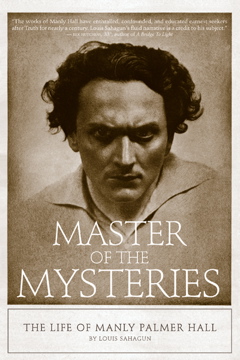
Last night I went to a lecture and book signing by Louis Sahagun, author of a biography of Manly Palmer Hall called Master of the Mysteries. Sahagun is a journalist at the Los Angeles Times and was working night duty on September 2, 1990 when the call came in that Hall had died at 89 years of age. Knowing nothing about the man, Sahagun looked him up in the files, finding little until he got back to the 1930s and 40s when he stumbled onto stacks of clippings. He wrote a brief obituary that didn’t begin to touch on the accomplishments of this internationally known metaphysician and occult scholar who eventually was a victim of extreme elder-abuse and probable murder.
Sahagun became fascinated by Hall’s story, was given access to several archives, interviewed dozens of people who had known Hall, and examined the police and medical reports on what is still an open suspicious-death investigation.
Hall is of interest to those of us in the Tarot world for his creation of what’s known as the Knapp-Hall Tarot deck, first published in 1929 by artist J. Augustus Knapp, illustrator of two of Hall’s first books, including the famous The Secret Teachings of All Ages (the latest edition is in its 16th printing).
I’ll leave you to read the fascinating details of the book from this article in the L.A. Times or listen to this podcast interview with Sahagun.
I want to talk here about the conversation I had with Louis Sahagun about the cult status of spiritual teachers. During his research Sahagun discovered an amazing but flawed human being—someone who married disastrously, fell behind the times and finally succumbed to the machinations of a conman. Despite this, Sahagun felt that he had found a man of immense talents and great personal integrity who warned against putting teachers on a pedestal. It is apparent that Hall’s scholarship left something to be desired (he had only a 6th grade education but a photographic memory), but it’s hard for many to accept that Hall could have been less than perfect. Sahagun was struck by the number of followers who seemed to do nothing with their lives but slavishly espouse the teachings. On the other hand, hundreds of people—mostly in the arts—creatively integrated Hall’s metaphysical principles into their work—making it their own. These included such diverse people as an L.A. mayor, a governor of California, Elvis Presley and Bela Lugosi.
Personally, I’ve been struck by the number of people who discover lies, misconduct or incorrect facts in the lives and work of their heroes and respond by either completely rejecting the teacher and work or by rejecting any evidence of a problem. Typical is a comment about the book from someone who regularly attended Hall’s lectures: “I wasn’t aware of any controversy surrounding Mr. Hall’s death either…. It was natural causes—and I suppose natural causes for an author to claim controversy.” This person has no desire to examine the evidence before claiming that the biographer must be lying.
When writing my biography of four original members of the Hermetic Order of the Golden Dawn, Women of the Golden Dawn: Rebels and Priestesses, I believed it vitally important to examine their flaws as well as their strengths. How are we to learn from someone’s story if we don’t see how that person navigated the difficulties of life? How can we evaluate a work if we aren’t willing to explore what’s true and what isn’t and what ‘works’ and what doesn’t? It’s important to realize that everyone is human. Just before I completed the biography, an acquaintance sent my text involving a different spiritual teacher, now deceased, to that person’s organization. I received a phone call asking me to remove quotes from letters that included accusations of an affair with someone he later married. It was felt this might harm the public perception of him as a great and good man. I ask, how are we ever to develop discrimination if we believe that spiritual teachers are somehow more perfect than the rest of us or that everything they write is Divine Truth?
The way I see it, there are three unacknowledged magical “initiations.” The first is when we come across a teaching or practice and have to determine if it contains a truth or way to which we want to commit ourselves. The second initiation is when we discover we’ve been betrayed by ‘lies’ and we have to decide to leave or continue the work. The third initiation is when we discover that the lie itself contains a greater truth. The second initiation is betrayal and until we have confronted betrayal and moved through it we will never encounter the third initiation. We experience these three initiations all the time, although a fourth is proposed that takes us beyond the world of truth and lies.
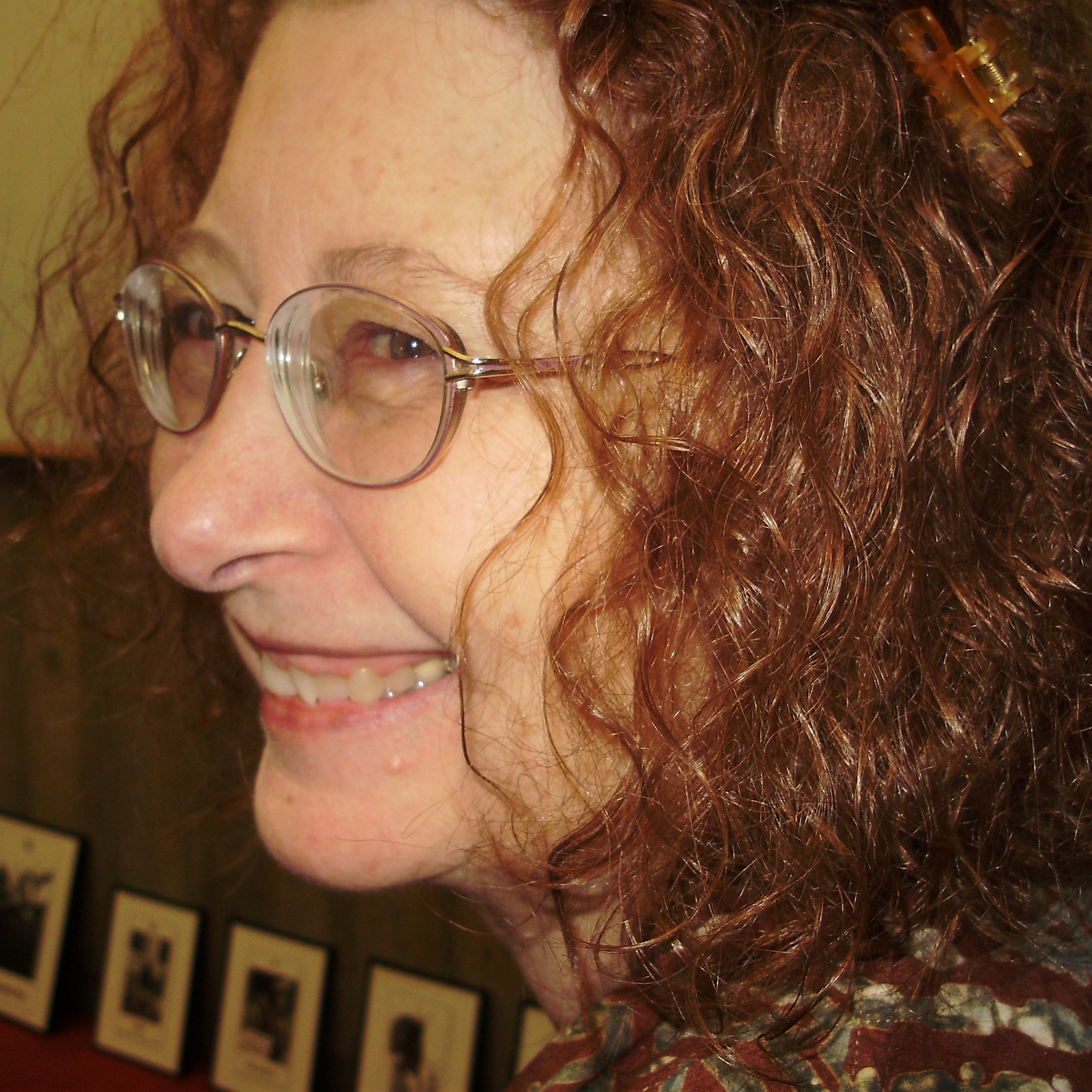 Mary K. Greer has made tarot her life work. Check here for reports of goings-on in the world of tarot and cartomancy, articles on the history and practice of tarot, and materials on other cartomancy decks. Sorry, I no longer write reviews. Contact me
 Mary K. Greer's Tarot Blog
Recent Comments