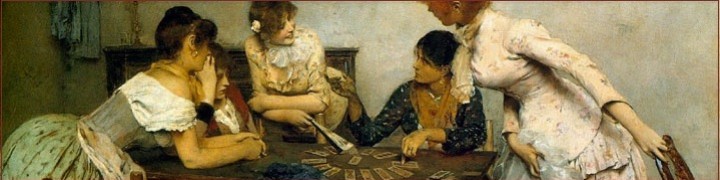
You are currently browsing the category archive for the ‘Lenormand’ category.

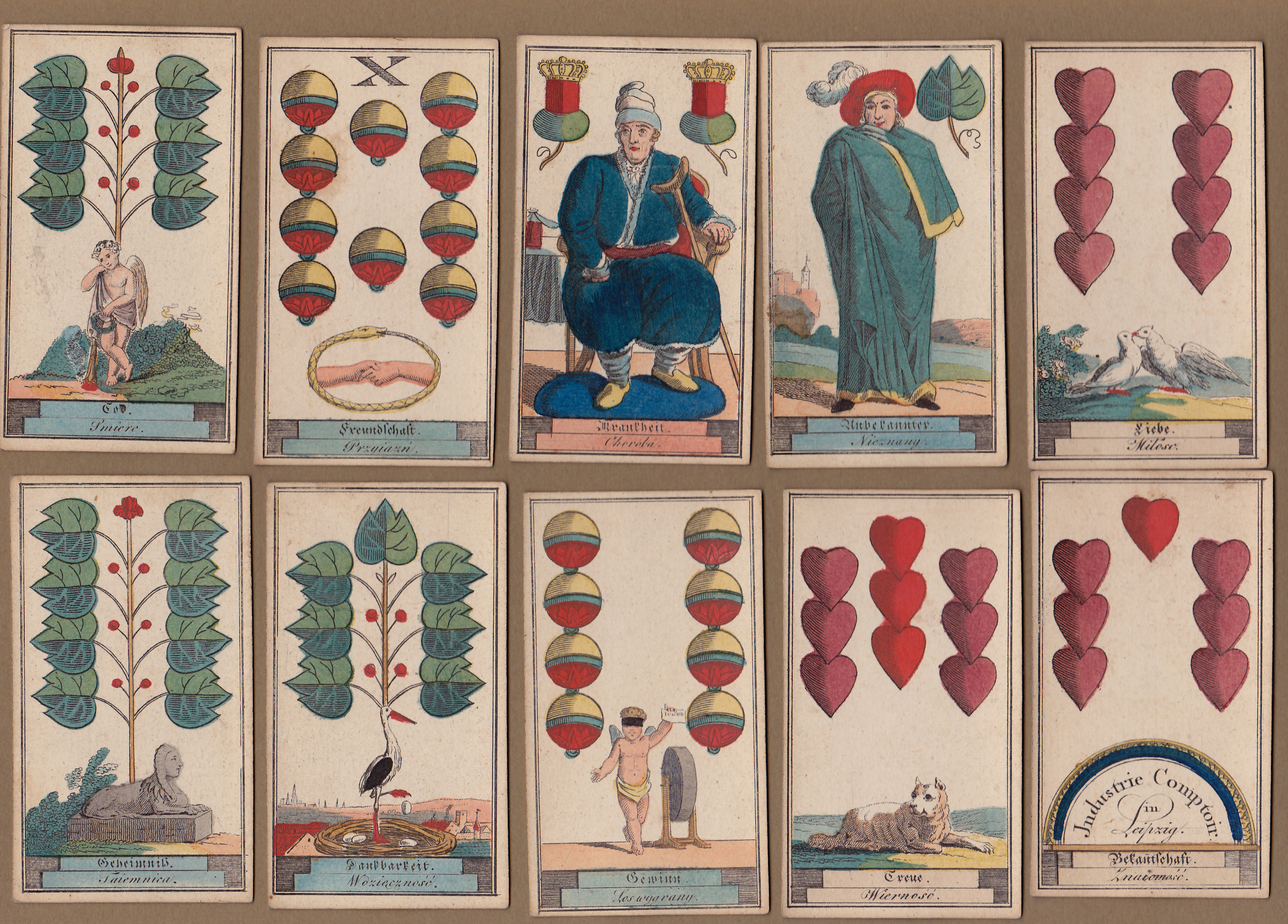
19th century Lenormand based on a deck from 1854.
The 36-card Petit Lenormand cards have taken the divinatory world by storm.

Dog-Liliac Dream Russian Lenormand
Two years ago only two classically-based Lenormand decks were available in the U.S. Since then there’s been a deluge of over 50 new decks (most with creative designs and self-published). Interest is supported by dozens of Facebook and forum study groups and websites in English, plus many more in other languages. Until this year, only two English-language books were available (compared to sixty or more in German, Dutch, French, Russian and Portuguese). By early next year there’ll be at least five or six new English-language books.
Two things are essential to a Lenormand reading: 1) a set of cards containing the Lenormand numbers, names and/or pictures, and 2) learning the traditional Lenormand system. Certainly, a person can use Lenormand cards as oracles: making up their own meanings, projecting stories onto them, and reading the images as symbols, but that is not what is meant by a Lenormand reading. One can use any object or image for an oracle reading; Lenormand includes specific meanings and methods.
14 Reasons Why the Lenormand Deck and Traditional System Are So Special:
.
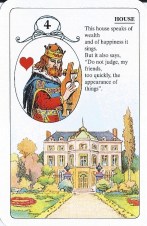
House-Carta Mundi Lenormand
- The images or ’emblems’ on each card are simple, everyday, iconic items: Dog, Fish, House, Path, Clover.
- The deck was first published in 1846 for fortune-telling and came with card meanings and reading instructions that were directly based on 18th century ’emblem cards’ and coffee-ground meanings. For over 220 years decks have been published with nearly identical images, instructions and meanings.
- Since the late 20th century original meanings have been expanded and adapted to reflect modern life. Even though variations exist, they are minor, such that a traditional reader can understand the interpretation of someone else, even from another country.
- Lenormand readings are extremely precise, mundane, concrete, blunt and accurate.
- The pictures are not read symbolically! The narrow range of meanings, which are functional rather than symbolic, ensure there is little ambiguity about their significance.
- Intuition plays a major role in reading the cards, enhanced by knowledge and experience.
- While a few cards are similar to Tarot (Moon, Stars, Tower, etc.), they have very different meanings.

Fish-Kendra’s Vintage Petit Lenormand
- All the cards are used in a standard layout, the Grand Tableau (“Big Picture”). Modern layouts provide shorter snapshots or portraits of a particular issue.
- In a reading, significance arises from card combinations: House+Book can be a school or library (a house of knowledge or secrets). Cards are not read individually but in pairs or larger groups.
- Lenormand cards work well for answering yes-or-no questions, describing past and present life situations, making short-term predictions, finding lost objects, and describing people and their condition. They can also address timing.
- The cards are easily adapted to modern situations as long as the integrity of the whole is not broken. For instance, Stars (like the nodes in a web) is the internet and, along with Garden (the public), they represent social networking.
- One has to learn the basic meanings and to practice combining cards and other interpretive techniques in order to develop one’s skill with Lenormand.
- There are many layers involved in learning the cards, such that one can learn enough to get started after only a workshop or presentation, yet it will take several years to gain proficiency and handle all the layers of significance.
- You can combine Lenormand with Tarot and other modalities, calling on each for its area of strength. For instance, Lenormand is great for describing the plot of a story or movie, whereas Tarot is generally better at describing theme, character conflict and motivations. See examples HERE (Virginia Woolf) and HERE (Beasts of the Southern Wild).
Bonus: Lenormand is fun!
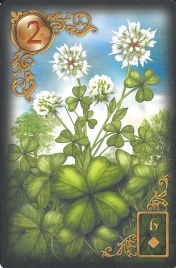
Clover-Ciro Marchetti’s Gilded Reverie Lenormand
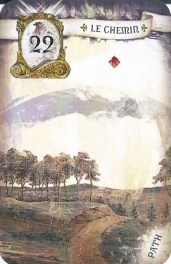
Paths-Foster+Paris’ Lenormand Revolution
I found a long and ultimately very disturbing account of Mlle Lenormand, written only a month after her death in the summer of 1843, by one Georgina Colmache (identification of G.C. is thanks to Judith Rideout). G.C. seems bent on portraying the great fortune-teller in the worst possible light for purposes of entertainment and as a warning against the perils of prophecy. It begins well enough.
It is said that out of the myriad thousands of esprits forts in Paris, but few could be named who have not at one epoch or another of their lives sought aid and counsel of Mademoiselle Lenormand.

Though quite a girl at the time of the first revolution, yet had she already acquired such celebrity in the art of divination, that many of the poor trembling marquises of the ancient regime flew to consult her upon their place of refuge, ere they dared take wing like frightened birds at the approach of night. . . . She used to say that Robespierre himself had trembled, when upon seeking her in disguise, unknown as he imagined, she had revealed to him her knowledge of his state and station. She would even laugh with malicious glee when telling how very pale his hideous countenance had turned, when at each shuffle which he gave the cards, the “Grand Pendu” [Hanged Man] would turn up, telling an awful tale of blood and violence.”
The author, a long-time resident of Paris, identified only by the initials “G.C.,” despite the disturbing stories she had witnessed (and recounted earlier in the article) of the great fallen low and the low rising just as predicted by Mlle Lenormand, sought her counsel one damp February day. But let’s let her tell the story.
It is now four years ago since I myself was led into the same folly, which I had ever been accustomed to condemn so much in others, and being in a sad dilemma. . . . I resolved to waive all responsibility, vis a vis de moi-meme, and go and consult Mademoiselle Lenormand. …
After waiting for nearly two hours while a storm raged outside and listening to a young woman and her elderly companion in the inner sanctum as they cried out against what must have been a fearful fate, our author entered the room of the celebre devineresse for her consultation:
She was, with astute knowledge of the part she had to play, seated in deep shadow, while the full light of the lamp was turned in the opposite direction, where stood the chair ready to receive the pale, eager consultant. This circumstance, and the sombre hue of her attire, certainly did contribute to throw a degree of mystery over her whole person, and it was some time before my eye, getting accustomed to the dim atmosphere, could succeed in tracing her outline with distinctness.
I was surprised to find in the powerful and dreaded adept, a person of short stature, and of immense bulk, doubtless the consequence of her sedentary life; and yet in spite of this, at the very first glance, it was easy to perceive that she was not a person of ordinary or vulgar aspect. Her face was round and flat, yet full of meaning, and there was a cunning restlessness in her bright blue eye, which seeming never to fix on any point, yet lost no one peculiarity of the ” consultant,” turning the blush of timidity, the stern gaze of defiance, or the smile of incredulity, equally to her own profit ere the divination began, and who, knowing well how very far events are ruled by temper and disposition, drew her own inferences therefrom, and foretold such wondrous possibilities, that timidity would listen all aghast, and incredulity disbelieve no longer.
On the table at which she sat were spread in awful mystery the Grand Jeu! Several worn and tattered volumes, looking dim and cabalistic enough, were scattered here and there, and from a red morocco case beamed and smiled, in matchless beauty, the miniature portrait of the Empress Josephine, the gift of the imperial lady herself. A chased gold cup given by the same royal hand stood near, destined to receive the gold pieces left there by her visitors, as the price of the fortune which she had awarded them. …
One end of the table was completely covered by piles of silver crowns displayed in long rows—rather ostentatiously methought. A large black cat was seated on the elbow of the chair, with blinking eyes and purring murmur, but to do the lady justice this was (saving the cards), the only token of witchcraft I could see around. …
She had already shuffled the cards and placed them before me, and begged me in a quick sharp tone to cut them with the left hand. She then again shuffled them, and while they passed rapidly through her fingers —for long habit had given her an agility I had never seen rivalled by the most keen card-playing old dowagers—she asked me the usual questions.
“What was my age—what animal I loved best, and what was my favourite flower?”
I observed that while she spoke her eyes were cast down, but while wailing for my answer she glanced at me with sidelong inquiry.
In nine cases out of ten the questions came upon the “consultant” unawares, and it was evident that this was the moment of hesitation upon which she reckoned for examining unobserved the expression and physiognomy of the credulous listener.
Her skill from long experience was such that it is verily believed she seldom or never erred in her judgment of the “consultant’s” station, character, or reasons for coming to consult her, and she was thus enabled to lay bare the past, the present, and the future, with such wonderful precision, that the thunderstruck victim would listen in open-mouthed astonishment. …
I shall never forget the impression conveyed by that deep voice as she spoke in low whispering words, rapid and monotonous, the decrees of Fate which stood revealed in the painted pictures she fingered with such marvellous dexterity.
It was a curious study to behold this woman play in mere sportive malice with the heart’s most tender sympathies, and I could imagine the thrilling effect which that whispered torrent of words might have upon the trembling maiden seeking her, perhaps by stealth, to confide all her misery to that willing ear, or ask counsel of the Powers of Darkness, when heaven and earth seemed to have abandoned her. And then the trembling suspense too with which the pale listener would await the sentence !—to her the decree of life or death— and yet murmured forth by those cold wrinkled lips, without change of tone or manner, without hurry or delay, merely as the sentence pronounced by the cards, and with which she herself, save as the interpreter, had nought to do. Of small import to her was it whether the decree brought weal or woe, bright dreams of happiness or grim visions of despair. …
The conference lasted for about an hour, during which time she ceased not speaking—her eyes half-closed, and bent upon the cards she held before her. I had the curiosity to lean across the table and gaze upon the set which she had lain down upon my entrance. They were sinister and hideous, well calculated to strike terror into the heart of the over-curious “consultant.” There lay in foul array the grim figure of the “Grand Pendu,” the blood-stained visage of the ” Supplice,” and the pale, livid face of the ” Suicide.” The cards were of about twice the dimensions of the ordinary pack—the cross-bones and skull formed the aces, and the hearts and diamonds were simulated by drops of blood! . . . The cards were ragged and worn by frequent use, until some of the figures were well-nigh obliterated.
She told me with much mildness, and with a degree of conviction which, if not real, was certainly admirably counterfeited, that this was the pack from which was drawn the measure of men’s lives, but added, it was a fearful search—that she never pressed it, but the “consultants” were ever eager to solve that one dread problem, either for themselves or for others near and dear. She said she advised me not to try, for they had already been shaken but a short time since; and told me that the extra charge was fifty francs. . . .
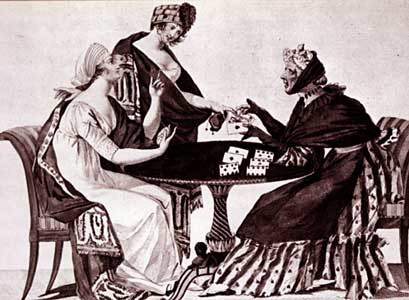
Choosing not to discover his ultimate fate, our author takes his leave.
It is at this point that the account assumes the character of a classic 19th century horror story, for G.C. finds on the street an elaborate gold snuff box left by the young woman and old lady whom she had heard sobbing as Mlle Lenormand told their fate. The box contains a portrait of a handsome young man. Georgina Colmache endeavors to discover the names of these women and learns they are impoverished nobel women, the Marquise de Keradec and her grandchild, Solange. She seeks them out to return the snuff box. She finally finds them in a mean hovel, dead via some powder that they had burned on the coals, and, next to them, the following note written by the elder woman:
“It is the eleventh hour of the night!—he comes not—neither will he come. She who knows all things, foretold that if he came not now, we should behold him no more. He is gone before us doubtless, and it was her kindly manner of giving us this warning. Oh, what a fool was I to hope even for that single instant!
“He who first enters here, must search the chamber with great care; he will find a golden box, which, by some evil chance, I have mislaid since yesterday. Let him who finds it, remember that I have wanted food and raiment, and yet have kept that bauble through all the penury which has been mine, because it was all that remained to me of my gallant boy, whose brave spirit gushed forth in the cause of life and liberty amid the green valleys of our loved Bocage.
“It would have soothed my death now to have had his image on my bosom; but even this poor consolation is denied me. I myself have sought it until I have grown weary. My brain is troubled, and my sight is failing. Ha! the clock of the Carmelite tolling the half hour !—that single stroke!—it is like the summons to eternity !—it is well that I am ready—there—let me kneel and pray—ay, it is well to pray—for”
The pen had dropped from her hand, for there was a large blot upon the paper which hid the meaning of the concluding words. She had died while yet her prayer was on her lips. Let us hope that it was heard at the bar of heaven and not refused.
Our author gives her report to the authorities and, just as she is leaving, happens upon a clerk who recognizes the name, saying that a young man had just recently tried to find these women. Georgina Colmache finds the man and learns that he is the brother of the young woman. He had gone to Argentina to try to revive the family fortunes. Because some letters had miscarried and the women had moved, he had been unable to find his sister and grandmother. In fact, he had tried and, on account of the storm, had failed to get their address from the clerk at the exact hour that Mlle Lenormand had told the women: “The principles of good and evil are struggling at this very hour. If you see him not to-night you will behold him no more.” This presentiment has proved true because, in despair, they killed themselves that very night.
I am told that with the restlessness of woe, armed with my information concerning Mademoiselle Lenormand, he went, before his departure, to seek her, full of reproach and bitter accusation, declaring that it was doubtless her hard prophecy which had driven the weak and credulous mind of the marquise to despair.
The “devineresse” listened with composure and in silence, as if overcome by the justness of his reproaches. She then turned thoughtfully to the large volume wherein she inscribed at times her “Oracles,” and after remaining for a few moments buried in deep calculation therein, she raised her eyes flashing with delight, and exclaimed joyfully,
“The combination then was just. It was my first trial; and since that day I have not dared to use it, for it was a fearful risk. Why came you not before? Could I have known that it would have proved so correct as this, I might have made discoveries yet more important. Leave me now, I pray you, while the inspiration is yet upon me, that I may recall, if possible, the means by which I had arrived at such important ends. Blame not me, young man, I but read the book of fate as it was unfolded to my sight, nor sought to deceive with false words or to betray ; and,” she paused a moment, and added with a self-satisfied smile, “See you, I have met with my reward, for the combination cannot be denied!”
The author, Georgina Colmache, concludes her account:
For myself I never again sought the sorceress, nor dabbled in her magic lore. The lesson had been too strong a one to pass unheeded by. I even resisted the invitation conveyed to me through a friend to visit her once more, for I thought of the Marquise de Keradec, and of the sweet Solange, and remembered that they both might yet have lived honoured and happy, had they but left to Providence the disposition of their fate, nor sought with rash and guilty mistrust of His divine mercy to forestal His all-wise decree.
Given the tone of the piece and the magazine in which the account appears, I can only hope that this story contains as much fiction as it does fact.
From The New Monthly Magazine and Humorist. 1843 (Part the Third). (London: Henry Colburn, Great Malborough St.).
A search for Georgina Comache turned up these interesting facts:
The Case of Georgina Colmache and Pauline Vaneri Filippi
“What was it like for a woman to be artistically productive in the 19th century? This talk follows the lives of mother-daughter pair Mme Colmache (1809-1904) and Mme Vaneri Filippi, both of whom enjoyed successful careers when professional opportunities for women were scarce and revolutions ravaged Europe. With close links to French statesman Prince de Talleyrand-Périgord and English novelist William Thackeray, Paris-based Georgina Colmache was a prolific journalist and writer. Her daughter, soprano Pauline Vaneri Filippi, studied with Gilbert Duprez in Paris and sang at prestigious venues throughout Europe, before being appointed professor – the first woman ever – at the Milan Conservatoire.” a talk by Per Ahlander.

I have spent the past two years obsessed with the Petit Lenormand cards, a deck of 36 fortune-telling cards created in Germany in 1846, based on an earlier multi-purpose game called the “Die Spiel der Hoffnung” created by Johann Kaspar Hechtel in Nuremburg in 1799. The Petit Lenormand appropriated the name of the Parisian Mlle Lenormand, the most famous fortune-teller of her age, who died in 1843, shortly before the newly incarnated deck appeared. I’ll write more about these cards later.
I am announcing here for the first time that I have found an earlier set of 32 fortune-telling cards that are the undoubtable forerunner of both the “Spiel der Hoffnüng” game and the Lenormand cards. My source is a 1796 book in English in the British Museum entitled: “Les Amusements des Allemands, or The Diversions of the Court of Vienna, in which the Mystery of Fortune-Telling from the Grounds of the Coffee-Cup is unravelled, and Three pleasant Games, viz.: 1. Fortune-telling from the Grounds of the Coffee-Cup. 2. Fortune-telling by laying out the cards. 3. The new Imperial Game of numbers are invented.
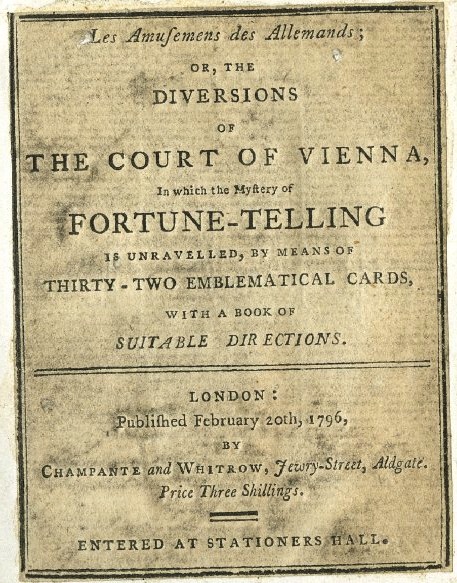
The work is based on an Austro-German set of cards from 1794. An introduction to the book states:
“These entertaining games first made their appearance at Vienna, in 1794, where they still are the favorite amusement of the Empress of Germany, and the Imperial Court. They have since been diffused through all the fashionable circles in that country. The Editor, therefore, has to hope that, in a country where the liberality and curious discernment of its inhabitants is so conspicuous as that of Britain, they will not be held in less estimation.”
While there are only 32 cards, most of them are exact forerunners to Lenormand cards. The few variations, like Lion, have close replacements as their Coffee-ground meanings indicate. For instance, “Lion, or a ferocious beast” has the same meaning as the Lenormand Bear.
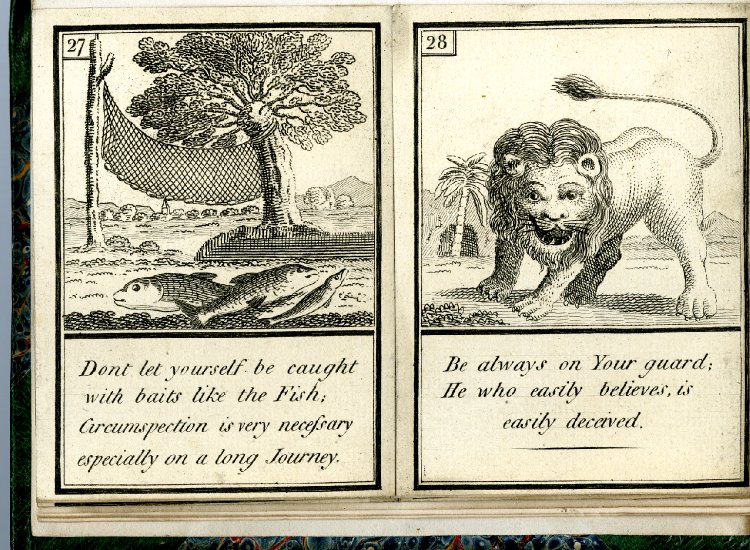
It’s been thought for several years that the Lenormand images were derived from Coffee-ground fortune-telling or Tasseomancy. This work is the missing link that proves this theory. It has been curious that several of the Lenormand images were not found in the old lists of coffee-ground emblems, but now we know that several cards were added to the original set. The reason for the expansion of the deck to 36 cards probably came about when Hechtel decided to combine “Les Amusements des Allemands” with the German 36-piece playing card deck, which was then more popular than either the 32-card Piquet deck or the 52-card deck.
The Empress, for whom these were a ‘favorite amusement’, was probably Maria Theresa of Naples and Sicily (1772–1807), the last Holy Roman Empress, first Empress of Austria and mother of nine. She was described as:
so jealous that she does not allow him [the Emperor] to take part in social life or meet other women. Vicious tongues accuse her of being so passionate that she exhausts her consort and never leaves him alone even for a moment. Although the people of Vienna cannot deny that she is gifted, charitable and carries herself beautifully, she is disliked for her intolerance and for forcing the Emperor to live isolated from everyone. She is also accused of interesting herself in unimportant matters and socializing exclusively with her lady-companions. With them she spends her evenings singing, acting out comedies and being applauded.
Could the “unimportant matters” mentioned above include her use of fortune-telling cards?
Here is the full British Museum description of the book:
A sequence of 32 playing-cards bound (at the British Museum) as a small book, having on them emblematic designs of various character, and below moral apophthegms to which the designs have reference. Each piece has a number at the upper left-hand corner answering to certain explanatory and descriptive tables given in a book of directions which accompanies the cards. The title page of this book of 31 pages bears the following lettered inscription: “Les Amusements des Allemands, or The Diversions of the Court of Vienna, in which the Mystery of Fortune-Telling from the Grounds of the Coffee-Cup is unravelled, and Three pleasant Games, viz.: 1. Fortune-telling from the Grounds of the Coffee-Cup. 2. Fortune-telling by laying out the cards. 3. The new Imperial Game of numbers are invented”, and “London: Printed for Champante and Whitrow, Jewry-Street, Aldgate, and may be had at every Booksellers and Toy Shop in the Kingdom, 1796.” Engraving and letterpress Backs plain (according to Willshire) 1796.
Bent Sorensen has offered this list of the 32 Emblematic Fortune-Telling Cards, ordered according to the numbers found on the cards:
1. Crossroads/Fingerpost
2. Ring
3. Clover
4. Anchor
5. Snake
6. Letter
7. Coffin
8. Star
9. Dog
10. Lily
11. Cross
12. Clouds
13. Sun
14. Moon
15. Mountain
16. Tree 1 – Labor, Pains, Long Effort
17. Child
18. Woman
19. Man
20. Rider
21. Mouse
22. Birchrod/Whip
23. Flower (Bouquet)
24. Heart
25. Garden
26. Bird/Turtledove
27. Fish
28. Lion (“any ferocious beast” for which Bear was later substituted)
29. Tree 2 – Green Bush (the Industrious, not in Lenormand—closest is Key?)
30. Worms or Vipers (“Bugs,” not in Lenormand—closest is Fox?)
31. House
32. Scythe
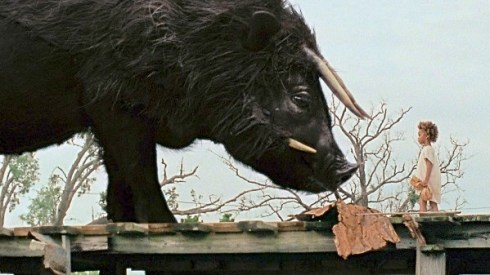
Have you ever noticed that after seeing some films you are snappish or silent, yearning or ponderous, giggly or jumpy, and that the affects can last for minutes, hours or even days, abducting us from our normal means of perception?
I was reading one of my all-time favorite books Becoming Animal: An Earthly Cosmology by David Abram and came to the part where he describes his own growing awareness that certain movies and books would “surreptitiously enter into my bloodstream, like a contagion . . . a curious spell that my organism was under.” He further characterizes these effects as a “capacity for being drawn, physiologically, into the terrain of certain stories—abducted into another landscape that would only belatedly release me back into the palpable present.” His description is reminiscent of being stolen away into the land of fairy.
I recently experienced such a state after going to see “Beasts of the Southern Wild”: my friends noticed that I couldn’t speak after the movie and that I refused their ride so I could walk home alone. I realized that Abram’s insights provided a second part to my established practice of active reading and movie-viewing, in which I draw cards before partaking of the work so as to sharpen my perception and enrich my understanding and appreciation of the work. Based on Abram’s commentary I’ve designed a spread that assists us in seeing how a work ensorcells us, temporarily coloring our perceptions and feelings and even influencing our actions.
Place the first six cards in a clockwise circle, beginning at the top, with the seventh card in the center.
1. What feeling tone colors my general outlook after seeing the film (or reading the book)?
2. How does this influence my immediate approach or response to things?
3. What fears does it stir?
4. What longings awaken?
5. What shifts do I perceive in my immediate surroundings? How do I see things differently?
6. What do I need from those around me? And, once I’ve answered that: How can I give this to myself?
7. What is the major lesson that this work offers me?

I went to see this movie because some friends had invited me, based on the recommendation of another friend. Before going I knew nothing about it and couldn’t even remember the title. So, I thought I’d try out the Petit Lenormand cards as a prediction of plot. I got Lilies-Clouds-Snake-Scythe-Whip, all of them Court Cards. Turns out it was pretty darn accurate for “Beasts of the Southern Wild.” It’s a coming-of-age mythic fable about a little girl, Hushpuppy, and her father who live on a fragile island, the Bathtub, south of the Louisiana dikes in the Gulf. It also features other people who exist in these unbelievably harsh conditions (all the Court Cards). There’s the dying father, a huge storm, a wise female teacher (as well as a dream-like encounter with a mother-figure), the poisoning of the creatures on the island, breaking through the dike, lots of arguments, and the inhabitants battle with the authorities. It’s an emotionally wrenching film with incredible acting – especially by the young girl and her father.
I drew five cards:
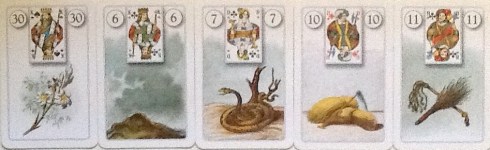
- Lilies -Family (also innocence and Father)
- Clouds – the Storm
- Snake – Poison/Wise Woman (at the center)
- Scythe – Decision to stay on the island; Death and Destruction
- Whip – Arguments, violent activity
An even better way to read Lenormand is in pairs:
- Lilies+Clouds – disfunctional family or problems with the father.
- Clouds+Snake – bad mojo, lack of clarity regarding a woman.
- Snake+Scythe – cut off from a woman; a treacherous decision; a poisonous death.
- Scythe+Whip – violent cutting, a decisive battle.
I was prepared for what could be a very dark, tragic film. It almost was, but something else broke through. My strongest thought during the intermission (they have to change the reels at our local art theatre) was, I couldn’t live like that! Several people left.
I later did a reading with the Mary-El Tarot to help me explore my conscious and unconscious reactions, responding directly to her images. I’ll only mention a few brief highlights of what I saw.
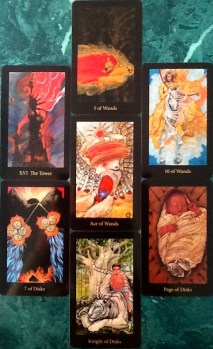 1. What colors my general outlook? 5 of Wands. First thought on looking at the growling red lion: “red-in-tooth-and-claw”. I had a very visceral reaction that touched on my most primitive fight-flight-freeze physiology.
2. How does this influence my immediate approach or response to things? 10 of Wands. This shows a warrior with bow and arrows on a horse. Flight. But I also wanted to be a defender of the movie to those who were repelled by it.
3. What fears does it stir? Page of Disks. This image of a sleeping baby with marks like nails surrounding it arouses my protectiveness. I fear that something primally innocent – the exquisite nature of the sentiment in the film – might be harmed. I also fear that I might slumber when I should awaken.
4. What longings awaken? Knight of Disks. The next stage of maturity: Knight as protector of the Page/Baby of Disks. This immediately reminded me of the scene shown in the lead photo above. I long to stand up for and to what might otherwise overwhelm us.
5. What shifts do I perceive in my immediate surroundings? How do I see things differently? 7 of Disks. I see a split, like two separate meteors. I am aware of the lack of words when I feel drawn out of myself.
6. What do I need from those around me? How can I give this to myself? The Tower. Strong words and opinions. Instead, both I and my friends retreated into silence. I can give myself the words, the surpressed fury, the burning to act on this film in some way.
7. What is the major lesson that this work offers me? Ace of Wands. That some creative spark can be birthed out of this fiery angelic torment. The reading is all Fire and Earth.
Words still fail me. Please let me know what you thought of the film and/or your experience in reading cards for enhancing your experience of films and books.
Much is made of how tarot cards can be interpreted through their images or symbols—especially modern decks that feature pictorial scenes with lots of images on all the cards. This post is about how to combine and translate the language of imagery into statements, such that these statements can be more easily interpreted than the images by themselves.
Many of us have spent fruitful hours pouring over symbol dictionaries in order to better understand each detail in the tarot. For instance, we might research and discover that a key, in addition to simply opening or locking a contained space, is seen as the means to unlock hidden meanings in symbols or doctrine. More specifically, in the Hierophant/Pope card,  keys have a special meaning regarding the priesthood: the gold key represents mercy and absolution, and the silver key stands for judgment and penance. Furthermore, these keys refer back to the gospel of Matthew (16:19) in which Jesus tells Peter, “I will give you the keys to the kingdom of heaven. Whatever you bind on earth shall be bound in heaven; and whatever you loose on earth shall be loosed in heaven.” Going further, you will discover that Mercy and Judgment (the gold and silver keys) are the two columns on the Kabbalistic Tree of Life.
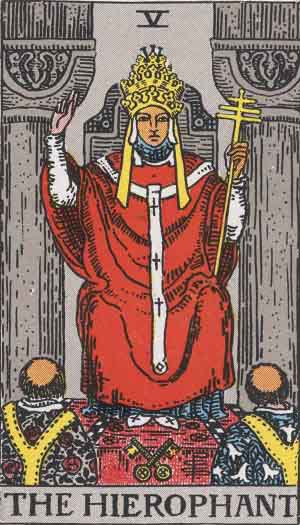 How many times have you mentioned any of the above references in an actual tarot reading?
Alternatively, a reader might try to discover the querent’s own, in-the-moment, personal associations with this image: “Oh, my gosh. Those are my car keys that I lost yesterday at church!” Or a reader will offer up his or her own projections and intuitions, as in, “As I’m seeing it right now, the keys are saying that your spiritual leader or tradition “holds the keys” to whether you should get a divorce.” These can certainly be rich ways to read the tarot, but they can sometimes get you sidetracked from the essential message of the card. Even the artist’s stated intention for a symbol can be so personal and idiosyncratic that it, too, misses the mark. I’m not saying that the following technique is the “best” method for interpreting images, but rather that it can be helpful and serve as a checkpoint to make sure you’ve touched on its roots.
What I offer here is a method that involves translations of the essential, objective meaning of an image—its denotative and connotative definitions and its core characteristics or functions (how the thing is used).
At the denotative level, a key is a small piece of metal shaped with parts that fit with parts in another mechanism (usually a lock) so that manipulation (turning) changes the latter mechanism’s function—usually to open or close things. The connotative meaning is that it binds or loosens, and a key often suggests gaining access to something. If we abstract it one more level, then it suggests obtaining the answer, solution or means to something crucial or important. Connotative meanings are more subjective and often convey pleasing or displeasing feelings about the word. [Note: I use ‘objective’ and ‘subjective’ here, not as absolutes, but as relative points along a continuum.]
Step 1
To try out this technique, you need to start with the most “objective” meanings and functions—what I often call the “literal” level of a symbol—rather than personal projections or mythic, occult, alchemical, astrological or psychological significances. In other words, try to use as little abstraction, impressionism or subjectivity as possible.
To try another example, the denotative level of the RWS dog in the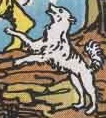 Fool card is “a domesticated, four-legged, carnivorous mammal with an acute sense of smell.” The functional aspect is that it is tamed by humans to function as a companion, protector or hunter. A further, connotative abstraction includes ideas such as loyalty, instincts or, sometimes, a scoundrel or wretch. (In this process, we won’t consider the mythic associations of dogs with death, like Cerberus at the gates of Hell, nor the Egyptian dog-headed Anubis, nor the association of dogs with the Moon and Artemis, nor the dog of Odysseus, or that in alchemy a dog represents sulfur or primitive, material gold. Nor will we consider that god is dog spelled backwards.) When in doubt, think of a dictionary rather than a book of religion, mythology or literature. In fact, a dictionary is often a good place to start when translating images.
Step 2
Step 2 involves linking together the most essential definitions, functions and connotations of three to five core images from one card into a “literal translation” of these images.
With the RWS Six of Cups as our example, let’s go through Steps 1 and 2. (We should also be aware that traditional meanings for this card often include gifts, pleasurable memories and emotions, nostalgia and old things.) 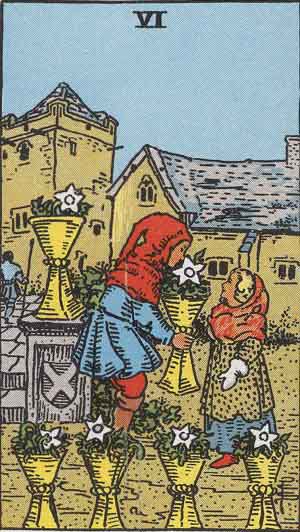 Here are three dominant images from the picture created by Pamela Colman Smith:
• Children – more than one pre-pubescent human being. Their key characteristics are small size, immaturity, innocence, vulnerability, playfulness, learning and development, and being a descendant or establishing a lineage.
• Flowers – the reproductive organs of a plant, usually with characteristics (scent, shape and color) that attract fertilizing mechanisms. Flowers are cultivated to function as decorations or gifts. Blooms suggest the flourishing peak of beauty, health and vigor.
• Glove/mitten – a garment covering the hand. It protects or safeguards the hand to avoid discomfort, damage, disease or contamination of self, others or environment. It may also serve as a fashion ornament.
First we combine these individual images into a simple statement: “A larger child hands a flower to a smaller child wearing a mitten.”
To translate this, we substitute a key word or phrase for each image:
“A larger, innocent offers a gift of beauty and reproductive vigor to a smaller, innocent whose vulnerability has some safeguards.”
Let’s add two more images to see if this changes anything:
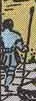 • Courtyard – a private space surrounded by walls or buildings. It functions as a place of air, light, privacy, security and tranquility.
• Guard – a person who keeps watch. He functions in a defensive manner to watch or protect what is vulnerable or to control access.
A very literal description might be: “In a private, guarded space, a child offers a gift of flowers to a another child.”
The next level of abstraction looks something like this:
“In a private, secure and guarded place, but with inattentive watchfulness, youthful innocence and vulnerability handle, with some safeguards, a gift of beauty and reproductive vigor.”
Step 3
Relate this translation back to the querent’s question or situation (via the spread position, if applicable). Now you interpret what the translated images in the cards add to the situation. Generating questions based on the translation is a good way to start.
Let’s add a keyword from the basic card meaning so that we have the following translation:
“A memory in which youthful innocence and vulnerability, in a private, secure and guarded place, but with inattentive protection, handle, with some safeguards, a gift of beauty and reproductive vigor.”
The following are example questions that emerged from the image translation:
Can you remember moments of former pleasure in which a mature, adult significance was not apparent at the time but may now be? Perhaps you were attracted to or given something that continues to reproduce emotional (Cups) reverberations in you? Have you been too guarded and naive to fully appreciate a gift given or received?
Alternatively, could a larger or more dominant self/person have offered something to a smaller self/person who covered up (gloved) her response as she wasn’t completely open to the experience?
Are some of your memories guarded? How do you protect yourself from what happened in the past? A worst case scenario suggests some kind of childhood abuse from which memory you’ve tried to protect yourself. There may be an element of seeing a difficult past through rose-colored glasses (and this card has had those difficult meanings on more than one occasion)—although, generally, it is a very good card.
In the Comments to this post you might want to try combining the image definitions into other translations, because even the most literal translations will vary. See where different translations take you. Feel free to explore this technique in your own way on your own blog or with others—just include a link back here.
Comparison with Cartomancy
It’s worth noting that readings with decks such as the Lenormand, Sybilla or Old Gypsy Fortune Telling Cards use a process similar to that above, in which each card represents a single image. The meanings of these cards have even more restricted parameters, but can be creatively combined. For instance, the card depicting a dog means loyalty and friendship. The child card can mean one or more children or anything small, young or innocent. A set of these cards are linked together in a fashion similar to what we’ve already done, although the result tends to be more mundane and may yield a single new image. For instance, Dog + Child can indicate a puppy, playmate, or childhood friend.
I’ve selected four cards from the Mlle. Lenormand deck (from Piatnik publishing) that are most similar to images in the Six of Cups just to see what happens if we use their meanings:

Child – Lily – Garden – Crossroads
•  Child: Child or children. Play. Anything small, immature. Naïve, innocent, trusting, sincere. Sometimes, gifts.
• Lily: Mature, old, the elderly. Commitment. Peace, satisfaction, contentment. Wisdom, soul development. Social welfare.
• Garden: Meetings, gatherings, parties, events, conferences. Social encounters and places for this. An audience. Outdoors.
• Crossroads: Options, choices, alternatives. Decisions. Separation. Many of something.
The most simple statement we could make about these cards is: “Many wise children (or immature elders) gather together.” (The order of the cards in an actual reading would affect the interpretation.)
To expand on this idea, we could say:
It is about a social interaction involving young and old, innocent and wise (to play old-fashioned games?), and that a choice may be involved. Peace or wisdom could be gained from childhood choices or from an older sibling. An older person could be reconnecting with past friends or relatives (or grandchildren) or, simply, remembering them.
[Notes: Traditional playing card meanings are usually not part of the standard interpretations for these cards (although it is interesting that three Court Cards appear. Regarding modern interpretations: Garden+Crossroads is a perfect description of social networking, ala facebook and twitter.]
Some Final Thoughts
I use the “Image Translation Technique” as a checkpoint to keep me on track and to compare with other card possibilities including projections and intuitions. Studies of intuition show that intuitions are just as likely to be wrong as right, but you can often get to a right understanding faster and more accurately than through any other known means. What works best is to check your intuitions against ‘rules of thumb,’ or what I call ‘checkpoints.’ The true issue is sometimes precisely what is shown by juxtapositions among traditional meanings, literal translations and the reader’s and querent’s projections and intuitions, revealing the tension or conflict causing the unease at the core of a reading.
I want to reiterate that translations of tarot card images are only one level of working with images (and some people prefer not to work with the pictorial images at all). But, even card keywords are images, and I believe that keeping in touch with the essential meaning of any image provides an important checkpoint for one’s intuition. I’d love to hear about how you work with these ideas and whether they are helpful to you or not.
Acknowledgements: Yoram Kaufmann’s book, The Way of the Image: The Orientational Approach to the Psyche, clarified and helped me to explain the technique I often use in readings. I’ve adopted a few, but not all, of his terms and methodology, and I’ve tried not to psychologize the above material too much (Kaufmann was writing about a Jungian approach to dreams). The concept of using “rules of thumb” with one’s intuition is discussed in Gerd Gigerenzer’s Gut Feelings: The Intelligence of the Unconscious. Sylvie Steinbach’s The Secrets of the the Lenormand Oracle was helpful in putting together the Lenormand interpretation. See my book 21 Ways to Read a Tarot Card for lots of other interpretation techniques.
This post gets updated as new information appears. See update notes at the end for significant changes. In addition to the links at the end, I encourage you to read Michael S. Howard’s article on the development of divination and cartomancy here.
The 15th Century
1414 Barcelona – Joch de nayps moreschs

Two Barcelona inventories have entries for “joch de nayps (or ‘nahyps’) moreschs”. The Instituto Municipal de Historia in Barcelona formerly held several sheets of uncut woodblock cards of the Moorish design from around this period. Their similarity to the late 15th or early 16th century Mamluk playing cards is obvious. What makes this important to our discussion is that the latter cards (see below) have calligraphic texts along the tops of the cards consist of rhyming aphorisms that are clearly predictions of one’s fortune. Here are a few of the translations given on Simon Wintle’s outstanding website The World of Playing Cards. Decide for yourself what you would think if you drew a card with such a saying upon it:
“As for the present that rejoices, thy heart will soon open up“
“With the sword of happiness I shall redeem a beloved who will afterwards take my life“
“O my heart, for thee the good news that rejoices”
“Rejoice in the happiness that returns, as a bird that sings its joy”
“The alif rejoices and fulfils your wishes”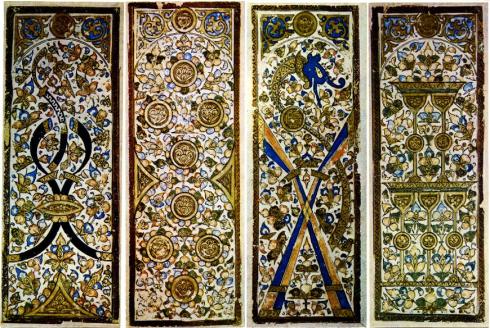
c. 1450 – Juego de Naypes
Ross Caldwell reports here on a Spanish “Juego de Naypes” (Game of Cards) by Fernando de la Torre, dedicated to the Countess of Castañeda, written around 1450. It is played with a 49 card deck, having only two court cards per suit plus an additional Emperador card “which wins over all the other cards” (que gane a todas las otras cartas). In this game “one can cast lots [tell fortunes] with them to know who each one loves most and who is most desired and by many other and diverse ways” (puédense echar suertes en ellos á quién más ama cada uno, e á quién quiere más et por otras muchas et diversas maneras). On each card is to be written a verse having the same number of lines as the number of the card, with each suit describing love according to different categories of women: Oros are Maidens, Copas are Wives, Bastones are Widows and Espadas are Nuns. Early Spanish/Morisca cards can be seen here.
This seems an unambiguous description of divination with playing cards that also includes a single additional “trump” card.
The 16th Century
1505 – “Lot” Books
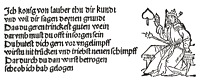
Playing cards were used for fortune telling in conjunction with the 1505 German Mainz Kartenlosbuch (literally, card-lot/fortune book). Fortunes in this work include such things as:
- You’re criticized because of too much avarice. You’ll lose a tooth and a thief will spend your money.
- You’ll have good luck, winning honors and riches.
- Secret sorrows, possibly connected to an old love.
Thanks to Huck Meyer at tarotforum for reminding me of this. See page from the text and more card meanings at Trionfi.com, which is, furthermore, one of the best sites on the history of tarot.
Lotbooks or (Losbücher) were described by Dr. Johann Hartlieb in 1456:
“One throws dice [or draws cards, mkg], until one reaches a number; in accordance with that number, one looks for the question [listed in the book], which the person has asked . . . there is nothing one will not find in these questions. Afterward one gets to an old man [often a king, god or hero] who points the way to a judge, who will explain the self-same questions [see illustration above]. This is all a singular disbelief and it stands in sharp opposition to God, for it has neither a spiritual or natural basis and is thus prohibited by the Holy Church in its decrees.”
Hartlieb is not entirely correct in that St. Augustine among other church officials spoke of the proper use of sortes (Latin for “lots”) to obtain answers. With the medieval sortes apostolorum or sortes des saints (composed specifically for divination rather than sortes sanctorum that is directly from scripture) one would consult them only after fasting on bread and water for three days and then a vigil with candles and the chanting of prayers (and sometimes a Mass) and the aspersion of holy water, upon which the sortes were deemed to be an “infallibly and entirely Christian oracle.” Of course, limiting the sources to apostles, saints, or scripture and the querents to those who could read Latin was an obvious attempt to limit divination to the educated few and forbid it to the multitudes.
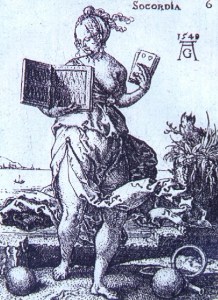 Socordia is Latin for laziness and idleness and so is shown with various games.

1507 – On the Foreknowledge of Things
In 1507 Francesco Pico della Mirandola (nephew of the better known Giovanni) wrote De rerum praenotione (“On the Foreknowledge of Things”) in which he supports the ability of divinely appointed prophets to know the future, while attacking all other forms of divination, including astrology, geomancy, palmistry and all kinds of sortilege/lots:
There are many kinds of lots [sortium], as in casting bones, in throwing dice, in the figures depicted in a pack of cards [in figuris chartaceo ludo pictis]; and in the expectation of whatever first should arrive, in picking the longer husk, or in casting the eyes on a page. [Thanks to Ross Caldwell–see link to his paper describing this at the end of this post.]
Being a work from Italy that specifically mentions the figures pictured on cards suggests that Pico may well have been referring to the tarot.
c. 1508 – “The Fortune-Teller” by Lucas van Leyden
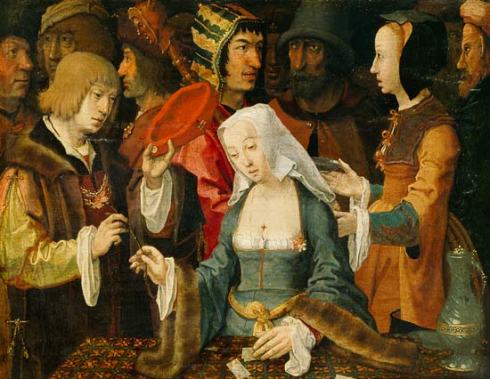
While this painting by Lucas van Leyden (1494-1533) has been called, in modern times, “The Fortune Teller” (c. 1508), it more likely commemorates Margarethe (Margaret) of Austria’s ascendancy to the governorship of the Netherlands in 1507 following the death of her brother, Philip the Handsome. Alternately, this painting may be commemorating Margarethe’s tragic three year marriage to Philibert (Phillip) of Savoy. By the age of 24 Margarethe had already lost a fiance and two husbands. She decided never to remarry and took the motto: FORTUNE . INFORTUNE . FORT.UNE (“Fortune, Unfortunate, Strength [in/of] One”}, which could be what is being symbolically portrayed. Both this painting and a 19th c. etching based on it has been cited as proof of early playing card divination (see “Chambers” below). Whatever is going on, it seems clear that the fall of the cards is an indicator of a fateful turn-of-fortune. Read my post here for more details. [Special thanks to Huck, Rosanne, and Alexandra—all who had pieces of the puzzle.]
1527 – Merlini’s Caos del Triperiuno
Teofilio Folengo’s 1527 work Caos del Triperiuno (written under the pseudonym Merlini Cocai) includes a series of poems representing the fortunes of people revealed by the cards dealt them. In this sonnet we find the twenty-two Triumph cards. Note that Death in Italian is the feminine la morte, and Love (Eros) is male. Love claims that although Death rules the physical body, Love never dies and therefore death is but a sham.
Love, under whose Empire many deeds (6, 4)
go without Time and without Fortune, (9, 10)
saw Death, ugly and dark, on a Chariot, (13, 7)
going among the people it took away from the World. (21)
She asked: “No Pope nor Papesse was ever won (5, 2)
by you. Do you call this Justice?” (8 )
He answered: “He who made the Sun and the Moon (19, 18 )
defended them from my Strength. (11)
“What a Fool I am,” said Love, “my Fire, (0, 16)
that can appear as an Angel or as a Devil (20, 15)
can be Tempered by some others who live under my Star. (14, 17)
You are the Empress[Ruler] of bodies. But you cannot kill hearts, (3)
you only Suspend them. You have a name of high Fame, (12)
but you are nothing but a Trickster.” (1)
Translated by Marco Ponzi (Dr. Arcanus) with help from Ross Caldwell and members of Aeclectic Tarot’s TarotForum.
 1540 – Marcolini’s Garden of Thoughts
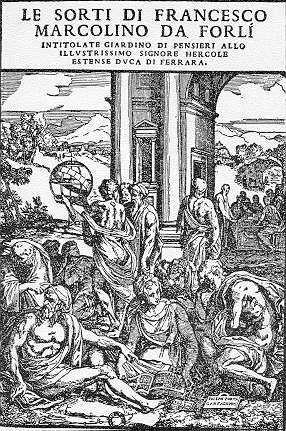
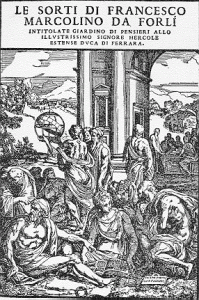
Another early use of playing cards as oracle comes from Le sorti intitolate giardino d’i pensieri (“The oracle called garden of thoughts) from 1540 Venice, published by typographer Francesco Marcolini with text by the Venetian poet Lodovico Dolce. Read all about it through the title’s link. The method of getting the oracle takes one through a convoluted series of steps to end up at a simple tercet of a type as follows:
Do not take an ugly and angry wife,
But even if you take one pleasant and nice,
I am afraid something strange will happen.
1556 – The Sin of Divining with Cards
In 1556, Martin de Azpilcueta (d. 1586) wrote in his Compendio del Manual de Confessores (an instruction book for confessors):
Lo quinto, pecca el que pregunta, o quiere preguntar al adeuino de algun hurto, o otra cosa secreta, o procura de la saber por suertes de dados, cartas, libros, harnero, o astrolabio, y el que encanto bruto animals, con palabras profanas, o sagradas, con obseruancia de alguna vanidad.
Fifth, he sins who asks, or wants to ask the diviner of some theft or other secret thing, or gain knowledge through the luck of dice, playing cards, books, sieve, or astrolabe, and he who enchants brute beasts, with words profane or sacred, with the observance of any vanity.
This book was later translated into Latin and published in France as: Martin de Azpilcueta, “Enchiridion sive Manuale Confessariorum et Poenitentium” (Paris, François Huby, 1620): c. XI, note 30 (p. 191). Thanks to Ross Caldwell for first finding this and to “Doctor Arcanus” for the Spanish original.
It should be noted that condemnation by the Church usually indicates that such deeds are rampant in the culture.
The 17th Century
1620 – Henry Cuffe and the Three Knaves
In 1620 John Melton recorded the following story in Astrologaster, or, The Figure Caster. It was repeated by William Rowland, in Judiciall astrologie, judicially condemned (London, 1652) and tells of Henry Cuffe, (1563-1601), secretary to the Earl of Essex, whose death was foretold by cards twenty years before it happened. Cuffe was executed in 1601, so the incident allegedly dates from 1581 when he would have been 18 years old:
“There was another Wizard (as it was reported to me by a learned and rare Scholler, as we were discoursing about Astrologie) that some twentie yeeres before his death told Cuffe our Countreyman, and a most excellent Graecian, that hee should come to an untimely end: at which, Cuffe laughed, and in a scoffing manner entreated the Astrologer to shew him in what manner he should come to his end: who condiscended to him, and calling for Cards, entreated Cuffe to draw out of the Packe three, which pleased him; who did so, and drew three Knaves: who (by the Wizards direction) layd them on the Table againe with their faces downewards, and then told him, if hee desired to see the summe of his bad fortunes reckoned up, to take up those Cards one after another, and looke on the inside of them, and he shluld be trouly resolved of his future fortunes. Cuffe did as he was prescribed, and first took up the first Card, and looking on it, he saw the true portraiture of himselfe Cape a Pe [head to foot], having men compassing him about with Bills and Halberds: then he tooke up the second Card, and there saw the Judge that sat upon him: at last, he tooke up the last Card, & saw Tyborne, the place of his Execution, & the Hangman, at which he then laughed heartily; but many yeres after, being condemned for Treason, he remembred the fatall Prediction of the Wizard, & before his death revealed it to some of his friends. If this be true, it was more then Astrology, and no better then flat Sorcery or Conjuring, which is divellish.” [John Melton, Astrologaster, or, The Figure Caster, p.42. Thanks to Michael J. Hurst.]
Edwin S. Taylor in The History of Playing Cards (1865), claimed the cards were the Devil, Justice and Hanged Man, but there is no justification for this in the original text, which refers to three Knaves (probably Jacks/Valets). Whether the incident actually occurred or not, the account shows that fortune-telling by cards was known in England by this time.
“The Allegory of Fortune” (mid-17th century)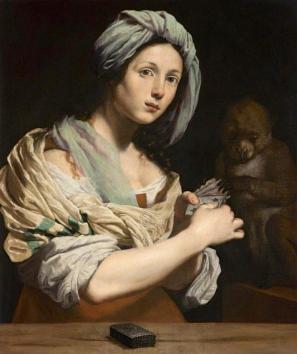
“The Allegory of Fortune” by Lorenzo Lippi (1606-1665), from Florence Italy, now in the National Museum of Northern Ireland, Ulster, depicts Fortune as being dependent upon the vagaries of chance similar to that of a monkey (seen on the right) selecting playing cards. Fortune herself, dressed as a gypsy, gazes out at the viewer as if to say, “Do you dare take whatever my companion chooses to give you?” What seems almost certain is that the gypsy woman is an allusion to fortune-telling. Furthermore, fortune-tellers in Europe, Africa and Asia, even today, use trained animals, usually birds, to select cards that reveal a querent’s future.
1665 – The Lenthall Fortune-Telling Deck
A deck of 52 fortune-telling cards was originally designed by Dormann Newman and published by John Lenthall of The Talbot, Fleet Street, London, in 1665. (The cards below are from the 3rd edition of 1714, published in facsimile by Harry Margary, Lympne Castle, Kent in 1972.) Update: These appear to have also been published by James Moxon (either father or son), who were British engravers and map-makers as well as producing a whole variety of geographic and educational cards. These card appear identical with a deck they published as “Astrology Cards” in 1676 [trionfi.com].
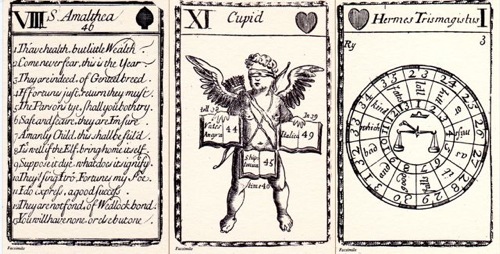
Each suit was numbered I to XIII. Odd numbered cards had a sign of the zodiac on them; even numbered cards contained a list of thirteen numbered statements. The Kings had a series of questions one could ask. The court cards were given the names of famous people from myth and legend. According to the directions, “When any person is desirous to try their fortune, let them go to one of the four kings and choose what question they please.” This is followed by an elaborate procedure for determining the answer. The explanation ends, “The stars foretell, they love you well.”
Lenthall later published a set of Proverb cards.

 17th century – German Proverb decks
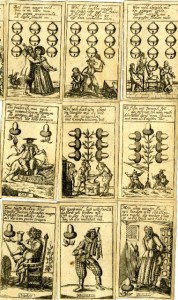
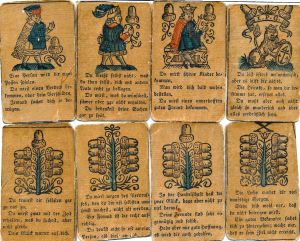 Quite a few old German decks featuring proverbs and sayings that must have been used for obtaining advice and prognostication of how a situation would progress. The suits consist of Green Leaves (Spades), Red Hearts (Hearts), Yellow Bells (Diamonds) and Black Acorns (Clubs). Acorns (Clubs) are generally the worst suit, while the Green Leaves (Spades) are the best suit.
16th & 17th century – Witchcraft and Cards
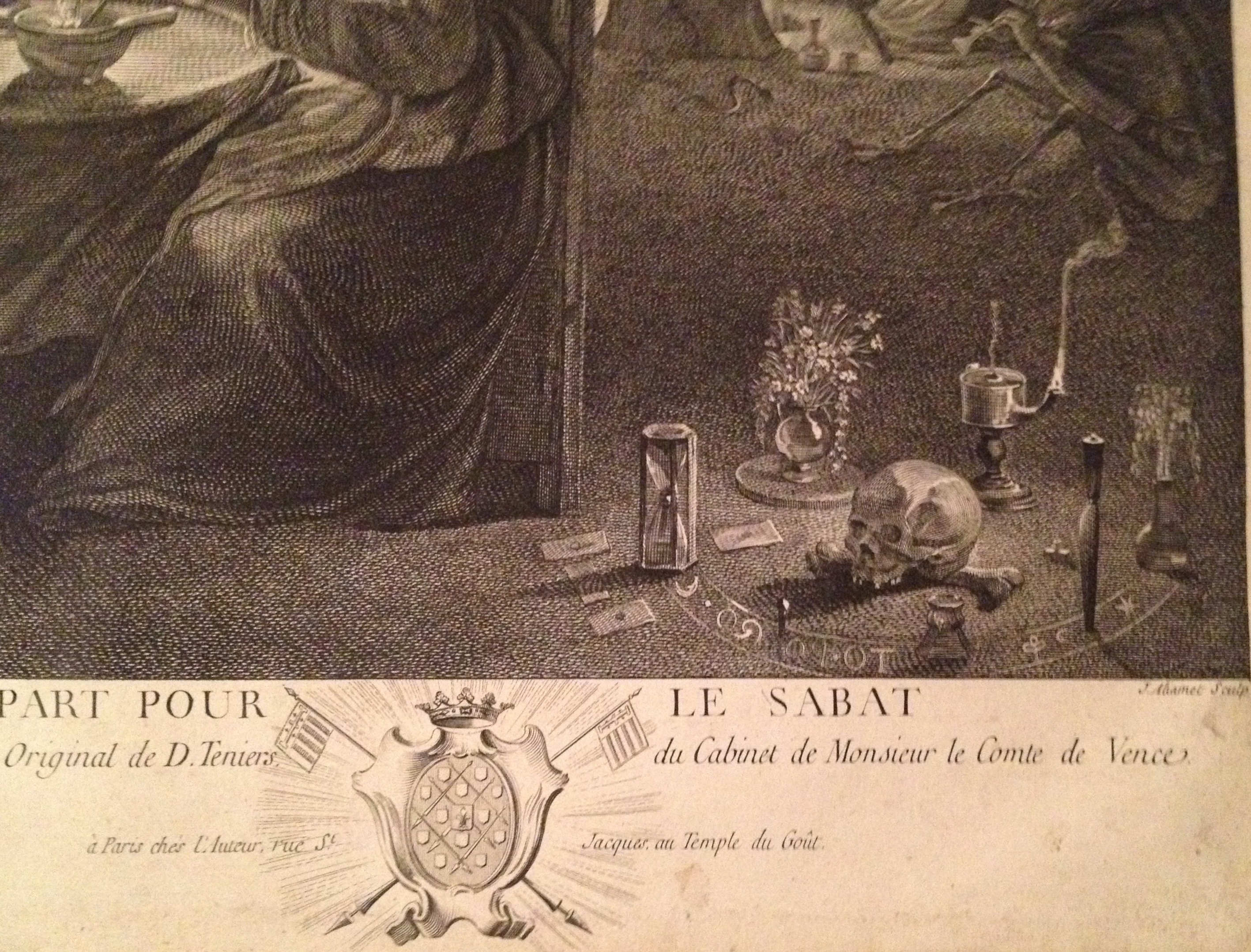
Focusing on the 16-17th centuries are reports in Italy, Spain and Belgium of witchcraft using playing cards. Whether this included fortune-telling as we know it is unclear. See my post on this subject HERE. In addition to transcripts of court trials, one of the most conclusive pieces of evidence for the use of cards in ritual is from a painting by David Teniers the Younger (1610-1690), now lost but reproduced as an engraving in the 18th century. Here is a photograph from my visit to an exhibit on witchcraft engravings at the British Museum.
The 18th Century
1702 – Fortune Telling Cards for sale
Advertisement for a deck of “Fortune Telling Cards” in The Post Man and The Historical Account, London, Dec. 22, 1702:

1727 – Destiny in a Game of Picquet
A book called Whartoniana; or, Miscellanies, in verse and prose by members of the Wharton family (and several other persons of distinction) was translated from the French and published in 1727. (Edited by Edmund Curll and translated by Joseph Morgan). It contained a detailed account of a card game that resulted in a divination. In the Table of Contents the piece is titled “To the lovely PALLAS, Or the Game at Picquet.” [Thanks to Stephen J. Mangan, (aka Kwaw) at Aeclectic’s tarotforum for finding this.]
A few Days ago, I took it into my Head to make a Visit to the celebrated Theresius, in order to be informed of my Destiny. —Help thyself to a Seat, said he, my Friend, sit down, and give me thy Hand. He pored on it for a considerable while, cast a Figure, said not one Word, but ordered me to return the next Day. His Silence seemed to me very ominous, and to portend me no Good; yet I much rather chose to be at once acquainted with my ill Fortune, than to continue longer in a suspenceful Uncertainty. I therefore very importunately pressed him to let me know his Reason for giving me no Answer to my Quere. Still the old Cuff was mute, making no manner of Reply, but reaching a Pack of Cards, sat down by me, and challenged me to play a Game with him at Piquet; the which, heavy-hearted and out of Humour as I was, I could not, nay durst not well refuse.
Well.— We cut; he has the Hand; I deal; he takes five, and leaves me three.— I find in my Hand a Quint in Hearts, three Kings, three Knaves, the Queen of Diamonds, and three Spades which I discarded. A promising Game! Great Hopes! But, Morbleu! Not one Ace in the three Cards I took in!— Faith, Madam ; I beg your Pardon for swearing; but it was so cursedly provoking, that I cannot keep my Temper when ever I think of it.
Sixty five? says he.— Good.— A Quint to a Knave?— Equal.— He then spreads out upon the Table seven Diamonds. Sixty five are seven, says my Antagonist, very gravely; a Quatorze of Aces, fourteen more.— All good, cries I, with a deep Sigh.— Diamonds, says he, playing his Ace, twenty-two, and plays out all his Diamondsrunning.— Down went my Queen, accompanied with two Clubs and four Hearts.— He next plays his Ace of Clubs, and that quite confounds me; for, the most unluckily in the World, I had left my King unguarded. He redoubles upon me with the Ten of Clubs; I fling him a Spade. Next, upon his Ace of Hearts, I give my Knave, still depending upon saving the Lurch, scarce doubting of his having the Queen.— My King of Spades next falls a Victim to his Ace.— But, how was I Thunder-struck! How were all my Hopes blasted! The Devil a Bit of the Queen of Hearts had he, and poor Charles found himself Capoted.
I have won the Game, said he.— From hence learn thy Destiny. If you must love, pitch upon some Object that is more your Match: For if ever you attack the divine Pallas, you will infallibly be Lurched.— Adieu. Heaven take thee into it’s Protection: Thus we parted.
- Lurch – a decisive defeat in a game (especially in cribbage).
- Capote – to win all the tricks from an opponent in a game of piquet.
 1729-50 – Dr. Flamstead’s and Mr. Patridge’s New Fortune-Book containing . . . Their new-invented method of knowing one’s fortune by a pack of cards (in various editions).
I found the source of the card fortune-telling verses quoted below in John Brand’s Observations on the popular antiquities of Great Britain (1777). They are from Dr. Flamstead’s and Mr. Patridge’s New Fortune-Book containing . . . Their new-invented method of knowing one’s fortune by a pack of cards. Read about it here.
1730 – Playing Card Divination in the early 18th century London Theatre
Read the earliest example of an actual card reading from a 1730 London play, Jack the Gyant-Killer – HERE, in which it is said that divination with cards is a newly-invented art. And what does this all have to do with a young Ben Franklin and Henry Fielding (author of the classic, Tom Jones, and founder of the first municipal police force, the Bow Street Runners) being led astray by one, A. Primcock? Note that despite the simplicity of the card reading method in the Flamstead and Patridge book, the play describes a technique that became the standard, still used today. The cards are spread in rows—probably 6 rows of 9 cards, except only 7 in the bottom row, as described in the 1791/3 book mentioned below.
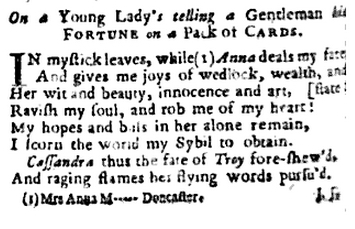
1734 – On a Young Lady’s telling a Gentleman his FORTUNE on a Pack of CARDS
from The Gentleman’s Magazine, or The Monthly Intelligencer, October, 1734 we find this delightful little poem that seems to be addressed to one Mrs. Anna M**** of Doncaster. While it may simply be a poem, by addressing a specific woman, it seems more as if he wants to remind her of a fond tryst. It goes:
In mystick leaves, while Anna* deals my fate,
And gives me joys of wedlock, wealth, and
Her wit and beauty, innocence and art, [state:
Ravish my soul, and rob me of my heart:
My hopes and bliss in her alone remain,
I scorn the world my Sybil to obtain.
Cassandra thus the fate of Troy fore-shew’d.
And raging flames her flying words pursu’d.
*Mrs Anna M**** Doncaster.
1735 – Gypsy Cartomancy – a Hoax!
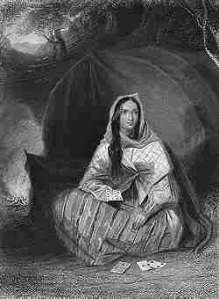
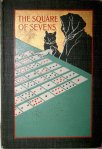
The Square of Sevens, and the Parallelogram: An Authoritative Method of Cartomancy with a Prefatory Note is a literary hoax. Said to be originally written by one Robert Antrobus and published in 1735, it was then edited by E. Irenaeus Stevenson and republished by Harper & Brothers, NY, in 1896. Read all about Ross Caldwell’s literary detective work showing that this book is a 19th century hoax – here.
1738 – Divination in Holland
In 1738, Antoine de La Barre de Beaumarchais writes about divination in Holland:
“That kind of divination is not the only one that still persists in Holland, despite its inhabitants common sense. Pyromancie and Ooscopy, or to speak in a more casual way, the art of guessing by watching a flame, burning coal, sparkles, eggs in a glass, are still commonly used in some part of Holland. The fortuitous disposition of a playing card deck, open and arranged in four or five lines, is another way to tell the future, not despised by certain ladies from this country. It is true that some of them pretend consulting the so-called witches for the sake of distraction. But one would think the exact opposite, seeing how they await with an attentive and worried attitude these women answers, and how they manifest their joy by the sudden serenity on their faces, when those Oracles are favorable.”
(Contributed by Bertrand—see comments.)
17??-1750 – Pratesi’s Bolognese Tarocchi
A manuscript written prior to 1750 was discovered by Italian playing card scholar, Franco Pratesi in the late 1980s. It lists cartomantic interpretations for 35 Bolognese tarocchi cards along with a rudimentary method of laying them out. A sheet of 35 Bolognese cards (trumps and number cards) are labeled with simple divinatory meanings such as “journey,” “betrayal,” “married man,” “love.” A later deck of double-headed Bolognese cards from the 1820’s are labeled both top and bottom with similar divinatory meanings, showing a continuity of use. A comparison of four variations on Bolognese divinatory meanings can be found here.
1750 Sketchley’s Conversation Cards and “The Complete Fortune Teller,” along with an advertisement for these cards from The Virginia Gazette of 1775.
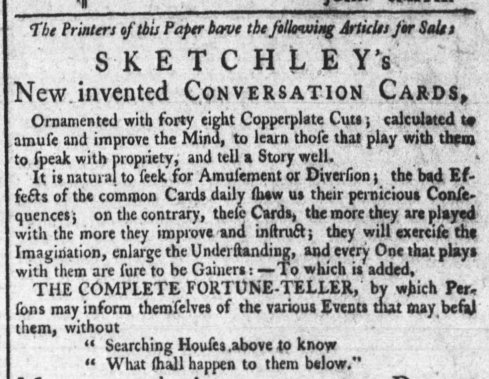
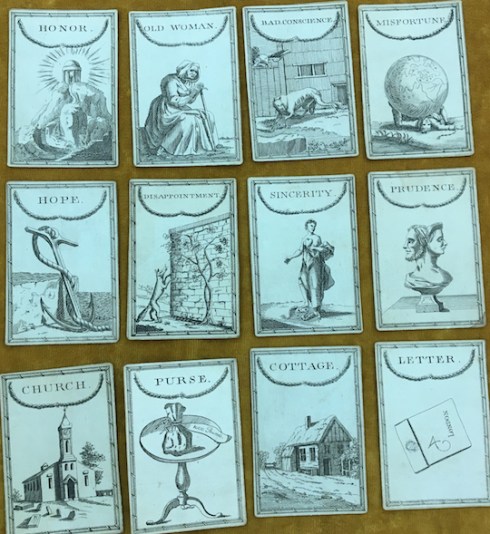
So, to this set of cards was added “The Complete Fortune Teller” – a standard book of the time. As it turns out, James Sketchley was a British publisher who produced, from at least 1750 in England, the “Conversation Cards” as an educational game for children. In addition, he was an ardent Freemason of whom it was said:
“A man, who, if Masonry e’er was the theme
His bosom with Rapture would glow and expand.”
Thanks to Andrew McGregor who obtained a photo of these cards for me from the Toronto Public Library Osborne Collection.
 mid-18th century – Cagliostro Reads the Cards
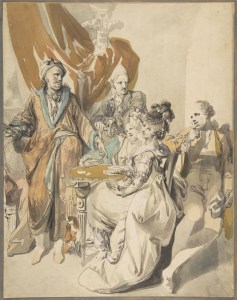
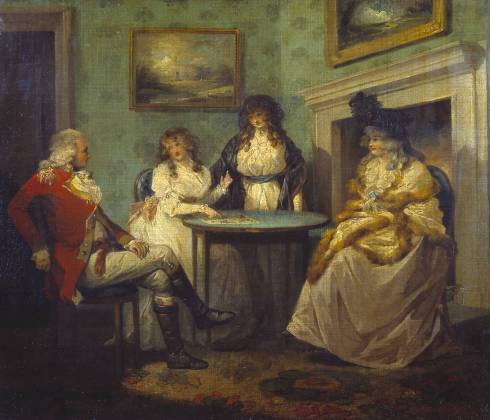
A watercolor by Johann Eleazar Zeissig (called Schenau), mislabeled at the Metropolitan Museum of Art as “Two Women and Three Men Playing Cards.” Cagliostro is identified, in French, on the reverse of the picture, but not acknowledged in the description of the work. He appears to be doing a card reading for a group of nobles. Cagliostro points to the Ace of Hearts or Diamonds (probably Hearts!) that the woman in the foreground is showing to him. Note how his “oriental” robe contrasts with their clothes and his cap is a type worn by those in the “arts.” A later print in a book by Julia Orsini repeats the claim that Cagliostro read cards (see below).
1755 – The Card
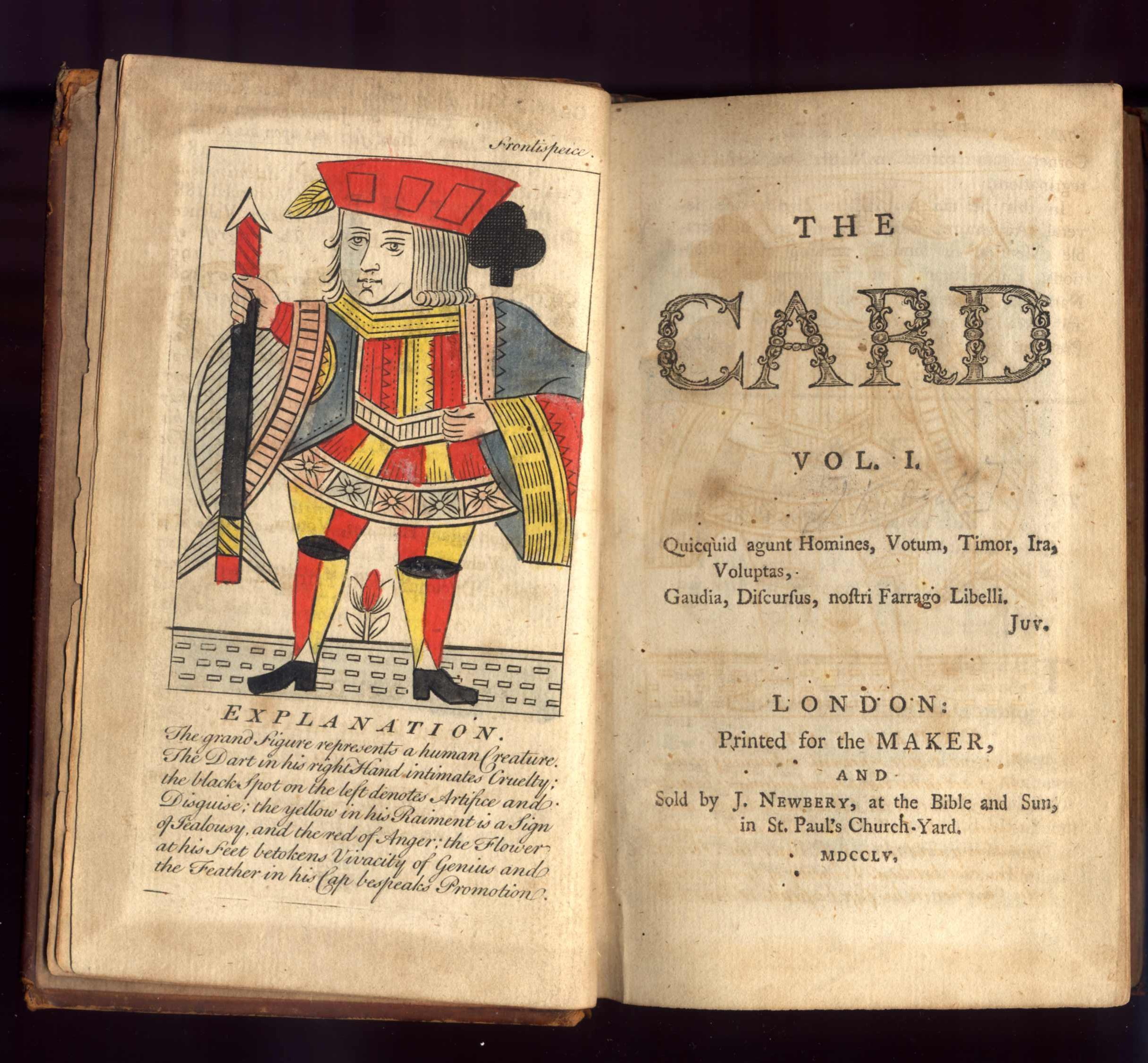 In 1755 we find a rambling novel in two volumes, The Card by John Kidgell (London: Printed for the Maker and sold by J. Newberry, 1755), that is famous as the first reference to a game of “baseball.” It is notable to us because of the frontispiece that features a large engraving of the Jack (or Knave) of Clubs, accompanied by a detailed commentary on its symbolism. I haven’t been able to find an online copy of the book to discover the role this figure plays in the text, but I would imagine it serves as Significator of the main character of the novel. It shows the kind of symbolism we tend to look for in cards when ‘reading’ them. Usually associated with Lancelot, this Jack also has a reputation as the scoundrel of the pack. The text explains:
“The grand figure represents a human Creature. The Dart in his right Hand intimates Cruelty; the black Spot on the left denotes Artifice and Disguise; the yellow in his Raiment is a Sign of Jealousy, and the red of Anger; the Flower at his feet betokens Vivacity of Genius and the Feature in his Cap bespeaks Promotion.”
1762/3 – The Vicar of Wakefield – “A very pretty manner of telling fortunes”
In 1762-3 Oliver Goldsmith writes his novel The Vicar of Wakefield in which we find that reading cards can be an admirable accomplishment in a young woman:
And I will be bold to say my two girls have had a pretty good education, and capacity, at least the country can’t shew better. They can read, write, and cast accompts; they understand their needle, breadstitch, cross and change, and all manner of plain-work; they can pink, point, and frill; and know something of music; they can do up small cloaths, work upon catgut; my eldest can cut paper, and my youngest has a very pretty manner of telling fortunes upon the cards.’ [in Chapter 11]
1765 – The Oracle, a pack of cards
An advertisement for an “The Oracle, a pack of Cards” from The Public Advertiser, London, May 17, 1765:
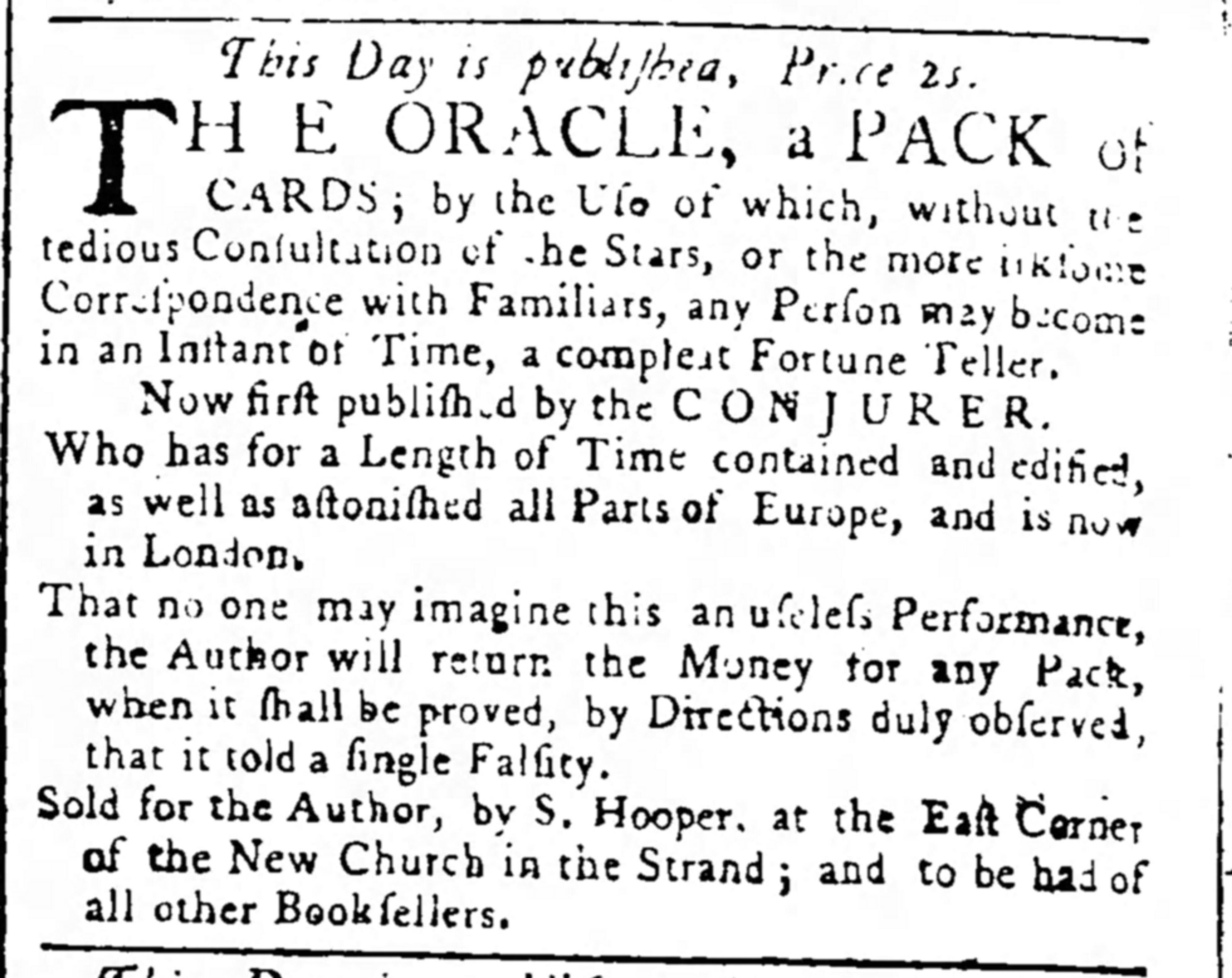
This may be the deck that is pictured here on Simon Wintle’s excellent website.
1765 – Zaïre, Casanova’s Russian mistress
The famous lover, Jacques Casanova, recounts in his memoires that in 1765 his then 13-year-old Russian peasant mistress would read the cards every day—laying them out in a square of twenty-five cards. As he describes it: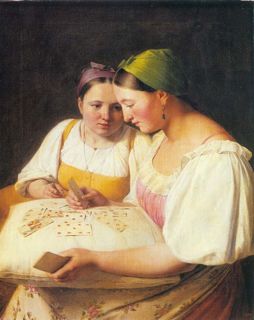
Without her desperate jealousy, without her blind trust in the infallibility of the cards, which she consulted ten times a day, this Zaïre would have been a marvellous woman and I would never have left her.
To convince me of my crime, she shows me a square of twenty-five cards wherein she makes me read all the debaucheries that had kept me out all night long. She shows me the tart, the bed, the love-play and even my unnatural acts. I didn’t see anything at all, but she imagined that she saw everything. After letting her say, without interruption, everything that might serve to assuage her jealousy and rage, I took her grimoire [the deck of cards] and threw it into the fire.
(From The Complete Memoires of Casanova by Jacques Casanova, Chapter CXVII. This translation by Ross Caldwell.) The painting entitled Fortunetelling (1842) is by Alexey Gavrilovich Venetsianov (1780-1847) and is in The Russian Museum, St. Petersburg.
Patience/Solitaire/Kabale
Casanova was one of the first to mention the card game solitaire or patience. Other names for these games suggest an origin in fortune-telling. In France, it was known as réussite (“success”), explained in Littré as “a combination of cards [by] which superstitious persons try . . . to divine the success of an undertaking, a vow, etc.” From at least 1783, Danish, Norwegian, and Icelandic solitaire was called kabal(e), or “secret knowledge,” a term reserved in Polish specifically for fortune-telling with cards. For more, visit David Parlett’s “History of Patience/Solitaire”.
1770 – Goethe has his cards read
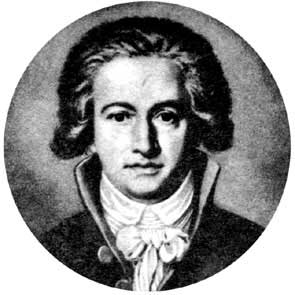
In Johann Wolfgang von Goethe’s autobiography Dichtung und Wahrheit (“Poetry and Truth”), he recounts that in 1770, when he was 20 years old, he took dancing classes in Strassburg from a Frenchman with two daughters who had both become enamored of him. He cared only for the younger. The girls brought an elderly fortune-teller to the house who agree to read the cards for all three. She began with the older girl:
“She carefully observed the positions of the cards, but then seemed to falter and be reluctant to speak — “I understand,” said the younger girl, who had already become better acquainted with interpreting this magical board. ‘You are hesitating because you do not want to reveal anything unpleasant to my sister, but that card is cursed!’” (The cards revealed that the older girl loved and was not loved in turn.)
“‘Let us see if it will get better,’ replied the old woman, shuffling the cards and laying them out a second time; but it had only grown worse, as we could all plainly see. The fair one’s card was not only more isolated, but was surrounded with many troubles; her friend had moved somewhat farther away and the intermediate figures had come closer.”
With uncontrolled weeping the older girl fled the room. Goethe couldn’t stand to be present while his cards were read, so he went home. When he returned the next day, the younger sister told him,
“I had the cards laid out for you, and the same verdict was repeated three times, always more emphatically. Your card was surrounded by all sorts of good and pleasant things, by friends and men of importance, and money was not lacking. The women kept themselves at some distance. My poor sister, especially, was always the one farthest away; another girl kept moving closer to you but never came to your side, for a third person, a man, placed himself in the way. I shall have to admit to you that I imagined myself to be the second lady, and after this confession you will best be able to understand my well meant advice. I have pledged my heart and hand to an absent friend, and up to now I have loved him better than anyone else. But possibly your presence would grow to mean more to me than before, and just imagine the difficult position in which you would be between two sisters, one of whom you had made unhappy with your affection, and the other with your coldness, and all this misery would be for nothing and for the sake of a short time. For if we had not already known who you are and what your prospects are, the cards would have set it before my eyes very plainly.”
There ensued a jealous scene with the older sister, and Goethe left, to never see them again. (Thanks to Christian Joachim Hartmann for finding this.)
 1770 – Paris: Etteilla, and “Illusive Enjoyments of the Mind”
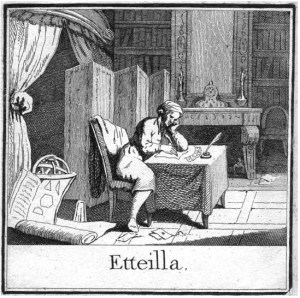
It was around 1750 that the print-seller and teacher of algebra (i.e., numerology), Etteilla (Jean-Baptiste Alliette 1738 – 1791), said he learned the art of telling fortunes with playing cards from three cartomancers, one of whom came from Piedmont in northern Italy. In 1770 he published his own book on fortune-telling with cards, Etteilla, ou manière de se récréer avec un jeu de cartes, for which he coined the term cartonomancie (which became cartomancy). Learn more about Etteilla’s tarot here.
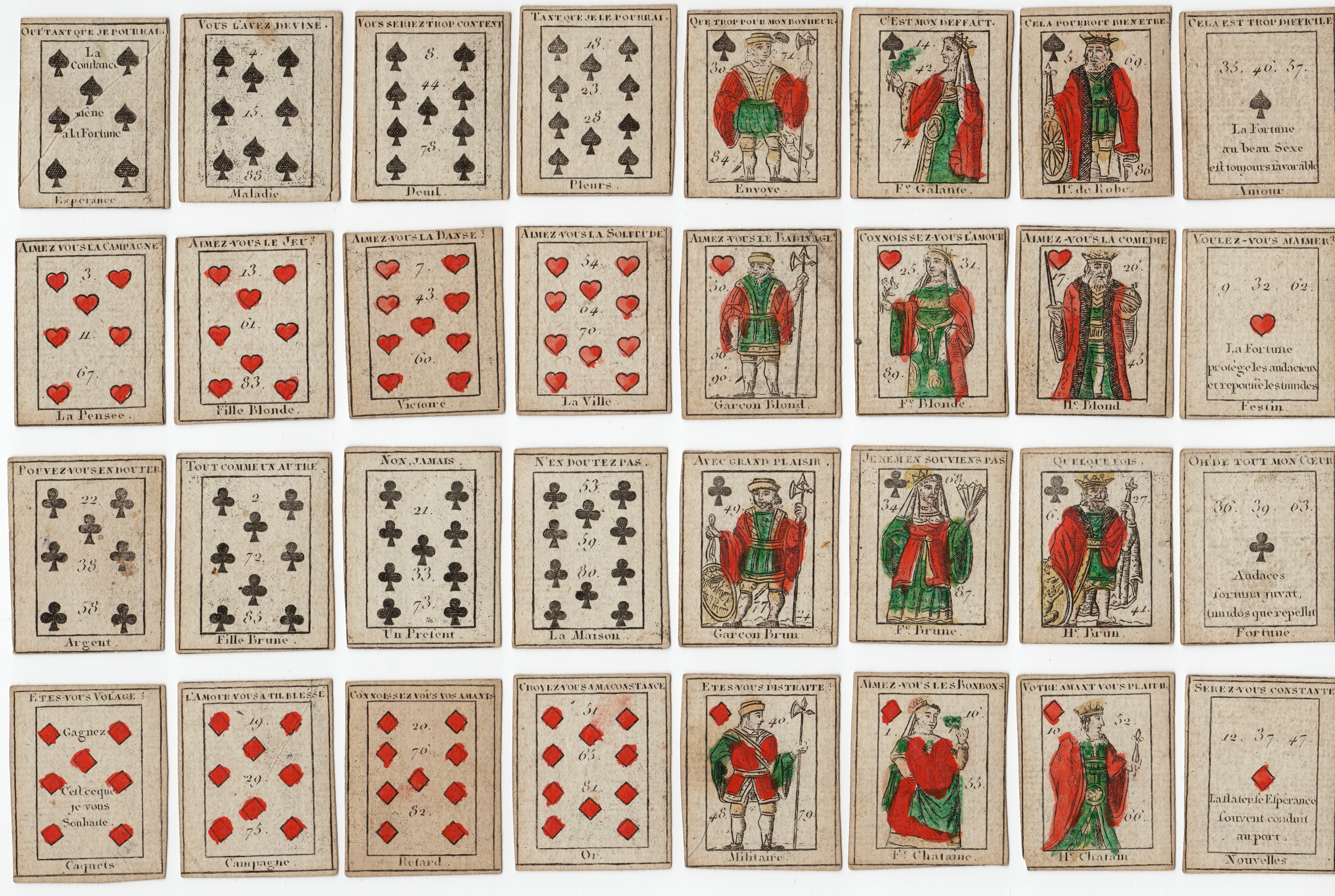
Soon after Etteilla published his book on fortune-telling with playing cards, numerous decks appeared utilizing his system. He followed up with a several books on the Tarot and a Tarot deck. Here is an early miniature “Petit Etteilla” deck from my own collection:
But, as we’ve seen, Etteilla was not really the first to write on the subject. In Germany we find a general Cartomancy text in German (1769): Abhandlung der Physiognomie, Metoposcopie und Chiromantie by Christian A. Peuschel (thanks to Huck).
1777 – From an old English chapbook
John Brand in his 1777 book, Observations on the popular antiquities of Great Britain, quoted from “an old chap book” what he called “curious lines on divination by drawing cards,” the source of which I’ve now found here. Example:
This noble king of diamonds shews
Thou long shalt live where pleasure flows;
But when a woman draws the king,
Great melancholy songs she’ll sing.
1781/89 – Antoine Court, Le Comte de Mellet and Etteilla
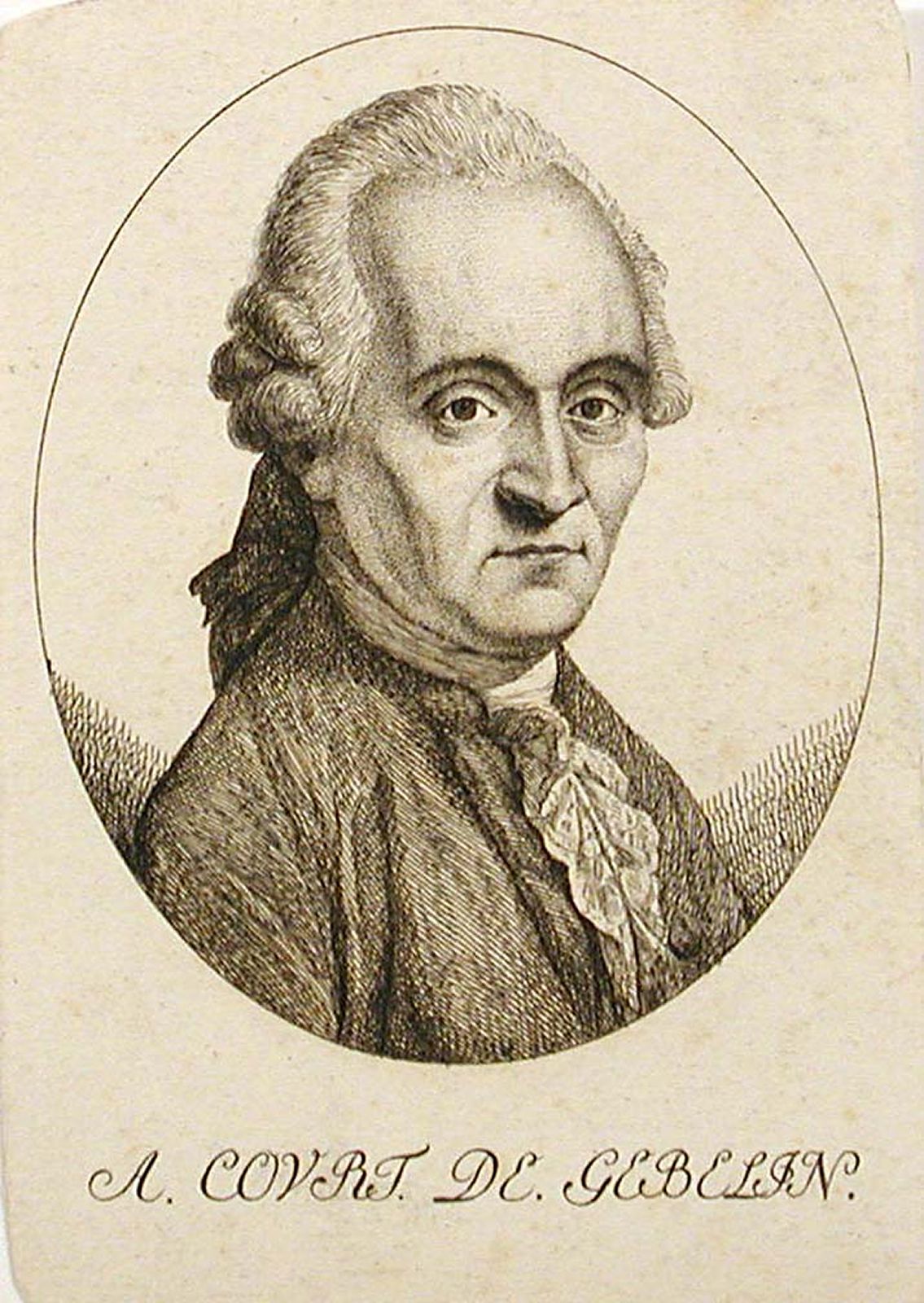 The 8th volume of the encyclopedia Le Monde primitif (“The Ancient World”) by Antoine Court de Gébelin (1725-1784) appears in 1781, claiming an Egyptian origin for Tarot as a book of wisdom. Antoine Court was a friend of Ben Franklin and James Madison who, along with the French King, subscribed to this encyclopedia; Court would die during a medical treatment with Antoine Mesmer (father of hypnotism). The volume includes an essay by le Comte de M*** [Mellet] that explains how to use the cards for divination. De Gébelin says there are 22 Trumps just as there are 22 Hebrew letters; Le Comte de Mellet tells us they correspond to The World as aleph, continuing in reverse order through the cards. It is Le Comte de Mellet also who first calls the suit of coins “talismans” (pantacles), which is later developed by Éliphas Lévi (circa 1865) and used by the Hermetic Order of the Golden Dawn as the suit of Pentacles. The following year Etteilla applies to the censors to publish his own book on the Tarot but is refused until 1783 when he publishes his Manière de se ré créer avec le Jeu de Cartes nommées Tarots (“A way to entertain oneself with the pack of cards called Tarots”), which he follows up with three more volumes and a deck (1789). These works forge the route for Tarot to officially enter the world of occult mysteries and divination. Read some interesting speculations regarding early occult and philosophical uses of the cards HERE.
 1791 – Every Lady’s Own Fortune Teller
By 1791 we find that the standard fortune telling chapbook has been expanded by a chapter called “Of Card Tossing.” Here are found explicit instructions for reading playing cards, along with a detailed sample reading laid out in 6 rows of 9 cards, with 7 cards in the final row (this edition from 1793, and later editions published with different titles). This is, perhaps, the earliest example in English of instructions that are still roughly current today. There’s also a brief description of coffee-ground reading.
c. 1790s – “The Fortune-Teller” (n.d.) by French artist Martin Drolling (1752-1817)
Napoleon’s soldiers and their families seek reassurances about what is coming next in their lives.

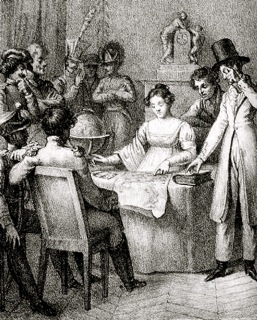 1790 to mid 19th century – The Career of Mlle. Lenormand
Around 1790 Marie-Ann-Adélaïde Lenormand (1772-1843) arrived in Paris saying she had learned to read the cards from gypsies (read about her here). With Etteilla’s several books on the subject and the dozen or so self-promoting works by Lenormand and several decks falsely ascribed to her, divination with playing cards became known to the world. She used a variety of divination tools as well as reading palms and some astrology and numerology. It is said that her table was covered with many different packs of cards including Tarot (probably the Etteilla deck) and that she would randomly pull cards from among the different decks as she spoke. Picture on right: A young Mlle. Lenormand reading for Napoleon— talk about pressure on the job! In actuality she read for Josephine but it is doubtful that she ever read for Napoleon.
1796 – Tawny Rachel
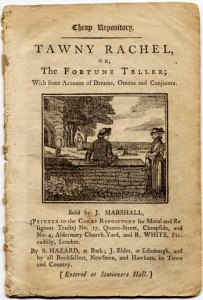 Tawny Rachel, or The Fortune Teller; With some Accounts of Dreams, Omens and Conjurers was a chapbook published in London in 1796. It tells the story of Rachel, a seeming “sun-burnt oracle of wisdom” who was actually a skilled con-artist (unfortunately they do exist).
She used a variety of methods of fortune-telling from reading moles to dreams to the disposition of plants. Having found a gullible young girl who was eager to find a husband, Rachel explains:
“If you cross my hand with a piece of silver I will tell you your fortune. By the power of my art I can do this three ways; by cards, by the lines of your hand, or by turning a cup of tea-grounds: which will you have?”
Unfortunately there is no account of her reading the cards. Eventually she is arrested, found guilty and sent to Botany Bay:
“And a happy day it was for the county of Somerset, when such a nuisance was sent out of it.”
The author thought it was his duty
“to print this little history as a kind of warning to all you young men and maidens not to have any thing to say to cheats, impostors, cunning women, fortune-tellers, conjurers, and interpreters of dreams.” [He continues,] “Listen to me, your true friend, when I assure you that God never reveals to weak and wicked women those secret designs of his Providence, which no human wisdom is able to foresee.”
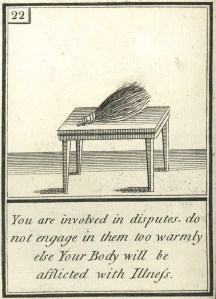 1794/6 – Viennese Coffee-Grounds and Cards
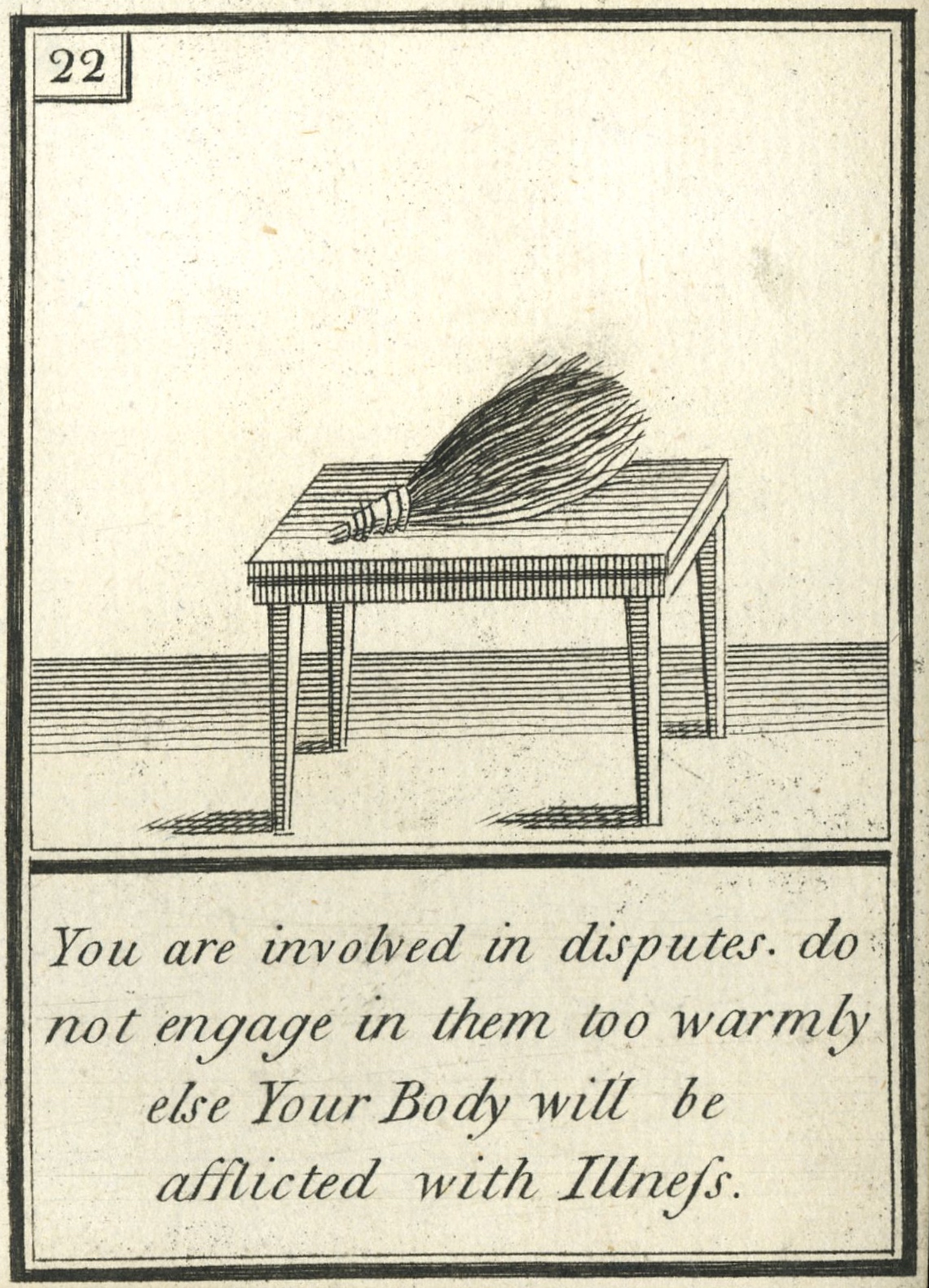
Meanwhile, in Vienna, in 1794, there appeared a deck of fortune-telling cards and book based on images commonly described as found in coffee-ground fortune-telling. With the advent of coffee to Europe and coffee-houses springing up starting around 1650, came the huge growth of coffee-house culture throughout Europe during the 18th century. Simultaneously a Turkish custom of fortune-telling by reading the images in coffee-grounds emerged (only later was this applied to tea-leaves). Lists of these images are first recorded in mid-18th century Germany, with the earliest detailed description being this Viennese book and deck. We know of it only through an English translation of 1796 that is found in the British Museum (see also my post about them here).
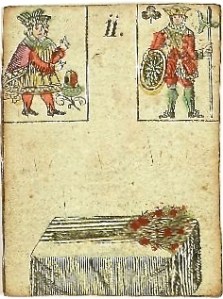 1798/9 – Das Spiel der Hoffnung (“The Game of Hope”)
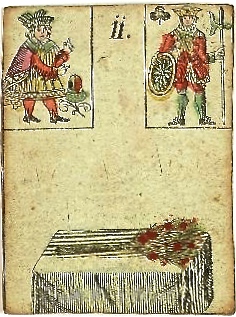
In 1798-9, a young German game designer, Johann Kaspar Hechtel (1771-1799), in Nuremberg, designed a 36-card multi-purpose game featuring simple images (Dog, House, Mice, Anchor) that are nearly identical to 30 of the the Viennese Coffee-Cards. Hechtel’s 36 cards for his Der Spiel die Hoffnung (“Game of Hope”) were inset with playing cards – a common German-suited deck on the top left and French-suited deck on the top-right for playing regular card games. The game described was played by laying out the cards in a square of 6 cards-by-6 cards with instructions for a race-game similar to the Game of Goose or Snakes-and-Ladders. At the end of the instructions, Hechtel mentions that these cards can also be used for fortune-telling (with the assumption that everyone knew how). While French and English playing card meanings have no relevancy to the images, it turns out that there is an entirely separate tradition of German Wahrsagekarten (“Fortune Telling Cards”) featuring suits of Leaves, Hearts, Bells and Acorns whose meanings do accord with the Game of Hope cards (see a discussion here). The card to the right is the Jack of Clubs (Knave of Acorns), called “The Birchrod” meaning disputes (see the same Coffee-card image just above).
The 19th Century

Early 19th century – Costumes of Foreign People (French deck)

A 54-card deck, in the Metropolitan Museum of Art, dated to 1700-1799 and described in French as: ‘Composées de tous les Costumes des peuples / étrangers avec de jolies devises et bons mots. / dediées aux Jeunes Gens’; ‘Je me fixe a la plus belle / Imitez moi.’ (“Featuring all forms of dress of foreign peoples, with many fine sayings and proverbs. Intended for children. ‘I set my sights on Beauty: Do as I do!’”) Each card contains a picture featuring people dressed in the clothing from foreign countries (identified at bottom). Near the top are numbers (for a lottery or game?) and some have a day of the week. The Aces feature traditional images found in cartomancy decks. On the bottom right is an upside-down playing card inset above which is a meaning associated with it by Etteilla. Around the sides are short sayings and advice. It appears to be a multi-purpose game that can also be used for advice or fortune-telling. These are probably more accurately dated to the early 1800s based on the English clothing style.
1803 – Many a Fine Lady . . .
The popularity of cartomancy in France is attested to in 1803 by Francis W. Blagdon in Paris As It Was and As It Is:
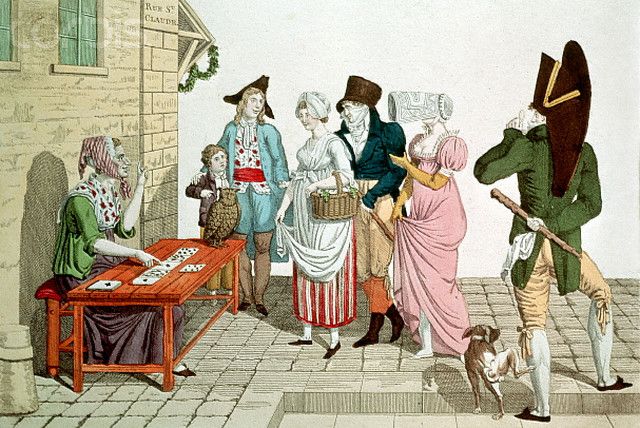
Much about that period, 1572, there were reckoned, in Paris alone, no less than thirty thousand astrologers. At the present day, the ambulating magicians frequent the Old Boulevards, and there tell fortunes for three or four sous; while those persons that value science according to the price set on it, disdaining these two-penny conjurers, repair to fortune-tellers of a superior class, who take from three to six francs, and more, when the opportunity offers….
“The Fortune Teller” (circa 1869) by French artist Frédéric Bazille (1841-1870)
Formerly, none but courtesans here drew the cards; now, almost every female, without exception, has recourse to them. Many a fine lady even conceives herself to be sufficiently mistress of the art to tell her own fortune; and some think they are so skilled in reading futurity in the cards, that they dare not venture to draw them for themselves, for fear of discovering some untoward event.
This rage of astrology and fortune-telling is a disease which peculiarly affects weak intellects, ruled by ignorance, or afflicted by adversity. In the future, such persons seek a mitigation of the present; and the illusive enjoyments of the mind make them almost forget the real sufferings of the body.
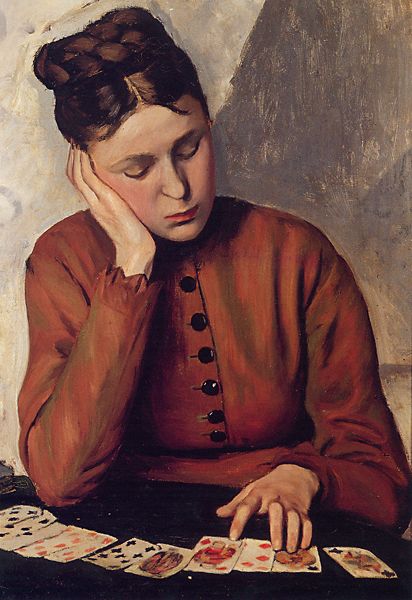
1820 – Les Jeunes Femmes
A description of fortune-telling with cards by a maid for her lady was translated into English from Les Jeunes Femmes, of M. Bouilly and published in Belle Assemblee: Or, Court and Fashionable Magazine in 1820. In this work, Madame de Saucerre wishes to discover her husband’s activities on the previous night. What is revealed is another matter altogether. Read this story and learn the truth discovered here.
1830 – German Fortune-Telling Cards
We previously saw German cards with mottos or sayings on them. By 1830 a 32-card deck was published in Munich by Franz Josef Holler (made by Comptoir Industry of Leipzig), with fortune-telling meanings printed on them. This deck falls right between the 1799 Spiel der Hoffnüng game (the direct forerunner of the Lenormand cards) that is illustrated with both German and French playing cards, and the nearly identical 1846 German fortune-telling deck named after Mlle. Lenormand. In both decks, for instance, the 10 of Clubs (Acorns) features a picture of a Bear and has a meaning of “envy.” (See my post on the Lenormand playing card inserts HERE.)
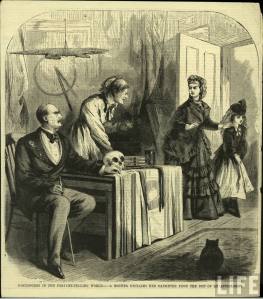 1836 & ’38 – American Cartomancers
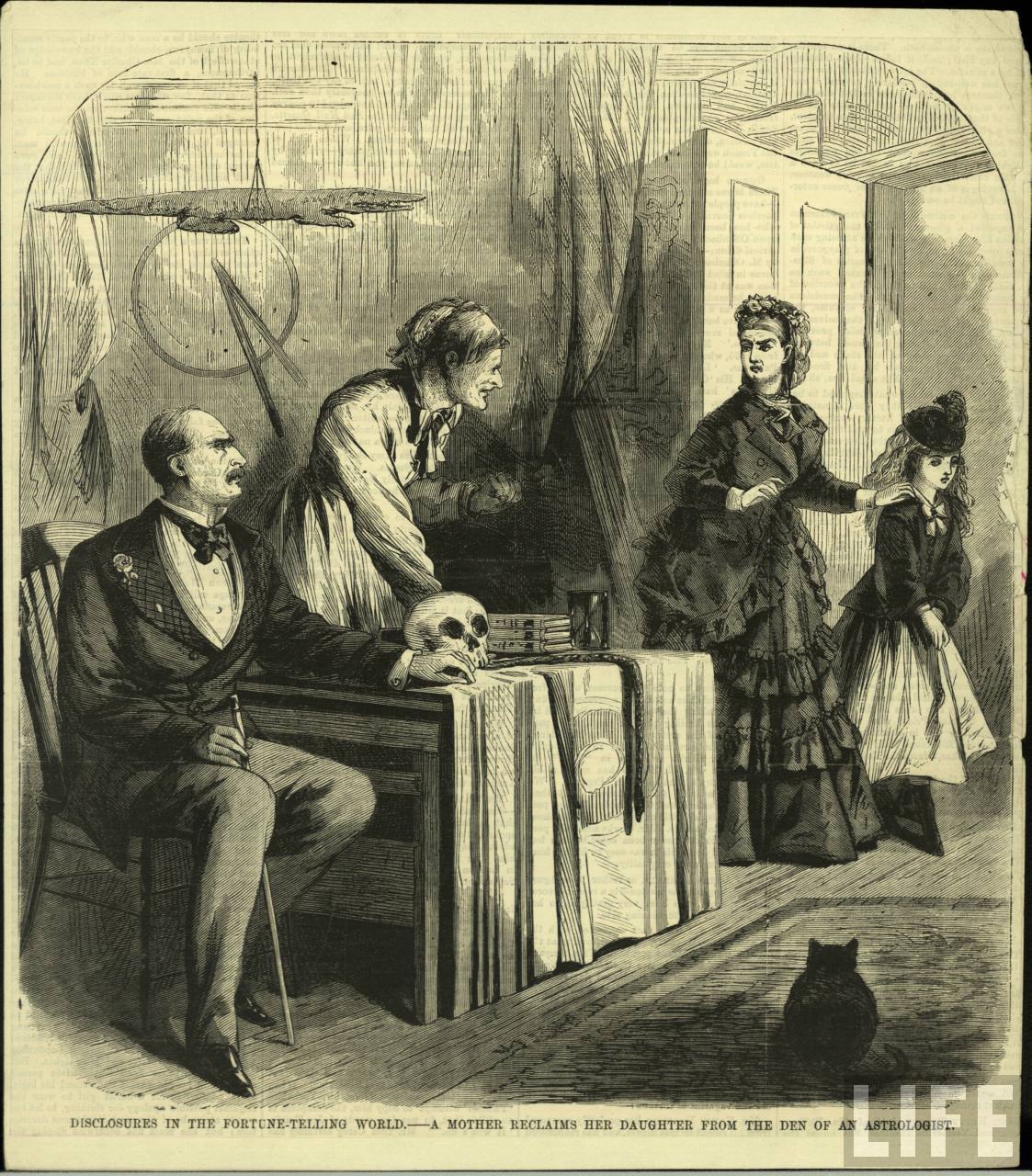
Extending back to the late 18th century, American newspapers report on fortune tellers using cards but usually only when they’ve been arrested for fraud. Here’s the earliest description I can find of professional readers in America—from The Burlington Weekly Free Press, Burlington, Vermont, July 1, 1836:
“Fortune Telling.—The Baltimore Transcript states that there are in that city no less than twelve professors of the art of divination or fortune telling. Most of them perform their incantations by the use of cards; but one old woman, wiser or more gifted than the others, pretends to delve into the mysteries of futurity by looking into an empty junk bottle! Strange as it may seem, the patrons of these vagabonds in the “Monumental city” are not confined to the low and vulgar. Some very genteel, respectable people—particularly ladies—run after these impudent imposters, to inquire after their future fate—as though “a tall, and mean, and meagre hag” knew more of the “shadows of coming events” than the beautiful and fascinating creatures whose bright eyes might if they would pierce into futurity even though it were a nether millstone.—Silly creatures! if they believe the predictions of these hags, they stand at least an even chance of making themselves miserable for life; if they do not, they certainly carry their time and money to a very bad market.”
The Public Ledger (Philadelphia) for January 10, 1838 carries this ad:
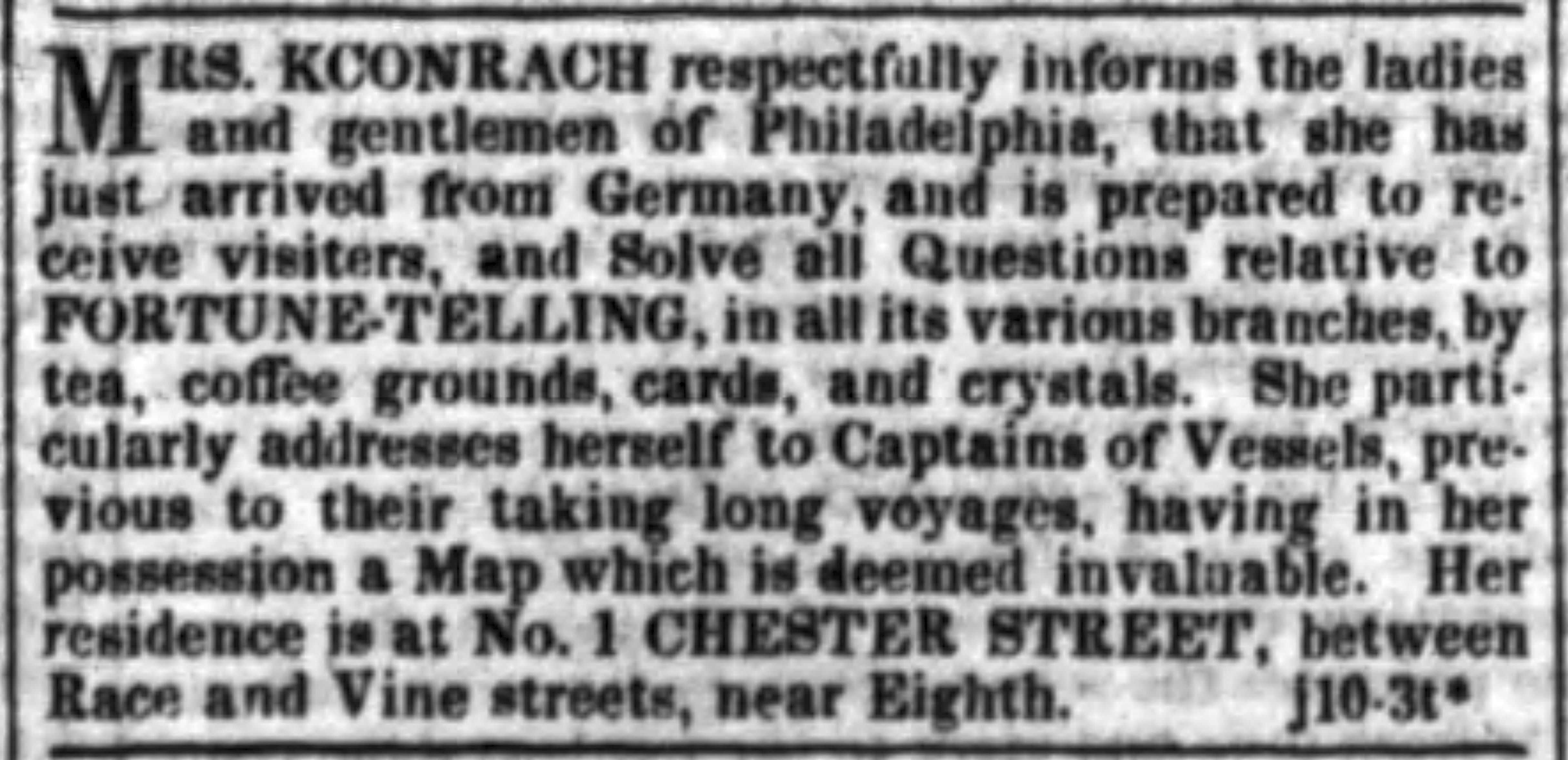
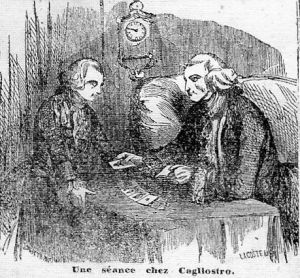 1838 – Julia Orsini
Julia Orsini wrote a book on reading with the Etteilla cards. In Le Grand Etteilla, ou l’art de tirer les cartes (Paris, 1838) containing a rare etching of a man reading the cards, identified as the scondrel, con-artist Count Cagliostro (1743-1795) who was made much of in Masonic circles.
1840/1853 – Rossetti’s Femme Fatale
Read about the poem, “The Card Dealer” (1853), that Dante Gabriel Rossetti wrote to Theodore von Holst’s painting “The Fortune-Teller” (1840) – here.
1846 – Petit Lenormand Deck
Upon the death of Mlle. Lenormand in 1843, as was the tradition, publishers began publishing Lenormand decks and books that had nothing to do with the original person. In France a 52-card Grand Jeu Lenormand deck was produced with designs taken from myth, constellations and flower oracles.
In 1846 in Coblenz, Germany we find the first Petit Lenormand – a 36 card deck (see cards below). It featured the same set of images found in the Spiel der Hoffnung, but with only the French-suited playing card inset. The sheet of instructions and card meanings, signed by a fictitious “Philippe, heir to Mlle. Lenormand” were nearly identical to the coffee-ground meanings and reading technique detailed in the Viennese Coffee-Card book (see above). The deck was soon produced by multiple publishers in Germany, Belgium, Sweden and the United States (where they were called, among other names, “Madam Morrow’s Fortune-Telling Cards). The earliest U.S. publications, found in Chicago and New York had bi-lingual German and American instruction sheets. Today these cards are experiencing a huge resurgence in interest.
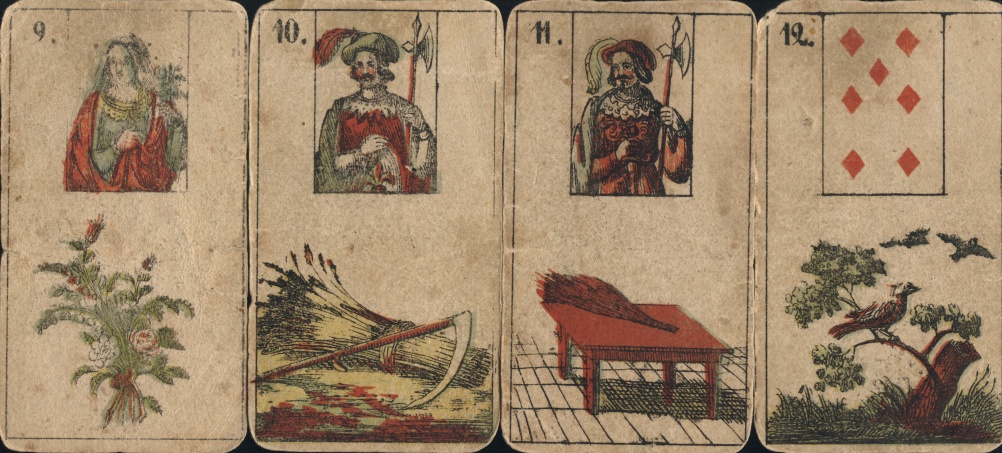
Soon after, a wide variety of fortune-telling decks began appearing, usually called Sybilla or Gypsy decks, with a varying number of cards and images. Despite the emergence of dozens of fortune-telling decks, paintings and prints of cartomancers up until the late 20th century almost universally show only standard playing cards.
1863 – Chambers’ Book of Days
In 1863, Robert Chambers, with his Book of Days, published a two volume “miscellany of popular antiquities” organized around the calendar year. For February 21st, he includes an article on English cartomancy called “The Folklore of Playing Cards” (illustrated with the picture below). In it he gives the card meanings he was taught as a child when struck by illness in a foreign land. (Read the whole article here—you need to scroll down a ways.)
The English system is used in all British settlements over the globe, and has no doubt been carried thither by soldiers’ wives, who, as is well known to the initiated, have ever been considered peculiarly skilful practitioners of the art. Indeed, it is to a soldier’s wife that this present exposition of the art is to be attributed. Many years ago . . . the writer, then a puny but not very young child, [was] left for many months in charge of a private soldier’s wife, at an out-station in a distant land. . . . She was too ignorant to teach her charge to read, yet she taught him the only accomplishment she possessed,—the art of ‘cutting cards,’ as she termed it: the word cartomancy, in all probability, she had never heard.
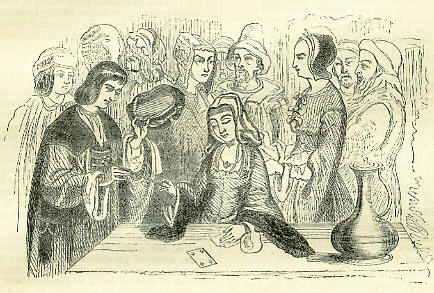 The above engraving that illustrated Chambers’ article first appeared in the Magasin Pittoresque in 1842 (according to Detleff Hoffmann). It loosely reproduces a painting by Lucas van Leyden that was later named The Fortune Teller (c. 1508) though it may actually commemorate a political negotiation mediated by Margaretha of Austria (see painting near the beginning of this post). Chambers’ meanings were used by A.E. Waite when he wrote his compendium on fortune-telling as “Grand Orient.” They appear almost intact in the supplemental meanings for the Lesser Arcana given in Waite’s Pictorial Key to the Tarot (1910).
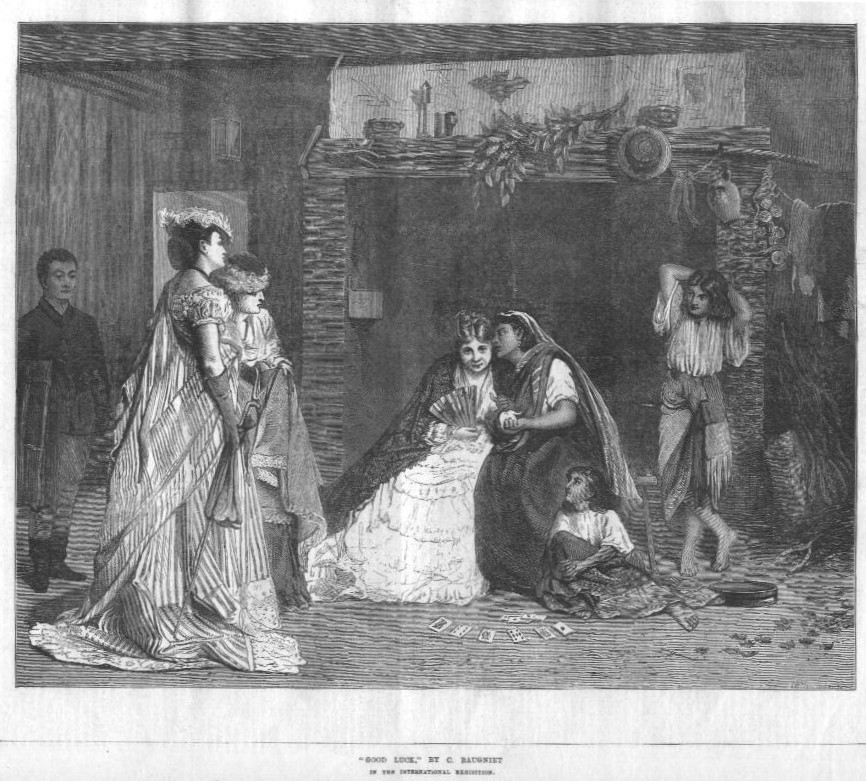
End of the 19th century
By the end of the 19th century we find all kinds of new fortune-telling decks springing up, including the Kipper Cards in 1873 (published by Matthias Seidlein and said to be created by a Frau Kipper), and various “Gypsy” and “Sybilla” decks each with their own emphasis on certain aspects of a daily life. Tarot was taking a huge leap forward as esoteric societies rushed to design occult decks and write books influenced by Antoine Court de Gébelin, Etteilla and Eliphas Lévi. The Tarot details are found in other posts and books.
To Sum It Up
 Never as ubiquitous as dice, palmistry or astrology, divination with cards goes back to at least the 16th century and probably earlier, though the form may not have been what we now call cartomancy, which emerged more recognizably in the 18th century. We can see from all the above that historically card divination was practiced mostly by illiterate gypsies, courtesans, soldier’s wives and old women, and by literate young women for whom it was a parlour game. It was largely scorned by men and more often officially ignored by legislation, until the stakes got higher. With the exception of Madame Lenormand’s fame, it wasn’t until a few men deemed the art worth mentioning and the decks or books worth writing that it was really acknowledged. Still, it was not to be taken too seriously and generally kept to the confines of frivolous social entertainment, yet all the while there was an underground of mostly older women who made a good, if precarious, living out of various forms of divination. (Out of more than 400 pre-1900 pictures I’ve found of cartomancers less than a dozen have been of male readers and most of them are making fun of the practice.) A. E. Waite integrated Chambers’ soldier’s wives card meanings into many of his Minor Arcana tarot interpretations, where they are still in use today.
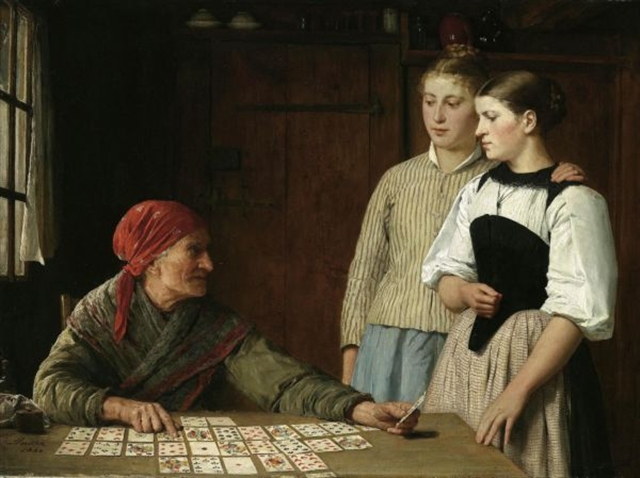
“Die Kartenlegerin” (1880) by Swiss artist Albert Anker
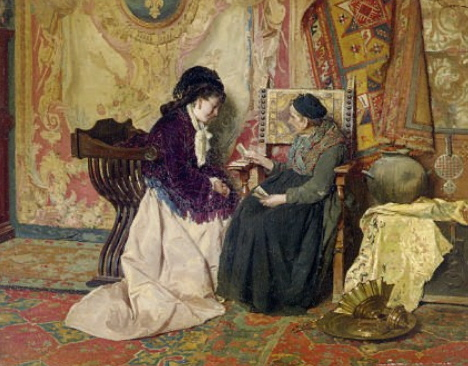
Maccari, The Fortune Teller
See more paintings of nineteenth century cartomancers here.
Additional Links
-
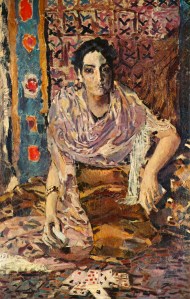
Fortune Teller by Mikhail Vrubel, 1895
Watch the 45 minute History Channel TV special on “Secrets of the Playing Card.”
- The best source on the history of playing cards is The World of Playing Cards.
- See especially Ross Caldwell’s presentation on playing cards (including Tarot) in divination and magic for the International Playing Card Society, September, 2006 – here, and his more recent report on references in Spanish documents here. I want to thank Ross for his historical professionalism and dedication to setting the story straight with concrete evidence.
- An account of cartomancy that draws from Chambers: The Gaming Table: its Votaries and Victims, Vol. II (1870) by Andrew Steinmetz – here. A set of modern playing card meanings can be found here. Seaqueen’s examples of cartomancy readings with a wide variety of decks are here.

Updates:
2/1/2015: Lots of 17th and 18th century material added, including photos, a 1791/3 book on “card tossing,” and more information on the card and coffee-ground reading from 1730.
2/1/2014: Information on the Mamluk cards inscriptions below comes from The World of Playing Cards website. A few notes added on the Grand and Petit Lenormand decks.
5/2011: There are a scattering of references to cards and their use in “lots” (sortes) or fortune-telling from the 15th century on, including analogies between the four suits and characteristics such as the virtues and the elements. Recently Ross Caldwell discovered a treasure-trove of Spanish references that he describes here. He notes: “The main points to be taken from the recent discoveries are that, in Spain at least, there were professional cartomancers in the 17th century, and they used layouts with multiple cards and positional significations.” Follow the trail of evidence below (and add to it Ross’s recent contributions) to see the development of divination with cards.
 Most of us have heard of Mlle. Lenormand, known for having read cards to make predictions for Napoleon and Josephine, but few know much more than this about the most famous card-reader of all time. She was born May 27, 1772 in Alençon, France and died June 25, 1843, having written over a dozen books. Look over her natal chart analysis by Elizabeth Hazel in the Comments (thank you, Liz). Marie Anne Adelaide Lenormand claimed to have obtained her first deck of cards when she was 14 from gypsies who taught her how to read them.
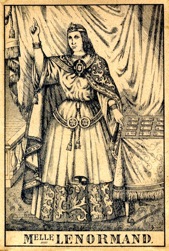
It wasn’t until two years after her death that a deck of cards called “Le Grand Jeu de Mlle. Lenormand” was first published by Grimaud. This 54 card deck was actually created by a Madame Breteau, who claimed to be a student of Madame Lenormand. (It is pictured in the Dumas story in this post.)
The 36-card “Petit Lenormand” was a German creation that, in 1845, appropriated the now-dead Mlle. Lenormand’s famous name. This deck was based on an earlier race game and multi-purpose set of cards called the “Spiel der Hoffnung” (“Game of Hope”; 1798) and the even earlier Viennese Coffee Cards (1794/6), published in both German and English.
Because Lenormand’s own memoirs were written as self-promotion and reveal little about her techniques, I’ve focused in this post on first person accounts of readings with her where we get some idea as to her character and methods. An overview of her life is available at trionfi.com. A short biography published 15 years after her death can be found here. New information by Jim McKeague based on newspaper accounts and a court case is available here. Learn to read the various Lenormand-style decks here, here, here and also here. Get a computerized Mlle. Lenormand-style reading here. Several portraits are available here and card meanings here.
Recordings of webinar classes by me teaching the Petit Lenormand deck (and also Tarot) are available through GlobalSpiritualStudies.com. (See additional links at the end.)
Updated 2/1/2015
In the Sibyl’s Boudoir
You can imagine my delight in coming across this first-person account of a visit to Madame Lenormand made by Captain R. H. Gronow of the Grenadier Guards & M.P. for Stafford in his book Celebrities of London and Paris (London: Smith, Elder & Co., 1865). Gronow probably met her during his 1815-1816 stay in Paris.
“One of the most extraordinary persons of my younger days was the celebrated fortune-teller, Mademoiselle le Normand. Her original residence was in the Rue de Tournon, but at the time of which I write she lived in the Rue des Sts Pères. During the Restoration, the practice of the “black art” was strictly forbidden by the police, and it was almost like entering a besieged citadel to make one’s way into her sanctum sanctorum.

“I was first admitted into a good-sized drawing-room, plainly but comfortably furnished, with books and newspapers about, as one sees them at a dentist’s. Two or three ladies were already there, who, from their quiet dress and the haste with which they drew down their veils, or got up and looked out of the window, evidently belonged to the upper ten thousand. Each person was summoned by an attendant to the sibyl’s boudoir, and remained a considerable time, disappearing by some other exit without returning to the waiting-room. At last I was summoned by the elderly servant to the mysterious chamber, which opened by secret panels in the walls, to prevent any unpleasant surprises by the police. I confess that it was not without a slight feeling of trepidation that I entered the small square room, lighted from above, where sat Mademoiselle le Normand in all her glory.
 “It was impossible for imagination to conceive a more hideous being. She looked like a monstrous toad, bloated and venomous. She had one wall-eye, but the other was a piercer. She wore a fur cap upon her head , from beneath which she glared out upon her horrified visitors. The walls of the room were covered with huge bats, nailed by their wings to the ceiling, stuffed owls, cabalistic signs, skeletons – in short, everything that was likely to impress a weak or superstitious mind. This malignant-looking Hecate had spread out before her several packs of cards, with all kinds of strange figures and ciphers depicted on them. Her first question, uttered in a deep voice, was whether you would have the grand or petit jeu, which was merely a matter of form. She then inquired your age, and what was the colour and the animal you preferred. Then came, in an authoritative voice, the word “Coupez“, repeated at intervals, till the requisite number of cards from the various packs were selected and placed in rows side by side. No further questions were asked, and no attempt was made to discover who or what you were, or to watch upon your countenance the effect of the revelations. She neither prophesied smooth things to you nor tried to excite your fears, but seemed really to believe in her own power. She informed me that I was un militaire, that I should be twice married and have several children, and foretold many other events that have also come to pass, though I did not at the time believe one word of the sibyl’s prediction.
“Madamoiselle le Normand was born in 1768, and was already celebrated as a fortune-teller so early as 1790. She is said to have predicted to the unfortunate Princess de Lamballe her miserable death at the hands of the infuriated populace. She is also reported to have been frequently visited and consulted by Robespierre and St Just; to have reported his downfall to Danton, at that time the idol of the people; to have warned the famous General Hoche of his approaching death by poison; to have foretold to Bernadotte a northern throne, and to Moreau exile and an untimely grave.
“The Empress Josephine, who, like most creoles, was very superstitious, used frequently to send for Madamoiselle le Normand to the Tuileries, and put great faith in her predictions; which she always asserted in after years had constantly been verified. But, unfortunately for the sybil, she did not content herself with telling Josephine’s fortune, but actually ventured to predict a future replete with malignant influences to the Emperor himself. This rash conduct entailed upon her great misfortunes and a long imprisonment; but she survived all her troubles, and died as late as 1843, having long before given up fortune telling, by which she had amassed a large sum of money.”

Danhauser: Neapoleon & Josephine with the Card Reader
Spellbound by the Prophetess
And from The Diary of Frances Lady Shelley (NY: Scribner’s Sons, 1912) we find that on July 4, 1816 Lady Shelley went to see Madame Le Normand:
“I was shown into a beautiful boudoir, furnished with a luxury which gave evidence of her prosperity. After waiting for some time, the prophetess appeared, and exclaimed “Passez, madame.” She then introduced me into a dimly lit cabinet d’étude. On a large table, under a mirror, were heaps of cards, with which she commenced her mysteries. She bade me cut them in small packets with my left hand. She then inquired my age—à peu prés—the day of my birth; the first letter of my name; and the first letter of the name of the place where I was born. She asked me what animal, colour, and number I was most partial to. I answered all these questions without hesitation. After about a quarter of an hour of this mummery, during which time she had arranged all the cards in order upon the table, she made an examination of my head. Suddenly she began, in a sort of measured prose, and with great rapidity and distinct articulation, to describe my character and past life, in which she was so accurate and so successful, even to minute particulars, that I was spellbound at the manner in which she had discovered all she knew.”
Like a Virgin Druidess
Writing eleven years after her death, the great magician Eliphas Lévi had this to say about Mlle. Lenormand (his reluctantly ambivalent admiration shown only through a few left-handed compliments):
“Mlle Lenormand, the most celebrated of our modern fortune-tellers, was unacquainted with the science of Tarot, or knew it only by derivation from Etteilla, whose explanations are shadows cast upon a background of light. She knew neither high Magic nor the Kabalah, but her head was filled with ill-digested erudition, and she was intuitive by instinct, which deceived her rarely. The works she left behind her are Legitimst tomfoolery, ornamented with classical quotations; but her oracles, inspired by the presence and magnetism of those who consulted her, were often astounding. She was a woman in whom extravagance of imagination and mental rambling were substituted for the natural affections of her sex; she lived and died a virgin, like the ancient druidesses of the isle of Sayne*. Had Nature endowed her with beauty, she might have played easily at a remoter epoch the part of a Melusine or a Velléda**.” (Transcendental Magic: its doctrine and ritual by Eliphas Lévi, translated by A. E. Waite.)
[*According to Paul Christian, the Celtic hero Vercingetorix went to the druidesses of Sayne seeking oracles that would help him defeat Caesar. **There are many legends of Melusine, a kind of water nymph or mermaid who enchanted men, brought them great gifts and then would disappear if betrayed. Velléda was a prophet and virgin priestess whom the ancient Germans revered as a living goddess.]
From the Journals of Washington Irving
Washington Irving writes of a dinner conversation that included Sir Henry Lytton Earle Bulwer, brother to the occultist Bulwer-Lytton:
“Speaking of Mad. La Norman, the famous fortune-teller, Bulwer said he had once been to see her—found her ingenious—prone to put questions and draw hints and conclusions from the replies.
“Walewsky told of his having some years since called upon her, knowing that a beautiful woman with whom he had some liaison was about to call on her. Madam La Norman began to talk to him in the usual way but he repeatedly interrupted her, telling her he had no occasion for her science, but had come to aid it. He described the lady who was coming to consult her. He related many striking facts concerning her. He stated what might be said to her as to the future—”I do not advise you to tell all these things,” said he, “I counsel nothing; you may do as you please, but here are six Louis for you.” So saying he took his leave. The lady’s fortune past and future was told in a manner to astonish her, and greatly to the advantage of Mr. Walewsky.”
A Prediction of Fame & Unrequited Love
Read about Marie d”Agoult and Eugène Sue’s readings with Mlle. Lenormand in 1834 HERE.
Treacherous and Ridiculous Insinuations
Jim McKeague in his blog writes in detail about a 1839 court case in which Mlle. Le Normand was embroiled four years before she died. Read the details of this fascinating event HERE, and HERE, while I briefly summarize Mlle. Lenormand’s own words from a letter she wrote to a journal editor to explain her part in the case and gives an inkling of her self-promotion:
“For many years Lord Stirling, a Scottish peer [whose family she had known since 1814], has been reclaiming the heritage of his ancestors; yet today there is even a dispute as to his name and his legal titles. A chart of Canada by Guillaume de Lisle, First Geographer to the King, and covered with precious autographs of Fenelon, Flechier, Louis XV, etc., was submitted in support of the claim in question [given to him by Mlle. Lenormand in exchange for a bond for 400,000 francs]. . . . And it is I who am accused of having co-operated!!! [The chart was eventually proved a forgery.] …
“All my efforts have tended for good; often I was quite happy to see them crowned with success, and it is with great pride when I think back to the ill-fated days of our bloody revolutions, I think of the many victims whom I could snatch from the scaffold or conceal from infamy, of the horrors of hunger.
“Like every good soul born, I have selflessly spread some benefits to the miserable, and offer consolations to suffering souls. Also my dedication in adversity, my firmness, all my conduct, has received at all times the approval of various parties. …
“Always willing to lend a helping hand to the oppressed, Miss Le Normand therefore wants the trial which is engaging Lord Stirling to be delayed; she asks this of all the authorities in order to enter the lists and contribute toward finding the truth.”
As Jim McKeague says in his blog: “The presiding Judge, Lord Meadowbank, in his summing up to the jury, was savage in his criticism of Marie-Anne Lenormand. Speaking of Humphrys-Alexander’s sojourn in Paris in 1836-7, the judge said that he was proved ‘to have been constantly engaged in negotiating with this sybil (sic) – this notorious adventuress in Paris, to whom at least the uttering of these forged documents has been traced – a person obviously of the worst character, and who, although she says that a lie never passed her lips, is proved to you to have had no profession but that of fortune-telling – no means of subsistence but that of imposture, and of telling falsehoods from morning to night.’“
An Obituary and a “Curious Account”
This may be one of the first fictionalized (and sensationalized) accounts of a reading with Mlle. Lenormand: HERE.
Consulting the Sybil
This description is from a German book on fortune telling from 1860. The translation may be a little rough:
“Above the door was a sign with the words:
Mlle. Lenormand – Bookseller.
The profession of Sybil had not yet been sanctioned by the law, and just as every transaction had to bear a legal title in order to justify a levy, Mlle. Lenormand had sought and obtained a patent as a bookseller. She received her clients undisturbed here, and could conduct her prophecies here, without attracting suspicions among the police. In her capacity as a bookseller, she was even in the royal National almanac.
When a person came into Lenormand’s consulting room, the bell of the oracle was rung, a maid opened the door, and led the visitor into a room which was less than sibylline. Lenormand spurned the usual household of the vulgar fortune-tellers, she surrounded herself with no kind of phantasmic decoration. The interior of the room was bourgeois. On the wall, in two rows, about thirty volumes of books were seen . . . recent books by herself and those more or less cabalistic.
After having had time to look around, Mlle. Lenormand appeared. In later years she was a small, strong woman, with a large blond wig on which an oriental turban was thrust.
“What services do you wish?” She usually asked the visitor.
“Madame, I come to consult you.”
“Good! Place yourself here. – Which playing card reading do you want? I have them from 6 francs, 10, 20 and even 400 francs.”
“I believe something in the price of a Louis d’or.”
“Well, then, come to this table and show me your hand.”
“Here it is!”
“Not that one, the left. – What is your age? What flower do you prefer? What animal is it before whom you feel the most resentment?” All these questions asked with a monotonous, nasal voice.
With every reply she repeated: “Good!
And, passing over the playing-cards she presented them to the client: “So, cut with your left hand!”
Then she would turn the cards one after the other, and spread them on the table, and now she set out [the meaning of] the cards at a speed that one was scarcely able to follow her. It was as if she were reading from a book, or as if she were teaching a learned lesson. In this seemingly contradictory stream of speeches, one was suddenly illuminated as by a beam of light. 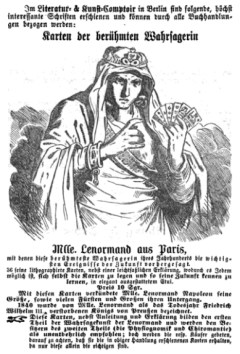 The Sybil excelled particularly in the investigation of the character, inclinations, and taste of the persons who sought them. She never failed to give her visitors information about the past, and the correctness of this is also confirmed by all who have ever had the opportunity to visit this strange woman.
What is even more, those who visited her always found a great pleasure in her prophetic conversation.”
From The most complete , and the only true, art of the fortune-telling of the most famous fortune-teller of the world-magnificence, Lenormand, Verlag des Literatur- und Kunst-Comptoirs, 1860. In addition to a biography of Mlle. Lenormand, the book contained this ad for their 36-card Lenormand deck:
The First Republic
One of the most fascinating stories of Mlle Lenormand is the account in The First Republic, or The Whites and the Blues (Les Blancs et Les Bleus, 1867-68) by Alexandre Dumas, author of The Three Musketeers. This work is part of a series of Napoleonic romances that begin with the Revolution and end with the fall of the Empire. Volume 2 contains chapters called “The Seeress” and “The Occult Art” in which Lenormand reads for both Josephine and Napoleon (who have not yet officially met). Dumas, writing nineteen years after Lenormand’s death, claimed that what he wrote was not fiction:
“I can guarantee the truth of this scene, for these details were given me by the friend and pupil of Mademoiselle Lenormand, Madame Moreau, who still lives (1867) at No. 5 Rue du Tournon, in the same rooms as the famous seeress, where she devotes herself to the same art with immense success.”
It seems that one evening Josephine Beauharnais and her friend Therese Tallien decided to see the fashionable seeress, Mademoiselle Lenormand. They disguised themselves as waiting-maids or ‘grisettes,’ and, using false names, made their way to Rue de Tournon No.7. There they were shown into an inner salon to await their turn. A young man silently joined them as he waited for his turn to have his fortune revealed. Therese Tallien went first into the inner chamber and learned that she is to become a princess. What follows is from Dumas’s text:
“Mademoiselle Lenormand at this period of her life was a woman somewhere between twenty-four and twenty-nine years of age; short and stout in figure, and concealing with difficulty that one shoulder was larger than the other. She wore a turban adorned with a bird of Paradise, a fashion of the day. Her hair fell in long curls on either side of her cheeks. She wore two skirts. . . . Near her, on a stool, was her favorite greyhound, Aza. The table on which she did her marvels was a plain round table with a green cloth on top and drawers, in which she kept her cards. . . . Facing the sibyl was an arm-chair, in which the consulting person was seated. Between that person and the seeress lay an iron wand, which was called the divining-rod; at the end turned toward the consulting person was a little iron snake. The opposite end was made like the handle of a whip or cane. . . .
Mademoiselle Lenormand made a sign to Josephine to take the chair which Madame Tallien had just left; then she drew a fresh pack of cards from her drawer, possibly to prevent the destiny given by the last pack from influencing that of the present. Then she looked fixedly at Madame de Beauharnais.
‘You and your friend have tried to deceive me, madame,’ she said, ‘by wearing the clothes of servants. But I am a waking somnambulist. I saw you start from a house in the centre of Paris; I saw your hesitation about crossing my threshold; and I also saw you in the antechamber when your proper place was the salon, and I went there to bring you in. Don’t try to deceive me now; answer my questions frankly; if you want the truth, tell the truth.’
Madame de Beauharnais bowed.
‘Question me, and I will answer truly,’ she said.
‘What animal do you like best?’
‘A dog.’
‘What flower do you prefer?’
‘The rose.’
‘What perfume is most agreeable to you?’
‘That of the violet.’
The seeress placed a pack of cards before Madame de Beauharnais, which was nearly double the size of an ordinary pack. These cards had been lately invented, and were called “the grand oracle.”
‘Let us first find where you are placed,’ said the seeress.
Turning over the cards, she moved them about with her middle finger until she found “the consultant;” that is to say, the image of a dark woman, with a white gown and deep embroidered flounce, and an overdress of red velvet forming a train behind, the whole on a rich background. This card was lying between the eight of hearts and the ten of clubs.
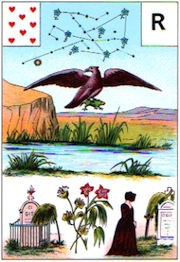 ‘Chance has placed you well, madame. See, the eight of hearts has three different meanings on three different lines. The first, which is the eight of hearts itself, represents the stars under whose conjunction you were born; the second, an eagle seizing a toad from a pond over which it hovers; the third, a woman near a grave. Listen to what I deduce from that first card madame. You are born under the influence of Venus and the Moon. You have just experienced a great satisfaction, almost equal to a triumph. That woman dressed in black beside a grave indicates that you are a widow. On the other hand, the ten of clubs pledges the success of a rash enterprise of which you are not yet aware. It would be impossible to have cards of better augury.’
Then, shuffling the cards, but leaving the “consultant” out, Mademoiselle Lenormand asked Madame de Beauharhais to cut them with her left hand, and then draw out fourteen of them, and place those fourteen in any order she like beside the “consultant,” going from right to left as the Eastern peoples do in their writings. . . .
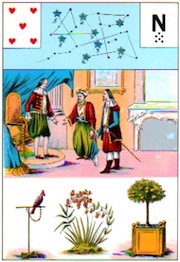 ‘Really, madame,’ she said, ‘you are a privileged person. I think you were right not to be frightened away by the fate I predicted for your friend, brilliant as it was. Your first card is the five of diamonds; beside the five of diamonds is [the five of hearts] that beautiful constellation of the Southern Cross, which is invisible to us in Europe. The main subject of that card, which represents a Greek or Mohammedan traveller, indicates that you were born either in the East or in the colonies. The parrot, or the orange-tree, which forms the third subject, makes me think it was the colonies. The flower, which is a veratrum, very common in Martinique, leads me to think you were born on that island.’
‘You are not mistaken, madame.’
‘Your third card, the nine of diamonds, indicating long and distant journeys, implies that you left that island young. The convolvulus, which is pictured at the bottom of this card, represents a woman seeking a support, and makes me suppose you left the island to be married.’
‘That is also true, madame.’
‘Your fourth card is the ten of spades, and that indicates the loss of your hopes; nevertheless, the flowers of the saxifrage which are on the card authorize me to say that those griefs will pass away, and that a fortunate issue—a marriage probably—has succeeded those distresses which at one time seemed to exclude all hope.’ . . .
[Lenormand correctly divines that Josephine’s husband died a violent death on the scaffold, that she has a son and daughter, and that the son is involved in an ‘affair of the sword’ but that hope will never fail him.]
‘And here, madame, is the eight of spades, which is a sure indication of marriage. Placed as it is next to the eight of hearts,—that is to say, near the eagle rising to the skies with a toad in his talons,—the eight of hearts indicates that this marriage will lift you above even the loftiest spheres of social life. But, if you doubt it, here is the six of hearts, which, unfortunately, seldom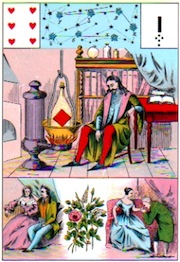 accompanies the eight,—that six of hearts in which the alchemist is looking at his stone now turned to gold; in other words, common life changed to a life of honor, nobleness, and high employments. See, among these flowers, is the same convolvulus, which entwines a broken lily: that means, madame, that you will succeed, you who seek a support, you will succeed—how shall I tell you this?—to all that is highest and noblest and most powerful in France,—to the broken lily: you will succeed that lily in a new sphere; passing, as the ten of spades has shown, over battlefields where—see on that card—Ulysses and Diomed drive the white horses of Rhesus, placed under the guardianship of the talisman of Mars.’
‘When you reach that point, madame, you will have the respect and the tender regard of every one. You will be the wife of that Hercules strangling the lion in the forest of Nemaea; that is to say, a useful and courageous man exposing himself to all dangers for the good of his country. the flowers which crown you are lilacs, arums, immortelles; for you will combine in your own person true merit and perfect kindness.’
She rose, with a movement of enthusiasm, caught Madame de Beauharnais’s hand, and knelt at her feet.
‘Madame,’ she said, ‘I do not know your name, I do not know your rank, but I know your future. Madame, remember me when you are —empress.’
‘Empress! I? You are mad, my dear.’
‘Eh, madame! do you not see that your last card, the one that leads the fourteen others, is the king of hearts; that is to say, the great Charlemagne, who bears in one hand a sword, in the other a globe? Do you not see on the same card a man of genius who, with a book in his hand, and a map at his feet, meditates on the destinies of the world? And, lastly, see on two desks opposite to each other, the books of Wisdom and the laws of Solon; those books prove that your husband will be not only a great conqueror, but a great lawgiver.’
[Josephine cries, ‘Impossible!’ and immediately leaves. Meanwhile, the young man who has been waiting his turn in the salon has ignored all the efforts of Therese Tallien to discover anything about him. He, too, has tried to disguise his real persona, but Mademoiselle Lenormand sees through it. She offers him many forms of divination and he chooses a palm reading.]
‘Your hand is the most complete of any that I have seen; it presents a mixture of all virtuous sentiments and human weaknesses; it shows me the most heroic of all characters and the most undecided. . . . The enigma I am about to read to you is far more difficult of interpretation than that of the Theban sphinx, for though you will be greater than Oedipus, you will be more unfortunate.’ . . . [She describes his rise and fall and several injuries he will sustain.]
‘But,’ said the young man, ‘ this is the second or third time you have mentioned an alliance which will protect the first eight lustres [glories] of my life. How am I to know that woman when I meet her?’
[Lenormand describes the dark-haired Josephine. She warns Napoleon that eventually he will forget Providence gave him her as a companion, and that he will abandon that companion. Then his happiness will be destroyed by a second wife, who is fair and the daughter of kings.]
‘You will be Alexander, you will be Caesar: you will be more than that,—you will be Atlas bearing the world on your shoulders. . . . As success came to you through a woman, so it will leave you through a woman.’ . . .
‘It is Caesar’s fate that you predict for me.’
‘More than Caesar’s fate,’ she replied; ‘for Caesar did not attain his ends, and you, you will attain yours. Caesar only placed his foot on the steps of a throne, you will sit upon the throne itself. Only do not forget the dark-haired woman, who has a sign above the right eyebrow, and puts her handkerchief to her lips when she smiles.’
‘Where shall I meet that woman?’ he asked.
‘You have already met her,’ replied the sibyl; ‘and she has marked with her foot the spot at which the long series of your victories will begin.’
It should be noted that the deck of cards described in the text,”Le Grand Jeu de Mlle. Lenormand” is known to have only been created after the death of Mlle. Lenormand, although it was named after her in order to take advantage of Lenormand’s fame. The book that came with my deck is dated 1845.
Society Under the First Empire
Here are a few short quotes from The Court of Napoleon: or, Society under the first empire by Frank Boott Goodrich and Jules Champagne, (New York, 1858). [Thanks to Caitlin Matthews for passing this on.]
M’lle Marie-Anne Lenormand, the most distinguished sibyl of modern times, the counsellor of Robespierre, Napoleon, and the Czar Alexander, the confidante and biographer of Josephine, and who possessed the ability to subject the most brilliant and enlightened court of Europe to the authority of her shuffles of cards and perusals of palms, merits more than a passing notice. . . .
She rejected cartomancy, or the art of reading cards. It is true that she used cards, but this was merely cabalistically, for the sake of the figures upon them, and to aid her in numerical processes. . . .
M’lle Lenormand became, therefore, the protégée, and was, in a certain sense, the object of the affectionate consideration, of Josephine. Her cabinet was now crowded with the elite of Parisian society—priests, nobles, magistrates and soldiers. The visitor to the dwelling of the pythoness was shown into a room in which books, prints, paintings, stuffed animals, musical and other instruments, bottles with lizards and snakes in spirits, wax fruits, artificial flowers, and a medley of nameless articles, covered the walls, the table and the floor, leaving the eye scarcely an unoccupied spot to rest upon.
The furniture of the cabinet of consultation was in maple; the walls were adorned with portraits of the Bourbons, with a painting by Greuze of great value, and with her own portrait by Isabey. Her cards, which were of large size and covered with colored hieroglyphics, were painted by Carle Vernet. . . .
On one occasion M’lle Lenormand was summoned by Fouché to his cabinet. He reproached her for the aid and comfort she had given to the Bourbons by her late predictions. She paid no attention to his complaints, being engaged in shuffling a pack of cards, and muttering from time to time, “The knave of clubs!” He then said that he intended to send her to prison, where she would probably remain a long time. “How do you know that?” she returned. “See, here is the knave of clubs again, and he will set me free.” “Oh, ho! the knave of clubs will set you free, will he? And who is the knave of clubs?” “The Duke de Rovigo, your successor in office.” . . .
One of the biographers of M’lle Lenormand has remarked, witch or no witch, a certain share of admiration will always be due to her, for having contrived to be believed in an age which neither believed in God and his angels, nor in the devil and his imps. . . .
In detailing the incidents of M’lle Lenormand’s life, we have sufficiently described the sate of the art of fortune-telling in France and the consideration with which it was regarded, during the period of her professorship. Her success does not seem to have been derived from any previous credit accorded to the art of necromancy, but was the result rather of her remarkable skill and the tendency of an atheistic age to fill the void it had itself created, with superstitious dreams. She estabished a faith in astrology and chiromancy, for a time; they fell, however, into disrepute at her death, being afterwards exercised only by acknowledged charlatans, and obtaining support only from the ignorant and the credulous.
More Lenormand-style deck resources (see others in the intro paragraph at top):
- Examples of historic decks can be found at the Lenormand Playing Card Museum.
- Overview of spreads and meanings. Bio, tutorial & meanings.
- A brief overview of material from the highly regarded Treppner course.
- Here’s a book and a forum discussion with its author.
- A Lenormand blog with videos.
 Mary K. Greer has made tarot her life work. Check here for reports of goings-on in the world of tarot and cartomancy, articles on the history and practice of tarot, and materials on other cartomancy decks. Sorry, I no longer write reviews. Contact me
 Mary K. Greer's Tarot Blog
Recent Comments