You are currently browsing the category archive for the ‘Tarot History & Research’ category.
This 18th century play contains the earliest description of cartomancy in action. The text below is from Jack the Gyant-Killer: A comi-tragical Farce of One Act as it is Acted at the New-Theatre in the Hay-Market [London]. Again, thanks go to Stephen J. Mangan, (aka Kwaw) at Aeclectic’s tarotforum for finding it.
In this play, Jack (the Knave of Spades) strives to have Reason triumph over the woman Folly (the Queen of Hearts) who is attended by four Giants (named as they are in the traditional Jack-and-the-Beanstock story). Three other women offer predictions using Coffee, Tea, Snuff and, finally, Cards—which we are told are newly invented for fortune-telling.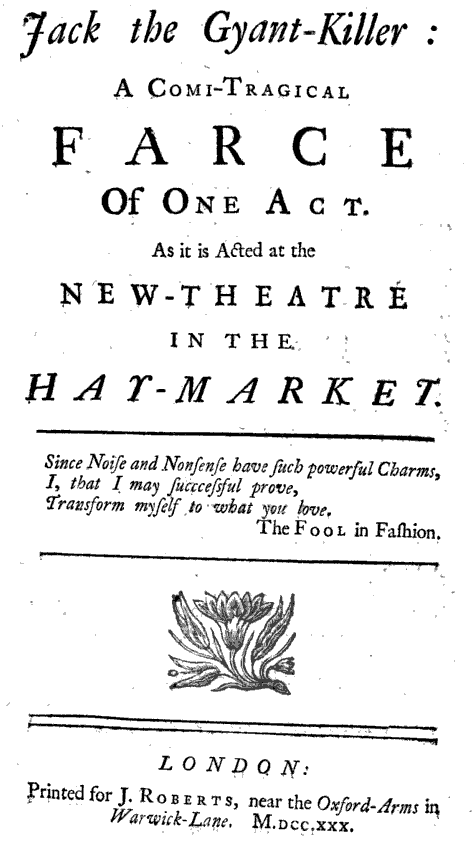
Folly. First we’ll examine the decrees of Fate,
In mystic Coffe-Cups and Tea reveal’d;
Then new-invented Arts of Snuff and Cards,
Shall all be try’d, the grand Event to shew,
If we, my Friends, shall conquer, or the Foe. . . .
Folly. You shall be satisfy’d anon- ….. — but we must lay the Cards first — Time presses, and the Princes must depart. Give us the Cards, that in our several Turns we all may Cut : I am the Queen of Hearts.
First Woman gives the Cards to Folly, then to each of the Gyants, who cut, and deliver to her again, and he lays on the Table in Rows.
First woman. You. Lord Gormillan, are the King of Clubs; Lord Thunderdale shall be the angry Majesty of Spades; The Diamond Crown Lord Blunderboar shall wear; and King of Hearts Lord Galligantus shall assume.
The Knave of Spades, Madam, seems to threaten Danger, but he lies oblique, and the Ten of Hearts between them shews he wants Power to hurt you — ‘the Eight of Clubs and Ace over your Head denote A chearful Bowl and Mirth will crown Night — all will be well — these Princes are surrounded with Diamonds; the Eight lies at the Feet of Lord Gormillan; the Deuce, the Four and Five are in a direct Line with Valiant Thunderdale; the Tray and Nine are at the Elbow of great Blunderboar, and the Six and Seven are just over the Head of noble Galligantus. Some Spades of ill aspect mingled with them, but the Hearts and Clubs take off their malevolent Quality.
Folly. Go then, my Friends, secure of Fame and Conquest, The Oracles pronounce it.
Ha! what Noise? {A great Noise ..}
Enter a Messenger out of Breath
Mess. Ah, Madam ! you are lost! — all-conquering Jack with his Retinue has broke into your Palace — behold ’em here—
Enter Jack and his Party, they throw down the Table, Cups, Cards, &c.
Jack. Fall on, my Friends
The cards were probably laid out in several rows, perhaps a square of 25 as we see in later examples. The significator card shows the location of the person within the situation, while the other court cards represent the other people involved. The cards that fall between the main significator and the significator of another person show what is occurring between them. Folly reads the overall fortune as “secure of Fame and Conquest.” Nevertheless, Folly is ultimately defeated, which may well be the lesson of this play, since, from the point of view of Reason, its main task is to overthrow Folly. (Note: this is an addition to an earlier post on the Origins of Playing Card Divination.)
 To Stephen J. Mangan (aka Kwaw) at Aeclectic’s tarotforum we owe two recent finds on the early history of fortune-telling with playing cards. I include one here (the other soon) with his blessings. More and more references are turning up as google puts old books that are out-of-copyright on the web.

This 1820 description of a revealing card reading was published as part of an excerpt, titled “Confidential Servants” from a French work, Les Jeunes Femmes, of M. Bouilly, as published in Belle Assemblee: Or, Court and Fashionable Magazine.
To discover what her husband did the previous night, Madame de Saucerre has her maid read the cards. What is revealed, however, is the story of her own affair with a younger man:
“Good! well, let us see, now we are alone. M.de Sancerre, who did not come home till midnight, will not come in before breakfast to give me an account of his sport.”
“Will Madame have the whole fortune?”
“Certainly.”—
“Cut. Remark, now, that Queen of Hearts, young and blooming, with that King of Spades, with his long beard, and thick mustache. Disparity of age, that always falls heavy on the youngest party — I dare say Madame has often found that out?”
“Go on.”
“Do you see near that Queen of Hearts where the Queen of Diamonds is placed? That is Friendship, opposed by this confounded King of Spades, the emblem of an uneasy and jealous churl. I’ll suffer my hand to be burnt if something of this kind has not happened to Madame?”
“In fact, he has made me break off intimacy with a female friend: but we ought to sacrifice every thing to domestic quiet.”
“Oh! Madame, here’s a pleasant circumstance! Do you see that charming Knave of Hearts, who shelters himself beside his Queen? How delighted he is! and I think he is pursued by the Queens of Clubs and Spades; those are old coquets, and spiteful enough. Poor young man! he has nothing for his defence but that Ace of Hearts, emblem of a pure mind. How they do beset him — how they torment him with that Ten of Spades and that Nine of Clubs, which signify the blackest designs! But here, very fortunately, is a Three of Hearts, surnamed the lance, which signifies that the handsome Knight is armed against his adversaries. Good! the Five of Diamonds, surnamed the shield, which proves that he will defend himself with bravery. Hai, hai; is not here a Knave of Clubs, agent of the two coquettes, and sent by them after this charming Knave of Hearts? Hai, hai, hai; see, too, that nasty King of Clubs taking part in the quarrel. Oh! charming Knave of Hearts, what will become of you ? Ah! I begin to breathe again: here is the Ten of Diamonds opposed against the Ten of Spades, and the Nine of Hearts that stands fast against the Nine of Clubs; and, at length, that excellent Queen of Hearts, who is always the protectress of her faithful Knight, shelters him from all attacks, and binds him to her for ever by his gratitude. I would pawn my honour that Madame has saved some handsome young man who has been pursued by two wicked women; and who cherishes for his dear deliverer a recollection——”
“What a mad creature you are,” answered Madame de Saucerre, with a blush; “come, cease this nonsense and finish dressing me.”
(Note: this is an addition to an earlier post on the Origins of Playing Card Divination.)
Is there any “true” way to lay the cards? Probably not. But here is the first tarot spread to appear in print. It is in an article by le Comte de M*** (Mellet) in Court de Gébelin’s Le Monde Primitif (1781). The spread instructions were followed by a sample interpretation—the dream of Joseph in the Bible. I decided that such a simple but powerful layout deserves to be brought back “into play.” Try it out for yourself.
The layout is best accomplished by two people working together, who have divided the deck into two stacks so that each has one of them:
Person 1 — the 56 Minor Arcana
Person 2 — the 22 Trumps (Major Arcana).
Each person takes their stack, shuffles it, and then simultaneously goes through the stacks card-by-card as follows:
Person 1: Turns the cards of the Minor Arcana over one-by-one while counting Ace, 2, 3, 4, … Page, Knight, Queen, King (use the court card names from your own deck), and continue counting with the Ace. Any card which has the same number or rank as that named is to be set aside. That is, if when counting 5, you turn over a 5 of any suit, that card is selected and put to the side.
Person 2: Goes through the Trumps at the same time, putting down a card each time Person 1 does so, but without turning it over. When Person 1 puts a card aside (because the number and the card matched), Person 2 takes the card he/she put down at the same time and turns it face up next to Person 1’s card to form a pair. When Person 2 has gone through all the Trumps, he/she picks up the reject stack and continues to put them down in the now-reversed order.
The process ends when Person 1 runs out of Minor Arcana cards.
Interpret the resulting cards as pairs.
 For example, in the first reading I did with this spread, the result of the count was:
Ace of Pentacles — Lovers
Ace of Cups — Sun
Three of Cups — Death
Knight of Wands — Star
These cards had an incredible feeling of power about them. My partner in the reading immediately said, “It’s all about the deaths!” and I realized he was right. We had just found out about the deaths of three people we knew (Three of Cups plus Death). Three incredible people—each making the transition (Knight of Wands) to another world in their own way. They were being shown to us as Beings of Light (the Sun) starting a new phase of existence (the two Aces). I was awed by the beauty of their souls that radiated out from these cards as if reborn in the spirit (the Sun). It was good to feel that they were with loved ones (Three of Cups and Lovers), and it seemed to me that they were riding (Knight of Wands) towards their highest destiny (Star). I took it as a message to us from the other side, saying that they were all right and just where they should be. (Deck: The Albano-Waite Miniature Tarot Cards.)
In the previous post on the origins of divination with playing cards I included a book called The Square of Sevens, and the Parallelogram: An Authoritative Method of Cartomancy with a Prefatory Note by Robert Antrobus that was supposedly written in 1735 and then edited and republished in 1896 by E. Irenaeus Stevenson. I’ve had suspicions for a while that this work was a literary hoax, which is now borne out by a review in 1897 that reveals all (see Update below).
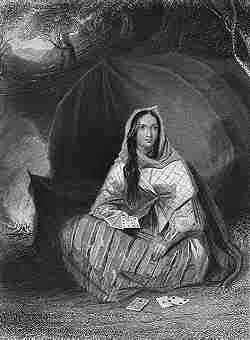 According to Irenaeus Stevenson, the original book tells how, around the year 1730, Robert Antrobus, “a Gentleman of Bath,” on a trip to Cornwall stayed at an inn where a dying man also lodged. Antrobus came to the aid of this George X— who, it turned out, was a gypsy of unusual education and breeding. During their time together, Mr. Antrobus agreed to care for Mr. George’s young daughter and Mr. George, in turn, revealed many secrets of the gypsies. Among these is a method of dukkeripens (divination) by playing cards. In 1735, so the story goes, Mr. Antrobus chose to publish this “betrayed secret” through John Gowne of The Mask bookshop. Unfortunately, a printing-house fire destroyed all except a dozen or so copies of the work.
In 1896, along comes E. Irenaeus Stevenson of New York, who republishes the work so that it may, “in our social day serve a lighter end—and entertain the parlor.”
What follows is an extremely complicated way of dealing out the cards for a Querist, resulting eventually in a rectangle (parallelogram) of 21 cards in 3 columns of 7. Each of the cards in the left column is a Master Card, which is modified by the two cards to its right. An additional three cards are called “Wish Cards.”
The cards are then read from interpretations given in a “Tavola [Table] of Significancies” in which a short meaning is given for each card as Master Card, followed by how the suits of the cards to its right will modify that meaning.
Red suits are auspicious and kind; black suits are unpleasing and less favorable.
• The Suit of Hearts is that of the Affections, Passions, Fancies and Feelings.
• The Suit of Diamonds refers to the condition in Life, Society, Wealth, Position and the Fine Arts.
• In Clubs lies Judgment, Intellect, Will, the Affairs of a Man’s Brains, and what he doeth of his own Mastery and Genius.
• The ominous Spades are the suit of doubtful or worse prognosticks of arbitrary events outside Man’s control.
It should be noted that it is not at all unusual for esoteric texts to be given a romanticized and totally false lineage. The text is available here.
I noticed that our 19th century editor prefaced his story about the work’s 18th century origins with a quote from Hamlet, “Tis easy as lying,” and ended it with another quote:
BRADAMANTE. But is this authentic? Is it an original? Is it a true, original thing, sir?
GRADASSO (making a leg). Madam, ’tis as authentic as very authenticity itself—’tis truth’s kernel, originality’s core—provided you are but willing to believe it such.
BRADAMANTE. Sir, you quibble.
GRADASSO (making a leg). Madam, ’tis precisely in my vocation to quibble,—and delicately.
From The Superglorious Life and Death of Prince Artius: A Tragedy. Act LI., sc. li.
I asked tarot scholar Ross Caldwell what he thought of these quotes, which imply a willingness to lie and believe lies. Ross came up with enough evidence to indicate the work is a 19th century fable. For instance, there is no stage play about a Prince Artius, and certainly no play has 51 acts and scenes. Instead, Ross realized that “Act LI., sc. li.” can be read as “Actually silly.”
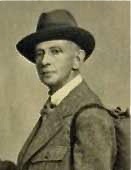 Edward Irenaeus Prime-Stevenson (1868-1942), an American, really existed and was a novelist and journalist, writing under several pseudonyms, and with a particular interest in 18th century history and opera. He is affectionately known today as “the father of American homophile literature,” being the first American to write openly about homosexuality. There was a Robert Antrobus who was a teacher at Eton but who died in 1730, ten years before Stevenson’s fictional Antrobus. He may have served as the model for Stevenson’s author.
As a final detail that proves this is all fiction, Stevenson wrote that Antrobus had written a “brochure on the Cock Lane Ghost.” When Ross checked this out, expecting a deadend, he found, instead, that the Cock Lane Ghost was an actual incident, but that it took place much later, in 1762, and it involved a hoax that rocked London. One hoax mentioned in another hoax—what could be plainer?
Ross Caldwell says about The Square of Sevens, “Given the era, it might be compared to Robert Chambers’ “The King in Yellow” (referring to an apocryphal book that drives its readers mad) or Lovecraft’s Necronomicon (itself perhaps inspired by Chambers).”
So, instead of an original 18th century work, we have a piece of 19th century fiction about gypsy card divination. Even the method of cartomancy was created by Stevenson (see update below).
UPDATE:
From “Literary Notes” by Laurence Hutton for Harper’s Magazine, Volume 94 (March 1897), a review of The Square of Sevens.
[Note: Stevenson worked as an editor for Harper’s, so we can assume that his co-worker, Hutton, got the following details directly from Stevenson.]
“Mr. Stevenson has evolved, out of nothing a certain Mr. Robert Antrobus, who lived in Bath during the reign of the Second English George. . . . ‘The Square of Sevens’ itself, it is needless to say, is as much an invention of Mr. Stevenson as is Mr. Antrobus. The ‘system,’ practically, is entirely his own; all the ‘significances,’ the general scheme and the idea of the work are purely original; although, here and there, they are in touch with the fundamental notions—all of them vague at best—of the professional cartomancists the wide world over.
“The author’s Editorial Preface is clever and entertaining; and it is not unlikely to deceive even the initiated. ‘The Square of Sevens’ is founded on recognized laws of recurrent chances; it will appeal to such as are interested in the occult sciences, and even the commonplace, ordinary ‘gorgio’ who is not a ‘dukker’ will recognize the charm, as well as the quaintness of the production.”
This post gets updated as new information appears. See update notes at the end for significant changes. In addition to the links at the end, I encourage you to read Michael S. Howard’s article on the development of divination and cartomancy here.
The 15th Century
1414 Barcelona – Joch de nayps moreschs

Two Barcelona inventories have entries for “joch de nayps (or ‘nahyps’) moreschs”. The Instituto Municipal de Historia in Barcelona formerly held several sheets of uncut woodblock cards of the Moorish design from around this period. Their similarity to the late 15th or early 16th century Mamluk playing cards is obvious. What makes this important to our discussion is that the latter cards (see below) have calligraphic texts along the tops of the cards consist of rhyming aphorisms that are clearly predictions of one’s fortune. Here are a few of the translations given on Simon Wintle’s outstanding website The World of Playing Cards. Decide for yourself what you would think if you drew a card with such a saying upon it:
“As for the present that rejoices, thy heart will soon open up“
“With the sword of happiness I shall redeem a beloved who will afterwards take my life“
“O my heart, for thee the good news that rejoices”
“Rejoice in the happiness that returns, as a bird that sings its joy”
“The alif rejoices and fulfils your wishes”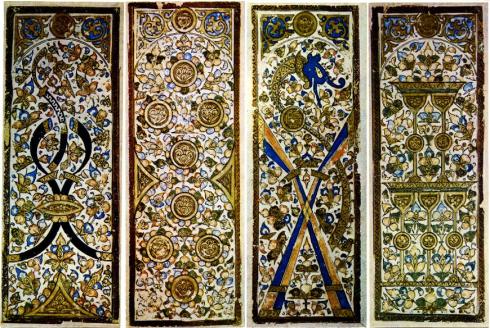
c. 1450 – Juego de Naypes
Ross Caldwell reports here on a Spanish “Juego de Naypes” (Game of Cards) by Fernando de la Torre, dedicated to the Countess of Castañeda, written around 1450. It is played with a 49 card deck, having only two court cards per suit plus an additional Emperador card “which wins over all the other cards” (que gane a todas las otras cartas). In this game “one can cast lots [tell fortunes] with them to know who each one loves most and who is most desired and by many other and diverse ways” (puédense echar suertes en ellos á quién más ama cada uno, e á quién quiere más et por otras muchas et diversas maneras). On each card is to be written a verse having the same number of lines as the number of the card, with each suit describing love according to different categories of women: Oros are Maidens, Copas are Wives, Bastones are Widows and Espadas are Nuns. Early Spanish/Morisca cards can be seen here.
This seems an unambiguous description of divination with playing cards that also includes a single additional “trump” card.
The 16th Century
1505 – “Lot” Books
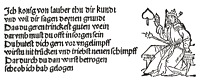
Playing cards were used for fortune telling in conjunction with the 1505 German Mainz Kartenlosbuch (literally, card-lot/fortune book). Fortunes in this work include such things as:
- You’re criticized because of too much avarice. You’ll lose a tooth and a thief will spend your money.
- You’ll have good luck, winning honors and riches.
- Secret sorrows, possibly connected to an old love.
Thanks to Huck Meyer at tarotforum for reminding me of this. See page from the text and more card meanings at Trionfi.com, which is, furthermore, one of the best sites on the history of tarot.
Lotbooks or (Losbücher) were described by Dr. Johann Hartlieb in 1456:
“One throws dice [or draws cards, mkg], until one reaches a number; in accordance with that number, one looks for the question [listed in the book], which the person has asked . . . there is nothing one will not find in these questions. Afterward one gets to an old man [often a king, god or hero] who points the way to a judge, who will explain the self-same questions [see illustration above]. This is all a singular disbelief and it stands in sharp opposition to God, for it has neither a spiritual or natural basis and is thus prohibited by the Holy Church in its decrees.”
Hartlieb is not entirely correct in that St. Augustine among other church officials spoke of the proper use of sortes (Latin for “lots”) to obtain answers. With the medieval sortes apostolorum or sortes des saints (composed specifically for divination rather than sortes sanctorum that is directly from scripture) one would consult them only after fasting on bread and water for three days and then a vigil with candles and the chanting of prayers (and sometimes a Mass) and the aspersion of holy water, upon which the sortes were deemed to be an “infallibly and entirely Christian oracle.” Of course, limiting the sources to apostles, saints, or scripture and the querents to those who could read Latin was an obvious attempt to limit divination to the educated few and forbid it to the multitudes.
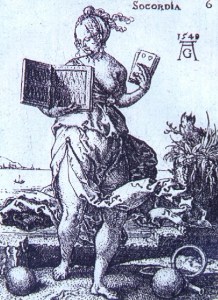 Socordia is Latin for laziness and idleness and so is shown with various games.

1507 – On the Foreknowledge of Things
In 1507 Francesco Pico della Mirandola (nephew of the better known Giovanni) wrote De rerum praenotione (“On the Foreknowledge of Things”) in which he supports the ability of divinely appointed prophets to know the future, while attacking all other forms of divination, including astrology, geomancy, palmistry and all kinds of sortilege/lots:
There are many kinds of lots [sortium], as in casting bones, in throwing dice, in the figures depicted in a pack of cards [in figuris chartaceo ludo pictis]; and in the expectation of whatever first should arrive, in picking the longer husk, or in casting the eyes on a page. [Thanks to Ross Caldwell–see link to his paper describing this at the end of this post.]
Being a work from Italy that specifically mentions the figures pictured on cards suggests that Pico may well have been referring to the tarot.
c. 1508 – “The Fortune-Teller” by Lucas van Leyden
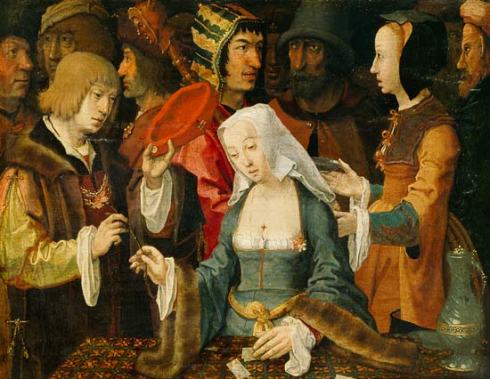
While this painting by Lucas van Leyden (1494-1533) has been called, in modern times, “The Fortune Teller” (c. 1508), it more likely commemorates Margarethe (Margaret) of Austria’s ascendancy to the governorship of the Netherlands in 1507 following the death of her brother, Philip the Handsome. Alternately, this painting may be commemorating Margarethe’s tragic three year marriage to Philibert (Phillip) of Savoy. By the age of 24 Margarethe had already lost a fiance and two husbands. She decided never to remarry and took the motto: FORTUNE . INFORTUNE . FORT.UNE (“Fortune, Unfortunate, Strength [in/of] One”}, which could be what is being symbolically portrayed. Both this painting and a 19th c. etching based on it has been cited as proof of early playing card divination (see “Chambers” below). Whatever is going on, it seems clear that the fall of the cards is an indicator of a fateful turn-of-fortune. Read my post here for more details. [Special thanks to Huck, Rosanne, and Alexandra—all who had pieces of the puzzle.]
1527 – Merlini’s Caos del Triperiuno
Teofilio Folengo’s 1527 work Caos del Triperiuno (written under the pseudonym Merlini Cocai) includes a series of poems representing the fortunes of people revealed by the cards dealt them. In this sonnet we find the twenty-two Triumph cards. Note that Death in Italian is the feminine la morte, and Love (Eros) is male. Love claims that although Death rules the physical body, Love never dies and therefore death is but a sham.
Love, under whose Empire many deeds (6, 4)
go without Time and without Fortune, (9, 10)
saw Death, ugly and dark, on a Chariot, (13, 7)
going among the people it took away from the World. (21)
She asked: “No Pope nor Papesse was ever won (5, 2)
by you. Do you call this Justice?” (8 )
He answered: “He who made the Sun and the Moon (19, 18 )
defended them from my Strength. (11)
“What a Fool I am,” said Love, “my Fire, (0, 16)
that can appear as an Angel or as a Devil (20, 15)
can be Tempered by some others who live under my Star. (14, 17)
You are the Empress[Ruler] of bodies. But you cannot kill hearts, (3)
you only Suspend them. You have a name of high Fame, (12)
but you are nothing but a Trickster.” (1)
Translated by Marco Ponzi (Dr. Arcanus) with help from Ross Caldwell and members of Aeclectic Tarot’s TarotForum.
 1540 – Marcolini’s Garden of Thoughts
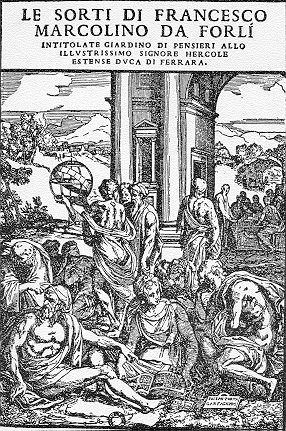
Another early use of playing cards as oracle comes from Le sorti intitolate giardino d’i pensieri (“The oracle called garden of thoughts) from 1540 Venice, published by typographer Francesco Marcolini with text by the Venetian poet Lodovico Dolce. Read all about it through the title’s link. The method of getting the oracle takes one through a convoluted series of steps to end up at a simple tercet of a type as follows:
Do not take an ugly and angry wife,
But even if you take one pleasant and nice,
I am afraid something strange will happen.
1556 – The Sin of Divining with Cards
In 1556, Martin de Azpilcueta (d. 1586) wrote in his Compendio del Manual de Confessores (an instruction book for confessors):
Lo quinto, pecca el que pregunta, o quiere preguntar al adeuino de algun hurto, o otra cosa secreta, o procura de la saber por suertes de dados, cartas, libros, harnero, o astrolabio, y el que encanto bruto animals, con palabras profanas, o sagradas, con obseruancia de alguna vanidad.
Fifth, he sins who asks, or wants to ask the diviner of some theft or other secret thing, or gain knowledge through the luck of dice, playing cards, books, sieve, or astrolabe, and he who enchants brute beasts, with words profane or sacred, with the observance of any vanity.
This book was later translated into Latin and published in France as: Martin de Azpilcueta, “Enchiridion sive Manuale Confessariorum et Poenitentium” (Paris, François Huby, 1620): c. XI, note 30 (p. 191). Thanks to Ross Caldwell for first finding this and to “Doctor Arcanus” for the Spanish original.
It should be noted that condemnation by the Church usually indicates that such deeds are rampant in the culture.
The 17th Century
1620 – Henry Cuffe and the Three Knaves
In 1620 John Melton recorded the following story in Astrologaster, or, The Figure Caster. It was repeated by William Rowland, in Judiciall astrologie, judicially condemned (London, 1652) and tells of Henry Cuffe, (1563-1601), secretary to the Earl of Essex, whose death was foretold by cards twenty years before it happened. Cuffe was executed in 1601, so the incident allegedly dates from 1581 when he would have been 18 years old:
“There was another Wizard (as it was reported to me by a learned and rare Scholler, as we were discoursing about Astrologie) that some twentie yeeres before his death told Cuffe our Countreyman, and a most excellent Graecian, that hee should come to an untimely end: at which, Cuffe laughed, and in a scoffing manner entreated the Astrologer to shew him in what manner he should come to his end: who condiscended to him, and calling for Cards, entreated Cuffe to draw out of the Packe three, which pleased him; who did so, and drew three Knaves: who (by the Wizards direction) layd them on the Table againe with their faces downewards, and then told him, if hee desired to see the summe of his bad fortunes reckoned up, to take up those Cards one after another, and looke on the inside of them, and he shluld be trouly resolved of his future fortunes. Cuffe did as he was prescribed, and first took up the first Card, and looking on it, he saw the true portraiture of himselfe Cape a Pe [head to foot], having men compassing him about with Bills and Halberds: then he tooke up the second Card, and there saw the Judge that sat upon him: at last, he tooke up the last Card, & saw Tyborne, the place of his Execution, & the Hangman, at which he then laughed heartily; but many yeres after, being condemned for Treason, he remembred the fatall Prediction of the Wizard, & before his death revealed it to some of his friends. If this be true, it was more then Astrology, and no better then flat Sorcery or Conjuring, which is divellish.” [John Melton, Astrologaster, or, The Figure Caster, p.42. Thanks to Michael J. Hurst.]
Edwin S. Taylor in The History of Playing Cards (1865), claimed the cards were the Devil, Justice and Hanged Man, but there is no justification for this in the original text, which refers to three Knaves (probably Jacks/Valets). Whether the incident actually occurred or not, the account shows that fortune-telling by cards was known in England by this time.
“The Allegory of Fortune” (mid-17th century)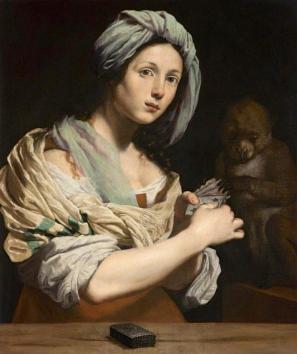
“The Allegory of Fortune” by Lorenzo Lippi (1606-1665), from Florence Italy, now in the National Museum of Northern Ireland, Ulster, depicts Fortune as being dependent upon the vagaries of chance similar to that of a monkey (seen on the right) selecting playing cards. Fortune herself, dressed as a gypsy, gazes out at the viewer as if to say, “Do you dare take whatever my companion chooses to give you?” What seems almost certain is that the gypsy woman is an allusion to fortune-telling. Furthermore, fortune-tellers in Europe, Africa and Asia, even today, use trained animals, usually birds, to select cards that reveal a querent’s future.
1665 – The Lenthall Fortune-Telling Deck
A deck of 52 fortune-telling cards was originally designed by Dormann Newman and published by John Lenthall of The Talbot, Fleet Street, London, in 1665. (The cards below are from the 3rd edition of 1714, published in facsimile by Harry Margary, Lympne Castle, Kent in 1972.) Update: These appear to have also been published by James Moxon (either father or son), who were British engravers and map-makers as well as producing a whole variety of geographic and educational cards. These card appear identical with a deck they published as “Astrology Cards” in 1676 [trionfi.com].
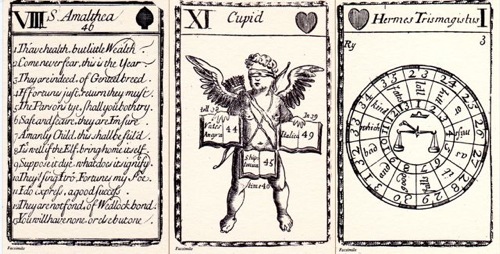
Each suit was numbered I to XIII. Odd numbered cards had a sign of the zodiac on them; even numbered cards contained a list of thirteen numbered statements. The Kings had a series of questions one could ask. The court cards were given the names of famous people from myth and legend. According to the directions, “When any person is desirous to try their fortune, let them go to one of the four kings and choose what question they please.” This is followed by an elaborate procedure for determining the answer. The explanation ends, “The stars foretell, they love you well.”
Lenthall later published a set of Proverb cards.

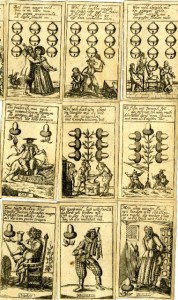 17th century – German Proverb decks
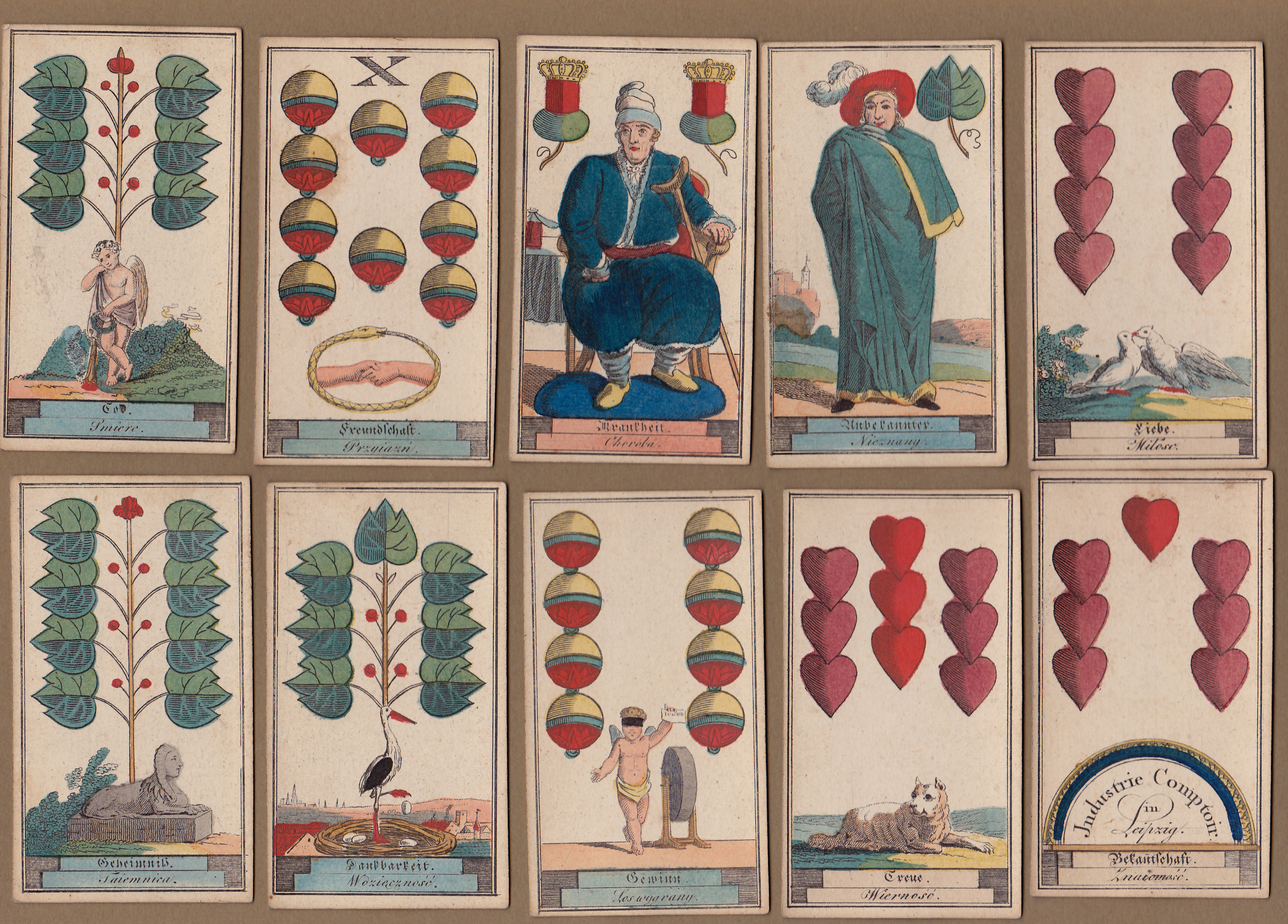
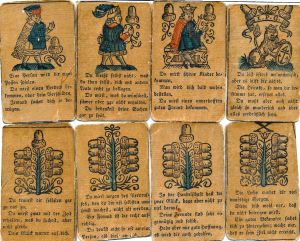 Quite a few old German decks featuring proverbs and sayings that must have been used for obtaining advice and prognostication of how a situation would progress. The suits consist of Green Leaves (Spades), Red Hearts (Hearts), Yellow Bells (Diamonds) and Black Acorns (Clubs). Acorns (Clubs) are generally the worst suit, while the Green Leaves (Spades) are the best suit.
16th & 17th century – Witchcraft and Cards
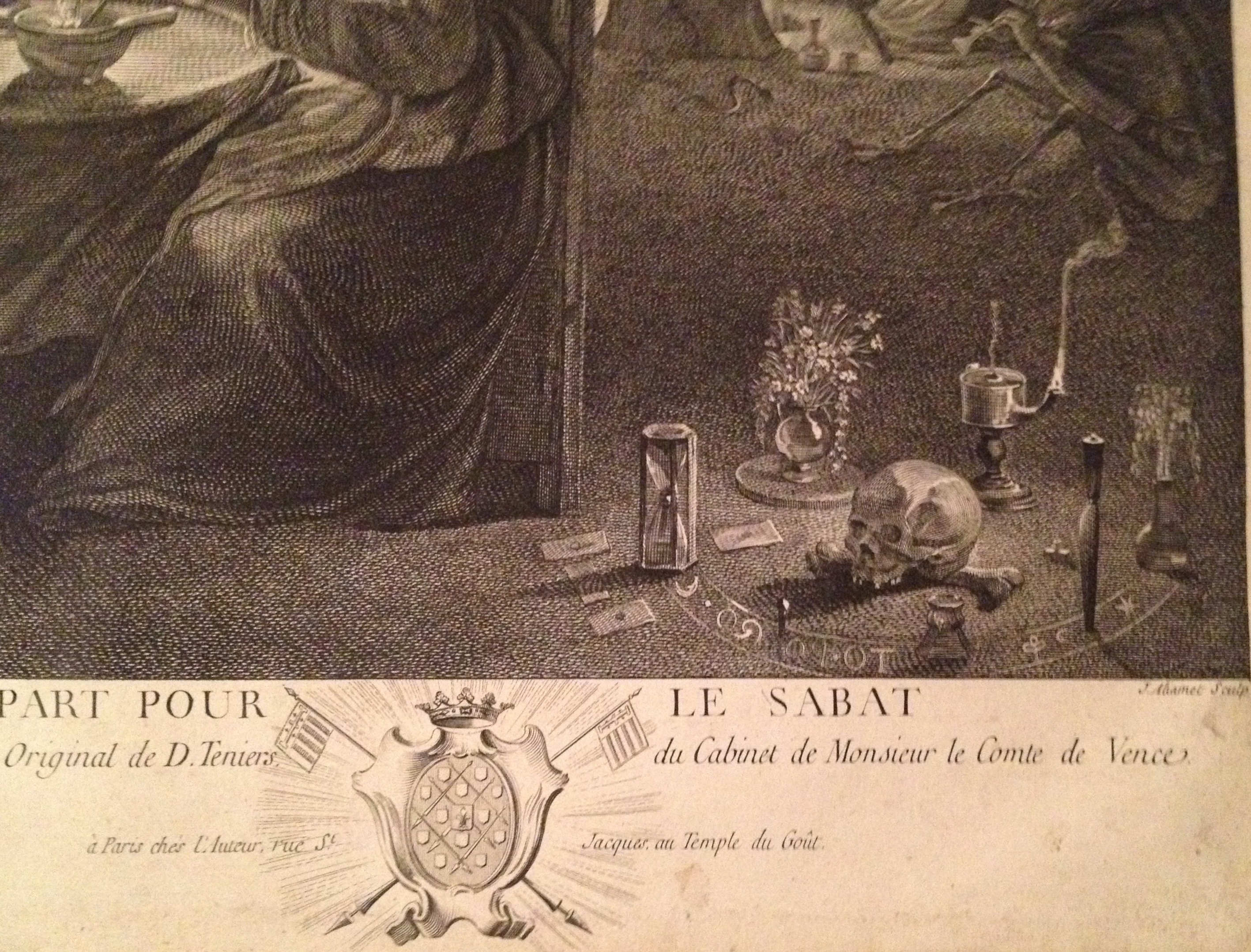
Focusing on the 16-17th centuries are reports in Italy, Spain and Belgium of witchcraft using playing cards. Whether this included fortune-telling as we know it is unclear. See my post on this subject HERE. In addition to transcripts of court trials, one of the most conclusive pieces of evidence for the use of cards in ritual is from a painting by David Teniers the Younger (1610-1690), now lost but reproduced as an engraving in the 18th century. Here is a photograph from my visit to an exhibit on witchcraft engravings at the British Museum.
The 18th Century
1702 – Fortune Telling Cards for sale
Advertisement for a deck of “Fortune Telling Cards” in The Post Man and The Historical Account, London, Dec. 22, 1702:

1727 – Destiny in a Game of Picquet
A book called Whartoniana; or, Miscellanies, in verse and prose by members of the Wharton family (and several other persons of distinction) was translated from the French and published in 1727. (Edited by Edmund Curll and translated by Joseph Morgan). It contained a detailed account of a card game that resulted in a divination. In the Table of Contents the piece is titled “To the lovely PALLAS, Or the Game at Picquet.” [Thanks to Stephen J. Mangan, (aka Kwaw) at Aeclectic’s tarotforum for finding this.]
A few Days ago, I took it into my Head to make a Visit to the celebrated Theresius, in order to be informed of my Destiny. —Help thyself to a Seat, said he, my Friend, sit down, and give me thy Hand. He pored on it for a considerable while, cast a Figure, said not one Word, but ordered me to return the next Day. His Silence seemed to me very ominous, and to portend me no Good; yet I much rather chose to be at once acquainted with my ill Fortune, than to continue longer in a suspenceful Uncertainty. I therefore very importunately pressed him to let me know his Reason for giving me no Answer to my Quere. Still the old Cuff was mute, making no manner of Reply, but reaching a Pack of Cards, sat down by me, and challenged me to play a Game with him at Piquet; the which, heavy-hearted and out of Humour as I was, I could not, nay durst not well refuse.
Well.— We cut; he has the Hand; I deal; he takes five, and leaves me three.— I find in my Hand a Quint in Hearts, three Kings, three Knaves, the Queen of Diamonds, and three Spades which I discarded. A promising Game! Great Hopes! But, Morbleu! Not one Ace in the three Cards I took in!— Faith, Madam ; I beg your Pardon for swearing; but it was so cursedly provoking, that I cannot keep my Temper when ever I think of it.
Sixty five? says he.— Good.— A Quint to a Knave?— Equal.— He then spreads out upon the Table seven Diamonds. Sixty five are seven, says my Antagonist, very gravely; a Quatorze of Aces, fourteen more.— All good, cries I, with a deep Sigh.— Diamonds, says he, playing his Ace, twenty-two, and plays out all his Diamondsrunning.— Down went my Queen, accompanied with two Clubs and four Hearts.— He next plays his Ace of Clubs, and that quite confounds me; for, the most unluckily in the World, I had left my King unguarded. He redoubles upon me with the Ten of Clubs; I fling him a Spade. Next, upon his Ace of Hearts, I give my Knave, still depending upon saving the Lurch, scarce doubting of his having the Queen.— My King of Spades next falls a Victim to his Ace.— But, how was I Thunder-struck! How were all my Hopes blasted! The Devil a Bit of the Queen of Hearts had he, and poor Charles found himself Capoted.
I have won the Game, said he.— From hence learn thy Destiny. If you must love, pitch upon some Object that is more your Match: For if ever you attack the divine Pallas, you will infallibly be Lurched.— Adieu. Heaven take thee into it’s Protection: Thus we parted.
- Lurch – a decisive defeat in a game (especially in cribbage).
- Capote – to win all the tricks from an opponent in a game of piquet.
 1729-50 – Dr. Flamstead’s and Mr. Patridge’s New Fortune-Book containing . . . Their new-invented method of knowing one’s fortune by a pack of cards (in various editions).
I found the source of the card fortune-telling verses quoted below in John Brand’s Observations on the popular antiquities of Great Britain (1777). They are from Dr. Flamstead’s and Mr. Patridge’s New Fortune-Book containing . . . Their new-invented method of knowing one’s fortune by a pack of cards. Read about it here.
1730 – Playing Card Divination in the early 18th century London Theatre
Read the earliest example of an actual card reading from a 1730 London play, Jack the Gyant-Killer – HERE, in which it is said that divination with cards is a newly-invented art. And what does this all have to do with a young Ben Franklin and Henry Fielding (author of the classic, Tom Jones, and founder of the first municipal police force, the Bow Street Runners) being led astray by one, A. Primcock? Note that despite the simplicity of the card reading method in the Flamstead and Patridge book, the play describes a technique that became the standard, still used today. The cards are spread in rows—probably 6 rows of 9 cards, except only 7 in the bottom row, as described in the 1791/3 book mentioned below.
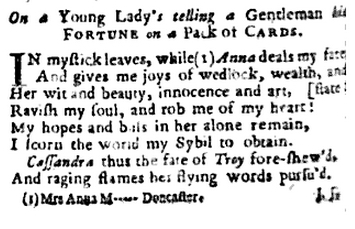
1734 – On a Young Lady’s telling a Gentleman his FORTUNE on a Pack of CARDS
from The Gentleman’s Magazine, or The Monthly Intelligencer, October, 1734 we find this delightful little poem that seems to be addressed to one Mrs. Anna M**** of Doncaster. While it may simply be a poem, by addressing a specific woman, it seems more as if he wants to remind her of a fond tryst. It goes:
In mystick leaves, while Anna* deals my fate,
And gives me joys of wedlock, wealth, and
Her wit and beauty, innocence and art, [state:
Ravish my soul, and rob me of my heart:
My hopes and bliss in her alone remain,
I scorn the world my Sybil to obtain.
Cassandra thus the fate of Troy fore-shew’d.
And raging flames her flying words pursu’d.
*Mrs Anna M**** Doncaster.
1735 – Gypsy Cartomancy – a Hoax!
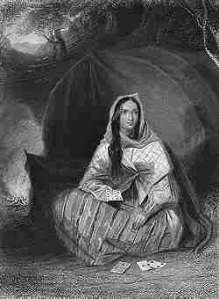
The Square of Sevens, and the Parallelogram: An Authoritative Method of Cartomancy with a Prefatory Note is a literary hoax. Said to be originally written by one Robert Antrobus and published in 1735, it was then edited by E. Irenaeus Stevenson and republished by Harper & Brothers, NY, in 1896. Read all about Ross Caldwell’s literary detective work showing that this book is a 19th century hoax – here.
1738 – Divination in Holland
In 1738, Antoine de La Barre de Beaumarchais writes about divination in Holland:
“That kind of divination is not the only one that still persists in Holland, despite its inhabitants common sense. Pyromancie and Ooscopy, or to speak in a more casual way, the art of guessing by watching a flame, burning coal, sparkles, eggs in a glass, are still commonly used in some part of Holland. The fortuitous disposition of a playing card deck, open and arranged in four or five lines, is another way to tell the future, not despised by certain ladies from this country. It is true that some of them pretend consulting the so-called witches for the sake of distraction. But one would think the exact opposite, seeing how they await with an attentive and worried attitude these women answers, and how they manifest their joy by the sudden serenity on their faces, when those Oracles are favorable.”
(Contributed by Bertrand—see comments.)
17??-1750 – Pratesi’s Bolognese Tarocchi
A manuscript written prior to 1750 was discovered by Italian playing card scholar, Franco Pratesi in the late 1980s. It lists cartomantic interpretations for 35 Bolognese tarocchi cards along with a rudimentary method of laying them out. A sheet of 35 Bolognese cards (trumps and number cards) are labeled with simple divinatory meanings such as “journey,” “betrayal,” “married man,” “love.” A later deck of double-headed Bolognese cards from the 1820’s are labeled both top and bottom with similar divinatory meanings, showing a continuity of use. A comparison of four variations on Bolognese divinatory meanings can be found here.
1750 Sketchley’s Conversation Cards and “The Complete Fortune Teller,” along with an advertisement for these cards from The Virginia Gazette of 1775.
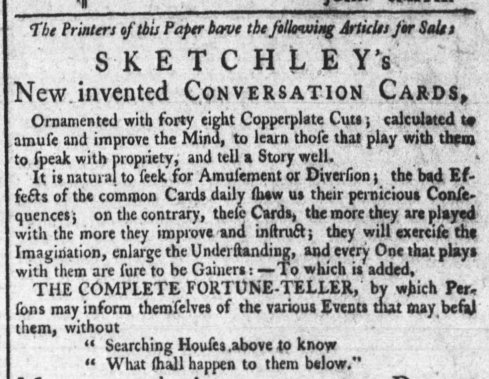
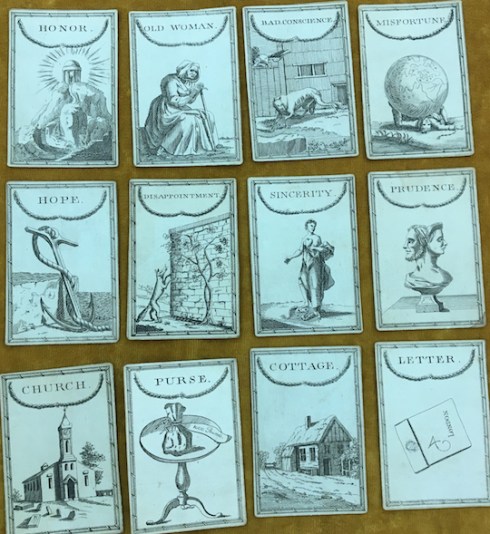
So, to this set of cards was added “The Complete Fortune Teller” – a standard book of the time. As it turns out, James Sketchley was a British publisher who produced, from at least 1750 in England, the “Conversation Cards” as an educational game for children. In addition, he was an ardent Freemason of whom it was said:
“A man, who, if Masonry e’er was the theme
His bosom with Rapture would glow and expand.”
Thanks to Andrew McGregor who obtained a photo of these cards for me from the Toronto Public Library Osborne Collection.
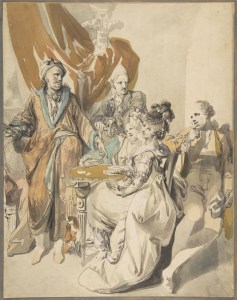 mid-18th century – Cagliostro Reads the Cards
A watercolor by Johann Eleazar Zeissig (called Schenau), mislabeled at the Metropolitan Museum of Art as “Two Women and Three Men Playing Cards.” Cagliostro is identified, in French, on the reverse of the picture, but not acknowledged in the description of the work. He appears to be doing a card reading for a group of nobles. Cagliostro points to the Ace of Hearts or Diamonds (probably Hearts!) that the woman in the foreground is showing to him. Note how his “oriental” robe contrasts with their clothes and his cap is a type worn by those in the “arts.” A later print in a book by Julia Orsini repeats the claim that Cagliostro read cards (see below).
1755 – The Card
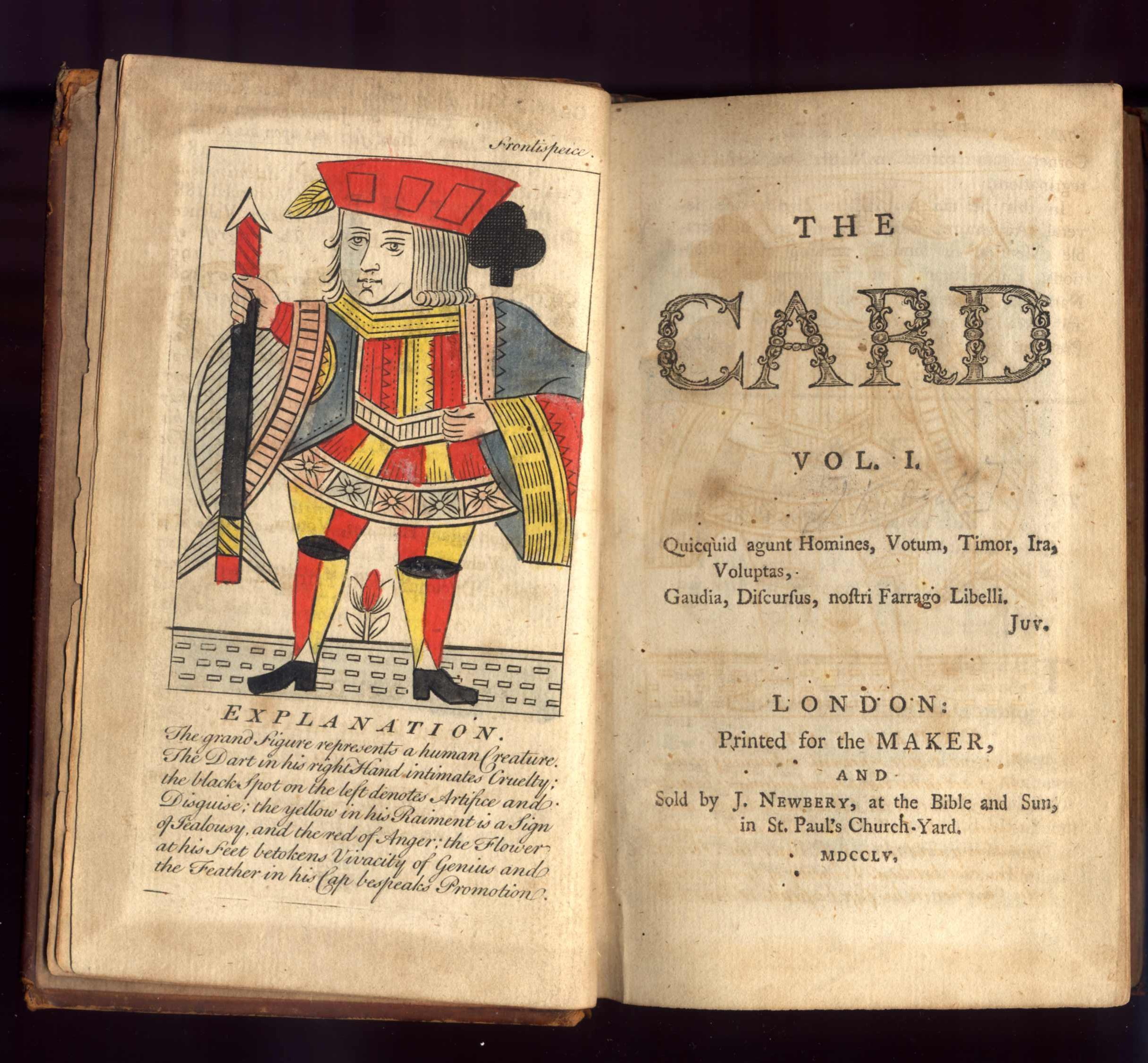 In 1755 we find a rambling novel in two volumes, The Card by John Kidgell (London: Printed for the Maker and sold by J. Newberry, 1755), that is famous as the first reference to a game of “baseball.” It is notable to us because of the frontispiece that features a large engraving of the Jack (or Knave) of Clubs, accompanied by a detailed commentary on its symbolism. I haven’t been able to find an online copy of the book to discover the role this figure plays in the text, but I would imagine it serves as Significator of the main character of the novel. It shows the kind of symbolism we tend to look for in cards when ‘reading’ them. Usually associated with Lancelot, this Jack also has a reputation as the scoundrel of the pack. The text explains:
“The grand figure represents a human Creature. The Dart in his right Hand intimates Cruelty; the black Spot on the left denotes Artifice and Disguise; the yellow in his Raiment is a Sign of Jealousy, and the red of Anger; the Flower at his feet betokens Vivacity of Genius and the Feature in his Cap bespeaks Promotion.”
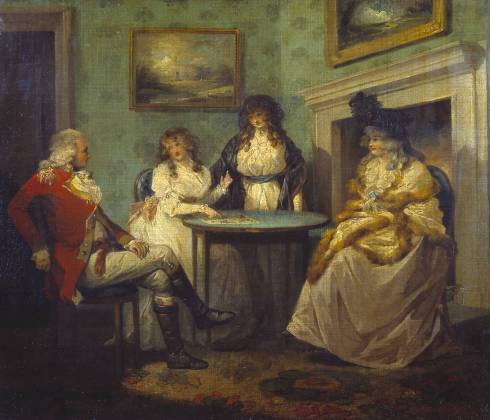
1762/3 – The Vicar of Wakefield – “A very pretty manner of telling fortunes”
In 1762-3 Oliver Goldsmith writes his novel The Vicar of Wakefield in which we find that reading cards can be an admirable accomplishment in a young woman:
And I will be bold to say my two girls have had a pretty good education, and capacity, at least the country can’t shew better. They can read, write, and cast accompts; they understand their needle, breadstitch, cross and change, and all manner of plain-work; they can pink, point, and frill; and know something of music; they can do up small cloaths, work upon catgut; my eldest can cut paper, and my youngest has a very pretty manner of telling fortunes upon the cards.’ [in Chapter 11]
1765 – The Oracle, a pack of cards
An advertisement for an “The Oracle, a pack of Cards” from The Public Advertiser, London, May 17, 1765:
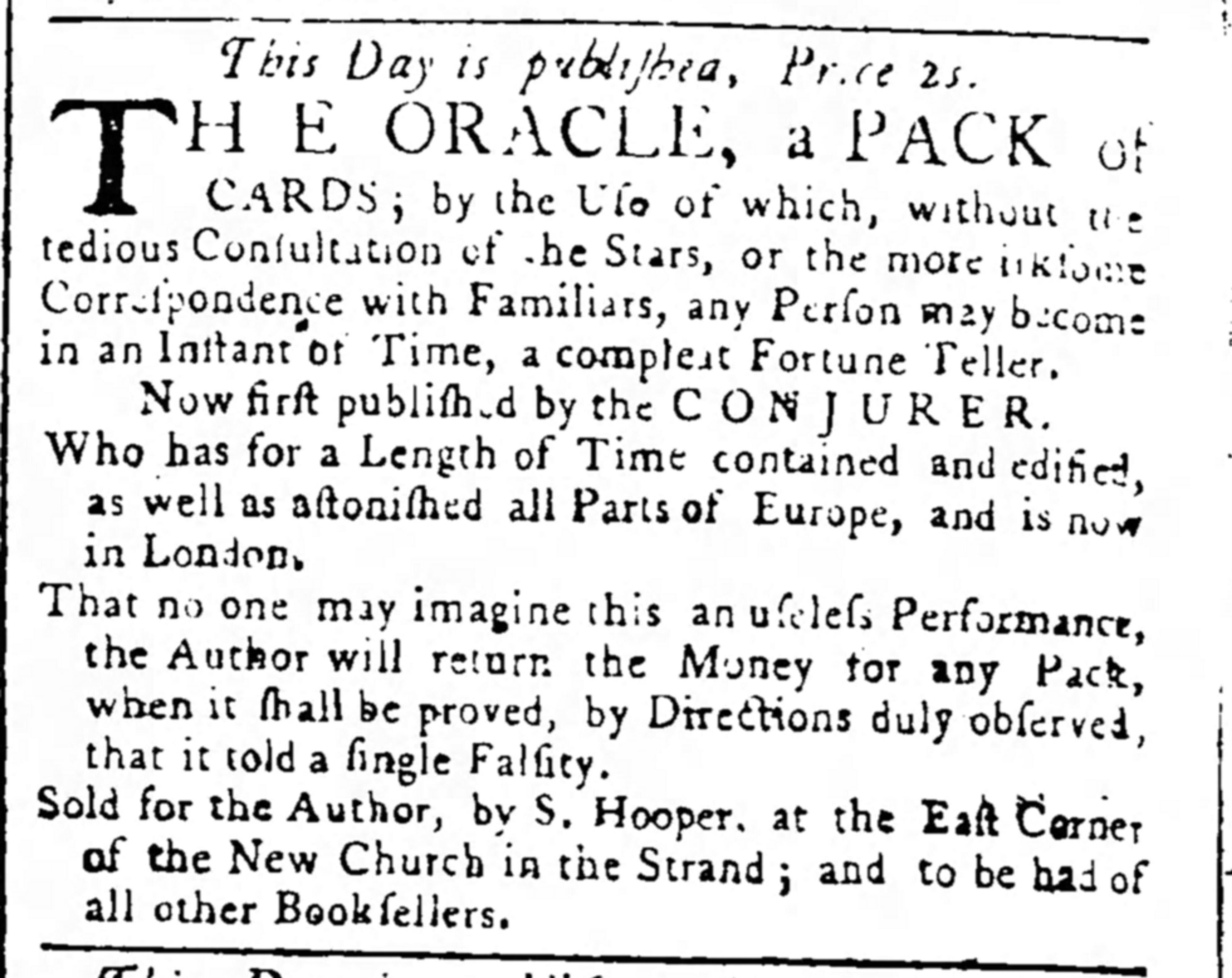
This may be the deck that is pictured here on Simon Wintle’s excellent website.
1765 – Zaïre, Casanova’s Russian mistress
The famous lover, Jacques Casanova, recounts in his memoires that in 1765 his then 13-year-old Russian peasant mistress would read the cards every day—laying them out in a square of twenty-five cards. As he describes it: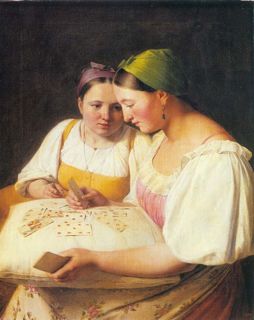
Without her desperate jealousy, without her blind trust in the infallibility of the cards, which she consulted ten times a day, this Zaïre would have been a marvellous woman and I would never have left her.
To convince me of my crime, she shows me a square of twenty-five cards wherein she makes me read all the debaucheries that had kept me out all night long. She shows me the tart, the bed, the love-play and even my unnatural acts. I didn’t see anything at all, but she imagined that she saw everything. After letting her say, without interruption, everything that might serve to assuage her jealousy and rage, I took her grimoire [the deck of cards] and threw it into the fire.
(From The Complete Memoires of Casanova by Jacques Casanova, Chapter CXVII. This translation by Ross Caldwell.) The painting entitled Fortunetelling (1842) is by Alexey Gavrilovich Venetsianov (1780-1847) and is in The Russian Museum, St. Petersburg.
Patience/Solitaire/Kabale
Casanova was one of the first to mention the card game solitaire or patience. Other names for these games suggest an origin in fortune-telling. In France, it was known as réussite (“success”), explained in Littré as “a combination of cards [by] which superstitious persons try . . . to divine the success of an undertaking, a vow, etc.” From at least 1783, Danish, Norwegian, and Icelandic solitaire was called kabal(e), or “secret knowledge,” a term reserved in Polish specifically for fortune-telling with cards. For more, visit David Parlett’s “History of Patience/Solitaire”.
1770 – Goethe has his cards read
In Johann Wolfgang von Goethe’s autobiography Dichtung und Wahrheit (“Poetry and Truth”), he recounts that in 1770, when he was 20 years old, he took dancing classes in Strassburg from a Frenchman with two daughters who had both become enamored of him. He cared only for the younger. The girls brought an elderly fortune-teller to the house who agree to read the cards for all three. She began with the older girl:
“She carefully observed the positions of the cards, but then seemed to falter and be reluctant to speak — “I understand,” said the younger girl, who had already become better acquainted with interpreting this magical board. ‘You are hesitating because you do not want to reveal anything unpleasant to my sister, but that card is cursed!’” (The cards revealed that the older girl loved and was not loved in turn.)
“‘Let us see if it will get better,’ replied the old woman, shuffling the cards and laying them out a second time; but it had only grown worse, as we could all plainly see. The fair one’s card was not only more isolated, but was surrounded with many troubles; her friend had moved somewhat farther away and the intermediate figures had come closer.”
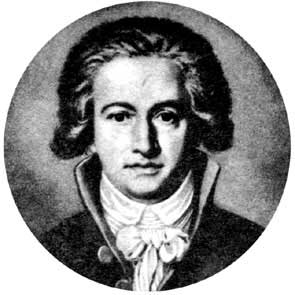
With uncontrolled weeping the older girl fled the room. Goethe couldn’t stand to be present while his cards were read, so he went home. When he returned the next day, the younger sister told him,
“I had the cards laid out for you, and the same verdict was repeated three times, always more emphatically. Your card was surrounded by all sorts of good and pleasant things, by friends and men of importance, and money was not lacking. The women kept themselves at some distance. My poor sister, especially, was always the one farthest away; another girl kept moving closer to you but never came to your side, for a third person, a man, placed himself in the way. I shall have to admit to you that I imagined myself to be the second lady, and after this confession you will best be able to understand my well meant advice. I have pledged my heart and hand to an absent friend, and up to now I have loved him better than anyone else. But possibly your presence would grow to mean more to me than before, and just imagine the difficult position in which you would be between two sisters, one of whom you had made unhappy with your affection, and the other with your coldness, and all this misery would be for nothing and for the sake of a short time. For if we had not already known who you are and what your prospects are, the cards would have set it before my eyes very plainly.”
There ensued a jealous scene with the older sister, and Goethe left, to never see them again. (Thanks to Christian Joachim Hartmann for finding this.)
 1770 – Paris: Etteilla, and “Illusive Enjoyments of the Mind”
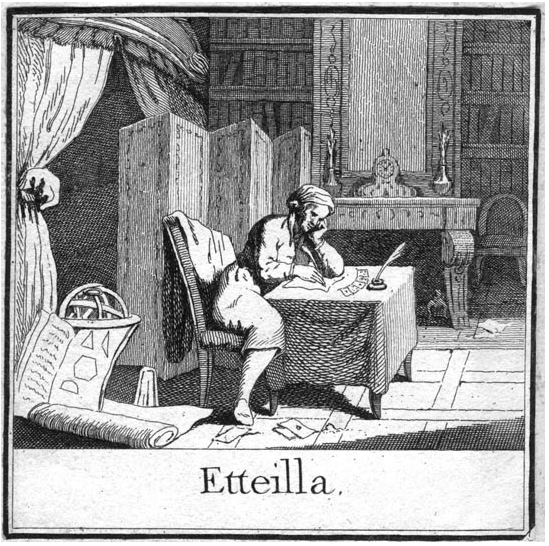
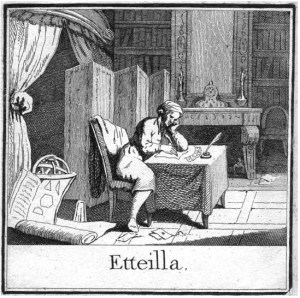
It was around 1750 that the print-seller and teacher of algebra (i.e., numerology), Etteilla (Jean-Baptiste Alliette 1738 – 1791), said he learned the art of telling fortunes with playing cards from three cartomancers, one of whom came from Piedmont in northern Italy. In 1770 he published his own book on fortune-telling with cards, Etteilla, ou manière de se récréer avec un jeu de cartes, for which he coined the term cartonomancie (which became cartomancy). Learn more about Etteilla’s tarot here.
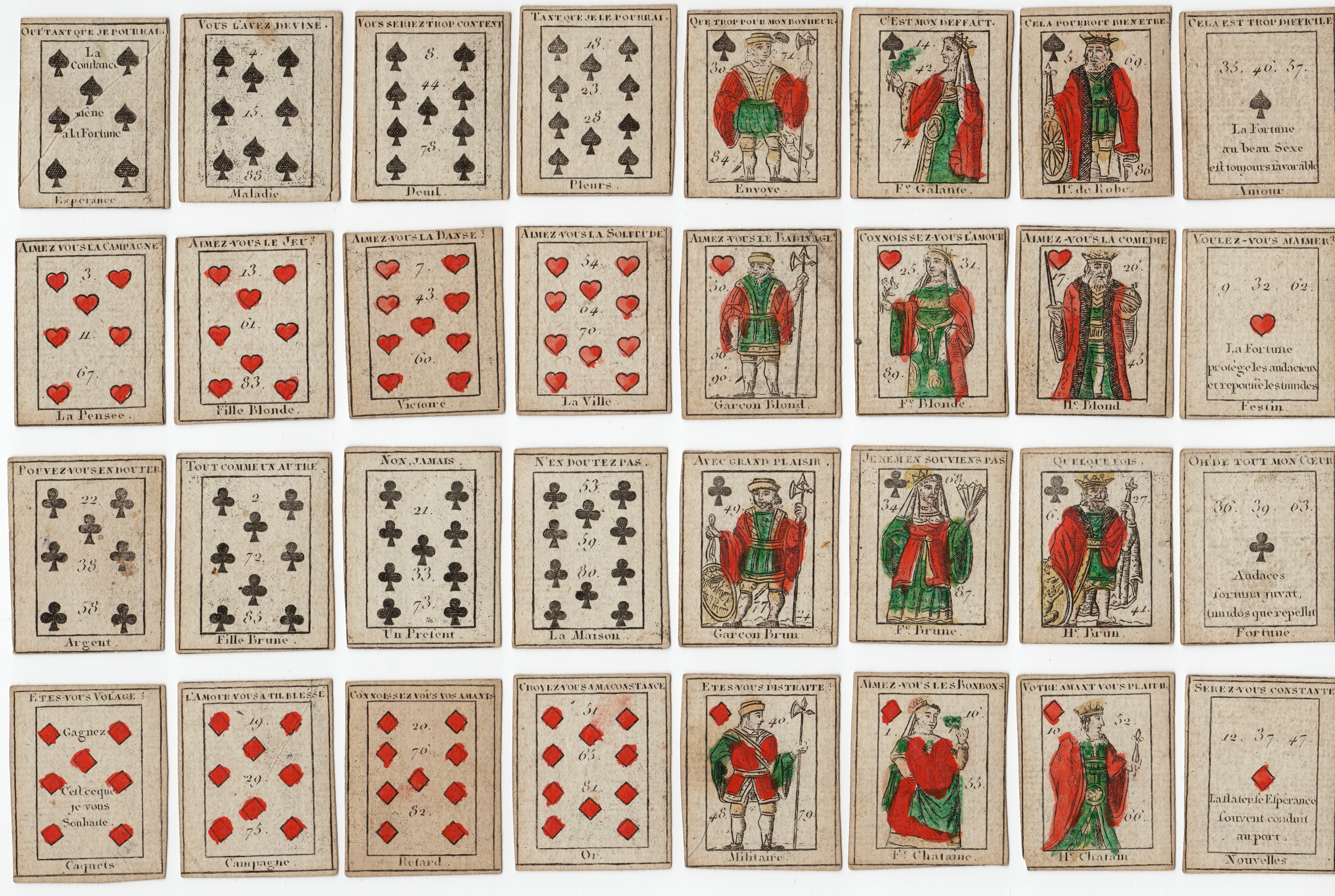
Soon after Etteilla published his book on fortune-telling with playing cards, numerous decks appeared utilizing his system. He followed up with a several books on the Tarot and a Tarot deck. Here is an early miniature “Petit Etteilla” deck from my own collection:
But, as we’ve seen, Etteilla was not really the first to write on the subject. In Germany we find a general Cartomancy text in German (1769): Abhandlung der Physiognomie, Metoposcopie und Chiromantie by Christian A. Peuschel (thanks to Huck).
1777 – From an old English chapbook
John Brand in his 1777 book, Observations on the popular antiquities of Great Britain, quoted from “an old chap book” what he called “curious lines on divination by drawing cards,” the source of which I’ve now found here. Example:
This noble king of diamonds shews
Thou long shalt live where pleasure flows;
But when a woman draws the king,
Great melancholy songs she’ll sing.
1781/89 – Antoine Court, Le Comte de Mellet and Etteilla
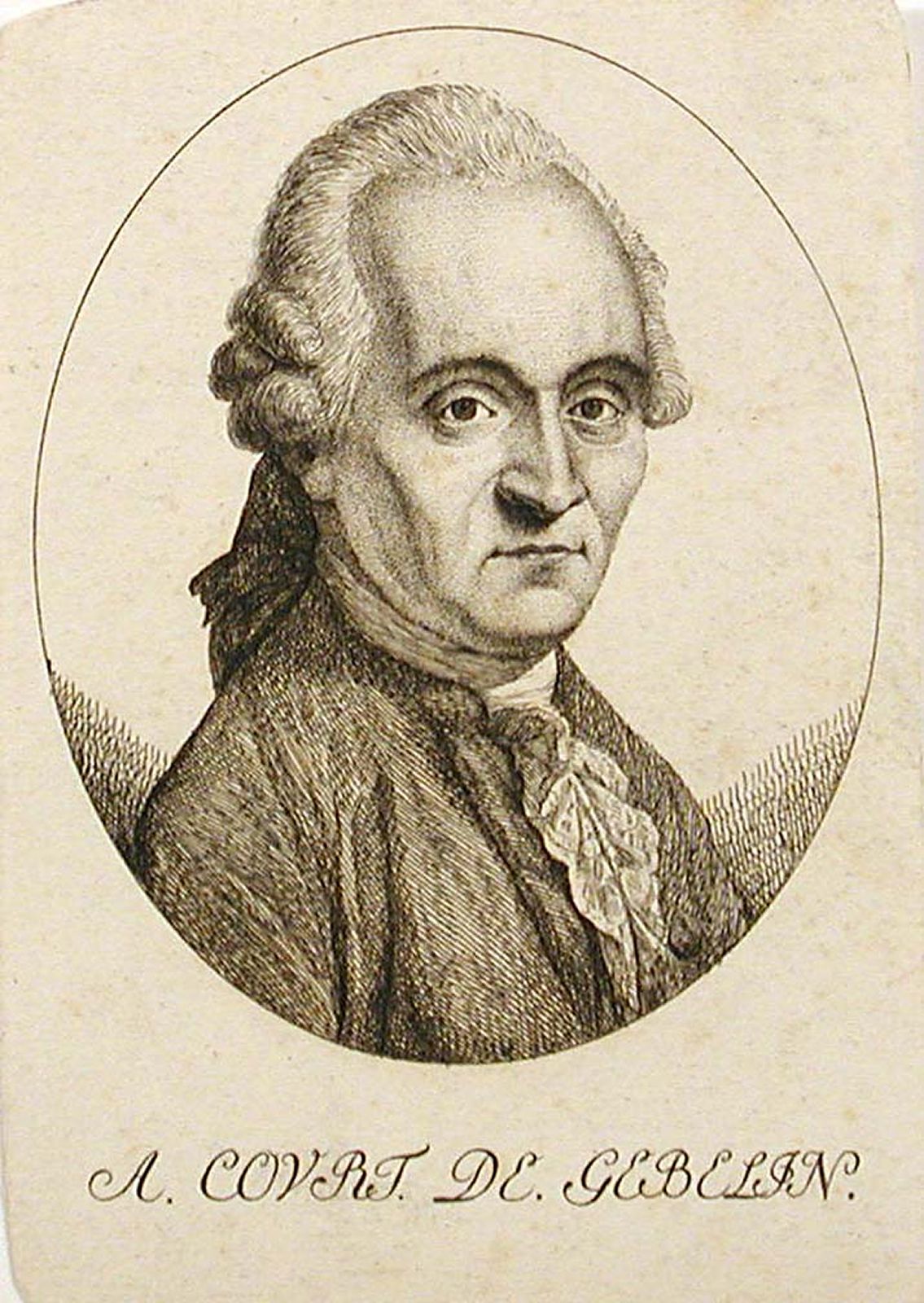 The 8th volume of the encyclopedia Le Monde primitif (“The Ancient World”) by Antoine Court de Gébelin (1725-1784) appears in 1781, claiming an Egyptian origin for Tarot as a book of wisdom. Antoine Court was a friend of Ben Franklin and James Madison who, along with the French King, subscribed to this encyclopedia; Court would die during a medical treatment with Antoine Mesmer (father of hypnotism). The volume includes an essay by le Comte de M*** [Mellet] that explains how to use the cards for divination. De Gébelin says there are 22 Trumps just as there are 22 Hebrew letters; Le Comte de Mellet tells us they correspond to The World as aleph, continuing in reverse order through the cards. It is Le Comte de Mellet also who first calls the suit of coins “talismans” (pantacles), which is later developed by Éliphas Lévi (circa 1865) and used by the Hermetic Order of the Golden Dawn as the suit of Pentacles. The following year Etteilla applies to the censors to publish his own book on the Tarot but is refused until 1783 when he publishes his Manière de se ré créer avec le Jeu de Cartes nommées Tarots (“A way to entertain oneself with the pack of cards called Tarots”), which he follows up with three more volumes and a deck (1789). These works forge the route for Tarot to officially enter the world of occult mysteries and divination. Read some interesting speculations regarding early occult and philosophical uses of the cards HERE.
 1791 – Every Lady’s Own Fortune Teller
By 1791 we find that the standard fortune telling chapbook has been expanded by a chapter called “Of Card Tossing.” Here are found explicit instructions for reading playing cards, along with a detailed sample reading laid out in 6 rows of 9 cards, with 7 cards in the final row (this edition from 1793, and later editions published with different titles). This is, perhaps, the earliest example in English of instructions that are still roughly current today. There’s also a brief description of coffee-ground reading.
c. 1790s – “The Fortune-Teller” (n.d.) by French artist Martin Drolling (1752-1817)
Napoleon’s soldiers and their families seek reassurances about what is coming next in their lives.

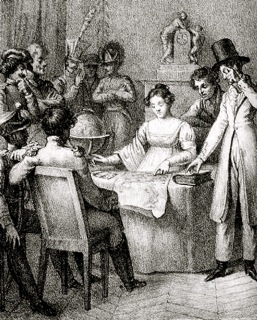 1790 to mid 19th century – The Career of Mlle. Lenormand
Around 1790 Marie-Ann-Adélaïde Lenormand (1772-1843) arrived in Paris saying she had learned to read the cards from gypsies (read about her here). With Etteilla’s several books on the subject and the dozen or so self-promoting works by Lenormand and several decks falsely ascribed to her, divination with playing cards became known to the world. She used a variety of divination tools as well as reading palms and some astrology and numerology. It is said that her table was covered with many different packs of cards including Tarot (probably the Etteilla deck) and that she would randomly pull cards from among the different decks as she spoke. Picture on right: A young Mlle. Lenormand reading for Napoleon— talk about pressure on the job! In actuality she read for Josephine but it is doubtful that she ever read for Napoleon.
1796 – Tawny Rachel
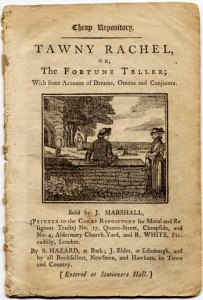 Tawny Rachel, or The Fortune Teller; With some Accounts of Dreams, Omens and Conjurers was a chapbook published in London in 1796. It tells the story of Rachel, a seeming “sun-burnt oracle of wisdom” who was actually a skilled con-artist (unfortunately they do exist).
She used a variety of methods of fortune-telling from reading moles to dreams to the disposition of plants. Having found a gullible young girl who was eager to find a husband, Rachel explains:
“If you cross my hand with a piece of silver I will tell you your fortune. By the power of my art I can do this three ways; by cards, by the lines of your hand, or by turning a cup of tea-grounds: which will you have?”
Unfortunately there is no account of her reading the cards. Eventually she is arrested, found guilty and sent to Botany Bay:
“And a happy day it was for the county of Somerset, when such a nuisance was sent out of it.”
The author thought it was his duty
“to print this little history as a kind of warning to all you young men and maidens not to have any thing to say to cheats, impostors, cunning women, fortune-tellers, conjurers, and interpreters of dreams.” [He continues,] “Listen to me, your true friend, when I assure you that God never reveals to weak and wicked women those secret designs of his Providence, which no human wisdom is able to foresee.”
 1794/6 – Viennese Coffee-Grounds and Cards
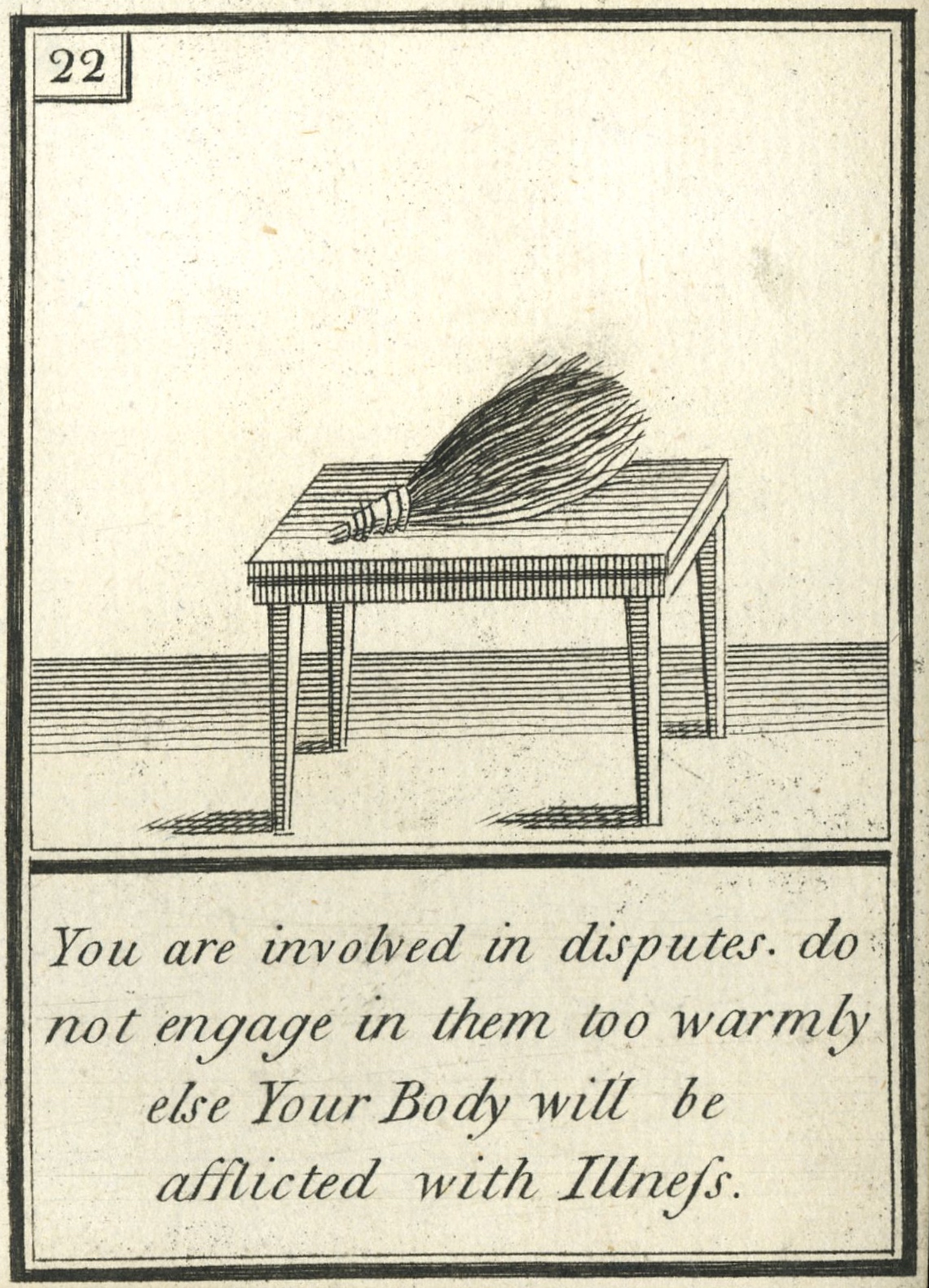
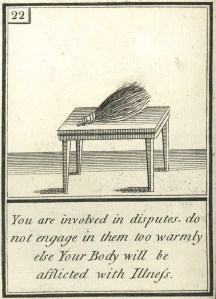
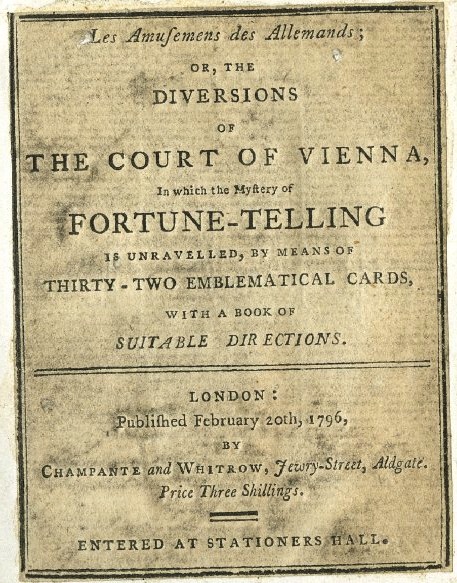 Meanwhile, in Vienna, in 1794, there appeared a deck of fortune-telling cards and book based on images commonly described as found in coffee-ground fortune-telling. With the advent of coffee to Europe and coffee-houses springing up starting around 1650, came the huge growth of coffee-house culture throughout Europe during the 18th century. Simultaneously a Turkish custom of fortune-telling by reading the images in coffee-grounds emerged (only later was this applied to tea-leaves). Lists of these images are first recorded in mid-18th century Germany, with the earliest detailed description being this Viennese book and deck. We know of it only through an English translation of 1796 that is found in the British Museum (see also my post about them here).
 1798/9 – Das Spiel der Hoffnung (“The Game of Hope”)
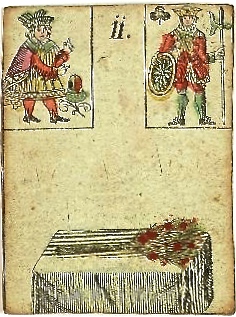
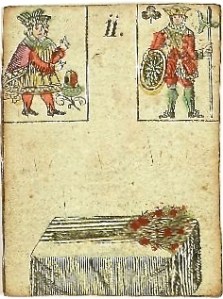
In 1798-9, a young German game designer, Johann Kaspar Hechtel (1771-1799), in Nuremberg, designed a 36-card multi-purpose game featuring simple images (Dog, House, Mice, Anchor) that are nearly identical to 30 of the the Viennese Coffee-Cards. Hechtel’s 36 cards for his Der Spiel die Hoffnung (“Game of Hope”) were inset with playing cards – a common German-suited deck on the top left and French-suited deck on the top-right for playing regular card games. The game described was played by laying out the cards in a square of 6 cards-by-6 cards with instructions for a race-game similar to the Game of Goose or Snakes-and-Ladders. At the end of the instructions, Hechtel mentions that these cards can also be used for fortune-telling (with the assumption that everyone knew how). While French and English playing card meanings have no relevancy to the images, it turns out that there is an entirely separate tradition of German Wahrsagekarten (“Fortune Telling Cards”) featuring suits of Leaves, Hearts, Bells and Acorns whose meanings do accord with the Game of Hope cards (see a discussion here). The card to the right is the Jack of Clubs (Knave of Acorns), called “The Birchrod” meaning disputes (see the same Coffee-card image just above).
The 19th Century

Early 19th century – Costumes of Foreign People (French deck)

A 54-card deck, in the Metropolitan Museum of Art, dated to 1700-1799 and described in French as: ‘Composées de tous les Costumes des peuples / étrangers avec de jolies devises et bons mots. / dediées aux Jeunes Gens’; ‘Je me fixe a la plus belle / Imitez moi.’ (“Featuring all forms of dress of foreign peoples, with many fine sayings and proverbs. Intended for children. ‘I set my sights on Beauty: Do as I do!’”) Each card contains a picture featuring people dressed in the clothing from foreign countries (identified at bottom). Near the top are numbers (for a lottery or game?) and some have a day of the week. The Aces feature traditional images found in cartomancy decks. On the bottom right is an upside-down playing card inset above which is a meaning associated with it by Etteilla. Around the sides are short sayings and advice. It appears to be a multi-purpose game that can also be used for advice or fortune-telling. These are probably more accurately dated to the early 1800s based on the English clothing style.
1803 – Many a Fine Lady . . .
The popularity of cartomancy in France is attested to in 1803 by Francis W. Blagdon in Paris As It Was and As It Is:
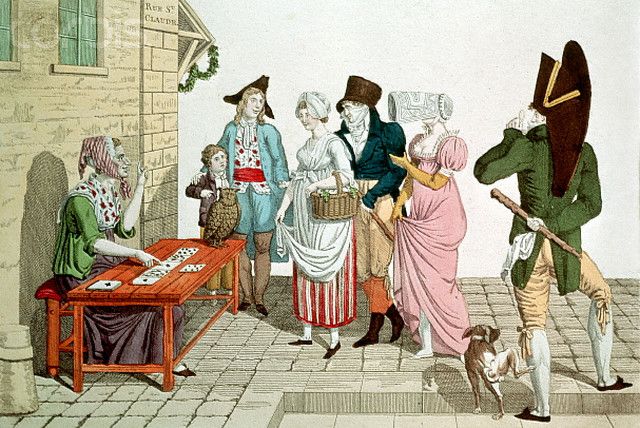
Much about that period, 1572, there were reckoned, in Paris alone, no less than thirty thousand astrologers. At the present day, the ambulating magicians frequent the Old Boulevards, and there tell fortunes for three or four sous; while those persons that value science according to the price set on it, disdaining these two-penny conjurers, repair to fortune-tellers of a superior class, who take from three to six francs, and more, when the opportunity offers….
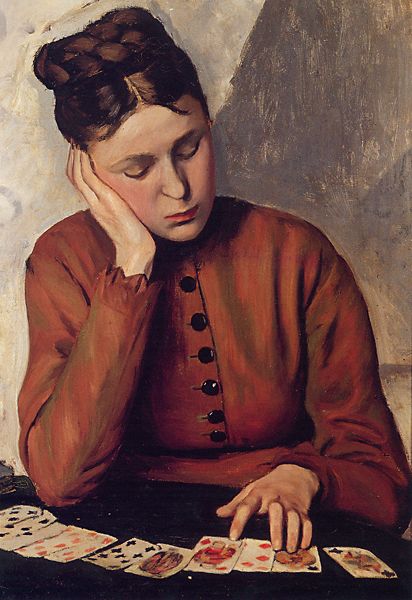
“The Fortune Teller” (circa 1869) by French artist Frédéric Bazille (1841-1870)
Formerly, none but courtesans here drew the cards; now, almost every female, without exception, has recourse to them. Many a fine lady even conceives herself to be sufficiently mistress of the art to tell her own fortune; and some think they are so skilled in reading futurity in the cards, that they dare not venture to draw them for themselves, for fear of discovering some untoward event.
This rage of astrology and fortune-telling is a disease which peculiarly affects weak intellects, ruled by ignorance, or afflicted by adversity. In the future, such persons seek a mitigation of the present; and the illusive enjoyments of the mind make them almost forget the real sufferings of the body.
1820 – Les Jeunes Femmes
A description of fortune-telling with cards by a maid for her lady was translated into English from Les Jeunes Femmes, of M. Bouilly and published in Belle Assemblee: Or, Court and Fashionable Magazine in 1820. In this work, Madame de Saucerre wishes to discover her husband’s activities on the previous night. What is revealed is another matter altogether. Read this story and learn the truth discovered here.
1830 – German Fortune-Telling Cards
We previously saw German cards with mottos or sayings on them. By 1830 a 32-card deck was published in Munich by Franz Josef Holler (made by Comptoir Industry of Leipzig), with fortune-telling meanings printed on them. This deck falls right between the 1799 Spiel der Hoffnüng game (the direct forerunner of the Lenormand cards) that is illustrated with both German and French playing cards, and the nearly identical 1846 German fortune-telling deck named after Mlle. Lenormand. In both decks, for instance, the 10 of Clubs (Acorns) features a picture of a Bear and has a meaning of “envy.” (See my post on the Lenormand playing card inserts HERE.)
 1836 & ’38 – American Cartomancers
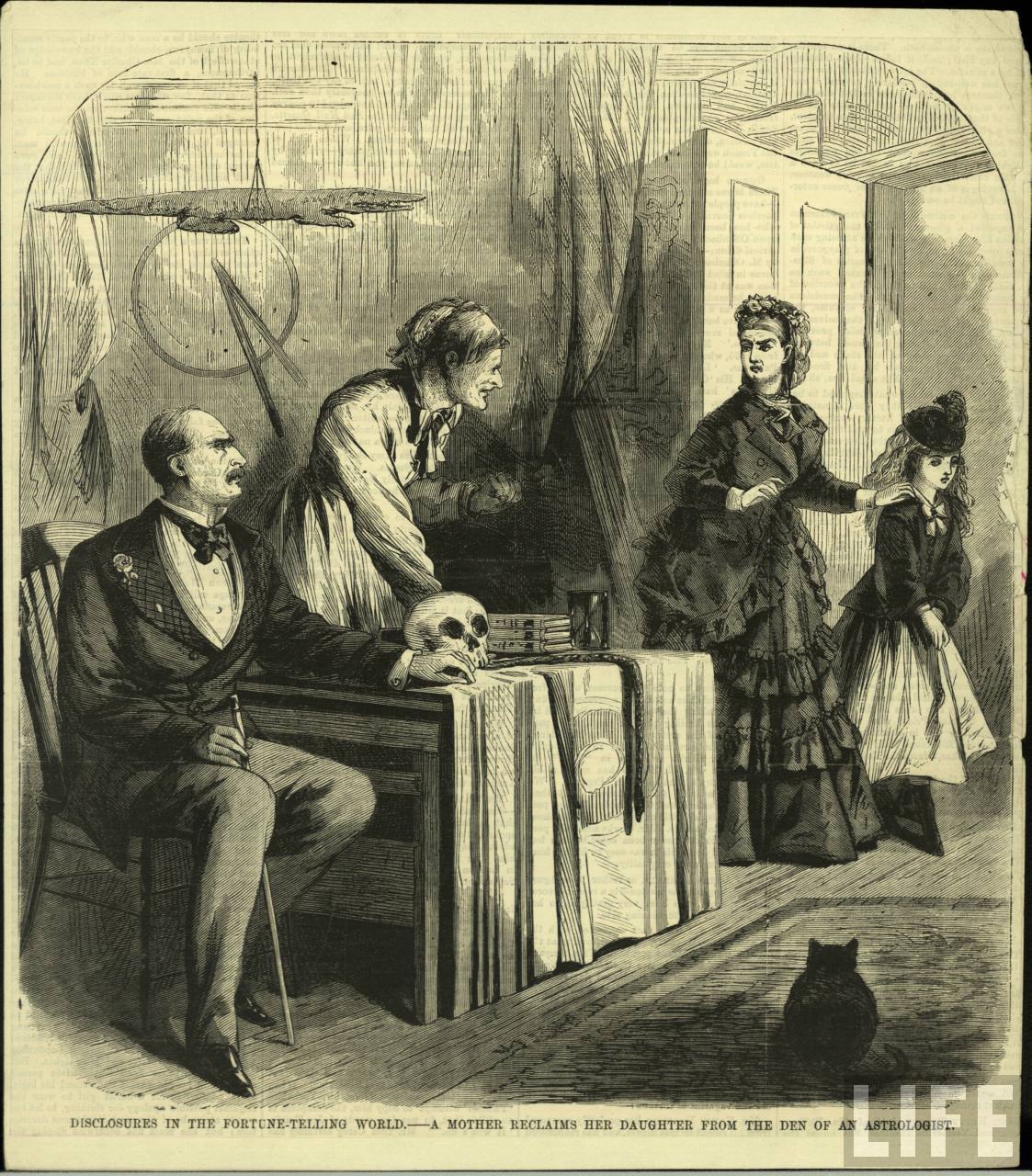
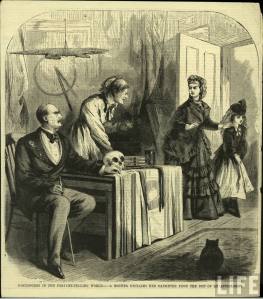
Extending back to the late 18th century, American newspapers report on fortune tellers using cards but usually only when they’ve been arrested for fraud. Here’s the earliest description I can find of professional readers in America—from The Burlington Weekly Free Press, Burlington, Vermont, July 1, 1836:
“Fortune Telling.—The Baltimore Transcript states that there are in that city no less than twelve professors of the art of divination or fortune telling. Most of them perform their incantations by the use of cards; but one old woman, wiser or more gifted than the others, pretends to delve into the mysteries of futurity by looking into an empty junk bottle! Strange as it may seem, the patrons of these vagabonds in the “Monumental city” are not confined to the low and vulgar. Some very genteel, respectable people—particularly ladies—run after these impudent imposters, to inquire after their future fate—as though “a tall, and mean, and meagre hag” knew more of the “shadows of coming events” than the beautiful and fascinating creatures whose bright eyes might if they would pierce into futurity even though it were a nether millstone.—Silly creatures! if they believe the predictions of these hags, they stand at least an even chance of making themselves miserable for life; if they do not, they certainly carry their time and money to a very bad market.”
The Public Ledger (Philadelphia) for January 10, 1838 carries this ad:
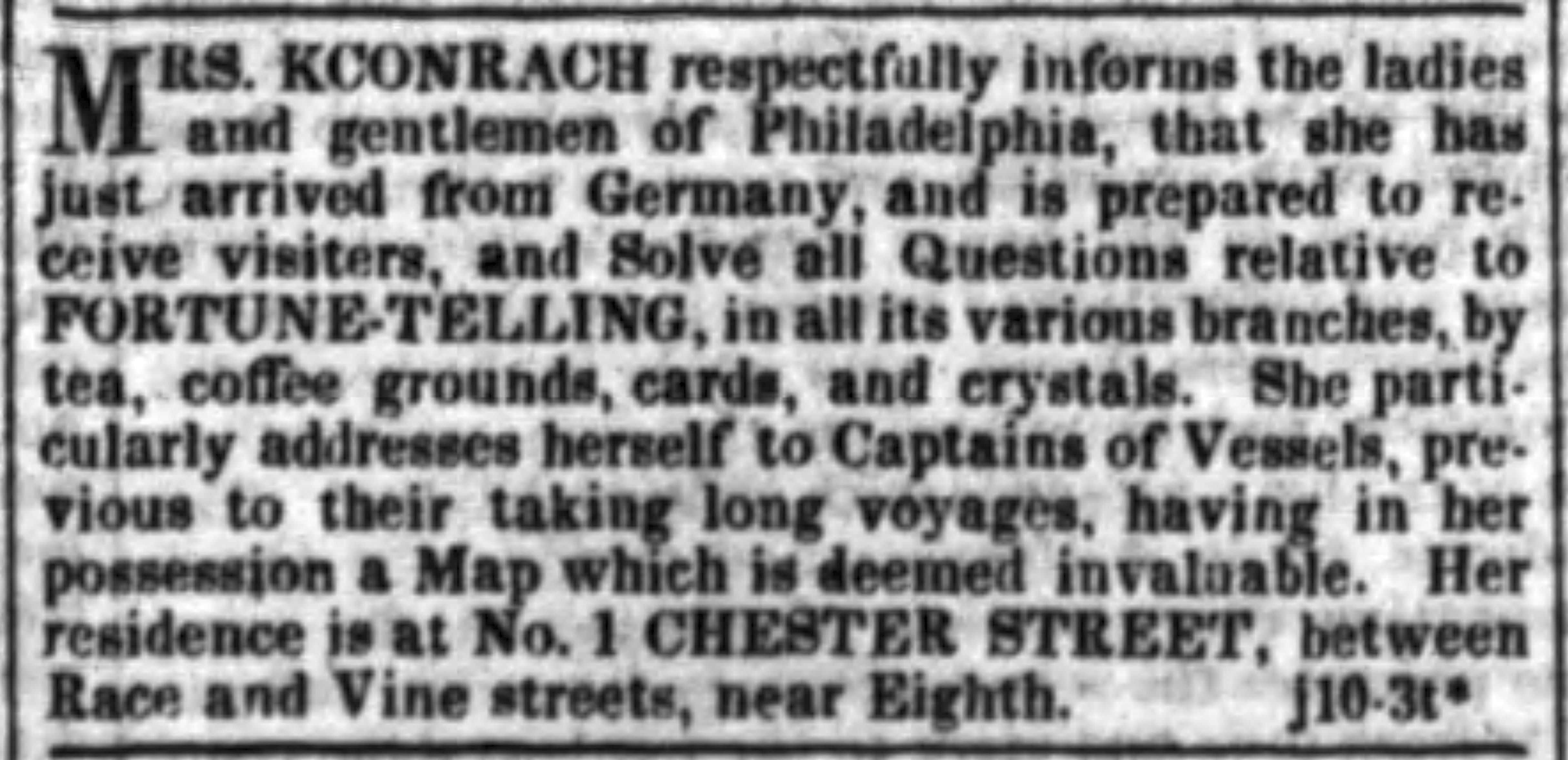
 1838 – Julia Orsini
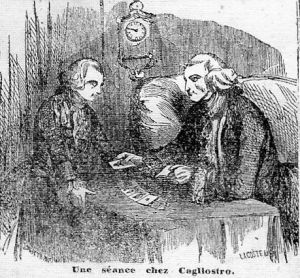
Julia Orsini wrote a book on reading with the Etteilla cards. In Le Grand Etteilla, ou l’art de tirer les cartes (Paris, 1838) containing a rare etching of a man reading the cards, identified as the scondrel, con-artist Count Cagliostro (1743-1795) who was made much of in Masonic circles.
1840/1853 – Rossetti’s Femme Fatale
Read about the poem, “The Card Dealer” (1853), that Dante Gabriel Rossetti wrote to Theodore von Holst’s painting “The Fortune-Teller” (1840) – here.
1846 – Petit Lenormand Deck
Upon the death of Mlle. Lenormand in 1843, as was the tradition, publishers began publishing Lenormand decks and books that had nothing to do with the original person. In France a 52-card Grand Jeu Lenormand deck was produced with designs taken from myth, constellations and flower oracles.
In 1846 in Coblenz, Germany we find the first Petit Lenormand – a 36 card deck (see cards below). It featured the same set of images found in the Spiel der Hoffnung, but with only the French-suited playing card inset. The sheet of instructions and card meanings, signed by a fictitious “Philippe, heir to Mlle. Lenormand” were nearly identical to the coffee-ground meanings and reading technique detailed in the Viennese Coffee-Card book (see above). The deck was soon produced by multiple publishers in Germany, Belgium, Sweden and the United States (where they were called, among other names, “Madam Morrow’s Fortune-Telling Cards). The earliest U.S. publications, found in Chicago and New York had bi-lingual German and American instruction sheets. Today these cards are experiencing a huge resurgence in interest.
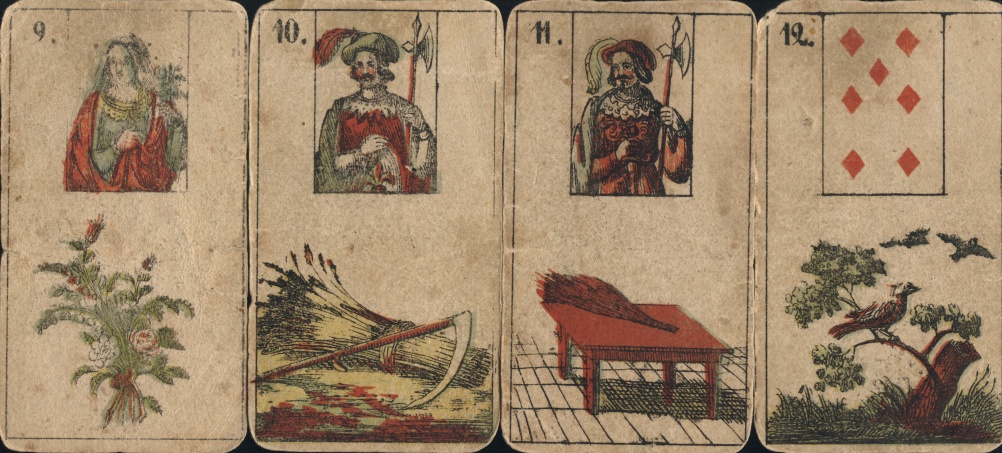
Soon after, a wide variety of fortune-telling decks began appearing, usually called Sybilla or Gypsy decks, with a varying number of cards and images. Despite the emergence of dozens of fortune-telling decks, paintings and prints of cartomancers up until the late 20th century almost universally show only standard playing cards.
1863 – Chambers’ Book of Days
In 1863, Robert Chambers, with his Book of Days, published a two volume “miscellany of popular antiquities” organized around the calendar year. For February 21st, he includes an article on English cartomancy called “The Folklore of Playing Cards” (illustrated with the picture below). In it he gives the card meanings he was taught as a child when struck by illness in a foreign land. (Read the whole article here—you need to scroll down a ways.)
The English system is used in all British settlements over the globe, and has no doubt been carried thither by soldiers’ wives, who, as is well known to the initiated, have ever been considered peculiarly skilful practitioners of the art. Indeed, it is to a soldier’s wife that this present exposition of the art is to be attributed. Many years ago . . . the writer, then a puny but not very young child, [was] left for many months in charge of a private soldier’s wife, at an out-station in a distant land. . . . She was too ignorant to teach her charge to read, yet she taught him the only accomplishment she possessed,—the art of ‘cutting cards,’ as she termed it: the word cartomancy, in all probability, she had never heard.
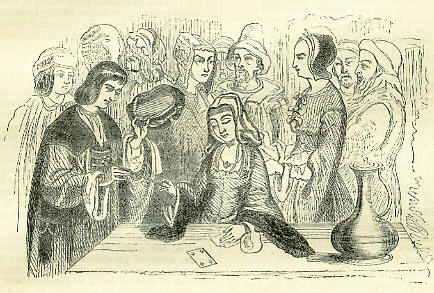 The above engraving that illustrated Chambers’ article first appeared in the Magasin Pittoresque in 1842 (according to Detleff Hoffmann). It loosely reproduces a painting by Lucas van Leyden that was later named The Fortune Teller (c. 1508) though it may actually commemorate a political negotiation mediated by Margaretha of Austria (see painting near the beginning of this post). Chambers’ meanings were used by A.E. Waite when he wrote his compendium on fortune-telling as “Grand Orient.” They appear almost intact in the supplemental meanings for the Lesser Arcana given in Waite’s Pictorial Key to the Tarot (1910).
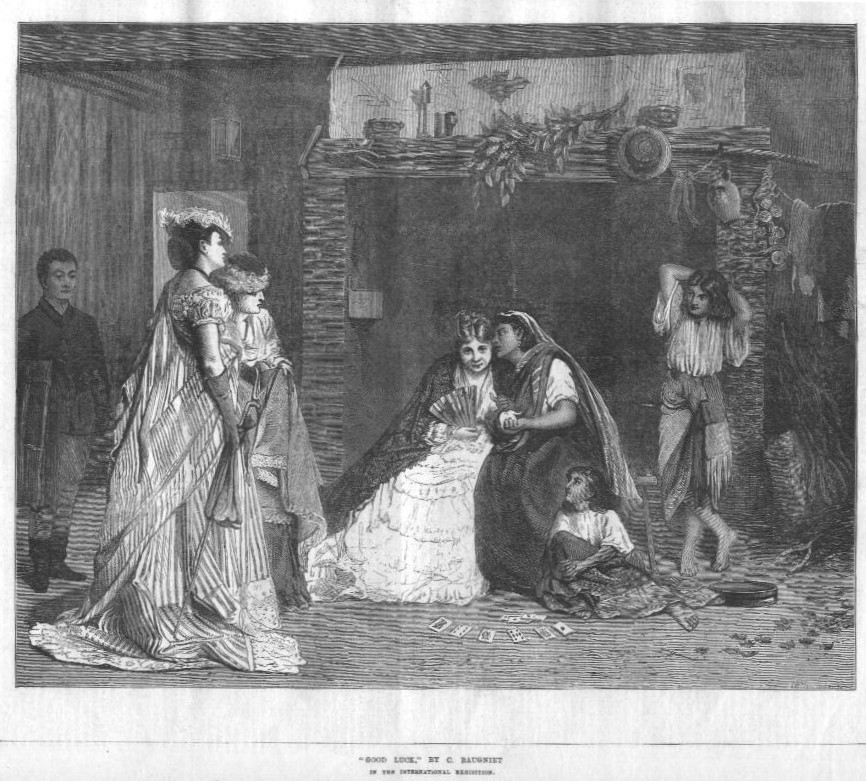
End of the 19th century
By the end of the 19th century we find all kinds of new fortune-telling decks springing up, including the Kipper Cards in 1873 (published by Matthias Seidlein and said to be created by a Frau Kipper), and various “Gypsy” and “Sybilla” decks each with their own emphasis on certain aspects of a daily life. Tarot was taking a huge leap forward as esoteric societies rushed to design occult decks and write books influenced by Antoine Court de Gébelin, Etteilla and Eliphas Lévi. The Tarot details are found in other posts and books.
To Sum It Up
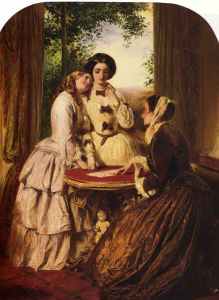 Never as ubiquitous as dice, palmistry or astrology, divination with cards goes back to at least the 16th century and probably earlier, though the form may not have been what we now call cartomancy, which emerged more recognizably in the 18th century. We can see from all the above that historically card divination was practiced mostly by illiterate gypsies, courtesans, soldier’s wives and old women, and by literate young women for whom it was a parlour game. It was largely scorned by men and more often officially ignored by legislation, until the stakes got higher. With the exception of Madame Lenormand’s fame, it wasn’t until a few men deemed the art worth mentioning and the decks or books worth writing that it was really acknowledged. Still, it was not to be taken too seriously and generally kept to the confines of frivolous social entertainment, yet all the while there was an underground of mostly older women who made a good, if precarious, living out of various forms of divination. (Out of more than 400 pre-1900 pictures I’ve found of cartomancers less than a dozen have been of male readers and most of them are making fun of the practice.) A. E. Waite integrated Chambers’ soldier’s wives card meanings into many of his Minor Arcana tarot interpretations, where they are still in use today.
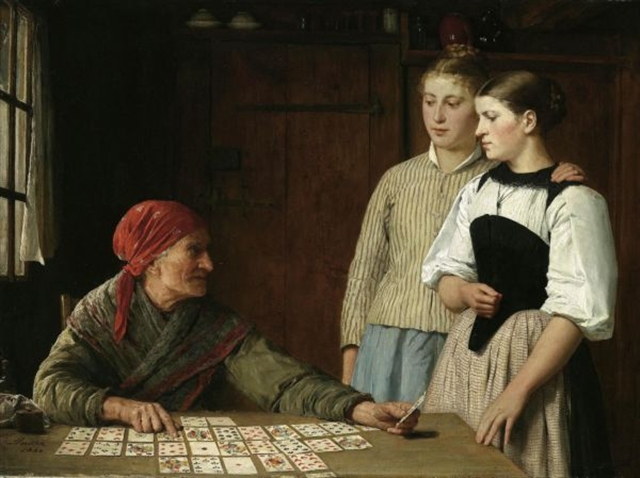
“Die Kartenlegerin” (1880) by Swiss artist Albert Anker
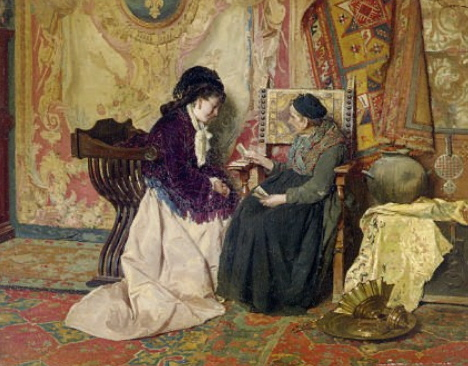
Maccari, The Fortune Teller
See more paintings of nineteenth century cartomancers here.
Additional Links
-
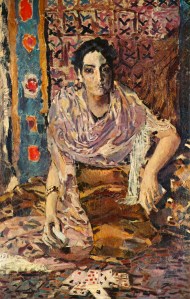
Fortune Teller by Mikhail Vrubel, 1895
Watch the 45 minute History Channel TV special on “Secrets of the Playing Card.”
- The best source on the history of playing cards is The World of Playing Cards.
- See especially Ross Caldwell’s presentation on playing cards (including Tarot) in divination and magic for the International Playing Card Society, September, 2006 – here, and his more recent report on references in Spanish documents here. I want to thank Ross for his historical professionalism and dedication to setting the story straight with concrete evidence.
- An account of cartomancy that draws from Chambers: The Gaming Table: its Votaries and Victims, Vol. II (1870) by Andrew Steinmetz – here. A set of modern playing card meanings can be found here. Seaqueen’s examples of cartomancy readings with a wide variety of decks are here.

Updates:
2/1/2015: Lots of 17th and 18th century material added, including photos, a 1791/3 book on “card tossing,” and more information on the card and coffee-ground reading from 1730.
2/1/2014: Information on the Mamluk cards inscriptions below comes from The World of Playing Cards website. A few notes added on the Grand and Petit Lenormand decks.
5/2011: There are a scattering of references to cards and their use in “lots” (sortes) or fortune-telling from the 15th century on, including analogies between the four suits and characteristics such as the virtues and the elements. Recently Ross Caldwell discovered a treasure-trove of Spanish references that he describes here. He notes: “The main points to be taken from the recent discoveries are that, in Spain at least, there were professional cartomancers in the 17th century, and they used layouts with multiple cards and positional significations.” Follow the trail of evidence below (and add to it Ross’s recent contributions) to see the development of divination with cards.
Although many tarot practitioners apply a Jungian psychological approach to their tarot work, there’s been a question as to whether Jung himself knew anything about tarot. In fact he did, and he would have liked to explore it more deeply but for a lack of hours in the day. Here are some of his references to the cards, although his tarot knowledge, especially of its history, was sorely lacking. Update: I’ve added brief notes by Jung on the Major Arcana here, and on “clouds of cognition” at the end of this article. 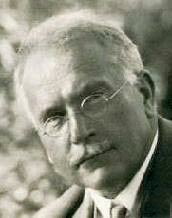
On 16 September 1930, Jung wrote to a Mrs. Eckstein:
“Yes, I know of the Tarot. It is, as far as I know, the pack of cards originally used by the Spanish gypsies, the oldest cards historically known. They are still used for divinatory purposes.”
[Jung was not always right: Current historical research does not support an original use of the cards by gypsies, nor were tarot cards the oldest known. The ordinary playing card deck (with many variations) preceded tarot by approximately 50 to 75 years. Tarot appeared first in Northern Italy roughly around 1440.]
On 1 March 1933, Carl Jung spoke about the Tarot during a seminar he was conducting on active imagination, demonstrating that he was a little more familiar with these images than we would have thought from just the preceding letter. This is a transcript of his actual spoken words:
“Another strange field of occult experience in which the hermaphrodite appears is the Tarot. That is a set of playing cards, such as were originally used by the gypsies. There are Spanish specimens, if I remember rightly, as old as the fifteenth century. These cards are really the origin of our pack of cards, in which the red and the black symbolize the opposites, and the division of four—clubs, spades, diamonds, and hearts—also belongs to the individuation symbolism. They are psychological images, symbols with which one plays, as the unconscious seems to play with its contents. They combine in certain ways, and the different combinations correspond to the playful development of events in the history of mankind. The original cards of the Tarot consist of the ordinary cards, the king, the queen, the knight, the ace, etc.,—only the figures are somewhat different—and besides, there are twenty-one cards upon which are symbols, or pictures of symbolical situations. For example, the symbol of the sun, or the symbol of the man hung up by the feet, or the tower struck by lightning, or the wheel of fortune, and so on. Those are sort of archetypal ideas, of a differentiated nature, which mingle with the ordinary constituents of the flow of the unconscious, and therefore it is applicable for an intuitive method that has the purpose of understanding the flow of life, possibly even predicting future events, at all events lending itself to the reading of the conditions of the present moment. It is in that way analogous to the I Ching, the Chinese divination method that allows at least a reading of the present condition. You see, man always felt the need of finding an access through the unconscious to the meaning of an actual condition, because there is a sort of correspondence or a likeness between the prevailing condition and
the condition of the collective unconscious.
“Now in the Tarot there is a hermaphroditic figure called the diable [the Devil card]. That would be in alchemy the gold. In other words, such an attempt as the union of opposites appears to the Christian mentality as devilish, something evil which is not allowed, something belonging to black magic.”[from Visions: Notes of the Seminar given in 1930-1934 by C. G. Jung, edited by Claire Douglas. Vol. 2. (Princeton NJ, Princeton University Press, Bollingen Series XCIX, 1997), p. 923.]
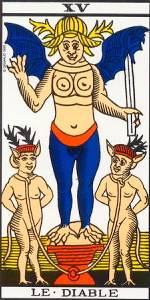
In The Archetypes of the Collective Unconscious (CW, Vol. 9:1, para 81), Jung wrote:
“If one wants to form a picture of the symbolic process, the series of pictures found in alchemy are good examples. . . . It also seems as if the set of pictures in the Tarot cards were distantly descended from the archetypes of transformation, a view that has been confirmed for me in a very enlightening lecture by professor [Rudolph] Bernoulli. The symbolic process is an experience in images and of images. Its development usually shows an enantiodromian* structure like the text of the I Ching, and so presents a rhythm of negative and positive, loss and gain, dark and light.” [*a Greek term used by Jung to mean ‘things turning over into their own opposite.’]
Dierdre Bair recounts in Jung: A Biography (Little, Brown, 2003, p. 549) that in 1950 Jung assigned to each of the four members of his Psychology Club an ‘intuitive, synchronistic method’ to explore. Hanni Binder was to research the Tarot and teach him how to read the cards. They determined that Grimaud’s Ancien Tarot de Marseille “was the only deck that possessed the properties and fulfilled the requirements of metaphor that he gleaned from within the alchemical texts.” Hanni Binder’s work amounted to very little as can be seen from her report preserved at the Jung Institute in New York. The group disbanded around 1954.
What was behind Jung’s attempt to gather all this material? Marie-Louise von Franz recounts in Psyche and Matter (1988) that toward the end of his life:
“Jung suggested investigating cases where it could be supposed that the archetypal layer of the unconscious is constellated*—following a serious accident, for instance, or in the midst of a conflict or divorce situation—by having people engage in a divinatory procedure: throwing the I Ching, laying the Tarot cards, consulting the Mexican divination calendar, having a transit horoscope or a geomantic reading done. If Jung’s hypothesis is accurate, the results of all these procedures should converge. . . . [*a Jungian term meaning ‘the coming together of elements in the unconscious so that they form a consciously recognizable pattern of relationships.’ Christine Houde adds, “The constellated material is activated in the psyche of the individual where it attempts to erupt into the field of experience.”]
“[This investigation would consist of] studying an incident (accident) by the convergence . . . of a multitude of methods, with the help of which we could try to find out what the Self “thought” of this particular accident. . . . The generally rather vague formulations of divinatory techniques resemble these “clouds of cognition” that, according to Jung, constitute “absolute knowledge.”
Von Franz further explains that Jung’s “clouds of cognition” represents an awareness on the part of our conscious intelligence of a far vaster field of information, an “absolute knowledge,” within the collective unconscious. These images, on the part of a “more or less conscious ego,” lack precise focus and detail. Thus, the realization of meaning has to be “a living experience that touches the heart just as much as the mind.” She continues:
“Archetypal dream images and the images of the great myths and religions still have about them a little of the “cloudy” nature of absolute knowledge in that they always seem to contain more than we can assimilate consciously, even by means of elaborate interpretations. They always retain an ineffable and mysterious quality that seems to reveal to us more than we can really know.”*
On 9 February 1960, about a year before he died, Jung wrote Mr. A. D. Cornell about the disappointing end to his grand experiment:
“Under certain conditions it is possible to experiment with archetypes, as my ‘astrological experiment’ has shown. As a matter of fact we had begun such experiments at the C. G. Jung Institute in Zurich, using the historically known intuitive, i.e., synchronistic methods (astrology, geomancy, Tarot cards, and the I Ching). But we had too few co-workers and too little means, so we could not go on and had to stop.”
The experiment proposed by Jung is discussed in the Journal of Parapsychology (March 1998): in an article titled: “The Rhine-Jung letters: distinguishing parapsychological from synchronistic events – J.B. Rhine; Carl Jung” by Victor Mansfield, Sally Rhine-Feather, James Hall. The authors conclude:
“Such an experiment fits our description of not being forced, controlling, or manipulating, but it presents its own difficulties. How, for example, can we convincingly show that the divinatory procedures in fact converge, that appropriate subjects were chosen when an archetype was actually constellated, that the data was taken without biasing the interpretation, and that other extraneous factors are not distorting the outcome? These problems are not insurmountable, but to do more than “preach to the converted,” this experiment or any other must be done with sufficient rigor that the larger scientific community would be satisfied with all aspects of the data taking, analysis of the data, and so forth.”
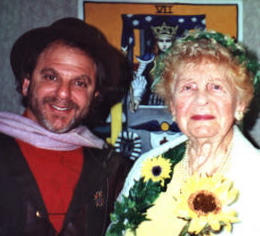
In 1984, Art Rosengarten (here shown with Tarot author, Eden Gray), as research for his doctoral dissertation, conducted an experiment very similar to the one described by Jung, in which he compared the tarot, TAT and dream interpretation. You can read about this experiment in his book, Tarot and Psychology: Spectrums of Possibility. I think Jung would have been pleased.
So what are we to make of all this?
Though not a direct focus of his energies, Carl Jung, nevertheless, recognized tarot as depicting archetypes of transformation like those he had found in myths, dreams and alchemy, and as having divinatory characteristics similar to the I-Ching and astrology. Most of all, Jung believed a person could use “an intuitive method” to understand—through tarot’s reflecting the collective unconscious into a “cloud of cognition”—the meaning in a present, prevailing condition.
See Jung’s own comments on the Major Arcana here.
ADDED: Here’s another statement by Jung on “clouds of cognition,” from the chapter, “On Life after Death,” in Memories Dream, Reflections, p 308. He states that in the “space-timelessness” surrounding an archetype there exists a diffuse cloud of cognition that contains “primorial images with many aspects” or “a “diffuse omniscience” but no discrete contents (that is, subjectless). For cognition to happen these potentialities [my word] have to be brought into space-time coordinates. Reading this entire chapter is absolutely essential to getting at what Jung saw as the source material for divinations.
“As I see it the three-dimensional world in time and space is like a system of co-ordinates, what is here separated into ordinates and abscissae may appear “there,” in space-timelessness, as a primordial image with many aspects, perhaps as a diffuse cloud of cognition surrounding an archetype. Yet a system of co-ordinates is necessary if any distinction of discrete contents is to be possible. Any such operation seems to us unthinkable in a state of diffuse omniscience, or, as the case may be, of subjectless consciousness, with no spatio-temporal demarcations. Cognition, like generation, presupposes an opposition, a here and there, an above and below, a before and after.”
For a different take, here is a bit of an interview with Jung on alchemy and predicting the future: “We can predict the future when we know how the present moment has evolved out of the past.”
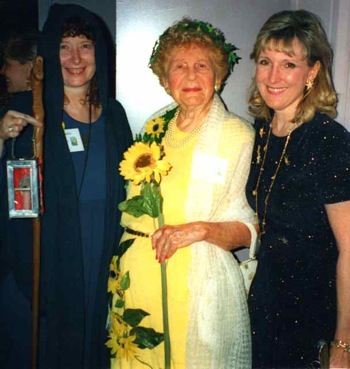
Eden Gray at the ’97 International Tarot Congress, dressed as the Sun, standing between Mary Greer as the Hermit and Barbara Rapp, organizer of the Los Angeles Tarot Symposiums.
Eden Gray (born June 9, 1901) began life as Priscilla Pardridge, Chicago debutante and second cousin to Princess Engalitcheff, wife of the Russian vice counsel. Still in her teens, Priscilla decided to become a stage actor. Despite her family’s owning Chicago’s Garrick Theatre (as well as a major department store), her father “snatched her from the footlights,” so she took a menial job in another department store. Before long she slipped off to New York where, at nineteen years of age, and without her parents’ knowledge, she married fellow-Chicago poet, novelist and screenwriter Lester Cohen (who wrote the screenplay for Of Human Bondage among others).
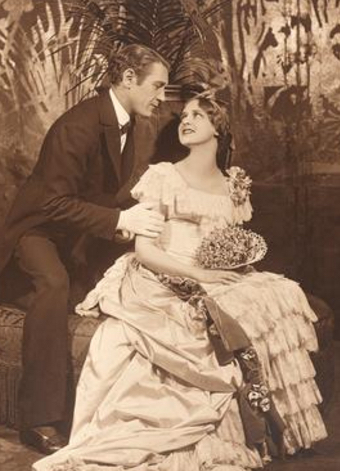 Adopting the stage name, Eden Gray, from 1920-1933 she was in a series of Broadway plays, including Edith Wharton’s The Age of Innocence, at New York’s Empire Theatre in 1928 (photo on right), and Doctor X on Broadway (see poster). She also performed supporting roles in three movies, being best known as Pamela Gordon in the 1925 film Lovers in Quarantine, and appearing as late as 1942 with Ronald Reagan in King’s Row (despite only a fleeting glimpse of her at a window in the film, she and Reagan shared an interest in positive thinking and astrology). In addition to all this she took a several year trip with her husband, which he described in his book, Two Worlds: An Account of a Journey around the World. During World War II, she put her acting career on hold to become a lab technician with the Women’s Army Corps.
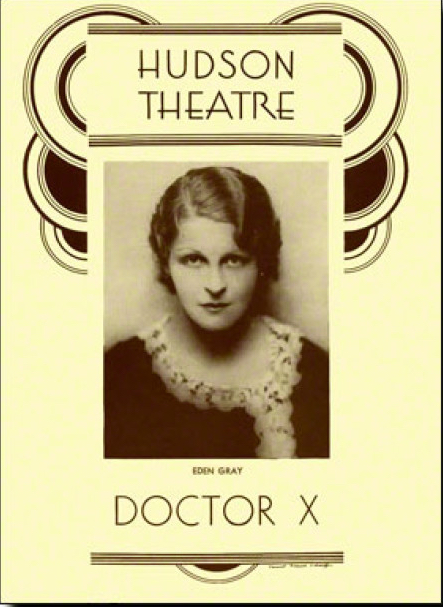
After living in Pennsylvania, Virginia, Indiana, Paris and London and working in radio and on the London stage, Gray moved back to New York. She earned a doctorate of divinity degree from the First Church of Religious Science and then lectured and taught classes in Science of Mind. Gray also got to know librarian Gertrude Moakley who, since the early 1950s, had been researching tarot’s origins in Renaissance Italy (see bio of Moakley here).
 Eden Gray ran a bookstore and publishing company called “Inspiration House,” one of the few places where a person could buy tarot cards and take tarot classes in the late 1950s and ’60s. Her customers complained that the available books were not easy to understand, so she spent weekends in the country coming up with a more accessible way of approaching the cards.
Eden Gray self-published her first book, Tarot Revealed: A Modern Guide to Reading the Tarot Cards in 1960 to which she applied her “New Thought” perspective (see my earlier post here). She followed up her first success with two more tarot books: A Complete Guide to the Tarot (1970) and Mastering the Tarot: Basic Lessons in an Ancient, Mystic Art (1971). All feature graphics by her artist son Peter Gray Cohen. These books have remained continuously in print and are still among the best-selling tarot books today.
My personal favorite is Mastering the Tarot, as the card meanings are the richest of the three, and it gives practical demonstrations of interpreting the cards through sample readings. Lesson 18, “The Use and Misuse of the Tarot,” is a small gem of “New Thought” philosophy and positive thinking applied to the cards. Gray advises:
“So watch for the pitfalls when you read the cards; recognize how very suggestible everyone is—and then go ahead and use the cards for good. . . . Give those for whom you read encouragement to strive for their highest ideals. The seeds you plant can blossom into lovely flowers of accomplishment.”
Along with various editions of the Rider-Waite-Smith deck (de Laurence, University Books, Albano-Waite, Merrimack, U.S. Games, Inc.), Eden Gray’s tarot books formed the main impetus to the hippie adoption of the Tarot as spiritual guide for navigating a world-turned-on-its-head, leading directly to the booming Tarot Renaissance that began in 1969 and continues to this day.
It was Eden Gray to whom we owe the term “Fool’s Journey,” appearing as the title of the Epilogue in A Complete Guide to the Tarot. She explained:
“The Fool represents the soul of everyman, which, after it is clothed in a body, appears on earth and goes through the life experiences depicted in the 21 cards of the Major Arcana, sometimes thought of as archetypes of the subconscious. Let each reader use his imagination and find here his own map of the soul’s quest, for these are symbols that are deep within each one of us.”
In 1960 she had already alluded to the idea, saying that the Fool “must pass through the experiences suggested in the remaining 21 cards, to reach in card 21 the climax of cosmic consciousness or Divine Wisdom”—an idea that resonated deeply with the hippies—and that Gray probably picked up from A.E. Waite who wrote about the “soul’s progress through the cards.”
 In 1971, Gray moved to Vero Beach, Florida, where she focused on her art and spiritual ministry. She was a member of the Vero Beach Art Club and Riverside Theater and Theater Guild. In the 1990s several people contacted her about her earlier work in tarot, including Ron Decker and Janet Berres of the International Tarot Society. Berres honored Gray at their third International Tarot Congress in 1997 in Chicago with the Tarot Lifetime Acheivement Award. It was here that Eden Gray learned to her great astonishment just how truly revered she was for her seminal tarot books.
(I received this bronze statue of the Hanged Man created by Eden Gray (see right) from Barbara Rapp at the Los Angeles Tarot Symposium for recognition of my work in tarot. Read about it’s significance while writing my Tarot Reversals book here. Read more about Eden Gray here.)
This adventurous, pioneering woman, and “Godmother of the Modern American Tarot Renaissance” died peacefully in her sleep at 97 years of age, on January 14, 1999 in Vero Beach, having driven herself to the hospital following a minor heart attack.
Her books (with first publication date):
- Tarot Revealed (1960)
- Recognition: Themes on Inner Perception (1969)
- A Complete Guide to the Tarot (1970)
- Mastering the Tarot (1971)
- The Harvest Home Natural Grains Cookbook with Mary Beckwith Cohen (1972)
- The Harvest Home Fresh Vegetables Cookbook with Mary Beckwith Cohen (1972)
- Marbling on Fabric with Daniel and Paula Cohen (1990)
You can hear her briefly in this replay of a Long John Nebel talk radio program from New York in 1964 (thanks to Kim). Be warned that she only gets in a couple of sentences in a show totally dominated by Walter Martin who wrote an anti-cult/occult book from a Christian perspective. Supposedly she appeared on other Nebel shows but I can’t find them on the net.
Just found: Eden Gray as “Angela” in The Firebrand,1924-25. She played the model of the Renaissance artist Benvenuto Cellini. The play was described as: “a modern farce masquerading in the trappings of the Renaissance, or a comedy of the sixteenth century “jazzed up” to delight a 1925 audience.” You can also see another photograph of her here.
 Do a Google search on the words ‘psychic + tarot’ and you’ll come up with 370,000 entries, the majority of which are professional readers advertising their skills. One person offers an “intuitive, psychic tarot reading.” Others list themselves as an “empathic, intuitive, psychic tarot reader,” a “gifted psychic reader,” and a “psychic medium who uses the tarot”. The claims are sometimes outrageous—“99% accurate psychic predictions,” “only the truth,” “world renown,” “specializing in reuniting loved ones,” and “love and money spells” to remove curses—all indicators that you should beware of what you’re getting into. One characteristic of a psychic tarot reading, it seems, is that you won’t find interpretations that come out of a book; instead these are “cosmic insights,” “channeled wisdom,” or clairvoyance. (I bought this statue when Tarot for Your Self first came out—to celebrate the day.)
Search on ‘intuition or intuitive + tarot’ and there are 385,000 entries. There are an additional 216,000 listings for ‘Tarot Reader’ that do not use the terms psychic, intuitive or intuition. And, 225,000 listings for either a ‘tarot consultant or counselor’ with all previous words eliminated. By contrast, a search on Tarot alone results in thirty-two and a half million entries.
Intuitive tarot, when the word ‘psychic’ has been eliminated, emphasizes listings for decks, books, articles and courses, but there are still plenty of ads for readings. These readers are somewhat more likely to advertise themselves as spiritual counselors or consultants (who might also practice Reiki or coaching or “down-to-earth guidance”). But descriptions still feature an aversion to interpretations found in books: “An intuitive approach to tarot reading places the power within,” while a book meaning “denies the power within.” Intuitive tarot involves “that gut feeling or first instinct that comes to you when you look at a card. . . . It is a gut reading more so than regurgitation of memorized definitions.”
Self-styled ‘tarot counselors’ (when eliminating the intuitive and psychic words) seem to have an altogether different vibe. They use tarot “as a therapeutic method and means for self-realization,” “for drawing out information lying deep inside,” and “for helping someone to clearly see a particular present situation.” Sessions are “designed to bring personal fulfillment . . . to assist and guide, to empower and uplift.” Book meanings are sometimes acknowledged as helpful for their depth, wisdom and guidance.
‘Therapeutic tarot’ or ‘tarot therapy’ seems to focus on healing modalities including massage and Reiki in addition to such counseling skills as “assisting you in reaching your goals [and to] gain clarity.” The querent’s projections (ascribing one’s own feelings, thoughts, attitudes or situation to another person or thing) are often described as a major method for determining the significance of the cards.
A search on ‘tarot + projection’ turned up an interesting report from Quirk’s Marketing Research Review called “Heart Maps and Tarot Cards” by Steven Richardson. It describes how tarot cards have been used to help medical doctors talk about the influence of marketing in their disease treatment decision-making processes:
“Tarot cards serve as unique picture-sort stimuli for images and archetypes (but are not used as actual tarot cards for readings, just for the symbolism). In this technique, ask physicians to thumb through the cards quickly and come up with ones that describe or dramatize how they personally feel about being a doctor in the practice of medicine as it relates to a particular disease state. . . . In another study conducted by [Myra] Summers, the tarot card technique was helpful in understanding doctors’ attitudes towards treating terminally ill patients (though Summers also does not use the cards as they are used in tarot readings). The technique revealed meaningful insight into the emotional distress a number of oncologists experience every day.”*
Notice how quick the author is to disassociate this use of cards from tarot readings. Yet, how many tarot readers would claim that such insights are precisely what they turn to the cards for?
I plan on writing much more on this topic, but will leave it for now. I encourage you to write in comments on your own thoughts on this subject.
*You can see a Power Point Presentation (ppt) by Pat Sabena and Nicole Sabena Feagin on their landmark research study using tarot, called “Getting Doctors to Spill their Guts” – here.
 Most of us have heard of Mlle. Lenormand, known for having read cards to make predictions for Napoleon and Josephine, but few know much more than this about the most famous card-reader of all time. She was born May 27, 1772 in Alençon, France and died June 25, 1843, having written over a dozen books. Look over her natal chart analysis by Elizabeth Hazel in the Comments (thank you, Liz). Marie Anne Adelaide Lenormand claimed to have obtained her first deck of cards when she was 14 from gypsies who taught her how to read them.
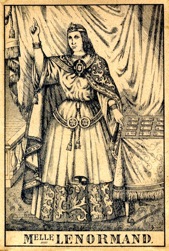
It wasn’t until two years after her death that a deck of cards called “Le Grand Jeu de Mlle. Lenormand” was first published by Grimaud. This 54 card deck was actually created by a Madame Breteau, who claimed to be a student of Madame Lenormand. (It is pictured in the Dumas story in this post.)
The 36-card “Petit Lenormand” was a German creation that, in 1845, appropriated the now-dead Mlle. Lenormand’s famous name. This deck was based on an earlier race game and multi-purpose set of cards called the “Spiel der Hoffnung” (“Game of Hope”; 1798) and the even earlier Viennese Coffee Cards (1794/6), published in both German and English.
Because Lenormand’s own memoirs were written as self-promotion and reveal little about her techniques, I’ve focused in this post on first person accounts of readings with her where we get some idea as to her character and methods. An overview of her life is available at trionfi.com. A short biography published 15 years after her death can be found here. New information by Jim McKeague based on newspaper accounts and a court case is available here. Learn to read the various Lenormand-style decks here, here, here and also here. Get a computerized Mlle. Lenormand-style reading here. Several portraits are available here and card meanings here.
Recordings of webinar classes by me teaching the Petit Lenormand deck (and also Tarot) are available through GlobalSpiritualStudies.com. (See additional links at the end.)
Updated 2/1/2015
In the Sibyl’s Boudoir
You can imagine my delight in coming across this first-person account of a visit to Madame Lenormand made by Captain R. H. Gronow of the Grenadier Guards & M.P. for Stafford in his book Celebrities of London and Paris (London: Smith, Elder & Co., 1865). Gronow probably met her during his 1815-1816 stay in Paris.
“One of the most extraordinary persons of my younger days was the celebrated fortune-teller, Mademoiselle le Normand. Her original residence was in the Rue de Tournon, but at the time of which I write she lived in the Rue des Sts Pères. During the Restoration, the practice of the “black art” was strictly forbidden by the police, and it was almost like entering a besieged citadel to make one’s way into her sanctum sanctorum.

“I was first admitted into a good-sized drawing-room, plainly but comfortably furnished, with books and newspapers about, as one sees them at a dentist’s. Two or three ladies were already there, who, from their quiet dress and the haste with which they drew down their veils, or got up and looked out of the window, evidently belonged to the upper ten thousand. Each person was summoned by an attendant to the sibyl’s boudoir, and remained a considerable time, disappearing by some other exit without returning to the waiting-room. At last I was summoned by the elderly servant to the mysterious chamber, which opened by secret panels in the walls, to prevent any unpleasant surprises by the police. I confess that it was not without a slight feeling of trepidation that I entered the small square room, lighted from above, where sat Mademoiselle le Normand in all her glory.
 “It was impossible for imagination to conceive a more hideous being. She looked like a monstrous toad, bloated and venomous. She had one wall-eye, but the other was a piercer. She wore a fur cap upon her head , from beneath which she glared out upon her horrified visitors. The walls of the room were covered with huge bats, nailed by their wings to the ceiling, stuffed owls, cabalistic signs, skeletons – in short, everything that was likely to impress a weak or superstitious mind. This malignant-looking Hecate had spread out before her several packs of cards, with all kinds of strange figures and ciphers depicted on them. Her first question, uttered in a deep voice, was whether you would have the grand or petit jeu, which was merely a matter of form. She then inquired your age, and what was the colour and the animal you preferred. Then came, in an authoritative voice, the word “Coupez“, repeated at intervals, till the requisite number of cards from the various packs were selected and placed in rows side by side. No further questions were asked, and no attempt was made to discover who or what you were, or to watch upon your countenance the effect of the revelations. She neither prophesied smooth things to you nor tried to excite your fears, but seemed really to believe in her own power. She informed me that I was un militaire, that I should be twice married and have several children, and foretold many other events that have also come to pass, though I did not at the time believe one word of the sibyl’s prediction.
“Madamoiselle le Normand was born in 1768, and was already celebrated as a fortune-teller so early as 1790. She is said to have predicted to the unfortunate Princess de Lamballe her miserable death at the hands of the infuriated populace. She is also reported to have been frequently visited and consulted by Robespierre and St Just; to have reported his downfall to Danton, at that time the idol of the people; to have warned the famous General Hoche of his approaching death by poison; to have foretold to Bernadotte a northern throne, and to Moreau exile and an untimely grave.
“The Empress Josephine, who, like most creoles, was very superstitious, used frequently to send for Madamoiselle le Normand to the Tuileries, and put great faith in her predictions; which she always asserted in after years had constantly been verified. But, unfortunately for the sybil, she did not content herself with telling Josephine’s fortune, but actually ventured to predict a future replete with malignant influences to the Emperor himself. This rash conduct entailed upon her great misfortunes and a long imprisonment; but she survived all her troubles, and died as late as 1843, having long before given up fortune telling, by which she had amassed a large sum of money.”

Danhauser: Neapoleon & Josephine with the Card Reader
Spellbound by the Prophetess
And from The Diary of Frances Lady Shelley (NY: Scribner’s Sons, 1912) we find that on July 4, 1816 Lady Shelley went to see Madame Le Normand:
“I was shown into a beautiful boudoir, furnished with a luxury which gave evidence of her prosperity. After waiting for some time, the prophetess appeared, and exclaimed “Passez, madame.” She then introduced me into a dimly lit cabinet d’étude. On a large table, under a mirror, were heaps of cards, with which she commenced her mysteries. She bade me cut them in small packets with my left hand. She then inquired my age—à peu prés—the day of my birth; the first letter of my name; and the first letter of the name of the place where I was born. She asked me what animal, colour, and number I was most partial to. I answered all these questions without hesitation. After about a quarter of an hour of this mummery, during which time she had arranged all the cards in order upon the table, she made an examination of my head. Suddenly she began, in a sort of measured prose, and with great rapidity and distinct articulation, to describe my character and past life, in which she was so accurate and so successful, even to minute particulars, that I was spellbound at the manner in which she had discovered all she knew.”
Like a Virgin Druidess
Writing eleven years after her death, the great magician Eliphas Lévi had this to say about Mlle. Lenormand (his reluctantly ambivalent admiration shown only through a few left-handed compliments):
“Mlle Lenormand, the most celebrated of our modern fortune-tellers, was unacquainted with the science of Tarot, or knew it only by derivation from Etteilla, whose explanations are shadows cast upon a background of light. She knew neither high Magic nor the Kabalah, but her head was filled with ill-digested erudition, and she was intuitive by instinct, which deceived her rarely. The works she left behind her are Legitimst tomfoolery, ornamented with classical quotations; but her oracles, inspired by the presence and magnetism of those who consulted her, were often astounding. She was a woman in whom extravagance of imagination and mental rambling were substituted for the natural affections of her sex; she lived and died a virgin, like the ancient druidesses of the isle of Sayne*. Had Nature endowed her with beauty, she might have played easily at a remoter epoch the part of a Melusine or a Velléda**.” (Transcendental Magic: its doctrine and ritual by Eliphas Lévi, translated by A. E. Waite.)
[*According to Paul Christian, the Celtic hero Vercingetorix went to the druidesses of Sayne seeking oracles that would help him defeat Caesar. **There are many legends of Melusine, a kind of water nymph or mermaid who enchanted men, brought them great gifts and then would disappear if betrayed. Velléda was a prophet and virgin priestess whom the ancient Germans revered as a living goddess.]
From the Journals of Washington Irving
Washington Irving writes of a dinner conversation that included Sir Henry Lytton Earle Bulwer, brother to the occultist Bulwer-Lytton:
“Speaking of Mad. La Norman, the famous fortune-teller, Bulwer said he had once been to see her—found her ingenious—prone to put questions and draw hints and conclusions from the replies.
“Walewsky told of his having some years since called upon her, knowing that a beautiful woman with whom he had some liaison was about to call on her. Madam La Norman began to talk to him in the usual way but he repeatedly interrupted her, telling her he had no occasion for her science, but had come to aid it. He described the lady who was coming to consult her. He related many striking facts concerning her. He stated what might be said to her as to the future—”I do not advise you to tell all these things,” said he, “I counsel nothing; you may do as you please, but here are six Louis for you.” So saying he took his leave. The lady’s fortune past and future was told in a manner to astonish her, and greatly to the advantage of Mr. Walewsky.”
A Prediction of Fame & Unrequited Love
Read about Marie d”Agoult and Eugène Sue’s readings with Mlle. Lenormand in 1834 HERE.
Treacherous and Ridiculous Insinuations
Jim McKeague in his blog writes in detail about a 1839 court case in which Mlle. Le Normand was embroiled four years before she died. Read the details of this fascinating event HERE, and HERE, while I briefly summarize Mlle. Lenormand’s own words from a letter she wrote to a journal editor to explain her part in the case and gives an inkling of her self-promotion:
“For many years Lord Stirling, a Scottish peer [whose family she had known since 1814], has been reclaiming the heritage of his ancestors; yet today there is even a dispute as to his name and his legal titles. A chart of Canada by Guillaume de Lisle, First Geographer to the King, and covered with precious autographs of Fenelon, Flechier, Louis XV, etc., was submitted in support of the claim in question [given to him by Mlle. Lenormand in exchange for a bond for 400,000 francs]. . . . And it is I who am accused of having co-operated!!! [The chart was eventually proved a forgery.] …
“All my efforts have tended for good; often I was quite happy to see them crowned with success, and it is with great pride when I think back to the ill-fated days of our bloody revolutions, I think of the many victims whom I could snatch from the scaffold or conceal from infamy, of the horrors of hunger.
“Like every good soul born, I have selflessly spread some benefits to the miserable, and offer consolations to suffering souls. Also my dedication in adversity, my firmness, all my conduct, has received at all times the approval of various parties. …
“Always willing to lend a helping hand to the oppressed, Miss Le Normand therefore wants the trial which is engaging Lord Stirling to be delayed; she asks this of all the authorities in order to enter the lists and contribute toward finding the truth.”
As Jim McKeague says in his blog: “The presiding Judge, Lord Meadowbank, in his summing up to the jury, was savage in his criticism of Marie-Anne Lenormand. Speaking of Humphrys-Alexander’s sojourn in Paris in 1836-7, the judge said that he was proved ‘to have been constantly engaged in negotiating with this sybil (sic) – this notorious adventuress in Paris, to whom at least the uttering of these forged documents has been traced – a person obviously of the worst character, and who, although she says that a lie never passed her lips, is proved to you to have had no profession but that of fortune-telling – no means of subsistence but that of imposture, and of telling falsehoods from morning to night.’“
An Obituary and a “Curious Account”
This may be one of the first fictionalized (and sensationalized) accounts of a reading with Mlle. Lenormand: HERE.
Consulting the Sybil
This description is from a German book on fortune telling from 1860. The translation may be a little rough:
“Above the door was a sign with the words:
Mlle. Lenormand – Bookseller.
The profession of Sybil had not yet been sanctioned by the law, and just as every transaction had to bear a legal title in order to justify a levy, Mlle. Lenormand had sought and obtained a patent as a bookseller. She received her clients undisturbed here, and could conduct her prophecies here, without attracting suspicions among the police. In her capacity as a bookseller, she was even in the royal National almanac.
When a person came into Lenormand’s consulting room, the bell of the oracle was rung, a maid opened the door, and led the visitor into a room which was less than sibylline. Lenormand spurned the usual household of the vulgar fortune-tellers, she surrounded herself with no kind of phantasmic decoration. The interior of the room was bourgeois. On the wall, in two rows, about thirty volumes of books were seen . . . recent books by herself and those more or less cabalistic.
After having had time to look around, Mlle. Lenormand appeared. In later years she was a small, strong woman, with a large blond wig on which an oriental turban was thrust.
“What services do you wish?” She usually asked the visitor.
“Madame, I come to consult you.”
“Good! Place yourself here. – Which playing card reading do you want? I have them from 6 francs, 10, 20 and even 400 francs.”
“I believe something in the price of a Louis d’or.”
“Well, then, come to this table and show me your hand.”
“Here it is!”
“Not that one, the left. – What is your age? What flower do you prefer? What animal is it before whom you feel the most resentment?” All these questions asked with a monotonous, nasal voice.
With every reply she repeated: “Good!
And, passing over the playing-cards she presented them to the client: “So, cut with your left hand!”
Then she would turn the cards one after the other, and spread them on the table, and now she set out [the meaning of] the cards at a speed that one was scarcely able to follow her. It was as if she were reading from a book, or as if she were teaching a learned lesson. In this seemingly contradictory stream of speeches, one was suddenly illuminated as by a beam of light. 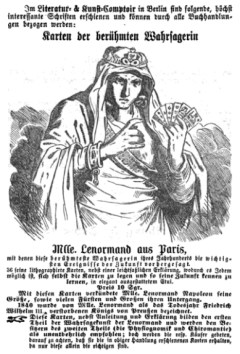 The Sybil excelled particularly in the investigation of the character, inclinations, and taste of the persons who sought them. She never failed to give her visitors information about the past, and the correctness of this is also confirmed by all who have ever had the opportunity to visit this strange woman.
What is even more, those who visited her always found a great pleasure in her prophetic conversation.”
From The most complete , and the only true, art of the fortune-telling of the most famous fortune-teller of the world-magnificence, Lenormand, Verlag des Literatur- und Kunst-Comptoirs, 1860. In addition to a biography of Mlle. Lenormand, the book contained this ad for their 36-card Lenormand deck:
The First Republic
One of the most fascinating stories of Mlle Lenormand is the account in The First Republic, or The Whites and the Blues (Les Blancs et Les Bleus, 1867-68) by Alexandre Dumas, author of The Three Musketeers. This work is part of a series of Napoleonic romances that begin with the Revolution and end with the fall of the Empire. Volume 2 contains chapters called “The Seeress” and “The Occult Art” in which Lenormand reads for both Josephine and Napoleon (who have not yet officially met). Dumas, writing nineteen years after Lenormand’s death, claimed that what he wrote was not fiction:
“I can guarantee the truth of this scene, for these details were given me by the friend and pupil of Mademoiselle Lenormand, Madame Moreau, who still lives (1867) at No. 5 Rue du Tournon, in the same rooms as the famous seeress, where she devotes herself to the same art with immense success.”
It seems that one evening Josephine Beauharnais and her friend Therese Tallien decided to see the fashionable seeress, Mademoiselle Lenormand. They disguised themselves as waiting-maids or ‘grisettes,’ and, using false names, made their way to Rue de Tournon No.7. There they were shown into an inner salon to await their turn. A young man silently joined them as he waited for his turn to have his fortune revealed. Therese Tallien went first into the inner chamber and learned that she is to become a princess. What follows is from Dumas’s text:
“Mademoiselle Lenormand at this period of her life was a woman somewhere between twenty-four and twenty-nine years of age; short and stout in figure, and concealing with difficulty that one shoulder was larger than the other. She wore a turban adorned with a bird of Paradise, a fashion of the day. Her hair fell in long curls on either side of her cheeks. She wore two skirts. . . . Near her, on a stool, was her favorite greyhound, Aza. The table on which she did her marvels was a plain round table with a green cloth on top and drawers, in which she kept her cards. . . . Facing the sibyl was an arm-chair, in which the consulting person was seated. Between that person and the seeress lay an iron wand, which was called the divining-rod; at the end turned toward the consulting person was a little iron snake. The opposite end was made like the handle of a whip or cane. . . .
Mademoiselle Lenormand made a sign to Josephine to take the chair which Madame Tallien had just left; then she drew a fresh pack of cards from her drawer, possibly to prevent the destiny given by the last pack from influencing that of the present. Then she looked fixedly at Madame de Beauharnais.
‘You and your friend have tried to deceive me, madame,’ she said, ‘by wearing the clothes of servants. But I am a waking somnambulist. I saw you start from a house in the centre of Paris; I saw your hesitation about crossing my threshold; and I also saw you in the antechamber when your proper place was the salon, and I went there to bring you in. Don’t try to deceive me now; answer my questions frankly; if you want the truth, tell the truth.’
Madame de Beauharnais bowed.
‘Question me, and I will answer truly,’ she said.
‘What animal do you like best?’
‘A dog.’
‘What flower do you prefer?’
‘The rose.’
‘What perfume is most agreeable to you?’
‘That of the violet.’
The seeress placed a pack of cards before Madame de Beauharnais, which was nearly double the size of an ordinary pack. These cards had been lately invented, and were called “the grand oracle.”
‘Let us first find where you are placed,’ said the seeress.
Turning over the cards, she moved them about with her middle finger until she found “the consultant;” that is to say, the image of a dark woman, with a white gown and deep embroidered flounce, and an overdress of red velvet forming a train behind, the whole on a rich background. This card was lying between the eight of hearts and the ten of clubs.
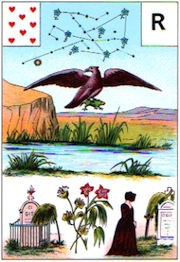 ‘Chance has placed you well, madame. See, the eight of hearts has three different meanings on three different lines. The first, which is the eight of hearts itself, represents the stars under whose conjunction you were born; the second, an eagle seizing a toad from a pond over which it hovers; the third, a woman near a grave. Listen to what I deduce from that first card madame. You are born under the influence of Venus and the Moon. You have just experienced a great satisfaction, almost equal to a triumph. That woman dressed in black beside a grave indicates that you are a widow. On the other hand, the ten of clubs pledges the success of a rash enterprise of which you are not yet aware. It would be impossible to have cards of better augury.’
Then, shuffling the cards, but leaving the “consultant” out, Mademoiselle Lenormand asked Madame de Beauharhais to cut them with her left hand, and then draw out fourteen of them, and place those fourteen in any order she like beside the “consultant,” going from right to left as the Eastern peoples do in their writings. . . .
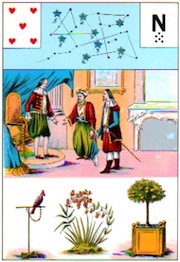 ‘Really, madame,’ she said, ‘you are a privileged person. I think you were right not to be frightened away by the fate I predicted for your friend, brilliant as it was. Your first card is the five of diamonds; beside the five of diamonds is [the five of hearts] that beautiful constellation of the Southern Cross, which is invisible to us in Europe. The main subject of that card, which represents a Greek or Mohammedan traveller, indicates that you were born either in the East or in the colonies. The parrot, or the orange-tree, which forms the third subject, makes me think it was the colonies. The flower, which is a veratrum, very common in Martinique, leads me to think you were born on that island.’
‘You are not mistaken, madame.’
‘Your third card, the nine of diamonds, indicating long and distant journeys, implies that you left that island young. The convolvulus, which is pictured at the bottom of this card, represents a woman seeking a support, and makes me suppose you left the island to be married.’
‘That is also true, madame.’
‘Your fourth card is the ten of spades, and that indicates the loss of your hopes; nevertheless, the flowers of the saxifrage which are on the card authorize me to say that those griefs will pass away, and that a fortunate issue—a marriage probably—has succeeded those distresses which at one time seemed to exclude all hope.’ . . .
[Lenormand correctly divines that Josephine’s husband died a violent death on the scaffold, that she has a son and daughter, and that the son is involved in an ‘affair of the sword’ but that hope will never fail him.]
‘And here, madame, is the eight of spades, which is a sure indication of marriage. Placed as it is next to the eight of hearts,—that is to say, near the eagle rising to the skies with a toad in his talons,—the eight of hearts indicates that this marriage will lift you above even the loftiest spheres of social life. But, if you doubt it, here is the six of hearts, which, unfortunately, seldom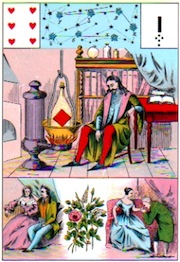 accompanies the eight,—that six of hearts in which the alchemist is looking at his stone now turned to gold; in other words, common life changed to a life of honor, nobleness, and high employments. See, among these flowers, is the same convolvulus, which entwines a broken lily: that means, madame, that you will succeed, you who seek a support, you will succeed—how shall I tell you this?—to all that is highest and noblest and most powerful in France,—to the broken lily: you will succeed that lily in a new sphere; passing, as the ten of spades has shown, over battlefields where—see on that card—Ulysses and Diomed drive the white horses of Rhesus, placed under the guardianship of the talisman of Mars.’
‘When you reach that point, madame, you will have the respect and the tender regard of every one. You will be the wife of that Hercules strangling the lion in the forest of Nemaea; that is to say, a useful and courageous man exposing himself to all dangers for the good of his country. the flowers which crown you are lilacs, arums, immortelles; for you will combine in your own person true merit and perfect kindness.’
She rose, with a movement of enthusiasm, caught Madame de Beauharnais’s hand, and knelt at her feet.
‘Madame,’ she said, ‘I do not know your name, I do not know your rank, but I know your future. Madame, remember me when you are —empress.’
‘Empress! I? You are mad, my dear.’
‘Eh, madame! do you not see that your last card, the one that leads the fourteen others, is the king of hearts; that is to say, the great Charlemagne, who bears in one hand a sword, in the other a globe? Do you not see on the same card a man of genius who, with a book in his hand, and a map at his feet, meditates on the destinies of the world? And, lastly, see on two desks opposite to each other, the books of Wisdom and the laws of Solon; those books prove that your husband will be not only a great conqueror, but a great lawgiver.’
[Josephine cries, ‘Impossible!’ and immediately leaves. Meanwhile, the young man who has been waiting his turn in the salon has ignored all the efforts of Therese Tallien to discover anything about him. He, too, has tried to disguise his real persona, but Mademoiselle Lenormand sees through it. She offers him many forms of divination and he chooses a palm reading.]
‘Your hand is the most complete of any that I have seen; it presents a mixture of all virtuous sentiments and human weaknesses; it shows me the most heroic of all characters and the most undecided. . . . The enigma I am about to read to you is far more difficult of interpretation than that of the Theban sphinx, for though you will be greater than Oedipus, you will be more unfortunate.’ . . . [She describes his rise and fall and several injuries he will sustain.]
‘But,’ said the young man, ‘ this is the second or third time you have mentioned an alliance which will protect the first eight lustres [glories] of my life. How am I to know that woman when I meet her?’
[Lenormand describes the dark-haired Josephine. She warns Napoleon that eventually he will forget Providence gave him her as a companion, and that he will abandon that companion. Then his happiness will be destroyed by a second wife, who is fair and the daughter of kings.]
‘You will be Alexander, you will be Caesar: you will be more than that,—you will be Atlas bearing the world on your shoulders. . . . As success came to you through a woman, so it will leave you through a woman.’ . . .
‘It is Caesar’s fate that you predict for me.’
‘More than Caesar’s fate,’ she replied; ‘for Caesar did not attain his ends, and you, you will attain yours. Caesar only placed his foot on the steps of a throne, you will sit upon the throne itself. Only do not forget the dark-haired woman, who has a sign above the right eyebrow, and puts her handkerchief to her lips when she smiles.’
‘Where shall I meet that woman?’ he asked.
‘You have already met her,’ replied the sibyl; ‘and she has marked with her foot the spot at which the long series of your victories will begin.’
It should be noted that the deck of cards described in the text,”Le Grand Jeu de Mlle. Lenormand” is known to have only been created after the death of Mlle. Lenormand, although it was named after her in order to take advantage of Lenormand’s fame. The book that came with my deck is dated 1845.
Society Under the First Empire
Here are a few short quotes from The Court of Napoleon: or, Society under the first empire by Frank Boott Goodrich and Jules Champagne, (New York, 1858). [Thanks to Caitlin Matthews for passing this on.]
M’lle Marie-Anne Lenormand, the most distinguished sibyl of modern times, the counsellor of Robespierre, Napoleon, and the Czar Alexander, the confidante and biographer of Josephine, and who possessed the ability to subject the most brilliant and enlightened court of Europe to the authority of her shuffles of cards and perusals of palms, merits more than a passing notice. . . .
She rejected cartomancy, or the art of reading cards. It is true that she used cards, but this was merely cabalistically, for the sake of the figures upon them, and to aid her in numerical processes. . . .
M’lle Lenormand became, therefore, the protégée, and was, in a certain sense, the object of the affectionate consideration, of Josephine. Her cabinet was now crowded with the elite of Parisian society—priests, nobles, magistrates and soldiers. The visitor to the dwelling of the pythoness was shown into a room in which books, prints, paintings, stuffed animals, musical and other instruments, bottles with lizards and snakes in spirits, wax fruits, artificial flowers, and a medley of nameless articles, covered the walls, the table and the floor, leaving the eye scarcely an unoccupied spot to rest upon.
The furniture of the cabinet of consultation was in maple; the walls were adorned with portraits of the Bourbons, with a painting by Greuze of great value, and with her own portrait by Isabey. Her cards, which were of large size and covered with colored hieroglyphics, were painted by Carle Vernet. . . .
On one occasion M’lle Lenormand was summoned by Fouché to his cabinet. He reproached her for the aid and comfort she had given to the Bourbons by her late predictions. She paid no attention to his complaints, being engaged in shuffling a pack of cards, and muttering from time to time, “The knave of clubs!” He then said that he intended to send her to prison, where she would probably remain a long time. “How do you know that?” she returned. “See, here is the knave of clubs again, and he will set me free.” “Oh, ho! the knave of clubs will set you free, will he? And who is the knave of clubs?” “The Duke de Rovigo, your successor in office.” . . .
One of the biographers of M’lle Lenormand has remarked, witch or no witch, a certain share of admiration will always be due to her, for having contrived to be believed in an age which neither believed in God and his angels, nor in the devil and his imps. . . .
In detailing the incidents of M’lle Lenormand’s life, we have sufficiently described the sate of the art of fortune-telling in France and the consideration with which it was regarded, during the period of her professorship. Her success does not seem to have been derived from any previous credit accorded to the art of necromancy, but was the result rather of her remarkable skill and the tendency of an atheistic age to fill the void it had itself created, with superstitious dreams. She estabished a faith in astrology and chiromancy, for a time; they fell, however, into disrepute at her death, being afterwards exercised only by acknowledged charlatans, and obtaining support only from the ignorant and the credulous.
More Lenormand-style deck resources (see others in the intro paragraph at top):
- Examples of historic decks can be found at the Lenormand Playing Card Museum.
- Overview of spreads and meanings. Bio, tutorial & meanings.
- A brief overview of material from the highly regarded Treppner course.
- Here’s a book and a forum discussion with its author.
- A Lenormand blog with videos.
 Mary K. Greer has made tarot her life work. Check here for reports of goings-on in the world of tarot and cartomancy, articles on the history and practice of tarot, and materials on other cartomancy decks. Sorry, I no longer write reviews. Contact me
 Mary K. Greer's Tarot Blog
Recent Comments