You can see a large image of this painting in my earlier post, along with an in depth discussion in the comments section.
Here’s an alternate version of this video:
Saltimbanques-1 (note: turn down your volume control first).
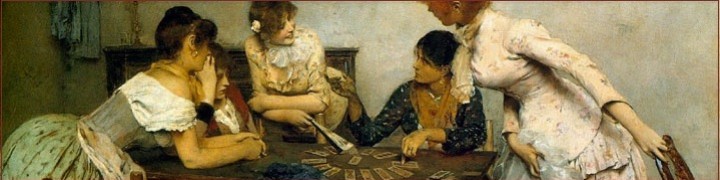
"Tarot helps you meet whatever comes in the best possible way."
You can see a large image of this painting in my earlier post, along with an in depth discussion in the comments section.
Here’s an alternate version of this video:
Saltimbanques-1 (note: turn down your volume control first).
I uploaded this animoto video to youtube in Hi-Res. Try watching it full-screen! Please share it around.
and here’s a couple more:
 What’s a Man Gotta Do – Die Kartenslaegerin
J-G Vibert – Tireuse de Cartes (The 5th)
J-G Vibert – Tireuse de Cartes (Smoke & Mirrors)
which of the two Vibert videos do you like better?
(Click here to get $5 off a year’s Animoto All Access Subscription (= $25) or use the code ptcsgdhi )
 Follow this link to my first attempt at an animoto video of some of my cartomancer pictures.
Watch the revised & extended (4 minute) version embeded in a later post here.
This is a press release from the ACLU – I’ve marked a few especially important passages in bold:
BETHESDA June 10, 2010: The American Civil Liberties Union of Maryland hailed a decision by the Maryland Court of Appeals that strongly defends fundamental free speech rights in a case involving fortunetelling in Montgomery County (Maryland).
In its decision, the state’s highest court, in keeping with rulings from the Supreme Court and courts around the country, ruled that a Montgomery County ordinance banning fortunetelling is an unconstitutional restriction on protected speech.
“This case has never been just about fortunetellers, but about the fundamental right to free speech,” said Ajmel Quereshi, an attorney with the ACLU of Maryland. “While individual fortunetellers can be punished if they fraudulently exploit their customers, banning all fortunetelling is overbroad and unconstitutional. It is not the role of government to decide that broad categories of speech can be banned merely because it finds them distasteful or disagreeable.”
The unconstitutional Montgomery County law provides that “every person who shall demand or accept any remuneration or gratuity for forecasting or foretelling or for pretending to forecast or foretell the future by card, [or] palm reading Š shall be subject to punishment.” The Court of Appeals found that fortunetelling for pay is due full First Amendment protection rejecting the County’s argument that such speech is “commercial speech”, like advertising. The court ruled the statute’s restriction on payment for fortunetelling is equivalent to a ban on protected speech. In addition, the court explicitly rejected the County’s arguments that fortunetelling is inherently fraudulent:
“Fortunetelling may be pure entertainment, it may give individuals some insight into the future, or it may be hokum. People who purchase fortunetelling services may or may not believe in its value. Fortunetellers may sometimes deceive their customers. We need not, however, pass judgment on the validity or value of the speech that fortunetelling entails. If Montgomery County is concerned that fortunetellers will engage in fraudulent conduct, the County can enforce fraud laws in the event that fraud occurs.
The County need not, and must not, enforce a law that unduly burdens protected speech to accomplish its goal. Such a law will curtail and have a chilling effect on constitutionally protected speech.”
The lawsuit was originally brought by Nick Nefredo in 2008, represented by attorney Edward Amourgis of Edwards Phillip Amourgis, PC, after he was denied a license to open a fortunetelling business in Montgomery County. A lower court acknowledged that fortunetelling is protected speech, but nevertheless upheld the law as constitutional. Due to the First Amendment issues at stake, the ACLU of Maryland became co-counsel for Nefedro on appeal, as the case was to be considered by the intermediate appeals court.
The state’s highest court took the case up on its own motion in July of 2009.
As the Court of Appeals found today, courts across the country have consistently held that fortunetelling is protected speech, and absolute bans on it, like the Montgomery County law, are therefore unconstitutional. In addition, the Supreme Court has held repeatedly that the mere fact that speech is for profit does not reduce the level of protection it is due.
Nefedro is represented by attorney Edward Amourgis of Edwards Phillip Amourgis, PC, and Ajmel Quereshi and Deborah Jeon from the American Civil Liberties Union of Maryland.
______________________________________
This is only one example among many in which the ACLU has acted to protect the free speech of fortune tellers. So far they have won every case of this type. [Thank you, ACLU!] More information on the Montgomery case is available here and here.
St. Louis is reconsidering its law. A humorous article about it in the St. Louis Suburban Journals quotes a U.S. Circuit Court of Appeals decision to strike down a Lincoln, Nebraska fortune telling law, stating:
“If the citizens of Lincoln wish to have their fortunes told, or to believe in palm-reading or phrenology, they are free to do so under our system of government, and to patronize establishments or ‘professionals’ who purport to be versed in such arts. Government is not free to declare certain beliefs – for example, that someone can see into the future – forbidden. Citizens are at liberty to believe the earth is flat, that magic is real, and that some people are prophets.”
Meanwhile, in Warren, Michigan, laws restricting fortune telling are becoming stricter, while San Francisco has an outrageously convoluted licensing system for fortune tellers. Such laws have little to do with actually protecting people from fraud (anti-fraud laws do this adequately) and more to do with ameliorating complaints and protecting special interests (see quote below).
Many states and city or county ordinances require licensing for fortune-telling, and they are very inconsistent with the range of fields that require such licenses as summarized here. An article, Occupational Licensing: Ranking the States and Exploring Alternatives by Adam B. Summers (of the Reason Foundation) concluded:
Occupational licensing boards and laws should be continually evaluated for their relevance and perceived need. These reviews should, first and foremost, evaluate whether licensing laws pass the “laugh test” (fortune tellers and rainmakers?). They should also ensure that regulations are narrowly tailored, and that they are providing at least some measure of public benefit, not merely a gravy train for special interests and bureaucrats. Reviews should, furthermore, analyze licensing board performance by evaluating enforcement actions against licensees. Reviews could be conducted by a special commission or an existing agency such as an audit bureau or legislative analyst’s office. [parenthetical remark and question mark is Summers’, bold emphasis is mine, mkg]
Robert Lederman offers excellent advice for fortune tellers in NYC which may help others with similar regulations regarding fortune telling-as-entertainment-only. Check out the Law and Magic Blog for updates on fortune telling and other related issues.
As I’ve mentioned before, it is incumbent on all professional tarot readers to know your local laws and establish yourself as a bona fide, legal business in your area.
I advocate supporting the ACLU and being willing to act locally to challenge laws that limit our freedom of speech. I also think that this information should be better understood by anyone who is thinking about certification or licensing for tarot readers. It is a slippery slope to government control that probably poses more liabilities than it does benefits! Comments and polite debate are welcome.
Few things are more exciting to me than stumbling across a text or image that perfectly reflects a tarot card, especially when it makes me reconsider my ideas about that card.
Today I read the following in the mystery novel A Rule Against Murder by Louise Penny. Chief Inspector Armand Gamache, head of homicide for the Sûreté du Québec, says to a family at their annual reunion:
“We believe Madame Martin was murdered.”
There was a stunned silence. He’d seen that transition almost every day of his working life. He often felt like a ferryman, taking men and women from one shore to another. From the rugged, though familiar, terrain of grief and shock into a netherworld visited by a blessed few. To a shore where men killed each other on purpose.
They’d all seen it from a safe distance, on television, in the papers. They’d all known it existed, this other world. Now they were in it. . . .
No place was safe.
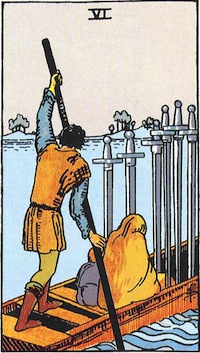 Ah, a perfect rendition of the Six of Swords! I was first struck by it being from the viewpoint of the ferryman, not the passengers. A ferryman who is compassionately aware of the deep emotional shifts of those he is transporting—but not partaking directly in those shifts. For a moment I thought, ‘But, of course, the Six of Swords is about the ferryman, not necessarily the passengers! A ferryman who again and again observes this shift taking place in those he ferries. A ferryman who is both separate and yet momentarily involved.’
There is no indication that the author, Louise Penny, had the tarot card in mind. Rather this is a common classical metaphor linking Charon and the river Styx to the family of a murdered person being ferried out of the world-as-they-had-known-it to a shore previously viewed only as a distant abstraction.
I often ask a querent, “Where are you in the card?” With the Six of Swords, the querent is always one of the figures, but it could equally be the ferryman or the hunched-over adult or the child. By contrast, with other cards, the querent occasionally sees him or herself standing just beyond the borders, behind a column, or, in the case of the Tower, still inside the structure—divorced from the action.
With the Six of Swords there is usually an eventual recognition that the querent is all three persons in the boat. As ferryman, the querent tends to feel he or she is in charge or at least doing something active that will lead to a better end. As passengers, anxiety or grief tends to trump hope, yet there is still a belief that the destination will be better than the “familiar terrain of grief and shock” that they’ve just left.
Interestingly, in the novel, the seven main suspects had, just the day before, gone out together in the lake on a boat—a passage fraught with animosity and repressed danger. The Chief Inspector/ferryman recognizes that the new world they are now facing will be more terrifying than the passengers ever could have imagined. Furthermore, they aren’t just visitors—blessed because they can leave—they will soon be inhabitants. There’s no going back. Grief and shock may exist in the land of the innocent. But, in the land of the experienced, as William Blake well knew, wrath and fear dominate, and the ferryman can’t stop it from happening. (See Blake’s Poems of Innocence and Poems of Experience.)
How different the card looks to me now. It is full of foreboding, and yet there is calm in knowing that this is an inevitable journey from the false safety of innocence into the land of Blake’s experience where realities will finally be faced. As in all murder mysteries the truth will be revealed. But, in an actual reading, is the client always ready to hear such truths?
Doesn’t the admonition, “to know thyself,” mean that we have to come to know and take responsibility for the part within ourselves who “kills another”? Both the querent and the reader want the other shore to be better than the one from which they’ve come, but there are times when we have to go through much worse. What is the reader to tell the client? And, here there are no easy answers.
I hope this makes me stop and think before I blurt out cheerfully, “Oh, you are going through a transition from the rough waters of the past to smooth waters ahead.” Sometimes I, the reader, am the ferryman/chief inspector, who must recognize with compassion that real detection can strip the soul bare and set one in the dread grasp of Blake’s tyger and not in the rejoicing vales of the lamb (see poems here). The rest of the Sword suit (7–10) warns what may come from a detection of the wrongs, or what comes to light when one really wants to “know thyself.” Does the querent really want to go there, or is the querent trusting the reader to ferry them to a safe harbor?
Still, I think it helps the reader—the ferryman who steers the way through the cards in a spread from one’s familiar anxieties to a different shore—to consider what may be truly implied from such a scene in the suit of Swords. This new perspective reminds me that in a reading I am attempting to steer the course when I don’t always know what is lying in wait for my passenger on the other side or how prepared my passenger might be to meet that. It is a grave responsibility.

So many people have lamented the fact that they didn’t go on the tarot tour to Italy with Brian Williams in 2000. Following in his footsteps is tarot deck creator Arnell Ando who went on that famous trip (as did I). Arnell has been back to Italy many times, creating deck creator Osvaldo Menegazzi’s website and being present at several Tarot Museum events near Bologna. Now she and her partner Michael McAteer will guide us through the most impressive array of major tarot-related sites I’ve ever seen. Plus, they’ve arranged visits with tarot experts throughout northern Italy. You don’t want to miss this tour! I guarantee you will be talking about it for the rest of your life and sharing your amazing photos of the original sources of the tarot imagery. Visiting these sites in Italy is the best way to get a solid understanding of how Pagan & Christian imagery intertwines and of how early decks emerged out of a very special period in art and history charting the course between the late medieval and Renaissance mindsets.
And, if that isn’t enough, you can choose to start your trip with attendance at the Association for Tarot Studies (ATS) Convention in Ste. Suzanne, France, the weekend of September 23-25 as I am sure many of us will be doing.
Having just returned from an incredible two weeks in Australia and New Zealand with Jean-Michel David at the Association for Tarot Studies Conference in Brisbane and with Fern Mercier and Lyn Olds of the Tarot Guild of Aotearoa, I want to affirm the power of spending so much time with people who know and love the tarot so deeply.
Tarot Art & History Tour, Italy 2011. When you sign up for the Tarot Tour please mention my name or blog—who knows what good karma will accrue! I think this tour will fill fast, so sign-up early!
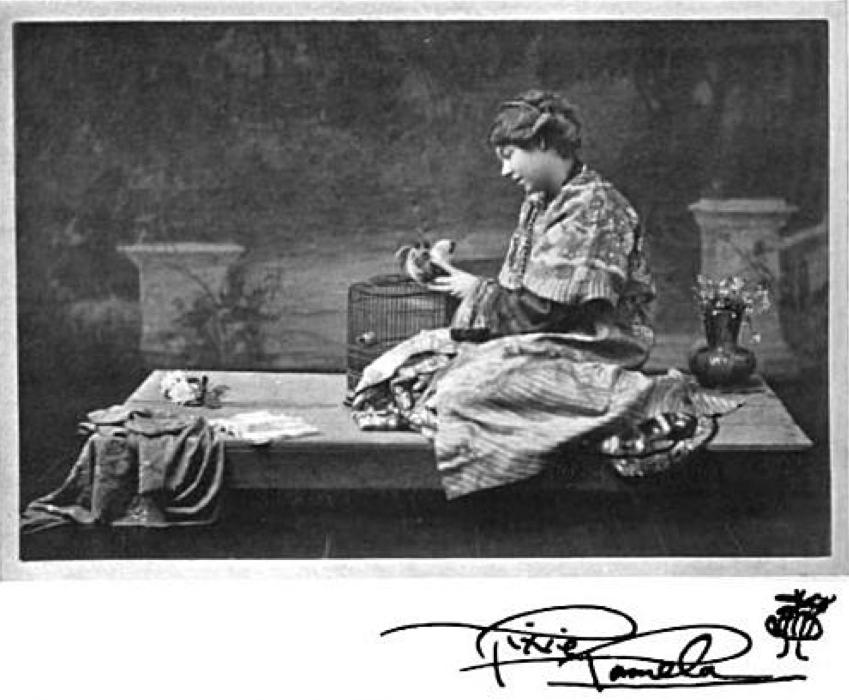
Here’s a newly discovered photo of Pamela Colman Smith with her signature from 1903, published in The Lamp (vol. 26), in which her publication “The Green Sheaf” is reviewed. (Thanks to Cerulean). Click on photo to see it larger.
 List to the podcast Elemental Castings in which Mary Greer and T. Thorn Coyle discuss the magickal element of Water (link now fixed). We cover water, tarot, cups, boundaries, depth, flow, the Magician vs the Priestess, and many other things. Thorn describes herself as a magic worker, mystic, and pagan. An internationally respected teacher and author, her work focuses on the alchemy that occurs when we open ourselves fully to our humanity in our quest for Divine knowledge. She is the author of Evolutionary Witchcraft.
One reason people enjoy going to tarot conferences is the opportunity to talk about our favorite topic—tarot—with others. We also get to do it on forums, although the process of truly engaging in a deep dialog with another is rarely the result. Rather we all-too-often indulge in quick exchanges of information, long monologues, or debates and challenges. Enrique Enriquez is what I call a rhetorician of the tarot, a philosopher of images (tarology). He teaches the ‘language of the birds,’ not just as communicating the soul of divination but as the art (or, more properly, ‘techne‘) of the practice. It was my great pleasure and honor to be asked to engage in an intriguing conversation with Enrique on tarot and related things. I hope you will enjoy it, too, and all of Enriques’ other musings.
A Conversation with Mary Greer at Enrique Enriquez’s Tarology Blog
 One additional note: You’ll find a photo of me when I was four or five at the end of the conversation. The day after completing the dialog with Enrique I was doing a major overhaul and moving of things in my house. In the process I “happened” on this photo, which was among some old things of my mother’s that I had forgotten. However, the flower-memory I spoke of in the conversation was in vivid color, and I saw myself in other locations. So, the synchronous stumbling upon of the black-and-white image of me in the kimono of which I spoke seemed a message of Beauty-in-authenticity mentioned in our conversation.
Check out Enrique’s other conversations with tarot notables:
Jean-Michel David of the Association for Tarot Studies
Ross Sinclair Caldwell, tarot historian
Jody Melnick, artist
Scott Grossberg, tarot author
Vito Acconci, performance artist
And Enrique’s interview with master tarot deck maker, Jean-Claude Flornoy, for the ATS Journal.
 Juliet Sharman-Burke will be teaching tarot at the Omega Institute Tarot Conference in June and in Melbourne and Sydney in August. The following is an interview conducted by Annie Dunlop, president of the Tarot Guild of Australia who interviewed her for “The Magician” journal (reprinted by permission).
Juliet has produced three tarot decks since 1986 – The Mythic Tarot with Liz Greene, the Sharman-Caselli deck, and an innovative “color it yourself” deck. She has also written eight tarot books.
Juliet, how would you describe yourself?
I am primarily a psychotherapist these days, with four days a week taken up with regular patients, but I do as many Tarot readings as I can fit in, and teach once a term for the Centre for Psychological Astrology. I love teaching and am looking forward to a conference in the Hudson Valley in June with Rachel Pollack and Mary Greer, and of course I am really looking forward to being in Australia and meeting the Tarot Guild members!
When did Tarot first come into your life?
I found my first Tarot deck and book by accident in a bookshop while on holiday with a friend. We were intrigued by the title, which was something like Tell Your Future with the Cards! As I was nineteen at the time, I was longing to know whether I would marry the current beau, and what my future would be, so we bought the book and cards between us, it was the Marseilles deck, and proceeded to try to tell our futures. We were not very good and my friend lost interest and let me keep the cards. I persevered on my own and found that while I was not terribly good at reading my own cards, I was having unexpected success with others. I started reading more, and learning astrology too, but in those days there were not many books or cards and many of the old books were very complicated. I collected notes from the books I could find and came across the RWS deck, which I found much easier to relate to than the Marseilles or the Visconti, which I owned. I decided to write a book for myself, using the notes I collected, and gradually started do more readings first for friends and then strangers. A client wrote a magazine article about me, and the readers’ response to the article, asking if I would do a correspondence course, inspired me to develop a course, which turned into my first book, The Complete Book of Tarot.
If you could take any Tarot deck to a deserted Island, would it be one of yours?
Yes, it would be the Mythic Tarot, because the mythic stories never fail to delight me.
You have such a deep knowledge and understanding of mythology; from where did this passion develop?
I have always responded to stories that describe or illustrate something that might otherwise be difficult to understand. Myths work on so many levels, and can be looked at from many different perspectives, so that something extremely deep and complex can be understood quite simply when told in story form. The archetypal nature of myth speaks to us all, which makes it accessible.
The utilisation of mythology in the Mythic tarot adds an extra layer of meaning to what is still primarily a deck of RWS tradition. Did you realise how successful and elucidating the connections with mythology were going to be when you first started this project?
I had no idea. I always loved fairy tales and myths from childhood and when I first heard Liz Greene talk about the horoscope and the planets from a mythological and psychological point of view I was enchanted. I felt that myths could imaginatively add another dimension to the divinatory meanings of each card so Liz and I decided to create a deck that would make it easier to follow. And because the Minor Arcana are often considered to be more difficult to learn than the Majors – even with the RWS deck where they are pictorial – I felt that having a story run through each suit from Ace to Ten would make it much easier to remember the meanings of each of the Minor. And the Court Cards, which again many people struggle with, seemed to make sense from an astrological view point, using the qualities and elements as well as taking a zodiacal perspective, as well as using a mythic figure to further elaborate the meaning of the card. I think perhaps that the Mythic Tarot has captured imaginations because people love myths (they are archetypal and thus speak to us all), yet myth is not always taught in school these days so many people have missed out on them and the cards provide an opportunity to engage with and sometimes learn about them for the first time.
What was the inspiration behind the beautiful Sharman-Caselli Tarot?
The story behind the Sharman-Caselli deck is quite funny really. I was asked to write a beginners book using the RWS deck as illustration, but in the end permission was refused to use the RWS, so the publishers suggested I design a new deck myself that was traditional, good for beginners and could stand alongside a popular deck like the RWS. It turned out to be great fun to design and Giovanni Caselli is certainly a wonderful artist and did a great job I think.
What do you love most about what you do?
I love the people I meet, both through therapy and Tarot reading, as well as through teaching. I am always interested in people and if I can make even a tiny difference in anyone’s life for the better, I am happy.
Juliet, you have been teaching Tarot in one form or another for the best part of 30 years. How has the content of the courses you offer changed over this time?
I think the content changes as my life experience changes and as I understand more about the complexity of life. I certainly started life, as most people do, as the Fool, but I am definitely more like the Hermit these days! Which I am happy about, as it seems appropriate. I love the Hermit card, and long to become as wise and patient as the image portrayed. I draw on my knowledge of psychology for the Tarot and the richness of the Tarot imagery inspires my work as a therapist.
You lead a very full life! As well as producing 3 tarot decks and 8 tarot books, you are involved in teaching and administration at the Centre for Psychological Astrology in London, and you run your own private psychotherapy practice. What does the future hold in store for you? Do you have a dream that you would like to share?
Yes, life is full, and I like it that way. I love doing everything I do, the only thing I would like to have time for is more travel. I would like to travel around India, South East Asia and Africa, as well as having time to revisit many European cities. I guess my dream is to have enough time and money to do this at leisure, and in a certain amount of comfort!
Do you have a favorite Major Arcana card?
I like all the cards, to be honest, but I guess my favorite is the Star – the card of hope!
≈◊≈◊≈◊≈◊≈
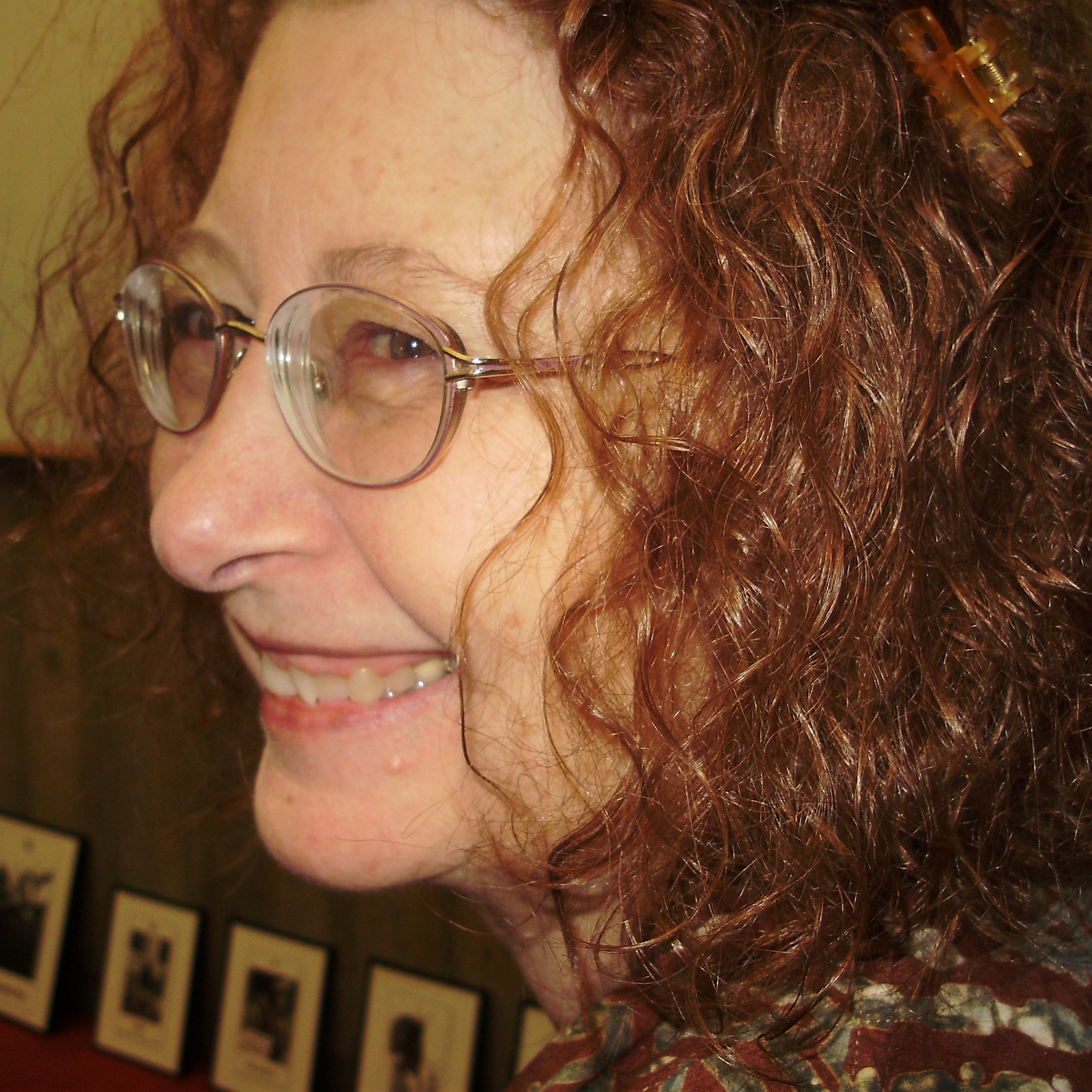 Mary K. Greer has made tarot her life work. Check here for reports of goings-on in the world of tarot and cartomancy, articles on the history and practice of tarot, and materials on other cartomancy decks. Sorry, I no longer write reviews. Contact me HERE.
© Mary K. Greer All material on this site is copyrighted. If you use anything, be sure to include my name and a link back to this site. Thank you.

Donate any amount to keep this ad-free blog growing.


Recent Comments