You’ve probably heard the phrase “Tarot is a Mirror of the Soul.” Certainly any reading can be examined from this perspective, giving you an ever-changing kalidescopic view of the self and your concerns. Here, though, is a fun way to make the Major Arcana your own. This personal process (it’s not a spread as you’d normally think of it) provides a way to view a deep reflection of your Soul-Self that probably won’t change much until (or unless) you do.

Take out your favorite Major Arcana deck—the one that speaks most expressively to you. Arrange the Major Arcana in order from the card you like and admire the most to the one you find the scariest and most fearful. Take one card which fits the least into your personal sequence and put it aside.

Next, keeping the cards in the order you’ve just determined, lay your Major Arcana out in three rows of seven cards as shown in the diagram below. Put the one card that “fits least” in the single position at the top.

Now comes the fun part. Examine each three-card column such that the top card in a column indicates your Ideals, the bottom card is its Shadow, and the middle card Mediates between these two. The mediating card can be seen as that which makes it possible for the Ideal and Shadow to relate to each other.

For instance, if you have the Sun as your Ideal and the Tower as its Shadow with Justice mediating, then Justice helps each to see that the other is necessary for a just balance. On the other hand, if Temperance is the Ideal and Death its Shadow, and the Wheel of Fortune mediates, then the Wheel reminds you that Temperance’s mixture of elements has to include the season of Death as part of its cycle.

Look at these cards in terms of how you handle and respond to situations. When you are striving for an Ideal, how can you integrate its Shadow? When you are annoyed or afraid, how can you call on your positive Ideal? Use the mediating card as a practical key to this integrative process.

How does the card you placed at the very top, the one that “didn’t fit,” seem to comment on all the others or, perhaps, lend an overall theme to the whole?

Do it once, save the results somewhere where you will “stumble” upon them in 6 months or a year. Re-order the Major Arcana of the same deck again (from the ones you like most to the ones you find most scary and disturbing) and see where your sequence has stayed the same as last time and where it’s changed.

Let me know how this works for you.

Here’s a little walk down memory lane. These cards are from London – late 1970 or early ’71, printed in a magazine called Gear of London and designed by Barry Josey. Obviously they are based on the works of Aubrey Beardsley. If anyone has any more information on this deck or the magazine, please let me know.

Update: I received an email from the artist Barry Josey (love the internet!). Finding that his art could not support him, he went back to his profession as an architect and also left the tarot behind, but hopes to return to art when he retires. Here he explains how the deck came about:

“Initially, the cards were set out as a poster style calendar, and then they were intended to be printed as packs.  At the time, I knew nothing of Tarot, but had to immerse myself albeit briefly to get a starting point for the drawings.  Beardsley was ‘in’ at the time and because I could approximate the style, Gear asked me to prepare the cards.  The drawings were black and white only, and it had been my intention that they be printed on a single buff or similar pastel colour.  Gear disagreed and printed them in the rather garish primary colours you see before you.”

Here’s another example of the art of Barry Josey—an illustration for a play by Jean Genet.

bj-1971-genet

The Hermetic Order of the Golden Dawn introduced what I consider the most extensive and elegant set of correspondences among the tarot and other magical systems. Here is a permutation I hadn’t seen before. It’s from The Magical Writings of Ithell Colquhoun edited by Steve Nichols. Colquhoun was an artist, magician and the biographer of MacGregor Mathers (Sword of Wisdom-o.p.). Magical Writings contains over a hundred pages of text on the Major Arcana (material on the last five cards added by Steve Nichols), plus reproductions of pages from Colquhoun’s tarot notebooks. It’s a treasure-trove for the discerning reader.

THE PLANETARY TRIPLICITIES – based on correspondences to the planets and the signs they rule.

MERCURY: Magus, Lovers, Hermit (Mercury, Gemini, Virgo)

MOON: Priestess, Chariot, Hanged Man (Moon, Cancer, Elemental Water)

VENUS: Empress, Hierophant, Justice (Venus, Taurus, Libra)

SUN: Sun, Strength, Judgment (Sun, Leo, Elemental Fire)

MARS: Tower, Emperor, Death (Mars, Aries, Scorpio)

JUPITER: Wheel, Temperance, Moon (Jupiter, Sagittarius, Pisces)

SATURN: World, Devil, Star (Saturn, Capricorn, Aquarius)

(Fool = Elemental Air)

These groupings can be very handy in a reading where the occurrence of two or three cards from one of the triplicities indicates a strong influence by that planetary energy. Mythically, it suggests the presence of that God/dess messing around in one’s life.

What I’m after isn’t flexible bodies, but flexible brains. What I’m after is to restore each person to their human dignity.”

Moshe Feldenkrais wrote a book called The Potent Self: A Study of Spontaneity and Compulsion. In his “Awareness through Movement” classes (the Feldenkrais Method) you can discover where you body has become inhibited and thus lacks a full range of movement. Using Feldenkrais’ techniques you can eventually regain most or all of that potential. For instance, if you ever broke a leg, your body compensated for the injury. After healing, your body may have become unconsciously habituated to some of that compensation, limiting your range of motion. In his book, Feldenkrais draws parallels with how the same thing occurs in our minds and attitudes. If you were told to always be polite, then you no longer have a full range of possible responses, so it may be difficult to say no. If you feel inhibited asking for what you really want, then your potency is compromised.

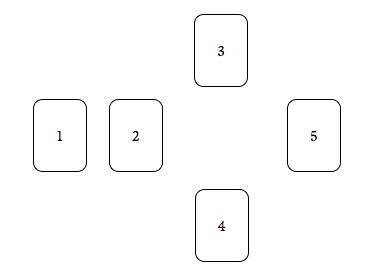
Use this spread, which is based on recommendations in The Potent Self, to explore inhibitions and impotencies of which you may not be fully aware. Be playful when interpreting the cards, looking for literal clues as well as puns and metaphors in the cards you draw. This is a wonderful spread to use with the Osho Zen Tarot, though any deck will work. Read all cards as if they were upright but explore a full range of the card’s possibilities. For instance, the Sun ranges from joy to burn out.

Shuffle the deck making sure you will obtain reversed cards. Cut and restack in a new order. Turn over cards from the top until you get to the first reversed card. Put this in Position 1.

Card 1: Where am I feeling impotent or inhibited? This describes the situation or issue where your full potential is restricted.

Briefly shuffle all cards except that in Position 1. Spread them face down in a fan on the table. Use your intuition to select cards for the remaining positions from anywhere in the fan.

Card 2: What is inhibiting the proper function and thus causing the impotency? Note: this may have been an appropriate response in the past but is now merely a compensatory habit.

Card 3: What will come from becoming more potent? Brainstorm as many possibilities as you can, including difficult ones.

Card 4: What will come from not becoming more potent, that is, staying the same or getting worse? Include the absolutely worst case scenario suggested by this card.

Card 5: What action is needed? What kinds of things does this card suggest that you do? Pick one and do it.

The U.S.A. has a new Poet Laureate, Kay Ryan. And, she tells everyone she started her career by writing poems about tarot cards.

This is from an interview in the Marin Independent Journal:

Ryan decided to pursue writing seriously after having an epiphany while bicycling up the Rocky Mountains while on a 4,000-mile, cross-country bicycle trip in 1976. When she returned home, she set to work. She began using a deck of Tarot cards as an exercise, forcing herself to write a poem about the subject of whichever card she drew at random. Some of the subjects were harder than others.

“Death, I’ve never minded that so much,” Ryan says. “Love, I minded because it’s just so icky, so overdone. I just didn’t want to touch it.”

And here’s from Tulsa World:

“Still shying away from difficut themes, Ryan assigned herself a task: She would get out a pack of tarot cards, turn one card over every day and write a poem from it. ‘So I had to start dealing with these abstractions like love, death, the wheel of fortune.'”

But Kay’s not the only one to use Tarot to inspire poetry. I taught a couple of workshops for the International Women’s Writing Guild conference retreat in California and I sometimes have my classes write tarot haiku. In my first book, Tarot for Your Self, I included tarot poems by Robert Creeley, John Weiners, Diane Wakoski, Diane DiPrima, Judy Grahn and Philip Lamantia and quoted poet Aethelaid Eldridge, who gave his student a tarot deck, saying, “Here, every good poet should know the Tarot inside and out.”

To learn quite a bit more about tarot and poetry, read this fascinating conversation between poets Alice Notley and CAConrad at PhillySound: new poetry. The tarot discussion begins almost halfway down with Notley’s description of a tarot reading by Ted Berrigan in 1969. It continues with Notley’s telling us how she’s used tarot cards in writing classes, inspired by a class Michael McClure taught at the Naropa Institute. The article goes into lots more about Conrad’s and Notley’s use of tarot. Here’s my favorite quote from Notley:

“I’m not an expert in the deck at all. My interest lies somewhere near a sense that words are like tarot cards, and that a poem manipulates unpredictable depths with its words. . . . I like the tarot because it works like poetry and because you don’t really have to ‘believe in’ anything. It’s there to be used. The symbols are remarkably durable and beautiful; they float out to encompass all kinds of meanings.”

Check out my earlier posts on tarot and poetry, here, here and here. And, thanks to The Tarot Channel where Eva Kay Ryan’s tarot connection.

When I lived in San Francisco I was privileged to meet several members of what was then known as the Holy Order of MANS (in which MANS stands for Mysterion, Agape, Nous, Sophia,” Greek for mystery, love, mind, and wisdom). I became interested in their organization, both because of the tremendous sincerity and integrity of the members I met and because of their study of tarot as a Christian mystery. They adopted the Waite-Smith Tarot as modified by Paul Foster Case and Jessie Burns Parke,  added their own layer of modifications to the deck, and then wrote a set of explanatory books that are thoughtful revisionings of Case’s text.

The Holy Order of MANS was founded in 1968 by visionary Earl Wilbur Blighton (formerly an electrical engineer) as a monastic order of esoteric, Rosicrucian Christianity dedicated to charity (Raphael Shelters) and their missionary work in 49 states. The order grew rapidly during San Francisco’s hippie era, when members served selflessly to help those in need. My sense is that they followed as closely as they could the model of the earliest Christian churches. Additionally, women could be ordained as priests. As Blighton expressed it in their statement of purpose:

I care not what doctrine you have or have decided on. But while the world argues over the theological discussions of doctrine, sin, apostolic succession and others, we will remove from the people their problems and give unto them the ray of hope and reality which our Lord Jesus commissioned us to carry forth as Christians and disciples of the Word and the works and the Light and the love of God.”

With Blighton’s death in 1974 there was a prolonged power struggle among Blighton’s wife and others for leadership over the 3,000 members. The new director focused on a more conservative, repressive and less metaphysical path, eventually joining with a defrocked priest from the Russian Orthodox Church. Since 1988 it has splintered into many groups including the Science of Man in Oregon, which was led by Blighton’s wife, Ruth, until her death in 2005.

But their own deck and books were not the extent of the tarot connection. In 1975, at a judo tournament, science fiction author, Piers Anthony, met and became friends with a brother from the original Order. Anthony was intrigued by their unique mix of Gnostic Christianity, co-ed communalism, and Tarot. Out of this came a character who would appear in several novels: Brother Paul of the Holy Order of Vision. Anthony also created an imaginary deck called the Animation Tarot, having a hundred cards in five suits. By September of 1977 he had a 250,000 word manuscript that no one wanted to publish. Members of the real order were told not to read the manuscript or speak with him, which he regretted, since the novel stemmed in significant part from his admiration of their operation. Anthony reluctantly agreed to splitting the book into a trilogy: God of Tarot, Vision of Tarot and Faith of Tarot. Jove then stopped publishing science fiction and the next two volumes were published by Berkeley (1980). It wasn’t until 1987 that the novel appeared in one volume (NY: Ace). It’s an interesting novel, although I remember it seeming rather incoherent in places—perhaps because I read it as each volume of the trilogy came out.

Although the Holy Order of MANS deck and books owe much to Case’s BOTA materials, there are plenty of additional insights to make them well worth obtaining, especially for those who are interested in a metaphysical Christian approach to the tarot symbols. The revised books, Keystone of the Tarot and the more detailed, Jewels of the Wise, and their color-it-yourself Major Arcana deck are still available here.

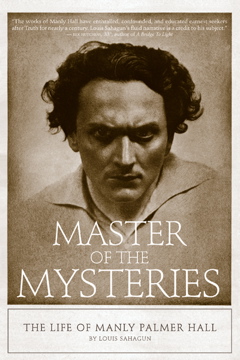
Last night I went to a lecture and book signing by Louis Sahagun, author of a biography of Manly Palmer Hall called Master of the Mysteries. Sahagun is a journalist at the Los Angeles Times and was working night duty on September 2, 1990 when the call came in that Hall had died at 89 years of age. Knowing nothing about the man, Sahagun looked him up in the files, finding little until he got back to the 1930s and 40s when he stumbled onto stacks of clippings. He wrote a brief obituary that didn’t begin to touch on the accomplishments of this internationally known metaphysician and occult scholar who eventually was a victim of extreme elder-abuse and probable murder.

Sahagun became fascinated by Hall’s story, was given access to several archives, interviewed dozens of people who had known Hall, and examined the police and medical reports on what is still an open suspicious-death investigation.

Hall is of interest to those of us in the Tarot world for his creation of what’s known as the Knapp-Hall Tarot deck, first published in 1929 by artist J. Augustus Knapp, illustrator of two of Hall’s first books, including the famous The Secret Teachings of All Ages (the latest edition is in its 16th printing).

I’ll leave you to read the fascinating details of the book from this article in the L.A. Times or listen to this podcast interview with Sahagun.

I want to talk here about the conversation I had with Louis Sahagun about the cult status of spiritual teachers. During his research Sahagun discovered an amazing but flawed human being—someone who married disastrously, fell behind the times and finally succumbed to the machinations of a conman. Despite this, Sahagun felt that he had found a man of immense talents and great personal integrity who warned against putting teachers on a pedestal. It is apparent that Hall’s scholarship left something to be desired (he had only a 6th grade education but a photographic memory), but it’s hard for many to accept that Hall could have been less than perfect. Sahagun was struck by the number of followers who seemed to do nothing with their lives but slavishly espouse the teachings. On the other hand, hundreds of people—mostly in the arts—creatively integrated Hall’s metaphysical principles into their work—making it their own. These included such diverse people as an L.A. mayor, a governor of California, Elvis Presley and Bela Lugosi.

Personally, I’ve been struck by the number of people who discover lies, misconduct or incorrect facts in the lives and work of their heroes and respond by either completely rejecting the teacher and work or by rejecting any evidence of a problem. Typical is a comment about the book from someone who regularly attended Hall’s lectures: “I wasn’t aware of any controversy surrounding Mr. Hall’s death either…. It was natural causes—and I suppose natural causes for an author to claim controversy.” This person has no desire to examine the evidence before claiming that the biographer must be lying.

When writing my biography of four original members of the Hermetic Order of the Golden Dawn, Women of the Golden Dawn: Rebels and Priestesses, I believed it vitally important to examine their flaws as well as their strengths. How are we to learn from someone’s story if we don’t see how that person navigated the difficulties of life? How can we evaluate a work if we aren’t willing to explore what’s true and what isn’t and what ‘works’ and what doesn’t? It’s important to realize that everyone is human. Just before I completed the biography, an acquaintance sent my text involving a different spiritual teacher, now deceased, to that person’s organization. I received a phone call asking me to remove quotes from letters that included accusations of an affair with someone he later married. It was felt this might harm the public perception of him as a great and good man. I ask, how are we ever to develop discrimination if we believe that spiritual teachers are somehow more perfect than the rest of us or that everything they write is Divine Truth?

The way I see it, there are three unacknowledged magical “initiations.” The first is when we come across a teaching or practice and have to determine if it contains a truth or way to which we want to commit ourselves. The second initiation is when we discover we’ve been betrayed by ‘lies’ and we have to decide to leave or continue the work. The third initiation is when we discover that the lie itself contains a greater truth. The second initiation is betrayal and until we have confronted betrayal and moved through it we will never encounter the third initiation. We experience these three initiations all the time, although a fourth is proposed that takes us beyond the world of truth and lies.

UPDATE: The Kitchen Tarot – a 22 card deck has been published by Hay House. Check out a commentary by the book’s author, Dennis Fairchild.

Take a look at this deck in progress – The Kitchen Tarot Deck by Susan Shie – done as “Outsider Art Quilts” from Turtle Moon Studios. The one pictured above is “The Potluck / World Card #21 in the Kitchen Tarot (aka “Healing on Common Ground”). See this and two other tarot quilts here. Other quilts in the tarot series can be viewed through her 2006 & 2007 Gallery links. (Thanks to Ferol Humphrey who turned me on to Susan’s website.)

Here I go – off again into strange byways of Tarot lore:

The late 15th century Sola Busca Tarot is most famous for having inspired several of the Minor Arcana images in the Rider-Waite-Smith Tarot deck. It is also the oldest deck to have all 78 cards. The trumps and court cards feature historical and mythical people – with many of their names printed on the cards. Not all of the referents have been identified.

The Sola-Busca deck is now available in a glorious full-color edition along with a book explaining all the figures and symbolism. This is a limited edition so get it while you can HERE.

In 1907 a B&W photographed version of the deck was sent to the British Museum by the Sola Busca family who then owned them. I believe the originals, as well as the family, have since disappeared. Waite, who spent much time studying tarot decks and books at the British Museum, was probably informed of this deck as soon as it arrived, so it may have sparked the idea itself of creating an illustrated Minor Arcana. Lo Scarabeo published a version of the deck known as the Ancient Enlightened Tarot (currently out-of-print). You can also learn more about the figures in this deck at Tea Hilander’s website, at Taropedia (specifically here for the Q of Cups), and at Michael J. Hurst’s website.

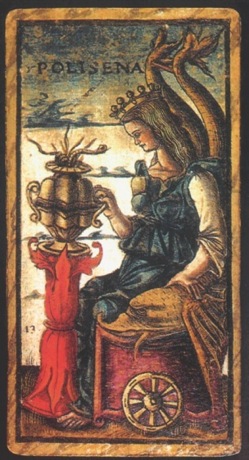
The Queen of Cups is labeled Polisena (also spelled, Polyxena). What stands out in the image is a snake emerging from the cup she holds. I have a feeling that the card refers not to the Trojan Polyxena (next) but to a later Christian Polyxena (see her story at bottom). Here’s the info I’ve managed to find:

First, the Trojan Polisena:
“Polyxena was the youngest daughter of Hecuba and King Priam of Troy. Homer never mentions Polyxena. Achilles fell in love with Polyxena whom he may have met when Polyxena and her brother Troilus went out to the fountatin where Achilles slew Troilus. One story has Polyxena pretending to fall in love with Achilles, learning about his heel, and betraying him to her brother Paris, who then shot and killed Achilles. Before he died, Achilles asked his followers to sacrifice Polyxena to him. Neoptolemus stabbed Polyxena to death.

There were Medieval and Renaissance versions of the story that may have contained a snake. Plus there’s a snake in a version of the story on a vase from ca. 500 B.C. – 490 B.C.:

Achilles and Polyxena at the fountain: Polyxena is walking right to a lion’s-head spout above a rock that contains the fountain. A hydria is set under the spout to catch the water gushing out. It splashes onto Polyxena’s hand before entering the container. On top of the fountain a crow is sitting, while a snake is lying alongside it. Behind the fountain rises a tree with leaves spreading left above the lion’s head spout, and right above the head of crouching Achilles. Ready to ambush, he is largely hidden by his shield, with his right leg extended beyond it.” Jane Ellen Harrison claimed that the snake in this story represented the Erinys.

However, the card could be another Polyxena – one who figures in a story about Paul and the early Christian converts as recounted in the Medieval Sourcebook: Acts of Xanthippe, Polyxena, and Rebecca.

“And as Polyxena lay upon the couch she saw this dream, that a dragon, hideous in appearance, came and signified to her to come to him, and when she did not obey him to go to him, he came running and swallowed her. From fear of this the girl leapt up trembling, and Xanthippe running to her said, What has happened to you, dearest, that you have leapt up thus suddenly? She for a long time was unable to speak; then coming to herself she said, Alas, my sister Xanthippe, what danger or tribulation awaits me, I know not; for I saw in my dream that a hideous dragon came and signed to me to go to him, and, when I would not go, he came running and swallowed me, beginning at my feet. While I was terrified at this, there suddenly spoke out of the air, in the light of the sun, a beautiful youth, whom I thought to be the brother of Paul, saying, Verily, you have no power. Who also took me by the hand and straightway drew me out of him, and straightway the dragon disappeared. And behold his hand was full of sweet odour as of balsam or anything else for fragrance. Xanthippe said to her, Truly you must be greatly troubled, my sister Polyxena, but God has you dear, seeing that he has shown you strange and marvellous things. Therefore arise quickly in the morning and receive the holy baptism, and ask in the baptism to be delivered from the snares of the dragon.”

Ultimately Polyxena becomes Christian and protects her virginity from the evil idolaters who try to despoil her. She goes through many such tribulations including being thrown to wild beasts and into the sea but is always saved by God. The story ends with her returning repentant to Paul, and “From that time forward she left not at all the blessed Paul in her fear of temptations.”

The serpent/dragon could, of course, signify those temptations and tribulations from which God has saved her – including, of course, idolatry. A more complex view might suggest that the snake is that ‘strange and marvelous thing’ called Wisdom, which Polyxena certainly must have gained in all her travels and from facing her many trials.

One interesting synchronicity is that Polyxena Sforza, illegitimate daughter of Francesco Sforza of Milan (for whom the Visconti-Sforza Tarot was made), married Sigismondo Pandolfo Malatesta in 1442, two years after we know that he was given a deck of Triumphs as a gift. According to a story put about by a Pope who hated him, the cultured but brutal condottiero Sigismondo murdered both his former wife and second wife, Polyxena (who had as the family heraldry a serpent). Could there have been an oblique reference to her?

Dark Horse publishers has announced that it slayed the “Buffy the Vampire Slayer Tarot.” It will not be publishing this deck, despite the fact that almost all the art work was completed and much of the book written, and a huge number of people were excitedly writing about it on line! Supposedly there were contractual problems. Did the card, depicted above, predict this slaying? What do you think?

Here’s the notice I got:

“Due to circumstances beyond our control, Dark Horse will not be producing the ‘Buffy the Vampire Slayer’ Tarot Deck. We sincerely apologize for the inconvenience, but no existing orders will be filled. We appreciate your support of this program, and again apologize to those who placed advance orders and to fans alike.”

About

Click HERE to subscribe to Mary K. Greer's Tarot Blog by Email

≈◊≈◊≈◊≈◊≈

Mary K. Greer has made tarot her life work. Check here for reports of goings-on in the world of tarot and cartomancy, articles on the history and practice of tarot, and materials on other cartomancy decks. Sorry, I no longer write reviews. Contact me HERE.

© Mary K. Greer All material on this site is copyrighted. If you use anything, be sure to include my name and a link back to this site. Thank you.

I truly appreciate donations to help me pay for additional space.

Donate any amount to keep this ad-free blog growing.

Archives