I’m back from New York and will be starting up the Tarot posts again soon. In the meantime, here’s a link to a translation by Donald Tyson of Antoine Court de Gébelin’s essay on the Tarot that started the whole occult tarot lineage and the belief in its Egyptian origin. It is followed by an essay by Le Comte de M*** (Mellet) on reading the cards that also appeared in 1781 in Vol. 8 of de Gébelin’s encyclopedic work Le Monde Primitif. These seminal works should be read by everyone who has any interest in tarot history. Try out the first published tarot spread from Le Comte de Mellet’s essay here.

See this blog article on the marginalia of U.S. President John Adams that includes comments on three volumes of de Gébelin’s encyclopedia, including this: “What a coruscation of metaphors, fables, allegories, fictions, mysteries and whatnot!”

Read a biography of Antoine Court de Gébelin from LE TAROT Associazione Culturale.

One of the simplest ways to start writing your own tarot poetry is to begin with the haiku format. There’s something about following it’s basic rules that frees up the creative sense. Since there are three lines you can either dedicate the whole poem to one card or use it for a three-card reading—one line for each card in your spread. (I write a haiku for each of the three cards and then take one line from each to form a fourth haiku that integrates those three cards.) Different decks tend to evoke entirely different “voices” in your haiku. Try it, and you’ll see what I mean.

Want some inspiration? You’ll find lots of examples, support and no criticism at Aeclectic’s Tarotforum haiku thread here.

The following are a few haiku rules, which you can feel free to break or use as you will.

A haiku describes natural phenomena in the fewest number of words, making an indelible impression on the reader. It calls attention to an observation and in effect says, “Look at this” or “Think about this.”

It consists of 17 syllables, or less, in three lines:
5 syllables
7 syllables
5 syllables

Guidelines (follow only if you wish):
• Use the present tense.
• No titles or rhymes (except to name your card, if you wish)
• Include two images that create harmony or contrast so each enriches the understanding of the other.

• Either the first or second line ends with a colon, long dash or ellipsis (marked or not).
• The two parts create a spark of energy, like the gap in a spark plug.
• Limit the use of pronouns.
• Traditionally, each haiku contains a seasonal reference.
• Use common, natural, sensory words. Avoid gerunds and adverbs.
• Images often begin wide-angle, then medium range and zoom in for a close up.
• Present what causes the emotion rather than the emotion itself.

Do you have a tarot haiku? If so, please share it via the comments.

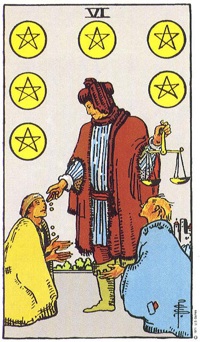
Here’s one based on a very literal description of the 6 of Pentacles:

Hands catch falling coins.

Under the balance, someone

reaches — emptiness.

Knitted Tarot Case Instructions

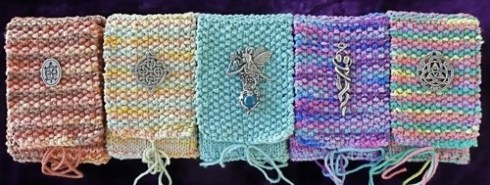
Finally, here’s the complete instructions (as a pdf file) for my knitted tarot bag (I prefer “case” since there are four sides and a flat bottom) as pictured in my earlier posts and above. Send me pictures if you knit your own. Happy knitting.

Here’s another forgotten tarot classic.

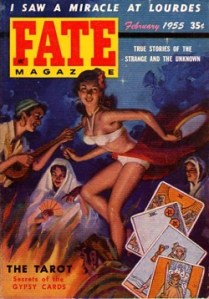
This “Yes-No Oracle” is by Irys Vorel in an article entitled “How the Gypsies Use the Tarot” from the February 1955 issue of Fate Magazine.

A version of this spread, expanded greatly by me, is now available at the commercial site Tarot.com. Check it out.

1. Write your problem or question on a piece of paper in such a fashion that “yes” or “no” could be the answer. Don’t ask ambiguous questions like “Should I marry Rick or Jason?” Situations such as this should be split into two questions.

2. Remove the Wheel of Fortune from the 78 card deck and place it before you face up.

3. Shuffle the rest of the deck, with your mind on the problem. Spread the cards in a fan, face down. With your left hand, draw seven cards at random. Put them face down on top of the Wheel. Set the remaining deck aside.

4. Turn the Wheel of Fortune face down like the other seven cards. Shuffle these eight cards until you no longer know where the Wheel is.

5. Deal the eight cards in a square consisting of four positions (see next), so that there are two cards in each position:

• Top Left: The 1st position (cards 1 & 5) signifies – YES.
• Top Right: The 2nd position (cards 2 & 6) signifies – SOON.
• Bottom Left: The 3rd position (cards 3 & 7) signifies – DELAY.
• Bottom Right: The 4th position (cards 4 & 8 ) signifies – NO.

6. Turn the cards over looking for the Wheel of Fortune. Its position gives you the answer.

• If the Wheel card has fallen in the first position, it indicates “Yes,” and the speedy and favorable solution of one’s problem.
• If in the second, “Soon,” position, it means: “You should not unduly press your interests.”
• If it lies in the “Delay” position, the indications are that some obstacles will have to be overcome.
• If it lies in the “No” position, it indicates adjustments have to be made and circumstances at the moment block the harmonious solution of the problem. Therefore, the wish cannot be fulfilled immediately. After changes have occurred this same wish could be answered in the affirmative.

7. If your answer is either “Delay” or “No,” then look at all the cards in the layout (the reversal of a card has no significance):

• Many Pentacles indicate a financial hitch.
• Swords show opposition.
• Wands suggest journeys and changes.
• Many Cups indicate fortunate circumstances and ultimately a happy ending, especially if the Grail [Ace of Cups] is among them.
• Many Major Arcana indicate that the situation is out of your hands: destiny is at work.
• Many Court Cards indicate that the wishes of other people determine the outcome.

This is not my favorite kind of spread as it seems too deterministic, but it’s worth checking out to see if it works for you. Let me know what you think.

Sample reading: Should I post this spread on my blog?
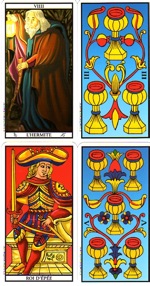
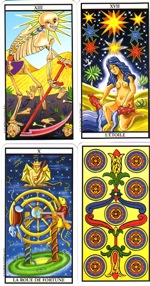
We can see that the answer is “No” (the Wheel of Fortune is in the bottom-right pair), but I decided to post it anyway. How else can we determine if the advice is good or not? There are three Major Arcana (in addition to the Wheel) indicating that the situation is in the hands of destiny, and two Cups cards, which slightly leans toward a favorable outcome over the long run. I’ll let you know if anything untoward occurs. The deck used is Le Grand Tarot Universel by Bruno de Nys.
“For in truth, this story begins not with bones in a Parisian graveyard but with a deck of cards.

“The Devil’s Picture Book.”

—from Sepulchre, p. 5.

Kate Moss, author of Labyrinth, has written a new novel called Sepulchre about the lives of two women who are linked through a tarot deck. Here Kate Moss discusses her use of tarot in the novel. You’ll find other video discussions of the work at youtube. You can see the eight tarot cards created for the deck here and an explanation of how the characters relate to the cards here.

Added: I finally finished Sepulchre and don’t even feel like writing a review of it. The core idea of an original deck linking two women across time was interesting and the evocation of 19th century France was okay, but ultimately none of the characters was particularly likeable and the ending was meaningless. Moss really needed someone to ask her, while she was still writing, what the point of the story was, as ultimately it led nowhere.

Are we tarot readers in the business of predicting the future? Some readers claim they are. They explain that we may be no more accurate or inaccurate then weather forecasters and stock market analysts (surely more accurate than stock market forecasters!). Of course, this hasn’t been formally tested yet. So it might behoove us to get a little understanding of the overall field of forecasting. For instance, the International Institute of Forecasters at the Wharton Business School, University of Pennsylvania has been developing theories, as well as testing and comparing different methods. Here’s how they define forecasting:

“Estimating in unknown situations. Predicting is a more general term and connotes estimating for any time series, cross-sectional, or longitudinal data. Forecasting is commonly used when discussing time series.”

So far tarot readings haven’t made the grade for their studies or even their listing tarot readings among the possible methods. Why should we be left out?

And here’s some information from the FAQ at forecastingprinciples.com:

Who can do forecasting?

“Anyone is free to practice forecasting for most products and in most countries. This has not always been true. Societies have been suspicious of forecasters. In A.D. 357, the Roman Emperor Constantius made a law forbidding anyone from consulting a soothsayer, mathematician, or forecaster. He proclaimed “…may curiosity to foretell the future be silenced forever.”

“It is sensible for a person practicing forecasting to have been trained in the most appropriate methods for the problems they face. Expert witnesses who forecast can be expected to be examined on their familiarity with methods.”

Aren’t forecasts wrong more often than they are right?

“This is a trick question. Some things are inherently difficult to forecast and, when forecasting numerical quantities, forecasters can seldom be exactly right. To be useful, a method must provide forecasts that are more accurate than chance. This condition can often be met, but one should not assume that it will be. A good forecasting procedure is one that is better than other reasonable alternatives.”

You might want to check where you think tarot belongs on the Methodology Tree.

Is it time that we begin to demand our place in the growing formal field of forecasting? Or, not?

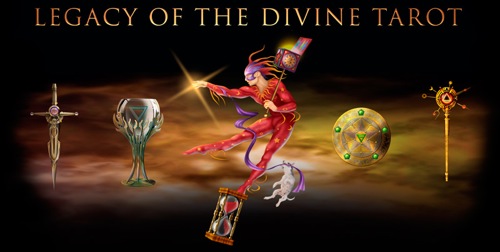
Ciro Marchetti, creator of the Gilded Tarot and Tarot of Dreams, has just released the final version of his video introduction to his new deck, Legacy of the Divine Tarot. This deck features an entirely new approach in that it is based on a short story about the demise of a people through a planetary catastrophe and the seeding of their wisdom throughout the galaxy—a message carried down through the ages. The video was created as a project by students at the Art Institute of Fort Lauderdale. You can see sample cards at Marchetti’s website.

View Video: Legacy of the Divine Tarot

I haven’t looked at much recent tarot poetry, but the web turns out to be a wonderful place to explore it. Here’s a few sites that offer something different or intriguing:

At heelstone.com’s poetry site you’ll find Tarot Poems by Mike Timonin, with Art by Cindy Duhe, presented in a very tarot-appropriate way. Click on the rapidly changing tarot card images and you’ll be taken to a poem determined by the shuffle. Want another card and poem? Shuffle the deck again.

You’ll also find a poem by Michael Gerald Sheehan for every card at Moon Path Tarot.

Tarot Poems by Donna Kerr from her book of poetry Between the Sword and the Heart.

Tarot Poetry by Rachel Pollack.

Here is one of the oldest tarot poems in existence: a sonnet by Teofilo Folengo, appearing in his 1527 work Caos del Triperiuno written under the pseudonym Merlini Cocai. The work includes a series of poems representing the individual fortunes of various people as revealed by cards dealt them. The summary sonnet below mentions each of the 22 Trump cards, which I’ve referenced by their number to the right of the line on which they appear. It helps to understand that Death is female in Italian, la morte, and Love (Cupid) is male. Love claims that although Death rules the physical body, Love never dies and therefore death is but a sham.

Love, under whose Empire many deeds (6, 4)
go without Time and without Fortune, (9, 10)
saw Death, ugly and dark, on a Chariot, (13, 7)
going among the people it took away from the World. (21)
She asked: “No Pope nor Papesse was ever won (5, 2)
by you. Do you call this Justice?” (8 )
He answered: “He who made the Sun and the Moon (19, 18 )
defended them from my Strength. (11)
“What a Fool I am,” said Love, “my Fire, (0, 16)
that can appear as an Angel or as a Devil (20, 15)
can be Tempered by some others who live under my Star. (14, 17)
You are the Empress[Ruler] of bodies. But you cannot kill hearts, (3)
you only Suspend them. You have a name of high Fame, (12)
but you are nothing but a Trickster.” (1)

Translated by Marco Ponzi (Dr. Arcanus) with help from Ross Caldwell, members of Aeclectic Tarot’s TarotForum, and by comparisons with the translation found in Stuart Kaplan’s Encyclopedia of Tarot, Vol II, p. 8-9 (read the discussion here). The first picture is from a 1485 Triumph of Death fresco on the wall of a Confraternity Chapel in Clusone, Italy. It depicts Death as an Empress before whom all others bow. The second picture is from Savonarola’s Sermon on the Art of Dying Well, published circa 1500.

See the translation of one of Folengo’s fortune-telling sonnets at taropedia – here.

Added: Check out the poetic concept of rhyme applied to visual aspects of the tarot in Enrique Enriquez’s article on “Eye Rhyme.”

A couple of people have asked me how I defined “modern” in my post on the 1969 Tarot Renaissance. Stephen wrote in the comments: “In my humble opinion I would have put “modern tarot” renaissance as a part of the age of enlightenment… say late 1700’s onward to the 1920’s…(Etteilla, Gebelin, Levi, Crowley and Case) and building up to A E Waite’s pivotal anglo-american deck.” And Shawn said, “I’d love to know how you define/distinguish “modern” Tarot from it’s ancestry.”

I tend to think of modern as being within the last hundred years or so – within the memory of those who are still living. I’m aware there is one school of thought that puts anything since the “Middle Ages” into the modern category—but a 600-year span makes the term practically meaningless. I suppose a better term would have been “contemporary,” although we’re almost 40 years past that.

I could say that 1969 marks the 20th-to-early-21st century Tarot Renaissance. And, that it’s defined by a continuing growth and development of tarot involving the creativity of many people, deck sales in the millions, and broadly affecting the culture in many countries around the globe. To me a “renaissance” is a creative force in the culture as a whole—affecting a multitude of cultural forms.

Can anyone point to a single year prior to 1969 in which 18 to 20 new tarot decks and/or books were produced—or even half that? Or, how about a span of many years in which an average of a dozen or more tarot works came out every single year as they did from 1969 on?

Prior to the 1960s, the best we can find is one new tarot work every few years or even decades, with the exception of 1888-89 when there were three works in two years, and the mid-1940s when three or four works were produced over several years but with very few in the decade prior to or after that.

Certainly 1781 (the birth of the occult tarot), 1854, 1870, 1888/9, 1909 and 1945 are hugely significant dates and turning points in tarot history, but these are the works of individuals in single years, not mass-movements. They didn’t directly affect the creative output of a large segment of the culture until we come to the 60s and especially 1969, when there was a popular groundswell that has continued to grow and spread.

There were around twelve new works in 1970, fourteen in 1971, nine or ten each from 1972 to ’74, seventeen in 1975, and so on. The effects could be seen throughout the culture: in poetry, painting, collage, sculpture and art installations, movies, television, theatre, fiction, comics, psychology, and even fabric, clothing and jewelry design.

Something happened to tarot since the late 60s and 70s that is vastly different and more creative then anything that had happened before, and across a much wider range of human experience.

I may not have all my terms right, but I’m trying to get some understanding of what happened. Keep the comments coming.

Like getting your history from a visual medium? Here’s one of the best brief video overviews of early tarot history out there, despite the incorrect prounciation of the Italian (not French) word tarocchi (correct: “tah-ROH-key”)—plural form of one of the oldest names for the cards, which is still used in Italy. However, when it comes to the later occult and divinatory tarot, videographer Mark (tokarski21) couldn’t resist falling into the occult-as-Devil trap. This is really too bad for someone who professes to deal straight with history. Mark promises to delve more into the subject later so I hope he gets better sources (me!?) and treats the subject with more historical objectivity. Catch up with Mark’s other videos here and here.

About

Click HERE to subscribe to Mary K. Greer's Tarot Blog by Email

≈◊≈◊≈◊≈◊≈

Mary K. Greer has made tarot her life work. Check here for reports of goings-on in the world of tarot and cartomancy, articles on the history and practice of tarot, and materials on other cartomancy decks. Sorry, I no longer write reviews. Contact me HERE.

© Mary K. Greer All material on this site is copyrighted. If you use anything, be sure to include my name and a link back to this site. Thank you.

I truly appreciate donations to help me pay for additional space.

Donate any amount to keep this ad-free blog growing.

Archives