Waite's grave

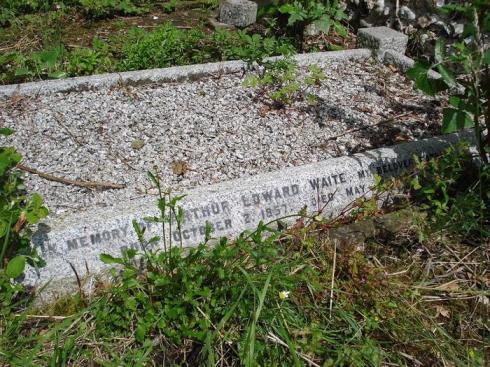
Waite__1910Many people have been incensed by the lack of a known grave for Pamela Colman Smith, artist of the Rider-Waite-Smith Tarot. But how many people have made pilgrimage to the gravesite of Arthur Edward Waite? Please let us know if you have. It turns out that Waite lived in his later years and died not far from where Pixie Smith drew many of the cards for their mutual deck. For those who are interested go HERE for the location and some pictures of his grave. At least you can have a virtual look at the place where he was buried. Photo by Julia&Keld

ADDED: On the end of Waite’s grave are the words “Est Una Sola Res.” Someone asked me what these words meant. “There is only One Thing.” But, I’ll let Waite himself explain his understanding of this phrase, from his book The Hidden Church of the Holy Grail, published the same year as the Tarot deck:

“Within the domain of the Secret Tradition the initiations are many and so are the schools of thought, but those which are true schools and those which are high orders issue from one root. Est una sola res, and they whose heart of contemplation is fixed upon this one thing may differ but can never be far apart. . . . I know not what systems of the æons may intervene between that which is imperishable within us and the union wherein the universe will in fine repose at the centre. But I know that the great systems . . . do not pass away, because that which was from the beginning is now and ever shall be–is one motive, one aspiration, one term of thought remaining, as if in the stillness of an everlasting present. We really understand one another, and our terms are terms over which our collective aspirations are united world without end.”

Looking further we see the alchemical roots of this phrase in Wilmshurst’s Introduction to Mary Anne Atwood’s A Suggestive Inquiry into the Hermetic Mystery—a book which was said to reveal too explicitly the great secrets of alchemy:

Est una sola Res ; and it is this ‘One Thing,’ this basal substrate and reality underlying phenomena, this pure matrix around which has accreted the impure (because disordered) matter of the sense-world that one must consciously possess as a passport to the regenerative work.”

And, of course, we find its origins in The Emerald Tablet of Hermes Trismegistus. Here, in the translation of Sir Isaac Newton:

“That which is below is like that which is above & that which is above is like that which is below to do the miracles of one only thing.”

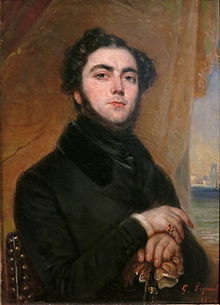
Marie d'AgoultIn June of 1834, Marie Catherine Sophie, Comtesse d’Agoult (later known as the writer Daniel Stern), at the urging of her friend, novelist Eugène Sue, sought a reading with Mlle. Lenormand that promised great things. Four days later a hopeful Eugène Sue obtained a reading. Both Marie d’Agoult’s reading and that of M. Sue are recounted in her memoirs.

Thus we learn of Eugène’s unrequited love for Marie and a prediction of her future that was soon to take an astonishing turn. The following year Marie divorced her husband and met the pianist and composer Franz Liszt, with whom she had three illegitimate children (one of whom became the celebrated and influential wife of Richard Wagner).

Here is Marie d’Agoult’s own account.


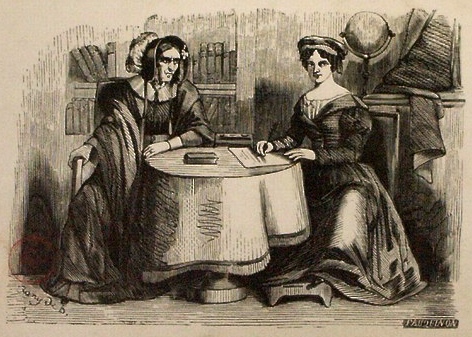
I went to Mlle. Lenormand on 23 June of the year 1834, at the suggestion of the famous novelist, Eugene Sue, who spoke to me of her as a prodigious person through her power of penetration and intuition. Mlle. Lenormand then lived in the rue de Tournon and gave her consultations from a very dark, dirty, and strongly musty room, to which, using some pretty childish tricks, she had given an air of necromancy.

Lenormand+cards - Version 2

It was no longer the period of her brilliant fame, when, by virtue of her prediction to Madame de Beauharnais, she had achieved credit with the greatest rulers of Europe – it will be recalled that, at the Congress of Aachen, Alexandre visited her frequently and seriously; Lord Wellington also consulted her to learn the name of the man who had attempted to assassinate him in 1818; she was now almost forgotten. Few people knew the way to her home.

Old, thick, sordid in her attire, wearing a square cap, how medieval she appeared, backlit in a large greasy leather armchair at her table covered with cabalistic cards; a large black cat meowed at her feet with a witch’s air. The prompt and piercing glance of the diviner, thrown on the sly, as she shuffled her cards—for a few francs in addition to the common price for what she called the big game (grand jeu)—she revealed to one, without doubt, the kind of concern and mood of the character of the one who consulted her and helped to predict a future that, after all, for each of us, and except for the very limited intervention of chance, is the result of our temperament and character.

What she said amazed me because I did not know myself then, otherwise I could have, to some extent, been my own oracle, and predicted, without consulting anyone [else], what my destiny would be. On my way home, I noted down what Mlle. Lenormand had said to me. I’ve copied it here for those curious about these kinds of meetings.

“There will be a total change in your destiny in the next two or three years. What would appear to you at this time, to be absolutely impossible will come true. You will entirely change your way of living. You will change your name thereafter, and your new name will become famous not only in France but in Europe. You will leave your country for a long time. Italy will be your adopted country; you will be loved and honored.

“You’ll love a man who will make an impression in the world and whose name will make a great clamour. You inspire strong feelings of enmity in two women who will seek to harm you by all means possible. But have faith; you will triumph through everything. You will live to be old, surrounded by true friends, and you will have a beneficial influence on a lot of people.

“Pay attention to your dreams that warn you of danger. Distrust your imagination that enthuses easily and will throw you in the path of danger, which you will escape through great courage. Moderate your benevolence which is blind. Expect that your mind, which is independent and sincere, will make you a lot of enemies and your kindness will be ignored.”

I also found, among my correspondence with Eugene Sue, a letter which refers to Mlle. Lenormand, and I have joined it here to supplement what I have told of this incident.

EugeneSueLetter of Eugène Sue,
Paris, June 27, 1834.

I have taken leave of our diviner, Madam, and I cannot but express my disappointment. You asked me to tell you the predictions she made me, as unpleasant as they are: so here they are:

You see, Madam, that the damned Sibyl varied at least in her prophecies, and your brilliant and European destiny contrasts badly with mine. After I was recognized as one of her assiduous believers, the accursed witch made me a few insignificant predictions, reminded me of others, and then suddenly, stopping to mix the diabolical cards, she fixed me with her penetrating and mocking eyes:

 “Ho Ho!” said she, “here is something new and fatal. You are feeling a sentiment that she will not respond to.”

 I wanted to deny it; she insisted. She spoke to me of a rare spirit of infinite charm; she painted for me a portrait that I would not dare recount here, but which was not unrecognizable. Then, seeing I was so completely divined, I was silent. I limited myself to asking her if there was, therefore, no hope, if some card had not been forgotten, if the combination was without error. The old woman began to re-calculate with an infernal complacency.

 Alas! Madame, the result was absolutely the same: a deeply passionate feeling, without any hope, disturbed my present and destroyed my future. You see, Madame, in comparing this prediction to that which was made to you, I am doubly subject to accuse the fates; because it is said that the man whose destiny you will share will be famous, from which I conclude that the lover you push away will remain obscure. Oh well, Ma’am, I dare confess it to you, this glory announced to the man whom you will deign to love, I dreamed about it, I aspired to it, I felt strong enough to win it; but now that it is foretold that I will not be loved, I’ve dropped from the height of my dreams and ambitions to sadness and discouragement, empty of heart and spirit.

Regards, etc.


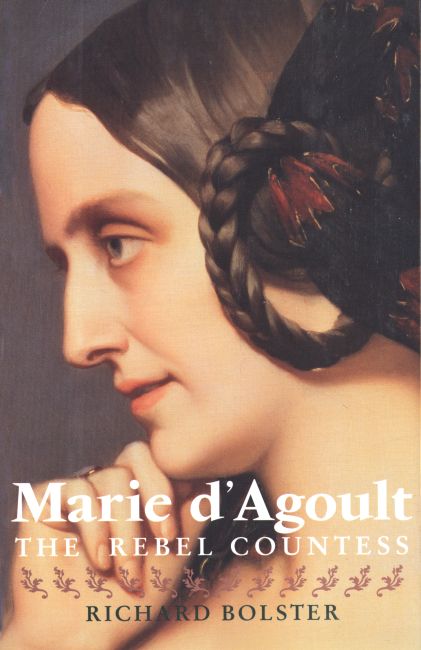
I wish to thank “Terry” who, in a comment on my detailed post on Mlle. Lenormand, introduced me to this material in Mes Souvenirs by Marie d’Agoult, Vol. 1, 1880, pp. 277-279. I cobbled the above account together from internet translators. Please feel free to share any corrections in the comments. The incident is only mentioned briefly in the biography by Richard Bolster (see cover photo above). See also my post: Madame Le Normand: The Most Famous Card Reader of All Time.

How many of us go to a movie or a play—even a really good one—and a couple of days or weeks later don’t remember a thing about it? Yes, movies have a role in relaxation and just plain momentary enjoyment, but there can be something said for the longer term pleasure of ruminating over the themes, questions and ideas presented in good art.

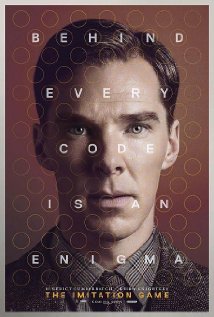
Imitation GameI have found Tarot and, more recently the 36 Lenormand cards, a great aid in meditating on ideas and art. This came into focus when I went to see the outstanding film The Imitation Game, about Alan Turing cracking the Enigma Code that helped end WWII. Themes also include the unconscionable way homosexuals have been treated and, ultimately, what is fair and just? I’ve put aside, for this discussion, the question of how accurate the film is—after all it is art, which serves to entertain and make us think and feel. [Trailer here.]

Note: if you know even the basics of Turing’s story, there is only one real spoiler below (so marked). 

Before seeing The Imitation Game, I drew three cards each from the Petit Lenormand and a Tarot deck as separate readings. I wished to compare, in part, how the messages I received would differ in terms of plot versus philosophical themes, character dilemmas or spiritual content. I knew only the broadest outline of Turing’s achievement: the facts mentioned above.

I asked: “What should I focus on in this movie to gain the greatest insights?”

From the Malpertuis Lenormand deck I received:

Fox – Clover – Bear

Before the movie, I summed up my page of notes: “Risky strategy pays off by protecting Britain.”

Fox is cunning, trickery, strategy; and in modern Lenormand can mean a job.

Clover is luck, chance, risk, fortuitous, brief.

Bear is strength, protection or envy; modern meanings include investment, gain and authority figures like CEOs or police and military.

In my method of doing line-readings the first card is the subject, so Clover modifies Fox: a risky strategy. Clover also serves as a verb, “pays off” leading to a future result: protection (Bear). I also considered that these cards could indicate a fortuitous relationship between an employer (Bear) and a worker (Fox), although with Fox and Bear looking in opposite directions, they might have different agendas. Furthermore, Bear could resent and be envious of the smartness of Fox. After the movie, I also considered Fox+Clover as “code-breaking” and Bear as the fearsome enemy (Bear is described as a “ferocious beast” in the oldest text). So we simply have: “breaking the Nazi code.”

Imagine my surprise when the movie opens with a film of a bear! It turned out to be the logo of the production company: Black Bear. Part way into the movie Turing makes an unsuccessful attempt to tell a joke about two people running into a bear: 

“The first one says, ‘You can’t outrun a bear.’ And the second one responds, ‘I don’t have to. I only have to outrun you.'”

This is a cunning strategy that can pay off when Fox is confronted by Bear. (Later I learned that Turing’s childhood toy bear—I seem to remember it being shown late in the film (?)—was his constant companion and is now featured in a display at Bletchley Park where the code-breaking took place.) 

At a more abstract level, Turing could be seen as the intelligent Fox, with Bear representing his monster of a machine that he named Christopher—after his only childhood friend who protected him at school. Additionally, Fox, which can also represent something false, a faked ploy, is key to how these cards can relate to the “Turing Test” of artificial intelligence and especially Turing’s example of it in his “Imitation Game.”

From the 78-card Rider-Waite-Smith Tarot deck I received:

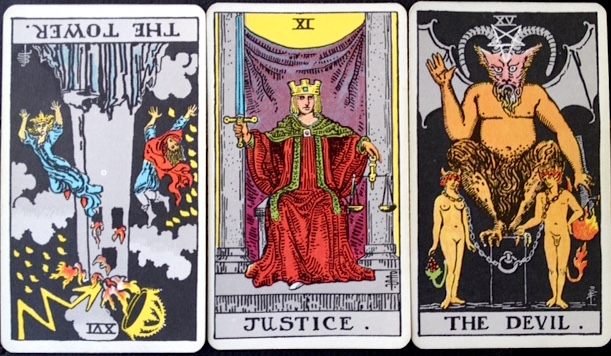
Tower reversed – Justice – Devil

Having three Major Arcana cards indicates deeply “destined” circumstances. I tried two summing ups: “Justice (logic/right) ends the War with Evil (material dominion).” or “Choosing materialism/shame (Devil as outcome) versus (Justice) a cover-up of flaws and problems (Tower reversed).”

Tower reversed is averting disaster; bailing out; impotence; blocking or overturning destruction.

Justice is measured rationality, seeing the pros & cons; choice; balance; decision; and, of course, law and justice.

The Devil is utmost materiality; power structures; ego; shame; blame. (The parallel to Bear as envious, ferocious beast is notable.)

I considered that Justice in the center represented a balancing act between the Tower R and the Devil. Was shame (the Devil) somehow balancing an end to war (Tower)? Or was it more about needing to find a solution (Justice) that would keep the pressure-cooker from exploding (Tower reversed) that would let evil reign?

Mild Spoiler Alert:

Contemplating these cards since seeing the film, I see a much deeper issue hinted at by the movie—perverted justice done by a blind institution that causes great harm. I’ve learned from reading Lenormand that we have to see cards as being modified by what surrounds them. Justice doesn’t have to be reversed to indicate injustice—the Devil following Justice can show the great evil that justice itself can do. When a person is seen as “inverted” (“inversion” is an old classification for homosexual) then grave injustices are done. A point has been made that the royal “pardon” of Turing for his conviction as a homosexual is a travesty as he was guilty under the law and therefore “justly” convicted as were the 47,000 other men who were also convicted (and not pardoned). What we are shocked by is that a hero who saved millions of lives should have been treated so badly—but is that just to all the others? These cards indicate the reaction of today’s viewers that the “justice” against “inversion” was heart-breakingly “wrong,” while, according to the time, it was not, despite the fact that we now see the institution itself (the law) as as a great evil. 

Major Spoiler Alert:

Upon breaking the Enigma Code, the team is faced with the realization that they cannot stop the Nazi attacks as that would reveal to the Nazis the breaking of the code and the immediate termination of its use. British intelligence would have to allow the killing and destruction to continue in order to know what the Germans were up to. I see this horrifying realization as the main climax of the film, perfectly depicted by the Tarot cards: the breakthrough that could end the war and the decision to allow great evil to continue as the only rational thing to do.

Added: A final summarizing of these Tarot cards in terms of the film:
To achieve true justice and the reversal of a destructive course there will be collateral damage (bad things happen).

I still find the Tarot to be the much deeper of the two decks, but the Lenormand cards astound me again and again with their uncanny precision and succinctness. As mentioned above, I’ll leave to you the implications of these cards to the Turing Test of artificial intelligence and his “Imitation Game.” Feel free to comment on these below.

Regarding the biographical accuracy of this piece of fiction: there are major problems. I can only hope that the film (enjoyable in its own right but only as fiction) will lead you to find out more about the real Alan Turing:
http://www.theguardian.com/film/2014/nov/20/the-imitation-game-invents-new-slander-to-insult-alan-turing-reel-history

Check out these other readings for films, plays and books:
https://marygreer.wordpress.com/2013/07/22/whos-afraid-of-virginia-woolf/
https://marygreer.wordpress.com/2012/10/09/reading-the-cards-for-movies-and-books/

I try to keep abreast of Tarot as it appears in fiction but somehow I missed this one: The Holy by Daniel Quinn (2002). The entire book is the playing out of a Tarot reading, made explicit by full-page illustrations of Rider-Waite-Smith cards that introduce book sections.
The central what if is, “What if the God of the Bible was not the only God, and what if the “false gods” referred to in the ten commandments actually exist?” We can extend this to ask the questions: Who are they? and What do they want?—questions the author leaves only partially answered.

This is a Fool’s journey, cross country, undertaken by several different people, at first independently and then with converging stories, all foreseen in the Tarot reading that becomes explicit only as the tale evolves. Quinn is known for his philosophical novels, starting with the highly regarded Ishmael, for which he won the half-million dollar Turner Tomorrow Fellowship. Quinn is an original thinker whose process has been described as “seeing through the myths of this culture” or “ripping away the shades so that people can have a clear look at history and what we’re doing to the world.” It’s interesting that despite the centrality of the Tarot reading and Tarot illustrations in this book, the Tarot content is hardly ever mentioned and never discussed in the reviews I’ve read.

Synopsis: Sixty-plus year-old private detective Howard Scheim is hired by an acquaintance to discover if the “false gods” of the Bible really exist. In agreeing to discover if he can even undertake such an inquiry he interviews several people including a journalist, a tarot reader, a clairvoyant and a Satanist. Meanwhile the Kennesey family is undergoing upheaval as husband David decides to walk away from his job, his wife and his 12-year old son, Tim. Tim and his mother go searching for David and, when Tim becomes accidentally separated from his mother, Howard stumbles upon him and offers to help Tim find her. As it turns out both David and his son Tim are being courted by amoral, non-human “others” who plan to “wake up” humanity because their blindness is creating havoc. These “others,” who refuse to define themselves, are trickster beings, neither evil nor benevolent, who have existed far longer than homo sapiens. They have been known to enchant those humans who look to the physical world rather than to a transcendent being to benefit them.

The Celtic Cross Tarot reading shows Quinn to be knowledgeable about Tarot consulting. References to people named Case (P.F. Case authored an influential Tarot book) and John Dee (magician to Elizabeth I), as well as a road named Morning Star Path (a Golden Dawn offshoot was called the “Stella Matutina” or morning star) makes it clear that Quinn is referencing modern occult lore.

Tarot reader Denise starts by explaining that the first card in Howard’s reading indicates the predominant influence in the subject’s life. Howard draws the Seven of Swords and Denise asks Howard to tell her what it is about, explaining this is not her usual way of working but, “If I proceed normally, you’ll think I’m slanting it.”

He describes a thief stealing swords for a battle who has overlooked something (two swords left behind).” Denise summarizes it: “You’re getting ready for a battle and you’re overestimating your own cleverness and underestimating the strength of your enemy. You’re overconfident and you think you can’t be hurt in the enterprise you’ve planned. . . . The reading will center on the conflict you’re preparing for.”

The Seven of Swords is crossed by the Two of Pentacles: “The pentacles represent grave extremes: the beginning and the end, life and deah, infinite past and the infinite future, good and evil. Nevertheless, the young man is dancing.” Denise says he takes the situation too lightly.

The card above him is the Eight of Cups: “At best, you can hope for a strange journey, an adventure into darkness.”

The frontispiece illustration is that of the Seven of Cups, appearing in the reading in the environment position: “A man is disconcerted by an array of tantalizing apparitions of love, mystery, danger, riches, fame, and evil. Illusions will bedevil you. You’ll be pulled in many directions, and your choices will be confused.” Perhaps this is the underlying theme of not only this book but other works by Daniel Quinn: Humankind is bedeviled by the illusions of culture and civilization so that our choices are confused, centering on all the wrong things. Quinn has one of the characters quote Plato’s The Republic: “Whatever deceives can be said to enchant.” Adding, “Anyone who shakes off the deception shakes off the enchantment as well – and ceases to be one of you [a homo sapien].” The Holy, p. 260.

I’ve left out most of the interplay about the cards, and I won’t reveal more of the story as I hope you will explore this book for yourselves.

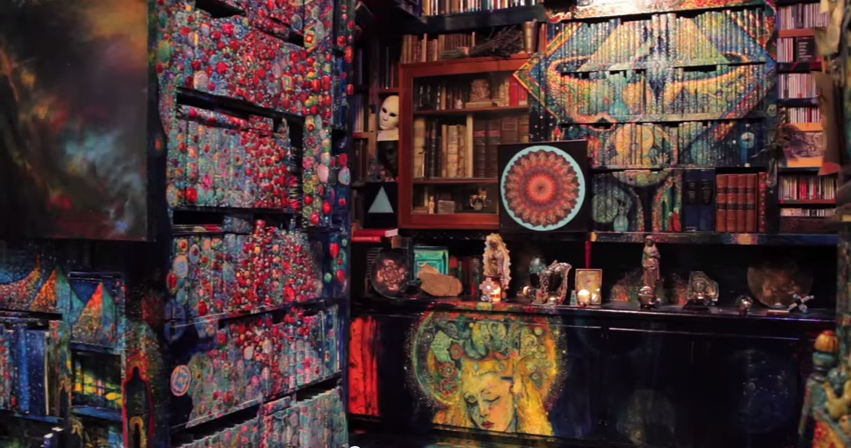
McCloskey studio

Visit the studio in the video below of artist Leigh J. McCloskey who created a modern Tarot deck like no other – Tarot ReVISIONed. If anyone has seen and created a multi-dimension universe, it is McCloskey. I visited Leigh McCloskey at his studio several years ago and it is beyond imagining. His art is at one with the books, the walls, the floor, the ceiling – like walking into an alternate realm of existence.

Watch a video presentation in which you can learn about his Tarot vision:

And don’t miss Leigh McCloskey, Chris Hopkins, Marcus Katz, Tali Goodwin, Melissae Lucia, Michael Robinson, David Shoemaker, Antero Alli, and me at the Tarosophy Tarot Convention in Sacramento CA on February 21-22. Information here.

44437_452583078160474_1979197327_n (1)

WANT TO LEARN LENORMAND? I will be available daily at a special forum from November 17 to December 8 for all who sign up for my five-session course (available online or via DVD). I will go through the materials with you, answer questions, and generally be available to help with your readings. There will also be a FREE live Q-and-A session via Skype on 4 December (space limited!). 

Register NOW. This is a chance to share your homework assignments and to practice readings, as well as explore topics beyond the scope of the lessons. I encourage you to use this winter holiday season (I know, I know – summer for a few of you) to explore a new divination tool or, if you’ve already begun, improve your understanding of the Lenormand system.

I favor a traditional approach with emphasis on the Grand Tableau – viewing short spreads as “training wheels” to get you familiar with all the elements of the “big picture.” Also, my approach to learning the individual cards is entirely different than you’ll find elsewhere as we focus on topics and all the cards related to each.

Information at: http://globalspiritualstudies.com/petit-lenormand/mary-k-greer/reading-the-petit-lenormand-cards/

PLEASE SHARE this opportunity with friends and Lenormand groups.

Try out this video sample from the course:

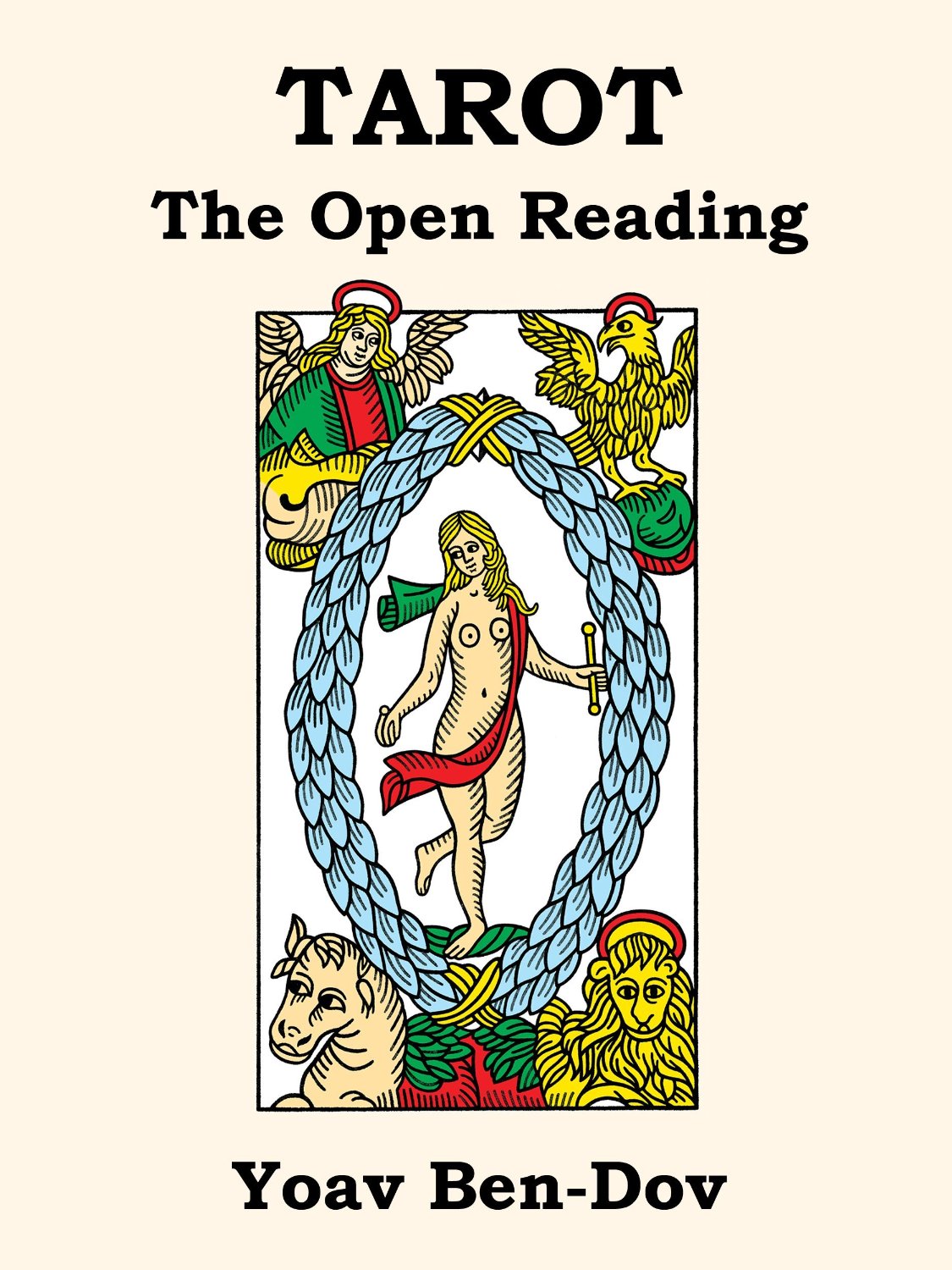
ImageIt’s been a long time since I was really excited and intrigued by a new ‘how-to’ book on reading the Tarot. Dr. Yoav Ben-Dov’s Tarot—The Open Reading is a book I just have to share with you. Ben-Dov describes the Tarot as a work of art, through whose details a full range of human experiences can be revealed. First, the book features the Marseilles Tarot deck—a deck that’s gaining greater interest and appreciation among English-speaking Tarotists. This deck is pre-occultized, as the images are not modified to conform with esoteric systems. While not identical to early 15th century decks, it expresses a folk tradition that dominated for at least three hundred years (out of the nearly 600 year history of Tarot) and is still the major style found in much of Europe. Additionally, Ben-Dov has created what I believe to be the most elegant restoration of the classic Conver Marseille deck available (see below). This process aided him in his close attention to detail in the cards.

What has been notably missing in English Tarot literature are good, non-Waite-based meanings for the four suits. You need look no further. The focus here is on reading the cards through the scenarios one perceives when looking at the images. For the Majors, Ben-Dov says the possibilities are open. Nevertheless, he points out valuable interpretive perspectives derived from symbolic, historical and mythological associations, many of which I found both original and obvious (once-stated)—in other words, extremely helpful as kick-starter phrases for the cards. Through comparison and contrast of visual details he demonstrates how the cards relate to one another. Emphasis is on a therapeutic approach, rather than being predictive or proscriptive. Providing an excellent introduction to practical reading skills, he stresses developing familiarity with psychological practices, for which he specifically recommends Irvin D. Yalom’s outstanding guide to interacting effectively with clients, The Gift of Therapy.

Previous authors stressed one of three approaches to the Minor pip cards: 1) a straightforward transfer of the Waite-Smith Minor Arcana meanings to the Marseille deck, 2) a memorized meanings often derived from Etteilla, or 3) a personal synthesis of number-plus-suit meanings for each card. Ben-Dov bases his Minor Arcana explications on the work of Alejandro Jodorowsky, emphasizing visual cues in the cards along with number, which make their arrangements ‘sensible,’ and therefore easy to learn and build on. His descriptions of the thematic progression within the Major and Minor suits provide an immediate handle on each. In keeping with his therapeutic approach, the Court Cards represent attitudes and characteristics of the querent rather than other people, although there’s nothing to stop you from applying them to others. I only wish that Ben-Dov had included sample readings utilizing the Minors like he did for the Majors, as his examples were so insightful.

Spreads are kept simple, with some innovative approaches to working with both Major and Minor suit cards that are well-worth trying out. His instructions for creating your own spreads gives you an infinite palette of deeply meaningful options to choose from.

I have two pet peeves: Ben-Dov completely ignores the first two hundred years of Tarot’s history when he describes the Marseille Tarot as the ‘genuine model’, with the ‘true order’ for the cards, saying it offers, “the most faithful and accurate representation of the ancient Tarot symbols.” The oldest decks (15th century Italian) are quite different in style, and there were several different orders for the cards in its first century. It would be better to describe the Marseille-style decks as the most long-lasting, consistent design (which is not to be scoffed at). My second pet peeve involves misunderstandings of the Golden Dawn system of Tarot reading, resulting in minor errors that are not centrally relevant to this work. Personally, I think he should have left out his few Golden Dawn references or listed the differences in an appendix.

Overall, this book offers fresh, practical instructions for reading the Marseille Tarot that will give you a great appreciation for the details and special characteristics of the deck that first inspired tarot divination. Additionally you will gain lots of valuable insights into the reading process itself.

Works Mentioned:

Tarot—The Open Reading by Dr. Yoav Ben-Dov.

The CBD Tarot de Marseille deck, created by Dr. Yoav Ben-Dov.

The CBD Tarot de Marseille app for Android.

The Gift of Therapy: An Open Letter to a New Generation of Therapists and Their Patients by Irvin D. Yalom, M.D.

The Way of Tarot by Alejandro Jodorowsky.

Note: Yoav Ben-Dov has generously made his deck and basic interpretations freely available for use for non-commercial purposes via the Creative Commons concept – http://www.cbdtarot.com/download/

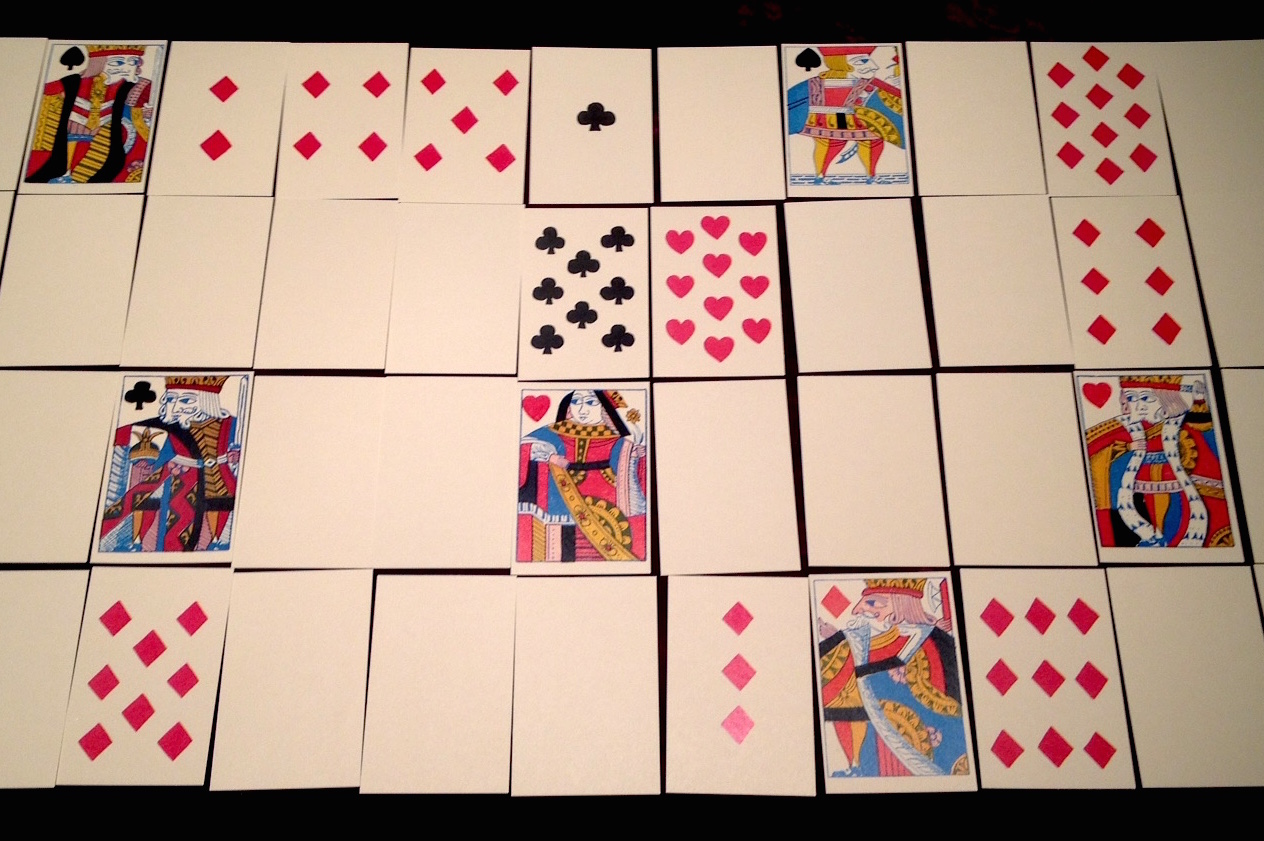
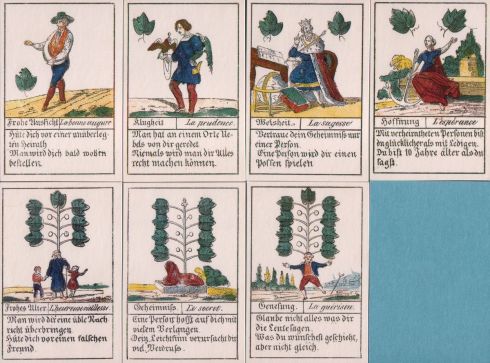
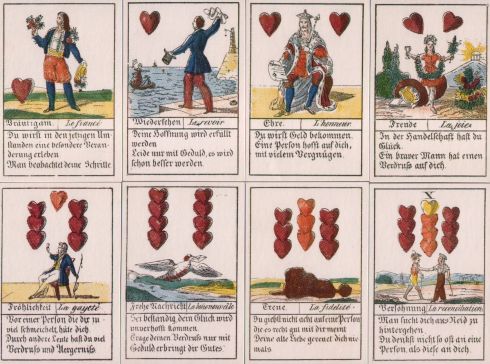
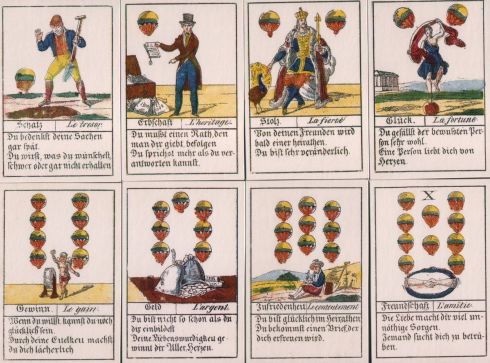
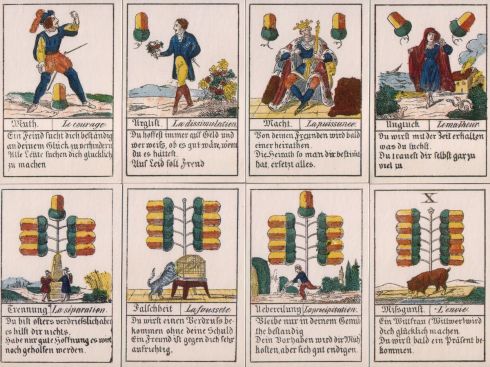
AN01172643_001 - Version 6 I recently bought a very early 20th century booklet on fortune-telling with German-suited playing cards: Green Leaves, Red Hearts, Bells and Acorns, as found on the Spiel der Hoffnüng cards. A friend is translating the book for me and, at first glance, it seems to provide a key to the Lenormand suits.

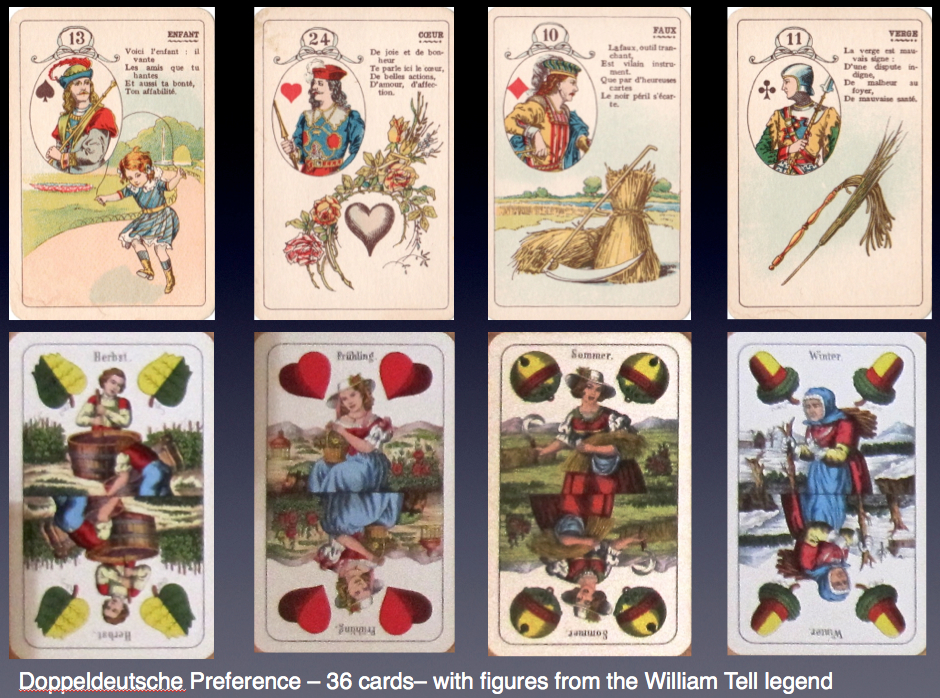
In looking for images to illustrate these old suits I came across an astonishing double-headed version of a deck that was popular in Germany, Austria and Hungary. In it the Daus cards (2’s which substituted for Aces) represent the four seasons, but look at how the pictures match the images on the Pages:

Jacks:Daus 4 Seasons

Starting on the right: Wintery Acorns (Eicheln) are Clubs and both the Jack and Daus feature birch rod switches.

Summer’s Bells (Schellen) are Diamonds and both cards show wheat being harvested with a scythe.

The red Hearts (Röt Herzen) of Spring (same in both decks) are all about hearts and flowers, the blossoming of love.

The green Leaves (Grün Laub) of Fall are Spades and show two children pressing wine grapes, while the Jack of Spades depicts a child at play. The Lenormand text for this Jack calls it is a card of goodness. Country customs often turn grape stomping into a time of fun and frivolity. Fall is also the season when children return to school.

A 1830 32-card set of German Fortune-Telling Playing Cards (Munich: Franz Josef Holler, made by Comptoir Industry of Leipzig)

I then found a webpage featuring German cards printed with fortune-telling meanings. This deck falls right between the 1799 Spiel der Hoffnüng game (the direct forerunner of the Lenormand cards) that is illustrated with both German and French playing cards, and the 1846 emergence of the German fortune-telling deck named after Mlle. Lenormand.

Comptoir Leipzig 1830 32 cards-Grun

Comptoir Leipzig 1830 32 cards-rot

Comptoir Leipzig 1830 32 cards - schell

Comptoir Leipzig 1830 32 cards

While the individual card meanings don’t seem to match the Lenormand cards, the suits do, and they show a fortune telling tradition that is quite different than the English and French systems most of us are familiar with. I’d be very grateful to anyone willing to translate some of the verses above into English. Please post translations in the comments.

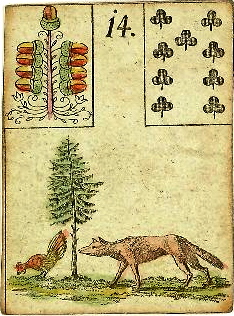
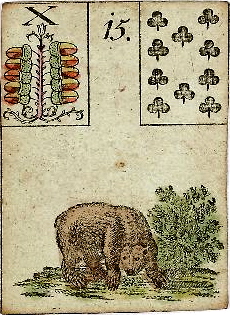
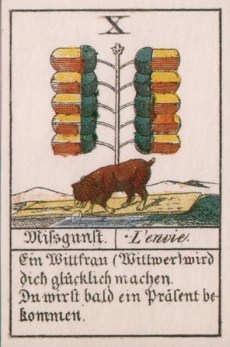
While it’s hard to tell what beast is shown on the 10 of Acorns (Eicheln), we also find a beast (Bear) on the equivalent 10 of Clubs. Both of them have envy as a keyword. The original Lenormand instructions read: “Bear means happiness, but it also indicates it is necessary to avoid discussions with an envious person.”

AN01172643_001 - Version 7

Comptoir Leipzig 1830 32 cards-Eichel - Version 2You can sign up anytime to access my Lenormand course or to order the DVDs at Global Spiritual Studies.
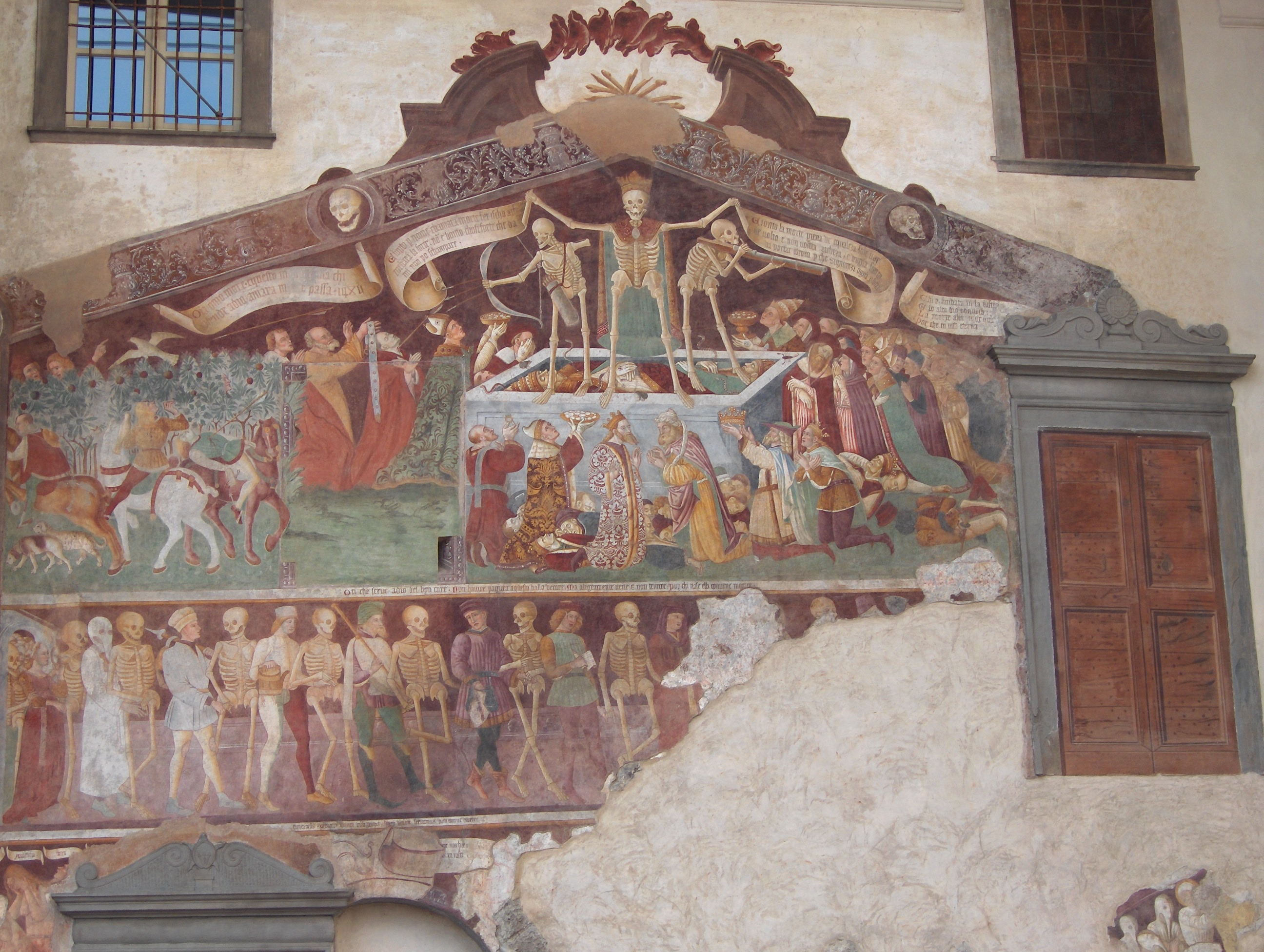
Clusone

Want a good, medieval mystery to read? The Song of the Nightingale by Alys Clare, sent this blogger, C. LaVielle, on a journey into the real life mystery of the origins of Tarot. As she notes, a Cathar origin is not really feasible, but its origins among “progressive Catholics who used existing Christian Apocalyptic art” is. This is an excellent summary of that perspective. The photo above is a 15th century fresco on the side of a Confraternity Chapel in Clusone, Italy. It depicts both a Dance of Death and a Triumph of Death and includes several figures that appear in the Tarot. Read the article at C. LaVielle’s Book Jacket Blog.

(Thanks to Mel Parsons for turning me on to the book and blog post.)


Natural Grand Tableau Taught by Mary K. Greer
Curious about what everyone finds so intriguing in the 36 card Lenormand deck? Join me in this five-week online course from 1 October to 5 November (no class on Oct. 22). On-line make-up sessions and getting the course in DVD form for later study are also available.

Right from the first week you’ll be working with the traditional Grand Tableau (“Big Picture”) that uses all the cards. You’ll explore the 36 cards via subject groups that help you understand the cards and fix their meanings in your mind. You’ll discover the secret of interpreting Lenormand through pairs and combinations, the kinds of questions that work best, and how to use the playing card inserts. Mary will help de-mystify the Tableau by discussing its basic components and breaking it down into easy-to-understand shorter layouts. Lenormand is an international language whose vocabulary is understood everywhere that the Petit Lenormand deck is found. We’ll be focusing on learning that standard language. Yet, your intuition will be given a huge boost as you start reading these cards immediately! Click here for more information. Join me for a fun-filled course. 

Facebook Support Group (optional) will be available to the live class members for review of “homework.”. An optional certificate of “Competency in Lenormand Level One” is available by taking and passing a test at the end of the course.

Session 1:

  • A brief overview of the origins and history of the Lenormand deck, including recent discoveries by Mary K. Greer
  • Approaching the cards by subject groups—the first subject group
  • The importance of interpretative nouns and adjectives and their use in card combinations
  • An introduction to the Grand Tableau and establishing the theme of the reading
  • Interpreting the four corners by working with pairs
  • Starting your Lenormand Notebook

About

Click HERE to subscribe to Mary K. Greer's Tarot Blog by Email

≈◊≈◊≈◊≈◊≈

Mary K. Greer has made tarot her life work. Check here for reports of goings-on in the world of tarot and cartomancy, articles on the history and practice of tarot, and materials on other cartomancy decks. Sorry, I no longer write reviews. Contact me HERE.

© Mary K. Greer All material on this site is copyrighted. If you use anything, be sure to include my name and a link back to this site. Thank you.

I truly appreciate donations to help me pay for additional space.

Donate any amount to keep this ad-free blog growing.

Archives