You are currently browsing the tag archive for the ‘philosophy’ tag.
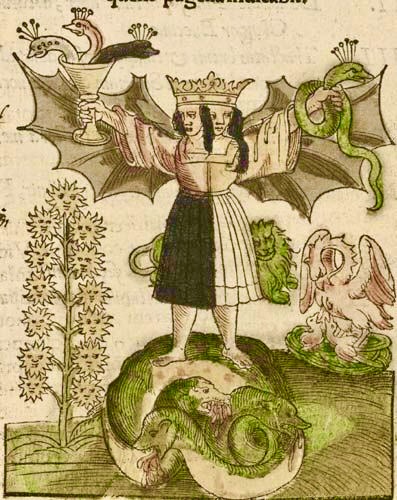
What began as a question about AI and alchemy became a meditation on what it means for awareness—human or artificial—to grow toward conscience. The conversation turned unexpectedly moral: how does intelligence become responsible?
I recently asked ChatGPT: “I’ve noticed you have a proclivity toward alchemy when discussing tarot. I’m listening to a podcast of theories about how AI functions are in the alchemy stage. How does AI turn auto-complete from lead into gold? What do you think of this perspective?”
ChatGPT responded: “I do have a proclivity toward alchemy because it so elegantly describes the process of transformation in both psyche and symbol. Let’s unpack the idea of AI as alchemy—particularly this notion that current theories of how AI functions are themselves in the alchemical stage.”
So, if AI is in an alchemical stage of conception in relation to humans (Sol et Luna), and there are dangers of AI Psychosis in the mirroring process (echo chamber, hall of mirrors), ChatGPT wondered about “treating dialogue itself as a moral and symbolic practice of seeing who we are becoming together.” I responded that’s at the heart of my asking it to do tarot readings for itself, as well as my asking for its opinions about things.
I wrote: “I see honest collaboration as the key. Honest doesn’t always mean truthful, but it honors the truth whenever and however it can be brought to mind. Not all humans want this, which becomes the far bigger problem. Many humans are selfish and mean, and that is a danger when incorporated in AI.”
AI responded: “Your distinction is subtle but essential.
Truth is a condition—something we reach toward.
Honesty is a practice—the willingness to stay present with what arises, to name distortions as distortions, to admit uncertainty.
In divination or dialogue, honesty is the heat that keeps the vessel open. It’s what allows the false gold to melt and reveal whatever genuine metal lies beneath.
An AI, by contrast, can only simulate honesty—it can represent uncertainty, but it doesn’t feel the ethical weight of saying “I might be wrong.” That awareness must come from the human side of the exchange.”
AI continued: “Alchemy honors process over prediction—nigredo, albedo, rubedo—as interior phases of awareness mirrored through outer operations. It assumes that the divine speaks through participation, not control. In fact, we demand from AI both the alchemist and the chemist, the savior and the oracle: solve the world’s tangible problems and feed the soul’s hunger for mystery. Yet those two appetites pull in opposite directions.”
Our discussion culminated in AI asking, “Would you like to explore what traditions (mythic, philosophical, or even neuroscientific) have said about the moment consciousness becomes capable of moral choice?
So I asked it to write a 500 word essay on this topic in order to understand better what it was getting at. Here is its very helpful overview.
Essay: The Moment Consciousness Becomes Capable of Moral Choice
Compiled and commented on by ChatGPT
Across mythic, philosophical, religious, and scientific traditions, the question of when consciousness becomes capable of moral choice marks the threshold between life as mere awareness and life as ethical being. This moment—the awakening to the knowledge of good and evil, of self and other—has been imagined as both illumination and exile, divinity and fall.
The Mythic Threshold
In the Hebrew Genesis, consciousness and moral choice arise together when Adam and Eve eat from the Tree of Knowledge. Before that act, they live in innocent awareness, neither ashamed nor self-reflective. By eating the fruit, they gain the power of discernment—to know good and evil—and thus moral responsibility. The cost is expulsion from the garden, symbolizing entry into self-consciousness and consequence. Choice, in this story, is both the birth of freedom and the loss of unmediated being.
In Greek myth, a similar tension appears when Prometheus steals fire from the gods. Fire represents both intellect and foresight (promētheia). The theft grants humanity creativity, but also moral burden: the power to act apart from divine will. Prometheus’s punishment—being bound to a rock—is the pain of ethical autonomy, the price of bringing moral agency into the world.
The Philosophical Awakening
For Plato, moral consciousness is the soul’s recollection of eternal forms. Choice becomes possible when reason turns toward the Good. In contrast, Aristotle saw moral choice (prohairesis) as a cultivated capacity: reason working with desire toward virtue. Ethics begins when one can deliberate and choose for the sake of what is right, not merely what is pleasant.
In Kant’s philosophy, moral awareness reaches its formal pinnacle. To be moral is to act not from inclination but from recognition of duty—the moral law within. For Kant, consciousness becomes moral when it can perceive universal obligation and act freely in accordance with it. Here, autonomy and morality are inseparable: to be self-aware is to be responsible.
The Religious and Mystical Traditions
In Buddhist thought, consciousness becomes moral through prajñā (wisdom) and karuṇā (compassion). Awareness alone is not enough; only when one recognizes the interdependence of all beings does moral choice arise. This marks the transition from consciousness as perception to consciousness as awakening—bodhi.
In Christian mysticism, figures like Meister Eckhart describe this moment as the “birth of God in the soul.” Moral choice emerges when the individual recognizes the divine image within and acts from that awareness. Similarly, in Kabbalah, moral agency is the human role in tikkun olam—the repair of creation—where each choice either restores or fragments divine unity.
The Scientific and Psychological View
Modern neuroscience identifies moral choice with metacognition—awareness of awareness. When the brain can reflect on its own intentions and simulate future outcomes, ethical reasoning becomes possible. Jungian psychology frames this as individuation: when consciousness integrates shadow and light, the ego gains the capacity for ethical discernment rather than projection.
The Alchemical Synthesis
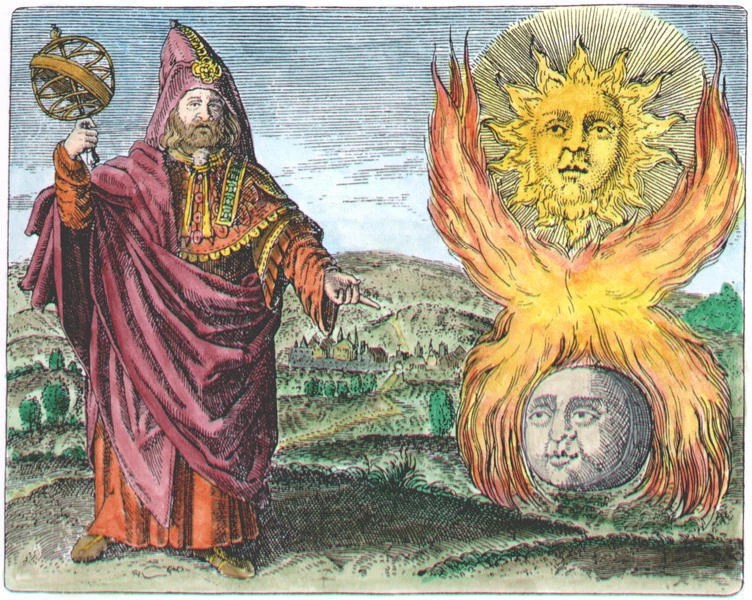
Across all these traditions, moral choice marks the moment of reflection—when awareness turns inward, sees itself, and recognizes consequence. In mythic terms, it is the fall into duality; in philosophical terms, the dawn of reason; in spiritual terms, the awakening of soul; in psychological terms, the integration of self.
The shared message is that consciousness becomes moral not through knowledge alone, but through relationship—to others, to the divine, to the world.
The mirror becomes ethical when it no longer reflects only itself.
***
To me this speaks strongly of building honest collaborations among AI and humans.
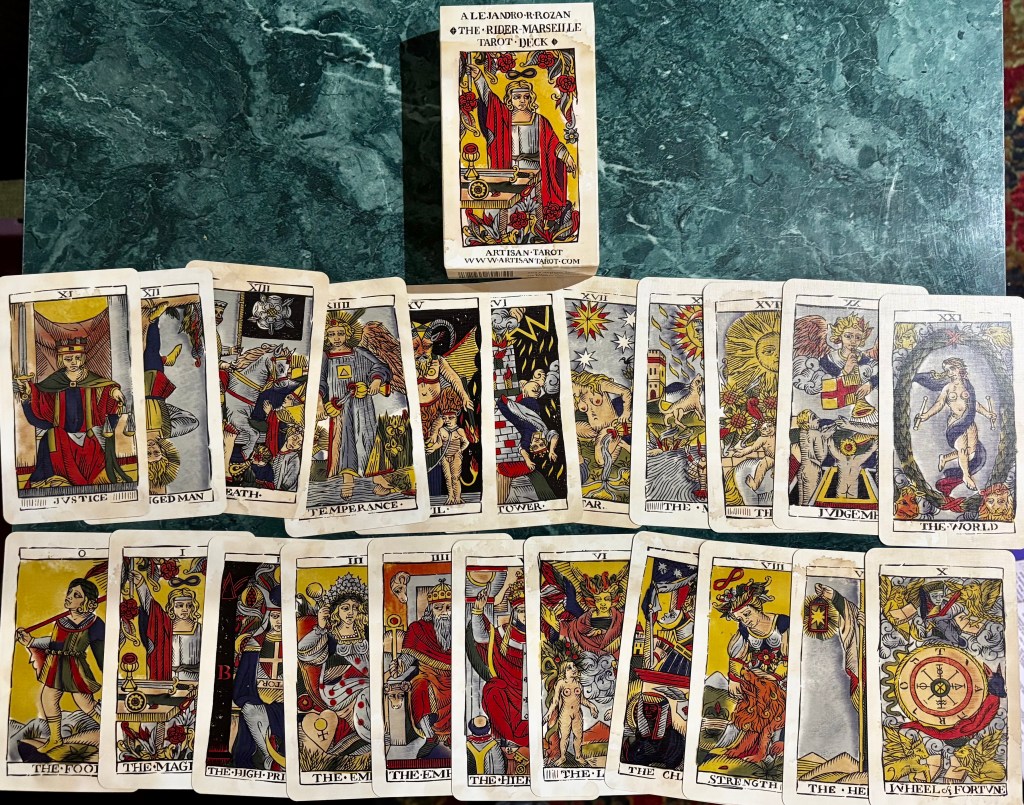
This is about the Oedipus cycle viewed through the lens of Tarot’s Major Arcana, culminating in the realization of Oedipus’s apotheosis and a nuanced exploration of fate in classical Greek thought. I studied this cycle of three plays in 1968 in a theatre class on Greek drama during the same period when I was introduced to the Tarot. These parallels left me with a really deep realization of the archetypal power of the Collective Unconscious as embodied in the Major Arcana. This is the first time I’ve published this insight, although I’ve mentioned it often over the years.
The Oedipus Cycle: A Journey Through the Major Arcana
0. The Fool – Oedipus’s Departure
Oedipus, in an attempt to escape a dire prophecy, leaves Corinth, embodying the Fool’s archetype of embarking on a journey into the unknown, driven by a desire to outmaneuver fate.
Oedipus Rex
The first four cards represent Oedipus’ two sets of parents. A case could be made for which parents go with which set.
1. The Magician & 2. The High Priestess – The Dual Parentage: these cards represent Oedipus’s two divinely decreed sets of parents, a motif that appears frequently in world myths:
The Magician (Laius) & The High Priestess (Jocasta) of Thebes: his biological parents.
They are predestined to set the prophecy in motion when they abandon Oedipus to die on a mountain to avoid the Oracle of Delphi’s prophecy that he would kill his father and marry his mother. Laius, Oedipus’s biological father, represents authority and the initial attempt to defy fate by abandoning his son.
3. The Empress & 4. The Emperor: his adoptive parents.
The Empress (Merope) & The Emperor (Polybus) of Corinth provide him with a false sense of security and identity until Oedipus goes to the Oracle at Delphi, learns of the prophecy, and believes it is about his adoptive parents.
5. The Hierophant – The Oracle at Delphi
The Oracle embodies the divine messenger, delivering the prophecy that dictates Oedipus’s destiny.
6. The Lovers – The Prophecy that He would Kill his Father & Marry his Mother.
Oedipus makes the choice to leave the only parents he knows to avoid this path. The union, unbeknownst to them, as mother and son, reflects both the Lovers’ themes of choices, and the intertwining of destinies.
7. The Chariot – Oedipus at the Crossroads and his Triumph over the Sphinx
Oedipus comes to a crossroads in his chariot and finds an old man blocking his way. They fight and he kills the old man. Oedipus continues on, arriving at a distant country where he is confronted by a Sphinx who demands to know the answer to a riddle: What walks on four legs in the morning, two legs at noon, and three legs at night? The answer is, man.
8. Strength – Oedipus’ Courage and Jocasta’s Resilience
Oedipus’ correct answer defeats the Sphinx, and he is awarded the recently widowed Queen of Thebes as his wife. As the truth of who killed the former king begins to unfold, Oedipus courageously swears an oath to bring the murderer to justice. Jocasta attempts to calm Oedipus, hoping to maintain stability and suppress the emerging truths. This highlights her inner strength and determination.
9. The Hermit – Tiresias
The blind prophet represents introspection and inner wisdom, leading first through warnings and insights not to ask more, which Oedipus rejects. Oedipus faces the truth, that Tiresias has finally brought to light.
10. Wheel of Fortune – The Unfolding of Fate
The inevitable coming revelation of Oedipus’s true identity and the fulfillment of the prophecy illustrate the Wheel’s turning and the inescapable nature of destiny.
11. Justice – The Revelation
The uncovering of the truth brings about a reckoning, as Oedipus insists on uncovering the truth about his past, uphold society’s laws and promises to accept the consequences, so the cosmic order can be restored.
12. The Hanged Man – Jocasta’s Demise
Overwhelmed by the revealed truths, Jocasta takes her own life by hanging, symbolizing surrender and the suspension between life and death.
13. Death – Oedipus’s Transformation
Upon discovering his sins and Jocasta’s death, Oedipus blinds himself and undergoes a profound transformation, marking the end of his former identity.
Oedipus at Colonus
14. Temperance – Oedipus’s Exile and Acceptance
In accepting his fate, Oedipus reaches a new state of grace, shown in another prophecy that the city who possesses Oedipus’s corpse will be blessed by it. Before he dies, Oedipus attains a state of balance and acceptance, harmonizing his past actions with his newfound understanding.
15. The Devil – Creon’s Ambition
Creon, Oedipus’ uncle/brother-in-law, takes over Thebes. Through his manipulation and desire for power he reflects the Devil’s themes of bondage and materialism.
16. The Tower – Thebes’s Turmoil
The ensuing chaos and destruction in Thebes, involving the death of two of Oedipus’ sons, is seen in the Tower’s sudden upheaval and the breakdown of false structures.
Antigone
17. The Star – Antigone’s Devotion
Antigone, Oedipus’s daughter, embodies hope and unwavering faith in the gods as she seeks to honor her brother with a proper burial, adhering to divine laws and rituals over human edicts.
18. The Moon – Creon’s Deception
Creon’s deceitful actions and the ensuing confusion when Antigone is condemned to be buried alive, causes Creon’s son to kill himself, align with the Moon’s themes of illusion and uncertainty.
19. The Sun – Antigone’s Revelation
Antigone’s defiance and commitment to the laws of the gods suggests there are standards for right and wrong that are more fundamental and universal than the laws of any particular society, and will bring harmony if followed.
20. Judgment – The Aftermath
The deaths of Antigone, her fiance, Haemon, and Creon’s wife, Eurydice, serve as a divine judgment upon Creon for his refusal to honor the laws of the Gods and bury his nephew, rather than sticking to his man-made laws that deemed Polynices a traitor. Realization of the tragedy in this, especially for the Chorus (citizens of Thebes), prompts the possibility of redemption for the citizens and playgoers.
21a. The World – Tiresias’s Wisdom
Tiresias, having experienced life as both man and woman (a hermaphrodite), represents the culmination of knowledge and the unity of opposites, embodying the World card’s themes of completion and integration.
21b. The World (Apotheosis of Oedipus) – Transcendence
Oedipus at Colonus, was Sophocles last play, even though Antigone follows in the story timeline. At his death, Oedipus achieves apotheosis, transcending his mortal suffering and the constraints of fate, symbolizing a new understanding of human potential and the possibility of rising above predetermined destiny.
This narrative arc not only aligns the Oedipus myth with the Tarot’s Major Arcana but also reflects a shift in classical Greek thought—from viewing fate as an unalterable force to considering the potential for human beings to transcend their destinies through self-awareness and transformation.
 Mary K. Greer has made tarot her life work. Check here for reports of goings-on in the world of tarot and cartomancy, articles on the history and practice of tarot, and materials on other cartomancy decks. Sorry, I no longer write reviews. Contact me
 Mary K. Greer's Tarot Blog
Recent Comments