You are currently browsing the category archive for the ‘Book/Story/Poetry Reports’ category.
James Redfield’s book The Celestine Prophecy recently came up in a discussion.
I read the book when Redfield first self-published it (he couldn’t find a publisher at the time), as he had given a copy to my brother-in-law. I saw it as a parable consisting of “new age” lessons made palatable through its story form. None of the ideas were new to me and the story was nothing more than a teaching device, but I enjoyed being reminded of things that I had experienced myself when “in the flow.” Reading it reminded me of how it is possible to live in that kind of “reality” (at least for short periods) and what magic can arise from it.
Flying home from a trip to visit my then-husband’s parents, as I read the book on the plane, I was especially intrigued by one section. Having just seen his parents, I asked my husband the same series of questions that the protagonist had been asked about his parents. As a result, Ed and I had one of the most deeply meaningful discussions ever about his life purpose or quest (as revealed through his beliefs about his parents).
When I got home I turned the process into a tarot spread that I’ve since used in many tarot workshops and occasional private consultations (always giving credit). I found it far more powerful to do with Tarot, since the cards suggest what may be, at first, a confusing possibility that, once comprehended, can contain a major breakthrough. This spread/process has resulted in significant insights for people. And, for siblings, and those who never knew one or both parents, it has fostered some remarkable healings.
Part One
For each question draw two cards—placing them in two parallel columns: one for your father and one for your mother (keep face down). Turn over and read the cards for one parent first and only after that for the other parent.
The key is to realize that this is not about your actual parents but about your perception of them. The interpretative process should be more about brainstorming possibilities than about applying set meanings. What memories or associations do the cards trigger?
Cards 1 & 2: What did your father(1) / mother(2) stand for and believe in?
Cards 3 & 4: In what way(s) did your father(3) / mother(4) achieve this?
Cards 5 & 6: What kept your father(5) / mother(6) from doing it perfectly?
Cards 7 & 8: What meaning or truth did YOU learn from the above experiences of your father(7) / mother(8)?
Cards 9 & 10: What would you have changed about your father(9) / mother(10) that would have enabled him or her to have a better life?
Part Two
Use the same cards received above (moving them to their own area of the table) and apply the same conclusions you’ve already drawn (although feel free to add new ones). You’ll be looking at these cards from a different perspective.
Cards 7 & 8 (from Part One): What is the Higher Synthesis or Truth for YOU based on what you learned from your parents? You derive this by blending Cards 7 & 8 along with the insights you had about them.
For instance, a summary of your earlier insights might be: My Higher Synthesis or Truth is that I believe in 7:”standing up for” 8:”the beauty of life.”
Cards 9 & 10 (from Part One): What do you want to find out how to do? This is based on your being able to integrate and do what you believe your father and mother SHOULD have done to live a better life.
Summarize this as:
My Life Quest is to find out how to ________. Combine 9 & 10 into a statement reflecting what you think they each should have done.
For instance, My Life Quest is to find out how to 9:”live my own truth” while 10:”caring deeply for others.” This might also be stated as, “. . . know the truth in myself about caring for and being sensitive to others.”
From this perspective, your Life Quest is to fulfill what you perceive as lacking in your parent’s lives—what you see as their unfulfilled potential or destiny. You combine these perceptions, deriving from the combination something that is unique to you. Thus, it is a kind of spiritual DNA.
As Carl Jung noted: “What usually has the strongest psychic effect on the child is the life which the parents . . . have not lived.” (The Red Book)
I’ll always be grateful to James Redfield and The Celestine Prophecy for this process.
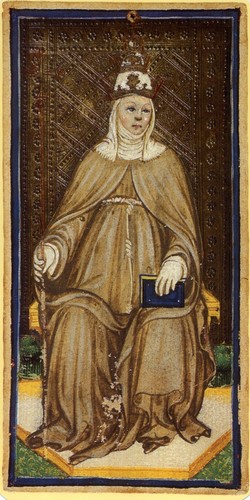 Gertrude Moakley (The Tarot Cards Painted by Bonifacio Bembo, 1966) introduced the Tarot world to a possible original source of the Papess card: Maifreda (or Manfreda) Visconti da Pirovano was to be declared Pope in Milan on Easter 1300 in a new age of the Holy Spirit. Instead, Maifreda and others in the sect were, that year, burned at the stake, along with the disinterred body of Guglielma, who had inspired this new movement. Could Maifreda be depicted on the Tarot Popess card?
Maifreda was an Abbess in the Umiliati Order and first cousin to Matteo Visconti, the Ghibelline (anti-pope) ruler of Milan. Maifreda believed the Holy Spirit had manifested on earth in the form of Guglielma (d. 1281), a middle-aged woman with a grown son who claimed to be a daughter of Premysl Otakar,King of Bohemia, and, who on arriving in Milan in 1260, donned a “simple brown habit” and lived the life of a saint. To the Guglielmites, her arrival fulfilled a prophecy of St. Joachim de Fiore that a new age of the Holy Spirit would begin in 1260, “heralding the inauguration of an ecclesia spiritualis in which grace, spiritual knowledge and contemplative gifts would be diffused to all.” Although she vehemently denied it, “rumors of divinity already swirled around Guglielma during her lifetime.” And, “Her words about ‘the body of the Holy Spirit,’ together with her mysterious royal origins, Pentecostal birth, imputed healings and stigmata, coalesced to create a more-than-human mystique in the minds of her friends.” Immediately after her death dozens of portraits were painted and chapels were dedicated to Santa Guglielma. (Visconti-Sforza card on the right – her cross at top left is hard to see.)
 Barbara Newman (aka Mona Alice Jean Newman) presented the most complete account in English of the Guglielmites in her From Virile Woman to WomanChrist: Studies in Medieval Religion and Literature, but it is in her more recent paper, “The Heretic Saint: Guglielma of Bohemia, Milan and Brunate,” that we learn important details that make an attribution to Maifreda as Papess much stronger than previously thought (all quotes and information not otherwise attributed are from this article).
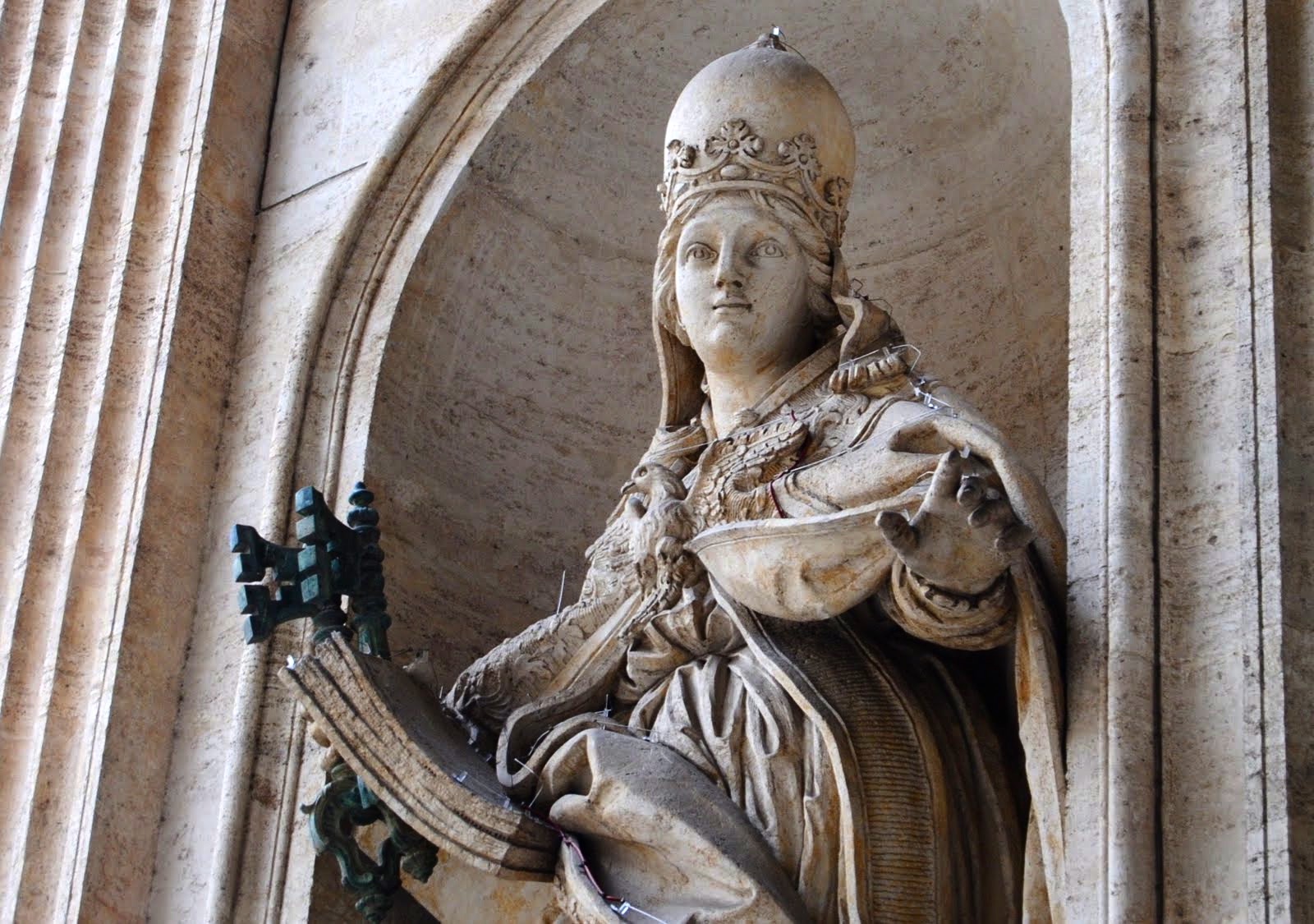
Many tarot scholars since Moakley have doubted Maifreda as source, nor do they give much credence to an older assumption that the card depicted Pope Joan (see article by Ross Caldwell). Instead, modern thinking proposes that it was always an allegorical image of Fides (Faith—see Giotto image to right), Sapientia (Wisdom), Ecclesia (Holy Mother Church) or the Papacy itself. Here’s an image from the Vatican itself:
Alternately, she could be Isis (see below with Hermes Trismegistus & Moses by Pinturicchio in the Vatican), the Blessed Virgin Mary or a priestess of Venus (below) —see especially Bob O’Neill’s “Iconology of the Early Papess Cards” and Andrea Vitali’s essay on “The High Priestess.” Even Paul Huson in Mystical Origins of the Tarot finds it difficult to believe the Visconti family would memorialize a family member burned at the stake as a heretic.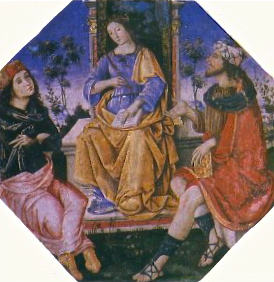


Certainly “Faith” and “Holy Mother Church” may be referenced in the Tarot image, but they were probably of a more heretical sort than the orthodox church has ever sanctioned. Andrea Vitali recounts a summary of the trial of Guglielma and her followers in which we find:
 “As Christ was true God and true Man, in the same manner, she [Guglielma] claimed herself to be true God and true Man in the female sex, come to save the Jews, the Saracens and the false Christians, in the same way as the true Christians are saved by means of Christ.” [Tying her story in with the final cards of Judgment and the World, we find,] “She too claimed she would arise again with a human body in the female sex before the final resurrection, in order to rise to heaven before the eyes of her disciples, friends and devotees.”
O’Neill objects that “beyond the deck specifically produced for the Visconti about 1450, the local Milanese phenomenon of Guglielmites is unlikely to be the source for the image on earlier decks, for example, the 1442 deck mentioned in an inventory of the Este estate in Ferrara.” But, as Newman’s paper points out, Matteo Visconti’s son, Galeazzo, married the Duke of Ferrara’s sister in 1300 and lived there from 1302-1310, so Ferrara had its own early connection to this saint. Furthermore, Guglielma’s story and veneration were popularized in Ferrara by 1425 through a hagiography (saint’s life) by Antonio Bonfadini, and in Florence through a popular late-15th century religious play by Antonia Pulci—although they garbled her history. (15th century deck on the right is known as the Fournier/Lombardy II.)
Matteo Visconti (first Duke of Milan and first cousin to Maifreda) had as an advisor his good friend,  Francesco da Garbagnate—an ardent devotee of Guglielma. Matteo was at the center of his own long battle with the Church, having expelled the Papal Inquisitors in 1311, and being himself excommunicated in 1317, tried for sorcery and heresy in 1321, and having Milan placed under interdict in 1322. Matteo’s grandmother and uncle (archbishop of Milan) had earlier been named heretics. (Pope/Papess? card, left, is from the “Cary Sheet” found at the Sforza Castle, Milan.)
From Newman’s article, we learn that Maifreda’s convent was in Biassono, but she fails to note that Biassono is only five miles from the small town of Concorezzo that in 1299 was home to 1,500 Cathars. (I’ve since been told that this source is wrong and that most of the Concorezzo Cathars were burned as heretics or driven out by 1230). After the Albigensian crusade many small towns around Milan became refugee outposts of this faith, of which Concorezzo was a center, and may have inspired the order of nuns who called themselves the “humble” (umiliati)—[correction: the Cathar influence on other groups is not known.] 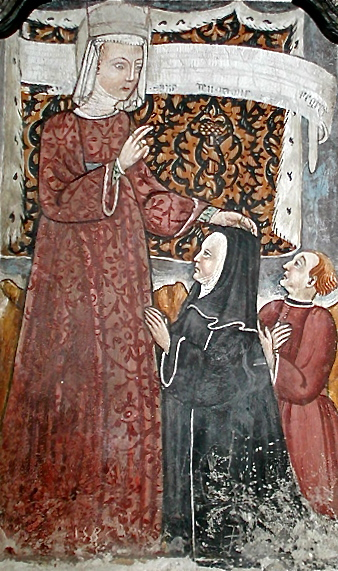
The most compelling bit of data making the attribution of the Papess card almost certain is that between 1440 and 1460 Bianca Maria Visconti, wife of Francesco Sforza and duchess of Milan, frequently visited Maddalena Albrizzi, Abbess of monasteries in Como and Brunate, and gave aid and gifts to the Order. (Brunate is just north of Milan with Biassono between them). Even the stones for the Como monastery were donated by Francesco Sforza. The Visconti-Sforza deck (first picture in post) was probably commissioned by or for Bianca Maria. Around 1450 (the same period as the deck) a cycle of frescos were painted in the Church of San Andrea at Brunate that recorded the story of Guglielma:
“How she left the house of her husband, came to Brunate, and lived a solitary life here, wearing a hairshirt and ordinary dress . . . in the company of a crucifix and an image of Our Lady.”
Only one of these frescos, ornately framed, remains today near the original chapel that had been dedicated to Saint Guglielma (see above). It depicts Guglielma with two figures kneeling before her. She appears to be giving a special blessing to a nun. Newman identifies the two as Maifreda and Andrea Saramita (he was the main promulgator of her divinity as the Holy Spirit). Others, more convincingly, claim them as Maddalena Albrizzi (founder of the monastery and candidate for sainthood) and her cousin Pietro Albrici who renovated the church. Even as late as the nineteenth century, Sir Richard Burton, author of The Arabian Nights, noted that “Santa Guglielma, worshipped at Brunate, works many miracles, chiefly healing aches of head.”
It seems reasonable to conclude that Bianca Maria Visconti may have had a special devotion to the woman whom, 150 years after being condemned by the Inquisition, so many Lombards venerated as a saint, and that she honored an earlier family member, Maifreda, who served as Guglielma’s Vicar—hiding her in plain sight as an allegory of Faith.
 Let’s ask the question about the source in a slightly different way: Would it have been possible for Bianca Maria Visconti to have not seen this card as Maifreda? Likewise, would it have been possible for a church reformer of the time, familiar with Maifreda and Pope Joan, to have not seen this card as an allegory of Heresy instead of Faith? For instance, a monk wrote in Sermones de Ludo Cum Aliis (c. 1450-1480) about La Papessa, “O wretched, it is what the Christian Faith denies.”
 I’d be remiss to not mention the very real possibility that the Popess represented St. Clare of the Poor Clares, the female branch of the Franciscans (right).
Or, perhaps she was simply the Church in contradistinction to the State as seen below in which a Popess and Empress represent each of these.
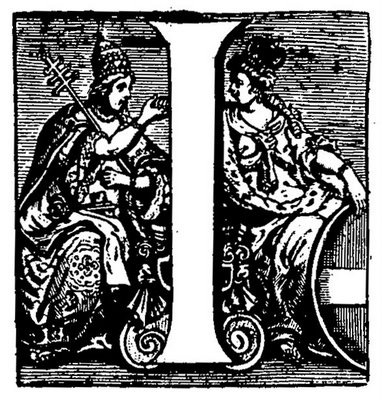
Later Swiss, Germans and Belgians de-sacralized the deck, finding both Pope and Papess objectionable and substituting for them cards like Jupiter & Juno, Bacchus & the Spanish Captain, or the Moors. The Papess, it seems, has always been a mysterious and disturbing force, spreading anxiety instead of the calm assurance one might expect from Faith.
Acknowledgements: Huck Meyer pointed out this picture and Newman’s article at Aeclectic’s tarotforum last year – see discussion. I was then reminded of this material through reading Helen Farley’s fascinating book, A Cultural History of Tarot: From Entertainment to Esotericism. Check out Ross Caldwell’s webpage on the Papessa and Alain Bougearel’s post on Catharism and other heresies of the period here.
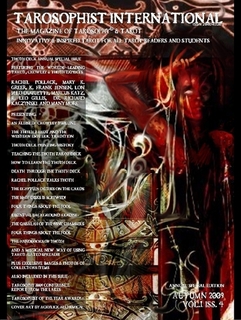 The Tarosophist International: The Magazine of Tarosophy is a new journal put out by Tarot Professionals. The Special Annual Edition features the Thoth Deck—Issue Four (1:4). It’s available in hardback and consists of 146 fully illustrated pages with articles by Rachel Pollack, Lon Milo DuQuette, Mary K. Greer, Richard Kaczynski, K. Frank Jensen, Marcus Katz. A must-have for anyone (beginner or expert) who wants to know more about the Thoth deck, Read the rest of this entry »
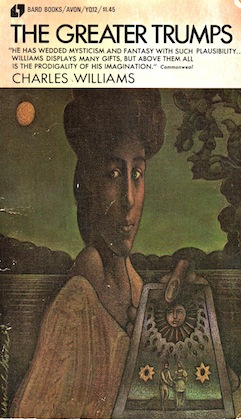 I am reprinting here a long review by Paul Nagy of the greatest tarot novel of all time, Charles Williams’s The Greater Trumps (1932)—with contributions from Nigel Jackson’s Amazon review (marked in blue). Paul has been reading tarot for over 40 years, is one of the active members of the Raleigh-Durham Tarot Meetup Group, offers tarot teleclasses, and leads a discussion series on the book Meditations on the Tarot. Paul’s introduction to some of the symbolism in this book should make it far more accessible and intriguing to modern readers. Nigel Jackson is the creator of Medieval Enchantment: The Nigel Jackson Tarot and The Rumi Tarot. Paul wishes to also acknowledge the insights of Glen Cavaliero and Michael Huggins whose reviews on Amazon.com contributed to initial drafts of this piece.
Charles Williams (1886-1945) was a novelist, poet, theologian, and member of Waite’s Fellowship of the Rosy Cross. He wrote seven occult novels—among the best ever written. Read about Charles Williams later in this post. At the very end you will find a list and description of the Trumps as modified by Williams. Now, here’s Paul Nagy:
THE GREATER TRUMPS
Williams’ use of symbolism is near its peak in The Greater Trumps. It is a classic occult mystery play where all the forces of truth and justice are very conventionally established as staid British institutions set against anarchistic gypsy intrigue and in the mysterious figures of the tarot Trumps. The trumps motivate and embody the characters, set the action and redeem the antagonists by being themselves neutral leaves from the tree of knowledge of good and evil that compete for their control.
The “Greater Trumps” are the original set of Tarot, the ur-deck of hyper powerful cards, bequeathed to a minor English civil servant, Lothair Coningsby (a rather dim and pompous fellow), by a deceased distant relative. Lothair’s daughter, the spritely Nancy is engaged to a young man, Henry Lee, whose heritage is Romany. In considering what to do with these very rare, old set of Tarot cards, Lothair Coningsby intends to turn them over to a museum upon his own death. The Lee family has something else in mind. Read the rest of this entry »
“If you’re interested in deepening your understanding of the Tarot, forming a personal bond with your deck, or enhancing your abilities as a reader, 21 Ways to Read a Tarot Card is an excellent experiential guide for connecting with the cards.” —Janet Boyer
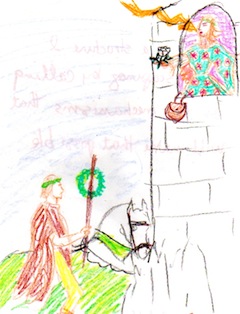
A 3-card drawing that helped me escape an untenable situation (see below).
Are you looking for a way to enliven your tarot practice and expand your skills? Then I urge you to try Mary K. Greer’s 21 Ways to Read a Tarot Card. This is a shameless plug for my latest book. I wrote it, in part, to help you discover what reading style you most resonate with but also to push the boundaries of what you thought was possible in a tarot reading. It’s all about how to discover meaning for yourself. It’s also where I reveal all my tarot reading “secrets.”
I first read Victor Frankl’s Man’s Search for Meaning a very long time ago. As an army brat who had lived in post-War Japan and Germany I was interested in Frankl’s concentration camp story and how he not only survived but transformed his experience into gold. What stuck with me was his belief that “Everything can be taken . . . [except for] the last of the human freedoms—to choose one’s attitude in any given set of circumstances, to choose one’s own way.” Read the rest of this entry »
Alejandro Jodorowsky presents a variation on the Three Card Spread that I’ve found very powerful. I call it “Jodorowsky’s Three Card Theosophic Sum Spread” because you begin with three cards that expand into seven (Major Arcana only). Jodorowky calls it, “Reading three cards according to their number value.” A “theosophic sum” results from adding a set of numbers and then reducing them, usually to a single digit or “root” number but, in the case of tarot, to a number that is 22 or below. By adding all the variations of the numbers in the three card spread you end up with four additional cards (see instructions below).
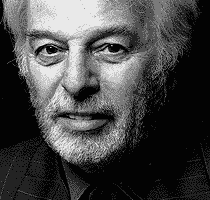 Jodorowsky was the writer/director of the late ’60s controversial cult films, El Topo and The Holy Mountain, re-released in 2007. The Holy Mountain contains Tarot content, a bit of which can be seen in this video tarot lecture by him (with English subtitles). I encourage you to look at his The Way of Tarot: The Spiritual Teacher in the Cards (co-written with Marianne Costa and formerly available only in French and Spanish). It will be available in English this December—get your pre-order in now. I highly recommend this book (which I’ve been slowly making my way through in Spanish) as an excellent way of understanding Marseille-style decks and especially for in-depth methods of reading the Major Arcana (he also discusses the Minors). Read the rest of this entry »

 I’ve been gathering pictures of cartomancers for a future gallery and in the process came across this poem written by Mary Darby Robinson (1758-1800; pictured above and on right). The poem is about a young man and woman who go to a gypsy fortune-teller to get their destinies foretold—with an unexpected twist at the end. Unfortunately we don’t get to see the technique used by the gypsies, but this story fits very well with some of the paintings I’ve found from the period, which suggest palmstry as the most likely method used. Mary Robinson, known as “Perdita,” was a notorious woman—an actress, author and mistress to the Prince of Wales, as well as being painted by Gainsborough (see right). While she was born into the “Georgian” period of George III, her affair was with his son, George IV, who ushered in the “Regency” period (made infamous by Jane Austen and modern Romance writers). Robinson’s writing—dealing as it did with matters not welcomed by the subsequent Victorians—was soon forgotten. Robinson was a contemporary of Antoine Court de Gébelin and Etteilla who started the modern occult tarot movement (although she lived across the channel in England). Hope someone makes a movie about her. If so, they should have Count Cagliostro (who spent time with Freemasons in both France and England) do a reading for her with the Etteilla deck. Read the rest of this entry »
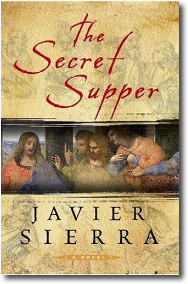
Several cards printed with curious effigies tumbled onto the floor. The first corresponded to a woman wearing the Franciscan habit, a triple crown on her head, a cross like that of Saint John the Baptist in her right hand and a closed book in her left. . . . “You’ll never open the priestess’ book,” the pilgrim said.
Javier Sierra’s novel The Secret Supper tells the story of Leonardo da Vinci’s painting of “The Last Supper” (or more properly the “Cenacolo“—a circle of companions who meet together). The novel takes us through an experience like that advised by Leonardo himself: Read the rest of this entry »
I highly recommend this interview by Arlene deWinter with Paul Huson.
Long ago (1971) Paul wrote a book on tarot called The Devil’s Picturebook: The Compleat Guide to Tarot Cards: Their Origins and their Usage. It was one of my earliest tarot books and gave me a better sense of the true tarot history then most other books of the time. Along with his Mastering Witchcraft, I got a rich sense of classical and pagan witchy lore out of a more sophisticated European sensibility than was usually found in the U.S. Read the rest of this entry »
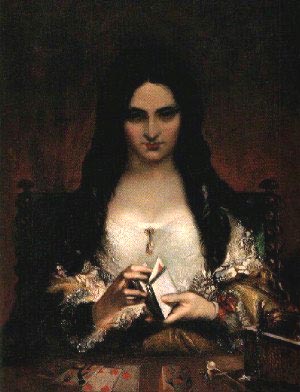
Pre-Raphaelite artist and poet Dante Gabriel Rossetti’s first published poem, “The Card-Dealer,” was based on a painting by Theodore von Holst (1810-1844) called “The Wish” or “The Fortune-Teller” (1840). The poem, which epitomized Rossetti’s fascination with the theme of the femme fatale, was inspired by the painting that he described as being of “a beautiful woman, richly dressed, who is sitting at a lamp-lit table, dealing out cards, with a peculiar fixedness of expression.” In his poem, the woman (Death?, La Morte, in Rossetti’s Italian) plays with men as she plays with the cards, which, we are told, represent the heart that craves the more it feeds, the diamond that makes even the base seem brave, the club that smites, and the spade that digs a grave.
Read the rest of this entry »
 Mary K. Greer has made tarot her life work. Check here for reports of goings-on in the world of tarot and cartomancy, articles on the history and practice of tarot, and materials on other cartomancy decks. Sorry, I no longer write reviews. Contact me
 Mary K. Greer's Tarot Blog
Recent Comments