You are currently browsing the category archive for the ‘Tarot Deck Reports’ category.
When I lived in San Francisco I was privileged to meet several members of what was then known as the Holy Order of MANS (in which MANS stands for “Mysterion, Agape, Nous, Sophia,” Greek for mystery, love, mind, and wisdom). I became interested in their organization, both because of the tremendous sincerity and integrity of the members I met and because of their study of tarot as a Christian mystery. They adopted the Waite-Smith Tarot as modified by Paul Foster Case and Jessie Burns Parke, added their own layer of modifications to the deck, and then wrote a set of explanatory books that are thoughtful revisionings of Case’s text.
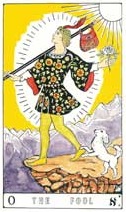
The Holy Order of MANS was founded in 1968 by visionary Earl Wilbur Blighton (formerly an electrical engineer) as a monastic order of esoteric, Rosicrucian Christianity dedicated to charity (Raphael Shelters) and their missionary work in 49 states. The order grew rapidly during San Francisco’s hippie era, when members served selflessly to help those in need. My sense is that they followed as closely as they could the model of the earliest Christian churches. Additionally, women could be ordained as priests. As Blighton expressed it in their statement of purpose:
“I care not what doctrine you have or have decided on. But while the world argues over the theological discussions of doctrine, sin, apostolic succession and others, we will remove from the people their problems and give unto them the ray of hope and reality which our Lord Jesus commissioned us to carry forth as Christians and disciples of the Word and the works and the Light and the love of God.”
With Blighton’s death in 1974 there was a prolonged power struggle among Blighton’s wife and others for leadership over the 3,000 members. The new director focused on a more conservative, repressive and less metaphysical path, eventually joining with a defrocked priest from the Russian Orthodox Church. Since 1988 it has splintered into many groups including the Science of Man in Oregon, which was led by Blighton’s wife, Ruth, until her death in 2005.
But their own deck and books were not the extent of the tarot connection. In 1975, at a judo tournament, science fiction author,  Piers Anthony, met and became friends with a brother from the original Order. Anthony was intrigued by their unique mix of Gnostic Christianity, co-ed communalism, and Tarot. Out of this came a character who would appear in several novels: Brother Paul of the Holy Order of Vision. Anthony also created an imaginary deck called the Animation Tarot, having a hundred cards in five suits. By September of 1977 he had a 250,000 word manuscript that no one wanted to publish. Members of the real order were told not to read the manuscript or speak with him, which he regretted, since the novel stemmed in significant part from his admiration of their operation. Anthony reluctantly agreed to splitting the book into a trilogy: God of Tarot, Vision of Tarot and Faith of Tarot. Jove then stopped publishing science fiction and the next two volumes were published by Berkeley (1980). It wasn’t until 1987 that the novel appeared in one volume (NY: Ace). It’s an interesting novel, although I remember it seeming rather incoherent in places—perhaps because I read it as each volume of the trilogy came out.
Although the Holy Order of MANS deck and books owe much to Case’s BOTA materials, there are plenty of additional insights to make them well worth obtaining, especially for those who are interested in a metaphysical Christian approach to the tarot symbols. The revised books, Keystone of the Tarot and the more detailed, Jewels of the Wise, and their color-it-yourself Major Arcana deck are still available here.

UPDATE: The Kitchen Tarot – a 22 card deck has been published by Hay House. Check out a commentary by the book’s author, Dennis Fairchild.
Take a look at this deck in progress – The Kitchen Tarot Deck by Susan Shie – done as “Outsider Art Quilts” from Turtle Moon Studios. The one pictured above is “The Potluck / World Card #21 in the Kitchen Tarot (aka “Healing on Common Ground”). See this and two other tarot quilts here. Other quilts in the tarot series can be viewed through her 2006 & 2007 Gallery links. (Thanks to Ferol Humphrey who turned me on to Susan’s website.)
 Here I go – off again into strange byways of Tarot lore:
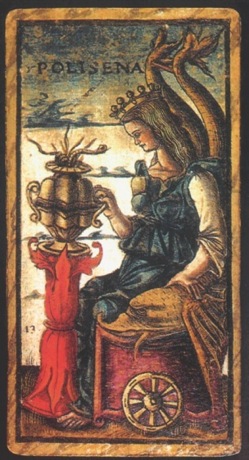
The late 15th century Sola Busca Tarot is most famous for having inspired several of the Minor Arcana images in the Rider-Waite-Smith Tarot deck. It is also the oldest deck to have all 78 cards. The trumps and court cards feature historical and mythical people – with many of their names printed on the cards. Not all of the referents have been identified.
The Sola-Busca deck is now available in a glorious full-color edition along with a book explaining all the figures and symbolism. This is a limited edition so get it while you can HERE.
In 1907 a B&W photographed version of the deck was sent to the British Museum by the Sola Busca family who then owned them. I believe the originals, as well as the family, have since disappeared. Waite, who spent much time studying tarot decks and books at the British Museum, was probably informed of this deck as soon as it arrived, so it may have sparked the idea itself of creating an illustrated Minor Arcana. Lo Scarabeo published a version of the deck known as the Ancient Enlightened Tarot (currently out-of-print). You can also learn more about the figures in this deck at Tea Hilander’s website, at Taropedia (specifically here for the Q of Cups), and at Michael J. Hurst’s website.
The Queen of Cups is labeled Polisena (also spelled, Polyxena). What stands out in the image is a snake emerging from the cup she holds. I have a feeling that the card refers not to the Trojan Polyxena (next) but to a later Christian Polyxena (see her story at bottom). Here’s the info I’ve managed to find:
First, the Trojan Polisena:
“Polyxena was the youngest daughter of Hecuba and King Priam of Troy. Homer never mentions Polyxena. Achilles fell in love with Polyxena whom he may have met when Polyxena and her brother Troilus went out to the fountatin where Achilles slew Troilus. One story has Polyxena pretending to fall in love with Achilles, learning about his heel, and betraying him to her brother Paris, who then shot and killed Achilles. Before he died, Achilles asked his followers to sacrifice Polyxena to him. Neoptolemus stabbed Polyxena to death.
There were Medieval and Renaissance versions of the story that may have contained a snake. Plus there’s a snake in a version of the story on a vase from ca. 500 B.C. – 490 B.C.:
“Achilles and Polyxena at the fountain: Polyxena is walking right to a lion’s-head spout above a rock that contains the fountain. A hydria is set under the spout to catch the water gushing out. It splashes onto Polyxena’s hand before entering the container. On top of the fountain a crow is sitting, while a snake is lying alongside it. Behind the fountain rises a tree with leaves spreading left above the lion’s head spout, and right above the head of crouching Achilles. Ready to ambush, he is largely hidden by his shield, with his right leg extended beyond it.” Jane Ellen Harrison claimed that the snake in this story represented the Erinys.
However, the card could be another Polyxena – one who figures in a story about Paul and the early Christian converts as recounted in the Medieval Sourcebook: Acts of Xanthippe, Polyxena, and Rebecca.
“And as Polyxena lay upon the couch she saw this dream, that a dragon, hideous in appearance, came and signified to her to come to him, and when she did not obey him to go to him, he came running and swallowed her. From fear of this the girl leapt up trembling, and Xanthippe running to her said, What has happened to you, dearest, that you have leapt up thus suddenly? She for a long time was unable to speak; then coming to herself she said, Alas, my sister Xanthippe, what danger or tribulation awaits me, I know not; for I saw in my dream that a hideous dragon came and signed to me to go to him, and, when I would not go, he came running and swallowed me, beginning at my feet. While I was terrified at this, there suddenly spoke out of the air, in the light of the sun, a beautiful youth, whom I thought to be the brother of Paul, saying, Verily, you have no power. Who also took me by the hand and straightway drew me out of him, and straightway the dragon disappeared. And behold his hand was full of sweet odour as of balsam or anything else for fragrance. Xanthippe said to her, Truly you must be greatly troubled, my sister Polyxena, but God has you dear, seeing that he has shown you strange and marvellous things. Therefore arise quickly in the morning and receive the holy baptism, and ask in the baptism to be delivered from the snares of the dragon.”
Ultimately Polyxena becomes Christian and protects her virginity from the evil idolaters who try to despoil her. She goes through many such tribulations including being thrown to wild beasts and into the sea but is always saved by God. The story ends with her returning repentant to Paul, and “From that time forward she left not at all the blessed Paul in her fear of temptations.”
The serpent/dragon could, of course, signify those temptations and tribulations from which God has saved her – including, of course, idolatry. A more complex view might suggest that the snake is that ‘strange and marvelous thing’ called Wisdom, which Polyxena certainly must have gained in all her travels and from facing her many trials.
One interesting synchronicity is that Polyxena Sforza, illegitimate daughter of Francesco Sforza of Milan (for whom the Visconti-Sforza Tarot was made), married Sigismondo Pandolfo Malatesta in 1442, two years after we know that he was given a deck of Triumphs as a gift. According to a story put about by a Pope who hated him, the cultured but brutal condottiero Sigismondo murdered both his former wife and second wife, Polyxena (who had as the family heraldry a serpent). Could there have been an oblique reference to her?

Dark Horse publishers has announced that it slayed the “Buffy the Vampire Slayer Tarot.” It will not be publishing this deck, despite the fact that almost all the art work was completed and much of the book written, and a huge number of people were excitedly writing about it on line! Supposedly there were contractual problems. Did the card, depicted above, predict this slaying? What do you think?
Here’s the notice I got:
“Due to circumstances beyond our control, Dark Horse will not be producing the ‘Buffy the Vampire Slayer’ Tarot Deck. We sincerely apologize for the inconvenience, but no existing orders will be filled. We appreciate your support of this program, and again apologize to those who placed advance orders and to fans alike.”
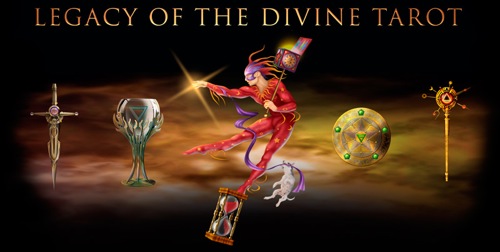
Ciro Marchetti, creator of the Gilded Tarot and Tarot of Dreams, has just released the final version of his video introduction to his new deck, Legacy of the Divine Tarot. This deck features an entirely new approach in that it is based on a short story about the demise of a people through a planetary catastrophe and the seeding of their wisdom throughout the galaxy—a message carried down through the ages. The video was created as a project by students at the Art Institute of Fort Lauderdale. You can see sample cards at Marchetti’s website.
When did the modern tarot renaissance actually begin? It’s always hard to pinpoint the beginning of a movement but here are some events worth noting that lead up to the breaking of the dam in 1969. I’m looking for corrections and additions to the information below, plus tarot stories from the 60s and early 70s. Please share them in the comments.
The 1940s saw some interesting tarot activities that set the stage for the later renaissance. The Crowley-Harris Thoth deck was completed and published in a limited edition of 200 in monochrome brown by Chiswick Press, but these were not available to the general public. In 1947 Paul Foster Case published his masterful work The Tarot: A Key to the Wisdom of the Ages, based on his tarot correspondence course. In France, Paul Marteau came out with his hugely influential book Le Tarot de Marseille that noted the symbolic significance of the smallest details in the deck. In Brazil, J. Iglesias Janeiro, published his book La Cabala de Prediccion, which popularized the turn-of-the-century Egyptianized Falconnier/Wegener cards. It became a center-piece of his important occult school, known mostly in Latin America. Meanwhile, in the U.S.A., Dr. John Dequer published The Major Arcana of the Sacred Egyptian Tarot, which was his revised version of those same Egyptianized cards, similar to what was already being used by C.C. Zain’s Brotherhood of Light correspondence school.

The Insight Institute in Surrey England started up their tarot correspondence course (later published in a book by Frank Lind) and produced their occultized version of the Marseilles deck (eventually published as the R.G. Tarot). Also appearing was an unusual book, solely on the psychological dimension of the Minor Arcana cards numbered 2-10 as they are associated with one’s birthday. It was Pursuit of Destiny by Muriel Bruce Hasbrouck, who had studied with Aleister Crowley when he was in the United States. Tudor Publishing’s The Complete Book of the Occult and Fortune Telling became the sole source in English of the unique Tarot card interpretations from Eudes Picard’s 1909 French work, Tarot.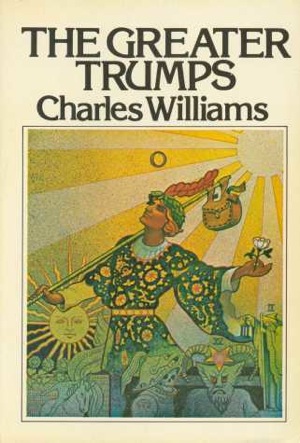
The 1940s also saw the incorporation of Tarot imagery in surrealist artworks such as Victor Brauner’s “The Surrealist,” and in Jackson Pollack’s “Moon Woman” (both of which I happened upon when I visited the Peggy Guggenheim Collection in Venice following the 2000 Tarot Tour with Brian Williams). William Gresham’s novel, Nightmare Alley, featured a carny mentalist who reads tarot and the book is presented as a twenty-two card reading. A year later Tyrone Power played the lead in the movie version featuring two tarot readings by Joan Blondell. Charles Williams’ landmark tarot novel, The Greater Trumps came out just as this decade ended and the next one began.
The 1950s produced even fewer tarot works. George Fathman published The Royal Road: A Study in the Egyptian Tarot, which used Dequer’s version of the Falconnier/Wegener cards. Paul Christian’s seminal work The History and Practice of Magic was translated from French to English, providing the original source material on which all those Egyptian-style decks were based. Arcanum Books reissued Papus’ The Tarot of the Bohemians with an introduction by librarian Gertrude Moakley, who noted the influence of tarot on creative writers and in psychology. Off in the Netherlands, Basil Rakoczi published the English language letterpress art book: The Painted Caravan: A Penetration into the Secrets of the Tarot Cards. Yet, the tarot seemed likely to fade away from popular view.

1960 started out the decade with a bang. University Books published Waite’s A Pictorial Key to the Tarot for an American readership, as well as a deck: Tarot Cards Designed by Pamela Colman Smith and Arthur Edward Waite. Eden Gray self-published her Tarot Revealed that still sells well to this day. In England Rolla Nordic came out with The Tarot Shows the Path: Divination through the Tarot. These last two books showed a clear shift in interest to practical tarot readings for the masses. Muriel Hasbrouck’s greatly overlooked 1940s work was re-published.
As the 60s progressed we got two heavy metaphysical works: Mouni Sadhu’s Tarot: A Contemporary Course of the Quintessence of Hermetic Occultism, and Mayananda’s The Tarot for Today, a study of Crowley’s material in the Book of Thoth (despite the latter’s being unavailable). The Brotherhood of Light came out with a new, revised edition of their 1930s Tarot deck. Idries Shah claimed, in The Sufis, that the Tarot was a Sufi creation. Influenced by T.S. Eliot’s “The Wasteland” and Yeats’ involvement in the Golden Dawn, poets like Robert Creeley, John Weiners, Diane Wakowski, Sylvia Plath, Philip Lamantia and Diane di Prima began using tarot imagery in their poems. While not published until 1974, Jack Hurley and John Horler worked on “The New Tarot,” a Jung-based deck, at the Esalen Institute throughout the 60s, influencing many who passed through there.
 In 1966 Gertrude Moakley set tarot history on it’s ear with her groundbreaking research in The Tarot Cards Painted by Bembo. The Grand Tarot Belline deck was published in Paris, as was a new edition of Oswald Wirth’s 1927 book, Le Tarot des imagiers du moyen age, that included his 22 card deck. Beginning in 1966 and running through 1971 the day-time TV soap opera Dark Shadows gave many people their first glimpse of a tarot deck as various episodes featured readings with the Marseille deck.
By 1967, even a paper company jumped on the bandwagon with its advertising Linweave Tarot Pack that gave David Palladini his introduction to tarot design (see card on right). Helios Books in England published a small edition of the Golden Dawn’s Inner Order tarot teachings, Book T. Doris Chase Doane came out with two books that helped popularize the Brotherhood of Light Egyptian tarot deck in America. Sidney Bennett wrote Tarot for the Millions.
 In 1968, the House of Camoin reproduced the classic 1760 Tarot de Marseille based on original pearwood woodcuts. The mysterious Frankie Albano redid Waite and Smith’s deck in brighter colors, giving those in the U.S.A. an alternative to the University Press version. Hades, in Paris, published Manuel complet d’interpretation du tarot, claiming it was based on a pre-de Gébelin 1761 original. Jerry Kay came up with his own version of Crowley’s deck that he called The Book of Thoth: The Ultimate Tarot. And, Stuart Kaplan brought back the Swiss 1JJ deck from the Nuremberg Toy Fair, selling 200,000 copies in the first year and making tarot available in department stores across the U.S.
The stage was now set for the 1969 deluge: at least five decks and twelve separate books where published! I won’t mention them all but they included Crowley’s Thoth book and deck (though not readily available for another two years), Cooke & Sharpe’s New Tarot for the Aquarian Age, an English-language edition of Grimaud’s Marseilles deck. Also books by Arland Ussher, Brad Steiger, Corinne Heline, Gareth Knight, C.C. Zain, Hilton Hotema, Frater Achad, Rodolfo Benavides, Elisabeth Haich, Sybil Leek, and Italo Calvino’s Italian short stories, ‘Il castello dei destini incrociati (“Castle of Crossed Destinies”). Every hippie pad had its requisite tarot reader.
1970 featured fewer books but even more decks, including the Rider-Waite and Palladini’s Aquarian. Stuart Kaplan at U.S. Games, Inc. started publishing his own decks.
The Tarot Renaissance was now fully underway.
For an even more extensive look at Tarot in America from 1910 to 1960 please see this Tarot Heritage page.
UPDATE ALERT: The contract for the Buffy the Vampire Slayer Tarot has been cancelled. See new post.

Rachel Pollack has done it again! This August her Buffy the Vampire Slayer Tarot will be available from Dark Horse Delux. With Rachel as the author and conceptualizer and Buffy artist Paul Lee illustrating the cards, this is a must have item for all Buffy fans and tarot collectors.
The wonderful thing about this deck is that it doesn’t just illustrate the life of Buffy. Instead, this is an ancient artifact in Slayer history, predicting coming events and emerging periodically, through time, when it is most needed. Although knowledge of its existence has been long suppressed by the Watcher’s Council, it is now available for use by the allies of Buffy to help her fight evil and save the world. By using this deck you, too, can be part of the continuing Slayer saga, and get guidance for your own life issues.
Read an interview with the creators here.
 Mary K. Greer has made tarot her life work. Check here for reports of goings-on in the world of tarot and cartomancy, articles on the history and practice of tarot, and materials on other cartomancy decks. Sorry, I no longer write reviews. Contact me
 Mary K. Greer's Tarot Blog
Recent Comments