You are currently browsing the category archive for the ‘Tarot History & Research’ category.
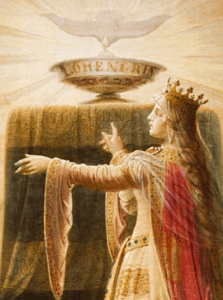
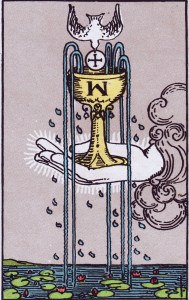
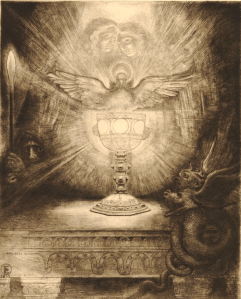
The Waite-Smith Ace of Cups image is not unique. A winged figure surmounts a fountain from which streams water in the Visconti-Sforza card. In the Marseille deck two of the aces (Wands and Swords) have a hand emerging from a cloud—a standard medieval device to indicate creation, miracles and gifts from a Divine source. We also find similarities in the pictures above. The first one is from Wilhelm Hauschild’s Temple of the Holy Grail (1878) and the third one is Santo Griaal by Rogelio Egusquiza (acquired by the British Museum in 1901). By the way, if you are Pagan, like me, I encourage you to look at the Christian references as psychological metaphors. Read Part 1 here.
Hand & Cloud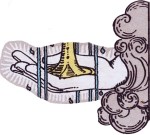
To display His divine nature, the hand of God is often depicted emerging from a cloud which hides his body, veiling us from his power as no person could see Him and live. As it is the right hand, it is actively giving the viewer one of the four sacred treasures found in the myths of many cultures. In the Talmud the Cup of Blessing is held on five fingers of the right hand representing the five leaves that protect a rose from its thorns. This image signifies a divine gift in the form of a supernatural vision (the cloud) that is often the starting point for a spiritual quest.
Dove & Host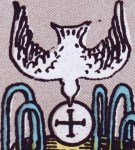
Waite has a lot to say about the dove, describing it as the invocation and descent of the Comforter or Holy Spirit to renew the virtue of the Grail and to consecrate the elements.
“In England during the Middle Ages . . . the Eucharist was reserved in a Columbarium, or Dove-House, being a vessel shaped like a dove. It recalls some archaic pictures of a Cup over which a dove broods and the descent of a dove on the Graal.” …
“There is the flight of the mystical dove from the casement to inmost Shrine, as if the bird went to renew the virtues of the Holy Graal.” …
“The Dove descends from Heaven carrying the Arch Natural Host to renew the virtues of the Stone [the form the Grail takes in some of the stories].” …
“O central point and sacred meeting-place of all the sacraments, there falls the Bread, broken within the Wine-Cup, and from both issues one living Spirit of Life Divine.” …
“On Good Friday, by the descent of a dove from heaven, carrying a sacred Host . . . the crown of all earthly riches were renewed.”
The Holy Spirit represents the life-giving spirit of air, and it was present at the baptism by water of Jesus, the awakening into a new life:
“As soon as Jesus was baptized, he went up out of the water. At that moment heaven was opened, and he saw the Spirit of God descending like a dove and lighting on him. And a voice from heaven said, “This is my Son, whom I love; with him I am well pleased.” Mark 1:10-11.
Additionally, the Dove maintains its pagan association with Goddess Venus/Aphrodite and with Love (Waite includes the ancient pagan mysteries in the Secret Tradition). The Dove blesses with supernatural gifts, like the gift of tongues (pictured as Yods, see below), and so it can be associated with the ancient “language of the birds” or gift of divination and with miracles. Waite favors the idea of Grace: “it is grace which fills the heart; it is the Holy Spirit of God which makes holy the spirit of man.” Grace, equated with the Hebrew word Chesed, is a blessing that gives guidance and protects us from the dangers of earthly power and adversity.
So, the Dove can be seen as the descent of Spirit into flesh, of the supernatural into the natural, a theme repeated by the cross on the Host composed of the vertical axis of spirit and the horizontal of matter. (The cross, which represents Christ’s suffering and sacrifice on the cross, becomes a blessing.)
I should note that Waite was known to have a prodigious and exacting memory. He was extremely precise in his use of language, so when an odd phrase appears it is usually a sign that he is quoting a source to further elucidate his meaning. The internet has made it possible to find a good number of these allusions.
For instance, for Waite the Host is the “panis quotidianus that has been changed into the panis vivus et vitalis“: that is the everyday bread is transformed into a living and vital bread. This quote from Waite refers to a popular hymn by Thomas Aquinas (circa 1264) called the Lauda Sion Salvatorem. It speaks of the Eucharist and presents the transformation of bread and wine ending with a familiar maxim “as above, so below”:
Here beneath these signs are hidden
Priceless things, to sense forbidden,
Signs, not things, are all we see. . . .Living bread, thy life supply:
Strengthen us, or else we die,
Fill us with celestial grace. . . .Thou, who feedest us below:
Source of all we have or know:
Grant that with Thy Saints above,
Sitting at the feast of love,
We may see Thee face to face.
Spiritual nourishment, the Host, is sent by the Holy Ghost; in many of the Grail stories it is found to heal all wounds.
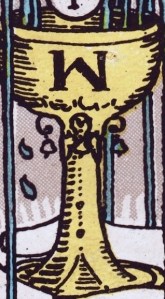
Cup, Grail and Fountain of Living Waters
This is the signature image of this card and is filled with meaning on so many levels. We will touch on only a few. As container, it is a major symbol of the receptive feminine and, in Christianity, the womb of the Virgin Mary, the seat of creation and manifestation of Love, esoterically seen as “the Bride”. It is a vessel in which things are “cooked,” making raw materials capable of providing rich nourishment and even, in alchemy, changing lead into gold. It is the cup of transformation containing the waters of life in which water is changed into wine and then into blood. It is the cauldron of Dagda in Celtic myth from which no company ever left unsatisfied.
“The message of the Secret Tradition in the Christian Graal mystery is this: The Cup corresponds to spiritual life. It receives the graces from above and communicates them to that which is below. The equivalent happens in the supernatural Eucharist, the world of unmanifest adeptship, attained by sanctity [Grace].”
Both cup and water represent the soul.
The Practicus Ritual in Waite’s Fellowship of the Rosy Cross initiates one through an encounter with the Living Waters. First we are informed that Water symbolizes the emotions, desires, and psychic nature of earthly man. But this is not the Water one is to encounter in the ritual, “The Waters that are below desire after the Waters that are above. . . . May the peace of their Union be upon us; be we dissolved therein.”
“The Spirit of God moved upon the face of the Waters, and the Spirit of the Most High God shall move upon the Waters of the Soul. . . . The stilled waters of the soul receive the Spirit of God moving upon the face of its waters. . . . Open thy heart, O Brother of the Rosy Cross, and receive the Water of Life.”
“Fountain of fountains, and of all fountains. Chalice of saving rain. Grace on the soul descending, as rain on the dry grass. Life-giving Rain of Doctrine. Mystical Fruit of the Doctrine. Dew of Divine Speech, falling in stillness on the heart, filling the soul with Knowledge. Enter into the heart and purify; come into the soul and consecrate.”
The image is one of both the Baptismal font and the Eucharist. “A Eucharistic allegory concerns [the dissolution] of the body by Divine Substance communicated to the soul, putting an end to the enchantments and sorceries of the five senses” and to the suffering on the cross (mentioned earlier).
This leads us directly to the five streams coming out of the cup.
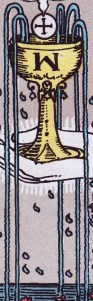 Five Streams
Why five streams of water and not the four that Waite specifies in Pictorial Key to the Tarot? Furthermore, Bible readers all know that there are four streams that come out of Eden. This could be an error either on the part of Waite or Pamela Colman Smith. Or, it could veil a secret: These five streams might, after all, represent the five senses (see the quote immediately above), or the five ways of salvation and five gates of grace (from Masonic ritual), or the five wounds of Christ, the five points of the Pentagram, the five petals of the rose that rest on five leaves (the fingers), or the four elements plus aether—the quintessence. In terms of the symbolism, five yields far more relevance according to Waite himself:
“In the Longer Prose Perceval we have seen that there is an account of five changes in the Graal which took place at the altar, being five transfigurations, the last of which assumed the seeming of a chalice, but at the same time, instead of a chalice, was some undeclared mystery: so the general as well as the particular elements of the legend in its highest form offer a mystery the nature of which is recognised by the mystic through certain signs which it carries on its person; yet it is declared in part only and what remains, which is the greater part, is not more than suggested. It is that, I believe, which was seen by the maimed King when he looked into the Sacred Cup and beheld the secret of all things, the beginning even and the end. In this sense the five changes of the Graal are analogous to the five natures of man, as these in their turn correspond to the four aspects of the Cosmos and that which rules all things within and from without the Cosmos.”
I believe that despite their blue color, the five streams best represent blood, for as Marie-Louise von Franz tells us, “Grace was depicted as a fountain of Blood from the five holy wounds of Christ,” The Psychological Meaning of Redemption Motifs in Fairytales.
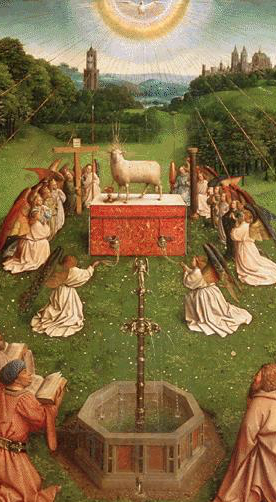 But it is in Evelyn Underhill, Anglo-Catholic author of a well-known book on mysticism, who perhaps reveals the deepest mystery. Underhill was a student or acolyte of Waite, having joined his branch of the Golden Dawn in 1904 and achieving at least four initiations. She wrote for Waite’s Horlick’s Magazine and published a novel in 1909 featuring the effects of the Holy Grail on a woman who came into its possession. In an article titled “The Fountain of Life” in the Burlington Magazine (1910) Underhill examined the fountains of water and of blood depicted on several religious works of art including the famous Ghent Altarpiece (right). She notes that baptism and penance which ‘renews the grace of baptism,’ are still spoken of by Catholic theologians as ‘effusions of the Precious Blood,’ i.e., of grace. She went on to describe:
“, , , a fountain which is filled by the Blood flowing from the Five Wounds. The Soul, or ‘Bride,’ holds out her heart, and the blood from the wounded side of Christ falls upon it, causing flowers to spring up from the place which has been touched by the vivifying stream. The Precious Blood then . . . stands not merely for an emblem of the Passion, Redemption, or the Eucharist, though it includes all these manifestations of Grace, but for the medium of communication of the Divine Life . . . since for ancient and mediaeval thought the spirit of life resided in the blood.”
Given that the Aces are also seen by Waite as the four Celtic treasures, I’d be remiss in not presenting this option from Celtic Myth and Religion by Sharon Paice MacLeod:
“In Cormac’s Adventures in the Land of Promise, Cormac has a vision of the sacred center of the Otherworld where he saw a shining fountain with five streams flowing out of it. He is told that it is the Fountain of Knowledge [others call it the Well of Wisdom], and the five streams are the five senses through which knowledge is obtained.”
Drops of Dew or Yods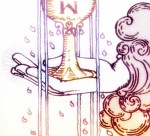
These drops, in the shape of the Hebrew letter Yod are found on many of the Tarot cards, generally signifying divine Grace. Shaped like a flame a Yod is the divine spark of creation that is the foundation of all the other letters and is the first letter in the Tetragrammaton or four-letter name of God. There are 26 yods and Eoin Keith Boyle notes in the comments that this is the sum of the 4-lettered name of God, the Tetragrammaton, in Kabbalistic gematria. They are also the shape of the tongues of fire at Pentecost:
“They saw tongues like flames of a fire that separated and came to rest on each of them. And they were all filled with the Holy Spirit and began to speak in other tongues as the Spirit enabled them.” Acts 2:3-4.
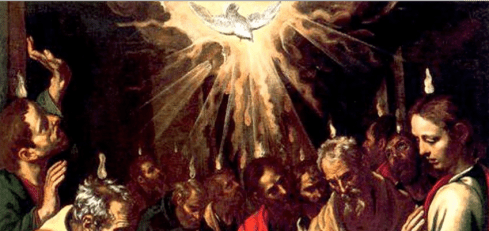
The alchemist Thomas Vaughn, in a compendium by Waite, calls it the divine spark or star-fire that is sympathetically attracted to its origin in God. It is spirit fructifying the soul.
These drops can also be seen as alchemical dew. Thomas Vaughn again explains that divine dew penetrates and transforms all that is physical. Waite claims that for the Rosicrucians “dew is light, coagulated and rendered corporeal. . . . When digested in its own vessel it is the true menstruum of the Red Dragon, i.e., of gold, the true matter of the Philosophers.”
Pool of Water
[In the beginning] “the Spirit of God moved over the face of the waters.” Genesis 1:2.
It is the soul that desires union with the spirit, “The Waters that are below desire after the Waters that are above.”
This is also the generative water of renewal and rebirth. It also represents the emotions which here have become serene and calm, being fed by the waters of the Holy Spirit. In the parlance of Carl Jung it is the rich and fertile pool of the unconscious psyche—the soul. And Evelyn Underhill already explained that the blood from Christ’s wounds causes flowers to spring up—in this case water-lilies that grow only in sweet waters, reaching up from the mud toward the light. Regarding sweet waters, in Waite’s book of aphorisms, Steps to the Crown, we find: “The Cup of bitterness ceases to exist for him who has drunk from the chalice of immortality”.
W or M ?
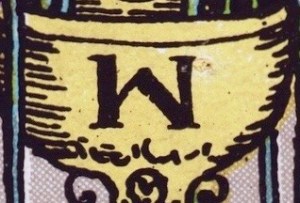
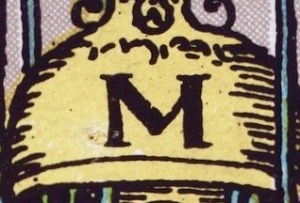
Finally we come to the major controversy associated with this card—What is the significance of the letter on the cup? The fact is that we will never know, but we do have some very likely possibilities, and knowing Waite, all of them may have been what was intended, for Waite saw all symbols as multi-valenced.
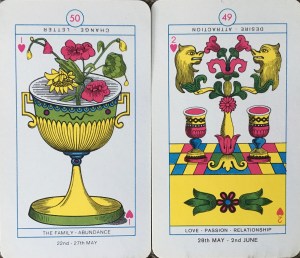 MacGregor Mathers, in his 1888 book Tarot: A Short Treatise on Reading the Cards claims that an inverted M on the front of the Spanish Ace of Cups represented the waters of creation in Genesis and all that remains of an Egyptian motif of twin serpents (as per this 19th century deck reproduced in the Cagliostro Tarot by Modiano of Italy). The Golden Dawn paper on the Tarot, “Book T,” says, “The great Letter of the Supernal Mother is traced in the spray of the Fountain.”
First it is note-worthy that the letter is shaped exactly like Pamela Colman Smith’s Ms and not like her Ws
 .
.
The main contenders for W are:
Waite (see the monogram on the Ten of Pentacles)
Water (“the implicit is that the Sign of the Cups naturally refers to water” PKT.)
Womb
Wisdom (more specifically, the Celtic Well of Wisdom)
Woman
The main contenders for M are:
Mystery (“For this is the chalice of my blood, of the new and eternal testament: the Mystery of Faith”).
Mem (or Maim, Hebrew for “water”)
Mary (or Mara, which also means “bitter sea”)
Mother (Matter. As Supernal Mother she is associated with Binah on the Tree of Life and the 2nd letter of the Tetragrammaton, He.)
Mercury (an alchemical maxim: “What wise men seek in Mercury is found”)
I believe that the letter is M and that it stands for Mystery, as viewed from above by the Holy Spirit. It is probably the word Waite uses most in his books where it is usually capitalized. To support this I have found almost this identical summary statement in several of Waite’s books:
“[In conclusion] the maxim which might and would be inscribed over the one Temple of the truly Catholic Religion when the faiths of this western world have been united in the higher consciousness–that is assuredly ‘Mysterium Fidei’–the mystery which endures for ever and for ever passes into experience.” HCHG, p. 469
We might also view the letters like this:
Waite – Mystery
Water – Mem
Womb – Mary/Mother
Wisdom – Mercury
An Act of Imagination
I suggest one final way of getting at the deeper meaning of this card.
Imagine for a moment that you are the Chalice and, perhaps, the liquid in the chalice. Picture yourself reaching up for the host held in the beak of the dove. You might see yourself as a baby bird stretching up to be fed by a parent. Can you experience the yearning? Or you may be a font of water that wells up from a deep source. Feel the draw from above and your yearning toward the source of that draw. Become aware of the wounds gathered through your earthly experience. The water (or blood) within you could begin to spill over, rising up and falling out in a continuous stream. Can you let yourself go, surrender to the movement, and then to gravity so that you fall into the pool beneath? What happens when you spill into that pond? Where do you go? How do you reflect back what is above?
One final characteristic of Cups, which Waite mentions over and over again through his discussion of the suit, is fantasy—the ability to imagine super-sensible things and have experiences of what he calls the Arch-Natural world. While there are dangers in doing so (the Seven of Cups), it is in through mystical experience, first accessed through the door of the imagination, that we are ultimately able to commune with Spirit. I hope to speak more about this in a third post on a Jungian interpretation of this image.
See also:
Part 1: Waite’s Eucharistic Ace of Cups.
Part 3: A Jungian Approach to the Ace of Cups
The Waite-Smith Ace of Cups, despite its seeming simplicity, is a very complex card with deep allusions that are central to Waite’s “Secret Tradition”—his mystical philosophy. This post explores Waite’s own very conscious and specific intention for this card.
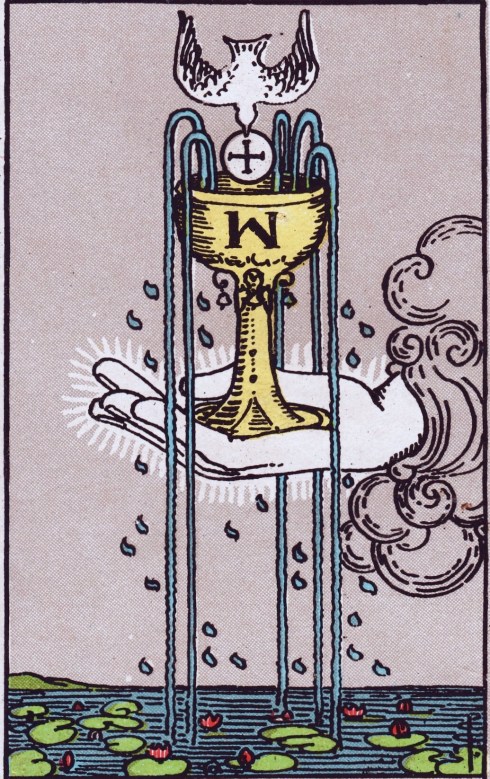
As an Ace in tarot readings it generally represents an opening of the heart, new love and relationships, the emergence of psychic abilities, dreams and imagination, spiritual nourishment and the gift of grace. It is the root of empathy.
In Pictorial Key to the Tarot, Waite explains that the Ace of Cups “is an intimation of that which may lie behind the Lesser Arcana.” In other words, it is key to the whole Minor Arcana. His declaration is not really surprising as 1909 saw not only the first publication of the tarot deck but also of Waite’s book The Hidden Church of the Holy Graal (HCHG), which in over 700 pages analyzed all that was known of the Grail and its myths. Most of the quotes below are from this book unless otherwise noted. As Waite’s sentences are quite obtuse and complex, I’ve simplified where necessary.
Waite completely ignores the Greater Arcana of the Tarot in HCHG but focuses a chapter on the Lesser Arcana suits. He saw them as a reflection of the four Grail Hallows and the four treasures of Celtic lore (an idea that Yeats later passed on to Jessie Weston; see From Ritual to Romance).
“The four Hallows are therefore the Cup, the Lance, the Sword and the Dish, Paten or Patella–these four, and the greatest of these is the Cup. As regards this Hallow-in-chief, of two things one: either the Graal Vessel contained the most sacred of all relics in Christendom, or it contained the Secret Mystery of the Eucharist.”
Waite wrote regarding these Lesser Hallows,
“The Lance renewed the Graal in some of the legends [he then compares Galahad, Perceval, Lancelot, Joseph of Arimathea, Merlin, Glastonbury and more], . . . but the places of the Hallows are in certain symbolical worlds which are known to the Secret Tradition. The Dish, which, as I have said, signifies little in the romances, has, for the above reason, aspects of importance in the Tarot.” [I assume here that he equates the symbology of the Dish with the tarot suit of Pentacles/Disks.]
If we need even further proof that Waite intended the Ace of Cups to represent the Grail, it is found in Waite’s divinatory meanings for the Ace of Cups, which are: “House of the true heart, joy, content, abode, nourishment, abundance, fertility; Holy Table, felicity hereof.”
He uses the term ‘Holy Table’ once in HCHG regarding an early Grail myth, describing “the graces and favors of the Holy Table” upon which the Grail appears and feeds the faithful, bringing them joy and contentment. Waite also includes this phrase in his digest of the writings of Eliphas Lévi, The Mysteries of Magic, where Lévi explains that primitive Christians gathered around the Holy Table to communicate with God and behold his face.
Although often couched in the terminology of the Catholic Church, Waite did not believe in the efficacy of instituted religions nor their requirements for ordination:
“The Mystic Quest is the highest of all adventures. . . . It exhibits the priesthood which comes rather by inward grace than by apostolical succession.”
“The Mass of the Graal . . . is celebrated only in the Secret Church and that Church is within. When the priest enters the Sanctuary he returns into himself by contemplation and approaches the altar which is within. . . . The Lord Christ comes down and communicates to him in the heart.”
When “grace and power fills them, permeates and overflows in the recipient’s heart . . . the Mystic Marriage by a Eucharistic rite” can take place—a theme central to most of Waite’s books. At heart this is a sexual mystery of Spirit and Nature, a “polarization of elements,” through which “Divine Life assumed the veils of flesh and blood” and through which flesh returns to Spirit.
This is the essence of Waite’s Secret Tradition that he wrote about in more than a hundred books and articles. He called the communication (or communion) the Eucharist, which is epitomized by the mystery of the transubstantiation of bread and wine into the body and blood of Christ.
In The Book of the Holy Graal, Waite explained:
The Hidden Church has sent out messengers with rumors of a noumenal Eucharist. . . . But once, through legend and through high romance, the Secret Church sent out the Holy Graal.
The secret to reading Waite is that he used words very precisely. The word noumenal is more from Plato than Kant, as it refers to objects of the highest knowledge: truths and values that exist outside of our human senses and perception. According to Waite, the Grail stories intimate or hint at the possibility of a spiritual communion with the Divine.
“The message of the Secret Tradition in the Christian Graal mystery is this: The Cup corresponds to spiritual life. It receives the graces from above and communicates them to that which is below. The equivalent happens in the supernatural Eucharist, the world of unmanifest adeptship, attained by sanctity [Grace].”
“The cup of blessing which we bless, is it not the communion of the blood of Christ? The bread which we break, is it not the communion of the body of Christ?” 1 Corinthians 10:16
Here Waite speaks more of the Eucharist, first as a higher kind of love, symbolized by the Grail, and then of the loss of “Mystery” to the world:
“The Eucharist is a mystery of the soul’s love. . . . The sense is that love is set free from the impetuosity and violence of passion and has become a constant and incorruptible flame.”
“The Holy Graal . . . is a mystery of the Eucharist in its essence. . . . It is an inward mystery [not found in the official Church]. It died, however, in the consciousness except of a few faithful witnesses, . . . [because when Christ] incarnated, a manifestation of the God within was intended but it did not take place because the world was not worthy, the Graal was said to be removed.”
As Waite saw it, our ability to directly commune with the Divine has been lost. All the official sanctuaries “are in widowhood and desolation,” even though they are “filled with meaning and intimations of meaning.” That is, they give intimations or hints of the mystical journey, which is not available in institutions as it can only be experienced within each individual. The four suits of the Lesser Arcana tell four stories of this loss.
“It must be admitted that the Lesser Chronicles are in some sense a failure; they seem to hold up only an imperfect and partial glass of vision. But they are full testimony to the secrecy of the whole experiment; they are also the most wonderful cycle by way of intimation. Their especial key-phrase is my oft-quoted exeunt in mysterium [“they exit into mystery”].”
“The sources all say the same things differently: “The Holy Sepulcher is empty; the Tomb of C.R.C. [Christian Rosy Cross] in the House of the Holy Spirit is sealed up; the Word of Masonry is lost; the Zelator of alchemy now looks in vain for a Master. The traditional book of the Graal . . . [is] lost, . . . [as is the book] which was eaten by St. John (i.e., The Book of Revelations).”
It is left to the Greater Arcana to chart the soul’s journey along the path of restitution. But that is a separate tale.
Waite claims he wrote The Hidden Church of the Holy Grail as a text-book of a Great Initiation in that there is a secret meaning hidden in these tales of loss.
“So came into being [the Graal stories]. Whether in the normal consciousness I know not or in the subconsciousness I know not . . . that dream of theirs was of the super-concealed sanctuary behind the known and visible altar.”
They point to something that can now only be experienced by the individual in the inner sanctuary of his or her own heart. “Their maxim is that God is within.”
“The history of the Holy Graal becomes the soul’s history, moving through a profound symbolism of inward being, wherein we follow as we can, but the vistas are prolonged for ever, and it well seems that there is neither a beginning to the story nor a descried ending.”
Part 2 explores Waite’s clearly intended and most likely meanings for the specific symbols in the Ace of Cups.
Part 3 is “A Jungian Approach to the Ace of Cups”.
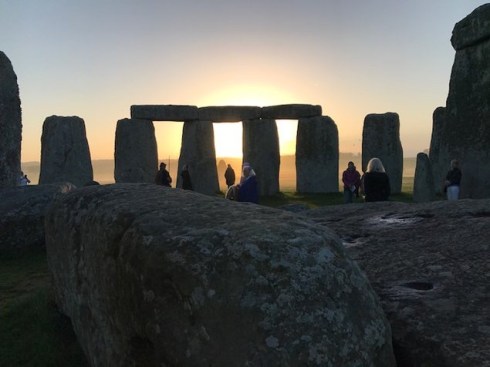
Announcing two Tarot Tours this coming summer in the British Isles. Last year’s trip, Tarot Magic in Merlin’s Britain, sold out early. We are doing it again, with a Tarot trip to Sacred Scotland preceeding it, and a discount if you go on both. Don’t let these journeys pass you by! Sign up before the November 30th deadline. Above is a photo of our private full moon sunrise ceremony in the circle at Stonehenge.
Just two weeks ago I discovered that the hotel where we stayed while searching for Tarot artist Pamela Colman Smith’s burial place, was a hotel she actually stayed at as a young woman. It was in 1897, the year King Arthur’s Castle Hotel opened, with its magnificent roundtable at which we did readings, that Pamela met Henry Irving of the Lyceum Theatre fame. Subsequently she toured with the Lyceum Theatre and designed costumes and sets, getting her nickname, Pixie, from her foster mother, the actress Ellen Terry. Here is what is now called the Camelot Castle Hotel in Tintagel, with Merlin’s Cave in the far bottom right.

I can’t begin to tell you all the amazing things we encountered on our journey: sacred wells in out of the way locations; stone circles, several of which we had to ourselves; the special fairy glen; a ritual on a hilltop labyrinth; Glastonbury Tor and Chalice Well where Dion Fortune made her home. 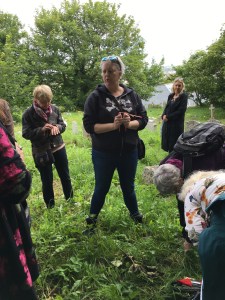 One of the most magical moments was our using dowsing rods to find what we believed was Pixie Smith’s unmarked grave. Linda dropped her pendulum, hearing it fall. We searched for it in vain, only to have the bus driver when we returned ask who had dropped a pendulum on the bus. It was Linda’s. That night at the Camelot Castle Hotel we used the pendulum to ask Pixie questions about her life – and it was months later that I discovered from one of her letters that she had probably drunk her favorite “Opal Hush” drink in that same bar 120 years before.
The Tarot Magic in Sacred Scotland Tour is
14-23 May 2018
and will feature Tarot readings in sacred sites for gaining insight into your own spiritual journey…readings whose messages will continue to unfold for years to come. Experience:
- Inverness and surrounding area – Prehistoric Clava Cairns and standing stones, Rosemarkie Fairy Glen, Loch Ness
- Orkney – Skara Brae, Maes Howe, Stones of Stennes, Ring of Brodgar, archaeological dig on the Ness of Brodgar
- Iona – Abbey, Nunnery, St Columba’s Chapel
- Standing stones at Kilmartin.
More information: https://globalspiritualstudies.com/travel/sacred-scotland/
The Tarot Magic in Merlin’s Britain Tour immediately follows on
23 May – 1 June 2018
and takes us to:
- Stonehenge
- Avebury and West Kennet long barrow
- Glastonbury and surrounding area – Chalice Well, the Tor, Glastonbury Abbey, Cadbury/Camelot
- Tintagel and surrounding area – Tintagel Castle, Merlin’s Cave, St Nectan’s Glen
- Boscastle – Museum of Witchcraft and Magic
- South Cornwall – Boscowen-un stone circle, Merry Maidens stone circle, holy wells of Madron and Sancreed.
More information: https://globalspiritualstudies.com/travel/avalon-to-camelot/
Watch this video of our trip, created by Linda Marson, to catch just a little of the magic:
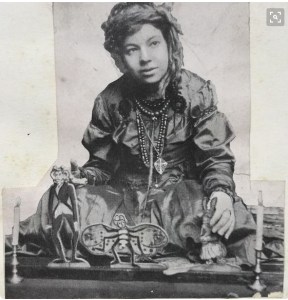
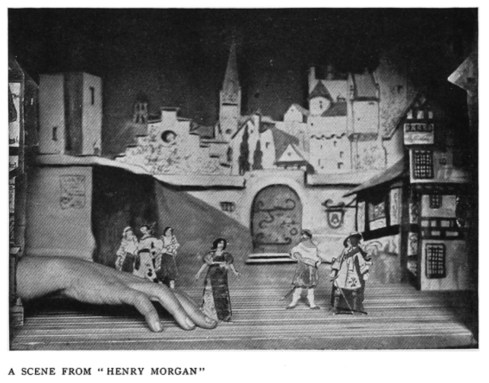
Pamela Colman Smith was known for telling Jamaican folk tales about the spider-man trickster figure, Annancy, and also for her toy theatre performances. The toy theatre scene shown below is from her play, Henry Morgan, based on a real life Welsh pirate who became lieutenant governor of Jamaica. The photo above of PCS telling a folk tale using her cutout figures was recently discovered by Dawn Robinson in Cornwall glued into a copy of The Russian Ballet.
Toy theatres were nothing new, as from 1811 they had become a popular pasttime in pre-television, Victorian England (check out this toy theatre site). Below are two newsreels of the original Pollack’s Toy Theatre construction showing how Pamela herself would have made her theatres and especially how she would have used stencils to color her illustrations for “The Broad Sheet”, “The Green Sheaf” and other works.
Finally, join author Ronald Hutton (Triumph of the Moon, Pagan Britain and The Witches) on a tour of modern day Pollack’s Toy Museum and view the Toy Theatres seen in the old newsreels above (view about half way through Hutton’s video).
A photograph of a modern toy theatre using figures from Pixie’s Tarot deck can be found on Pinterest, but since I don’t have the original source for the photo I won’t show it until permission is given by the creator.
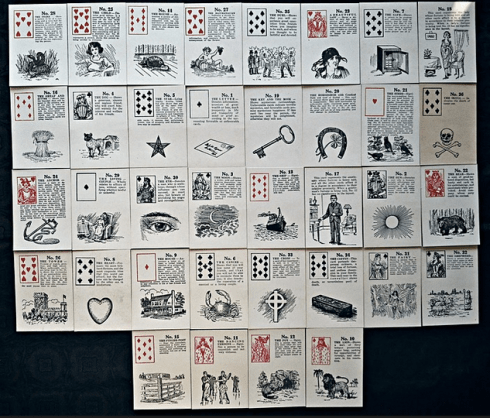 Old Gypsy Fortune Telling Cards from United Novelty, Mfc Company, Chicago, circa 1920-30 are a 36-card deck with playing cards inset and meanings given on each card. The instructions are in Polish and English and the Lady (significator) is clearly dressed as a 1920s flapper. At least 22 of the 36 cards are close cognates with the Lenormand cards. A few of the other card images are found on other cartomancy decks of the period. See this post in which Camelia Elias demonstrates using the deck.
They were printed by the Valmor Company of Chicago (also doing business as King Novelty; United Novelty appear to be distributors) and so are sometimes called the Valmor Fortune-Telling Cards. This hints at an interesting crossover between the immigrant community of Jewish founder Morton and Rose Neumann (the Polish connection?) and the African-American hoodoo tradition.
A surprisingly large number of hoodoo mail-order companies were founded by Jewish chemists who perceived a need for affordable beauty products and who then expanded into incense, candles and hoodoo potions. 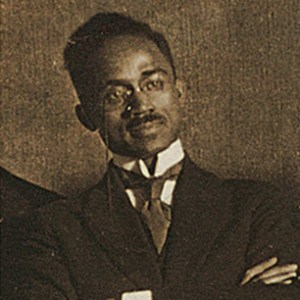 Two years after Morton Neumann started Valmor he married Rose and then the whole approach to Valmor advertising changed radically. The company became known for its illustrations featuring fair-skinned, black-haired beauties in seductive, sexy scenes. The original advertisment illustrator was African-American artist, Charles Dawson. Could he have been the artist of this deck?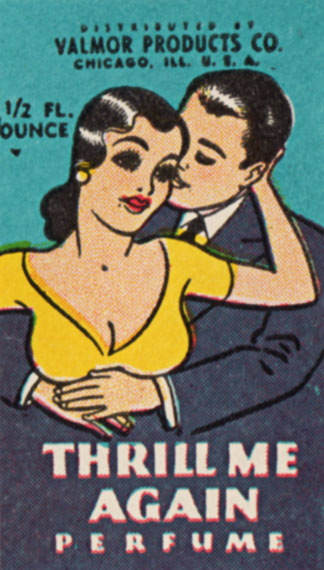
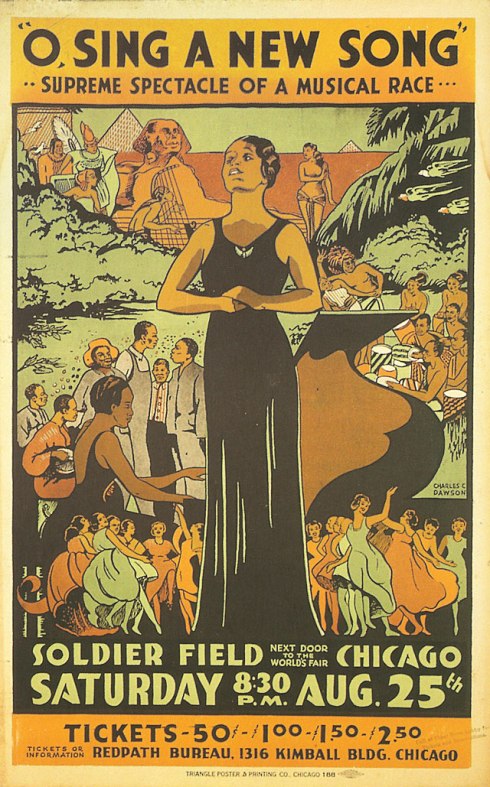
It’s interesting that Morton and Rose Neumann, by the mid-20th century, began investing their wealth in 19th century European art and later in American art, amassing what is considered today to be the foremost and most valuable private family art collection in America. They tried to keep it intact until the death of Rose and son, Hubert, when an inheritance tax of $50 million forced the sale of several works.
 The Old Gypsy Cards Fortune Telling Game from Addison Products Co, Chicago (no-date – 1940s?) is an identical deck, also with instructions in English and Polish. Looking similar to the Gypsy Witch, and with elements appearing in Whitman’s “Old Gypsy” deck, this deck has its own assignation of playing cards such that the suits & numbers appear in sequence according to the numbering of the cards, and they accord most closely with the usual French and English playing card meanings. While most of the deck includes Lenormand-like cards there are also unique ones like 23-A Beautiful Lady, 27-The Bacchanalian, 29-The Loving Couple, 31-The Fairy, 32-The Shepherd, 11-The Dancing Persons. Cards like 20-the Horseshoe, 30-The Eye and 35-The Duel are found in other “gypsy” decks that I talk about here. In 1948 this same deck was published by Wehman Bros. but without the text.
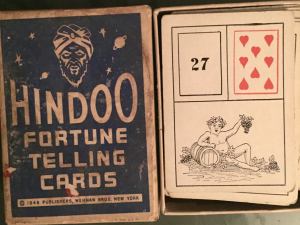
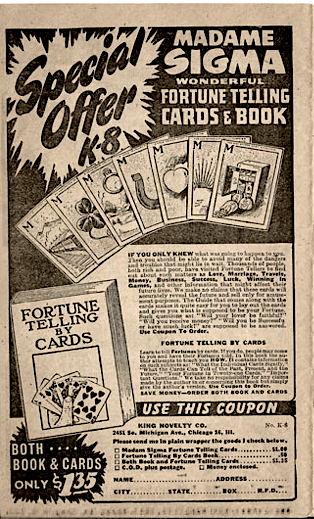
I was unable to find this particular deck in a King Novelty (Valmor) catalog but I did come across their 1944 catalog ad for a nearly identical deck called Madame Sigma Fortune Telling Cards. You could purchase both the deck and book together for $1.35!
Here’s a interesting comparison of the three Whitman “Old Gypsy” deck editions (top), while (below) is the Horseshoe/Trefoil from the Old Gypsy Fortune Telling Cards (which, along with the Key, Gentleman & Lady cards, have no playing cards printed on them), and two from the Gypsy Dream deck – Horn of Plenty and Horseshoe.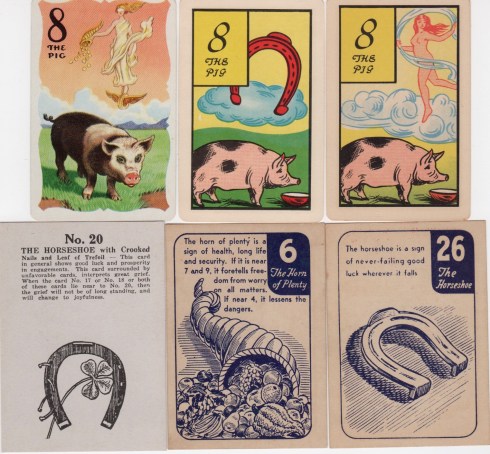
See also my post on 19th Century American Lenormand decks.
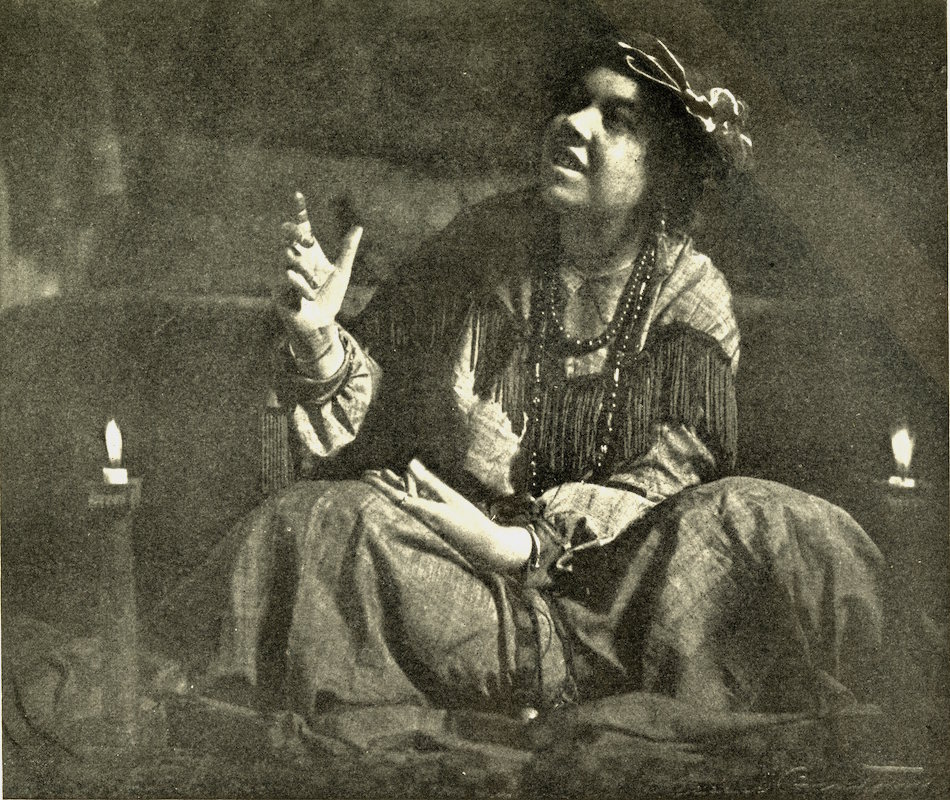
Photograph by Alice Boughton from the Brooklyn Life magazine, January, 1907. Thanks to the Brooklyn Public Library for a better resolution photograph than I was able to get previously.
When I began collecting Lenormand decks I soon discovered that in the 19th and early 20th centuries they were far more common in the United States than I had imagined. It appears that German-American immigrant communities, centered mostly in New York and Chicago, published a continuous stream of decks, from different publishers, to meet local demand. The majority of these decks contained the original, 1846 “Philippe” instruction sheet, unchanged, in both German and in English-translation. This was of particular interest to me as my German-American great-grandmother was known to have the “sight” and read cards for visitors in her New Orleans kitchen. I like to think she would have known the Lenormand deck.
Since the 175-year-old German divination deck known as the Petit Lenormand burst onto the English-language scene about five years ago, nearly a hundred new, published decks have appeared and a half-a-dozen books and ebooks. [And by 2018 it’s become a divination staple.] Even though USGames has published a German “Blue Owl” Lenormand deck for nearly fifty years, Lenormand has remained an oddity, superseded by a similar, though more negative, “Gypsy Witch” deck, with 52 instead of 36 cards, that quickly came to dominate the American cartomancy scene.
We now know that the Lenormand (also known as the Petit Lenormand) cards had nothing to do with the famous French fortune-teller, Mlle. Lenormand, merely co-opting her name. The date of their inception has been pushed back to the late 18th century with the multi-purpose “Game of Hope” from Nuremburg and similar Coffee-Cards from Vienna.
Here is the little-known American branch of the family. Anyone with an early American edition not included here, please contact me with a photo and as much information as you have so we can add to the list.
L’Oracle de Bonaparte ou cartes de Mlle. Lenormand: pour dire la bonne aventure (Publices par C. Magnus, New York, circa 1855).
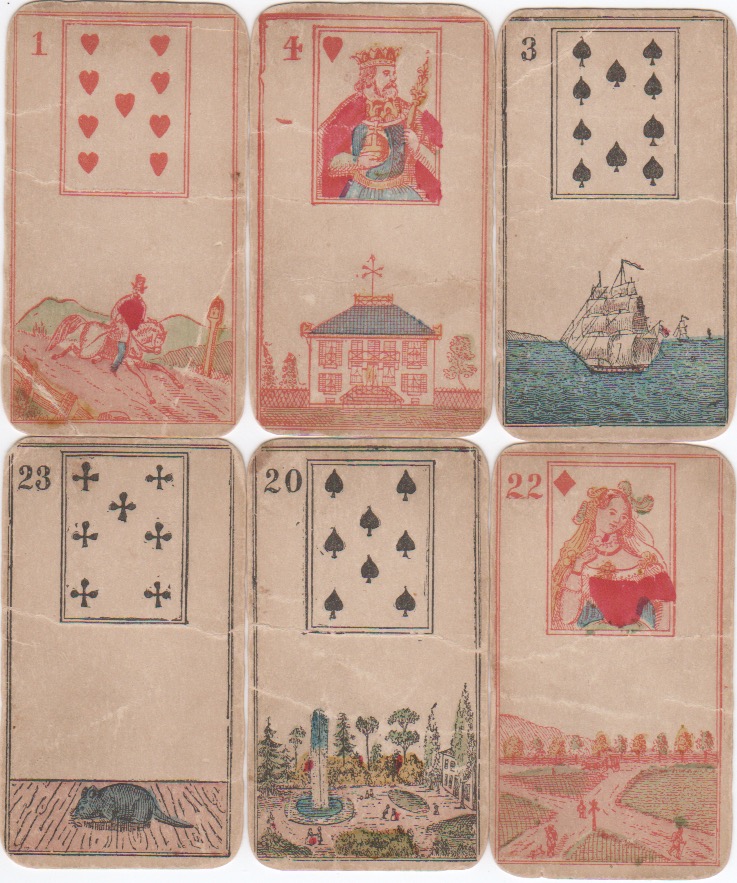
 This is my earliest American deck. While the box cover is in French, the booklet is in German (my copy is without these), and it was published in New York, for the immigrant community. Charles Magnus (1826-1900) was a print publisher, map dealer, bookseller and stationer working in New York City from 1850 to 1899, having arrived from Germany around 1848. He is especially known for his maps of Civil War battlefields. The deck is on matt cardboard. It was printed in black or red (depending on the card suit) and then colored by stencil in red, blue and yellow with green being a combination of yellow and blue. The size is 1-5/8″ x 2-7/8″ (4.1 cm x 7.3 cm) – a little taller than today’s mini decks. (A much later German deck of the same style appears at the Lenormand Museum online.)
Madam Morrow’s Fortune-Telling Cards, 1867. New Illustrations, copyrighted 1886 by McLoughlin Bros., New York. [The cards here are from the 1894 printing.]

first edition, 1867
Madam Morrow cards first came out some time after the death of an infamous fortune-teller (arrested many times) who worked in New York and Philadelphia. She described herself thusly in an advertisement:
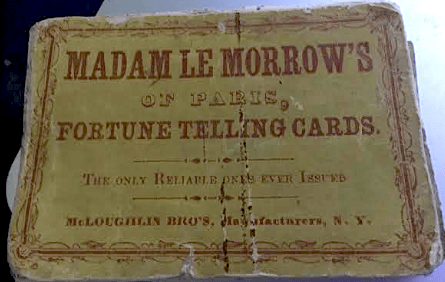
The earliest box?
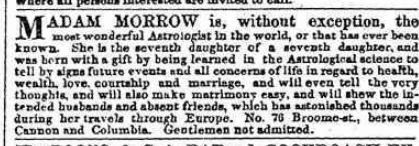

1886 Revised Illustrations
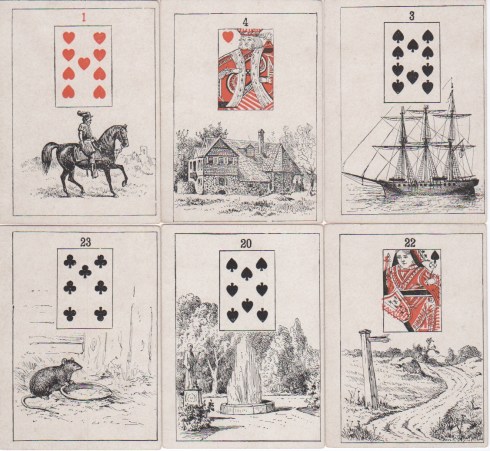
 The first edition, mentioned in the Uniform Trade List of July 1867 as Madam Morrow’s Fortune Telling Cards, was an exact replica of the German Kunst-Comptoir, Berlin deck of 1854. (They were also published by McLoughlin as Madam Le Normand’s Mystic Cards of Fortune in a simple b&w printing – see Wehman Bros deck below.) In 1886 a new edition was copyrighted – a beautifully etched masterpiece (large cards above)! Note that the Court Cards have been redone to match those found in contemporary playing card decks. An oddity of this deck, which influenced a few other decks, is that three of the Queens are switched from their normal Lenormand card placements. Crossroads should be the Queen of Diamonds (originally Bells) instead of Spades, while
 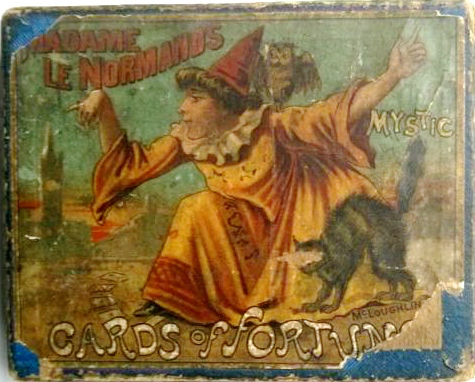 the Queen of Spades should be Bouquet and the Queen of Hearts, Stork. All the other cards are correct. The booklet is only in English, but it is an exact translation of the standard German instruction sheet. The illustrations on the boxes changed frequently. The deck is a standard poker size.
Mlle. Lenormand’s L’Oracle and Appendix: 36 Illuminated Cards with English and German Description for sale by Fitzgerald Publishing Corporation, 18 Vesey St., New York (circa 1916+).

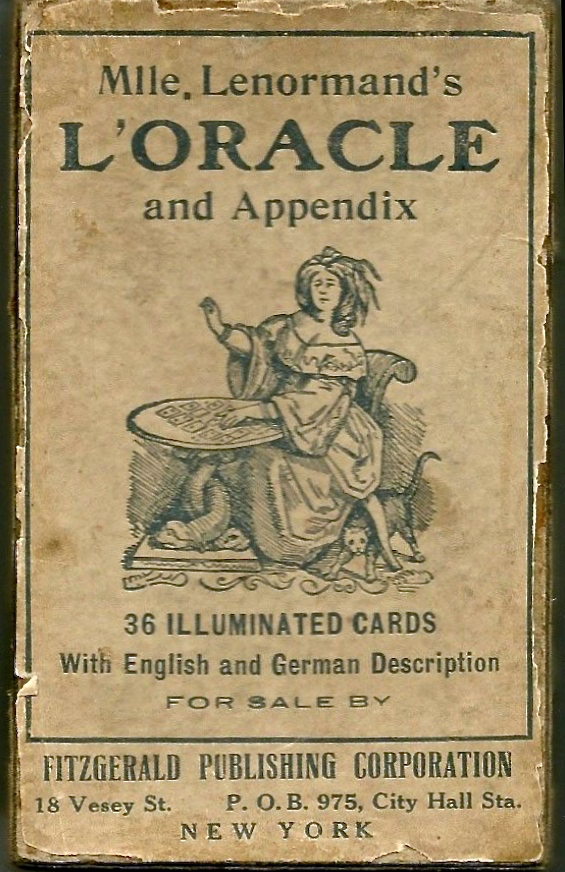 My copy came without a box or book, so the closest I’ve come to identifying it is via a deck that sold from the Fitzgerald Publishing Corporation edition, which makes it 1916 or later. The Dick & Fitzgerald Publishing Co was originally founded in 1858 on Anne St. and they did publish playing card decks. Upon the death of the founder’s son in 1816, the Fitzgerald Publishing Corporation at 18 Vesey St. came into being, known mainly for editions of theatrical plays and music. Whether this deck was a carry-over from the earlier company or not will not be known until an earlier box is found. The style is a near exact replica of one of the earliest Lenormand decks: black & white cards from Kunst-Comptoir in Berlin, Germany in 1854 (see the early Madam Morrow deck). This particular deck is notable not only for the fine coloring of the scenes but also for the lovely pink and blue sky. The deck is a standard poker size.
Cards of Fate and Gypsy Fortune Teller, J.H. Singer, New York, circa 1890s.


 J.H. Singer, New York, (1880’s-1902) published this chromolithography deck on heavy cardstock with children’s-book-like illustrations under at least two names (see above). Singer also published a planchette game and a miniature theatre. While the 36 cards are all standard Lenormand, they feature non-standard numbers, and many of the playing card correspondences have changed. The instruction sheet gives very brief keyword meanings, some of which are different than usual:
13-Mountain (9 of Clubs) =”friendship.”
8-Key (6 of Diamonds) =”insight to secrets or mysteries, best of a bargain.”
18-The Stars (10 of Hearts) =”foretells.”
Madame Le Normand’s Gipsy Fortune Telling Card Game, Wehman Bros., New York, no date, circa 1900.

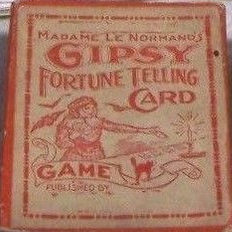 This deck is found fairly often on eBay. It is a simple red & black version of the Kunst-Comptoir, Berlin deck of 1854 and the same as the b&w Mystic Cards of Fortune (see above). Notice that the Ship is quite different, while the other cards are identical. There’s some indication that publishers would substitute their own country’s ships and flag. Although I can’t see enough detail on most of the flags, this one does appear to be an American flag. This edition is instantly recognizable because the black playing card suits have red pictures and the red suits have black pictures. The Queens are the only cards with no suit markers (due to the confusion that arose with the McLoughlin deck?). Several of the outer boxes have a blank space following the words “Published by” which suggests that Wehman Bros of New York may have merely been a distributor for decks printed elsewhere. The instructions are printed in both English and German. This small deck measures 2-1/8″ x 3″.
Gypsy Sabina Self-Explaining Fortune-Telling Cards, The American Illustrating Co., 64 Fulton Street, NY, 1904.

 This deck was quite a find. It contains the same 36 figures that are found in a standard Lenormand deck but the Queens are switched around yet again! Snake is the Queen of Spades (rather than the Queen of Clubs). The drawings are original to this deck and include the unusual device of a curtain being pulled back by a winged child to reveal the pictorial scene. “Self-explaining” verses in furled banners in both German and English give the meanings on each card. The minimalistic instruction sheet is also in German and English, telling one to lay the cards in four rows of nine cards with the Significator always in the center of the top row. The card backs feature an advertisement for John Miles Wholesale Millinery Goods, which suggests that a printer offered them as promotional products to their business customers. The cards are a little taller than usual, measuring 2-3/8″ x 3-5/8″. The back of the box has this interesting explanation for the deck:
“These Cards have been used for years with unvarying success by Queen Sabina, one of the most foremost Queens of the Romany Rye. Venerated by her subjects for her good qualities, she is also regarded by them with a superstitious awe, and guarded with such a jealous care that no one outside the inner circle is allowed to see or hold converse with her, and she has taken this means of holding communication with the outside world, so that they may partake of her wondrous gift of lifting the curtain of the future for all who have faith.”
Dr. Jayne’s Egyptian Fortune Telling Cards, Dr. D. Jayne & Son, Inc., Philadelphia, no date.
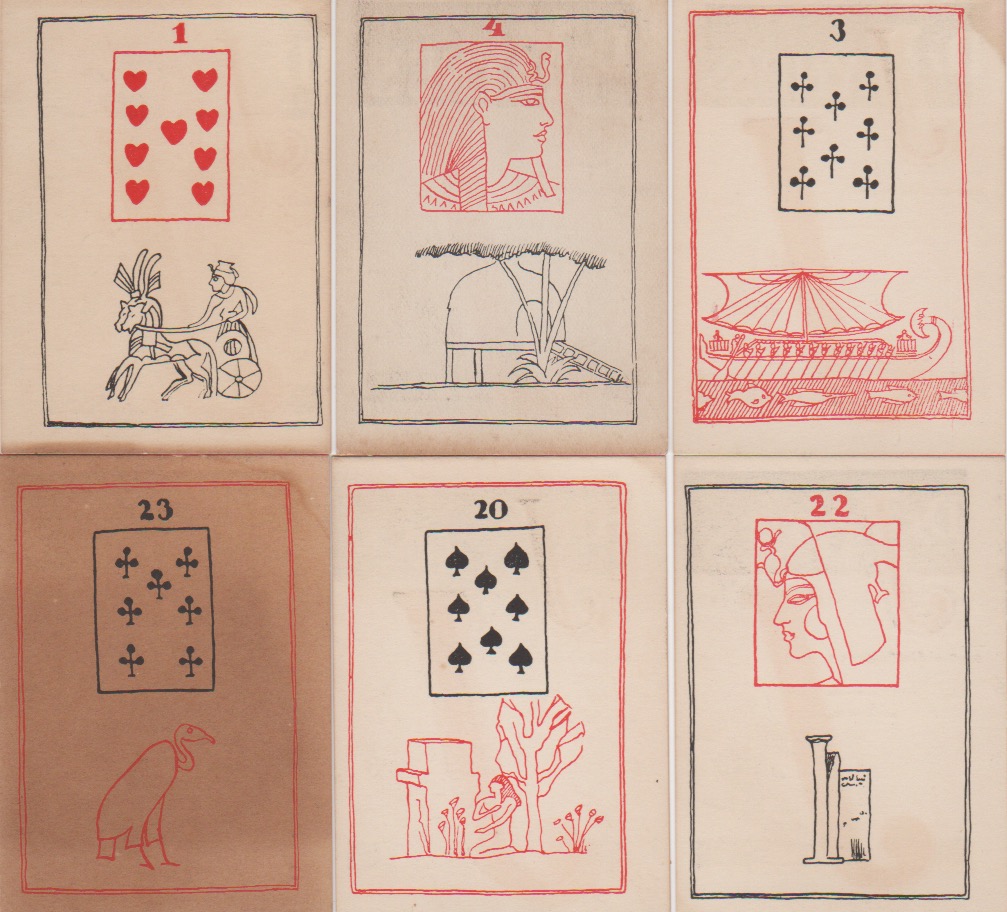
 While these cards look quite different than the Lenormand decks we are used to, they are actually exact matches to the standard deck. Dr. Jayne and Son was a patent medicine company that existed from 1843 to 1930. They used almanacs, trading cards, recipe books, a dream & fortune telling book, striking graphics and this deck to promote their medicines, primarily to families, many of whom were functionally illiterate. The vulture (Mice) card probably darkened from being exposed to the sun. The back of the cards and the box have the same design. There is an error in my deck where the Ship should have been the 10 of Spades, the card mistakenly shows the 8 of Clubs. Interestingly the Jack of Hearts card should have a red playing card and black emblem, but as the emblem is a heart the colors are reversed so the heart can be red. They are roughly poker size.
 Box for unknown deck (picture on the left). Is this another Lenormand deck? It says the instructions are in German and English and there are 36 cards. It was published in New York. Does anyone have any further information?
All of these decks are on matt card-stock that’s easily torn or bent, rather than the glossy-finished flexible and quality stock found on many 19th century European decks. Compared to the fine artistry and the best in chromo-lithography of the European decks, these American decks seem like poor cousins, but I find them to be outstanding examples of a folk-tradition. They add much to an overlooked aspect of immigrant and everyday life here in America.
The Evening World’s Home Magazine (New York) reproduced the original “Philippe” (heirs of Mlle. Lenormand) Instruction Sheet in their October 19, 1903 issue. Included are the standard Kunst-Comptoir 1854 images that one is encouraged to cut out to make one’s own deck. Here is the article if you wish to print it out and do the same. Click the picture for a large version.

Lenormand Off-Shoots:
The Gypsy Witch Fortune Telling Playing Cards
As early as 1894 Frederick J. Drake & Co. of Chicago, Illinois began publishing an expanded 52-card version of the Lenormand cards called Mlle. Le Normand’s Gypsy Witches Fortune Telling Cards. It was based on a 48-card deck from Danner G. Mühlhausen, Berlin that in 1875 had added twelve extra illustrations to the original deck (plus incorporated an alchemical-looking script in place of the playing card insets) – see later Adolf Engel edition (1880?) here. The Gypsy Witches deck switched all the playing card associations around, increased the cards to 52 and included a Joker card. By 1903 it was being published by Home Game Co., and later by the United States Playing Card Co. of Cincinnati, Ohio. Today, as the Gypsy Witch Fortune Telling Playing Cards, it is available from USGames.
Old Gypsy Fortunetelling Cards
are from United Novelty, Mfg Company, Chicago, c. 1920 – a 36-card deck with playing cards inset and meanings given on each card. The instructions are in Polish and English and the Woman is clearly dressed as a 1920s flapper. They were printed by the Valmor Company of Chicago (also doing business as King Novelty. United Novelty were distributors) and so are sometimes called the Valmor Fortune-Telling Cards. This hints at an interesting crossover between the immigrant community of Jewish founder Morton Neumann (the Polish connection?) and the African-American hoodoo tradition. Could African-American artist, Charles Dawson, who did Valmor ads, have been the artist of these cards? See post using this deck by Camelia Elias.
They are identical to the Old Gypsy Cards Fortune Telling Game from Addison Products Co, Chicago (no-date – 1940s?), also with instructions in English and Polish. Looking similar to the Gypsy Witch, and with elements appearing in Whitman’s deck (see below), this deck has its own unique assignation of playing cards (the suits & numbers appear in sequence in the numbering of the cards), which accord most closely with the usual French & English playing card meanings. While most of the deck includes Lenormand-like cards there are also unique ones like 21-The Fairy and 27-The Bacchanalian. Cards like 30-The Eye are found in other “gypsy cards” mentioned here. In 1948 this same deck was published by Wehman Bros. but without the text.
I was unable to find this particular deck in a King Novelty (Valmor) catalog but I did come across their 1944 catalog ad for a nearly identical deck called Madame Sigma Fortune Telling Cards. You could purchase both the deck and book together for $1.35!
Gypsy Dream Fortune Telling Cards, no publisher, no date (c. 1920-30 or earlier?).
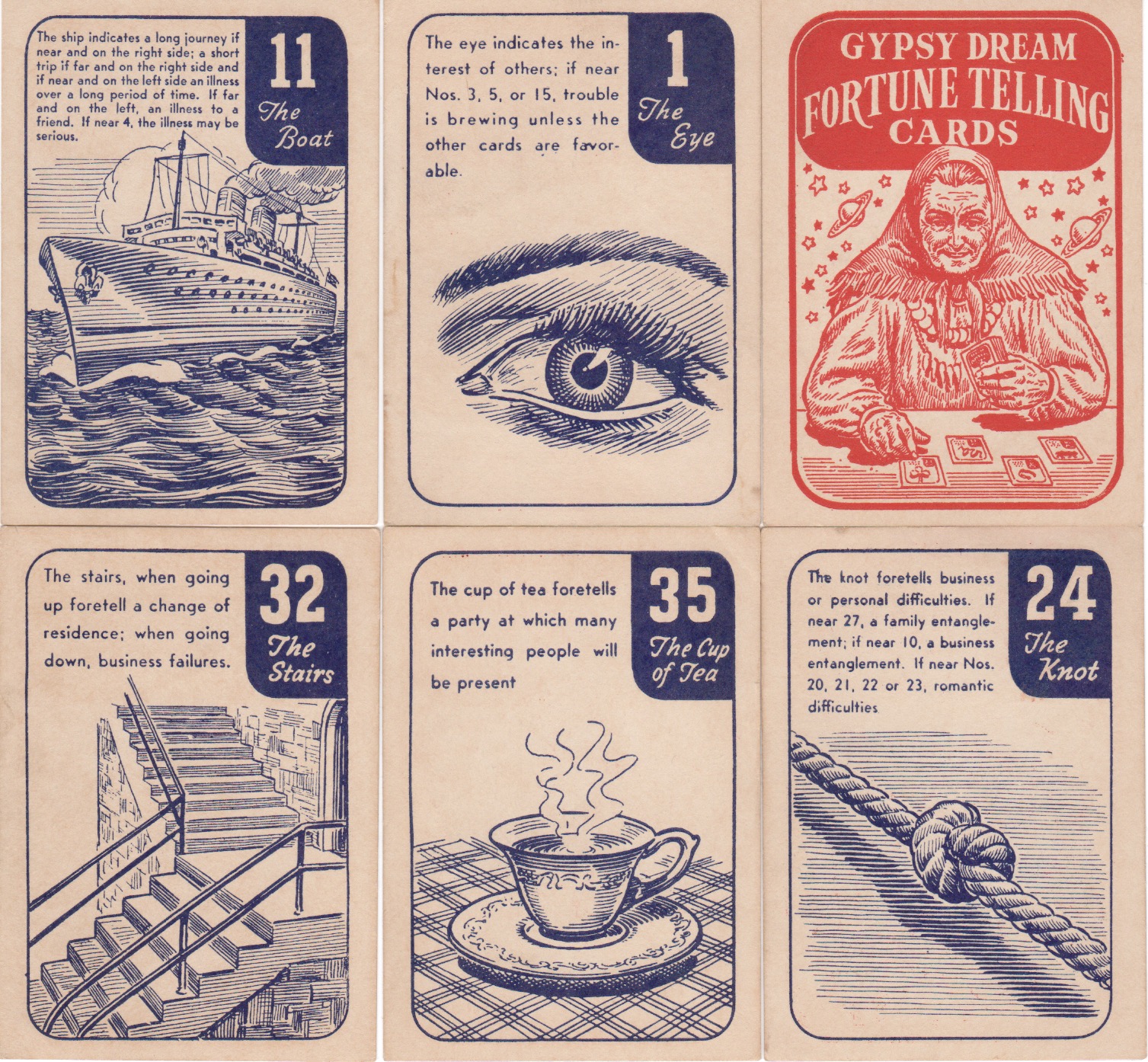
This is a very rare, unusual 36-card deck. Eighteen cards are the same or very similar to Lenormand cards, although in a different numerical order, and 22 cards share some (if not exact) similarities with the Old Gypsy FT Cards just above. The other cards share similarities with other cartomancy decks, like the Eye, Cat, Coins (bags of money) and Cornucopeia, but this deck also features unusual cards like the Stairs, the Horse, the Bee, the Ivy, and the Candle. There’s no instruction sheet as all the meanings and most significant combinations are printed on the cards.
Old Gypsy Fortune Telling Cards, Whitman Publishing Co., 1940.

This 36-card deck probably originated in Germany—see Das Echte Wahrsagespiel from approximately 1925-30, featuring identical pictures but with fake “alchemical-kabbalistic script” in the yellow insets instead of the numbers and titles. This, in turn, was a variation of the Mühlhausen/Engel (Berlin) 48-card deck of 1875/80.
This version is essentially a Lenormand with twelve cards that vary from the standard—some a mere substitution of a different image and others, entirely new but drawn out of the Mülhausen/Drake selection. Several of the non-standard cards appear in the two previous alternative decks. This deck features an emphasis on love and marriage. There have been three different artistic renditions of the Whitman deck, all designed in the style of children’s book illustrations. There are no playing card associations.
Here’s a interesting comparison of fortune cards: In the top row: the three different Whitman editions. On the bottom row, left to right, is the Horseshoe/Trefoil from the Old Gypsy deck (playing cards are included on all but this card and the Man & Woman cards), and two cards from the Gypsy Dream deck – Horn of Plenty and Horseshoe.
A few other American variations on the Lenormand deck began appearing in the late 20th century, but that’s for another post.
Read a greatly expanded version of the material on the Valmor Old Gypsy Fortune Telling Cards.
One of the most varied collections of early European Petit Lenormand decks can be seen at Stregato’s Blog.
This “museum” can be searched by categories: Lenormand Fortune-Telling Cards Museum.
“Watch out for wormholes: you never know what may come out of them.”
— Stephen Hawking
One of the first things people want to know about Tarot is how it works. Most seasoned practitioners will admit they haven’t a clue but have considered a few possibilities including:
- Carl Jung’s theory of synchronicity (not really a theory but rather a belief in meaningful coincidence)
- Quantum physics (theory of entanglement, etc.)
- Psychological projection (as a kind of Rorschach test)
- Contact with a Spiritual Being, Higher Self, Universal Consciousness or paranormal force
- Magic(k) (an as-yet-unknown scientific principle)
- One’s subconscious directing the placement of the cards
- Self-fulfilling prophecies
- A mentalist’s set of cold-reading tricks conjoined with the Barnum Effect
I was fascinated to see that the physicist, Stephen Hawking, in The Universe in a Nutshell (albeit a rehash of his earlier work) addresses this very concern. In a chapter called “Predicting the Future,” he compares astrology to his understanding of how the universe works. I thought we’d also see what modern science might suggest about Tarot’s ability to predict. [I’ll leave it up to the reader to further explore the scientific concepts in bold italics.]
Hawking begins with the provocative statement,
“The human race has always wanted to control the future, or at least to predict what will happen. That is why astrology is so popular. . . There is no more experimental evidence for some of the theories described this book than there is for astrology, but we believe them [scientific theories] because they are consistent with theories that have survived testing.”
Hawking explains how, in the 19th century, Laplace’s scientific determinism proposed that with enough knowledge we could predict the state of the universe at any time in the past or future.  In principle, the future is predictable. But, even the tiniest disturbance can cause a major change somewhere else. While the flapping of a butterfly’s wing could cause rain in New York, the sequence of events is not repeatable. “The next time the butterfly flaps its wings, a host of other factors will be different and will also influence the weather.” While a Tarot card might predict an exact event one time, can we count on a repetition of this prediction at another time to be as accurate?
Determinism is also confounded by the uncertainty principle: we cannot accurately measure both the position and the velocity of a particle at the same time. If we put inaccurate data in, we get inaccurate data out. This conundrum led to quantum mechanics, which examines wave function to determine the probability that a particle will have a position and velocity within a certain range. Generally speaking, when there is a small uncertainty in position there is a large uncertainty in velocity and vice versa. Hawking sums this up:
“We now realize that the wave function is all that can be well defined. We cannot even suppose that the particle has a position and velocity that are known to God but are hidden from us. Such “hidden-variable” theories predict results that are not in agreement with observation. Even God is bound by the uncertainty principle and cannot know the position and velocity. He can only know the wave function.”
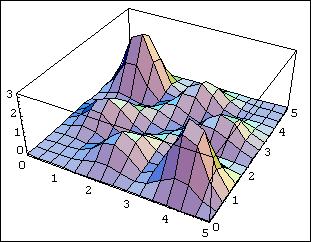
Wave function gives us a kind of half-determinism in which we can predict either the position or the velocity within any given measure of time. But, it seems, the special theory of relativity threw out the notion of absolute time. It turns out that time is only one direction in a four-dimensional continuum called spacetime. Different observers traveling through space at different velocities each have their own measure of time (oh, no!) in which there are different intervals between events. There is an equation (Schrödinger’s) that, 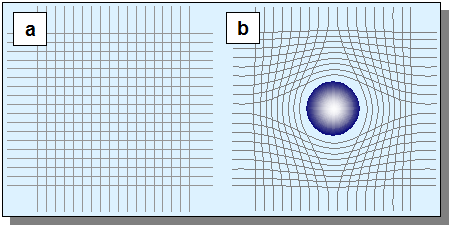 in the flat spacetime of special relativity, can obtain a deterministic evolution of the wave function, but not in the curved spacetime of the general theory of relativity, where a wormhole can create stagnation points. Hawking: “Watch out for wormholes: you never know what may come out of them.”
What follows are several pages on black holes, quasars and singularities (eek!), all leading to the fact that we cannot know the part of the wave function that is inside a black hole—potentially a very large amount of information! Eventually a black hole will lose mass, down to zero, and disappear completely, carrying its hidden information with it.
 Hawking explains:
“In general, . . . people such as astrologers and those who consult them are more interested in predicting the future than in retrodicting the past [love that word, “retrodicting”]. At first glance, it might seem that the loss of part of the wave function down the black hole would not prevent us from predicting the wave function outside the black hole. But it turns out that this loss does interfere with such a prediction.”
Without this hidden knowledge it is impossible to predict the spin or the wave function of the particle (in a virtual particle pair) that escapes the black hole—further reducing our power to predict the future. Is there no hope?
“If one particle falls into the black hole, there is no prediction we can make with certainty about the remaining particle. This means that there isn’t any measurement outside the black hole that can be predicted with certainty: our ability to make definite predictions would be reduced to zero. So maybe astrology is no worse at predicting the future than the laws of science.”
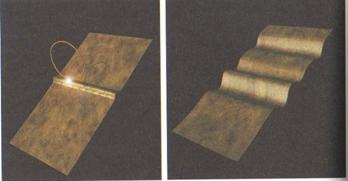 UNLESS . . . a black hole is made up of p-branes that move through ten dimensions (3 dimensions of space and 7 additional, unknown ones) that are regarded as sheets in the flat spacetime of special relativity (see above). In that case, time moves forward smoothly so the information in the waves won’t be lost! (Forgive me if I sound a little lost at this point.)
I hate to tell you that Hawking himself now asks:
“Does part of the wave function get lost down black holes, or does all the information get out again, as the p-brane model suggests? This is one of the outstanding questions in theoretical physics today.”
Even Stephen Hawking isn’t sure if “the world is safe and predictable or not.” So how can the rest of us be confident that our pea-brains can figure it all out? I welcome discussion, polite debate, and scientific updates or clarification in the comments section.
Thought: If the “wave function” is all we can predict, then what does this suggest for Tarot? What is the wave function in a Tarot reading?
I just had to add this additional piece from The Reader: An Illustrated Monthly Magazine, September, 1903, p. 331-332. (note: date corrected).
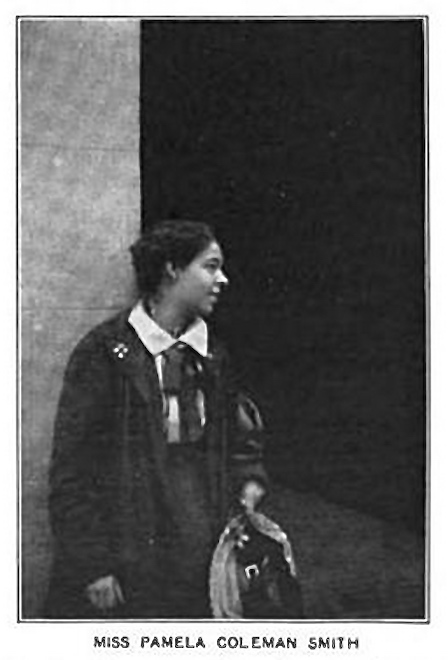
MISS Pamela Coleman Smith was born of American parents in London, where her father was at the time engaged in business. On both sides her forebears exhibited in some degree the tendencies which have brought Miss Smith to the front in literary and artistic circles. One may say that from her mother she derived an intense, individual creative desire, which very early in life began to satisfy itself in a curious sort of drawing, later developed into the style already so well known, especially in England. While she was still a child the family removed to the island of Jamaica, where she lived seven years. During the time her chief diversion, outside her drawing, was learning the West Indian negro folk-tales. A volume of this folk-lore was later published by Harper & Bros.; among her other activities in London are her readings from this collection. It is easy . to understand the grace of original composition in one so thoroughly imbued with the simple naturalness which characterizes the style of all spontaneous popular tales, lyrics and ballads.
Two years’ study at the Pratt Institute in Brooklyn, N. Y., followed this period. As no noticeable change showed itself in the character of her work under this tutelage, and as she became more determined to work out her own problems in her own way, she ended her connection with the school and shortly went to London, wehre she became identified with the Celtic movement. For some time she contributed regularly to “The Broad Sheet.” With the beginning of the present year, however, she started a paper of her own, called “The Green Sheaf,” of which thirteen numbers will be published annually. This she edits. To it also she contributes poems and illustrations in color. Herein lies the most striking feature of her work. For, whereas in outline the influence of the pre-Raphaelites is very evident, her colors and color-schemes are all her own. Though fantastically fanciful and in a way impossible, the Mendings always please. From recipes which she has evolved, she herself “prepares many of the unusual shades which she employs, adding more individuality to the general effect thereby. “It is very interesting to see her,” says one who knows, “dressed as ‘Gelukiezanger’ in parti-colored, gypsy-like gown and with beaded hair, sitting in Turkish fashion on the floor of a drawing-room, reciting her outland tales full of their queer conceits and unpronounceable names.” She is an indefatigable worker, enthusiastic and rapid.
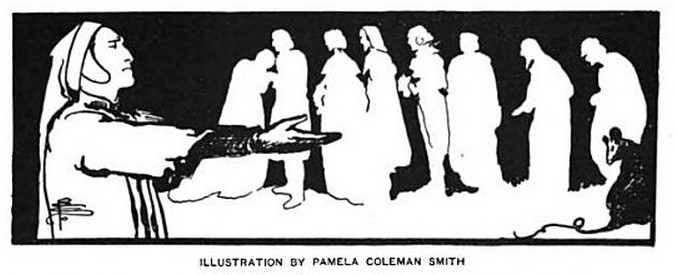
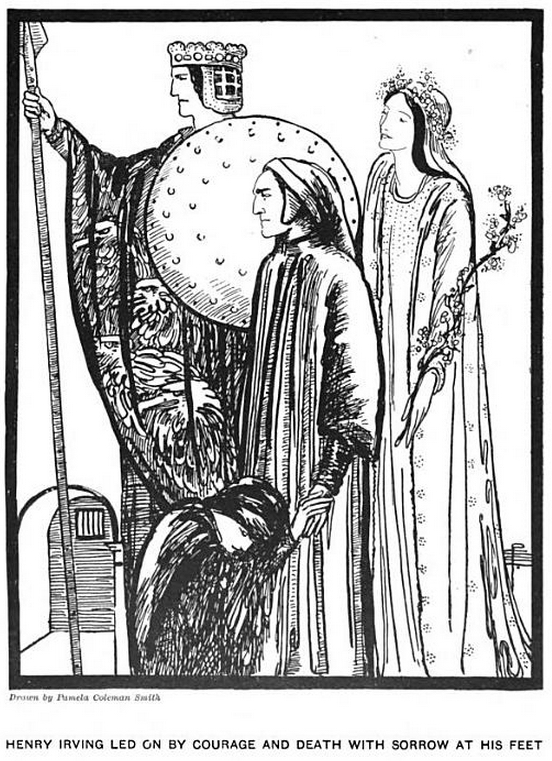
We reproduce two of Miss Smith’s drawings published in “The Green Sheaf” (colored, of course) at the time Sir Henry Irving was giving his farewell performances at the old Lyceum Theatre, now being torn down.
The following apologia appears on the cover of ” The Green Sheaf “:
“My Sheaf is small . . . but it is green.
I will gather into my Sheaf all the young fresh things I can—pictures, verses, ballads of love and rear; tales of pirates and the sea.
You will find ballads of the old world in-my Sheaf. Are the)—not green for ever . . .
Ripe ears are good for bread, but green ears are good for pleasure.”
With these later news articles it becomes apparent how much of Pamela Colman Smith’s work has been lost. We find a tendency among the reporters to “damn with faint praise” as Pixie moves out of the realm of neighborhood parlour entertainment and begins to be taken seriously by people like Alfred Stieglitz—always dangerous for a woman of the time. I’ve placed Pixie’s paintings-to-music here rather than in my 1907 post (when she began exhibiting them) because these news articles are more slanted toward her musical works. See also this article in Current Literature on “Pictured Music.”
Stieglitz purchased quite a few of Pixie’s paintings, which Georgia O’Keefe sold off separately soon after he died—despite his desire, stated in his will, to keep them together—amid some speculation that a decades-old jealousy was involved. The Delaware Art Museum has a few in of her works in their collection and produced an exhibit in 1975 curated by Melinda Boyd Parsons (she wrote the catalog and has an unpublished biography of Smith), also shown more recently in Santa Fe. 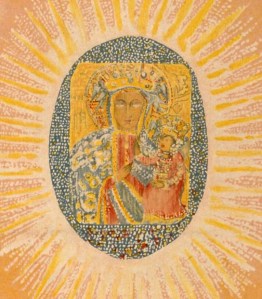 We now know for certain, from the article in the Brooklyn Daily Eagle, that Pixie split up her drawings for the Tarot deck, bringing some of them to the US. In what attics might they still reside?
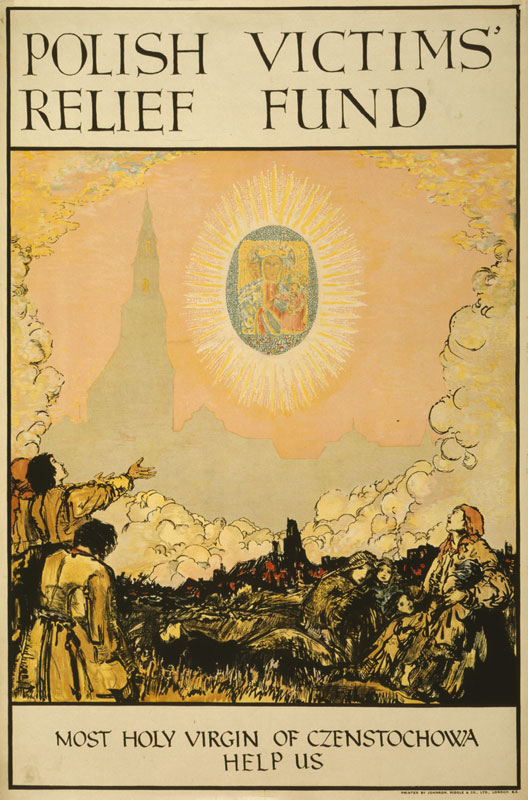
Demonstrating Pixie’s evolving Catholicism, we find a series of works called the “Litany of Loreto,” described as “byzantine” and taking their names from the call-and-response list of titles given the Blessed Virgin Mary in 1587: Spiritual vessel, Mystical rose, Tower of David, Tower of ivory, Morning star (see below in Latin). This poster featuring the Holy Virgin of Czenstochowa (c. 1915-18) is the only hint we have of what the “Litany” paintings may have been like:
“strong and full of the mystic, impressive power”
Mon., Mar. 18, 1912
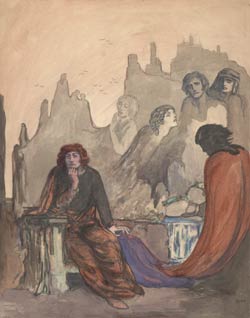
Schumann’s “Doubt”
Pamela Coleman Smith, a Brooklyn artist who made a name for herself early in her career at the Pratt Art Department, is exhibiting “drawings suggested by music, paintings on silk, and other original work” at the Berlin Photograph Company, Manhattan. There are twenty paintings on silk, framed like water colors and her handling of the material is very clever, having much of the strength of water colors, added to the softness of the silk texture. Five pictures exemplify what Miss Smith’s ideas of five Debussy compositions are: “L’Isle Joyous,” Gardens in the Rain,” “The Little Shepherd,” “What the West Wind Saw,” and “Snow is Dancing.” The first two pictures are in the Japanese style, largely, and have gorgeous color schemes. Less fantastic is “The Tree of Dawn,” suggesting an aria, by Mozart; it is the best of the paintings, full of tempered imagination and fine in color. “The Little Shepherd” is charming and natural. When Miss Smith does not give her fancy full rein, she is more enjoyable purely and simply. There is a fine sense of rhythm and swing to her pictures. When the drawings have the merest touches of dark, for example, there is a freedom and action about them which is impressive. “Spring Carried by Showers,” suggesting an aria, by Arthur Foote, and “People of the Rain” are two interesting paintings; in the first the goddess is carried in a litter by personified rain columns, and in the latter, rain people are suggested by falling masses of rain; they are two most attractive designs. “Dancing Trees,” and “Rain Passing Through a Valley.” both inspired by Dvorak music, are tree forms and rain forms, made into figures, cleverly and charmingly. “Snow is Dancing” and “Cloud Faces” are two more nature studies in which faces look out at you from the contours of snow and cloud. “The Ship of Dreams” and “Dreams Returning Home” (Nachstuck), the latter by Schumann, are very different, one being a fantasy and the other a realistic theme where dream people are shown returning home up a hill, toward its top, where a figure stands unfurling a flag. “Ruined Temples and Spilt Wine,” “Seven Towers of Fairy,” “Blue Smoke” and “Phantom Inn” are other color pieces. Designs for the “Litany of Loretto” are: “Vas Spirituale,” “Rosa Mystica,” “Turris Muideca,” “Turris Eburicca” all weird and mystical. A Caesar Franck Prelude has suggested a woman with a paddle in a foreground of rushes an a man in the distance with a paddle.
Hamlet is not a musical reflection but is strong; the snow drifts around the Dane and his ghostly father. “The Call to Earth” is a Caesar Franck idea, and is clever and imaginative, but most persons will prefer to retain their own impressions of what music suggests rather than exchange them for other’s thoughts. Some of these sonatas, arias and symphonies are highly descriptive, suggesting “Dancing Cloud,” “Ruined Temples and Spilt Wine,” “Seven Towers of Fairy,” “Blue Smoke” and “Phantom Inn.”
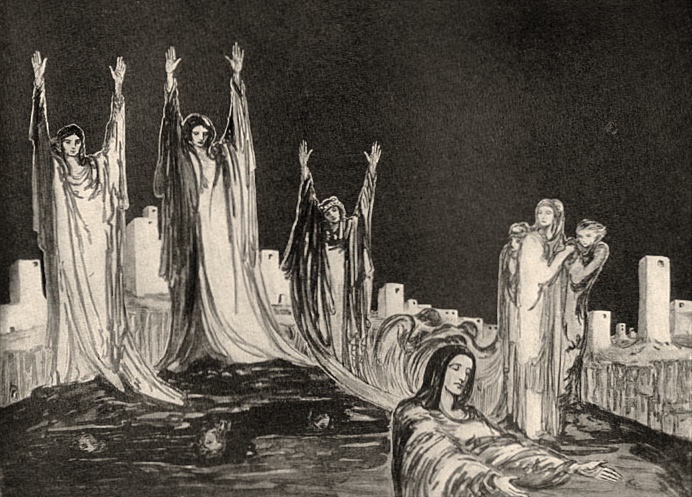
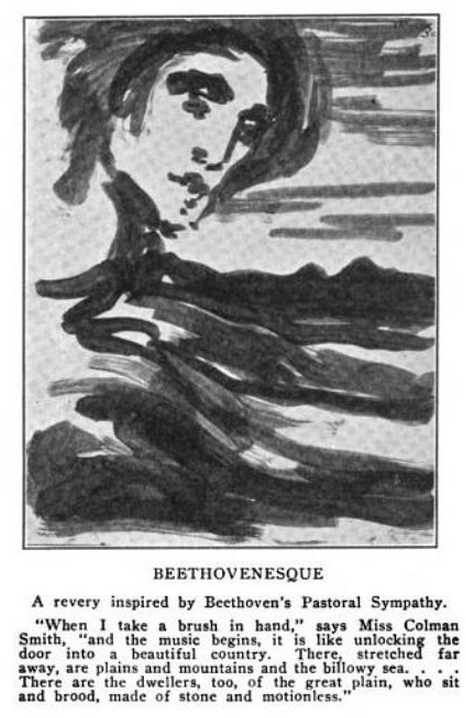
Beethoven’s Symphony #5
The drawings are strong and full of the mystic, impressive power. Miss Smith’s conception of the “Appassionata Sonata” is a swanlike figure, huge and having the face of a woman, billows and turrets, or they may suggest trees, to some observers. The Mozart music themes are interesting as the dress of the time, figures in the drawing. A Schumann symphony suggests a swaying, giant woman’s figure and a background of trees. Miss Smith takes violin concertos, fugues, quartets and other musical divisions to make pictures about. “E Tourdine” shows Debussy’s music suggesting two figures bearing heavy burdens. Strauss music suggests a bold and mystical drawing to Miss Smith.
The designs for a set of Tarot cards are excellent. “Page of Cups,” “Page of Pentacles,” “Ace of Swords,” “Nine of Swords,” “ Five of Cups,” “Four of Wands.” Several hand colored prints are included in the exhibition: “Alone,” “Charles and Annie,” “The Recitation” and other designs.
— The Brooklyn Daily Eagle
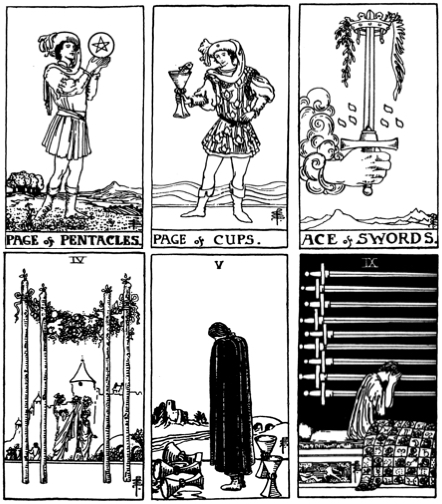
Drawings brought to US by PCS, 1912.
“an imagination of no common order”
Sun. Mar. 17, 1912
Henry James has called music “the great dissolvent,” but after looking at the exhibition of drawings “suggested by music” at the Berlin Photographic company signed Pamela Coleman Smith, one is inclined to think the precise opposite. Miss Smith’s lines seems to quicken into creative activity when she listens to music. The sound waves set her pencil weaving strange arabesques and always to a distinctly recognized rhythm. She is nothing if not rhythmic. Mr. Birnbaum tells us that the artist makes her designs in the concert room. But we hasten to assure those to whom this mixing of the sister arts is incomprehensible that these drawings qua drawings may be enjoyed without their musical genesis obtruding itself. If Miss Smith is affected by music and produces work of such a distinctive delicacy, charm, subtlety, why that is her own psychology. Certainly some of the Debussy illustrations are as satisfactory as their tonal originals. Debussy thinks so himself, owns and admires an entire portfolio.
“Snow is Dancing” is truly an evocation in which the decorative impulse looms large; “Garden in the Rain” is lyric. “People of the Rain” betrays true fantasy; indeed, fantasy rules these singularly attractive paintings on silk and all the drawings. Since Miss Smith first exhibited at Mr. Stieglitz’s Photo-Secession Gallery she has much improved technically. Her line is less crabbed, more firm and sweeping; her color sense is warmer. Naturally these memoranda are never welded into a whole. Miss Smith has yet to make a composition. She has a preference for ultramodern music, possibly because of its indeterminate form, its raporous melancholy and its rhythmic variety, yet she can ring in a virile manner the changes on Beethoven as exemplified in the Appasionata Sonata op 57. Her water colors are exquisite notations. Let us suggest that the entire collection be taken at its face value, artistically speaking, without troubling over the evasive correspondence of tone and form. Theophile Gautier’s poem, “Correspondences,” might serve as a general title for the entire exhibition. The designs for the Litany of Loreto—Rose mystical, Turris Davidica, Turris eburnea and Stella matutina—demonstrate an imagination of no common order. They are decorative, spiritual and with a touch of the hieratic that may be noted in Byzantine art.
— The Sun (New York)
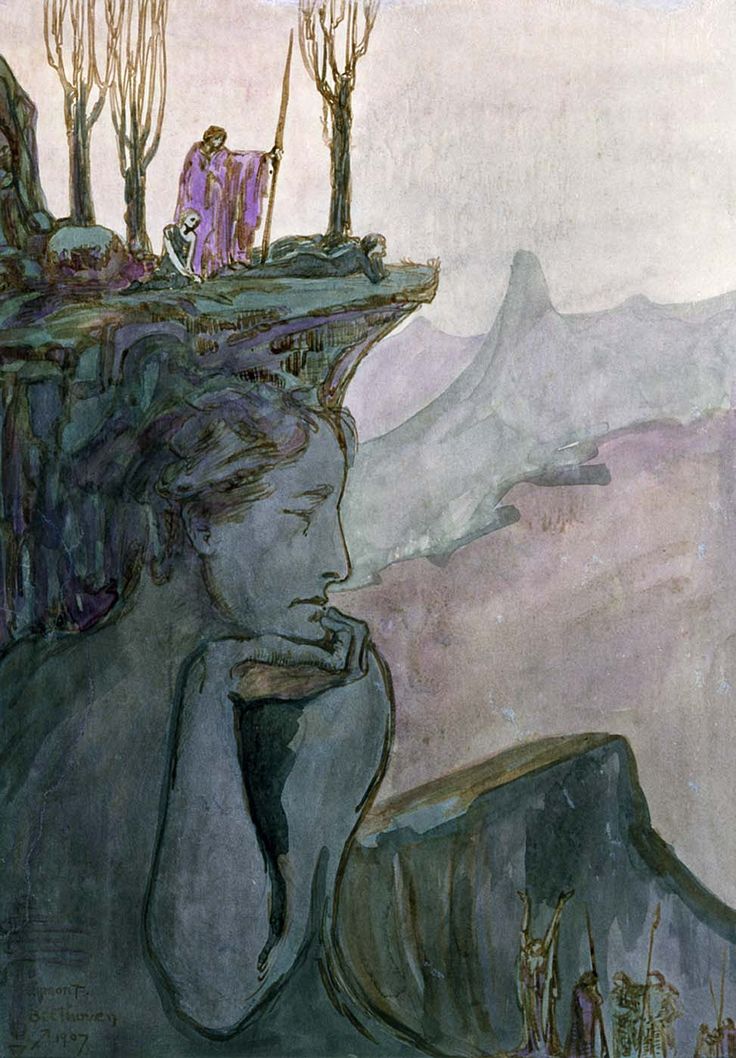
Overture. “Egmont” Beethoven, 1907
“we must not take these very personal expressions too seriously”
Mar. 17, 1912
“Illustrating Music”
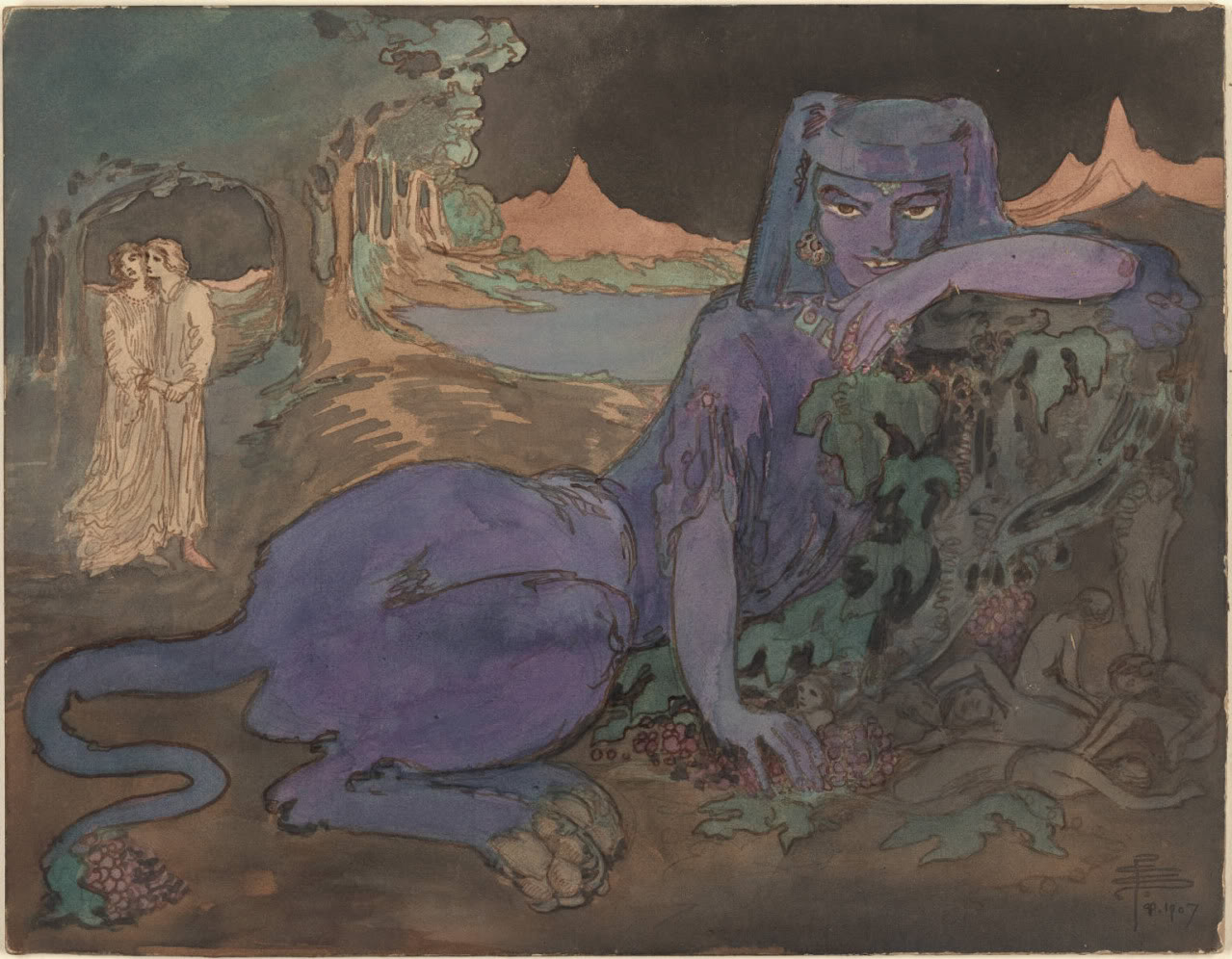
The Blue Cat, 1907
Pamela Coleman Smith is exhibiting at the Berlin Photographic Company’s gallery a group of drawings made to music. Her method is simple. She is not a musician and the laws of structure and harmony known to the composer are not in her mind. While she listens to music she draws lines suggested by the emotion the music causes. Sometimes they are long and slow, sometimes broken and staccato, sometimes whirling, sometimes curly and rococo, and the observer recognizes in some of them his own impressions while listening to certain movements.
It is a guileless art rooted in the great truth that all arts meet somewhere on common ground; but too much easily could be made of it. Miss Smith is sensitive to inspiration and delightfully suggests spontaneous feeling. Many a well-trained painter fails to do this. On the other hand, a painter as well grounded in his art as the musical composers illustrated in this charming exhibition are in theirs would probably not interrupt the rhythms of his line so inadvertently as we frequently find them interrupted here. Three dancing figures twining in swift movement are to the laymen very inspiring, but an artist would feel impatient at noting a stiff little square made by four unnecessary accents of dark among the flowing rhythms, which only means, of course, that we must not take these very personal expressions too seriously.
Miss Smith has given pleasure in a very quaint and personal manner. In a few of her drawings she communicates a genuine thrill, and all are well worth seeing for a quiet half hour. In her paintings, several of which are also on exhibition, she shows anew her fine sense of color. Her hilltop with a sky full of the tints of dawn and the figures of dreams trooping homeward is a rare piece of color and a lovely little fairy story.
All the work, drawings, and paintings alike illustrate childlike feelings and imaginings, and have a sweet, old-fashioned freshness of style, a simplicity of thought not often to be found in public galleries. Children love Miss Smith’s drawings because they retain the sparkle of childish fantasy.
— New York Times
 Mary K. Greer has made tarot her life work. Check here for reports of goings-on in the world of tarot and cartomancy, articles on the history and practice of tarot, and materials on other cartomancy decks. Sorry, I no longer write reviews. Contact me
 Mary K. Greer's Tarot Blog

Recent Comments