You are currently browsing the category archive for the ‘Tarot Tips & Techniques’ category.
Part I: Skeptics, Mentalists and Tarot Readers
 For purposes of this article let us assume that there is no paranormal or spiritual aspect to tarot readings. Let’s pretend, for the moment, that all tarot readings have a rational basis in easily explained normal human skills.
Skeptics and mentalists reduce tarot reading to just this level. Mentalists utilize skills to make money in public performances, while skeptics denounce any tarot or psychic readings that don’t acknowledge they are merely mental tricks. They claim “pseudo-psychics” exploit human weaknesses and take advantage of the desire to easily gain benefit from something. Pseudo-psychic readings are seen as “too-good-to-be-true” and as giving false hope just to make money. Skeptics claim that psychic and tarot readings can be explained by techniques gathered under the terms Cold and Hot Readings. We will ignore hot readings (that fraudulently use information obtained ahead of time) as our purpose is to examine readings where nothing prior is known about the client. Read the rest of this entry »
I experienced a breakthrough regarding tarot when I realized that all the Major Arcana cards are operating somewhere within me at all times. I discovered this from doing a variety of twenty-two card spreads that show where each energy or archetype is operating at the moment. Of course some cards are emphasized or highlighted around particular issues. These are the ones that show up in smaller spreads saying: “Look at me. I’m what’s most important right now regarding your question.” It’s kind of like they’re doing a jig or vibrating more than the others, and thrusting themselves to the front to get your attention. Meanwhile, the others are in the background, quietly doing their own thing or maintaining the status quo.
Sometimes it’s worth seeing the whole picture to understand how each energy or archetype plays its role in relation to the others. There are several ways to do this. Read the rest of this entry »
This is the simplest, yet best, tarot game I’ve tried. I learned it in 1982 from David Quigley, creator of “Alchemical Hypnotherapy”.
It’s a great dinner party game that can be played by people who know nothing about tarot in that they are asked to free-associate about the images and symbols on the cards. A knowledgeable tarotist can act as guide and add insights and possibilities, but the ideal is to encourage each player to talk about what they see in the cards and in the other players. (Some shorter “ice-breaker” variations are described in the Comments.) Read the rest of this entry »
Is prediction what tarot reading is all about? What if it is not to learn that a particular thing is going to happen but, rather, to explore later what those cards can teach us about what does happen? What if the reading is simply to make us spiritually or psychologically aware of what’s really important and significant in life events—to wake us up to how the outer and the inner reflect each other in a meaningful way?
As an example, I’ll describe a very powerful experience a group of us had in one of my classes (permission granted to tell this story). I had proposed an experiment in prediction. Each member of the class was to draw a Major Arcana card to signify the most significant archetype that would be functioning over the following week. They were then to draw two Minor Arcana cards that would describe the situation that archetype would function within—giving us the particular circumstances and literal details. As a group we made predictions that would be evaluated the following week. (Without reading any further you may want to look at the three cards below and think what prediction you would make.)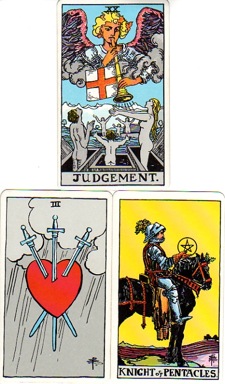
The cards Heidi drew from the RWS deck were Judgment, Three of Swords, and Knight of Pentacles. Knowing that Heidi’s father had recently died, we predicted that her feelings of grief for her father would be strongly triggered but would result in some kind of awakening or acceptance of her loss. She told us she would be going to his home three hours away to tie up his financial affairs and we warned that going through his papers would probably be very difficult.
When we gathered the following week Heidi told us that the reading had referred to a very specific dangerous and traumatic event. Given that the assignment was prediction, she wondered (as did we all) why no one had been able to warn her so she could have avoided it.
She had gone to the bank to close her father’s accounts when a man with a gun came in to rob the bank. As the robber waved his gun around, Heidi dropped to the floor in fear for her life. The robber even stepped on her shoulder when he took money from that cashier’s window. To add to it all, he had taken a bank deposit box withdrawal slip containing the address of her father’s house.
When a customer stupidly ran after the robber, Heidi had held and comforted his young daughter, assuring her that her father would be all right (although she couldn’t know that) and that the robber wouldn’t return.
She felt that Judgment referred to her fear for her life. Heidi had faced the thought that she might be meeting her maker. The Three of Swords was her terror and anguish, and the Knight of Pentacles was the robber (jumping in a getaway car with the money), as well as herself (traveling to the bank to deal with money issues). He might even have been the “hero” who tried to stop the robber from getting away. And, of course, it was her father leaving her.
The archetypal images in the Judgment card include a guardian angel, a “wake up call,” emergence from some kind of “boxed” thinking, and a child and parents. Something about being a child to a parent appeared to be breaking into consciousness. Having just lost her father, plenty of early childhood issues were being triggered in Heidi. She was able to be both guardian angel to a terrified child and the child herself.
Heidi also noted that, like in the movie Roshamon, everyone’s judgment varied. Each person at the scene described the robber differently (the three swords crossing each other). And, while most people turned in only a few lines of written description to the police, she had written at least a page and a half, even while realizing that her own judgments might be coloring what she said. Judgment would never mean the same thing to her again!
The strangest thing Heidi found was that she was left with a tremendous fear of revolving glass doors leading outside, and she remembers having had this fear when she was younger—although we didn’t have time in class to explore that. The revolving metal holding the glass was like the metal of the three crossed swords. Of course, death itself is a painful doorway—especially to those left behind on the other side. In essence, Heidi had been robbed of her father, but she ended up assuring a little girl (as well as the child within herself) that both her father and she would be all right. Would it have served her as well to have avoided the situation all together?
Everyone in class agreed that they could never have predicted a bank robbery from the cards Heidi had drawn. However, looking back on the incident, we saw how perfectly they describe the robbery. Much more importantly, they indicate how Heidi was affected and point to unconscious complexes that were triggered by the events. An experience she’ll never forget also became a rich vein of personal alchemical gold that Heidi will be able to mine for years, using the cards in the reading as guides to layers of healing.
So, is tarot best at prediction (since it is too often a hit-or-miss proposition), or is it more ideal for reliably exploring the deeper significance of whatever does happen?
The Hermetic Order of the Golden Dawn introduced what I consider the most extensive and elegant set of correspondences among the tarot and other magical systems. Here is a permutation I hadn’t seen before. It’s from The Magical Writings of Ithell Colquhoun edited by Steve Nichols. Colquhoun was an artist, magician and the biographer of MacGregor Mathers (Sword of Wisdom-o.p.). Magical Writings contains over a hundred pages of text on the Major Arcana (material on the last five cards added by Steve Nichols), plus reproductions of pages from Colquhoun’s tarot notebooks. It’s a treasure-trove for the discerning reader.
THE PLANETARY TRIPLICITIES – based on correspondences to the planets and the signs they rule.
MERCURY: Magus, Lovers, Hermit (Mercury, Gemini, Virgo)
MOON: Priestess, Chariot, Hanged Man (Moon, Cancer, Elemental Water)
VENUS: Empress, Hierophant, Justice (Venus, Taurus, Libra)
SUN: Sun, Strength, Judgment (Sun, Leo, Elemental Fire)
MARS: Tower, Emperor, Death (Mars, Aries, Scorpio)
JUPITER: Wheel, Temperance, Moon (Jupiter, Sagittarius, Pisces)
SATURN: World, Devil, Star (Saturn, Capricorn, Aquarius)
(Fool = Elemental Air)
These groupings can be very handy in a reading where the occurrence of two or three cards from one of the triplicities indicates a strong influence by that planetary energy. Mythically, it suggests the presence of that God/dess messing around in one’s life.
One of the simplest ways to start writing your own tarot poetry is to begin with the haiku format. There’s something about following it’s basic rules that frees up the creative sense. Since there are three lines you can either dedicate the whole poem to one card or use it for a three-card reading—one line for each card in your spread. (I write a haiku for each of the three cards and then take one line from each to form a fourth haiku that integrates those three cards.) Different decks tend to evoke entirely different “voices” in your haiku. Try it, and you’ll see what I mean.
Want some inspiration? You’ll find lots of examples, support and no criticism at Aeclectic’s Tarotforum haiku thread here.
The following are a few haiku rules, which you can feel free to break or use as you will.
A haiku describes natural phenomena in the fewest number of words, making an indelible impression on the reader. It calls attention to an observation and in effect says, “Look at this” or “Think about this.”
It consists of 17 syllables, or less, in three lines:
5 syllables
7 syllables
5 syllables
Guidelines (follow only if you wish):
• Use the present tense.
• No titles or rhymes (except to name your card, if you wish)
• Include two images that create harmony or contrast so each enriches the understanding of the other.
• Either the first or second line ends with a colon, long dash or ellipsis (marked or not).
• The two parts create a spark of energy, like the gap in a spark plug.
• Limit the use of pronouns.
• Traditionally, each haiku contains a seasonal reference.
• Use common, natural, sensory words. Avoid gerunds and adverbs.
• Images often begin wide-angle, then medium range and zoom in for a close up.
• Present what causes the emotion rather than the emotion itself.
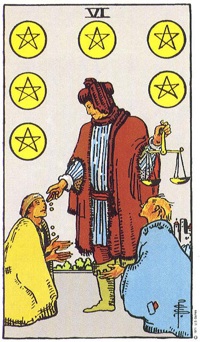 Do you have a tarot haiku? If so, please share it via the comments.
Here’s one based on a very literal description of the 6 of Pentacles:
Hands catch falling coins.
Under the balance, someone
reaches — emptiness.
In responding to a comment by tarotgirl about my previous post I wrote:
You can also create a spread around a definition or description of a single word or concept.
She asked: “How would you create a spread around a single word?”
So I thought I’d write my response here.
It’s not the word itself, but the definition of the word that I use. The parts of the definition become the position meanings and the word itself is the theme of the reading. Word roots could also be used.
I collect definitions of words that I find intriguing like for “symbol,” “imagination,” “meaning” and “myth.” Almost every writer on these subjects defines these words as they have come to understand and use them. Some of these definitions are very poetic, some strike at the heart of life’s dilemmas and issues. They can help us see the world and our mundane situations through a different lens, similar to what Rachel Pollack calls “Wisdom Readings” – but in this case, focusing on the wisdom in our own lives.
For instance:
According to Joseph Campbell: “A myth is a public dream; a dream is a private myth.”
You could draw two cards for what is the “public dream”/myth of your situation and what is the “private myth”/dream aspect of a situation. In doing this you take yourself out of the mundane level of what’s going on and choose to look at it from a wider perspective.
Or, Freud: “A myth is conscious ignorance and unconscious wisdom.”
You could ask “In this myth that I have about my mother . . . (add specific details) . . . : what is the conscious ignorance on my part (Card 1)? and what is the unconscious wisdom (Card 2) in that story?
Besides elucidating situations in your life, you can arrive at a very deep understanding of what the author of the definition was trying to convey. By operating “as if” this definition were true, you can also get a sense if it really works or not – it may just be a nice platitude that doesn’t go anywhere. Your life becomes the test case.
If you try this technique and like it, leave a comment and let us know what definition (or favorite quote) you used and how it worked.
Although I’ve been using this technique for a long time, I want to mention that the inspiring tarot author James Ricklef came up with it independently and taught it at one of the Bay Area Tarot Symposiums, using favorite quotes and proverbs. His book on creating spreads, Tarot: Get the Whole Story, is excellent.
Some tarot readers advertise themselves as psychic. Psychics often use tarot cards in their readings. There are a number of books and decks that use both psychic and tarot in their titles. They are seen together often enough that many people think you need to be psychic to read tarot. Yet few, if any, books give specific instructions for reading tarot psychically, nor do they describe how it differs from reading intuitively or by using fixed meanings. The vague discussion of psychic techniques in tarot reading has led to the comment, based on advice found in some books (but used pejoratively by detractors) that this is the “look at the card and just say anything that comes to mind” school. If it were this easy, why wouldn’t all our “unthinking” pronouncements yield lottery wins and ideal decisions? And why any need for psychic development classes?
Earlier, I talked about the difference between psychic and intuitive abilities. Here, I want to present a few thoughts on what is actually involved in the psychic aspect of reading the cards. Primarily it involves putting yourself in a state or framework conducive to psychic insights as well as using techniques that help you recognize and capture accurate insights (ones not tangled up with personal projections). In essence, it involves getting all your own stuff—everything that colors and distorts—out of the way of the raw information that is available to “other” levels of awareness. These techniques also aid in intuition.
I previously defined psychic as a paranormal, extrasensory perception or sixth sense. Psi involves accessing information beyond the reach of our normal input, though it may be associated with any sense. For instance, clairvoyant means “clear seeing,” clairaudient is “clear hearing,” clairsentient is “clear feeling.” There’s even a “clear smelling.” The field of ESP or psi also includes telepathy, mediumship and precognition.
Everyone is psychic. Some (as with artists and musicians) are more talented then others. Almost everyone can be taught to recognize and use psychic abilities to some extent. Basically it involves turning off or sidestepping the logical, analytical mind and the flow of negative and critical thoughts about being wrong. Instead you learn to open yourself to other modes of awareness. Stress and anxiety, though they can sometimes increase psychic sensitivity as part of a survival mechanism, more often inhibit psi. A positive attitude and belief certainly helps to increase psychic awareness.
The first instruction is usually to learn to meditate. By meditate, I mean to relax the body, breathe deeply and evenly (oxygenating the blood), and quiet the mind’s incessant chatter so as to quickly and easily reach an alpha and, eventually, a theta state (brain-wave frequencies similar to that found during dreaming and hypnotic trances). As the Buddhist meditation teacher, Thich Nhat Hahn observes, a meditation practice is precisely that—practice to enable you to quickly access these states when you need to. Such practice sessions are used, for instance, by Christian mystics who find that meditating on a spiritual text clears away irrelevant details and allows an image or idea to arise, as if out of a still pool, that captures the essential nature of the text. Other explanations are then recognized as superfluous ornamentation to this core message.
Meditation can result in a sensation of floating around in the ozone and coming back “spaced,” so along with it comes a whole variety of ways of centering the attention:—staring at something, concentrating on a word, or using a visualization whose intent is “grounding”. There is also a sense of being able to move through different “layers” of reality or consciousness and to widen or narrow one’s focus. These have been defined in each culture or group to fit in with their particular stories about what is happening—whether it’s Theosophy, shamanism, spiritualism, mysticism, or ceremonial magic. For instance, imaginative routines have been developed that help you choose and identify a layer or plane of consciousness that is most ideal for a specific task and to move energy from one plane to another, and even to effect physical world changes (known as “magic”). Some systems make use of an interior movie screen or crystal or library or a guide or ally to help bring the information through more clearly.
The fact is, if you’re psychically talented you probably don’t need to go through all these processes to get psychic impressions, but you may not be able to turn the impressions off when you want, or you may be unable to tell when information is for you or someone else. Additionally, if you are not especially talented or are walled off from your psychic self, then these techniques are the basis of an effective training program. The meditation and visualization techniques are designed to enable you to control when and how the psychic information presents itself to you.
On its own, psychic sensitivity often operates in cycles through your life. Certain circumstances, which you probably won’t be able to identify, will trigger a phase of being more or less psychic. “Psi tech” can even these fluctuations out. Fluctuations in ability are one reason why many psychics and mediums have resorted to fraudulent practices. It’s bad for business when you aren’t always psychically “on.”
Now, when it comes to tarot, a psychic will usually approach the cards differently then someone who reads them primarily through symbolic meanings. When using symbolic meanings we learn that “ones,” for instance, indicate new beginnings, a focused will and individuality, and that flowers mean a “flowering” or cultivating something beautiful, and that red is about energy and passion. We put these things together to come up with an interpretation of their melded meanings. It’s in the “melding” that intuitive and psychic insights often make their way in.
By contrast, when working psychically (and there is much variation in the way this can be done), you don’t focus on the details at first. Rather you use what I call “diffuse awareness.” Let me give you an example and a practice technique.
Ideally, you would have someone you don’t know well sitting across from you who thinks of their question while shuffling but doesn’t say it aloud. If practicing by yourself, try to not think of anything. Use breath and relaxation to center and ground yourself.
Instead of using a spread, take the shuffled deck and throw the top five cards face up onto the reading surface so that they overlap each other slightly and at random angles. Keep your awareness open and diffuse—as if trying to be aware of what’s at the edges of your visual range without actually looking there. It may help to keep your eyes only half open. Glance at your “pile” and catch a sense of the color emphasis. Look away keeping your eyes unfocused. Was one area more red then another? Did blue peep through on the right side? Was a predominantly yellow card separated from the others? Look again quickly if you need to. Then, let your mind be filled with these different areas of color. How do they feel? What do they want of you? Notice any sensations that arise in your body. Speak these feelings and impressions out loud without censoring anything. In fact, try to reel in anything that flickers at the edge of your awareness or that you find yourself resisting or negating. Be a little silly. Say the ridiculous.
Now glance at the cards again and notice what images catch your attention. Look away and do the same thing with the symbols and images that jumped out at you from the cards. Occasionally, as you speak, look back at the cards to catch another impression from them. Don’t get caught up in reading an individual card but rather try to keep a sense of them as a field.
Close your eyes, deepen your breath. Let yourself sink into the center of yourself. If there were a message in everything you’ve seen, said and felt, what is its essence? What do all these impressions want you to know? Finally, tell yourself you will remember everything that has occurred.
Take a deep breath and on the exhale deliberately come back to normal, waking consciousness. Stretch back into your usual self. If alone, write it all down. If with another person, now is the time to become analytical. Ask her what you said that seemed to work and was most accurate. Note what was going on when you said those things. Then ask her what seemed most inaccurate. Note if there was any difference in where that came from. Ask the person for any other impressions she had or things she noticed. If possible, write down what the person says and get an update in a couple of weeks and/or months. This is a way to discover and refine from where and how the most accurate information comes.
What I’ve noticed most about truly psychic, rather than intuitive, information is that it appears as well-known facts and so obvious that it’s not even worth mentioning. In fact, it’s so blatant and obvious that it would seem manipulative or embarrassing to state it and yet the thought doesn’t go away. For instance, once at a lecture just before the break, the speaker offered to give a book to anyone who knew the four-digit number she was thinking. I thought it was silly since the number was too obvious for words, but I wrote it down on my piece of paper and handed it in. After the break, but before the number was announced, she asked if anyone knew what the number referred to. Again, it seemed totally obvious it was her birth year. It mean, what else could it be? It was so silly I didn’t even bother to speak up. Well, I won the book and it was her birth year. It was only when I realized that none of the other 80-odd people had gotten it right that I realized anything out of the ordinary had happened—but it still felt absurdly obvious.
For me, psychic information comes without any emotion—it just is. I’m more strongly empathic (which is related but different), but even the “emotions” I sense have a certain charge-less quality to them. One other example happened at work in an office with several other people and one phone. The phone rang and I said, without thinking, “I’ll get it. It’s Terry (my then-husband), and he’s been in a car accident.” It was simply a fact, plus I knew he was all right. The problem was, he never forgave me, because the first words out of my mouth after he told me was, “How’s the car?” It was totaled, but he took my question as my caring more about the car then him, rather than my already knowing absolutely that he was unharmed.
Here are a couple of things to watch for. The points may seem to contradict each other, but part of the psychic character can be a certain paradoxical quality like perceiving something as both a wave and a particle.
• Watch for images, thoughts, impressions, smells at the edge of awareness.
• It may seem too obvious and ordinary a fact to be significant. Doesn’t everyone know it?
• The impression keeps slipping in, getting in the way of other things, though a part of you insists on ignoring it or telling you that you’ve made it up or that it’s irrelevant.
• There’s no emotional impact; it simply is (even when part of the impression is of an emotion). Occasionally psychic information can only reach you by making you sick but, usually, if you are anxious and afraid that something will happen (like your child getting hurt) it’s not a psychic insight but your own fears. I’ve used this last point as a test for years.
Finally, for most tarot readers, psychic insights are only a small part of what we do during a reading, and they can occur in ways I haven’t even begun to mention. Almost everyone who reads tarot reports an increase in psychic experiences. However, not all psychic predictions come to pass nor are all insights true in the way you think they are. Reading tarot is both an art and a responsibility so it pays to improve your inner tools and skills in every way that you can so that each ability can become a check-and-balance for the others.
It is assumed that tarot readers use either psychic or intuitive abilities. In fact, these are, almost always, among their skills. Querents usually come for a reading because they are looking for information outside the normal, rational processes for obtaining it. They want that “something extra,” even if it’s just entertainment.
What I want to query today is:
• Why are ‘psychic’ and ‘intuitive’ so often conflated into a single thing? (A web search on psychic + intuitive should convince you that the words often appear together to express the same thing.)
• As tarot readers do we know when we are using psychic rather than intuitive faculties and vice versa?
The terms psychic and intuitive actually describe two different processes that could be seen as opposite ends of a spectrum. One can even trigger another. By using both words together or interchangeably we attempt to cover all bases. Can we improve our skill in using these abilities? Yes. But it helps to differentiate between them— at least while developing them as skills.
Psychic is usually described as “extra sensory perception.” It accesses information beyond the reach of our normal senses. Thus, it is deemed paranormal; a sixth sense. The term psychic was first used by the French astronomer Camille Flammarion in the 1860s and, soon after, by the chemist William Crookes to describe the spiritualist medium Daniel Douglas Home. Originally it implied seership, prophecy or mediumship. Now it refers to a broad range of abilities including telepathy, clairvoyance, clairaudience, and precognition.
Psi research (parapsychology) has amassed enough evidence to convince all but a few of the most skeptical scientists, who have examined this evidence, of its existence. Even the CIA and then the military had what they called a “remote viewing” program from the early 1970s until 1995.
Intuition, on the other hand, is the completely normal functioning of human cognition. It is part of a bodily survival mechanism. It has been called gut feeling, a hunch, instinct or insight. It involves intelligence at work without conscious thought. Essentially it is the act or process of coming to direct knowledge without reasoning or inferring. With intuition we sense truth without explanations. Using unconscious forms of analogy and induction we instantly perceive connections and patterns. This sometimes results in a clear direction for action.
Both psychic awareness and intuition communicate to us through symbols, sensory feelings and emotions, which is one reason why they may be so hard to separate. With intuition, however, we can sometimes justify our hunches by backtracking and discerning sensory input and mental connections that only make sense after the fact. By contrast, with a true psychic impression a direct connection simply doesn’t exist, except, perhaps, when interpreting feelings and symbols in which the psychic impression can be cloaked.
I highly recommend two books for understanding and developing your intuition:
• Gut Feelings: The Intelligence of the Unconscious by Gerd Gigerenzer.
• The Gift of Fear: Survival Signals that Protect Us from Violence by Gavin de Becker.
Gerd Gigerenzer is a director of the Max Planck Institute for Human Development. His research was a major source for Malcolm Gladwell’s bestseller Blink. In Gut Feelings, he describes intuition as a judgment that appears quickly, whose underlying reasons we are not fully aware of, yet is strong enough to act upon. “It ignores information, violates the laws of logic, and is the source of many human disasters.” On the other hand, as Gigerenzer shows, it can outwit the most sophisticated reasoning and computational strategies.
Intuitional skills can be learned. Gigerenzer explains how it often works through simple rules of thumb that take advantage of cognitive abilities, recognition memory, social instincts, and visual tracking.
Gavin de Becker, in The Gift of Fear, says, “Intuition is the journey form A to Z without stopping at any other letter along the way. It is knowing without knowing why.” True, this book focuses on high-stakes predictions: how to spot subtle signs of danger to avoid violence. Yet, it is one of the best and most compassionate books I know that tells you how to recognize and when to trust intuition.
How do you tell the difference between fear that is true and fear that is unwarranted? “Intuition is always learning,” de Becker tells us, “and though it may occasionally send a signal that turns out to be less than urgent, everything it communicates to you is meaningful. Unlike worry, it will not waste your time.”
Intuition comes to us through emotions, persistent thoughts, physical sensations, wonder, anxiety and humor. De Becker’s “elements of prediction,” along with Gigerenzer’s “rules of thumb,” can help you make better decisions than just relying on reason alone.
Intuition can arise during a tarot reading in countless ways. One of these is when symbols in several cards suddenly seem to come forward and link together to reveal a repeating or developing theme. Everything else can appear to recede in the face of the insistence and aliveness of these symbols. In face-to-face readings, subtle clues from the querent—including things picked up from so-called “cold reading”—will echo meanings in the cards, creating a kind of resonance. Words said by the querent can ring with truth, especially when they match keywords for cards in the spread.
Tarot readers can become much more aware of when and how they access intuition in a reading. They can then help a querent recognize when the querent’s own intuitions have been activated and may contain valuable truths.
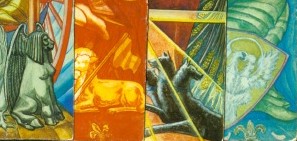
The picture above is an amalgam of four cards from the Crowley-Harris Thoth deck. Can you identify them?
I’ll write later about psychic development and another important ability in reading tarot, empathy.
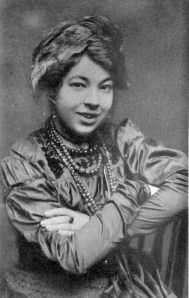
Pamela Colman Smith (also known as Pixie), artist of the Rider-Waite (Smith) Tarot deck, wrote nothing about the deck she created except in a letter to her mentor, Alfred Stieglitz, “I just finished a big job for very little cash!” She did tell us, however, in an article called “Should the Art Student Think?,” what must have been her own approach to reading the cards. This is the core of my own reading style.
“Note the dress, the type of face; see if you can trace the character in the face; note the pose. . . . First watch the simple forms of joy, of fear, of sorrow; look at the position taken by the whole body. . . . After you have found how to tell a simple story, put in more details. . . . Learn from everything, see everything, and above all feel everything! . . . Find eyes within, look for the door into the unknown country.”*
Essentially, she’s suggesting the following steps:
- Describe the card literally.
- Describe what seem to be the emotions, style and attitudes of the people on the card.
- Physically embody the card—act it out.
- Make up a story about what’s happening and turn it into a first person account (so you are feeling everything yourself).
- In your mind’s eye, step over the border of the card (through the door).
- Enter into that world, seeing beyond the borders to things you never knew were there.
In my opinion, this is the best way to discover what these cards mean for you in any situation.
 Mary K. Greer has made tarot her life work. Check here for reports of goings-on in the world of tarot and cartomancy, articles on the history and practice of tarot, and materials on other cartomancy decks. Sorry, I no longer write reviews. Contact me
 Mary K. Greer's Tarot Blog
Recent Comments