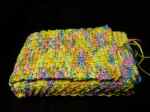
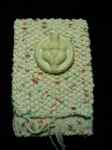
Here’s a few more tarot bags that I’ve knitted while watching TV this winter. The first picture is of a purplish drawstring bag made from two wool sock yarns mixed. My favorite yarn so far for my tarot cases is the 100% cotton Lily “Sugar ‘n Cream” 4-ply worsted (see the last two pictures – a flecked off-white and striped brown). This brand offers tons of colors and a whole set of “Naturals.” I use size US3 needles instead of the recommended US7 in order to get a tight knit which gives firmness to the bag and makes it feel more like a case. If you have a knitted tarot bag you like, send me a link to your pictures and/or knitting instructions and I’ll post them here.

Update: Check out Amber’s knitted tarot bags here and her limited edition Knitting Tarot deck and book here. Get instructions for knitting my Tarot case here.

Some tarot readers advertise themselves as psychic. Psychics often use tarot cards in their readings. There are a number of books and decks that use both psychic and tarot in their titles. They are seen together often enough that many people think you need to be psychic to read tarot. Yet few, if any, books give specific instructions for reading tarot psychically, nor do they describe how it differs from reading intuitively or by using fixed meanings. The vague discussion of psychic techniques in tarot reading has led to the comment, based on advice found in some books (but used pejoratively by detractors) that this is the “look at the card and just say anything that comes to mind” school. If it were this easy, why wouldn’t all our “unthinking” pronouncements yield lottery wins and ideal decisions? And why any need for psychic development classes?

Earlier, I talked about the difference between psychic and intuitive abilities. Here, I want to present a few thoughts on what is actually involved in the psychic aspect of reading the cards. Primarily it involves putting yourself in a state or framework conducive to psychic insights as well as using techniques that help you recognize and capture accurate insights (ones not tangled up with personal projections). In essence, it involves getting all your own stuff—everything that colors and distorts—out of the way of the raw information that is available to “other” levels of awareness. These techniques also aid in intuition.

I previously defined psychic as a paranormal, extrasensory perception or sixth sense. Psi involves accessing information beyond the reach of our normal input, though it may be associated with any sense. For instance, clairvoyant means “clear seeing,” clairaudient is “clear hearing,” clairsentient is “clear feeling.” There’s even a “clear smelling.” The field of ESP or psi also includes telepathy, mediumship and precognition.

Everyone is psychic. Some (as with artists and musicians) are more talented then others. Almost everyone can be taught to recognize and use psychic abilities to some extent. Basically it involves turning off or sidestepping the logical, analytical mind and the flow of negative and critical thoughts about being wrong. Instead you learn to open yourself to other modes of awareness. Stress and anxiety, though they can sometimes increase psychic sensitivity as part of a survival mechanism, more often inhibit psi. A positive attitude and belief certainly helps to increase psychic awareness.

The first instruction is usually to learn to meditate. By meditate, I mean to relax the body, breathe deeply and evenly (oxygenating the blood), and quiet the mind’s incessant chatter so as to quickly and easily reach an alpha and, eventually, a theta state (brain-wave frequencies similar to that found during dreaming and hypnotic trances). As the Buddhist meditation teacher, Thich Nhat Hahn observes, a meditation practice is precisely that—practice to enable you to quickly access these states when you need to. Such practice sessions are used, for instance, by Christian mystics who find that meditating on a spiritual text clears away irrelevant details and allows an image or idea to arise, as if out of a still pool, that captures the essential nature of the text. Other explanations are then recognized as superfluous ornamentation to this core message.

Meditation can result in a sensation of floating around in the ozone and coming back “spaced,” so along with it comes a whole variety of ways of centering the attention:—staring at something, concentrating on a word, or using a visualization whose intent is “grounding”. There is also a sense of being able to move through different “layers” of reality or consciousness and to widen or narrow one’s focus. These have been defined in each culture or group to fit in with their particular stories about what is happening—whether it’s Theosophy, shamanism, spiritualism, mysticism, or ceremonial magic. For instance, imaginative routines have been developed that help you choose and identify a layer or plane of consciousness that is most ideal for a specific task and to move energy from one plane to another, and even to effect physical world changes (known as “magic”). Some systems make use of an interior movie screen or crystal or library or a guide or ally to help bring the information through more clearly.

The fact is, if you’re psychically talented you probably don’t need to go through all these processes to get psychic impressions, but you may not be able to turn the impressions off when you want, or you may be unable to tell when information is for you or someone else. Additionally, if you are not especially talented or are walled off from your psychic self, then these techniques are the basis of an effective training program. The meditation and visualization techniques are designed to enable you to control when and how the psychic information presents itself to you.

On its own, psychic sensitivity often operates in cycles through your life. Certain circumstances, which you probably won’t be able to identify, will trigger a phase of being more or less psychic. “Psi tech” can even these fluctuations out. Fluctuations in ability are one reason why many psychics and mediums have resorted to fraudulent practices. It’s bad for business when you aren’t always psychically “on.”

Now, when it comes to tarot, a psychic will usually approach the cards differently then someone who reads them primarily through symbolic meanings. When using symbolic meanings we learn that “ones,” for instance, indicate new beginnings, a focused will and individuality, and that flowers mean a “flowering” or cultivating something beautiful, and that red is about energy and passion. We put these things together to come up with an interpretation of their melded meanings. It’s in the “melding” that intuitive and psychic insights often make their way in.

By contrast, when working psychically (and there is much variation in the way this can be done), you don’t focus on the details at first. Rather you use what I call “diffuse awareness.” Let me give you an example and a practice technique.

Ideally, you would have someone you don’t know well sitting across from you who thinks of their question while shuffling but doesn’t say it aloud. If practicing by yourself, try to not think of anything. Use breath and relaxation to center and ground yourself.

Instead of using a spread, take the shuffled deck and throw the top five cards face up onto the reading surface so that they overlap each other slightly and at random angles. Keep your awareness open and diffuse—as if trying to be aware of what’s at the edges of your visual range without actually looking there. It may help to keep your eyes only half open. Glance at your “pile” and catch a sense of the color emphasis. Look away keeping your eyes unfocused. Was one area more red then another? Did blue peep through on the right side? Was a predominantly yellow card separated from the others? Look again quickly if you need to. Then, let your mind be filled with these different areas of color. How do they feel? What do they want of you? Notice any sensations that arise in your body. Speak these feelings and impressions out loud without censoring anything. In fact, try to reel in anything that flickers at the edge of your awareness or that you find yourself resisting or negating. Be a little silly. Say the ridiculous.

Now glance at the cards again and notice what images catch your attention. Look away and do the same thing with the symbols and images that jumped out at you from the cards. Occasionally, as you speak, look back at the cards to catch another impression from them. Don’t get caught up in reading an individual card but rather try to keep a sense of them as a field.

Close your eyes, deepen your breath. Let yourself sink into the center of yourself. If there were a message in everything you’ve seen, said and felt, what is its essence? What do all these impressions want you to know? Finally, tell yourself you will remember everything that has occurred.

Take a deep breath and on the exhale deliberately come back to normal, waking consciousness. Stretch back into your usual self. If alone, write it all down. If with another person, now is the time to become analytical. Ask her what you said that seemed to work and was most accurate. Note what was going on when you said those things. Then ask her what seemed most inaccurate. Note if there was any difference in where that came from. Ask the person for any other impressions she had or things she noticed. If possible, write down what the person says and get an update in a couple of weeks and/or months. This is a way to discover and refine from where and how the most accurate information comes.

What I’ve noticed most about truly psychic, rather than intuitive, information is that it appears as well-known facts and so obvious that it’s not even worth mentioning. In fact, it’s so blatant and obvious that it would seem manipulative or embarrassing to state it and yet the thought doesn’t go away. For instance, once at a lecture just before the break, the speaker offered to give a book to anyone who knew the four-digit number she was thinking. I thought it was silly since the number was too obvious for words, but I wrote it down on my piece of paper and handed it in. After the break, but before the number was announced, she asked if anyone knew what the number referred to. Again, it seemed totally obvious it was her birth year. It mean, what else could it be? It was so silly I didn’t even bother to speak up. Well, I won the book and it was her birth year. It was only when I realized that none of the other 80-odd people had gotten it right that I realized anything out of the ordinary had happened—but it still felt absurdly obvious.

For me, psychic information comes without any emotion—it just is. I’m more strongly empathic (which is related but different), but even the “emotions” I sense have a certain charge-less quality to them. One other example happened at work in an office with several other people and one phone. The phone rang and I said, without thinking, “I’ll get it. It’s Terry (my then-husband), and he’s been in a car accident.” It was simply a fact, plus I knew he was all right. The problem was, he never forgave me, because the first words out of my mouth after he told me was, “How’s the car?” It was totaled, but he took my question as my caring more about the car then him, rather than my already knowing absolutely that he was unharmed.

Here are a couple of things to watch for. The points may seem to contradict each other, but part of the psychic character can be a certain paradoxical quality like perceiving something as both a wave and a particle.

• Watch for images, thoughts, impressions, smells at the edge of awareness.

• It may seem too obvious and ordinary a fact to be significant. Doesn’t everyone know it?

• The impression keeps slipping in, getting in the way of other things, though a part of you insists on ignoring it or telling you that you’ve made it up or that it’s irrelevant.

• There’s no emotional impact; it simply is (even when part of the impression is of an emotion). Occasionally psychic information can only reach you by making you sick but, usually, if you are anxious and afraid that something will happen (like your child getting hurt) it’s not a psychic insight but your own fears. I’ve used this last point as a test for years.

Finally, for most tarot readers, psychic insights are only a small part of what we do during a reading, and they can occur in ways I haven’t even begun to mention. Almost everyone who reads tarot reports an increase in psychic experiences. However, not all psychic predictions come to pass nor are all insights true in the way you think they are. Reading tarot is both an art and a responsibility so it pays to improve your inner tools and skills in every way that you can so that each ability can become a check-and-balance for the others.
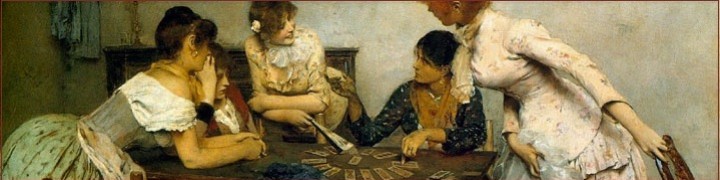
As an update to my earlier post on Carl Jung and Tarot, I just received a paper from the Jung Institute library in New York. It contains brief notes Hanni Binder took of Jung’s descriptions, in German, when he spoke to her about the Tarot cards. A friend of hers made a literal translation into English, typing it onto large file cards. What follows is Jung’s verbal description of the Major Arcana. They are based on cards from the Grimaud Tarot de Marseille, which he felt most closely contained properties he recognized from his reading of alchemical texts. I have corrected obvious errors in language, but kept these changes to a minimum. My own comments are in brackets [ ].

If you are familiar with Jung’s core concepts you’ll find several of them referred to directly or indirectly: Self, Shadow, extraversion, intraversion, conscious, unconscious, fate, center, inflation, compensation, sacrifice, etc. Notice also his interest in what’s held in the right and left hands as indications of masculine/active or feminine/passive (I prefer ‘receptive’) energies. These notes are simplistic but were obviously only meant to be a starting place for further exploration.

ADDED: Japanese tarotist, Kenji, discovered that Jung’s descriptive text comes almost directly from Papus’ Tarot of the Bohemians (thank you, Kenji). However, Jung seems to have added several keywords from his own psychological lexicon as I noted above. Comparing these two texts will clarify what ideas Jung added.

1 The Magician

The Magician has, in the right hand, a golden ball, in the left a stick [wand]. The hat makes an eight [infinity sign]. The bearing of the hand shows right activity, left passivity. Sign of force, stability, self. He has all the symbols before him.

2 The High Priestess

Sitting Priestess. She wears a veil. On her knees is a book. This book is open. She stands in connection with the moon. Occult wisdom. Passive, eternal woman.

3 The Empress

Empress with wings. In the right hand she has an eagle, in the left a scepter. She has a crown with 12 stones. Eagle as a symbol of soul and life. Feminine activity. Fruitfulness, goddess.

4 The Emperor

Emperor sitting in profile. In the right hand he is holding the scepter. He wears a helmet with 12 stones. The legs are crossed. Will, force, reality, duty, brightness.

5 The Hierophant

The Hierophant leans on a three fax[sic – triple?] cross. The two columns are standing on the right as law, on the left liberty. Two men are kneeling before him: one is red, the other black. Will, religion, fate [faith?], Self, center.

6 The Lovers

The young man stands in a corner where two streets come together. The woman on the right has a golden garland on her head. The woman on the left is wreathed with a vine. Beauty, cross-road, way inward or outward.

7 The Chariot

Conqueror with coronet. He has three angle [right angles on his cuirass]. In his hand is a scepter. Arrow and weapon arm [right hand?]. Actively going toward his fate. He has a goal, achieving victory. Activity, extraversion. Inflation.

8 Justice

Sitting woman with a coronet. In the right hand she has a sword, in the left, a balance [scales]. Compensation between nature and the force of a man. Justice, compensation. Conflict with the law.

9 The Hermit

An old man walks with a stick [staff]. Wisdom as symbolized by the lamp. Protection with the overcoat. Cleverness, love, introversion. Wisdom.

10 Wheel of Fortune

Sphinx holding a sword. Wheel symbolizing endlessness. Finger as a sign of command. Human being as ball [circumference?] of the wheel of fortune. Luck/misfortune.

11 Strength

A young girl opens the mouth of a lion. The girl has the sign of vitality on her hat. Liberty, strength.

12 The Hanged Man

The hands of this man on in back. The eyes are open. The right leg is crossed. On the right and left a trunk of a tree. Turning back [enantiodromia?], powerless, sacrifice, test, proof. Face against the sky.

13 Death

A skeleton in a field with heads and fingers. Death and regeneration. The Ego should not take [the] place, the Self has to take [the] place. New standpoint, liberation, end.

14 Temperance

Young girl pours water from one jug in the other. The sun gives the liquid of life from a golden in[to] a silver jug. Movement, consciousness, natural growth.

15 The Devil

The right hand of the Devil is raised to the sky, the left points to the earth. Two persons are under him. He holds the torch as a sign of black magic. Fate, Shadow, emotion.

16 The Tower

Burning tower. Hospital, prison, struck by lightning. Sacrifice.

17 The Star

A naked woman spills water from two jugs. Around the girl are seven stars. The Self shines, stars of fate, night, dreams. Hope. The Self is born in the stars. Union with the eternal.

18 The Moon

In the middle of a field is a dog and a wolf. A crayfish comes out of the water. It is night. The door to the unconscious is open. The crayfish likes to go the shore. The light is indirect.

19 The Sun

Two naked girls. The sun shines on the children. Drops of gold fall on the earth. The Self is ruling the situation. Consciousness. Enlightenment.

20 Judgement

An angel with fiery wings, an open grave in the earth. Birth of the Self. Inspiration, liberation.

21 The World

Naked woman, her legs are crossed. In the four corners we have the angel, the lion, the bull and the eagle. Completion, finishing. In the world but not from the world.

0 The Fool

A man who doesn’t take care on his way. Beginning and end. The fool has no home in this world; the home is in heaven. Dreamer, mystic side.

Masculine cards:

Wands = Libido [sexual drive]
Swords = Spiritual force

Feminine cards:

Pentacles = Material
Cups = Feeling

Added note on the Four Suits: Jung obviously failed to link the four suits to his four psychological types or functions, based on the quaternity of elements and humors. However, with the “Feminine” suits he came close, calling Cups Feeling, while Pentacles as Material is close to Sensation. Most people link Intuition with Wands and Thinking with Swords.  Jung’s most succinct explanation of his psychological types can be found in Man and His Symbols (highly recommended reading for anyone interested in a Jungian approach to tarot):

  • Sensation tells you that something exists (through the senses).
  • Thinking tells you what it is (its definition).
  • Feeling tells you whether it is agreeable or not (its value).
  • Intuition tells you whence it comes and where it is going (its possibilities).


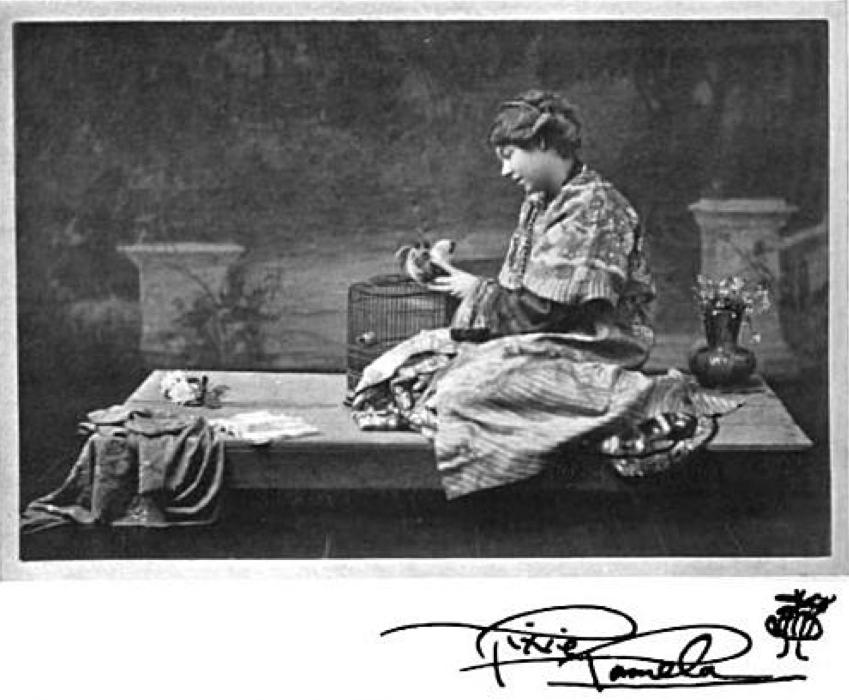
Pamela Colman Smith never became well-known as an artist and, without the Tarot deck she illustrated, she may have fallen into total obscurity. Stuart Kaplan, president of U.S. Games, Inc. says he could have made her a millionaire.

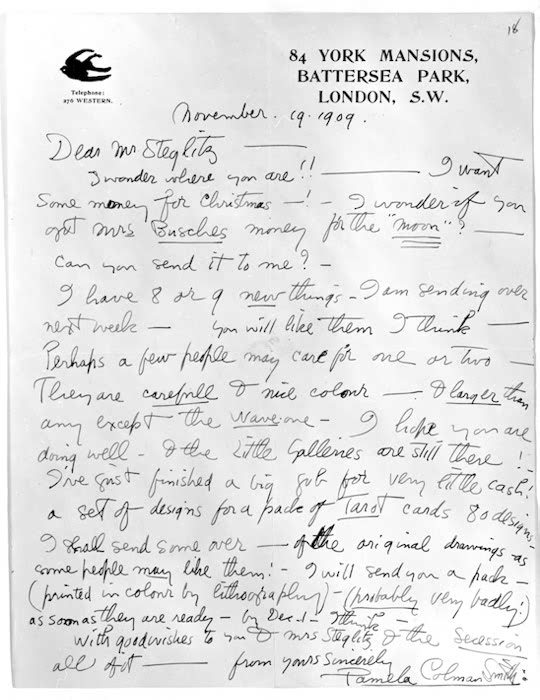
The only comment from Pixie Smith about the creation of the tarot deck was in a letter to her mentor Alfred Stieglitz (click on the letter to see a larger version).

You can see much of the artwork of Pamela Colman Smith at these sites (thanks especially to Roppo and Holly Voley for their efforts to make Pixie’s work available to the rest of us):

• All the card images from Holly Voley’s first edition deck (“Pamela A”) and from The Pictorial Key to the Tarot at the Sacred Texts site

• Roppo’s The Works of Pamela Colman Smith – page 1

• Roppo’s The Works of Pamela Colman Smith – page 2

A Portrait of William Butler Yeats by PCS

A Broad Sheet

The Shakespeare’s Heroines Poster

A Variety of Works by Pamela Colman Smith from Holly Voley’s site

Including my own copy of her book Chim-Chim: Folk Stories from Jamaica

• Susan and the Mermaid, an illustrated children’s story by PCS, republished by Corinne Kenner

Tales for Philip and Peter, illustrated by PCS

The Pamela Colman Smith Collection at Bryn Mawr

Paintings at the Beinecke Rare Book and Manuscript Library – search on Pamela+Smith, and while you are there, see their collection of 15th century Tarot cards by searching on Tarot.

• K. Frank Jensen’s Waite-Smith Tarot Research

• Here’s an outstanding website by Phil Norfleet devoted to PCS with a lot of biographical information not found anywhere else.

“‘We Disgruntled Devils Don’t Please Anybody’: Pamela Colman Smith, The Green Sheaf, and Female Literary Networks” article by Elizabeth Foley O’Connor in the South Carolina Review.

• See Pixie’s artwork archived at Ellen Terry’s home, Smallhythe – here.

Articles by and about PCS can be found by searching The Craftsmanhere (search on her name).

• Pamela Colman Smith & “De Six Poach Eggs” (story)

• Secrets of the Waite-Smith Tarot by Marcus Katz and Tali Goodwin.

Video by the Japanese collector of the works of Pamela Colman Smith, Roppo (see links above):

Correction to video: I don’t know of any evidence that suggests that PCS was adopted by her parents. However, she did become the foster daughter of the great actress, Ellen Terry.

See my post on Pixie’s instructions for reading the cards here. Let me know if I’ve missed anything and I’ll add it to the above list.

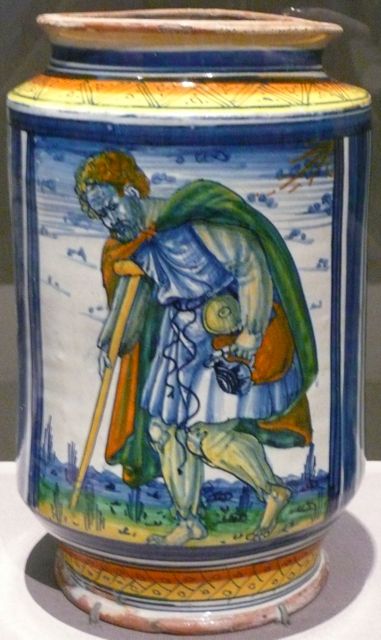
I went to visit my daughter in Los Angeles and for the first time saw the exhibits at the J. Paul Getty Museum. While the collection on view is small, there were quite a few pieces from Renaissance Italy. It’s always astounding to me how much of the art from that period portrays images similar to those in the tarot. Judge for yourself:

The Hermit – circa 1510 century earthenware jar. Also similar to the RWS 5 of Pentacles.

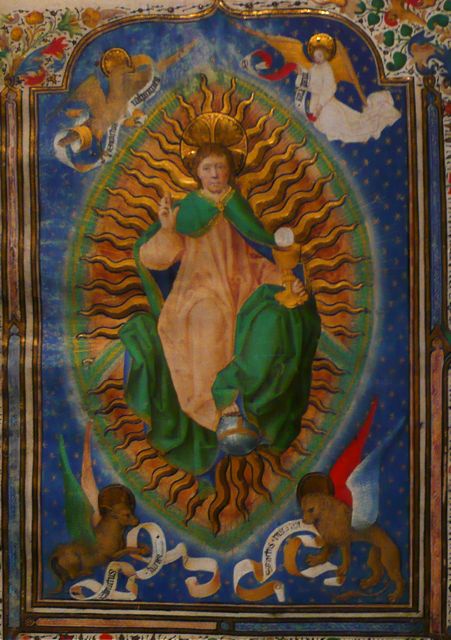
The World – 15th century missal

The Tower – circa 1525 earthenware platter

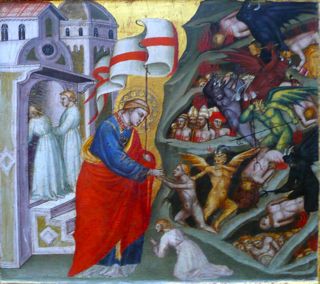
Judgment – 15th century painting (here a saint carries the flag with the red cross rather than it hanging from the trumpet blown by an angel)

The RWS 4 of Cups – circa 1535 earthenware platter

This is not a Major Arcana image but rather is similar to the man under the tree in the RWS 4 of Cups created in 1909. The description card says: “The young man in the center is bound to a tree. This image, popular in Italy in the 1500s, is an allegory of love, depicted as a bittersweet force that holds its victims captive.”

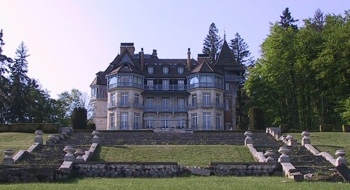
Once upon a time in a far away land, an American heiress named Mary Wallace Shillito lost her beloved sister. In her grief she wandered the world until she came to the Salève mountains of France where she fell in love with the exquisite view. She vowed to build a sanctuary there and dedicate it to her sister. Several years later she met Assan Faride Dina, a part-Hindu part-French native of the then-British island of Mauritius (which lies off the southeast coast of Africa). He was an astronomer and engineer with an interest in Assyriology and occult metaphysics. They married and together built Le Château des Avenières, which they decorated with sphinxes, mythological figures, grottos and underground pools with the symbol of Mercury.

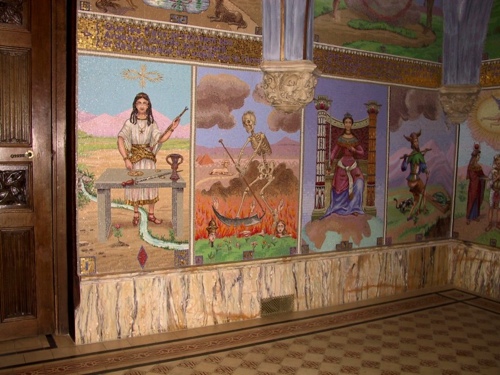
But, the most magnificent and mysterious room of all was the chapel, in which the walls were covered with mosaic tarot cards in the tradition of the Tarot de Marseille while blending in the occult mysteries of the Oswald Wirth Tarot.

Take a journey through this magnificent occult chapel where you can view all 22 Major Arcana and read the stories of Mary Shillito and Assan Dina here. You may also want to visit the website of the Hotel Le Château des Avenières where you can schedule a stay and visit the chapel. Personally, I’m dreaming of the day when a tarot conference will take place there. Is anyone willing to off-set some of the costs of such a fabulous event? Let me know. I also found some mentions of the the Chapel here Schwaller de Lubicz by H. Dossier and Emmanuel Dufour-Kowalski.

First, I need to be forthcoming and let you know that despite my 1,000+ collection of tarot decks, the Rider-Waite-Smith (RWS) Tarot is my all-time favorite (not that I don’t like and use many others). I’ll talk about the reasons another time. Now I just want to offer up this tidbit of publishing history.

This deck, first published in December 1909 simply as “Tarot Cards,” was available more-or-less continually from 1910 until 1939 when Rider appears to have ceased publication. This may have been because of the WWII bombings when paper was scarce and the printing plates destroyed. French and Italian decks had never been easily available in England as such imports were heavily taxed. The Waite-Smith Tarot Cards were not officially republished until 1971 when the publisher/importer Waddington Playing Card Co Ltd. and U.S. Games, under a license from Rider & Co., jointly began publishing a version printed by A. G. Mueller in Switzerland.

I was always curious why such a popular deck was out-of-print for so long, until I came across this autobiography by one-time London bookseller Albert Meltzer called I Couldn’t Paint Golden Angels (Oakland CA: AK Press, 1996) and online here. As Meltzer tells it:

One of the minor curiosities I found when bookselling [he owned a bookstore on Gray’s Inn Rd.] was that one was constantly asked for tarot cards. For years these had been illegal — the ‘devil’s bible’ — and imports were banned. Any pretext that it was ‘only a game’ was dismissed by Customs. Tarot readers lined up at Bow Street every Monday, to be fined with the prostitutes, palm readers and graphologists (the latter have since blossomed out as forensic scientists).

Then the post-war Labour Government abolished the Witchcraft Act in 1946 [the actual year was 1951]. It was a favour to the journalist Hannen Swaffer* who had campaigned in the mainstream press for the Labour Party for years but refused an offer of the Lords. He merely asked for political relief to be given to the spiritualists. They were banned under the Witchcraft Act, and it was such medieval nonsense one could not amend it so it was abolished and so incidentally dream interpreters, psychics, tarot readers and soothsayers were legalised. Thus Britain emerged officially from the Dark Ages. . . .

It was in order, therefore, to import Tarot cards but they were taxed ‘as a game’. For years it had been insisted they were not a game. If they were religious appurtenances even of witchcraft, now legal, or at least not illegal, they could not incur tax. I tried fighting the Customs on this, but with no success. I could never afford to sue them, but tried to persuade the main importers, John Waddington, to do so. They, however, preferred paying tax and having it kept as a ‘game’. It is curious how this nonsense upset the police. The bookshop was actually raided to see if I had imported Tarot cards and not paid tax on them. The police were quite apologetic. When I explained about the Witchcraft Act they were not sure if I was being sarcastic or not. Neither was I.

So, from 1939 until 1951 (the year Pixie Smith died) it appears that fortune-telling cards were considered, in England, to be illegal under the Witchcraft Act, and no one was willing to take this issue to court. After 1951 and until the late sixties they were probably simply thought strange and old fashioned. The gap was filled for a while by Rolla Nordic who issued her own version of a Marseille tarot. Then, some old works on tarot were republished, and new works began to appear in the United States.

Meanwhile, in the U.S., University Books began publishing its own version of the deck in the early sixties (followed by Merrimack and Frankie Albano’s Tarot Productions), ceasing when U.S. Games started enforcing a copyright in 1971. Read my discussion of the 1969 Tarot Renaissance here.

*Slightly off-topic but to fill in some gaps in the quote above: In Great Britain, in 1951 the Fraudulent Mediums Act replaced the 1735 Witchcraft Act, which had increasingly been applied to Spiritualists and mediums. The last person to be convicted under the Witchcraft Act was Helen Duncan who in 1943, during a séance in Portsmouth, channeled a young man who told the gathering, which included his mother, that his ship had been sunk. The mother contacted the War Office asking for details. An investigation was launched into Duncan’s activities prompted by this revelation of top-secret information during war time. Supposedly the authorities became concerned that the medium might make pronouncements about the D-Day plans. Helen Duncan was tried and convicted in 1944, serving nine months in prison. The journalist and ghost-hunter Harry Price had investigated Helen Duncan’s ectoplasmic mediumship years before, and he claimed to have proven her a fraud. The British Society of Paranormal Studies and Duncan’s granddaughter recently have been petitioning the government for a pardon.

As a result of his own interests in Spiritualism and spurred on by the conviction of Helen Duncan, the popular journalist Hannen Swaffer (who was influential in and for the Labour Party), asked for restrictions on Spiritualism to be lifted as a reward for his services. To do so, the Government had to abolish the medieval Witchcraft Act. Three years later Spiritualism was officially recognized as a religion.

“I heard a distemperate dicer solemnly sweare that he faithfully beleeved, that dice were first made of the bones of a witch, and the cards of her skin, in which there hath ever sithence remained an enchantment that whosoever once taketh delight in either, he shall never have power utterly to leave them.”
—George Whetstone, The Enemie to Unthriftinesse, 1586.

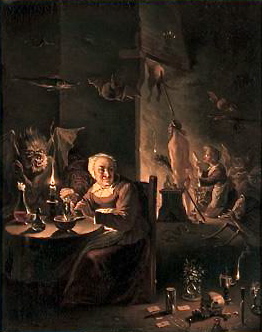
In a 1519 Milanese edition of a 14th century Spanish romance poem called La Spagna Istoriata, the hero Roland tries to discover the enemies of Charlemagne via magic by making a circle and casting or “throwing” the cards (fece un cerchio e poscia gittò le carte). Ross Caldwell tracked down the evidence and discovered that this phrase appears in only that one edition. All others say: fece un gran cerchio e poi gettava l’arte (“he made a big circle and then cast the art”). Upon comparing several versions Ross came to the conclusion that Roland is using a grimoire. He has a book in hand, he makes the circle, “throws the art,” and in the next verse he starts reading (leggendo il libro). Whereupon thousands of demons, big and small, enter the circle. Ross thinks that the best reading for “gettava” is “threw OPEN” the book (of art), and that the 1519 reference to le carte probably signifies throwing open the “pages” of the grimoire. I mention this possibility here since the reference appears in several books as evidence of an early use of playing cards in magic, which may not be the case. However, in the 17th century painting below we do see playing cards being used in a magic circle—so it is not completely beyond the range of possibility.

Ruth Martin in Witchcraft and the Inquisition in Venice, 1550-1650 (Oxford: Blackwell, 1989) tells of one Isabella Bellochio who in January of 1589 was “found guilty of being apostate from God.” It seems she so desperately wanted a faithless lover to return to her that she called on the Devil for assistance. Her housemaid testified that Isabella had burned a candle continuously in the kitchen “in front of a devil and the tarots.” Later the same year in another trial, a witch named Angela was accused of telling a client “‘you need to adore the devil if you want to get help,’ and she suggested getting hold of a tarot card.”

Marisa Milani, professor of the literature of folklore at the University of Padua, who did the original research in the Venetian Sant-Uffizio archive, claims this was a regular part of Venetian “martelli” (love magic): “One such ritual made use of the tarot cards, especially the one that portrayed the devil, which they would place next to a light until a certain time of day when prayers were addressed to it and formulas were recited.” Quoted in Margaret F. Rosenthal in The Honest Courtesan: Veronica Franco, Citizen and Writer in Sixteenth Century Venice (U of Chicago Press, 1992). Marisa Milani, wrote about these practices in Antiche Pratiche di medicina popolare nei processi del S. Uffizio (Venezia, 1527-1591) (Padova, 1986).

In 1622 Pierre de l’Ancre published in L’incredulité et mescréance du sortilege plainement convaincue (Paris) that one Jean Jordain made a pact with the Devil that was sealed by two playing cards: the 2 and 4 of Hearts. We are told that the Devil chose the two of hearts “to mark that he would not have two hearts to serve two masters.” The Two of Hearts was later destroyed, rendering the pact null and void. Del’Ancre defined cartomancy as “a type of divination certain people practice who take the images and place them in the presence of certain demons or spirits, which they have summoned, so that those images will instruct them on the things that they want to know.” (Thanks to Ross Caldwell for additional details.)

But the evidence is not just from court room records in Venice. Two 17th century works of art attest to the use of playing cards in witchcraft. “Depart pour le Sabat” by David Teniers the Younger (1610-1690) shows playing cards as part of a magical circle (see picture at top and to the right.)

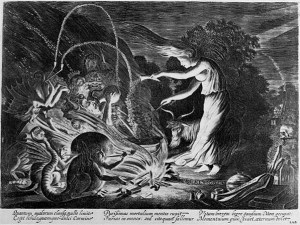
Slightly more ambiguous is the 1626 engraving by Jan van de Velde in which a sorceress conjures demons while playing cards lay at her feet.

An accompanying text reads: “What evils Desire commands, in the small secluded place; who, by sweet incantation, overcomes the minds of the purest mortals, induces frenzy in everyone! But how quickly it slips by; Death overtakes brief life, brief delights. Laughing for a moment, in eternity suffering regret.” (Translation by Ross Caldwell.)

Before you condemn these women you might want to read “Marriage or a Career?: witchcraft as an alternative in seventeenth century Venice” by Sally Scully (Journal of Social History, Summer 1995). Scully postulates that “witchcraft was a role available to women for managing their lives, operating as individual players on the social stage. To call it a career option may not be anachronistic.”

It should be noted that Isabella Bellochio was a staunch Christian who, in calling on the Devil to obtain her desires was merely “giving the Devil his due”—she knew she was doing something wrong in trying to coerce another to fulfill her own desires and so recognized this as the Devil’s work in his role as the lord of base, material desires. As Guido Ruggiero explained in Binding Passions: Tales of Magic, Marriage and Power at the End of the Renaissance (Oxford University Press, 1993), it did not signify for Isabella that she  rejected Christ for the Devil. “I never understood”, she claimed, “that one had to pray to or honor the Devil but only that one must light a lamp to him in order to have that which one desired, that is in this case my lover. Thus I did not light it with the intention of worshiping or praying to him, but with the intention that my lover be made to come.” In a sense it was an honest acknowledgement that, in the context of Christianity, whenever you try to achieve your own desires at the expense of another you are doing the Devil’s work.

See also this report by Ross Caldwell on Spanish cartomancy and witchcraft from at least the 16th century – here.

Jodorowsky is, perhaps, best known as director of the cult film El Topo. He has been a life-long student of the Tarot and worked with Phillipe Camoin to restore lost details to the Marseille deck, as described here. Jodorowsky wrote a major work, La Via del Tarot, which is only available in Spanish and French. You can also see him on many You-Tube videos, but not in English. This video lecture, with interesting graphics, has English subtitles which makes it great for the rest of us who want to learn from this tarot master.

This 18th century play contains the earliest description of cartomancy in action. The text below is from Jack the Gyant-Killer: A comi-tragical Farce of One Act as it is Acted at the New-Theatre in the Hay-Market [London]. Again, thanks go to Stephen J. Mangan, (aka Kwaw) at Aeclectic’s tarotforum for finding it.

In this play, Jack (the Knave of Spades) strives to have Reason triumph over the woman Folly (the Queen of Hearts) who is attended by four Giants (named as they are in the traditional Jack-and-the-Beanstock story). Three other women offer predictions using Coffee, Tea, Snuff and, finally, Cards—which we are told are newly invented for fortune-telling.

Folly. First we’ll examine the decrees of Fate,
In mystic Coffe-Cups and Tea reveal’d;
Then new-invented Arts of Snuff and Cards,
Shall all be try’d, the grand Event to shew,
If we, my Friends, shall conquer, or the Foe. . . .

Folly. You shall be satisfy’d anon- ….. — but we must lay the Cards first — Time presses, and the Princes must depart. Give us the Cards, that in our several Turns we all may Cut : I am the Queen of Hearts.

First Woman gives the Cards to Folly, then to each of the Gyants, who cut, and deliver to her again, and he lays on the Table in Rows.

First woman. You. Lord Gormillan, are the King of Clubs; Lord Thunderdale shall be the angry Majesty of Spades; The Diamond Crown Lord Blunderboar shall wear; and King of Hearts Lord Galligantus shall assume.

The Knave of Spades, Madam, seems to threaten Danger, but he lies oblique, and the Ten of Hearts between them shews he wants Power to hurt you — ‘the Eight of Clubs and Ace over your Head denote A chearful Bowl and Mirth will crown Night — all will be well — these Princes are surrounded with Diamonds; the Eight lies at the Feet of Lord Gormillan; the Deuce, the Four and Five are in a direct Line with Valiant Thunderdale; the Tray and Nine are at the Elbow of great Blunderboar, and the Six and Seven are just over the Head of noble Galligantus. Some Spades of ill aspect mingled with them, but the Hearts and Clubs take off their malevolent Quality.

Folly. Go then, my Friends, secure of Fame and Conquest, The Oracles pronounce it.

Ha! what Noise? {A great Noise ..}

Enter a Messenger out of Breath

Mess. Ah, Madam ! you are lost! — all-conquering Jack with his Retinue has broke into your Palace — behold ’em here—

Enter Jack and his Party, they throw down the Table, Cups, Cards, &c.

Jack. Fall on, my Friends

The cards were probably laid out in several rows, perhaps a square of 25 as we see in later examples. The significator card shows the location of the person within the situation, while the other court cards represent the other people involved. The cards that fall between the main significator and the significator of another person show what is occurring between them. Folly reads the overall fortune as “secure of Fame and Conquest.” Nevertheless, Folly is ultimately defeated, which may well be the lesson of this play, since, from the point of view of Reason, its main task is to overthrow Folly. (Note: this is an addition to an earlier post on the Origins of Playing Card Divination.)

About

Click HERE to subscribe to Mary K. Greer's Tarot Blog by Email

≈◊≈◊≈◊≈◊≈

Mary K. Greer has made tarot her life work. Check here for reports of goings-on in the world of tarot and cartomancy, articles on the history and practice of tarot, and materials on other cartomancy decks. Sorry, I no longer write reviews. Contact me HERE.

© Mary K. Greer All material on this site is copyrighted. If you use anything, be sure to include my name and a link back to this site. Thank you.

I truly appreciate donations to help me pay for additional space.

Donate any amount to keep this ad-free blog growing.

Archives