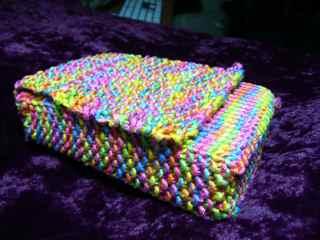
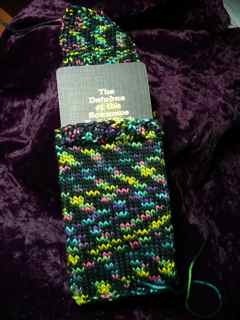
rainbow-tarot-case.jpgWell, I think I’ve come up with just about my perfect knitted tarot bag design, although I’m still looking for the ideal yarn. My bags are fitted and have squared-off sides and bottom—you could almost call them cases rather than bags. Pictured are two versions in cotton. I think I’ll try a hemp yarn next as its slight stiffness might give a little more body to the case.

First I knit a sample to get the yarn’s gauge (using smaller needles than the yarn normally calls for). I determine the number of stitches to match the deck’s measurements plus about 1/8″ to 1/4″ for each dimension.

stainedglasstarotcase.jpgI knit the flap in seed stitch (Row 1: k1p1; Row 2: p1k1)* so it will lie flat. When the flap, including top edge, is long enough, I cast on enough additional stitches to knit the rest of the bag in the round with 5 double pointed sock needles. (Note: Plan on adding 1 or 2 stitches to the front and back needles as the seed stitch used on the flap is wider than stockinette stitch.)

Needle 1 = knit side stitches in seed stitch; needle 2 = front stitches in stockinette; needle 3 = side stitches in seed stitch; needle 4 = back stitches in stockinette (the back continues directly on from the flap). Optional: My needle 2 (front stitches) begin with 3 rows of k1p1 ribbing to keep the top edge from curling.

deirdretarotcase.jpgIn order to have a nice flat bottom I end the body with a purl row to define the edge. My bottom is stockinette with the purl side out. You want to be positioned to begin a needle 1 (side) row. Pick up the adjacent stitch from the back (needle 4) and purl together with the first stitch of needle 1. Purl until one side stitch remains on needle 1; purl it together with the adjacent stitch from the front (needle 2). Turn the work. Knit together the next stitch from needle 2 with the first stitch on needle 1. Knit the rest of the stitches on needle 1 except one. Knit this last stitch together with a stitch from needle 4. Turn the work. Repeat as above until you reach the other end of your case and meet the stitches on needle 3. Knit the stitches from needles 1 & 3 together using a Kitchener Stitch. (Note: you may need to turn the bag inside out in order to do the Kitchener Stitch. This is better anyway as the final row will have the purl side out.)

I then weave the beginning and ending tails of yarn to a center point on the front edges so that the tails become ties for securing the center of the top flap to the center bottom edge.

Happy knitting. All suggestions for yarns or improvements are gratefully accepted.

See the earlier version of my tarot case and links to other tarot bags here.

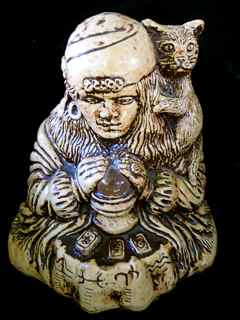
psychictarotreader2.jpgDo a Google search on the words ‘psychic + tarot’ and you’ll come up with 370,000 entries, the majority of which are professional readers advertising their skills. One person offers an “intuitive, psychic tarot reading.” Others list themselves as an “empathic, intuitive, psychic tarot reader,” a “gifted psychic reader,” and a “psychic medium who uses the tarot”. The claims are sometimes outrageous—“99% accurate psychic predictions,” “only the truth,” “world renown,” “specializing in reuniting loved ones,” and “love and money spells” to remove curses—all indicators that you should beware of what you’re getting into. One characteristic of a psychic tarot reading, it seems, is that you won’t find interpretations that come out of a book; instead these are “cosmic insights,” “channeled wisdom,” or clairvoyance. (I bought this statue when Tarot for Your Self first came out—to celebrate the day.)

Search on ‘intuition or intuitive + tarot’ and there are 385,000 entries. There are an additional 216,000 listings for ‘Tarot Reader’ that do not use the terms psychic, intuitive or intuition. And, 225,000 listings for either a ‘tarot consultant or counselor’ with all previous words eliminated. By contrast, a search on Tarot alone results in thirty-two and a half million entries.

Intuitive tarot, when the word ‘psychic’ has been eliminated, emphasizes listings for decks, books, articles and courses, but there are still plenty of ads for readings. These readers are somewhat more likely to advertise themselves as spiritual counselors or consultants (who might also practice Reiki or coaching or “down-to-earth guidance”). But descriptions still feature an aversion to interpretations found in books: “An intuitive approach to tarot reading places the power within,” while a book meaning “denies the power within.” Intuitive tarot involves “that gut feeling or first instinct that comes to you when you look at a card. . . . It is a gut reading more so than regurgitation of memorized definitions.”

Self-styled ‘tarot counselors’ (when eliminating the intuitive and psychic words) seem to have an altogether different vibe. They use tarot “as a therapeutic method and means for self-realization,” “for drawing out information lying deep inside,” and “for helping someone to clearly see a particular present situation.” Sessions are “designed to bring personal fulfillment . . . to assist and guide, to empower and uplift.” Book meanings are sometimes acknowledged as helpful for their depth, wisdom and guidance.

‘Therapeutic tarot’ or ‘tarot therapy’ seems to focus on healing modalities including massage and Reiki in addition to such counseling skills as “assisting you in reaching your goals [and to] gain clarity.” The querent’s projections (ascribing one’s own feelings, thoughts, attitudes or situation to another person or thing) are often described as a major method for determining the significance of the cards.

A search on ‘tarot + projection’ turned up an interesting report from Quirk’s Marketing Research Review called “Heart Maps and Tarot Cards” by Steven Richardson. It describes how tarot cards have been used to help medical doctors talk about the influence of marketing in their disease treatment decision-making processes:

“Tarot cards serve as unique picture-sort stimuli for images and archetypes (but are not used as actual tarot cards for readings, just for the symbolism). In this technique, ask physicians to thumb through the cards quickly and come up with ones that describe or dramatize how they personally feel about being a doctor in the practice of medicine as it relates to a particular disease state. . . . In another study conducted by [Myra] Summers, the tarot card technique was helpful in understanding doctors’ attitudes towards treating terminally ill patients (though Summers also does not use the cards as they are used in tarot readings). The technique revealed meaningful insight into the emotional distress a number of oncologists experience every day.”*

Notice how quick the author is to disassociate this use of cards from tarot readings. Yet, how many tarot readers would claim that such insights are precisely what they turn to the cards for?

I plan on writing much more on this topic, but will leave it for now. I encourage you to write in comments on your own thoughts on this subject.

*You can see a Power Point Presentation (ppt) by Pat Sabena and Nicole Sabena Feagin on their landmark research study using tarot, called “Getting Doctors to Spill their Guts” – here.

Check out this interview I did in 2006 on the Tarot, hosted by Paul O’Brien, on his Pathways Radio program (out of Eugene, Oregon), now available as an MP3 Podcast. There’s stuff about how I got into Tarot, a bit on the history, an overview of the court cards and much more.

While there you might want to check out some of Paul’s other interviews.


Pamela Colman Smith (also known as Pixie), artist of the Rider-Waite (Smith) Tarot deck, wrote nothing about the deck she created except in a letter to her mentor, Alfred Stieglitz, “I just finished a big job for very little cash!” She did tell us, however, in an article called “Should the Art Student Think?,” what must have been her own approach to reading the cards. This is the core of my own reading style.

“Note the dress, the type of face; see if you can trace the character in the face; note the pose. . . . First watch the simple forms of joy, of fear, of sorrow; look at the position taken by the whole body. . . . After you have found how to tell a simple story, put in more details. . . . Learn from everything, see everything, and above all feel everything! . . . Find eyes within, look for the door into the unknown country.”*

Essentially, she’s suggesting the following steps:

  • Describe the card literally.
  • Describe what seem to be the emotions, style and attitudes of the people on the card.
  • Physically embody the card—act it out.
  • Make up a story about what’s happening and turn it into a first person account (so you are feeling everything yourself).
  • In your mind’s eye, step over the border of the card (through the door).
  • Enter into that world, seeing beyond the borders to things you never knew were there.

In my opinion, this is the best way to discover what these cards mean for you in any situation.

*“Should the Art Student Think?” by Pamela Colman Smith in The Craftsman 14:4 (July 1908), pp. 417-19. Read the article here. See also my post on the Art of Pamela Colman Smith.

Tree of Life on the Tarot in the Four Worlds

I am delighted to provide this previously unpublished text, which is from a hand-copied manuscript of Sub Spe [John Brodie Innes] I apologize to those who will find many of the references difficult, but the information can help greatly in understanding the Golden Dawn approach to the Minor Arcana and also the Rider-Waite-Smith and Crowley’s Thoth decks. A glossary of Golden Dawn terms is available at The Hermetic Order of the Golden Dawn website (click on H.O.G.D. Dictionary in the directory).

General Scheme:

The Breath of God passes down through the Four Worlds of the Qabalah from the purely Spiritual to the absolutely material. In each world there is a Tree of Life and the Breath passes down from Sephira to Sephira from Kether to Malkuth and thence to the Kether of the new lower World.
Atziluth, Yetzirah, Briah, Assiah (Wands, Swords, Cups, Pentacles).
Thus in Atziluth the Archetypal World it passes from Eheieh the Creative Breath to Adonai Malekh. This gives its impulse to Kether of Briah the Archangelic World, and in this plane it passes from Metatron the Male Kerub to Sandalphon the Female Kerub. This in turn gives its impulse to Kether of Assiah the Astral Plane where it is received by Chaioth ha Qadesh. The Holy Living Creatures, i.e. the Zodiac which is a wheel or Vortex and goes down to Ashim the Souls of Fire. The work of this Plane being to disintegrate the Astral Form that it may pass through the veils of Negative Existence and be reborn on the Material in Kether of Assiah. Here it is received by Rashith ha Gilgalim the Primum Mobile or Lord Kelvin’s “Vortex ring” and passes down to Cholem Yesodoth. Material Wealth. Malkuth of Assiah.
Thus we have four Trees one above the other containing 40 Sephiroth; i.e., the 4 Aces & 36 small cards of the Tarot arranged in 4 suits corresponding to the Worlds, each attributed to a Planet in a Decanate, and ruled by 2 Angels of the Shemhamaphoresch. This allocation of symbols gives the meaning ascribed to each card.

[The results and names of the cards are arrived at by combining the meanings of the numbers, with the meanings of the suits and interpreting by the Kabbalah. I have added clarifying material from other sources in brackets[ ]. Tarot card illustrations are from the Golden Dawn Whare Ra deck. —mkg]

Meaning of Numbers:

2. unites the Forces of the Positive and Negative, the King and Queen of the suit. Hence it signifies a beginning or Initiation.
[Unites forces of King and Queen, Fire & Water, Postive & Negative = reflection, love, pleasure, harmony. Chokmah is exalted above every head. Sphere of Wheel of Change and the Zodiac.]

3. produces the Prince. The Resultant of that union. A spiritual card.
[Produces the Prince (resultant (perfect manifestation) of union of King and Queen). Saturn = steadiness and restraint.]

4. produces the Princess. The Realization making the matter fixed or settled. Often taken as a new beginning. A material card.
[The Princess. Realization (4) of Power (Jupiter). Makes the matter fixed and settled. Chesed = the receptacle of all the Holy Powers and from it emanates all the Virtues).]

5. compounded of the first odd and the first even numbers denotes Opposition.
[Sphere of Mars. 5 = opposition, strife. Geburah = severity. Unites Wisdom and Knowledge.]

6. called by Nichomachus the form of form and by the Pythagoreans the Perfection of Parts, is taken to imply Accomplishment.
[Sphere of Sun = power, rank, rule. 6 = Accomplishment. Tiphereth = Mediating Intelligence for it causes that influence to flow into all the Reservoirs of Blessings.]

7. in Hebrew called ShBV Shibo or abundance unites the spiritual 3 to the material 4 and signifies a Supernal Force, also a possible result to be obtained by skill and courage.
[Sphere of Venus = external (outer) splendour. Netzach = the Refulgent Splendour of all Intellectual Virtues. Force transcending the material plane.]

8. The first cube of energy and the only evenly even number in the decade. Signifies material success, but sterile – not heading further. Solitary successes.
[Sphere of Mercury = Genius. Hod = Solitary Successes. 8 = Feeble Force, lacks initiative. Martial force without restraint.]

9. The triple Three, the first square of the odd number, of the Spiritual three. No further elementary number is possible hence it is like the horizon. All other numbers are bounded by it. Hence it implies Fundamental Force.
[Sphere of the Moon which governs the Waters of earth, the feminine & negative. 9 = a strong fundamental force. Yesod – the Path of Pure Intelligence.]

10. The beginning again of the decimal scale. Completed Force.
[Sphere of the Elements/Earth. Fixed and completed force. Power exercised in material things only.]

The 4 Aces are always the Roots of the Powers of their element. For other meanings see “Extracts from Book T., given in Ritual N.”

Note:
YOD-HE-VAU-HE is the Supreme God of the Plane of Earthly life governing material, mental and psychic forces by immutable laws. The “God” of the Old Testament.
ELOHIM = the Guiding Spirits who under YHVH sway the material forces. Always used collectively and usually translated Lord.
The ELOHIM contact humanity. YHVH does not – directly.
ADONI = the Planetary God of Earth. To a certain extent answers to Christ when looked at from his Human aspect, but recognising His Divinity. YHShVH is His Divine Aspect.

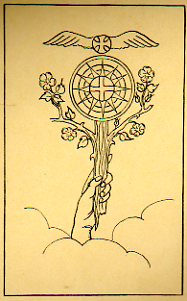
ace-wands010.jpgWANDS – The Tree of Life in Atziluth

Ace of Wands: (Kether of Atziluth, Root of the Powers of Fire) Eheieh is the Creative Sigh, the Divine outbreathing – the Eastern Hamsa. The Greek [_?_]. The Spirit of God in Genesis. By this Divine Life first enters the Kether of the highest of the Four Worlds and penetrates to Malkuth of the Lowest. In the Tarot this influence comes from the Keys to the Ace of Wands.

Two of Wands: (Chokmah of Atziluth, Lord of Dominion, Mars in Aries) Unites forces of King & Queen. The Union of Fire & Water. The Spirit of Yod [Jehovah] on the face of the Water. Chokmah is exalted above every head. Mars in Aries representing the decanate is absolutely powerful. Hence influence over others. Good or bad according to dignity.

Three of Wands: (Binah of Atziluth, Established Strength, Sun in Aries) Produces the Prince. Resultant of union of King and Queen. Here the union of the Earth God Yod-He-Vau-He with the Lords of Creation Binah Elohim is the basis of Primordial Wisdom. The forms of Faith and its Roots. Amen. Sun the center of Power to the Earth in the fiery Aries give realization of hopes of energy = Established Strength.

Four of Wands: (Chesed of Atziluth, Perfected Work, Venus in Aries) Produces the Princess making the matter fixed and settled. EL is the definite article. The absolute. Chesed is the receptacle of all the Holy Powers and from it emanates all the Virtues. Venus in the fiery Aries has her full fruition. Hence have we perfected work.

Five of Wands: (Geburah of Atziluth, Strife, Saturn in Leo) Opposition. Elohim Gebor is the Lord of Severity [and battles]. He intensifies opposition. Geburah is itself severity. It unites Wisdom and Knowledge. Here gloomy Saturn dulls the light of Leo hence we get Strife. Ultimate success or failure is otherwise [elsewhere] shown.

Six of Wands: (Tiphareth in Atziluth, Victory, Jupiter in Leo) Accomplishment. The dual influences of the Earth God and the Directing Lords of Creation Elohim [Jehovah Aloah va Daath] directed to NETZACH or Knowledge give absolute success to skill and courage. Jupiter power in the shining light of Leo completes the idea. Tiphereth is the Mediating Intelligence for it causes that influence to flow into all the Reservoirs of Blessings. Hence is Victory after Strife.

Seven of Wands: (Netzach in Atziluth, Valour, Mars in Leo) A possible result. A force transcending the Material Plane. Mars in Leo gives this a martial direction. Jehovah Tzabaoth the Earth God of Hosts shows terrific force but restrained. Netzach is the Refulgent Splendour of all Intellectual Virtues. The sum of all these gives Valour.

Eight of Wands: (Hod in Atziluth, Swiftness, Mercury in Sagittarius) Solitary Successes. The Name is the Lord of Armies Elohim Tzabaoth. Martial Force without restraint. Mercury in the fire of the Sagittarius Centaur also gives the idea of too much force suddenly applied. Swiftness of the horse but running nowhere. Success but leading to nothing.

Nine of Wands: (Yesod of Atziluth, Great Strength, Moon in Sagittarius) Strong fundamental force Shaddai el Chai = the Vast & Mighty One. Both are of the same character but less fierce than the 10. The gentle Moon somewhat restrains the fire of the Centaur Sagittarius – it giving great strength but benignly used. The Sephiroth is the Path of Pure Intelligence.

Ten of Wands: (Malkuth of Atziluth, Oppression, Saturn in Sagittarius) Fixed and completed force. Adonai Malekh = The Power of Earth as a King. The two give to the Fire of Wands an overpowering Force which = Cruelty. Gloomy Saturn rides but does not control the fire of the Centaur Sagittarius which is the Airy Fire. Such fierce blast of Fire whirls to the Male Kerub, Metatron, in Kether of Briah. [The Divine Impulse … by growing materially powerful becomes sheer cruelty and oppression.]

CUPS – The Tree of Life in Briah

Ace of Cups: (Kether of Briah, Root of the Powers of Water) The Right Hand Male Kerub [Metatron] receives the influences from Adoni Malekh. See Key Table for further information.

Two of Cups: (Chokmah of Briah, Love, Venus in Cancer) Unites the King and Queen. Positive and Negative forces of Love and Pleasure. Ratziel the Archangel of the forces of a Vortex or wheel gives Power. Venus in Cancer is especially Venusian. All the Ideas tend in the same way to the unmodified and uncombined ideas of Cups – Love.

Three of Cups: (Binah of Briah, Abundance, Mercury in Cancer) Produces the Prince. = Abundance resulting from Love. Tzaphkiel has to do with forces of Saturn giving the steadying quality to Mercury, the versatility which qualify the overstrong cup-action making it fruitful.

Four of Cups: (Chesed of Briah, Blended Pleasure, Moon in Cancer) Produces the Princess. Realisation. Tzadkiel is the power of Jupiter so far good, but Moon in Cancer gives change and instability. Happiness approaching an end. Too passive to be perfectly complete.

Five of Cups: (Geburah of Briah, Loss in Pleasure, Mars in Scorpio) Opposition neutralises the force of Cups. Khamael is the Archangel of the Mars forces. Quarrels and fighting – the antithesis of Love. Mars in Scorpio = the stirring up of stagnant water. All intensify the idea. End of Pleasure. Sadness. Deceit. Treachery in Love.

Six of Cups: (Tiphareth in Briah, Pleasure, Sun in Scorpio) Accomplishment. Raphael is the Archangel of the Sun. United influence brings to pass what is wished – e.g. on the material plane. Sensual Pleasure. The influence of Sun in Scorpio is enervating breeding corruption. If Sun is strong – vanity, etc.

Seven of Cups: (Netzach in Briah, Illusionary Success, Venus in Scorpio) A possible success. The Supernal Forces Haniel is the Archangel connected with the Venus forces. Success is only outward. Supernal forces bring it to nothing. Nogah the sphere of Venus represents external splendour. Venus in Scorpio the gleam on stagnant water. All repeat the idea.

Eight of Cups: (Hod in Briah, Abandoned Success, Saturn in Pisces) Solitary Success. Michael the Archangel of Fire is too strong for the feeble force of the 8. Saturn in the airy Pisces gives indolence and dispondency. The whole shows temporary success abandoned as soon as gained.

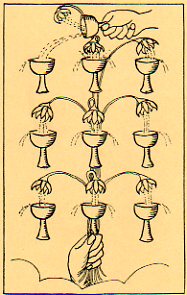
10-cups013.jpgNine of Cups: (Yesod of Briah, Material Happiness, Jupiter in Pisces) Strong fundamental force. Gabriel is the Archangel of Water on the material plane. He presides over birth and generation. Hence he was announcer of the birth of Christ and of John the Baptist. More material than Sandalphon as 9 is less complete than 10. Jupiter is not such a perfect combination with Pisces as Mars, so this card is almost perfect happiness.

Ten of Cups: (Malkuth of Briah, Perfected Success, Mars in Pisces) A fixed and Completed Force. Sandalphon, the Female Kerub, an Archangel yet Chief of the Angels. Showering influence of Chaioth ha Qadesh [Kether] – being the Female Kerub receiving its influence from above and transmuting it to the Zodiac, the Wheel of material creation. Mars gives the balance of Fire; Pisces that of Water. Hence this is an extremely good and fortunate card.

SWORDS – The Tree of Life in Yetzirah

Ace of Swords: (Kether in Yetzirah, Root of the Powers of Air) The Holy Living Creatures [Chaioth ha Qadesh], represent the Zodiac itself as Chokmah of Assiah represents its sphere. Hence a vortex receiving the influence through the veils of the negative from Malkuth of Briah which is Perfected Happiness.

Two of Swords: (Chokmah of Yetzirah, Peace Restored, Moon in Libra) Unites King and Queen thus producing Harmony. Auphanim is the Wheel of Change. Thus the Angels of the Revolving Symbolism restore peace. The gentle influence of Moon on Libra fiery air, restores and pacifies.

Three of Swords: (Binah of Yetzirah, Sorrow, Saturn in Libra) Produces the Prince. = The beginning and ending. Giver of Death. Aralim called Thrones more properly. Heroes intensifies the Prince. Hence Sorrow. Gloomy Saturn in fiery Air repeats the idea.

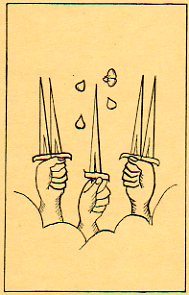
Four of Swords: (Chesed of Yetzirah, Rest from Strife, Jupiter in Libra) Realization. Chasmalim = a brillant metal, perhaps gold or silver. The Angels characterised by brightness [Shining Ones]. The realization of Brilliance. Thus = Rest after Strife. Jupiter Power in Libra fiery Air. Holds its heat restrained. This repeats the idea.5-swords012.jpg

Five of Swords: (Geburah of Yetzirah, Defeat, Venus in Aquarius) Opposition. Strife. Seraphim = Angelic Beings whose character is burning or Fire [fiery serpents]. There is nothing to modify the fiery heat of strife which must bring defeat. Venus in the soft nature of Watery air succumbs to any Force.

Six of Swords: (Tiphareth in Yetzirah, Earned Success, Mercury in Aquarius) Accomplishment. Malachim – King Forces & those who obtain success by commanding it. Hence success not by luck but by effort. Mercury = Genius. Versatility acting on the plastic material of watery Air strives for and obtains success.

Seven of Swords: (Netzach in Yetzirah, Unstable Effort, Moon in Aquarius) Forces transcending the material Plane. Elohim = the idea of strength; hence effort but Supernal Forces overcome & render it unstable. Aquarius – Watery Air acted on by the inconstant Moon increases this result.

Eight of Swords: (Hod in Yetzirah, Shortened Force, Jupiter in Gemini) Solitary Successes. Beni Elohim = Sons of God. A lower and inferior order of Angels. Not able to prevail against the restrictions of the number 8. Jupiter = Power, but having only the Airy Air of Gemini as a basis, cannot exert Power to the full.

Nine of Swords: (Yesod of Yetzirah, Despair and Cruelty, Mars in Gemini) 9 = A strong fundamental force. Cherubim = Sphinxes compounded of the Elements. The supporters of Diety who fly with a swooping or circling motion, the beginning of a whirl, outcasting answering to Rashith ha Gilgalim [Kether’s First Swirlings]. The strong force tending to break up, appears like cruelty & despair. Mars has his full unmodified sway in the Airy Air of Gemini.

Ten of Swords: (Malkuth of Yetzirah, Ruin, Sun in Gemini) 10 = a fixed & completed force. Ashim = the Souls of Fire. These complete their work, which is to break up, disintegrate and ruin the Astral form that it may pass through the negative veils to be reborn in Kether of Assiah. Sun = very fiery energy, destructive unless it acts on very solid material & is modified. Acting on Gemini the tenuous or most Airy Air it is destructive. Compare the deadly arrows of Apollo. [Here the ideas take form, but the Astral Shells are broken up in Ruin by the Souls of Fire that the forms may be reborn in the Material.]

PENTACLES – The Tree of Life in Assiah

Ace of Pentacles: (Kether in Assiah, Root of the Powers of Earth) All Aces are the roots of the Powers of their Element. The Primum Mobile [Rashith ha Gilgalim] Beginning of Whirlings = Primary Vortex Ring. This is the Germ of all Matter (vide Lord Kelvin).

Two of Pentacles: (Chokmah of Assiah, Harmonious Change, Jupiter in Capricorn) Unites King and Queen. The Sphere of the Zodiac counter charges all. All forces acting on Earth. Jupiter = Calm Power on Capricorn = Barren Earth. Gives Harmonious Change but no product.

Three of Pentacles: (Binah of Assiah, Material Works, Mars in Capricorn) Produces the Prince = The perfect manifestation of the forces of Earth. The Sphere of Saturn [Shabathai= rest] restrains his influence. Mars shining on Capricorn the barren earth brings about material works and no more.

Four of Pentacles: (Chesed of Assiah, Earthly Power, Sun in Capricorn) 4 = Realization. Sphere of Jupiter = Power [Tzadekh = righteousness]. Thus the realization of Power. Sun = Power and force on Capricorn = a barren and desert land. Dominates, but leads to nothing beyond.

Five of Pentacles (Geburah of Assiah, Material Trouble, Mercury in Taurus) 5 = Opposition & Strife. Sphere of Mars [Madim = vehement strength] accentuates this. Mercury = Genius but etherial and erratic. Quite unable to deal with the dull heavy earth of Taurus.

Six of Pentacles: (Tiphareth in Assiah, Material Success, Moon in Taurus) 6 = Accomplishment. Sphere of Sun = Power, Rank, Rule [Shemesh = Solar Light]. These give abundant success. Luna in her exaltation of Taurus. The Mistress of the Floods. Breaking up the dull heavy earth under the influence of Sun = Great fertility.

Seven of Pentacles: (Netzach in Assiah, Success Unfulfilled, Saturn in Taurus) Force transcending the material Plane. Nogah = Sphere of Venus = External Splendour. The outside fair, but Supernal Force destroys the promise. The gloom of Saturn on the heavy dull earth of Taurus gives no success in farming.

Eight of Pentacles: (Hod in Assiah, Prudence, Sun in Virgo) Solitary Successes. Sphere of Mercury = Genius [Kokab = The Stellar Light]. This when only ocasionally successful is over careful. Sun = prudence and punctuality in Virgo the fertile earth gives success in farming. Mercury unrestrained by the forces of 8 lacks initiative energy.

Nine of Pentacles: (Yesod of Assiah, Material Gain, Venus in Virgo) 9 = A strong fundamental force. Levanah = Sphere of the Moon which governs the Waters of earth. A force which governs the feminine & negative is usually termed luck. This = gain. Venus the generative power in Virgo the fertile earth = material increase.

Ten of Pentacles: (Malkuth of Assiah, Wealth, Mercury in Virgo) 10 = Fixed and completed force. Sphere of the Elements [Cholem Yesodoth] = Power exercised in material things only . Mercury extremely versatile genius employed in Virgo = the fertility of the earth. Therefore successful completion of material gain = Material Wealth. Malkuth of Assiah. There is nothing human below this. [The acme of worldly prosperity and progress.] (Hereafter it must take an upward curve or pass out to The Qlippoth.).

[Note: the following zodiacal attributes relate to the elemental qualities of the decanates and the cards associated with those decanates. mkg]

Aries: Ascending Flames. A Great and Ruling Force.
Leo: Rushing Flames. A Force Wise.
Sagittarius: Darting Flames. A Force Great and Potent.
Taurus: Fertile land in a valley. A Force Exalted.
Virgo: Undulating land and low hill. A Force Just.
Capricorn: Precipitous, rocky and barren land. A Force Strong and Mighty.
Gemini: Cirrhous and flecked cloud. A Powerful Force.
Libra: Cumulo-stratous clouds. A Force Illustrious.
Aquarius: Rain descending from clouds. A Force Manifesting and Manifested.
Cancer: Eddies of swirling water. A Force that renders Powerful.
Scorpio: Undulating surface of water. A Wisely Dispensing Force.
Pisces: Breaking waves of the sea. A Force Avenging.

Added: The Major Arcana of the Whare Ra Golden Dawn deck can be seen here. The closest modern version is the Classic Golden Dawn Tarot (now out-of-print).

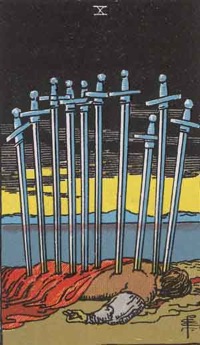
10swordssm.jpgWe were discussing the Ten of Swords on AeclecticTarot’s forum so I thought I’d summarize my thoughts here. A person lies on land by a body of water with hills blue in the distance. I usually think of the water as a lake because there’s no movement indicated—the water looks placid or even lifeless. The sky is black overhead but, above the mountains, the darkness breaks to reveal a slit of yellow sky.

Contrary to their attributed qualities of Air and Mind, Swords both depict and evoke in the viewer very strong, mostly disturbing, emotions. I once did a Tarot and Emotions Research Project in response to this fact.

Here are the emotion words for the Ten of Swords (times the number of respondents who picked the word):

hopeless (x15)
overwhelmed (x12)
despair (x11)
exhausted (x5)
hatred (x5)
pity (x3)

Waite says very little about this card in his Pictorial Key to the Tarot (PKT):

“A prostrate figure, pierced by all the swords belonging to the card. Divinatory Meanings: Whatsoever is intimated by the design; also pain, affliction, tears, sadness, desolation. It is not especially a card of violent death.”

His additional meanings include imprisonment and treason on the part of friends—which I interpret as ‘stabbed in the back.’

Waite was always very precise with his vocabulary. The key word in his description above is “prostrate,” which means “to cast (oneself) face down on the ground in humility, submission, or adoration; to overthrow, overcome, or reduce to helplessness.” For me, it emphasizes submission to something overwhelming either by choice (humility) or by being overcome. Victimization is a possibility.

He also uses “pierce,” meaning to penetrate or cut through, “by all the swords,” which correspond with mind and intellect. This suggests a kind of ultimate penetration, reaching the end of thought or an idea. This can also indicate pinning ideas down.

Waite’s main emotions are sadness and desolation. Of the latter, the Random House Dictionary says: “The desolate person is deprived of human consolation, relationships, or presence.” Is that why three people gave pity as their emotion in my research project? Has hatred of him by others rendered him desolate?

I have a copy of PKT that once belonged to a priest, whose notes are often enlightening. He points to Rev. 19:15: “And out of his mouth goeth a sharp sword, that with it he should smite the nations: and he shall rule them with a rod of iron: and he treadeth the winepress of the fierceness and wrath of Almighty God.” The poor guy looks like he could be both the grapes that were pressed and the nation that was smited.

This priest also refers to Waite’s book The Holy Kabbalah, where we find: “The Flaming Sword which turned every way signifies angels set over the chastisement of man in this world.” This is in a section on the Fall of Man and the Legend of the Deluge [Flood] in which Waite talks about both Eve and Noah having pressed grapes into wine. “The fact that Noah pressed the grapes—as Eve is said also to have done—partook of the juice and so became drunken, is affirmed to contain a mystery of wisdom. . . . [Noah], having set himself to fathom that sin which had caused the fall of the first man, . . . raised a corner of the veil concerning that breach of the world which ought always to remain secret.” Waite then refers to the dangers of some kinds of knowledge. Could this be chastisement for knowing too much? To “chastise” comes from roots meaning “to make pure.” Are limiting thoughts being pressed from him so that what’s left are pure “spirits”?

In the Grail and Masonic Mysteries that Waite used when devising the Minor Arcana (see my article in Llewellyn’s Tarot Reader 2006), this card refers specifically to the death of the Masonic ‘Master Builder’ (murdered treasonously by his brethern), as well as the death of the many knights who perished on the Grail Quest. In the Welsh Perceval, it is the “Sword which broke and was rejoined, [and] in the stress of the last trial, was shattered beyond recovery.”

Waite specifically tells us in PKT that the Knight of Swords is Galahad (who was girded with the Sword of David). He explains how the Quest of Galahad tells how “the Warden of the Mysteries together with the Holy Things [the four suits/Grail Hallows], was removed once and for all . . . [because] the world was not worthy.” And, “The death pictured in the Mysteries is therefore in no sense physical, but is mystical, like the resurrection which follows it” (Waite, The Hidden Church of the Holy Grail). Remember that in PKT, he said: “It is not especially a card of violent death.”

This is the suit of Swords taken to an extreme—”to the nth degree.” Yet in reaching its ultimate conclusion, nothing further can be done in that direction through either thought or aspiration. Now there’s room for a new possibility to emerge [the rising of the black clouds revealing yellow light]—though it has to come from a new and different place. It is an ending that clears the way for new opportunity, but it is only when the ending is fully accepted that the opportunity can emerge. This card is about being pinned down and stuck and finding the blessing in that (note that his hand makes the Hierophant’s sign of benediction). Otherwise the new potential, the Ace (which is the sum of 1+0) cannot be perceived, much less appreciated.

Nevertheless, each of the cards is so rich that a single meaning can’t be the sum total of any card, including this one. I always go with how the querent sees the card at the moment of the reading. Some never see the hand of benediction, while others focus on it right away. Some are very frightened by the card. They think it means the absolute end of something they don’t want to let go of. Or they think it will hurt. Or that they’ll be stuck here forever. Alternatively, they ignore everything except the yellow light.

If I ask a querent to lay down on the floor in the exact position of the figure on the RWS card, something else always happens. Often there’s a feeling of relief and surrender. Some people find it’s like the “deadman’s pose” at the end of a strenuous yoga session, a position from which few want to move because it feels so-o-o good. It’s nice not to have to fight things any more. Others find that the sensation is like acupuncture that awakens the meridians or like the paralysis of spinal injury that numbs.

Essentially, I believe in understanding as deeply as possible the state and sensations depicted on the card as it is, before one rushes on to the yellow light that breaks through the dark clouds. As hard as it is, it is only by knowing the true state and feelings of the person on this card that we having any chance of knowing its blessings.

tbfront.jpgI enjoy knitting socks but end up with a lot of leftover yarn. I looked through several books with patterns for bits and ends and saw a cool ipod case. That made me think of knitting a tarot bag. One of the things I don’t like about bags is that they’re usually loose and bulky, so I wanted something slim and fitted. Here’s my first effort – more of a fitted deck-sock-with-a-flap than a bag. I used sock yarn where all the designs are dyed into the yarn. This one also has some metallic silver running through it. I knitted it on five – US1 (2.25mm) double-pointed needles at 8 stitches per inch (in the round). I started with the flap and then cast on the remaining stitches to make the bag. I just measured it for the exact size of the deck figuring the yarn would stretch a little to get the deck in and out. The size is just about perfect. I like the flat fitted bottom that I created by knitting mitered corners and then doing a Kitchener stitch to connect the remaining front and back stitches.

tbside.jpg
For my next attempt I plan on changing a lot of things. I’ll probably do it all in seed stitch and have the flap come all the way down to the bottom. Warning: don’t store cards in wool or silk for long periods as these fibers can attract bugs and breakdown paper products. Click on the pictures to see a larger view.


tbflap.jpg

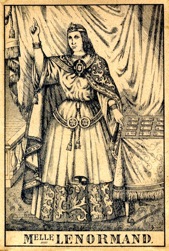
lenormand.jpgMost of us have heard of Mlle. Lenormand, known for having read cards to make predictions for Napoleon and Josephine, but few know much more than this about the most famous card-reader of all time. She was born May 27, 1772 in Alençon, France and died June 25, 1843, having written over a dozen books. Look over her natal chart analysis by Elizabeth Hazel in the Comments (thank you, Liz). Marie Anne Adelaide Lenormand claimed to have obtained her first deck of cards when she was 14 from gypsies who taught her how to read them.
It wasn’t until two years after her death that a deck of cards called “Le Grand Jeu de Mlle. Lenormand” was first published by Grimaud. This 54 card deck was actually created by a Madame Breteau, who claimed to be a student of Madame Lenormand. (It is pictured in the Dumas story in this post.)
The 36-card “Petit Lenormand” was a German creation that, in 1845, appropriated the now-dead Mlle. Lenormand’s famous name. This deck was based on an earlier race game and multi-purpose set of cards called the “Spiel der Hoffnung” (“Game of Hope”; 1798) and the even earlier Viennese Coffee Cards (1794/6), published in both German and English.
Because Lenormand’s own memoirs were written as self-promotion and reveal little about her techniques, I’ve focused in this post on first person accounts of readings with her where we get some idea as to her character and methods. An overview of her life is available at trionfi.com. A short biography published 15 years after her death can be found here. New information by Jim McKeague based on newspaper accounts and a court case is available here. Learn to read the various Lenormand-style decks here, here, here and also here. Get a computerized Mlle. Lenormand-style reading here. Several portraits are available here and card meanings here
Recordings of webinar classes by me teaching the Petit Lenormand deck (and also Tarot) are available through GlobalSpiritualStudies.com.  (See additional links at the end.)
Updated 2/1/2015

In the Sibyl’s Boudoir

You can imagine my delight in coming across this first-person account of a visit to Madame Lenormand made by Captain R. H. Gronow of the Grenadier Guards & M.P. for Stafford in his book Celebrities of London and Paris (London: Smith, Elder & Co., 1865). Gronow probably met her during his 1815-1816 stay in Paris.

“One of the most extraordinary persons of my younger days was the celebrated fortune-teller, Mademoiselle le Normand. Her original residence was in the Rue de Tournon, but at the time of which I write she lived in the Rue des Sts Pères. During the Restoration, the practice of the “black art” was strictly forbidden by the police, and it was almost like entering a besieged citadel to make one’s way into her sanctum sanctorum.
Lenormand+cards

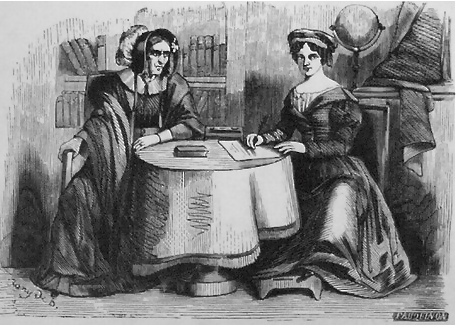
“I was first admitted into a good-sized drawing-room, plainly but comfortably furnished, with books and newspapers about, as one sees them at a dentist’s. Two or three ladies were already there, who, from their quiet dress and the haste with which they drew down their veils, or got up and looked out of the window, evidently belonged to the upper ten thousand. Each person was summoned by an attendant to the sibyl’s boudoir, and remained a considerable time, disappearing by some other exit without returning to the waiting-room. At last I was summoned by the elderly servant to the mysterious chamber, which opened by secret panels in the walls, to prevent any unpleasant surprises by the police. I confess that it was not without a slight feeling of trepidation that I entered the small square room, lighted from above, where sat Mademoiselle le Normand in all her glory.

madamelenormand.jpg“It was impossible for imagination to conceive a more hideous being. She looked like a monstrous toad, bloated and venomous. She had one wall-eye, but the other was a piercer. She wore a fur cap upon her head , from beneath which she glared out upon her horrified visitors. The walls of the room were covered with huge bats, nailed by their wings to the ceiling, stuffed owls, cabalistic signs, skeletons – in short, everything that was likely to impress a weak or superstitious mind. This malignant-looking Hecate had spread out before her several packs of cards, with all kinds of strange figures and ciphers depicted on them. Her first question, uttered in a deep voice, was whether you would have the grand or petit jeu, which was merely a matter of form. She then inquired your age, and what was the colour and the animal you preferred. Then came, in an authoritative voice, the word “Coupez“, repeated at intervals, till the requisite number of cards from the various packs were selected and placed in rows side by side. No further questions were asked, and no attempt was made to discover who or what you were, or to watch upon your countenance the effect of the revelations. She neither prophesied smooth things to you nor tried to excite your fears, but seemed really to believe in her own power. She informed me that I was un militaire, that I should be twice married and have several children, and foretold many other events that have also come to pass, though I did not at the time believe one word of the sibyl’s prediction.

“Madamoiselle le Normand was born in 1768, and was already celebrated as a fortune-teller so early as 1790. She is said to have predicted to the unfortunate Princess de Lamballe her miserable death at the hands of the infuriated populace. She is also reported to have been frequently visited and consulted by Robespierre and St Just; to have reported his downfall to Danton, at that time the idol of the people; to have warned the famous General Hoche of his approaching death by poison; to have foretold to Bernadotte a northern throne, and to Moreau exile and an untimely grave.

“The Empress Josephine, who, like most creoles, was very superstitious, used frequently to send for Madamoiselle le Normand to the Tuileries, and put great faith in her predictions; which she always asserted in after years had constantly been verified. But, unfortunately for the sybil, she did not content herself with telling Josephine’s fortune, but actually ventured to predict a future replete with malignant influences to the Emperor himself. This rash conduct entailed upon her great misfortunes and a long imprisonment; but she survived all her troubles, and died as late as 1843, having long before given up fortune telling, by which she had amassed a large sum of money.”
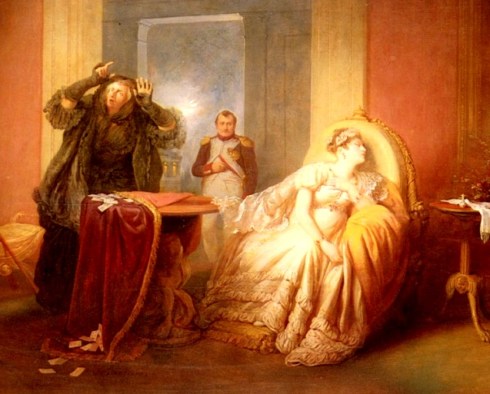
Danhauser: Neapoleon & Josephine with the Card Reader

Danhauser: Neapoleon & Josephine with the Card Reader

Spellbound by the Prophetess

And from The Diary of Frances Lady Shelley (NY: Scribner’s Sons, 1912) we find that on July 4, 1816 Lady Shelley went to see Madame Le Normand:

“I was shown into a beautiful boudoir, furnished with a luxury which gave evidence of her prosperity. After waiting for some time, the prophetess appeared, and exclaimed “Passez, madame.” She then introduced me into a dimly lit cabinet d’étude. On a large table, under a mirror, were heaps of cards, with which she commenced her mysteries. She bade me cut them in small packets with my left hand. She then inquired my age—à peu prés—the day of my birth; the first letter of my name; and the first letter of the name of the place where I was born. She asked me what animal, colour, and number I was most partial to. I answered all these questions without hesitation. After about a quarter of an hour of this mummery, during which time she had arranged all the cards in order upon the table, she made an examination of my head. Suddenly she began, in a sort of measured prose, and with great rapidity and distinct articulation, to describe my character and past life, in which she was so accurate and so successful, even to minute particulars, that I was spellbound at the manner in which she had discovered all she knew.”

Like a Virgin Druidess

Writing eleven years after her death, the great magician Eliphas Lévi had this to say about Mlle. Lenormand (his reluctantly ambivalent admiration shown only through a few left-handed compliments):

“Mlle Lenormand, the most celebrated of our modern fortune-tellers, was unacquainted with the science of Tarot, or knew it only by derivation from Etteilla, whose explanations are shadows cast upon a background of light. She knew neither high Magic nor the Kabalah, but her head was filled with ill-digested erudition, and she was intuitive by instinct, which deceived her rarely. The works she left behind her are Legitimst tomfoolery, ornamented with classical quotations; but her oracles, inspired by the presence and magnetism of those who consulted her, were often astounding. She was a woman in whom extravagance of imagination and mental rambling were substituted for the natural affections of her sex; she lived and died a virgin, like the ancient druidesses of the isle of Sayne*. Had Nature endowed her with beauty, she might have played easily at a remoter epoch the part of a Melusine or a Velléda**.” (Transcendental Magic: its doctrine and ritual by Eliphas Lévi, translated by A. E. Waite.)

[*According to Paul Christian, the Celtic hero Vercingetorix went to the druidesses of Sayne seeking oracles that would help him defeat Caesar. **There are many legends of Melusine, a kind of water nymph or mermaid who enchanted men, brought them great gifts and then would disappear if betrayed. Velléda was a prophet and virgin priestess whom the ancient Germans revered as a living goddess.]

From the Journals of Washington Irving

Washington Irving writes of a dinner conversation that included Sir Henry Lytton Earle Bulwer, brother to the occultist Bulwer-Lytton:

“Speaking of Mad. La Norman, the famous fortune-teller, Bulwer said he had once been to see her—found her ingenious—prone to put questions and draw hints and conclusions from the replies.

“Walewsky told of his having some years since called upon her, knowing that a beautiful woman with whom he had some liaison was about to call on her. Madam La Norman began to talk to him in the usual way but he repeatedly interrupted her, telling her he had no occasion for her science, but had come to aid it. He described the lady who was coming to consult her. He related many striking facts concerning her. He stated what might be said to her as to the future—”I do not advise you to tell all these things,” said he, “I counsel nothing; you may do as you please, but here are six Louis for you.” So saying he took his leave. The lady’s fortune past and future was told in a manner to astonish her, and greatly to the advantage of Mr. Walewsky.”

A Prediction of Fame & Unrequited Love

Read about Marie d”Agoult and Eugène Sue’s readings with Mlle. Lenormand in 1834 HERE.

Treacherous and Ridiculous Insinuations

Jim McKeague in his blog writes in detail about a 1839 court case in which Mlle. Le Normand was embroiled four years before she died.  Read the details of this fascinating event HERE, and HERE, while I briefly summarize Mlle. Lenormand’s own words from a letter she wrote to a journal editor to explain her part in the case and gives an inkling of her self-promotion:

“For many years Lord Stirling, a Scottish peer [whose family she had known since 1814], has been reclaiming the heritage of his ancestors; yet today there is even a dispute as to his name and his legal titles. A chart of Canada by Guillaume de Lisle, First Geographer to the King, and covered with precious autographs of Fenelon, Flechier, Louis XV, etc., was submitted in support of the claim in question [given to him by Mlle. Lenormand in exchange for a bond for 400,000 francs]. . . . And it is I who am accused of having co-operated!!! [The chart was eventually proved a forgery.] … 

“All my efforts have tended for good; often I was quite happy to see them crowned with success, and it is with great pride when I think back to the ill-fated days of our bloody revolutions, I think of the many victims whom I could snatch from the scaffold or conceal from infamy, of the horrors of hunger.

“Like every good soul born, I have selflessly spread some benefits to the miserable, and offer consolations to suffering souls. Also my dedication in adversity, my firmness, all my conduct, has received at all times the approval of various parties. …

“Always willing to lend a helping hand to the oppressed, Miss Le Normand therefore wants the trial which is engaging Lord Stirling to be delayed; she asks this of all the authorities in order to enter the lists and contribute toward finding the truth.”

As Jim McKeague says in his blog: “The presiding Judge, Lord Meadowbank, in his summing up to the jury, was savage in his criticism of Marie-Anne Lenormand. Speaking of Humphrys-Alexander’s sojourn in Paris in 1836-7, the judge said that he was proved ‘to have been constantly engaged in negotiating with this sybil (sic) – this notorious adventuress in Paris, to whom at least the uttering of these forged documents has been traced – a person obviously of the worst character, and who, although she says that a lie never passed her lips, is proved to you to have had no profession but that of fortune-telling – no means of subsistence but that of imposture, and of telling falsehoods from morning to night.’

An Obituary and a “Curious Account”

This may be one of the first fictionalized (and sensationalized) accounts of a reading with Mlle. Lenormand: HERE.

Consulting the Sybil

This description is from a German book on fortune telling from 1860. The translation may be a little rough:

“Above the door was a sign with the words:
Mlle. Lenormand – Bookseller.

The profession of Sybil had not yet been sanctioned by the law, and just as every transaction had to bear a legal title in order to justify a levy, Mlle. Lenormand had sought and obtained a patent as a bookseller. She received her clients undisturbed here, and could conduct her prophecies here, without attracting suspicions among the police. In her capacity as a bookseller, she was even in the royal National almanac.

When a person came into Lenormand’s consulting room, the bell of the oracle was rung, a maid opened the door, and led the visitor into a room which was less than sibylline. Lenormand spurned the usual household of the vulgar fortune-tellers, she surrounded herself with no kind of phantasmic decoration. The interior of the room was bourgeois. On the wall, in two rows, about thirty volumes of books were seen . . . recent books by herself and those more or less cabalistic.

After having had time to look around, Mlle. Lenormand appeared. In later years she was a small, strong woman, with a large blond wig on which an oriental turban was thrust.

“What services do you wish?” She usually asked the visitor.

“Madame, I come to consult you.”

“Good! Place yourself here. – Which playing card reading do you want? I have them from 6 francs, 10, 20 and even 400 francs.”

“I believe something in the price of a Louis d’or.”

“Well, then, come to this table and show me your hand.”

“Here it is!”

“Not that one, the left. – What is your age? What flower do you prefer? What animal is it before whom you feel the most resentment?” All these questions asked with a monotonous, nasal voice.

With every reply she repeated: “Good!

And, passing over the playing-cards she presented them to the client: “So, cut with your left hand!”

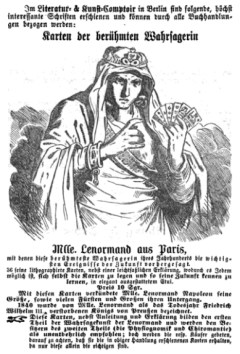
Then she would turn the cards one after the other, and spread them on the table, and now she set out [the meaning of] the cards at a speed that one was scarcely able to follow her. It was as if she were reading from a book, or as if she were teaching a learned lesson. In this seemingly contradictory stream of speeches, one was suddenly illuminated as by a beam of light. Mlle Lenormand Kunst-Comptoir AdThe Sybil excelled particularly in the investigation of the character, inclinations, and taste of the persons who sought them. She never failed to give her visitors information about the past, and the correctness of this is also confirmed by all who have ever had the opportunity to visit this strange woman.
What is even more, those who visited her always found a great pleasure in her prophetic conversation.”

From The most complete , and the only true, art of the fortune-telling of the most famous fortune-teller of the world-magnificence, Lenormand, Verlag des Literatur- und Kunst-Comptoirs, 1860. In addition to a biography of Mlle. Lenormand, the book contained this ad for their 36-card Lenormand deck:

The First Republic

One of the most fascinating stories of Mlle Lenormand is the account in The First Republic, or The Whites and the Blues (Les Blancs et Les Bleus, 1867-68) by Alexandre Dumas, author of The Three Musketeers. This work is part of a series of Napoleonic romances that begin with the Revolution and end with the fall of the Empire. Volume 2 contains chapters called “The Seeress” and “The Occult Art” in which Lenormand reads for both Josephine and Napoleon (who have not yet officially met). Dumas, writing nineteen years after Lenormand’s death, claimed that what he wrote was not fiction:
“I can guarantee the truth of this scene, for these details were given me by the friend and pupil of Mademoiselle Lenormand, Madame Moreau, who still lives (1867) at No. 5 Rue du Tournon, in the same rooms as the famous seeress, where she devotes herself to the same art with immense success.”

It seems that one evening Josephine Beauharnais and her friend Therese Tallien decided to see the fashionable seeress, Mademoiselle Lenormand. They disguised themselves as waiting-maids or ‘grisettes,’ and, using false names, made their way to Rue de Tournon No.7. There they were shown into an inner salon to await their turn. A young man silently joined them as he waited for his turn to have his fortune revealed. Therese Tallien went first into the inner chamber and learned that she is to become a princess. What follows is from Dumas’s text:

“Mademoiselle Lenormand at this period of her life was a woman somewhere between twenty-four and twenty-nine years of age; short and stout in figure, and concealing with difficulty that one shoulder was larger than the other. She wore a turban adorned with a bird of Paradise, a fashion of the day. Her hair fell in long curls on either side of her cheeks. She wore two skirts. . . . Near her, on a stool, was her favorite greyhound, Aza. The table on which she did her marvels was a plain round table with a green cloth on top and drawers, in which she kept her cards. . . . Facing the sibyl was an arm-chair, in which the consulting person was seated. Between that person and the seeress lay an iron wand, which was called the divining-rod; at the end turned toward the consulting person was a little iron snake. The opposite end was made like the handle of a whip or cane. . . .

Mademoiselle Lenormand made a sign to Josephine to take the chair which Madame Tallien had just left; then she drew a fresh pack of cards from her drawer, possibly to prevent the destiny given by the last pack from influencing that of the present. Then she looked fixedly at Madame de Beauharnais.

‘You and your friend have tried to deceive me, madame,’ she said, ‘by wearing the clothes of servants. But I am a waking somnambulist. I saw you start from a house in the centre of Paris; I saw your hesitation about crossing my threshold; and I also saw you in the antechamber when your proper place was the salon, and I went there to bring you in. Don’t try to deceive me now; answer my questions frankly; if you want the truth, tell the truth.’

Madame de Beauharnais bowed.

‘Question me, and I will answer truly,’ she said.

‘What animal do you like best?’

‘A dog.’

‘What flower do you prefer?’

‘The rose.’

‘What perfume is most agreeable to you?’

‘That of the violet.’

The seeress placed a pack of cards before Madame de Beauharnais, which was nearly double the size of an ordinary pack. These cards had been lately invented, and were called “the grand oracle.”

‘Let us first find where you are placed,’ said the seeress.

Turning over the cards, she moved them about with her middle finger until she found “the consultant;” that is to say, the image of a dark woman, with a white gown and deep embroidered flounce, and an overdress of red velvet forming a train behind, the whole on a rich background. This card was lying between the eight of hearts and the ten of clubs.
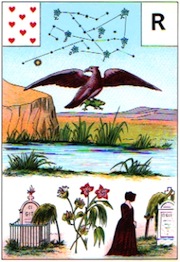
‘Chance has placed you well, madame. See, the eight of hearts has three different meanings on three different lines. The first, which is the eight of hearts itself, represents the stars under whose conjunction you were born; the second, an eagle seizing a toad from a pond over which it hovers; the third, a woman near a grave. Listen to what I deduce from that first card madame. You are born under the influence of Venus and the Moon. You have just experienced a great satisfaction, almost equal to a triumph. That woman dressed in black beside a grave indicates that you are a widow. On the other hand, the ten of clubs pledges the success of a rash enterprise of which you are not yet aware. It would be impossible to have cards of better augury.’

Then, shuffling the cards, but leaving the “consultant” out, Mademoiselle Lenormand asked Madame de Beauharhais to cut them with her left hand, and then draw out fourteen of them, and place those fourteen in any order she like beside the “consultant,” going from right to left as the Eastern peoples do in their writings. . . .

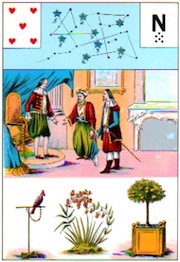
‘Really, madame,’ she said, ‘you are a privileged person. I think you were right not to be frightened away by the fate I predicted for your friend, brilliant as it was. Your first card is the five of diamonds; beside the five of diamonds is [the five of hearts] that beautiful constellation of the Southern Cross, which is invisible to us in Europe. The main subject of that card, which represents a Greek or Mohammedan traveller, indicates that you were born either in the East or in the colonies. The parrot, or the orange-tree, which forms the third subject, makes me think it was the colonies. The flower, which is a veratrum, very common in Martinique, leads me to think you were born on that island.’

‘You are not mistaken, madame.’

‘Your third card, the nine of diamonds, indicating long and distant journeys, implies that you left that island young. The convolvulus, which is pictured at the bottom of this card, represents a woman seeking a support, and makes me suppose you left the island to be married.’

‘That is also true, madame.’

‘Your fourth card is the ten of spades, and that indicates the loss of your hopes; nevertheless, the flowers of the saxifrage which are on the card authorize me to say that those griefs will pass away, and that a fortunate issue—a marriage probably—has succeeded those distresses which at one time seemed to exclude all hope.’ . . .

[Lenormand correctly divines that Josephine’s husband died a violent death on the scaffold, that she has a son and daughter, and that the son is involved in an ‘affair of the sword’ but that hope will never fail him.]

‘And here, madame, is the eight of spades, which is a sure indication of marriage. Placed as it is next to the eight of hearts,—that is to say, near the eagle rising to the skies with a toad in his talons,—the eight of hearts indicates that this marriage will lift you above even the loftiest spheres of social life. But, if you doubt it, here is the six of hearts, which, unfortunately, seldom accompanies the eight,—that six of hearts in which the alchemist is looking at his stone now turned to gold; in other words, common life changed to a life of honor, nobleness, and high employments. See, among these flowers, is the same convolvulus, which entwines a broken lily: that means, madame, that you will succeed, you who seek a support, you will succeed—how shall I tell you this?—to all that is highest and noblest and most powerful in France,—to the broken lily: you will succeed that lily in a new sphere; passing, as the ten of spades has shown, over battlefields where—see on that card—Ulysses and Diomed drive the white horses of Rhesus, placed under the guardianship of the talisman of Mars.’
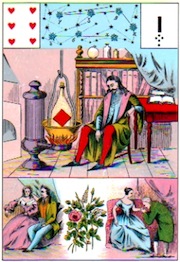
‘When you reach that point, madame, you will have the respect and the tender regard of every one. You will be the wife of that Hercules strangling the lion in the forest of Nemaea; that is to say, a useful and courageous man exposing himself to all dangers for the good of his country. the flowers which crown you are lilacs, arums, immortelles; for you will combine in your own person true merit and perfect kindness.’

She rose, with a movement of enthusiasm, caught Madame de Beauharnais’s hand, and knelt at her feet.

‘Madame,’ she said, ‘I do not know your name, I do not know your rank, but I know your future. Madame, remember me when you are —empress.’

‘Empress! I? You are mad, my dear.’

‘Eh, madame! do you not see that your last card, the one that leads the fourteen others, is the king of hearts; that is to say, the great Charlemagne, who bears in one hand a sword, in the other a globe? Do you not see on the same card a man of genius who, with a book in his hand, and a map at his feet, meditates on the destinies of the world? And, lastly, see on two desks opposite to each other, the books of Wisdom and the laws of Solon; those books prove that your husband will be not only a great conqueror, but a great lawgiver.’

[Josephine cries, ‘Impossible!’ and immediately leaves. Meanwhile, the young man who has been waiting his turn in the salon has ignored all the efforts of Therese Tallien to discover anything about him. He, too, has tried to disguise his real persona, but Mademoiselle Lenormand sees through it. She offers him many forms of divination and he chooses a palm reading.]

‘Your hand is the most complete of any that I have seen; it presents a mixture of all virtuous sentiments and human weaknesses; it shows me the most heroic of all characters and the most undecided. . . . The enigma I am about to read to you is far more difficult of interpretation than that of the Theban sphinx, for though you will be greater than Oedipus, you will be more unfortunate.’ . . . [She describes his rise and fall and several injuries he will sustain.]

‘But,’ said the young man, ‘ this is the second or third time you have mentioned an alliance which will protect the first eight lustres [glories] of my life. How am I to know that woman when I meet her?’

[Lenormand describes the dark-haired Josephine. She warns Napoleon that eventually he will forget Providence gave him her as a companion, and that he will abandon that companion. Then his happiness will be destroyed by a second wife, who is fair and the daughter of kings.]

‘You will be Alexander, you will be Caesar: you will be more than that,—you will be Atlas bearing the world on your shoulders. . . . As success came to you through a woman, so it will leave you through a woman.’ . . .

‘It is Caesar’s fate that you predict for me.’

‘More than Caesar’s fate,’ she replied; ‘for Caesar did not attain his ends, and you, you will attain yours. Caesar only placed his foot on the steps of a throne, you will sit upon the throne itself. Only do not forget the dark-haired woman, who has a sign above the right eyebrow, and puts her handkerchief to her lips when she smiles.’

‘Where shall I meet that woman?’ he asked.

‘You have already met her,’ replied the sibyl; ‘and she has marked with her foot the spot at which the long series of your victories will begin.’

It should be noted that the deck of cards described in the text,”Le Grand Jeu de Mlle. Lenormand” is known to have only been created after the death of Mlle. Lenormand, although it was named after her in order to take advantage of Lenormand’s fame. The book that came with my deck is dated 1845.

Society Under the First Empire

Here are a few short quotes from The Court of Napoleon: or, Society under the first empire by Frank Boott Goodrich and Jules Champagne, (New York, 1858). [Thanks to Caitlin Matthews for passing this on.]

M’lle Marie-Anne Lenormand, the most distinguished sibyl of modern times, the counsellor of Robespierre, Napoleon, and the Czar Alexander, the confidante and biographer of Josephine, and who possessed the ability to subject the most brilliant and enlightened court of Europe to the authority of her shuffles of cards and perusals of palms, merits more than a passing notice. . . .
    She rejected cartomancy, or the art of reading cards. It is true that she used cards, but this was merely cabalistically, for the sake of the figures upon them, and to aid her in numerical processes. . . .
    M’lle Lenormand became, therefore, the protégée, and was, in a certain sense, the object of the affectionate consideration, of Josephine. Her cabinet was now crowded with the elite of Parisian society—priests, nobles, magistrates and soldiers. The visitor to the dwelling of the pythoness was shown into a room in which books, prints, paintings, stuffed animals, musical and other instruments, bottles with lizards and snakes in spirits, wax fruits, artificial flowers, and a medley of nameless articles, covered the walls, the table and the floor, leaving the eye scarcely an unoccupied spot to rest upon.
    The furniture of the cabinet of consultation was in maple; the walls were adorned with portraits of the Bourbons, with a painting by Greuze of great value, and with her own portrait by Isabey. Her cards, which were of large size and covered with colored hieroglyphics, were painted by Carle Vernet. . . .
    On one occasion M’lle Lenormand was summoned by Fouché to his cabinet. He reproached her for the aid and comfort she had given to the Bourbons by her late predictions. She paid no attention to his complaints, being engaged in shuffling a pack of cards, and muttering from time to time, “The knave of clubs!” He then said that he intended to send her to prison, where she would probably remain a long time. “How do you know that?” she returned. “See, here is the knave of clubs again, and he will set me free.” “Oh, ho! the knave of clubs will set you free, will he? And who is the knave of clubs?” “The Duke de Rovigo, your successor in office.” . . .
    One of the biographers of M’lle Lenormand has remarked, witch or no witch, a certain share of admiration will always be due to her, for having contrived to be believed in an age which neither believed in God and his angels, nor in the devil and his imps. . . .
    In detailing the incidents of M’lle Lenormand’s life, we have sufficiently described the sate of the art of fortune-telling in France and the consideration with which it was regarded, during the period of her professorship. Her success does not seem to have been derived from any previous credit accorded to the art of necromancy, but was the result rather of her remarkable skill and the tendency of an atheistic age to fill the void it had itself created, with superstitious dreams. She estabished a faith in astrology and chiromancy, for a time; they fell, however, into disrepute at her death, being afterwards exercised only by acknowledged charlatans, and obtaining support only from the ignorant and the credulous.

More Lenormand-style deck resources (see others in the intro paragraph at top):
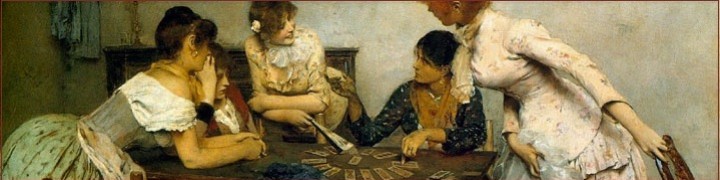
Elemental Dignities is the most misunderstood topic in Tarot. It is a method of giving importance to cards in a spread that is based on the relationship between the cards’ elements (fire, earth, air, water) and used to identify cards that strengthen or weaken each other.

It was first discussed by MacGregor Mathers, for members of the Hermetic Order of the Golden Dawn, in a manuscript called “Book T,” which included his instructions on reading the cards. The problem is that few people study “Book T” and really look at the examples that Mathers gives for using Elemental Dignities.

The system was a way for determining how ‘strong’ (i.e., powerful and important) each card or set of cards was in a reading and, therefore, which cards to pay most attention to. It was also a way to eliminate irrelevant cards. It was designed to go with specific spreads in which the cards were read in pairs and triads.

You need to actually lay out the cards he used as examples and follow closely what he did if you want to understand the GD system. For one thing, Mathers used the terms “neutral” and, in a different context, “neutralize,” and they signify two different but important things. Secondly, the term ‘friendly’ does not mean that the cards act nicely toward each other. Any combination can be for ‘good or ill’ depending on the cards!!!

Here are Mathers’ basic rules (see my book 21 Ways to Read a Tarot Card for a more complete explanation):

1) Cards are “Strong” when the suits/elements are the same; they are “very strong for either good or evil, according to their nature.”

In other words, two swords cards are like-minded and egg each other on. They can greatly increase either the good or ill in each (depending on their individual meanings).

2) When the suits/elements are both masculine/active or feminine/passive, they are “moderately strong because they are friendly to each other.” [Fire+Air; Water+Earth.]

They increase the power and strength of the other, but whether this is good or bad depends on the specific cards.

3) When the suits/elements complement each other, they are “somewhat friendly” (also called neutral). [Fire+Earth; Air+Water.]

They show relatively ineffectual interactions. (Personally, I like to think of them as irritants that can be mildly correctional and therapeutic to each other but without great impact as to whether they strengthen or weaken the other.)

4) When the cards are of contrary elements they tend to “weaken each other greatly for good or evil, and neutralize [cancel out] their force.” They are sometimes referred to as enemies or ill-dignified. [Fire+Water; Air+Earth.]

In practice, Mathers often cancelled out the effect of cards with contrary elements. He simply did not read PAIRS that were of contrary elements!! (They could not co-exist in the same room so BOTH would leave.)

In TRIADS, if the two cards flanking a central one were contrary to each other, he simply didn’t read those flanking cards but, instead, concentrated on the center card as if it were alone.

However: “If the contrary element is only in one flanking card, then the other becomes a connecting card so that the first [center] is not weakened, but is modified by the influence of both cards and is, therefore, fairly strong.” In other words, the center card overcomes the neutralizing force of its contrary flanking card through the support of the flanking card that is more ‘friendly’ to it – for good or ill.

If both flanking cards are contrary to the center one then they dominate it completely; the effects of the central card become extremely weak.

People have modified this system to make sense to themselves (and often because they didn’t understand the original). It’s fine to modify the idea to your own use, just understand that you are doing so, and that none of these adaptations are “right” while others are “wrong.” The important thing is what works for you.

An Analogy

When looking at a spread in terms of pairs, what you end up with are, if it were a book or movie:

1) Strong: the leading characters (they can be lovers or antagonist and protagonist). The focus of the action is on them.

2) Friendly: supporting actors – secondary characters – the best friend, a mentor, the malicious co-worker: those who further the action of the story through support or by throwing a spanner in the works.

3) Somewhat Friendly/Neutral: those who add in a little but aren’t terribly significant: brief encounters, comedic relief, etc.

4) Weak (neutralizing): non-speaking parts: crowd scenes, background at a restaurant, faces on the street, etc. If these people are alone in a room (without the characters mentioned above) then simply NOTHING happens.

This is not an exact analogy, but it should get the point across. I want to emphasize again that you can devise a system of elemental dignities that goes beyond this, using psychological, astrological or even alchemical principles for the interaction of elements. But, then understand that this is a personal adaptation of the original idea.

Want more? Step-by-step instructions for reading all variations of Elemental Dignities with three-cards can be found at Tarot Elements.

Someone asked about the varieties of astrological correspondences among the Tarot Major Arcana cards on a tarot forum: “I assume that the Tarot of Marseilles is a totally different tradition than the Golden Dawn?”

This is my attempt to give an overview of how the astro-alpha-numeric correspondences used by the Hermetic Order of the Golden Dawn (founded in 1888 ) came to be formulated. The creators of the Golden Dawn (GD) tarot system were familiar with the French tradition (Marseilles), but deviated markedly from it in creating their own tarot lineage.

Part of the “secret” material taught in the GD were their unique attributions for the Tarot, which formed the basis for their levels of initiation. Centering on the 1880s, the Tarot was treated as a puzzle, and both French and British ceremonial magicians were racing to solve it. At the heart of this race was discovering the “real” correspondences among the Hebrew letters, astrological signs & planets, and numbers. Tarot author Christine Payne-Towler in The Underground Stream coined the term “astro-alpha-numeric correspondences” to cover these.

In the late 18th c. le Comte de Mellet in de Gébelin’s Le Monde Primitif suggested one solution—linking the last card with the first Hebrew letter (World=Aleph).

French magician Eliphas Lévi, working in the mid-1800s, came up with his own solution based on the fact that the Hebrew letters ARE the numbers (Magician = 1 = Aleph). Furthermore, a Kabbalistic document, the Sepher Yetzirah, relates these directly with the astrological signs (the planets were not so explicitly related – creating all kinds of controversy). Writers like Paul Christian, Oswald Wirth, Papus, and members of the Brotherhood of Luxor (and the later Brotherhood of Light) continued along these lines.

The Golden Dawn had yet another solution. Before he died, Lévi and a British Freemason and occultist, Kenneth MacKenzie, met in Paris. Lévi showed MacKenzie a deck he had designed (but which disappeared after his death) and they discussed this Hebrew letter “puzzle.” MacKenzie was not satisfied with Lévi’s attributes and worked on his own solution to the puzzle (“I work it with the aid of astrology”), but he died before he could publish it. He wrote one of the founders of the GD (Westcott) that it was too ‘dangerous’ to be revealed to the masses:

“I am not disposed to communicate the Tarot System indiscriminately although I am acquainted with it. To do so would put a most dangerous weapon into the hands of persons less scrupulous than I am.”

As soon as MacKenzie died, William Westcott bought a box of papers from MacKenzie’s widow. With two other “chiefs” (all who belonged to various Masonic and Rosicrucian societies) he started up the GD, using as its basis a manuscript written in cipher describing a series of rituals (translated and worked up by MacGregor Mathers). These rituals were based on initiation grades from the 18th c. German “New and Gold Rosicrucians,” combined with the GD correspondences as given in the cipher manuscript (two books have since been published reproducing the manuscript and discussing it in depth). Although there is no absolute “proof” that MacKenzie wrote the cipher manuscript, the evidence is pretty strong.

Both Aleister Crowley and Paul Foster Case (American member of the GD) made some minor changes to the MacKenzie/GD alpha-astro-numeric correspondences – Crowley switched positions of the Emperor and Star, and Case replaced the three “elemental” cards with the more recently discovered outer planets.

A. E. Waite always declared he was dissatisfied with the correspondences, but used them in his own GD-based rite, until, in the 1920s, he finally created a revised set of Major Arcana, changing their order to fit with mystical rituals he devised for his Fellowship of the Rosy Cross. A few of the black-and-white versions of these cards that are so different from the Rider-Waite-Smith deck are illustrated in Dummett & Decker’s A History of the Occult Tarot: 1870-1970 and in K. Frank Jensen’s The Story of the Waite-Smith Tarot.

About

Click HERE to subscribe to Mary K. Greer's Tarot Blog by Email

≈◊≈◊≈◊≈◊≈

Mary K. Greer has made tarot her life work. Check here for reports of goings-on in the world of tarot and cartomancy, articles on the history and practice of tarot, and materials on other cartomancy decks. Sorry, I no longer write reviews. Contact me HERE.

© Mary K. Greer All material on this site is copyrighted. If you use anything, be sure to include my name and a link back to this site. Thank you.

I truly appreciate donations to help me pay for additional space.

Donate any amount to keep this ad-free blog growing.

Archives