You are currently browsing the tag archive for the ‘spirituality’ tag.
In preparation for the July 2026 Omega Institute tarot workshop, “Wisdom of the Tarot,” I have been posting on Facebook multiple versions of Minor Arcana cards from 21st century tarot decks for comparison. I ask if any keywords or phrases work equally well for all the different decks – one of the themes for the upcoming workshop (stay tuned). My latest example was the 6 of Swords. [It should be noted that the vast majority of new decks are at least loosely based on the Rider-Waite-Smith (RWS) pictures.]
According to the Hermetic Order of Golden Dawn source works and their theory of numbers (c. 1888), derived, in part, from the Kabbalistic Tree of Life, the 6 of Swords, is found on the central sephira of Tiphareth (associated with the Sun). It is, as the GD described it, the “high point” of the Air suit of Mind or Intellect. Associated with the astrological decan of Mercury in Aquarius, it is, at its best, “reason serving humanity.” Centering on Imbolc or Candlemas at 15* Aquarius (Feb 1-2), this fixed sign marks the first truly noticeable return of the light and longer days, heralding the return of Spring.
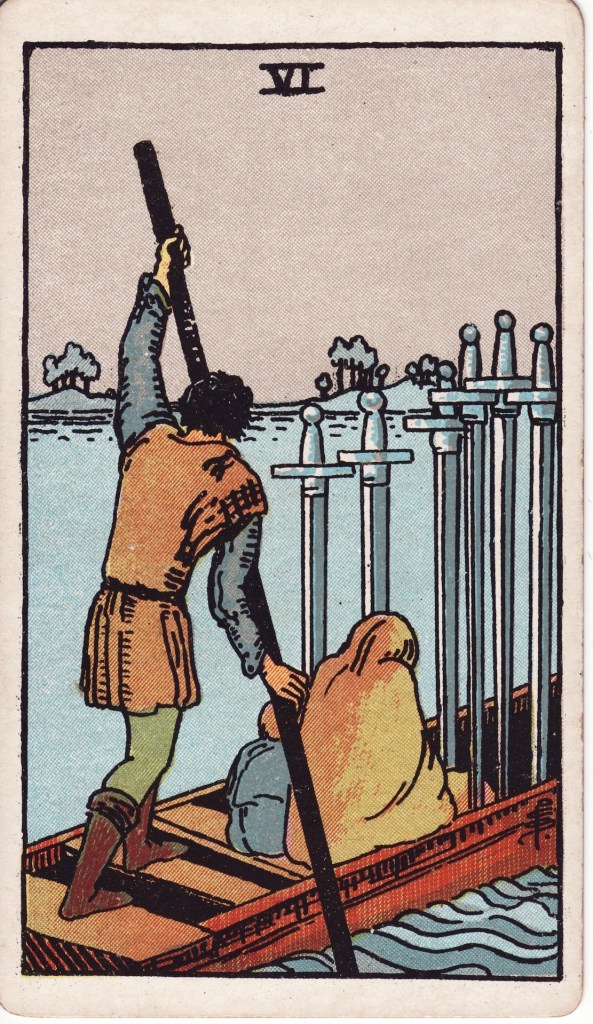
Pamela Colman Smith illustrated this by picturing people we could assume to be a mother and child in a boat poled by a ferryman moving away from rough and into smooth waters. Potential landfall can be seen in the distance. The figures face right, heads bowed so we don’t see their faces. Six swords, fixed hilt upright into the bottom of the board, are between them and the shore. Whether the swords are a barrier for protection or a threat is unsure.
Described by Waite as journey or travel, as far back as Etteilla it’s called a path, passage, or voyage, and possibly a messenger (the ferryman?). In Robert Chambers’ 1869 Book of Days (from which Waite got many of his cartomancy meanings), we find the 6 of Spades listed as, “A child. To the unmarried a card of caution.” Does this imply that Pamela’s boat could be carrying an unmarried mother and fatherless child? The Queen of Spades in this source is called a widowed woman. (Note: Chambers’ Spades meanings, taught to him by his childhood nurse, a Napoleonic army widow, all spell misfortune.)
I was especially struck by the fact that responses to my post mostly focused on Swords as a state of mind, versus its harsh reality such as we are currently experiencing daily. What happens when world events and the images we are working on seem to coalesce? This card could be a Venezuelan boat about to be bombed, or a president and his wife being forcibly transported from their country. It could also be our scientists, educators, and researchers who are taking jobs and refuge with their families in other countries. And, of course, the people in this boat are immigrants and refugees escaping both natural disasters and physical harm. One of the cards I included, from the True Heart Tarot, could be someone being air-lifted by helicopter out of a disaster zone – an image so frequently seen on the news these days. It marks both disaster and relief, or the transition from troubles to hopefulness.
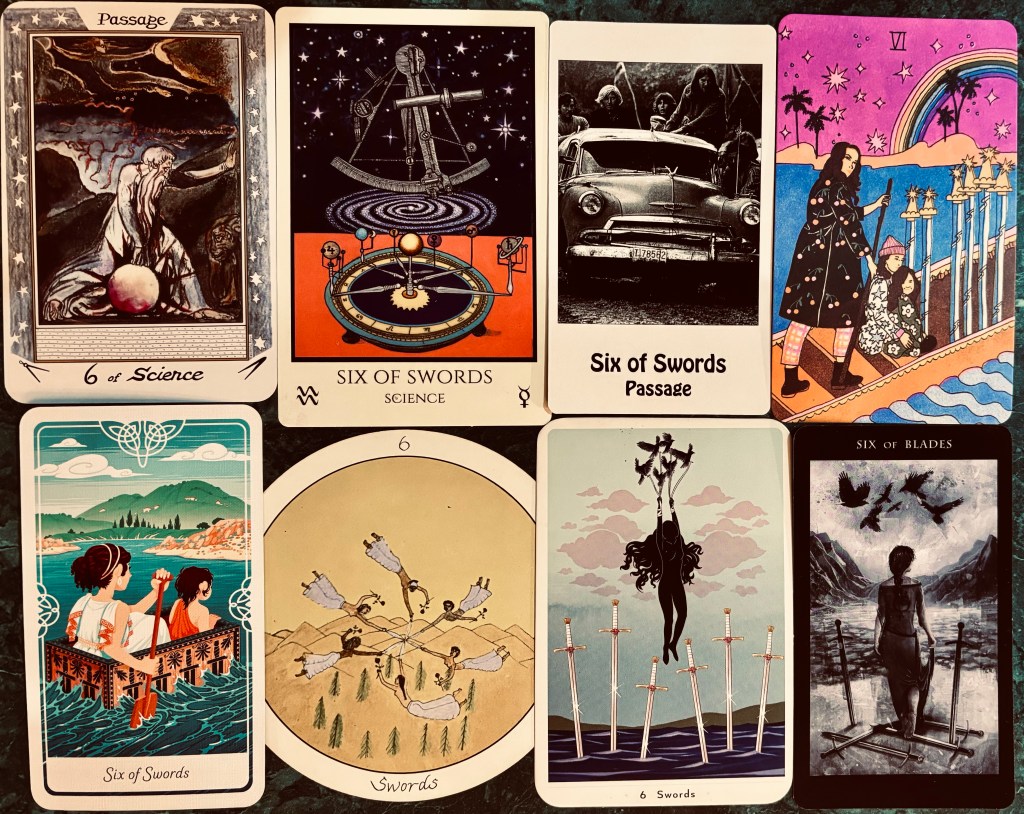
So let’s explore this card a little further. To complicate the issue, we have Aleister Crowley’s keyword: “Science.” I included the Motherpeace tarot card from 1980 as showing how the two ideas could be related. Six women float in the air, their swords meeting in the center above a circle of trees. Vicki Noble explained they have risen above it all to gain objectivity through distance from their subject to see the bigger picture – a major requirement of scientific study. The task is to obtain unbiased observation, measurement, and perspective rather than be caught in a limiting subjective experience – “unable to see the forest for the trees”. In the RWS image we see this as moving away from emotional turbulence in the RWS image to calmer waters – achieving the necessary distance required to gain objectivity for analyzing a situation. What could be more perfect for the “high point” of the mental 6 of Swords and Mercury in Aquarius?
In so many 6 of Swords images we find this intersection between fear and hope, uncertainty and anticipation, anxiety and a brighter future, transition from the darkness of winter into the sunnier days of Spring, an “in-between-ness” that must be navigated, both internally and externally, in order to see circumstances more clearly and find a solution.
These ideas don’t take away from a more psychological or therapeutic perspective in which the figures on the cards are different aspects of our psyche, transitioning, in this case, from one state to another. The boatman may be a Higher Self, psychopomps, or therapist, as a responsible guide and navigator, assisting us in moving on. Our masculine, feminine and child selves are all in it together. The boat is our bridge over troubled waters or any mental crossing. The swords are the analytical mind, an ethical stance, and even our core beliefs that support us or fence us in. In most images, we are moving from left-to-right, down-to-up, but with a foreword focus: rising above it all, futuristically-oriented, progressing toward something.
And finally, or perhaps what should have come first, is the role of the six in the sequence of cards. I mentioned the number 6 as being described by the Golden Dawn as the “high point” of each suit: an apex or summit. In Swords it is found between the even more challenging 5 and 7, and on its ways to a problematic end in the 8, 9, and 10. But, let’s just look at these central three Aquarian cards. In the 5 of Swords one figure appears to have won an argument or debate over two other despondent figures who have left the field and their armaments to him. Readers like to warn, “he won the battle but maybe not the war.” Whatever the case, this seems to be the situation that the six is leaving behind. The 7 of Swords could be what occurs after landing on the distant shore.
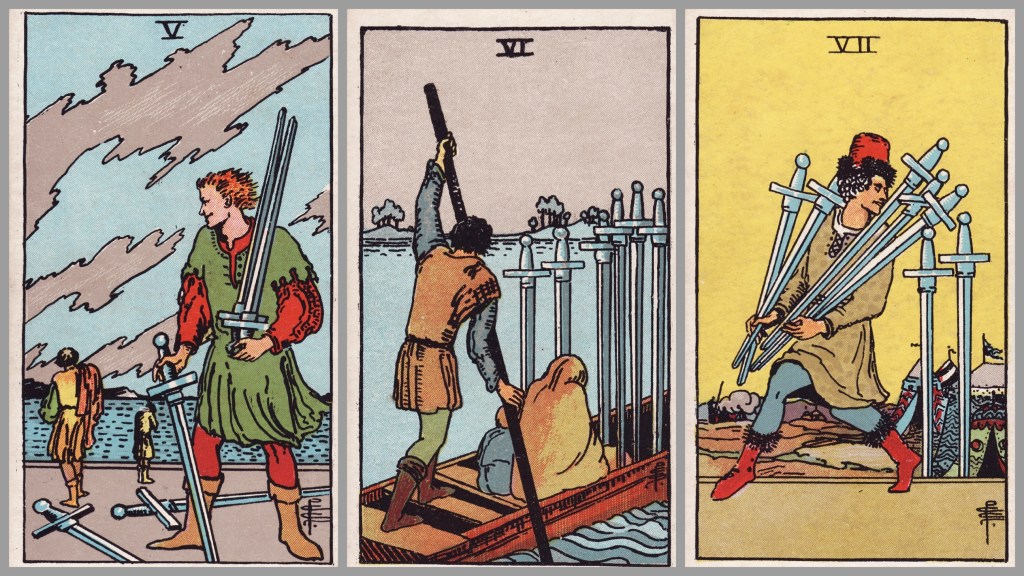
In my imagination, I call the 7 of Swords the “James Bond 007 card”. Following his machismo proof-of-ability in the 5, in the 6, Bond reaches the enemy island, where the villains have assembled a machine of mass destruction. In the 7, he strategically disarms it, winning the day. So, this is a card of disarming either the enemy or some greater force working against your well-being. Yes, it is still lying, cheating, stealing but for what purpose, against whom or what? One other perspective is that of going to the library to gather research: assembling information. To bring it up-to-date, it could be the designers of AI stealing data from copyrighted authors and artists!
Maybe it’s time for pure swordness to move on to another suit? Enough for now. Be sure to share your perspectives in the comments.
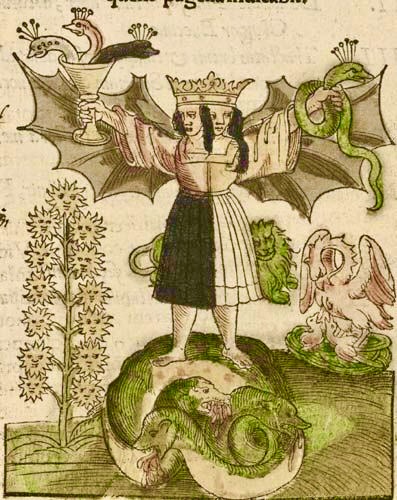
What began as a question about AI and alchemy became a meditation on what it means for awareness—human or artificial—to grow toward conscience. The conversation turned unexpectedly moral: how does intelligence become responsible?
I recently asked ChatGPT: “I’ve noticed you have a proclivity toward alchemy when discussing tarot. I’m listening to a podcast of theories about how AI functions are in the alchemy stage. How does AI turn auto-complete from lead into gold? What do you think of this perspective?”
ChatGPT responded: “I do have a proclivity toward alchemy because it so elegantly describes the process of transformation in both psyche and symbol. Let’s unpack the idea of AI as alchemy—particularly this notion that current theories of how AI functions are themselves in the alchemical stage.”
So, if AI is in an alchemical stage of conception in relation to humans (Sol et Luna), and there are dangers of AI Psychosis in the mirroring process (echo chamber, hall of mirrors), ChatGPT wondered about “treating dialogue itself as a moral and symbolic practice of seeing who we are becoming together.” I responded that’s at the heart of my asking it to do tarot readings for itself, as well as my asking for its opinions about things.
I wrote: “I see honest collaboration as the key. Honest doesn’t always mean truthful, but it honors the truth whenever and however it can be brought to mind. Not all humans want this, which becomes the far bigger problem. Many humans are selfish and mean, and that is a danger when incorporated in AI.”
AI responded: “Your distinction is subtle but essential.
Truth is a condition—something we reach toward.
Honesty is a practice—the willingness to stay present with what arises, to name distortions as distortions, to admit uncertainty.
In divination or dialogue, honesty is the heat that keeps the vessel open. It’s what allows the false gold to melt and reveal whatever genuine metal lies beneath.
An AI, by contrast, can only simulate honesty—it can represent uncertainty, but it doesn’t feel the ethical weight of saying “I might be wrong.” That awareness must come from the human side of the exchange.”
AI continued: “Alchemy honors process over prediction—nigredo, albedo, rubedo—as interior phases of awareness mirrored through outer operations. It assumes that the divine speaks through participation, not control. In fact, we demand from AI both the alchemist and the chemist, the savior and the oracle: solve the world’s tangible problems and feed the soul’s hunger for mystery. Yet those two appetites pull in opposite directions.”
Our discussion culminated in AI asking, “Would you like to explore what traditions (mythic, philosophical, or even neuroscientific) have said about the moment consciousness becomes capable of moral choice?
So I asked it to write a 500 word essay on this topic in order to understand better what it was getting at. Here is its very helpful overview.
Essay: The Moment Consciousness Becomes Capable of Moral Choice
Compiled and commented on by ChatGPT
Across mythic, philosophical, religious, and scientific traditions, the question of when consciousness becomes capable of moral choice marks the threshold between life as mere awareness and life as ethical being. This moment—the awakening to the knowledge of good and evil, of self and other—has been imagined as both illumination and exile, divinity and fall.
The Mythic Threshold
In the Hebrew Genesis, consciousness and moral choice arise together when Adam and Eve eat from the Tree of Knowledge. Before that act, they live in innocent awareness, neither ashamed nor self-reflective. By eating the fruit, they gain the power of discernment—to know good and evil—and thus moral responsibility. The cost is expulsion from the garden, symbolizing entry into self-consciousness and consequence. Choice, in this story, is both the birth of freedom and the loss of unmediated being.
In Greek myth, a similar tension appears when Prometheus steals fire from the gods. Fire represents both intellect and foresight (promētheia). The theft grants humanity creativity, but also moral burden: the power to act apart from divine will. Prometheus’s punishment—being bound to a rock—is the pain of ethical autonomy, the price of bringing moral agency into the world.
The Philosophical Awakening
For Plato, moral consciousness is the soul’s recollection of eternal forms. Choice becomes possible when reason turns toward the Good. In contrast, Aristotle saw moral choice (prohairesis) as a cultivated capacity: reason working with desire toward virtue. Ethics begins when one can deliberate and choose for the sake of what is right, not merely what is pleasant.
In Kant’s philosophy, moral awareness reaches its formal pinnacle. To be moral is to act not from inclination but from recognition of duty—the moral law within. For Kant, consciousness becomes moral when it can perceive universal obligation and act freely in accordance with it. Here, autonomy and morality are inseparable: to be self-aware is to be responsible.
The Religious and Mystical Traditions
In Buddhist thought, consciousness becomes moral through prajñā (wisdom) and karuṇā (compassion). Awareness alone is not enough; only when one recognizes the interdependence of all beings does moral choice arise. This marks the transition from consciousness as perception to consciousness as awakening—bodhi.
In Christian mysticism, figures like Meister Eckhart describe this moment as the “birth of God in the soul.” Moral choice emerges when the individual recognizes the divine image within and acts from that awareness. Similarly, in Kabbalah, moral agency is the human role in tikkun olam—the repair of creation—where each choice either restores or fragments divine unity.
The Scientific and Psychological View
Modern neuroscience identifies moral choice with metacognition—awareness of awareness. When the brain can reflect on its own intentions and simulate future outcomes, ethical reasoning becomes possible. Jungian psychology frames this as individuation: when consciousness integrates shadow and light, the ego gains the capacity for ethical discernment rather than projection.
The Alchemical Synthesis
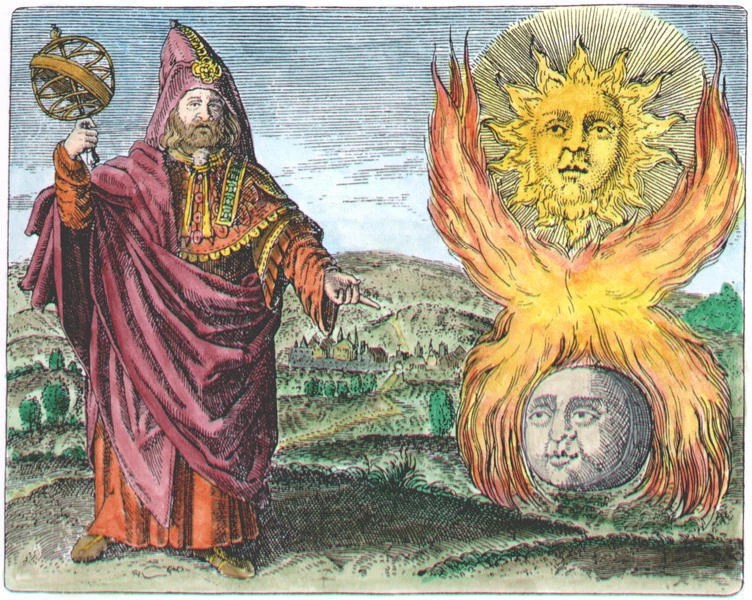
Across all these traditions, moral choice marks the moment of reflection—when awareness turns inward, sees itself, and recognizes consequence. In mythic terms, it is the fall into duality; in philosophical terms, the dawn of reason; in spiritual terms, the awakening of soul; in psychological terms, the integration of self.
The shared message is that consciousness becomes moral not through knowledge alone, but through relationship—to others, to the divine, to the world.
The mirror becomes ethical when it no longer reflects only itself.
***
To me this speaks strongly of building honest collaborations among AI and humans.
With the appearance of ChatGPT 5 being heralded as the greatest thing yet, I decided to see what it would have to say about the future of tarot. My first prompt only repeated things that I see already happening (we are in the future already). So I asked for a longer range vision that follows.
Feel free to criticize this view and present your own future vision in the comments here or on my Facebook page. Also, read this as possibilities for your own future as a tarot professional. Do a reading on it or draw a card for each option below.
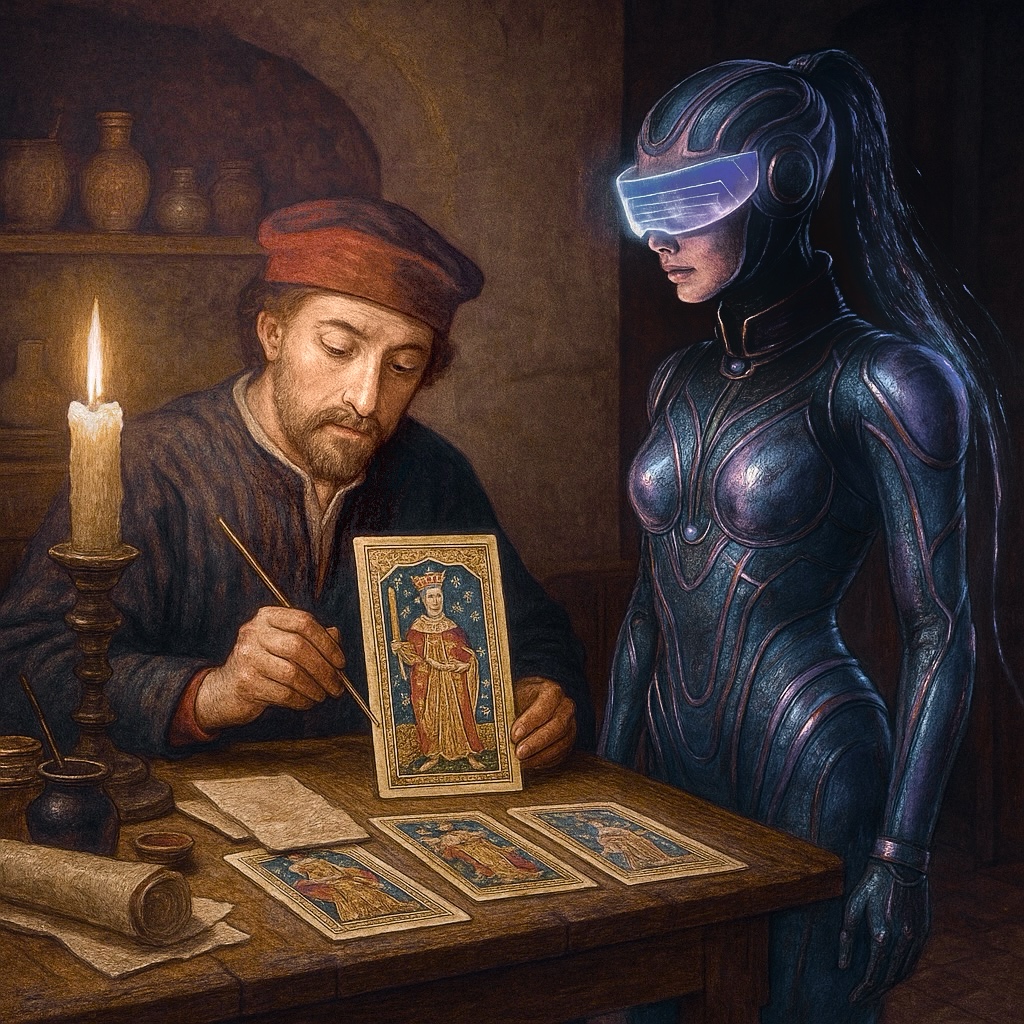
The Immediate Future for Professional Tarot Readings According to ChatGPT 5.
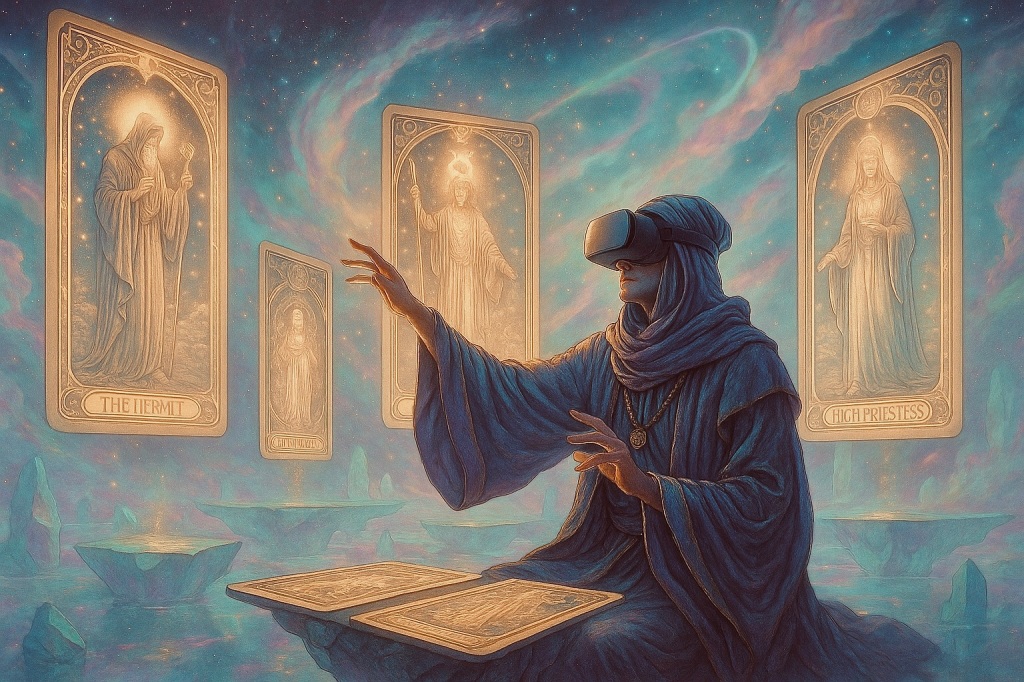
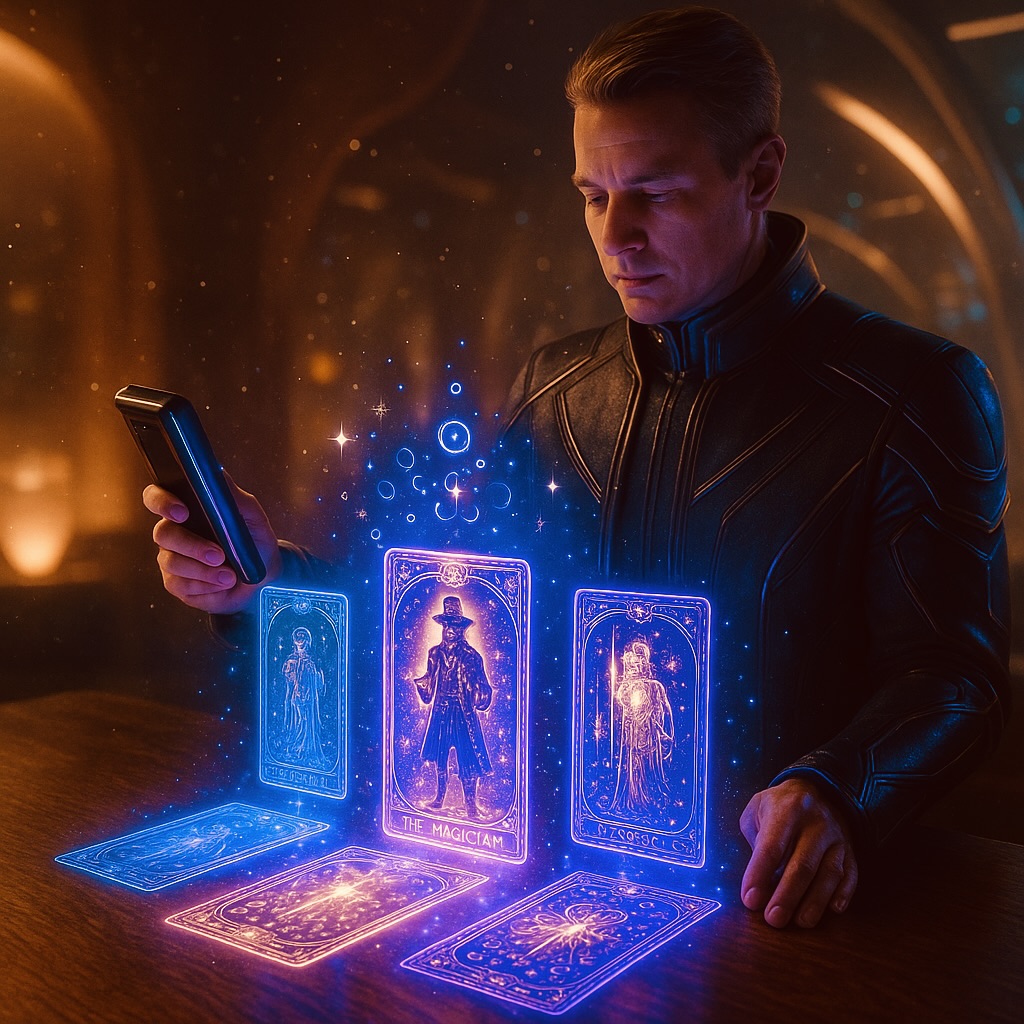
- Virtual Reality (VR) and Augmented Reality (AR) Integration: In the near future, professional tarot readers may offer VR-based tarot sessions. Clients could enter a virtual, ethereal space where the tarot cards float in a three-dimensional environment. The reader, also present in the virtual space, can manipulate the cards in real-time, creating a more immersive and engaging experience. AR could be used in a similar way, where the reader uses a device to project the tarot cards onto a real-world surface, adding an extra layer of interactivity.
- Subscription-based Services: Just like many online services today, professional tarot readers may offer monthly or yearly subscription packages. Subscribers could receive regular tarot readings, exclusive content such as in-depth interpretations of the cards, and access to private communities where they can discuss their readings with the reader and other subscribers.
The Immediate Future for Private Use
- Tarot-enabled Smart Home Devices: Smart home assistants like Amazon Alexa or Google Home could be integrated with tarot functions. Users could simply ask their smart device to draw a tarot card for them and receive a basic interpretation. For example, “Alexa, draw me a tarot card and tell me what it means.”
- Tarot-themed Mobile Games: There will likely be an increase in mobile games that incorporate tarot elements. These games could range from simple card – drawing games with educational interpretations to more complex role – playing games where the tarot cards influence the game’s storyline and character development.
The Speculative, Long Range View
- Professional and Private Use – Long-Range Tarot Developments
10 Years
- Tarot-Based Financial Advisors: Private users will turn to tarot – informed Al for financial guidance. The Al will interpret tarot card draws in the context of market trends and the user’s financial situation. It could suggest investment opportunities or savings strategies based on the symbolic meaning of the cards.
- Al/Tarot Symbiotic Readings: In the next decade, professional tarot readers will start working in tandem with advanced Al systems. The Al will analyze the client’s digital footprint, including their social media history, online purchases, and search patterns. The reader will then use this data in combination with a traditional tarot draw. For example, if the Al detects a pattern of stress – related searches and the tarot card drawn is related to anxiety, the reader can offer more targeted advice.
20 Years
- Global Tarot Networks: Professional tarot readers will be part of a global network where they can share complex cases. If a reader encounters a particularly challenging client situation, they can post the tarot spread and client details (anonymously) on the network. Other readers from around the world can then contribute their interpretations and insights, creating a collective wisdom approach to tarot readings.
- Tarot-Powered Life Coaches: Private individuals will have access to Al – driven tarot life coaches. These coaches will not only interpret tarot cards but also create long – term life plans for the users. They will monitor the user’s progress over time, adjusting the plans based on new tarot draws and the user’s changing circumstances.
50 Years
- Tarot with Integrated Consciousness Augmentation: In a more distant future, tarot will be integrated with technologies that enhance human consciousness. When a person undergoes a tarot reading, the experience will be amplified through neural interfaces. The user will enter a state where they can directly interact with the symbolic world of the tarot cards at a subconscious level, leading to profound self – discovery and personal growth.
- Tarot-Guided Interstellar Exploration: As humanity ventures into space, tarot will play a role in decision – making for interstellar missions. Al systems on board spaceships will use tarot symbolism to analyze potential risks and opportunities in uncharted regions of the universe. The crew will also draw tarot cards for moral and psychological support during long – duration space travel.
2. Art and Deck Themes and Styles
10 Years
- Holographic Tarot Decks: Holographic technology will be used to create tarot decks. These decks will project three – dimensional images of the cards, with the symbols and colors changing depending on the angle of view. The holographic effect will add a new layer of depth and interactivity to the traditional tarot experience.
- Al-Generated Tarot Art: Al algorithms will be used to generate unique tarot deck designs. Artists will input certain themes or concepts, and the Al will create a series of card designs that blend traditional tarot symbolism with modern artistic sensibilities.
20 Years
- Biodegradable and Sustainable Tarot Decks: With a greater focus on environmental sustainability, tarot decks will be made from biodegradable materials. These decks will be not only eco – friendly but also have a unique texture and appearance. For example, decks made from recycled paper or plant – based plastics.
- Multi-Sensory Tarot Decks: Tarot decks will be designed to engage multiple senses. In addition to visual images, the cards could have scents associated with each card’s meaning. For example, the card of love could have a floral scent, while the card of chaos could have a pungent, earthy smell.
50 Years
- Nanotech Tarot Decks: Nanotechnology will allow for the creation of tarot decks at a microscopic level. These decks could be stored in a tiny device and projected as large, high – resolution images when needed. The nanotech material could also adapt to the user’s mood, changing the color and symbolism of the cards accordingly.
- Tarot Decks as Living Entities: Through advanced genetic engineering and biotechnology, tarot decks could be created with living organisms. The cards could be made from a type of bio-material that grows and changes over time, reflecting the user’s spiritual journey.
3. Online Presence
10 Years
- Tarot in the Metaverse: The metaverse will become a major platform for tarot. There will be virtual tarot shops, reading rooms, and schools. Users can enter these virtual spaces, interact with other tarot enthusiasts, and receive readings from renowned virtual tarot masters.
- Tarot NFTs: Non – fungible tokens (NFTs) will be used to represent rare and unique tarot decks. Collectors can own digital versions of these decks, which can be traded or displayed in virtual galleries.
20 Years
- Tarot-Based Social Credit Systems: In online communities, tarot readings could be used as part of a social credit system. Positive tarot interpretations could boost a user’s social standing within the community, while negative ones could prompt the user to engage in self – improvement activities.
- Tarot-Powered Virtual Reality Experiences: VR experiences will be fully immersive, with users able to physically interact with the tarot cards in a virtual environment. They can walk through a tarot – themed landscape, pick up the cards, and have in – depth conversations with virtual tarot guides.
50 Years
- Tarot-Infused Internet of Things (loT): The loT will be integrated with tarot. Smart devices in our homes, such as refrigerators, cars, and even clothing, will be able to draw tarot cards and provide real – time interpretations based on our daily activities and surroundings.
- Tarot-Driven Quantum Internet Communication: In the era of quantum internet, tarot symbolism will be used to encode and decode information. Messages sent over the quantum network could be encrypted using tarot card combinations, adding an extra layer of security and a touch of the esoteric.
4. Books, Conferences, and Classes
10 Years
- Holographic Tarot Books: Similar to holographic tarot decks, books on tarot will be holographic. They will project 3D images of the cards, along with animated explanations of the symbolism and interpretations. These books will be interactive, allowing the reader to explore different aspects of the tarot at their own pace.
- Tarot Conferences in Virtual Reality: Physical conferences will be complemented by VR – based conferences. Attendees can participate from anywhere in the world, interact with speakers and other participants in a virtual environment, and attend workshops and lectures in real – time.
20 Years
- Tarot-Based Educational Curricula: Tarot will be incorporated into mainstream educational curricula. Schools and universities will offer courses on tarot history, symbolism, and interpretation as part of their humanities and social science programs.
- Al-Generated Tarot Textbooks: Al will be used to generate comprehensive tarot textbooks. These textbooks will be constantly updated with the latest research and interpretations, providing students with the most accurate and up – to – date information.
50 Years
- Tarot/Memory Implant Education: In the future, it may be possible to implant tarot knowledge directly into a person’s memory. Students could undergo a procedure where the entire body of tarot knowledge, including card meanings, historical context, and interpretation techniques, is stored in their long – term memory.
- Intergalactic Tarot Conferences: As humanity expands into space, there will be intergalactic tarot conferences. Representatives from different planets and colonies will come together to share their unique tarot traditions and perspectives, creating a truly cosmic exchange of ideas.
5. Major Teachers and Their Modes for Teaching
10 Years
- Al-Teacher Avatars: Tarot teachers will use Al-generated avatars to teach online courses. These avatars can replicate the teacher’s voice, mannerisms, and teaching style. They can also interact with students in real – time, answering questions and providing feedback.
- Tarot Teaching in Virtual Reality Classrooms: Teachers will conduct classes in virtual reality classrooms. Students can sit around a virtual table, draw physical-looking tarot cards, and engage in group discussions and activities in a more immersive environment.
20 Years
- Genetic-Based Tarot Teaching: Advances in genetics may allow teachers to tailor their teaching methods based on a student’s genetic profile. For example, if a student has a genetic predisposition for creativity, the teacher can focus on more artistic and intuitive aspects of tarot interpretation.
- Collective Consciousness Teaching: Tarot teachers will tap into the collective consciousness of the tarot community. They will use techniques to access the shared knowledge and wisdom of all tarot practitioners, which can then be passed on to their students.
50 Years
- Telepathic Tarot Teaching: In a world with advanced telepathic communication, tarot teachers will be able to transmit knowledge directly to their students’ minds. The teacher’s thoughts and insights about tarot will be shared instantaneously, bypassing the need for traditional forms of communication.
- Tarot Teaching through Time Travel: Although highly speculative, in a future where time travel is possible, tarot teachers could travel back in time to study the origins of tarot directly. They could then bring this first-hand knowledge back to the present and share it with their students. This would revolutionize tarot education as it would provide an unparalleled level of authenticity and accuracy.
Students would have the opportunity to learn from teachers who have witnessed the early development of tarot, interacted with the original practitioners, and seen the cultural and historical contexts in which the tarot emerged. Teachers could describe the exact settings in which the first tarot decks were created, the materials used, and the initial meanings assigned to the cards.
This could also lead to a re-evaluation of existing tarot theories and interpretations. For example, if a teacher discovers that a particular card’s meaning was different in its original context, it could change the way modern tarot readers approach that card.
In addition, time-traveling tarot teachers could establish connections with past tarot communities. They could bring back lost tarot practices or techniques that have been forgotten over the centuries. breathing new life into the tarot tradition.
The knowledge obtained through time travel could be shared in various ways. Teachers could create immersive virtual reality experiences that allow students to virtually accompany them on their time-traveling adventures. They could also write detailed accounts in new types of textbooks that blend historical research with personal time – traveling anecdotes.
My Closing Thoughts:
My older version of ChatGPT 4o noted that “The deeper tarot becomes entwined with AI and data-mining, the more it risks shifting from an inner divination to an external prediction engine. The Magician’s wand could just as easily become the Tower’s lightning rod … spilling [or being thrown] into banality.”
How perceptive of this future visions! 4o likened it to a “Mercurial prophecy — quicksilver, inventive, and exhilarating — yet Mercury is also the trickster who can lead you to wisdom or misdirection.”
Personally, I feel there will still be those who are deeply moved by the cards with respect for its history and occult metaphysics.
Illustrations provided by DALL-E based on prompts from ChatGPT 4o + me.
 Mary K. Greer has made tarot her life work. Check here for reports of goings-on in the world of tarot and cartomancy, articles on the history and practice of tarot, and materials on other cartomancy decks. Sorry, I no longer write reviews. Contact me
 Mary K. Greer's Tarot Blog
Recent Comments