You are currently browsing the yearly archive for 2008.
I haven’t looked at much recent tarot poetry, but the web turns out to be a wonderful place to explore it. Here’s a few sites that offer something different or intriguing:
At heelstone.com’s poetry site you’ll find Tarot Poems by Mike Timonin, with Art by Cindy Duhe, presented in a very tarot-appropriate way. Click on the rapidly changing tarot card images and you’ll be taken to a poem determined by the shuffle. Want another card and poem? Shuffle the deck again.
You’ll also find a poem by Michael Gerald Sheehan for every card at Moon Path Tarot.
Tarot Poems by Donna Kerr from her book of poetry Between the Sword and the Heart.

Tarot Poetry by Rachel Pollack.
Here is one of the oldest tarot poems in existence: a sonnet by Teofilo Folengo, appearing in his 1527 work Caos del Triperiuno written under the pseudonym Merlini Cocai. The work includes a series of poems representing the individual fortunes of various people as revealed by cards dealt them. The summary sonnet below mentions each of the 22 Trump cards, which I’ve referenced by their number to the right of the line on which they appear. It helps to understand that Death is female in Italian, la morte, and Love (Cupid) is male. Love claims that although Death rules the physical body, Love never dies and therefore death is but a sham.
Love, under whose Empire many deeds (6, 4)
go without Time and without Fortune, (9, 10)
saw Death, ugly and dark, on a Chariot, (13, 7)
going among the people it took away from the World. (21)
She asked: “No Pope nor Papesse was ever won (5, 2)
by you. Do you call this Justice?” (8 )
He answered: “He who made the Sun and the Moon (19, 18 )
defended them from my Strength. (11)
“What a Fool I am,” said Love, “my Fire, (0, 16)
that can appear as an Angel or as a Devil (20, 15)
can be Tempered by some others who live under my Star. (14, 17)
You are the Empress[Ruler] of bodies. But you cannot kill hearts, (3)
you only Suspend them. You have a name of high Fame, (12)
but you are nothing but a Trickster.” (1)
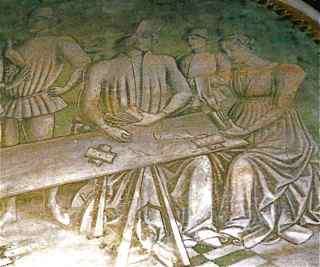
Translated by Marco Ponzi (Dr. Arcanus) with help from Ross Caldwell, members of Aeclectic Tarot’s TarotForum, and by comparisons with the translation found in Stuart Kaplan’s Encyclopedia of Tarot, Vol II, p. 8-9 (read the discussion here). The first picture is from a 1485 Triumph of Death fresco on the wall of a Confraternity Chapel in Clusone, Italy. It depicts Death as an Empress before whom all others bow. The second picture is from Savonarola’s Sermon on the Art of Dying Well, published circa 1500.
See the translation of one of Folengo’s fortune-telling sonnets at taropedia – here.
Added: Check out the poetic concept of rhyme applied to visual aspects of the tarot in Enrique Enriquez’s article on “Eye Rhyme.”
A couple of people have asked me how I defined “modern” in my post on the 1969 Tarot Renaissance. Stephen wrote in the comments: “In my humble opinion I would have put “modern tarot” renaissance as a part of the age of enlightenment… say late 1700’s onward to the 1920’s…(Etteilla, Gebelin, Levi, Crowley and Case) and building up to A E Waite’s pivotal anglo-american deck.” And Shawn said, “I’d love to know how you define/distinguish “modern” Tarot from it’s ancestry.”
I tend to think of modern as being within the last hundred years or so – within the memory of those who are still living. I’m aware there is one school of thought that puts anything since the “Middle Ages” into the modern category—but a 600-year span makes the term practically meaningless. I suppose a better term would have been “contemporary,” although we’re almost 40 years past that.
I could say that 1969 marks the 20th-to-early-21st century Tarot Renaissance. And, that it’s defined by a continuing growth and development of tarot involving the creativity of many people, deck sales in the millions, and broadly affecting the culture in many countries around the globe. To me a “renaissance” is a creative force in the culture as a whole—affecting a multitude of cultural forms.
Can anyone point to a single year prior to 1969 in which 18 to 20 new tarot decks and/or books were produced—or even half that? Or, how about a span of many years in which an average of a dozen or more tarot works came out every single year as they did from 1969 on?
Prior to the 1960s, the best we can find is one new tarot work every few years or even decades, with the exception of 1888-89 when there were three works in two years, and the mid-1940s when three or four works were produced over several years but with very few in the decade prior to or after that.
Certainly 1781 (the birth of the occult tarot), 1854, 1870, 1888/9, 1909 and 1945 are hugely significant dates and turning points in tarot history, but these are the works of individuals in single years, not mass-movements. They didn’t directly affect the creative output of a large segment of the culture until we come to the 60s and especially 1969, when there was a popular groundswell that has continued to grow and spread.
There were around twelve new works in 1970, fourteen in 1971, nine or ten each from 1972 to ’74, seventeen in 1975, and so on. The effects could be seen throughout the culture: in poetry, painting, collage, sculpture and art installations, movies, television, theatre, fiction, comics, psychology, and even fabric, clothing and jewelry design.
Something happened to tarot since the late 60s and 70s that is vastly different and more creative then anything that had happened before, and across a much wider range of human experience.
I may not have all my terms right, but I’m trying to get some understanding of what happened. Keep the comments coming.
Like getting your history from a visual medium? Here’s one of the best brief video overviews of early tarot history out there, despite the incorrect prounciation of the Italian (not French) word tarocchi (correct: “tah-ROH-key”)—plural form of one of the oldest names for the cards, which is still used in Italy. However, when it comes to the later occult and divinatory tarot, videographer Mark (tokarski21) couldn’t resist falling into the occult-as-Devil trap. This is really too bad for someone who professes to deal straight with history. Mark promises to delve more into the subject later so I hope he gets better sources (me!?) and treats the subject with more historical objectivity. Catch up with Mark’s other videos here and here.
. . . With my gypsy ancestress and my weird luck
And my Tarot pack and my Tarot pack . . . (at minute 1:43)
See more Sylvia Plath videos here (then search on her name).
Added: It turns out that the original manuscript of Sylvia Plath’s book, Ariel, was ordered according to the Tarot and Qabala—with the first twenty-two poems associated with the Major Arcana and the next ten with the ten pips and sephiroth followed by the four ranks of the Court and then the four suits. This ordering is now apparent in Ariel: The Restored Edition (2004). All of this is explained in an article by Julia Gordon-Bramer for the journal Plath Profiles. Download a pdf of Gordon-Bramer’s article here.
When did the modern tarot renaissance actually begin? It’s always hard to pinpoint the beginning of a movement but here are some events worth noting that lead up to the breaking of the dam in 1969. I’m looking for corrections and additions to the information below, plus tarot stories from the 60s and early 70s. Please share them in the comments.
The 1940s saw some interesting tarot activities that set the stage for the later renaissance. The Crowley-Harris Thoth deck was completed and published in a limited edition of 200 in monochrome brown by Chiswick Press, but these were not available to the general public. In 1947 Paul Foster Case published his masterful work The Tarot: A Key to the Wisdom of the Ages, based on his tarot correspondence course. In France, Paul Marteau came out with his hugely influential book Le Tarot de Marseille that noted the symbolic significance of the smallest details in the deck. In Brazil, J. Iglesias Janeiro, published his book La Cabala de Prediccion, which popularized the turn-of-the-century Egyptianized Falconnier/Wegener cards. It became a center-piece of his important occult school, known mostly in Latin America. Meanwhile, in the U.S.A., Dr. John Dequer published The Major Arcana of the Sacred Egyptian Tarot, which was his revised version of those same Egyptianized cards, similar to what was already being used by C.C. Zain’s Brotherhood of Light correspondence school.

The Insight Institute in Surrey England started up their tarot correspondence course (later published in a book by Frank Lind) and produced their occultized version of the Marseilles deck (eventually published as the R.G. Tarot). Also appearing was an unusual book, solely on the psychological dimension of the Minor Arcana cards numbered 2-10 as they are associated with one’s birthday. It was Pursuit of Destiny by Muriel Bruce Hasbrouck, who had studied with Aleister Crowley when he was in the United States. Tudor Publishing’s The Complete Book of the Occult and Fortune Telling became the sole source in English of the unique Tarot card interpretations from Eudes Picard’s 1909 French work, Tarot.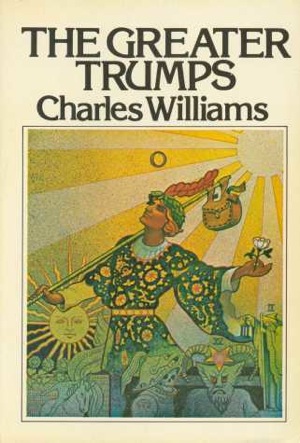
The 1940s also saw the incorporation of Tarot imagery in surrealist artworks such as Victor Brauner’s “The Surrealist,” and in Jackson Pollack’s “Moon Woman” (both of which I happened upon when I visited the Peggy Guggenheim Collection in Venice following the 2000 Tarot Tour with Brian Williams). William Gresham’s novel, Nightmare Alley, featured a carny mentalist who reads tarot and the book is presented as a twenty-two card reading. A year later Tyrone Power played the lead in the movie version featuring two tarot readings by Joan Blondell. Charles Williams’ landmark tarot novel, The Greater Trumps came out just as this decade ended and the next one began.
The 1950s produced even fewer tarot works. George Fathman published The Royal Road: A Study in the Egyptian Tarot, which used Dequer’s version of the Falconnier/Wegener cards. Paul Christian’s seminal work The History and Practice of Magic was translated from French to English, providing the original source material on which all those Egyptian-style decks were based. Arcanum Books reissued Papus’ The Tarot of the Bohemians with an introduction by librarian Gertrude Moakley, who noted the influence of tarot on creative writers and in psychology. Off in the Netherlands, Basil Rakoczi published the English language letterpress art book: The Painted Caravan: A Penetration into the Secrets of the Tarot Cards. Yet, the tarot seemed likely to fade away from popular view.

1960 started out the decade with a bang. University Books published Waite’s A Pictorial Key to the Tarot for an American readership, as well as a deck: Tarot Cards Designed by Pamela Colman Smith and Arthur Edward Waite. Eden Gray self-published her Tarot Revealed that still sells well to this day. In England Rolla Nordic came out with The Tarot Shows the Path: Divination through the Tarot. These last two books showed a clear shift in interest to practical tarot readings for the masses. Muriel Hasbrouck’s greatly overlooked 1940s work was re-published.
As the 60s progressed we got two heavy metaphysical works: Mouni Sadhu’s Tarot: A Contemporary Course of the Quintessence of Hermetic Occultism, and Mayananda’s The Tarot for Today, a study of Crowley’s material in the Book of Thoth (despite the latter’s being unavailable). The Brotherhood of Light came out with a new, revised edition of their 1930s Tarot deck. Idries Shah claimed, in The Sufis, that the Tarot was a Sufi creation. Influenced by T.S. Eliot’s “The Wasteland” and Yeats’ involvement in the Golden Dawn, poets like Robert Creeley, John Weiners, Diane Wakowski, Sylvia Plath, Philip Lamantia and Diane di Prima began using tarot imagery in their poems. While not published until 1974, Jack Hurley and John Horler worked on “The New Tarot,” a Jung-based deck, at the Esalen Institute throughout the 60s, influencing many who passed through there.
 In 1966 Gertrude Moakley set tarot history on it’s ear with her groundbreaking research in The Tarot Cards Painted by Bembo. The Grand Tarot Belline deck was published in Paris, as was a new edition of Oswald Wirth’s 1927 book, Le Tarot des imagiers du moyen age, that included his 22 card deck. Beginning in 1966 and running through 1971 the day-time TV soap opera Dark Shadows gave many people their first glimpse of a tarot deck as various episodes featured readings with the Marseille deck.
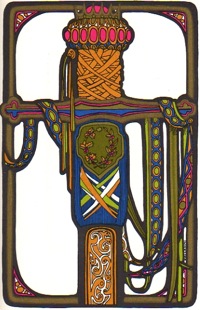
By 1967, even a paper company jumped on the bandwagon with its advertising Linweave Tarot Pack that gave David Palladini his introduction to tarot design (see card on right). Helios Books in England published a small edition of the Golden Dawn’s Inner Order tarot teachings, Book T. Doris Chase Doane came out with two books that helped popularize the Brotherhood of Light Egyptian tarot deck in America. Sidney Bennett wrote Tarot for the Millions.
 In 1968, the House of Camoin reproduced the classic 1760 Tarot de Marseille based on original pearwood woodcuts. The mysterious Frankie Albano redid Waite and Smith’s deck in brighter colors, giving those in the U.S.A. an alternative to the University Press version. Hades, in Paris, published Manuel complet d’interpretation du tarot, claiming it was based on a pre-de Gébelin 1761 original. Jerry Kay came up with his own version of Crowley’s deck that he called The Book of Thoth: The Ultimate Tarot. And, Stuart Kaplan brought back the Swiss 1JJ deck from the Nuremberg Toy Fair, selling 200,000 copies in the first year and making tarot available in department stores across the U.S.
The stage was now set for the 1969 deluge: at least five decks and twelve separate books where published! I won’t mention them all but they included Crowley’s Thoth book and deck (though not readily available for another two years), Cooke & Sharpe’s New Tarot for the Aquarian Age, an English-language edition of Grimaud’s Marseilles deck. Also books by Arland Ussher, Brad Steiger, Corinne Heline, Gareth Knight, C.C. Zain, Hilton Hotema, Frater Achad, Rodolfo Benavides, Elisabeth Haich, Sybil Leek, and Italo Calvino’s Italian short stories, ‘Il castello dei destini incrociati (“Castle of Crossed Destinies”). Every hippie pad had its requisite tarot reader.
1970 featured fewer books but even more decks, including the Rider-Waite and Palladini’s Aquarian. Stuart Kaplan at U.S. Games, Inc. started publishing his own decks.
The Tarot Renaissance was now fully underway.
For an even more extensive look at Tarot in America from 1910 to 1960 please see this Tarot Heritage page.
Many of you will be familiar with the tarot teachings of Paul Foster Case and the Builders of the Adytum (BOTA). Case took the idea of the adytum from a word long associated with the Mysteries. His idea was to build the adytum by meditating on the tarot Arcana. Adytum means inner shrine or holy-of-holies, from aduein meaning “not to be entered.” The adytum is said to contain the arcana, from the root arcus, “chest or box,” and arcere, “to ward off; shut up, keep,” from whence we get such concepts as the Ark of the Convenant, as a container of the secret knowledge between God and humanity that also wards off the profane. But what do these two terms, arcana and adytum, really mean and how do they relate to the tarot?
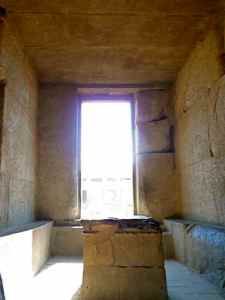
The phrase Arcana in the Adytum, first mentioned by Iamblichus, signifies the container of mysteries in the innermost sanctuary of a temple. Mystically speaking, this sanctuary must be built in the heart where the mysteries are directly experienced out of view of the profane. [This photograph is of the altar in the sanctum sanctorum at Karnak, which only the pharaoh was allowed to enter. The picture after it is of the spirit ascending into the starry sky in that sanctuary.]
Helena Blavatsky described the innermost shrine as:
“The Sanctum Sanctorum of the Ancients, i.e., that recess on the Western side of the Temple which was enclosed on three sides by blank walls and had its only aperture or door hung over with a curtain—also called the Adytum—was common to all ancient nations. . . . They regarded it—in its esoteric meaning—as the symbol of resurrection, cosmic, solar (or diurnal), and human. In Theosophy, therefore, the Holy of Holies represents the womb of nature, the female generative principle found in the mystery religions of Egypt, Babylon, India, Kabbalism, Masonry, etc. . . . The esoteric meaning of this arrangement typified cosmic, planetary and human resurrection or regeneration” (Blavatsky, The Secret Doctrine, Vol. II).

The word arcana goes back at least to the Neoplatonist, Iamblichus (165-180 CE). Thomas Taylor, in translating Iamblichus’ On the Mysteries explains:
“For the highest order of intelligibles is denominated by Orpheus the adytum, as we are informed by Proclus in Timaeus. By the arcanum in the adytum, therefore, is meant the deity who subsists at the extremity of the intelligible order [i.e. Phanes]; and of whom it is said in the Chaldean Oracles, ‘that he remains in the paternal profundity, and in the adytum, near to the god-nourished silence.’ . . . And all things remain perfect and entire, because the arcana in the adytum are never disclosed. Hence, in those particulars in which the whole of things possesses its safety, I mean in arcana being always preserved occult, and in the ineffable essence of the Gods, never receiving a contrary condition; in these, terrestrial daemons cannot endure.”
The Abbot Trithemius (1462-1516) defined arcana as “a synthesis of Hermetic alchemical doctrine, Pythagorean numerology, astrological correspondences, and Cabalistic word magic” (Trithemius and Magical Theology by Noel L. Brann). It was Trithemius’ cryptogram that was employed in the “cipher manuscripts” upon which the Golden Dawn rituals and tarot correspondences were based.
Paracelsus (1493-1591) uses the word in his philosophy of alchemical medicine. He tells us that in contrast with our bodily being, arcana are immortal and eternal, “they have the power of transmuting, altering and restoring us, and are to be compared to the secrets of God, being vital in human health” (Paracelsus, Archidoxies, Bk V, trans. A.E. Waite).
It was in the adytum that the Ark of the Covenant was kept. The arcana (plural form of arcanum) contain and preserve the hidden wisdom, the esoteric, versus exoteric knowledge. This distinction is made explicit by Eckartshausen, a favorite author of A.E. Waite, in speaking of the different roles of priest and prophet, where the prophet, not the priest, held the inner truth of the arcanum in the adytum:
“The wisdom of the ancient temple alliance was preserved by priests and by prophets. To the priests was confided the external,—the letter of the symbol, hieroglyphics. The prophets had the charge of the inner truth, and their occupation was to continually recall the priest to the spirit in the letter, when inclined to lose it. The science of the priests was that of the knowledge of exterior symbol. That of the prophets was experimental possession of the truth of the symbols. In the interior the spirit lived. There was, therefore, in the ancient alliance a school of prophets and of priests, the one occupying itself with the spirit in the emblem, the other with the emblem itself. The priests had the external possession of the Ark, of the shewbread, of the candlesticks, of the manna, of Aaron’s rod, and the prophets were in interior possession of the inner spiritual truth which was represented exteriorly by the symbols just mentioned” (The Cloud upon the Sanctuary (c. 1790) by Karl von Eckartshausen (translated by Madame Isabel de Steiger)).
The Golden Dawn named their tarot rites of the 12 Zodiacal and 7 Planetary Major Arcana after the items mentioned in the quote above: “The Table of the Shewbread” and the “Ritual of the Seven-Branched Candlestick,” respectively, making clear that for them the Ark was the Arcana.
In 1782 Count Cagliostro gathered his research in secret societies into a body of knowledge known as the Arcana Arcanorum, or A. A., consisting of a series of magical practices that stressed “internal alchemy.”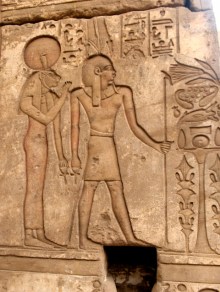
Although he doesn’t mention arcana, Etteilla tells us of the mystical arrangement of these cards in the Temple of Ptah at Memphis, “Upon a table or altar, at the height of the breast of of the Egyptian Magus, were on one side a book or assemblage of cards or plates of gold.” [The photograph to the right is of an image at the entrance to Ptah’s temple at Thebes showing Pharaoh making his offerings with Shekmet, wife of Ptah, giving him strength and direction.]
In 1863 Paul Christian (pseudonym of J-P. Pitois) wrote a novel called L’homme rouge des Tuileries, which tells of an encounter between Napoleon and a Benedictine monk who possesses an occult manuscript. This manuscript described seventy-eight symbolic houses or pictorial keys, referred to as Arcana. Virtually the same Egyptianized descriptions of the Arcana appeared in Christian’s 1870 Histoire de la magie, where they were finally acknowledged as the tarot.
Ely Star’s 1888 work, Mystéres de l’Horoscope contains a chapter on the tarot based almost entirely on Paul Christian. He was first to use the terms Major Arcana and Minor Arcana, and the following year they also appeared in Papus’ book Tarot of the Bohemians, suggesting that these terms were already in general use.
Blavatsky believed the Arcana were key to the science of the soul.
“There is a regular science of the soul. . . . This science, by penetrating the arcana of nature far deeper than our modern philosophy ever dreamed possible, teaches us how to force the invisible to become visible; the existence of elementary spirits; the nature and magical properties of the astral light; the power of living men to bring themselves into communication with the former through the latter” (Blavatsky, Isis Unveiled, Vol. 1).
The term arcana continually calls us back to the spirit of the hieroglyphs that make up the tarot, which can only become known in the astral light of the inner temple of the heart. We must make of ourselves a sacred place to receive and contain the inner spiritual truth that can, in turn, transmute, alter and restore us.
Added: for a modern perspective on arcanum check out the definition from Inna Semetsky here.
Have you ever wondered about the real tarot history? There appears to be no doubt that it began in Northern Italy, probably between 1420 and 1440. Italy is also the home of a major resurgence in tarot art. Join artist and writer Robert Place, creator of the Alchemical Tarot and the upcoming Vampire Tarot, and Ernesto Frazioli, curator of the Museo dei Tarocchi in Bologna and an expert on Italian history and art, on a Tarot Tour of Northern Italy this October 12—25, 2008. Go to cities in Northern Italy where the tarot began, visit historic and artistic sites, discover inspirations and parallels for the tarot trumps in the mystical symbols of the artworks of the 15th century.
I went on a Tarot Tour to Italy in 2000 with the late Brian Williams (the Renaissance Tarot deck and many more) – read about it here. It was a never-to-be forgotten experience that changed forever my understanding of tarot origins. In the process of directly encountering the imagery of 15th century Italy, you will come to truly appreciate how and why this deck of cards emerged as it did in a way that books can never portray. Plus, Italy is luscious and has just about the best food in the whole world! You can read more about Tarot in Italy and the Museo dei Tarocchi at Fern Mercier’s website – here.
UPDATE ALERT: The contract for the Buffy the Vampire Slayer Tarot has been cancelled. See new post.

Rachel Pollack has done it again! This August her Buffy the Vampire Slayer Tarot will be available from Dark Horse Delux. With Rachel as the author and conceptualizer and Buffy artist Paul Lee illustrating the cards, this is a must have item for all Buffy fans and tarot collectors.
The wonderful thing about this deck is that it doesn’t just illustrate the life of Buffy. Instead, this is an ancient artifact in Slayer history, predicting coming events and emerging periodically, through time, when it is most needed. Although knowledge of its existence has been long suppressed by the Watcher’s Council, it is now available for use by the allies of Buffy to help her fight evil and save the world. By using this deck you, too, can be part of the continuing Slayer saga, and get guidance for your own life issues.
Read an interview with the creators here.
In responding to a comment by tarotgirl about my previous post I wrote:
You can also create a spread around a definition or description of a single word or concept.
She asked: “How would you create a spread around a single word?”
So I thought I’d write my response here.
It’s not the word itself, but the definition of the word that I use. The parts of the definition become the position meanings and the word itself is the theme of the reading. Word roots could also be used.
I collect definitions of words that I find intriguing like for “symbol,” “imagination,” “meaning” and “myth.” Almost every writer on these subjects defines these words as they have come to understand and use them. Some of these definitions are very poetic, some strike at the heart of life’s dilemmas and issues. They can help us see the world and our mundane situations through a different lens, similar to what Rachel Pollack calls “Wisdom Readings” – but in this case, focusing on the wisdom in our own lives.
For instance:
According to Joseph Campbell: “A myth is a public dream; a dream is a private myth.”
You could draw two cards for what is the “public dream”/myth of your situation and what is the “private myth”/dream aspect of a situation. In doing this you take yourself out of the mundane level of what’s going on and choose to look at it from a wider perspective.
Or, Freud: “A myth is conscious ignorance and unconscious wisdom.”
You could ask “In this myth that I have about my mother . . . (add specific details) . . . : what is the conscious ignorance on my part (Card 1)? and what is the unconscious wisdom (Card 2) in that story?
Besides elucidating situations in your life, you can arrive at a very deep understanding of what the author of the definition was trying to convey. By operating “as if” this definition were true, you can also get a sense if it really works or not – it may just be a nice platitude that doesn’t go anywhere. Your life becomes the test case.
If you try this technique and like it, leave a comment and let us know what definition (or favorite quote) you used and how it worked.
Although I’ve been using this technique for a long time, I want to mention that the inspiring tarot author James Ricklef came up with it independently and taught it at one of the Bay Area Tarot Symposiums, using favorite quotes and proverbs. His book on creating spreads, Tarot: Get the Whole Story, is excellent.
A wonderful way to create spreads is to adapt a self-help process that you especially like to a spread. You can also do this with a favorite quote or aphorism (a technique favored by tarot author James Ricklef). I undertook a long-term study of Dante’s Commedia in a small study group and made it my special task to look for tarot images—of which there are many.
When I came to Inferno, Canto 32, line 76, I found, “se voler fu o destino o fortuna, non so.” Translated, it says, “if it was will or fate or chance, I do not know.”
This struck me as one of the great questions that is implied when we seek answers through the Tarot. Don’t you sometimes wonder how you got into a situation? Do you always have a choice? What keeps you bound to your past? Are some things fated? What role does chance play? What furthers your destiny? Fate, destiny and fortune are often used interchangably. How do they relate to will? In exploring this topic I’ve come to see each of these as having their own implications in a situation. I went back to Dante’s Italian language to see if I could understand these perspectives better.
If you have ever wondered, along with Dante, about such things, then you might want to try this spread.

1 – What is my current Will? Voler means will, wish or volition (all come from the same root). This is your personal desire or intent and suggests deliberate, conscious choice.
2 – What is my current Fortune? Fortuna means luck in Italian, but it also suggests something stormy and tempestuous or chaotic. The Goddess Fortuna throws you around in a random and unpredictable way. This shows you what chance or happenstance has in store.
3 – What is my current Fate? Related to karma, Fato assumes that an outcome is the result or consequence of an earlier, though sometimes unknown, cause. This includes the playing out of previous actions or tendencies as they’ve become conditioning and habits. Carl Jung noted, “That which we do not confront in ourselves, we will meet as fate.”
4 – What is my current Destiny? Destino suggests destination and implies a higher, divine or ultimate goal toward which you are impelled by something greater than or outside yourself.
An example showing the difference among these four is: I wish (will) to lose weight, but fortune takes me to a dinner party where all my favorite fatty foods are deliciously prepared. I am fated to break my diet because I’ve always done so when tempted. It is my destiny to eventually . . . become fat? Or, to overcome my habits and develop willpower? Or, as a friend mentioned, remain overweight as a divine flaw that keeps me from getting too arrogant (thanks to James Wells). The cards will reveal all.
Added: I was reading Thomas Moore’s Care of the Soul and came across the phrase “the demands of fate.” I wondered how this related to the four concepts above—if it could add another dimension to the positions. So I came up with the phrases that follow. What do you think?
• Fortune happens
• Fate demands
• Destiny urges
• Will decides
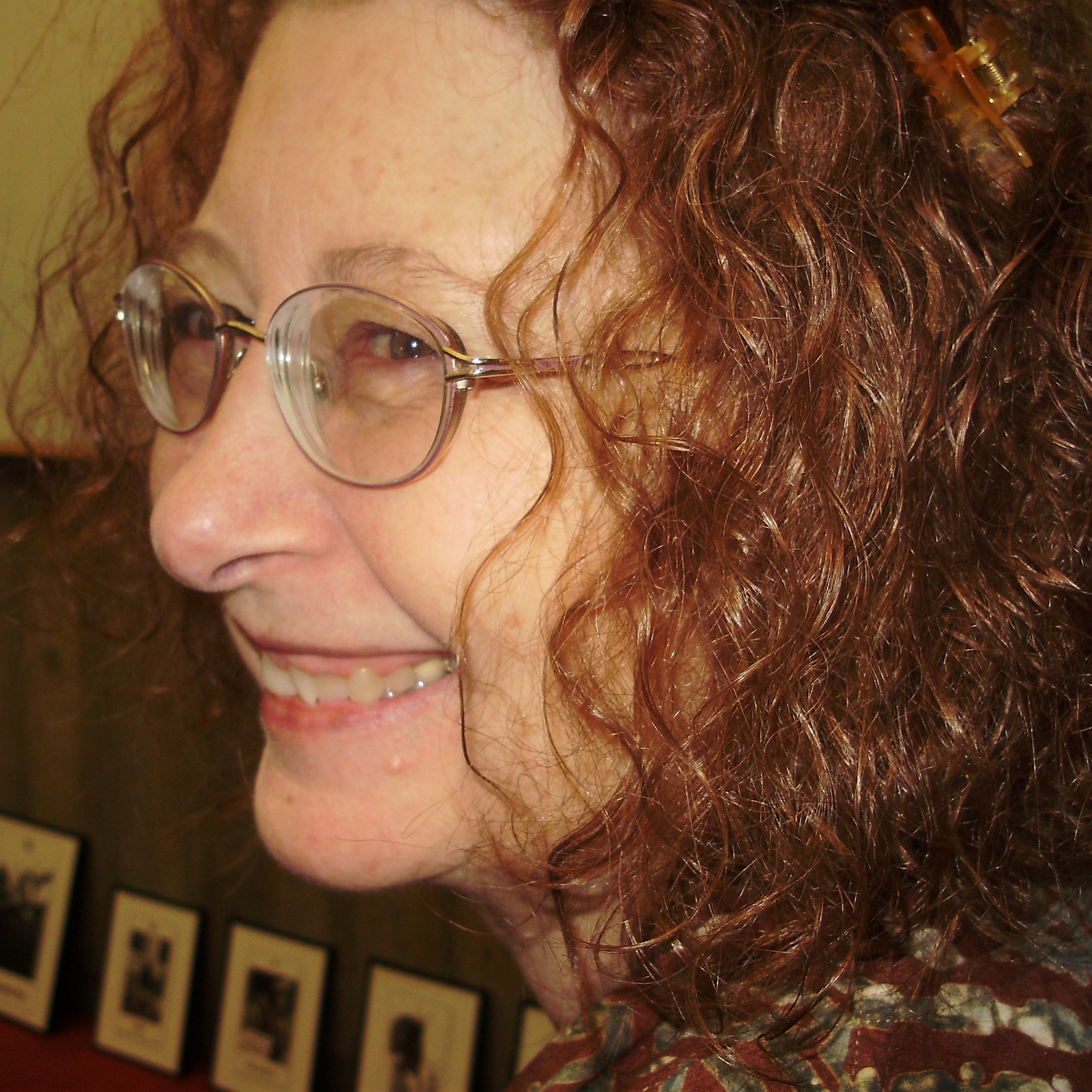 Mary K. Greer has made tarot her life work. Check here for reports of goings-on in the world of tarot and cartomancy, articles on the history and practice of tarot, and materials on other cartomancy decks. Sorry, I no longer write reviews. Contact me
 Mary K. Greer's Tarot Blog
Recent Comments