You are currently browsing the category archive for the ‘RWS Tarot’ category.
How many of us go to a movie or a play—even a really good one—and a couple of days or weeks later don’t remember a thing about it? Yes, movies have a role in relaxation and just plain momentary enjoyment, but there can be something said for the longer term pleasure of ruminating over the themes, questions and ideas presented in good art.
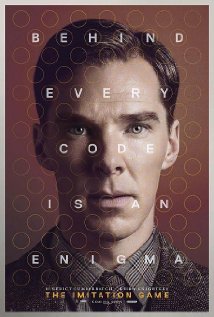 I have found Tarot and, more recently the 36 Lenormand cards, a great aid in meditating on ideas and art. This came into focus when I went to see the outstanding film The Imitation Game, about Alan Turing cracking the Enigma Code that helped end WWII. Themes also include the unconscionable way homosexuals have been treated and, ultimately, what is fair and just? I’ve put aside, for this discussion, the question of how accurate the film is—after all it is art, which serves to entertain and make us think and feel. [Trailer here.]
Note: if you know even the basics of Turing’s story, there is only one real spoiler below (so marked).
Before seeing The Imitation Game, I drew three cards each from the Petit Lenormand and a Tarot deck as separate readings. I wished to compare, in part, how the messages I received would differ in terms of plot versus philosophical themes, character dilemmas or spiritual content. I knew only the broadest outline of Turing’s achievement: the facts mentioned above.
I asked: “What should I focus on in this movie to gain the greatest insights?”
From the Malpertuis Lenormand deck I received:
Fox – Clover – Bear

Before the movie, I summed up my page of notes: “Risky strategy pays off by protecting Britain.”
Fox is cunning, trickery, strategy; and in modern Lenormand can mean a job.
Clover is luck, chance, risk, fortuitous, brief.
Bear is strength, protection or envy; modern meanings include investment, gain and authority figures like CEOs or police and military.
In my method of doing line-readings the first card is the subject, so Clover modifies Fox: a risky strategy. Clover also serves as a verb, “pays off” leading to a future result: protection (Bear). I also considered that these cards could indicate a fortuitous relationship between an employer (Bear) and a worker (Fox), although with Fox and Bear looking in opposite directions, they might have different agendas. Furthermore, Bear could resent and be envious of the smartness of Fox. After the movie, I also considered Fox+Clover as “code-breaking” and Bear as the fearsome enemy (Bear is described as a “ferocious beast” in the oldest text). So we simply have: “breaking the Nazi code.”
Imagine my surprise when the movie opens with a film of a bear! It turned out to be the logo of the production company: Black Bear. Part way into the movie Turing makes an unsuccessful attempt to tell a joke about two people running into a bear:
“The first one says, ‘You can’t outrun a bear.’ And the second one responds, ‘I don’t have to. I only have to outrun you.'”
This is a cunning strategy that can pay off when Fox is confronted by Bear. (Later I learned that Turing’s childhood toy bear—I seem to remember it being shown late in the film (?)—was his constant companion and is now featured in a display at Bletchley Park where the code-breaking took place.)
At a more abstract level, Turing could be seen as the intelligent Fox, with Bear representing his monster of a machine that he named Christopher—after his only childhood friend who protected him at school. Additionally, Fox, which can also represent something false, a faked ploy, is key to how these cards can relate to the “Turing Test” of artificial intelligence and especially Turing’s example of it in his “Imitation Game.”
From the 78-card Rider-Waite-Smith Tarot deck I received:
Tower reversed – Justice – Devil
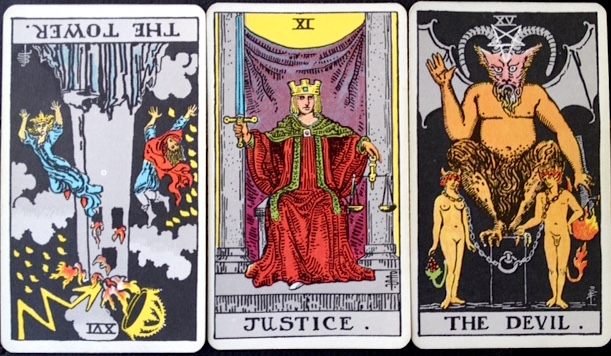
Having three Major Arcana cards indicates deeply “destined” circumstances. I tried two summing ups: “Justice (logic/right) ends the War with Evil (material dominion).” or “Choosing materialism/shame (Devil as outcome) versus (Justice) a cover-up of flaws and problems (Tower reversed).”
Tower reversed is averting disaster; bailing out; impotence; blocking or overturning destruction.
Justice is measured rationality, seeing the pros & cons; choice; balance; decision; and, of course, law and justice.
The Devil is utmost materiality; power structures; ego; shame; blame. (The parallel to Bear as envious, ferocious beast is notable.)
I considered that Justice in the center represented a balancing act between the Tower R and the Devil. Was shame (the Devil) somehow balancing an end to war (Tower)? Or was it more about needing to find a solution (Justice) that would keep the pressure-cooker from exploding (Tower reversed) that would let evil reign?
Mild Spoiler Alert:
Contemplating these cards since seeing the film, I see a much deeper issue hinted at by the movie—perverted justice done by a blind institution that causes great harm. I’ve learned from reading Lenormand that we have to see cards as being modified by what surrounds them. Justice doesn’t have to be reversed to indicate injustice—the Devil following Justice can show the great evil that justice itself can do. When a person is seen as “inverted” (“inversion” is an old classification for homosexual) then grave injustices are done. A point has been made that the royal “pardon” of Turing for his conviction as a homosexual is a travesty as he was guilty under the law and therefore “justly” convicted as were the 47,000 other men who were also convicted (and not pardoned). What we are shocked by is that a hero who saved millions of lives should have been treated so badly—but is that just to all the others? These cards indicate the reaction of today’s viewers that the “justice” against “inversion” was heart-breakingly “wrong,” while, according to the time, it was not, despite the fact that we now see the institution itself (the law) as as a great evil.
Major Spoiler Alert:
Upon breaking the Enigma Code, the team is faced with the realization that they cannot stop the Nazi attacks as that would reveal to the Nazis the breaking of the code and the immediate termination of its use. British intelligence would have to allow the killing and destruction to continue in order to know what the Germans were up to. I see this horrifying realization as the main climax of the film, perfectly depicted by the Tarot cards: the breakthrough that could end the war and the decision to allow great evil to continue as the only rational thing to do.
Added: A final summarizing of these Tarot cards in terms of the film:
To achieve true justice and the reversal of a destructive course there will be collateral damage (bad things happen).
I still find the Tarot to be the much deeper of the two decks, but the Lenormand cards astound me again and again with their uncanny precision and succinctness. As mentioned above, I’ll leave to you the implications of these cards to the Turing Test of artificial intelligence and his “Imitation Game.” Feel free to comment on these below.
Regarding the biographical accuracy of this piece of fiction: there are major problems. I can only hope that the film (enjoyable in its own right but only as fiction) will lead you to find out more about the real Alan Turing:
http://www.theguardian.com/film/2014/nov/20/the-imitation-game-invents-new-slander-to-insult-alan-turing-reel-history
Check out these other readings for films, plays and books:
https://marygreer.wordpress.com/2013/07/22/whos-afraid-of-virginia-woolf/
https://marygreer.wordpress.com/2012/10/09/reading-the-cards-for-movies-and-books/
 I try to keep abreast of Tarot as it appears in fiction but somehow I missed this one: The Holy by Daniel Quinn (2002). The entire book is the playing out of a Tarot reading, made explicit by full-page illustrations of Rider-Waite-Smith cards that introduce book sections.
The central what if is, “What if the God of the Bible was not the only God, and what if the “false gods” referred to in the ten commandments actually exist?” We can extend this to ask the questions: Who are they? and What do they want?—questions the author leaves only partially answered.
This is a Fool’s journey, cross country, undertaken by several different people, at first independently and then with converging stories, all foreseen in the Tarot reading that becomes explicit only as the tale evolves. Quinn is known for his philosophical novels, starting with the highly regarded Ishmael, for which he won the half-million dollar Turner Tomorrow Fellowship. Quinn is an original thinker whose process has been described as “seeing through the myths of this culture” or “ripping away the shades so that people can have a clear look at history and what we’re doing to the world.” It’s interesting that despite the centrality of the Tarot reading and Tarot illustrations in this book, the Tarot content is hardly ever mentioned and never discussed in the reviews I’ve read.
Synopsis: Sixty-plus year-old private detective Howard Scheim is hired by an acquaintance to discover if the “false gods” of the Bible really exist. In agreeing to discover if he can even undertake such an inquiry he interviews several people including a journalist, a tarot reader, a clairvoyant and a Satanist. Meanwhile the Kennesey family is undergoing upheaval as husband David decides to walk away from his job, his wife and his 12-year old son, Tim. Tim and his mother go searching for David and, when Tim becomes accidentally separated from his mother, Howard stumbles upon him and offers to help Tim find her. As it turns out both David and his son Tim are being courted by amoral, non-human “others” who plan to “wake up” humanity because their blindness is creating havoc. These “others,” who refuse to define themselves, are trickster beings, neither evil nor benevolent, who have existed far longer than homo sapiens. They have been known to enchant those humans who look to the physical world rather than to a transcendent being to benefit them.
The Celtic Cross Tarot reading shows Quinn to be knowledgeable about Tarot consulting. References to people named Case (P.F. Case authored an influential Tarot book) and John Dee (magician to Elizabeth I), as well as a road named Morning Star Path (a Golden Dawn offshoot was called the “Stella Matutina” or morning star) makes it clear that Quinn is referencing modern occult lore.
Tarot reader Denise starts by explaining that the first card in Howard’s reading indicates the predominant influence in the subject’s life. Howard draws the Seven of Swords and Denise asks Howard to tell her what it is about, explaining this is not her usual way of working but, “If I proceed normally, you’ll think I’m slanting it.”
He describes a thief stealing swords for a battle who has overlooked something (two swords left behind).” Denise summarizes it: “You’re getting ready for a battle and you’re overestimating your own cleverness and underestimating the strength of your enemy. You’re overconfident and you think you can’t be hurt in the enterprise you’ve planned. . . . The reading will center on the conflict you’re preparing for.”
The Seven of Swords is crossed by the Two of Pentacles: “The pentacles represent grave extremes: the beginning and the end, life and deah, infinite past and the infinite future, good and evil. Nevertheless, the young man is dancing.” Denise says he takes the situation too lightly.
The card above him is the Eight of Cups: “At best, you can hope for a strange journey, an adventure into darkness.”
The frontispiece illustration is that of the Seven of Cups, appearing in the reading in the environment position: “A man is disconcerted by an array of tantalizing apparitions of love, mystery, danger, riches, fame, and evil. Illusions will bedevil you. You’ll be pulled in many directions, and your choices will be confused.” Perhaps this is the underlying theme of not only this book but other works by Daniel Quinn: Humankind is bedeviled by the illusions of culture and civilization so that our choices are confused, centering on all the wrong things. Quinn has one of the characters quote Plato’s The Republic: “Whatever deceives can be said to enchant.” Adding, “Anyone who shakes off the deception shakes off the enchantment as well – and ceases to be one of you [a homo sapien].” The Holy, p. 260.
I’ve left out most of the interplay about the cards, and I won’t reveal more of the story as I hope you will explore this book for yourselves.
I went to see the play, “Who’s Afraid of Virginia Woolf?” last night. As I like to do, I drew cards before going so I could contemplate them during the performance. It enhances the experience for me to be more aware of the dynamics, character conflict and themes as they are occuring.
For those who don’t remember the movie with Liz Taylor and Richard Burton, or who never saw the play: A middle-aged couple, George and Martha, have invited a young couple, Nick and Honey, over for late night drinks after a dinner party. What follows is a series of drunken mind games getting more and more deadly as they all head straight for nuclear armageddon. It was played as a very black comedy. Luckily, it was done by a local troupe of fine actors who gave the play their own unique twist. I focused on George and Martha.
I hadn’t remembered many details of the drama, so I was thrilled by how perfect the cards turned out to be. I did two spreads. The first one was with the Rider-Waite-Smith Tarot. What was I to think when three out of five cards were reversed Court Cards? As it turned out, the play provided excellent examples of how these Court Card types can “go wrong.”
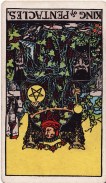 • What is Martha’s core need or issue? King of Pentacles reversed.
Martha definitely has father issues. Her father is president of the college where her husband teaches in the history department, a sorry disappointment in that George never fulfilled the potential for which Martha had picked him—to become head of his department and eventually take her father’s place. Really, she is the one who should have done so; she, we are told, “wears the pants in the family.” But, her father has never really “seen” her. George sees that she’s the one who should have been king and he keeps her from falling into total despair.
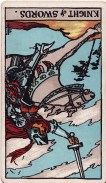 • What is George’s core need or issue? Knight of Swords reversed.
George wields words like a sword, slashing and burning with derision, scorn and disgust all who come within his reach. A word-smith, he’s comfortable with attack and is always looking for a worthy opponent, only most of them fall far too easily beneath his sword. Martha does not.
He’s also her Knight in Shining Armor, tarnished beyond repair and, if we are to believe him, the agent of the deaths of both his mother and his father.
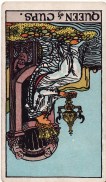 • What is the main theme? Queen of Cups reversed.
While many other themes can be found, this card clearly points to this one: how we hurt those we love and how little love there can be when one doesn’t love oneself. It suggests the lengths they will go in order to not feel sorry for themselves, despite being emotional wrecks.
Among other things, this theme is played out through the failure of both couples to have given birth, to have had a child—the empty, deflated womb (poof!). The card could also be a nod to the alcoholic haze they are all in.
.
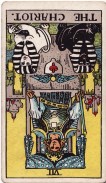
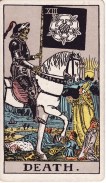
• What is the central conflict?
The Chariot reversed, crossed by Death.
This is war; a horrible end is always just around the corner, the death of every supposed victory cuts off one-after-another means of escape or reconciliation. The play culminates with a fresh story, concocted by George, the botched novelist, in which he tells Martha that a telegram has been delivered informing them of the death of their son on the day before his 21st birthday. The Chariot is often seen as the son of the Empress and Emperor (3+4 = 7). That the existence of a son is just another game they play with each other doesn’t diminish the agony of a mortal wound—the seeming death of another piece of themselves and their relationship—that ultimately strips them down to the bare bones of who they are.
I also drew five cards from the Petit Lenormand Deck asking for a description of the plot, and I got:
Heart – Mountain – Letter – Book – Man
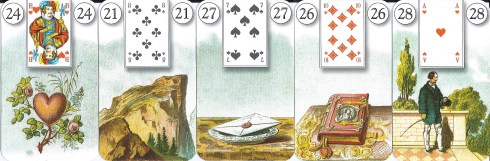
24-Heart: love and relationships
21-Mountain: blocks, obstacles, barriers
27-Letter: written communications, documents
26-Book: secrets, knowledge, books
28-Man: a man, the querent or significant other
This is the story of love (Heart) that has insurmountable blocks (Mountain) keeping it hidden (Book) and from being communicated (Letter). George (Man) wrote (Letter) his biggest secrets (Book) in a book that never got published (Mountain – blocked by Martha’s father). The characters are continually sending messages to each other, uncovering secrets in an attempt to touch on their true hearts that are unreachable behind the barriers they’ve erected in their disfunctional lives. As I mentioned, George (Man) is the wordsmith who is essentially composing (Letter+Book) all the scenarios (the scripts-within-the-script) to get at what is most deeply barricaded (Mountain) in each person’s heart (Heart). The Letter is also central when George claims that a telegram has arrived reporting the death of their supposed-to-be-secret son (Book+Man).
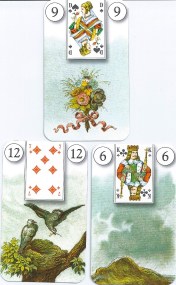 Finally, I added the numbers of these cards together and got 126, reducing it to 9-Bouquet (1+2+6=9). This stumped me at first. What could the plot have to do with a beautiful gift or invitation? Of course!—the play opens with Martha having invited the other couple over for drinks. But I was even more astounded when George mockingly presents Martha with a bouquet of flowers that he proceeds to throw at her, stem by stem.
Before the play, I also felt compelled to look at two other cards contained within that sum of 126: 12-Birds and 6-Clouds. These were perfect to describe a play that is all about conversations (Birds) or, more properly, dialogs between two couples (Birds can also mean two or a couple) that play on deliberate misunderstandings, fears, doubts, instability, sensibilities fogged with alcohol, and confusion as to what is true and what isn’t (Clouds).
Decks: The 1910 (Pamela”A”) Rider-Waite-Smith deck. The Königsfurt Lenormand Orakelspielkarten, based on the 19th century Dondorf Lenormand (borders cut off).
Also check out my post involving reading for the movie, Beasts of the Southern Wild.
 As promised, here is the information on the IndiGoGo fundraising campaign for the Waite-Trinick Tarot Book. You can help publish A.E. Waite’s Second Tarot images as quickly as possible—so we can all get them in our hands! Be part of this historic presentation.
Tali Goodwin has started a series on her discovery of the images and the continuing saga involving her research into John Trinick. Read all about it at The Tarot Speakeasy.
Much is made of how tarot cards can be interpreted through their images or symbols—especially modern decks that feature pictorial scenes with lots of images on all the cards. This post is about how to combine and translate the language of imagery into statements, such that these statements can be more easily interpreted than the images by themselves.
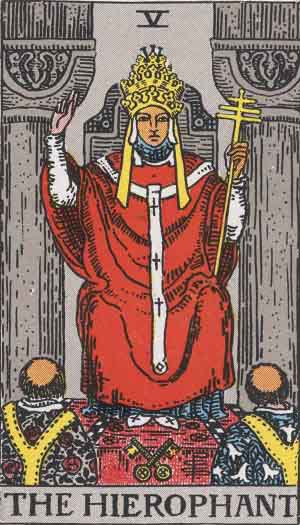
Many of us have spent fruitful hours pouring over symbol dictionaries in order to better understand each detail in the tarot. For instance, we might research and discover that a key, in addition to simply opening or locking a contained space, is seen as the means to unlock hidden meanings in symbols or doctrine. More specifically, in the Hierophant/Pope card,  keys have a special meaning regarding the priesthood: the gold key represents mercy and absolution, and the silver key stands for judgment and penance. Furthermore, these keys refer back to the gospel of Matthew (16:19) in which Jesus tells Peter, “I will give you the keys to the kingdom of heaven. Whatever you bind on earth shall be bound in heaven; and whatever you loose on earth shall be loosed in heaven.” Going further, you will discover that Mercy and Judgment (the gold and silver keys) are the two columns on the Kabbalistic Tree of Life.
 How many times have you mentioned any of the above references in an actual tarot reading?
Alternatively, a reader might try to discover the querent’s own, in-the-moment, personal associations with this image: “Oh, my gosh. Those are my car keys that I lost yesterday at church!” Or a reader will offer up his or her own projections and intuitions, as in, “As I’m seeing it right now, the keys are saying that your spiritual leader or tradition “holds the keys” to whether you should get a divorce.” These can certainly be rich ways to read the tarot, but they can sometimes get you sidetracked from the essential message of the card. Even the artist’s stated intention for a symbol can be so personal and idiosyncratic that it, too, misses the mark. I’m not saying that the following technique is the “best” method for interpreting images, but rather that it can be helpful and serve as a checkpoint to make sure you’ve touched on its roots.
What I offer here is a method that involves translations of the essential, objective meaning of an image—its denotative and connotative definitions and its core characteristics or functions (how the thing is used).
At the denotative level, a key is a small piece of metal shaped with parts that fit with parts in another mechanism (usually a lock) so that manipulation (turning) changes the latter mechanism’s function—usually to open or close things. The connotative meaning is that it binds or loosens, and a key often suggests gaining access to something. If we abstract it one more level, then it suggests obtaining the answer, solution or means to something crucial or important. Connotative meanings are more subjective and often convey pleasing or displeasing feelings about the word. [Note: I use ‘objective’ and ‘subjective’ here, not as absolutes, but as relative points along a continuum.]
Step 1
To try out this technique, you need to start with the most “objective” meanings and functions—what I often call the “literal” level of a symbol—rather than personal projections or mythic, occult, alchemical, astrological or psychological significances. In other words, try to use as little abstraction, impressionism or subjectivity as possible.
To try another example, the denotative level of the RWS dog in the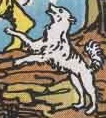 Fool card is “a domesticated, four-legged, carnivorous mammal with an acute sense of smell.” The functional aspect is that it is tamed by humans to function as a companion, protector or hunter. A further, connotative abstraction includes ideas such as loyalty, instincts or, sometimes, a scoundrel or wretch. (In this process, we won’t consider the mythic associations of dogs with death, like Cerberus at the gates of Hell, nor the Egyptian dog-headed Anubis, nor the association of dogs with the Moon and Artemis, nor the dog of Odysseus, or that in alchemy a dog represents sulfur or primitive, material gold. Nor will we consider that god is dog spelled backwards.) When in doubt, think of a dictionary rather than a book of religion, mythology or literature. In fact, a dictionary is often a good place to start when translating images.
Step 2
Step 2 involves linking together the most essential definitions, functions and connotations of three to five core images from one card into a “literal translation” of these images.
With the RWS Six of Cups as our example, let’s go through Steps 1 and 2. (We should also be aware that traditional meanings for this card often include gifts, pleasurable memories and emotions, nostalgia and old things.) 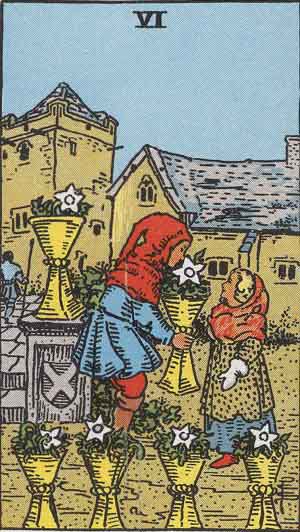 Here are three dominant images from the picture created by Pamela Colman Smith:
• Children – more than one pre-pubescent human being. Their key characteristics are small size, immaturity, innocence, vulnerability, playfulness, learning and development, and being a descendant or establishing a lineage.
• Flowers – the reproductive organs of a plant, usually with characteristics (scent, shape and color) that attract fertilizing mechanisms. Flowers are cultivated to function as decorations or gifts. Blooms suggest the flourishing peak of beauty, health and vigor.
• Glove/mitten – a garment covering the hand. It protects or safeguards the hand to avoid discomfort, damage, disease or contamination of self, others or environment. It may also serve as a fashion ornament.
First we combine these individual images into a simple statement: “A larger child hands a flower to a smaller child wearing a mitten.”
To translate this, we substitute a key word or phrase for each image:
“A larger, innocent offers a gift of beauty and reproductive vigor to a smaller, innocent whose vulnerability has some safeguards.”
Let’s add two more images to see if this changes anything:
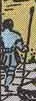 • Courtyard – a private space surrounded by walls or buildings. It functions as a place of air, light, privacy, security and tranquility.
• Guard – a person who keeps watch. He functions in a defensive manner to watch or protect what is vulnerable or to control access.
A very literal description might be: “In a private, guarded space, a child offers a gift of flowers to a another child.”
The next level of abstraction looks something like this:
“In a private, secure and guarded place, but with inattentive watchfulness, youthful innocence and vulnerability handle, with some safeguards, a gift of beauty and reproductive vigor.”
Step 3
Relate this translation back to the querent’s question or situation (via the spread position, if applicable). Now you interpret what the translated images in the cards add to the situation. Generating questions based on the translation is a good way to start.
Let’s add a keyword from the basic card meaning so that we have the following translation:
“A memory in which youthful innocence and vulnerability, in a private, secure and guarded place, but with inattentive protection, handle, with some safeguards, a gift of beauty and reproductive vigor.”
The following are example questions that emerged from the image translation:
Can you remember moments of former pleasure in which a mature, adult significance was not apparent at the time but may now be? Perhaps you were attracted to or given something that continues to reproduce emotional (Cups) reverberations in you? Have you been too guarded and naive to fully appreciate a gift given or received?
Alternatively, could a larger or more dominant self/person have offered something to a smaller self/person who covered up (gloved) her response as she wasn’t completely open to the experience?
Are some of your memories guarded? How do you protect yourself from what happened in the past? A worst case scenario suggests some kind of childhood abuse from which memory you’ve tried to protect yourself. There may be an element of seeing a difficult past through rose-colored glasses (and this card has had those difficult meanings on more than one occasion)—although, generally, it is a very good card.
In the Comments to this post you might want to try combining the image definitions into other translations, because even the most literal translations will vary. See where different translations take you. Feel free to explore this technique in your own way on your own blog or with others—just include a link back here.
Comparison with Cartomancy
It’s worth noting that readings with decks such as the Lenormand, Sybilla or Old Gypsy Fortune Telling Cards use a process similar to that above, in which each card represents a single image. The meanings of these cards have even more restricted parameters, but can be creatively combined. For instance, the card depicting a dog means loyalty and friendship. The child card can mean one or more children or anything small, young or innocent. A set of these cards are linked together in a fashion similar to what we’ve already done, although the result tends to be more mundane and may yield a single new image. For instance, Dog + Child can indicate a puppy, playmate, or childhood friend.
I’ve selected four cards from the Mlle. Lenormand deck (from Piatnik publishing) that are most similar to images in the Six of Cups just to see what happens if we use their meanings:

Child – Lily – Garden – Crossroads
•  Child: Child or children. Play. Anything small, immature. Naïve, innocent, trusting, sincere. Sometimes, gifts.
• Lily: Mature, old, the elderly. Commitment. Peace, satisfaction, contentment. Wisdom, soul development. Social welfare.
• Garden: Meetings, gatherings, parties, events, conferences. Social encounters and places for this. An audience. Outdoors.
• Crossroads: Options, choices, alternatives. Decisions. Separation. Many of something.
The most simple statement we could make about these cards is: “Many wise children (or immature elders) gather together.” (The order of the cards in an actual reading would affect the interpretation.)
To expand on this idea, we could say:
It is about a social interaction involving young and old, innocent and wise (to play old-fashioned games?), and that a choice may be involved. Peace or wisdom could be gained from childhood choices or from an older sibling. An older person could be reconnecting with past friends or relatives (or grandchildren) or, simply, remembering them.
[Notes: Traditional playing card meanings are usually not part of the standard interpretations for these cards (although it is interesting that three Court Cards appear. Regarding modern interpretations: Garden+Crossroads is a perfect description of social networking, ala facebook and twitter.]
Some Final Thoughts
I use the “Image Translation Technique” as a checkpoint to keep me on track and to compare with other card possibilities including projections and intuitions. Studies of intuition show that intuitions are just as likely to be wrong as right, but you can often get to a right understanding faster and more accurately than through any other known means. What works best is to check your intuitions against ‘rules of thumb,’ or what I call ‘checkpoints.’ The true issue is sometimes precisely what is shown by juxtapositions among traditional meanings, literal translations and the reader’s and querent’s projections and intuitions, revealing the tension or conflict causing the unease at the core of a reading.
I want to reiterate that translations of tarot card images are only one level of working with images (and some people prefer not to work with the pictorial images at all). But, even card keywords are images, and I believe that keeping in touch with the essential meaning of any image provides an important checkpoint for one’s intuition. I’d love to hear about how you work with these ideas and whether they are helpful to you or not.
Acknowledgements: Yoram Kaufmann’s book, The Way of the Image: The Orientational Approach to the Psyche, clarified and helped me to explain the technique I often use in readings. I’ve adopted a few, but not all, of his terms and methodology, and I’ve tried not to psychologize the above material too much (Kaufmann was writing about a Jungian approach to dreams). The concept of using “rules of thumb” with one’s intuition is discussed in Gerd Gigerenzer’s Gut Feelings: The Intelligence of the Unconscious. Sylvie Steinbach’s The Secrets of the the Lenormand Oracle was helpful in putting together the Lenormand interpretation. See my book 21 Ways to Read a Tarot Card for lots of other interpretation techniques.
A short animation by Trepaned Productions in Flash featuring music from the Portland band Polly High. Just another example of what can be done.
Music Video with RWS deck. Anyone care to explain how the reading relates to the storyline? (Thanks to John McBride.)
I thought I had this posted, but it seems not. All the “Tarot Music Videos” now have their own category—view them all by clicking on the category above or to the left.
Few things are more exciting to me than stumbling across a text or image that perfectly reflects a tarot card, especially when it makes me reconsider my ideas about that card.
Today I read the following in the mystery novel A Rule Against Murder by Louise Penny. Chief Inspector Armand Gamache, head of homicide for the Sûreté du Québec, says to a family at their annual reunion:
“We believe Madame Martin was murdered.”
There was a stunned silence. He’d seen that transition almost every day of his working life. He often felt like a ferryman, taking men and women from one shore to another. From the rugged, though familiar, terrain of grief and shock into a netherworld visited by a blessed few. To a shore where men killed each other on purpose.
They’d all seen it from a safe distance, on television, in the papers. They’d all known it existed, this other world. Now they were in it. . . .
No place was safe.
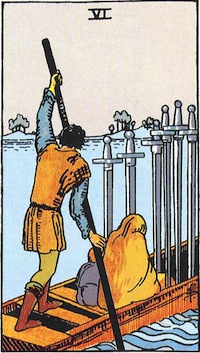 Ah, a perfect rendition of the Six of Swords! I was first struck by it being from the viewpoint of the ferryman, not the passengers. A ferryman who is compassionately aware of the deep emotional shifts of those he is transporting—but not partaking directly in those shifts. For a moment I thought, ‘But, of course, the Six of Swords is about the ferryman, not necessarily the passengers! A ferryman who again and again observes this shift taking place in those he ferries. A ferryman who is both separate and yet momentarily involved.’
There is no indication that the author, Louise Penny, had the tarot card in mind. Rather this is a common classical metaphor linking Charon and the river Styx to the family of a murdered person being ferried out of the world-as-they-had-known-it to a shore previously viewed only as a distant abstraction.
I often ask a querent, “Where are you in the card?” With the Six of Swords, the querent is always one of the figures, but it could equally be the ferryman or the hunched-over adult or the child. By contrast, with other cards, the querent occasionally sees him or herself standing just beyond the borders, behind a column, or, in the case of the Tower, still inside the structure—divorced from the action.
With the Six of Swords there is usually an eventual recognition that the querent is all three persons in the boat. As ferryman, the querent tends to feel he or she is in charge or at least doing something active that will lead to a better end. As passengers, anxiety or grief tends to trump hope, yet there is still a belief that the destination will be better than the “familiar terrain of grief and shock” that they’ve just left.
Interestingly, in the novel, the seven main suspects had, just the day before, gone out together in the lake on a boat—a passage fraught with animosity and repressed danger. The Chief Inspector/ferryman recognizes that the new world they are now facing will be more terrifying than the passengers ever could have imagined. Furthermore, they aren’t just visitors—blessed because they can leave—they will soon be inhabitants. There’s no going back. Grief and shock may exist in the land of the innocent. But, in the land of the experienced, as William Blake well knew, wrath and fear dominate, and the ferryman can’t stop it from happening. (See Blake’s Poems of Innocence and Poems of Experience.)
How different the card looks to me now. It is full of foreboding, and yet there is calm in knowing that this is an inevitable journey from the false safety of innocence into the land of Blake’s experience where realities will finally be faced. As in all murder mysteries the truth will be revealed. But, in an actual reading, is the client always ready to hear such truths?
Doesn’t the admonition, “to know thyself,” mean that we have to come to know and take responsibility for the part within ourselves who “kills another”? Both the querent and the reader want the other shore to be better than the one from which they’ve come, but there are times when we have to go through much worse. What is the reader to tell the client? And, here there are no easy answers.
I hope this makes me stop and think before I blurt out cheerfully, “Oh, you are going through a transition from the rough waters of the past to smooth waters ahead.” Sometimes I, the reader, am the ferryman/chief inspector, who must recognize with compassion that real detection can strip the soul bare and set one in the dread grasp of Blake’s tyger and not in the rejoicing vales of the lamb (see poems here). The rest of the Sword suit (7–10) warns what may come from a detection of the wrongs, or what comes to light when one really wants to “know thyself.” Does the querent really want to go there, or is the querent trusting the reader to ferry them to a safe harbor?
Still, I think it helps the reader—the ferryman who steers the way through the cards in a spread from one’s familiar anxieties to a different shore—to consider what may be truly implied from such a scene in the suit of Swords. This new perspective reminds me that in a reading I am attempting to steer the course when I don’t always know what is lying in wait for my passenger on the other side or how prepared my passenger might be to meet that. It is a grave responsibility.
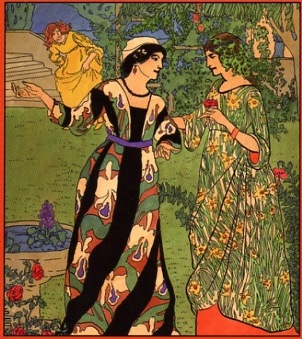 I’m so excited. My Pamela Colman Smith Commemorative Tarot Set has arrived from U.S. Games. The book of Pixie’s art is delightful—full of colorful images and showing a full range of her work, including a couple of pieces from late in her life. Waite’s Pictorial Key to the Tarot (included) is the same-old book in a new cover but with no pictures (huh?). The postcards are great to have—a very nice bonus. Read the rest of this entry »
 Mary K. Greer has made tarot her life work. Check here for reports of goings-on in the world of tarot and cartomancy, articles on the history and practice of tarot, and materials on other cartomancy decks. Sorry, I no longer write reviews. Contact me
 Mary K. Greer's Tarot Blog
Recent Comments