You are currently browsing the category archive for the ‘Tarot History & Research’ category.
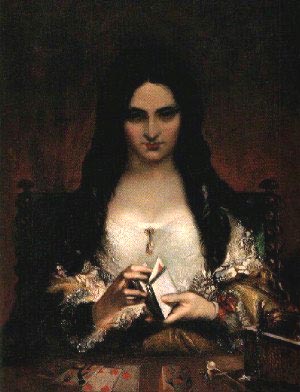
Pre-Raphaelite artist and poet Dante Gabriel Rossetti’s first published poem, “The Card-Dealer,” was based on a painting by Theodore von Holst (1810-1844) called “The Wish” or “The Fortune-Teller” (1840). The poem, which epitomized Rossetti’s fascination with the theme of the femme fatale, was inspired by the painting that he described as being of “a beautiful woman, richly dressed, who is sitting at a lamp-lit table, dealing out cards, with a peculiar fixedness of expression.” In his poem, the woman (Death?, La Morte, in Rossetti’s Italian) plays with men as she plays with the cards, which, we are told, represent the heart that craves the more it feeds, the diamond that makes even the base seem brave, the club that smites, and the spade that digs a grave.
Read the rest of this entry »
Part 2: Hijacking What It Means to Be Human
(Read Part 1 to learn about mentalists, skeptics and cold reading.)
Imagine my surprise when I discovered there are at least a half-dozen extremely expensive books marketed by mentalists on tarot, of which I’d never heard in my forty-plus years collecting tarot books. And, they were written by and for professional tarot readers that I didn’t even know existed as a self-identified group. Of course, I was aware there are fraudulent tarot readers who deliberately used cold reading techniques to con their marks. Naively, I had assumed, though, that cold reading was used mostly by fake mediums and clairvoyants (as in the 19th century) and by mentalist entertainers. I had no idea that tarot was regularly taught as a scam except among some phone psychics and those storefront psychics who used it to extort money for removing curses, etc.—a whole different, albeit related, enterprise. [Note: some mentalists are also ethical tarot readers, and not all mentalists deny the paranormal. I am also not referring, in most of what follows, to ethical mentalists who are honest about using mental tricks.] Read the rest of this entry »
Part I: Skeptics, Mentalists and Tarot Readers
 For purposes of this article let us assume that there is no paranormal or spiritual aspect to tarot readings. Let’s pretend, for the moment, that all tarot readings have a rational basis in easily explained normal human skills.
Skeptics and mentalists reduce tarot reading to just this level. Mentalists utilize skills to make money in public performances, while skeptics denounce any tarot or psychic readings that don’t acknowledge they are merely mental tricks. They claim “pseudo-psychics” exploit human weaknesses and take advantage of the desire to easily gain benefit from something. Pseudo-psychic readings are seen as “too-good-to-be-true” and as giving false hope just to make money. Skeptics claim that psychic and tarot readings can be explained by techniques gathered under the terms Cold and Hot Readings. We will ignore hot readings (that fraudulently use information obtained ahead of time) as our purpose is to examine readings where nothing prior is known about the client. Read the rest of this entry »
The New York Times reporter Ruth La Ferla has written an article, “Love, Jobs & 401(k)s” about the popularity of psychics (including tarot readers) in the economic downturn. It seems that business is booming in this profession. La Ferla quotes one stock trader as saying, ““When conditions are this volatile, consulting a psychic can be as good a strategy as any other.” To which she responds that when the Treasury secretary changes his mind weekly “a good set of tarot cards might come in handy.” Read the rest of this entry »
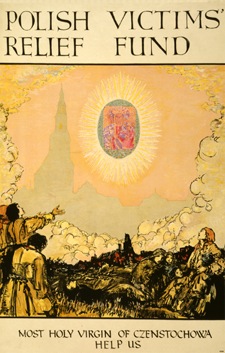 A reproduction of a poster by Pamela Colman Smith is available at ebaystores:
POLISH RELIEF FUND POSTER VIRGIN OF CZESTOCHOWA 1008 or here.

Pixie’s initials can be seen in the lower left corner and the similarity to several of her cards is apparent.
The poster is from 1915. Pixie was a friend of the Honorary Secretary of this Fund, Miss Laurence Alma Tadema (daughter of the artist).
The reproduction is 10.5″ x 16.5″ and printed on 100 lb. glossy stock—suitable for framing.
Thanks to Holly Voley for telling me about this at BATS.
In my talk at the Los Angeles Tarot Symposium (LATS) this past weekend, I asked participants to draw three cards that would predict something specific that would happen to them within the next week. They were to get suggestions regarding what this might be from other tarot readers at the symposium and write these down. Then I asked that they watch what actually happens and what most relates to these three cards over the next two or more weeks (timing is not one of tarot’s best features), and report back here in the comments section of this post.
I invite anyone else who wants to “play” to comment here. Please state:
- what three cards you drew,
- the specific prediction made for the following week,
- and then tell us how these three cards most relate to what actually happens.
Feel free to come back later and add anything else to the comments section that seems relevant down the road.

Thanks to Barbara Rapp-Geerling and The Crystal Cave in Costa Mesa CA for making this event possible.
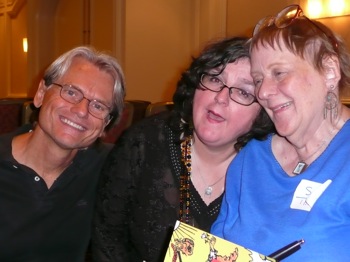
Here’s a photo showing one of the moments missed if you didn’t attend this year’s LATS (please come next year). A great time was had by all with many talks on the theme of happiness. From the left: James Ricklef (see his self-published deck Tarot of the Masters), Thalassa, and Sandra Thomson (read an interview with her) click on their names to find out more about what they’ve contributed to tarot.
 Scholarly-oriented readers will appreciate a paper on Tarot by Inna Semetsky called “Simplifying Complexity: Know Thyself…and Others” in Complicity: An International Journal of Complexity and Education, 2008, Vol. 5, No. 1 (click on the title and it will download as a pdf). Dr. Semetsky is a Research Academic with the Institute of Advanced Study for Humanity, University of Newcastle, Australia who has been writing scholarly papers on tarot for many years. Drawing on semiotics, systems theory, and ideas about meaning and synchronicity (among others), she posits that Tarot “can be considered an education tool contributing to our learning and, respectively, the evolution of the human mind situation in the larger, both cultural and natural, context.”
In relation to my earlier post on Arcana in the Adytum, I found Semetsky’s description of arcanum to be especially interesting:
Arcanum (or arcana, plural) . . . is the ever present potential catalyst . . . that, when actualized and brought to consciousness, elicits transformations at the levels of thoughts, affects, and actions so that an individual becomes fruitful and creative in his/her possible endeavours. If and when discovered – that is, made manifest at the level of conscious awareness – it becomes a powerful motivational force to facilitate a change for the better at the emotional, cognitive, and/or behavioral levels and thus to accomplish important educational and ethical objectives.
Semetsky also talks about reading tarot as pattern-recognition and the identifying of probabilities of what is likely to happen rather than making fixed predictions. You can read her academic profile here, find more of her publications here and listen to her talk about tarot on La Trobe Philosophy Radio show here.
The discerning reader will want to compare this paper with a response by James Anthony Whitson (same link above) who appeals to Wittgenstein to determine whether it is even seemly to be “effing . . . the ineffable.” (Love that technical jargon!)
Thanks to Jean-Michel David and the latest issue of the Association for Tarot Studies (ATS) Journal for drawing attention this article.
When I lived in San Francisco I was privileged to meet several members of what was then known as the Holy Order of MANS (in which MANS stands for “Mysterion, Agape, Nous, Sophia,” Greek for mystery, love, mind, and wisdom). I became interested in their organization, both because of the tremendous sincerity and integrity of the members I met and because of their study of tarot as a Christian mystery. They adopted the Waite-Smith Tarot as modified by Paul Foster Case and Jessie Burns Parke, added their own layer of modifications to the deck, and then wrote a set of explanatory books that are thoughtful revisionings of Case’s text.
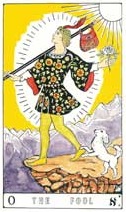
The Holy Order of MANS was founded in 1968 by visionary Earl Wilbur Blighton (formerly an electrical engineer) as a monastic order of esoteric, Rosicrucian Christianity dedicated to charity (Raphael Shelters) and their missionary work in 49 states. The order grew rapidly during San Francisco’s hippie era, when members served selflessly to help those in need. My sense is that they followed as closely as they could the model of the earliest Christian churches. Additionally, women could be ordained as priests. As Blighton expressed it in their statement of purpose:
“I care not what doctrine you have or have decided on. But while the world argues over the theological discussions of doctrine, sin, apostolic succession and others, we will remove from the people their problems and give unto them the ray of hope and reality which our Lord Jesus commissioned us to carry forth as Christians and disciples of the Word and the works and the Light and the love of God.”
With Blighton’s death in 1974 there was a prolonged power struggle among Blighton’s wife and others for leadership over the 3,000 members. The new director focused on a more conservative, repressive and less metaphysical path, eventually joining with a defrocked priest from the Russian Orthodox Church. Since 1988 it has splintered into many groups including the Science of Man in Oregon, which was led by Blighton’s wife, Ruth, until her death in 2005.
But their own deck and books were not the extent of the tarot connection. In 1975, at a judo tournament, science fiction author,  Piers Anthony, met and became friends with a brother from the original Order. Anthony was intrigued by their unique mix of Gnostic Christianity, co-ed communalism, and Tarot. Out of this came a character who would appear in several novels: Brother Paul of the Holy Order of Vision. Anthony also created an imaginary deck called the Animation Tarot, having a hundred cards in five suits. By September of 1977 he had a 250,000 word manuscript that no one wanted to publish. Members of the real order were told not to read the manuscript or speak with him, which he regretted, since the novel stemmed in significant part from his admiration of their operation. Anthony reluctantly agreed to splitting the book into a trilogy: God of Tarot, Vision of Tarot and Faith of Tarot. Jove then stopped publishing science fiction and the next two volumes were published by Berkeley (1980). It wasn’t until 1987 that the novel appeared in one volume (NY: Ace). It’s an interesting novel, although I remember it seeming rather incoherent in places—perhaps because I read it as each volume of the trilogy came out.
Although the Holy Order of MANS deck and books owe much to Case’s BOTA materials, there are plenty of additional insights to make them well worth obtaining, especially for those who are interested in a metaphysical Christian approach to the tarot symbols. The revised books, Keystone of the Tarot and the more detailed, Jewels of the Wise, and their color-it-yourself Major Arcana deck are still available here.
 Here I go – off again into strange byways of Tarot lore:
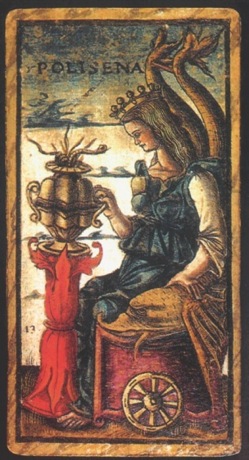
The late 15th century Sola Busca Tarot is most famous for having inspired several of the Minor Arcana images in the Rider-Waite-Smith Tarot deck. It is also the oldest deck to have all 78 cards. The trumps and court cards feature historical and mythical people – with many of their names printed on the cards. Not all of the referents have been identified.
The Sola-Busca deck is now available in a glorious full-color edition along with a book explaining all the figures and symbolism. This is a limited edition so get it while you can HERE.
In 1907 a B&W photographed version of the deck was sent to the British Museum by the Sola Busca family who then owned them. I believe the originals, as well as the family, have since disappeared. Waite, who spent much time studying tarot decks and books at the British Museum, was probably informed of this deck as soon as it arrived, so it may have sparked the idea itself of creating an illustrated Minor Arcana. Lo Scarabeo published a version of the deck known as the Ancient Enlightened Tarot (currently out-of-print). You can also learn more about the figures in this deck at Tea Hilander’s website, at Taropedia (specifically here for the Q of Cups), and at Michael J. Hurst’s website.
The Queen of Cups is labeled Polisena (also spelled, Polyxena). What stands out in the image is a snake emerging from the cup she holds. I have a feeling that the card refers not to the Trojan Polyxena (next) but to a later Christian Polyxena (see her story at bottom). Here’s the info I’ve managed to find:
First, the Trojan Polisena:
“Polyxena was the youngest daughter of Hecuba and King Priam of Troy. Homer never mentions Polyxena. Achilles fell in love with Polyxena whom he may have met when Polyxena and her brother Troilus went out to the fountatin where Achilles slew Troilus. One story has Polyxena pretending to fall in love with Achilles, learning about his heel, and betraying him to her brother Paris, who then shot and killed Achilles. Before he died, Achilles asked his followers to sacrifice Polyxena to him. Neoptolemus stabbed Polyxena to death.
There were Medieval and Renaissance versions of the story that may have contained a snake. Plus there’s a snake in a version of the story on a vase from ca. 500 B.C. – 490 B.C.:
“Achilles and Polyxena at the fountain: Polyxena is walking right to a lion’s-head spout above a rock that contains the fountain. A hydria is set under the spout to catch the water gushing out. It splashes onto Polyxena’s hand before entering the container. On top of the fountain a crow is sitting, while a snake is lying alongside it. Behind the fountain rises a tree with leaves spreading left above the lion’s head spout, and right above the head of crouching Achilles. Ready to ambush, he is largely hidden by his shield, with his right leg extended beyond it.” Jane Ellen Harrison claimed that the snake in this story represented the Erinys.
However, the card could be another Polyxena – one who figures in a story about Paul and the early Christian converts as recounted in the Medieval Sourcebook: Acts of Xanthippe, Polyxena, and Rebecca.
“And as Polyxena lay upon the couch she saw this dream, that a dragon, hideous in appearance, came and signified to her to come to him, and when she did not obey him to go to him, he came running and swallowed her. From fear of this the girl leapt up trembling, and Xanthippe running to her said, What has happened to you, dearest, that you have leapt up thus suddenly? She for a long time was unable to speak; then coming to herself she said, Alas, my sister Xanthippe, what danger or tribulation awaits me, I know not; for I saw in my dream that a hideous dragon came and signed to me to go to him, and, when I would not go, he came running and swallowed me, beginning at my feet. While I was terrified at this, there suddenly spoke out of the air, in the light of the sun, a beautiful youth, whom I thought to be the brother of Paul, saying, Verily, you have no power. Who also took me by the hand and straightway drew me out of him, and straightway the dragon disappeared. And behold his hand was full of sweet odour as of balsam or anything else for fragrance. Xanthippe said to her, Truly you must be greatly troubled, my sister Polyxena, but God has you dear, seeing that he has shown you strange and marvellous things. Therefore arise quickly in the morning and receive the holy baptism, and ask in the baptism to be delivered from the snares of the dragon.”
Ultimately Polyxena becomes Christian and protects her virginity from the evil idolaters who try to despoil her. She goes through many such tribulations including being thrown to wild beasts and into the sea but is always saved by God. The story ends with her returning repentant to Paul, and “From that time forward she left not at all the blessed Paul in her fear of temptations.”
The serpent/dragon could, of course, signify those temptations and tribulations from which God has saved her – including, of course, idolatry. A more complex view might suggest that the snake is that ‘strange and marvelous thing’ called Wisdom, which Polyxena certainly must have gained in all her travels and from facing her many trials.
One interesting synchronicity is that Polyxena Sforza, illegitimate daughter of Francesco Sforza of Milan (for whom the Visconti-Sforza Tarot was made), married Sigismondo Pandolfo Malatesta in 1442, two years after we know that he was given a deck of Triumphs as a gift. According to a story put about by a Pope who hated him, the cultured but brutal condottiero Sigismondo murdered both his former wife and second wife, Polyxena (who had as the family heraldry a serpent). Could there have been an oblique reference to her?
 Mary K. Greer has made tarot her life work. Check here for reports of goings-on in the world of tarot and cartomancy, articles on the history and practice of tarot, and materials on other cartomancy decks. Sorry, I no longer write reviews. Contact me
 Mary K. Greer's Tarot Blog
Recent Comments