You are currently browsing the category archive for the ‘Tarot Spreads’ category.
 Here’s another forgotten tarot classic.
This “Yes-No Oracle” is by Irys Vorel in an article entitled “How the Gypsies Use the Tarot” from the February 1955 issue of Fate Magazine.
A version of this spread, expanded greatly by me, is now available at the commercial site Tarot.com. Check it out.
1. Write your problem or question on a piece of paper in such a fashion that “yes” or “no” could be the answer. Don’t ask ambiguous questions like “Should I marry Rick or Jason?” Situations such as this should be split into two questions.
2. Remove the Wheel of Fortune from the 78 card deck and place it before you face up.
3. Shuffle the rest of the deck, with your mind on the problem. Spread the cards in a fan, face down. With your left hand, draw seven cards at random. Put them face down on top of the Wheel. Set the remaining deck aside.
4. Turn the Wheel of Fortune face down like the other seven cards. Shuffle these eight cards until you no longer know where the Wheel is.
5. Deal the eight cards in a square consisting of four positions (see next), so that there are two cards in each position:
• Top Left: The 1st position (cards 1 & 5) signifies – YES.
• Top Right: The 2nd position (cards 2 & 6) signifies – SOON.
• Bottom Left: The 3rd position (cards 3 & 7) signifies – DELAY.
• Bottom Right: The 4th position (cards 4 & 8 ) signifies – NO.
6. Turn the cards over looking for the Wheel of Fortune. Its position gives you the answer.
• If the Wheel card has fallen in the first position, it indicates “Yes,” and the speedy and favorable solution of one’s problem.
• If in the second, “Soon,” position, it means: “You should not unduly press your interests.”
• If it lies in the “Delay” position, the indications are that some obstacles will have to be overcome.
• If it lies in the “No” position, it indicates adjustments have to be made and circumstances at the moment block the harmonious solution of the problem. Therefore, the wish cannot be fulfilled immediately. After changes have occurred this same wish could be answered in the affirmative.
7. If your answer is either “Delay” or “No,” then look at all the cards in the layout (the reversal of a card has no significance):
• Many Pentacles indicate a financial hitch.
• Swords show opposition.
• Wands suggest journeys and changes.
• Many Cups indicate fortunate circumstances and ultimately a happy ending, especially if the Grail [Ace of Cups] is among them.
• Many Major Arcana indicate that the situation is out of your hands: destiny is at work.
• Many Court Cards indicate that the wishes of other people determine the outcome.
This is not my favorite kind of spread as it seems too deterministic, but it’s worth checking out to see if it works for you. Let me know what you think.
Sample reading: Should I post this spread on my blog?
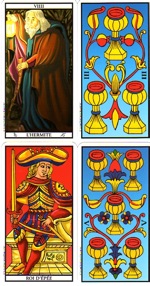
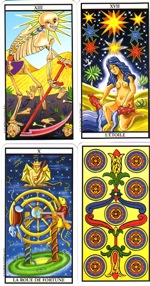
We can see that the answer is “No” (the Wheel of Fortune is in the bottom-right pair), but I decided to post it anyway. How else can we determine if the advice is good or not? There are three Major Arcana (in addition to the Wheel) indicating that the situation is in the hands of destiny, and two Cups cards, which slightly leans toward a favorable outcome over the long run. I’ll let you know if anything untoward occurs. The deck used is Le Grand Tarot Universel by Bruno de Nys.
In responding to a comment by tarotgirl about my previous post I wrote:
You can also create a spread around a definition or description of a single word or concept.
She asked: “How would you create a spread around a single word?”
So I thought I’d write my response here.
It’s not the word itself, but the definition of the word that I use. The parts of the definition become the position meanings and the word itself is the theme of the reading. Word roots could also be used.
I collect definitions of words that I find intriguing like for “symbol,” “imagination,” “meaning” and “myth.” Almost every writer on these subjects defines these words as they have come to understand and use them. Some of these definitions are very poetic, some strike at the heart of life’s dilemmas and issues. They can help us see the world and our mundane situations through a different lens, similar to what Rachel Pollack calls “Wisdom Readings” – but in this case, focusing on the wisdom in our own lives.
For instance:
According to Joseph Campbell: “A myth is a public dream; a dream is a private myth.”
You could draw two cards for what is the “public dream”/myth of your situation and what is the “private myth”/dream aspect of a situation. In doing this you take yourself out of the mundane level of what’s going on and choose to look at it from a wider perspective.
Or, Freud: “A myth is conscious ignorance and unconscious wisdom.”
You could ask “In this myth that I have about my mother . . . (add specific details) . . . : what is the conscious ignorance on my part (Card 1)? and what is the unconscious wisdom (Card 2) in that story?
Besides elucidating situations in your life, you can arrive at a very deep understanding of what the author of the definition was trying to convey. By operating “as if” this definition were true, you can also get a sense if it really works or not – it may just be a nice platitude that doesn’t go anywhere. Your life becomes the test case.
If you try this technique and like it, leave a comment and let us know what definition (or favorite quote) you used and how it worked.
Although I’ve been using this technique for a long time, I want to mention that the inspiring tarot author James Ricklef came up with it independently and taught it at one of the Bay Area Tarot Symposiums, using favorite quotes and proverbs. His book on creating spreads, Tarot: Get the Whole Story, is excellent.
A wonderful way to create spreads is to adapt a self-help process that you especially like to a spread. You can also do this with a favorite quote or aphorism (a technique favored by tarot author James Ricklef). I undertook a long-term study of Dante’s Commedia in a small study group and made it my special task to look for tarot images—of which there are many.
When I came to Inferno, Canto 32, line 76, I found, “se voler fu o destino o fortuna, non so.” Translated, it says, “if it was will or fate or chance, I do not know.”
This struck me as one of the great questions that is implied when we seek answers through the Tarot. Don’t you sometimes wonder how you got into a situation? Do you always have a choice? What keeps you bound to your past? Are some things fated? What role does chance play? What furthers your destiny? Fate, destiny and fortune are often used interchangably. How do they relate to will? In exploring this topic I’ve come to see each of these as having their own implications in a situation. I went back to Dante’s Italian language to see if I could understand these perspectives better.
If you have ever wondered, along with Dante, about such things, then you might want to try this spread.

1 – What is my current Will? Voler means will, wish or volition (all come from the same root). This is your personal desire or intent and suggests deliberate, conscious choice.
2 – What is my current Fortune? Fortuna means luck in Italian, but it also suggests something stormy and tempestuous or chaotic. The Goddess Fortuna throws you around in a random and unpredictable way. This shows you what chance or happenstance has in store.
3 – What is my current Fate? Related to karma, Fato assumes that an outcome is the result or consequence of an earlier, though sometimes unknown, cause. This includes the playing out of previous actions or tendencies as they’ve become conditioning and habits. Carl Jung noted, “That which we do not confront in ourselves, we will meet as fate.”
4 – What is my current Destiny? Destino suggests destination and implies a higher, divine or ultimate goal toward which you are impelled by something greater than or outside yourself.
An example showing the difference among these four is: I wish (will) to lose weight, but fortune takes me to a dinner party where all my favorite fatty foods are deliciously prepared. I am fated to break my diet because I’ve always done so when tempted. It is my destiny to eventually . . . become fat? Or, to overcome my habits and develop willpower? Or, as a friend mentioned, remain overweight as a divine flaw that keeps me from getting too arrogant (thanks to James Wells). The cards will reveal all.
Added: I was reading Thomas Moore’s Care of the Soul and came across the phrase “the demands of fate.” I wondered how this related to the four concepts above—if it could add another dimension to the positions. So I came up with the phrases that follow. What do you think?
• Fortune happens
• Fate demands
• Destiny urges
• Will decides
You can find a computer-generated version of my “Hidden Influences Spread” from The Complete Book of Tarot Reversals at the website of Students-of-Tarot.com. Try out the spread here.
This is a complex spread involving approximately a third of the deck, but this site can help you make your way through it. The best part is that you can click on the “Hide or Reveal individual cards” link (at both the top and bottom of the interpretation page) to show only the upright or only the reversed cards (see suggestions below). Another clickable item called “Interpreting Your Cards” offers more suggestions.
Here are some keys to using the Hidden Influences Spread:
• The cards that surround your significator (up/down/left/right) are those which most strongly affect you right now. Hide the other cards and reveal just these to get the most potent and direct interpretation. Add another layer with the cards in the diagonal corners.
• If your significator is upright it suggests you are active in the situation. Reveal only the upright cards to see the actions you take and the choices you make. Second, reveal only the reversed cards to see where there could be challenges, obstacles or breakthroughs.
• If your significator is reversed you are going to be more conscious of the story told by the reversed cards. Try reading this spread as a shamanic or mythic journey. The focus is on your inner resources or spiritual life. Reveal only the reversed cards to see how you are experiencing the situation and what inner resources are at play. Don’t use the reversed card meanings shown in the program, rather, use upright meanings. Then, reveal only the upright cards to indicate those outer events that happen to you.
Summary: Look at all the upright cards as one story—about outer world events. And, look separately at all the reversed cards as the inner story of what’s going on under the surface. Remember that the reversed cards have their normal reversed meanings only if the significator is upright. If the significator is reversed then read the reversals as upright but with an emphasis on one’s inner awareness, abilities and truth rather than the outer events (upright cards) that tend to be out of your hands. (Note: when you create change at the inner level the outer will automatically change, too.)
More of the complexities in this spread are mentioned in a supplemental page here.
This site offers other spreads and fun things to do, for instance you can determine your Myers-Briggs Personality Type and its corresponding Court Card here, or get a Madame Lenormand-style reading here.
Is there any “true” way to lay the cards? Probably not. But here is the first tarot spread to appear in print. It is in an article by le Comte de M*** (Mellet) in Court de Gébelin’s Le Monde Primitif (1781). The spread instructions were followed by a sample interpretation—the dream of Joseph in the Bible. I decided that such a simple but powerful layout deserves to be brought back “into play.” Try it out for yourself.
The layout is best accomplished by two people working together, who have divided the deck into two stacks so that each has one of them:
Person 1 — the 56 Minor Arcana
Person 2 — the 22 Trumps (Major Arcana).
Each person takes their stack, shuffles it, and then simultaneously goes through the stacks card-by-card as follows:
Person 1: Turns the cards of the Minor Arcana over one-by-one while counting Ace, 2, 3, 4, … Page, Knight, Queen, King (use the court card names from your own deck), and continue counting with the Ace. Any card which has the same number or rank as that named is to be set aside. That is, if when counting 5, you turn over a 5 of any suit, that card is selected and put to the side.
Person 2: Goes through the Trumps at the same time, putting down a card each time Person 1 does so, but without turning it over. When Person 1 puts a card aside (because the number and the card matched), Person 2 takes the card he/she put down at the same time and turns it face up next to Person 1’s card to form a pair. When Person 2 has gone through all the Trumps, he/she picks up the reject stack and continues to put them down in the now-reversed order.
The process ends when Person 1 runs out of Minor Arcana cards.
Interpret the resulting cards as pairs.
 For example, in the first reading I did with this spread, the result of the count was:
Ace of Pentacles — Lovers
Ace of Cups — Sun
Three of Cups — Death
Knight of Wands — Star
These cards had an incredible feeling of power about them. My partner in the reading immediately said, “It’s all about the deaths!” and I realized he was right. We had just found out about the deaths of three people we knew (Three of Cups plus Death). Three incredible people—each making the transition (Knight of Wands) to another world in their own way. They were being shown to us as Beings of Light (the Sun) starting a new phase of existence (the two Aces). I was awed by the beauty of their souls that radiated out from these cards as if reborn in the spirit (the Sun). It was good to feel that they were with loved ones (Three of Cups and Lovers), and it seemed to me that they were riding (Knight of Wands) towards their highest destiny (Star). I took it as a message to us from the other side, saying that they were all right and just where they should be. (Deck: The Albano-Waite Miniature Tarot Cards.)
 Mary K. Greer has made tarot her life work. Check here for reports of goings-on in the world of tarot and cartomancy, articles on the history and practice of tarot, and materials on other cartomancy decks. Sorry, I no longer write reviews. Contact me
 Mary K. Greer's Tarot Blog
Recent Comments