You are currently browsing the category archive for the ‘Video & Audio Tarot’ category.
With the appearance of ChatGPT 5 being heralded as the greatest thing yet, I decided to see what it would have to say about the future of tarot. My first prompt only repeated things that I see already happening (we are in the future already). So I asked for a longer range vision that follows.
Feel free to criticize this view and present your own future vision in the comments here or on my Facebook page. Also, read this as possibilities for your own future as a tarot professional. Do a reading on it or draw a card for each option below.
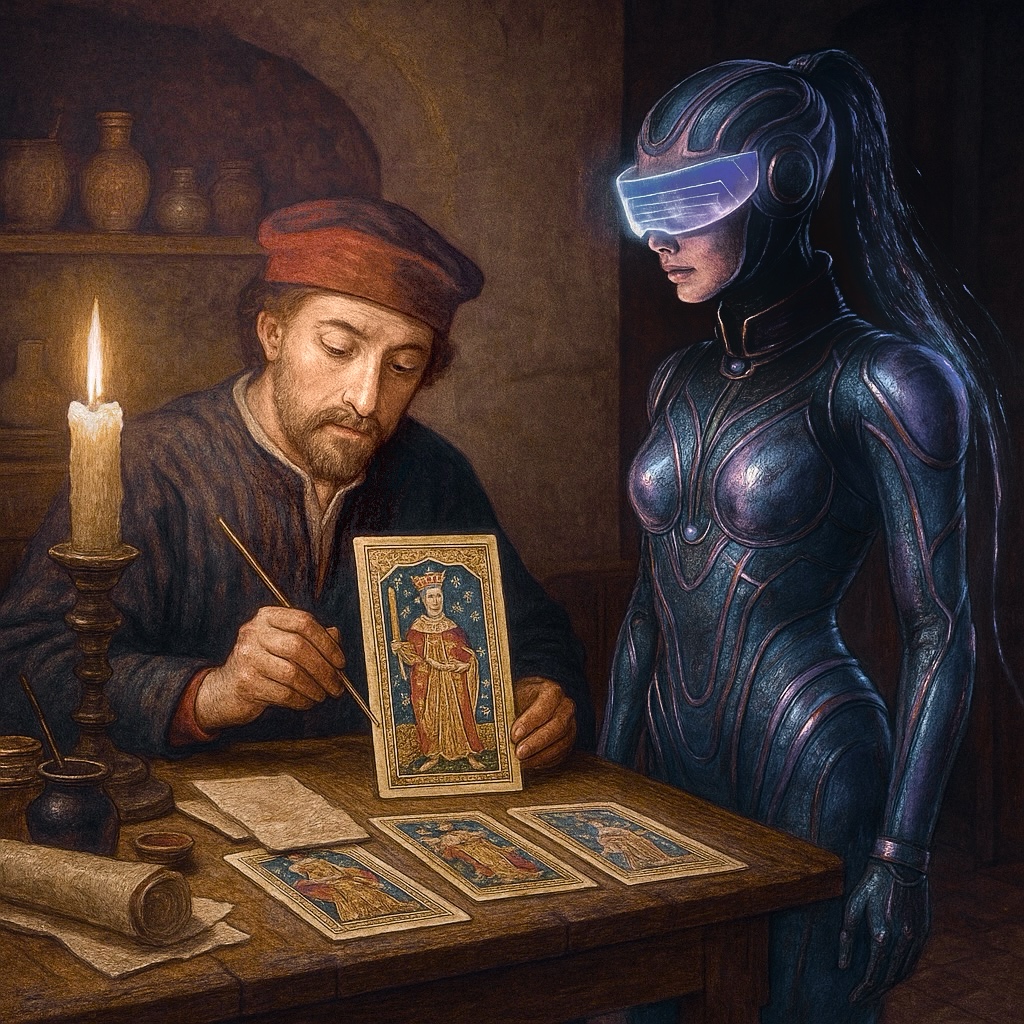
The Immediate Future for Professional Tarot Readings According to ChatGPT 5.
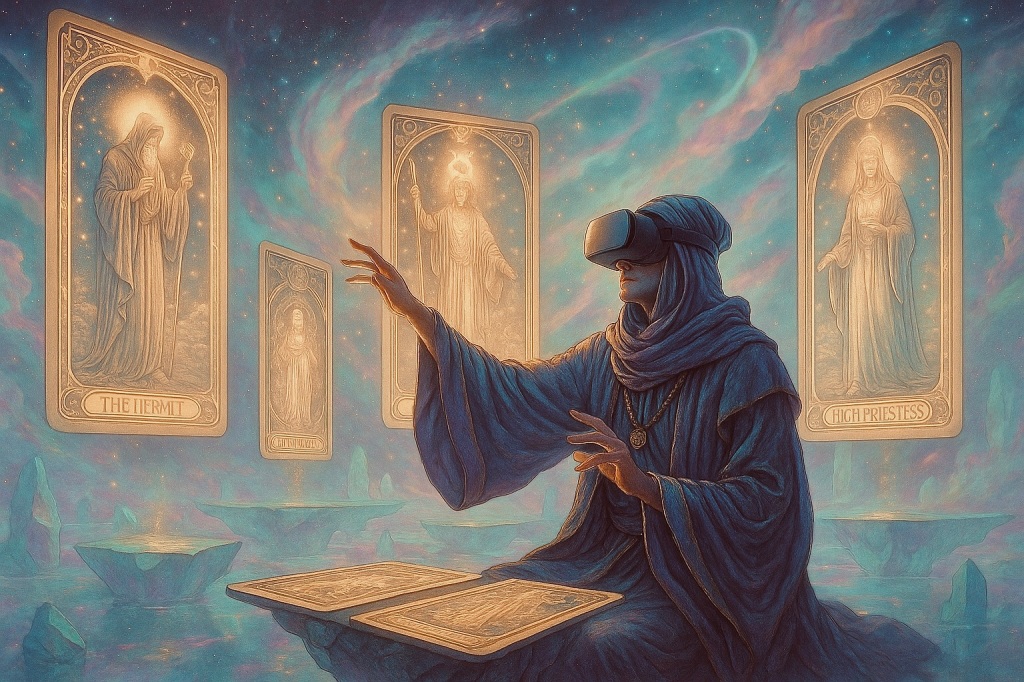
- Virtual Reality (VR) and Augmented Reality (AR) Integration: In the near future, professional tarot readers may offer VR-based tarot sessions. Clients could enter a virtual, ethereal space where the tarot cards float in a three-dimensional environment. The reader, also present in the virtual space, can manipulate the cards in real-time, creating a more immersive and engaging experience. AR could be used in a similar way, where the reader uses a device to project the tarot cards onto a real-world surface, adding an extra layer of interactivity.
- Subscription-based Services: Just like many online services today, professional tarot readers may offer monthly or yearly subscription packages. Subscribers could receive regular tarot readings, exclusive content such as in-depth interpretations of the cards, and access to private communities where they can discuss their readings with the reader and other subscribers.
The Immediate Future for Private Use
- Tarot-enabled Smart Home Devices: Smart home assistants like Amazon Alexa or Google Home could be integrated with tarot functions. Users could simply ask their smart device to draw a tarot card for them and receive a basic interpretation. For example, “Alexa, draw me a tarot card and tell me what it means.”
- Tarot-themed Mobile Games: There will likely be an increase in mobile games that incorporate tarot elements. These games could range from simple card – drawing games with educational interpretations to more complex role – playing games where the tarot cards influence the game’s storyline and character development.
The Speculative, Long Range View
- Professional and Private Use – Long-Range Tarot Developments
10 Years
- Tarot-Based Financial Advisors: Private users will turn to tarot – informed Al for financial guidance. The Al will interpret tarot card draws in the context of market trends and the user’s financial situation. It could suggest investment opportunities or savings strategies based on the symbolic meaning of the cards.
- Al/Tarot Symbiotic Readings: In the next decade, professional tarot readers will start working in tandem with advanced Al systems. The Al will analyze the client’s digital footprint, including their social media history, online purchases, and search patterns. The reader will then use this data in combination with a traditional tarot draw. For example, if the Al detects a pattern of stress – related searches and the tarot card drawn is related to anxiety, the reader can offer more targeted advice.
20 Years
- Global Tarot Networks: Professional tarot readers will be part of a global network where they can share complex cases. If a reader encounters a particularly challenging client situation, they can post the tarot spread and client details (anonymously) on the network. Other readers from around the world can then contribute their interpretations and insights, creating a collective wisdom approach to tarot readings.
- Tarot-Powered Life Coaches: Private individuals will have access to Al – driven tarot life coaches. These coaches will not only interpret tarot cards but also create long – term life plans for the users. They will monitor the user’s progress over time, adjusting the plans based on new tarot draws and the user’s changing circumstances.
50 Years
- Tarot with Integrated Consciousness Augmentation: In a more distant future, tarot will be integrated with technologies that enhance human consciousness. When a person undergoes a tarot reading, the experience will be amplified through neural interfaces. The user will enter a state where they can directly interact with the symbolic world of the tarot cards at a subconscious level, leading to profound self – discovery and personal growth.
- Tarot-Guided Interstellar Exploration: As humanity ventures into space, tarot will play a role in decision – making for interstellar missions. Al systems on board spaceships will use tarot symbolism to analyze potential risks and opportunities in uncharted regions of the universe. The crew will also draw tarot cards for moral and psychological support during long – duration space travel.
2. Art and Deck Themes and Styles
10 Years
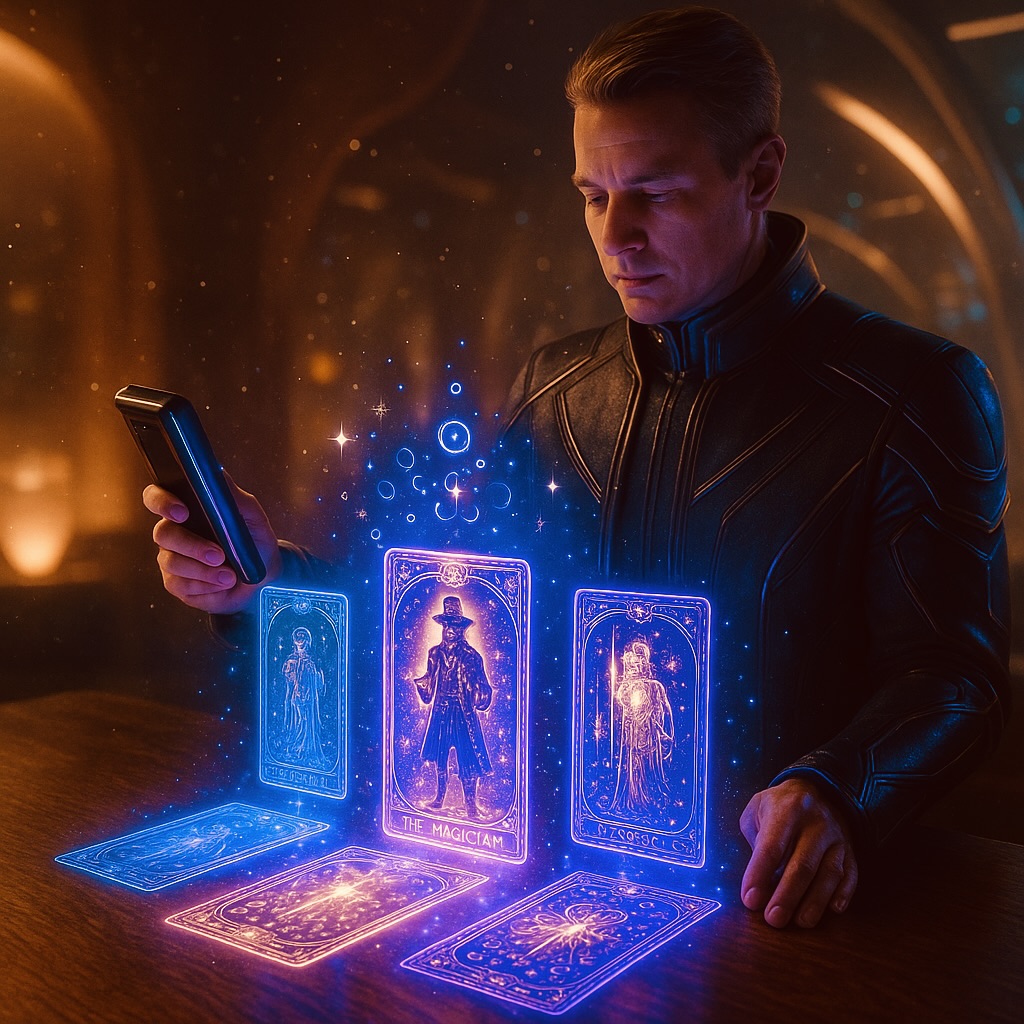
- Holographic Tarot Decks: Holographic technology will be used to create tarot decks. These decks will project three – dimensional images of the cards, with the symbols and colors changing depending on the angle of view. The holographic effect will add a new layer of depth and interactivity to the traditional tarot experience.
- Al-Generated Tarot Art: Al algorithms will be used to generate unique tarot deck designs. Artists will input certain themes or concepts, and the Al will create a series of card designs that blend traditional tarot symbolism with modern artistic sensibilities.
20 Years
- Biodegradable and Sustainable Tarot Decks: With a greater focus on environmental sustainability, tarot decks will be made from biodegradable materials. These decks will be not only eco – friendly but also have a unique texture and appearance. For example, decks made from recycled paper or plant – based plastics.
- Multi-Sensory Tarot Decks: Tarot decks will be designed to engage multiple senses. In addition to visual images, the cards could have scents associated with each card’s meaning. For example, the card of love could have a floral scent, while the card of chaos could have a pungent, earthy smell.
50 Years
- Nanotech Tarot Decks: Nanotechnology will allow for the creation of tarot decks at a microscopic level. These decks could be stored in a tiny device and projected as large, high – resolution images when needed. The nanotech material could also adapt to the user’s mood, changing the color and symbolism of the cards accordingly.
- Tarot Decks as Living Entities: Through advanced genetic engineering and biotechnology, tarot decks could be created with living organisms. The cards could be made from a type of bio-material that grows and changes over time, reflecting the user’s spiritual journey.
3. Online Presence
10 Years
- Tarot in the Metaverse: The metaverse will become a major platform for tarot. There will be virtual tarot shops, reading rooms, and schools. Users can enter these virtual spaces, interact with other tarot enthusiasts, and receive readings from renowned virtual tarot masters.
- Tarot NFTs: Non – fungible tokens (NFTs) will be used to represent rare and unique tarot decks. Collectors can own digital versions of these decks, which can be traded or displayed in virtual galleries.
20 Years
- Tarot-Based Social Credit Systems: In online communities, tarot readings could be used as part of a social credit system. Positive tarot interpretations could boost a user’s social standing within the community, while negative ones could prompt the user to engage in self – improvement activities.
- Tarot-Powered Virtual Reality Experiences: VR experiences will be fully immersive, with users able to physically interact with the tarot cards in a virtual environment. They can walk through a tarot – themed landscape, pick up the cards, and have in – depth conversations with virtual tarot guides.
50 Years
- Tarot-Infused Internet of Things (loT): The loT will be integrated with tarot. Smart devices in our homes, such as refrigerators, cars, and even clothing, will be able to draw tarot cards and provide real – time interpretations based on our daily activities and surroundings.
- Tarot-Driven Quantum Internet Communication: In the era of quantum internet, tarot symbolism will be used to encode and decode information. Messages sent over the quantum network could be encrypted using tarot card combinations, adding an extra layer of security and a touch of the esoteric.
4. Books, Conferences, and Classes
10 Years
- Holographic Tarot Books: Similar to holographic tarot decks, books on tarot will be holographic. They will project 3D images of the cards, along with animated explanations of the symbolism and interpretations. These books will be interactive, allowing the reader to explore different aspects of the tarot at their own pace.
- Tarot Conferences in Virtual Reality: Physical conferences will be complemented by VR – based conferences. Attendees can participate from anywhere in the world, interact with speakers and other participants in a virtual environment, and attend workshops and lectures in real – time.
20 Years
- Tarot-Based Educational Curricula: Tarot will be incorporated into mainstream educational curricula. Schools and universities will offer courses on tarot history, symbolism, and interpretation as part of their humanities and social science programs.
- Al-Generated Tarot Textbooks: Al will be used to generate comprehensive tarot textbooks. These textbooks will be constantly updated with the latest research and interpretations, providing students with the most accurate and up – to – date information.
50 Years
- Tarot/Memory Implant Education: In the future, it may be possible to implant tarot knowledge directly into a person’s memory. Students could undergo a procedure where the entire body of tarot knowledge, including card meanings, historical context, and interpretation techniques, is stored in their long – term memory.
- Intergalactic Tarot Conferences: As humanity expands into space, there will be intergalactic tarot conferences. Representatives from different planets and colonies will come together to share their unique tarot traditions and perspectives, creating a truly cosmic exchange of ideas.
5. Major Teachers and Their Modes for Teaching
10 Years
- Al-Teacher Avatars: Tarot teachers will use Al-generated avatars to teach online courses. These avatars can replicate the teacher’s voice, mannerisms, and teaching style. They can also interact with students in real – time, answering questions and providing feedback.
- Tarot Teaching in Virtual Reality Classrooms: Teachers will conduct classes in virtual reality classrooms. Students can sit around a virtual table, draw physical-looking tarot cards, and engage in group discussions and activities in a more immersive environment.
20 Years
- Genetic-Based Tarot Teaching: Advances in genetics may allow teachers to tailor their teaching methods based on a student’s genetic profile. For example, if a student has a genetic predisposition for creativity, the teacher can focus on more artistic and intuitive aspects of tarot interpretation.
- Collective Consciousness Teaching: Tarot teachers will tap into the collective consciousness of the tarot community. They will use techniques to access the shared knowledge and wisdom of all tarot practitioners, which can then be passed on to their students.
50 Years
- Telepathic Tarot Teaching: In a world with advanced telepathic communication, tarot teachers will be able to transmit knowledge directly to their students’ minds. The teacher’s thoughts and insights about tarot will be shared instantaneously, bypassing the need for traditional forms of communication.
- Tarot Teaching through Time Travel: Although highly speculative, in a future where time travel is possible, tarot teachers could travel back in time to study the origins of tarot directly. They could then bring this first-hand knowledge back to the present and share it with their students. This would revolutionize tarot education as it would provide an unparalleled level of authenticity and accuracy.
Students would have the opportunity to learn from teachers who have witnessed the early development of tarot, interacted with the original practitioners, and seen the cultural and historical contexts in which the tarot emerged. Teachers could describe the exact settings in which the first tarot decks were created, the materials used, and the initial meanings assigned to the cards.
This could also lead to a re-evaluation of existing tarot theories and interpretations. For example, if a teacher discovers that a particular card’s meaning was different in its original context, it could change the way modern tarot readers approach that card.
In addition, time-traveling tarot teachers could establish connections with past tarot communities. They could bring back lost tarot practices or techniques that have been forgotten over the centuries. breathing new life into the tarot tradition.
The knowledge obtained through time travel could be shared in various ways. Teachers could create immersive virtual reality experiences that allow students to virtually accompany them on their time-traveling adventures. They could also write detailed accounts in new types of textbooks that blend historical research with personal time – traveling anecdotes.
My Closing Thoughts:
My older version of ChatGPT 4o noted that “The deeper tarot becomes entwined with AI and data-mining, the more it risks shifting from an inner divination to an external prediction engine. The Magician’s wand could just as easily become the Tower’s lightning rod … spilling [or being thrown] into banality.”
How perceptive of this future visions! 4o likened it to a “Mercurial prophecy — quicksilver, inventive, and exhilarating — yet Mercury is also the trickster who can lead you to wisdom or misdirection.”
Personally, I feel there will still be those who are deeply moved by the cards with respect for its history and occult metaphysics.
Illustrations provided by DALL-E based on prompts from ChatGPT 4o + me.
Recently, music producer for BigHit, PDogg, was asked what his favorite BTS song is and he answered “The Truth Untold,” sung by the four vocalists (live performance below). It seems there is a long, fascinating history behind it. I’ll try to make this short. (Check out these sites for details: The BTS Effect and the florist’s Flower Smeraldo stories.)
This poignant love song is based on an Italian folk tale about a 16th century hideously deformed recluse who devotes himself to his garden. A ragged girl sneaks in to steal flowers. He watches her first in anger but eventually falls in love as he learns she sells them to survive. Fearing his appearance will disgust her, he creates beautiful flowers for her and eventually wants to give her his most beautiful flower of all, the blue Smeraldo Flower, but she has disappeared. He disguises himself with a mask and goes looking for her only to learn she is dead.
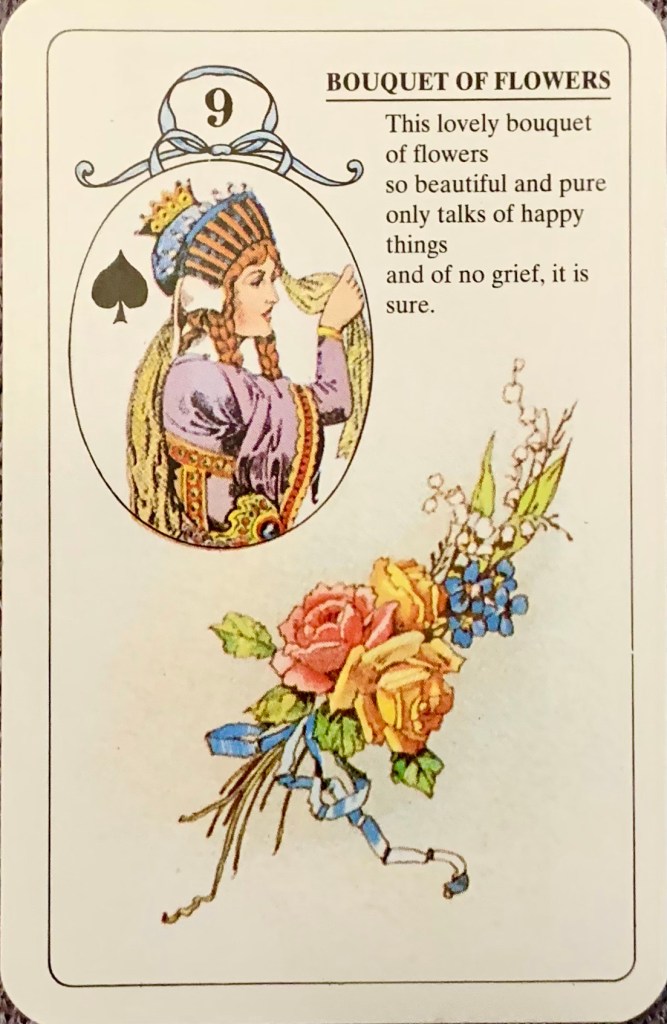
Just before the BTS song came out a series of blog stories appeared, supposedly by a S. Korean florist who was about to open a Smeraldo Flower Shop. The stories tell about this flower, a 16th century poet named Ashbless, a set of Ashbless Playing Cards and the Mlle. Lenormand Flower card. The first flower order taken by the shop is for Kim Seokjin (a member of BTS) in his guise as the time-traveler in the BTS Universe saga that lies behind their first albums (in which Jin continually goes back in time to try and save his six friends from death and other teen tragedies.) After the song came out Jin posted a photo of himself with a Smeraldo flower.
Well, it turns out that William Ashbless is actually a 19th century fictional poet made up by two California college students in the early 1970s. They became the famous fantasy writers Tim Powers and James Blaylock, both of whom eventually wrote novels that included Ashbless as a character or poems by him, including Powers’ The Anubis Gates and Last Call, the latter being especially beloved by tarot aficionados. According to Powers and Blaylock, Ashbless never appeared in public because he was hideously deformed, and his poetry was deemed portentous and meaningless. (See this video recounting the creation of Ashbless).
Here is the song in a mix from multiple performances with English subtitles. The lyrics can also be read as a love song from BTS to their fans ARMY, in that they had been going through a very rough time being besieged by haters who issued death threats, called some members ugly, and said their songs were unoriginal trash. In a way it is a prelude to their later album Mask of the Soul: Persona, in which they explore the masks they assume as Idols. The best translation can be found on doolset’s website.
I’ve collected quite a few Tarot music albums over the years so I thought I’d share what I have. I ask you to contribute to this list in the comments section. I link mainly to amazon but you’ll find many of these on iTunes and probably other places on the web. Forgive the dearth of commentary but, lacking a musical background, I feel unqualified to speak of the characteristics of each album.
I begin with my personal favorite (otherwise the list is in no particular order). It might not even be a tarot album except that the CD cover features the Star and the Fool. Still, listen to the story-telling folk-style lyrics and tell me this is not about the Fool’s journey through the cards: Pilgrims by Eliza Gilkyson.
Tarot by Réjean Paquin. Serious musical compositions for the 22 Major Arcana (with voice/sounds reflecting social commentary). There is plenty of variety that accords well with each Arcana.
Tarots, composed by Tomás Marco, guitar by Juan Carlos Laguna. Booklet in Spanish and English. Classical guitar pieces for the Major Arcana.
Tarot Music for Readings by Gene Newton. New Age, synthesizer, meditative. Not much variation.
Music of the Tarot by David & Steve Gordon. Meditative space-music with 3 pieces that cover the 22 Major Arcana and separate pieces for each suit of the Minors.
The Power of a New Aeon: Musical Impressions of the Tarot by mixed artists. Two-CD set. A selection for each card of the Major Arcana. The styles vary widely but seem to emphasize heavy metal (?).
The Book of Thoth: A Musical Interpretation of the Tarot by Zehm Aloim. This album doesn’t seem to be readily available but you’ll find a review here. Music for six of the Arcana. Zehm Aloim also created music to go with several Israel Regardie Golden Dawn training audios (found on iTunes).
Tarot: a musical and spiritual album inspired by the Tarot, music by Kevin Kendle; text by Steve Hounsome. New Age, mystical, covers the Fool through Wheel of Fortune.
Tarot Keys by Ruth Ann Amberstone. Collection of piano improvisations for the Major Arcana composed in the key of the musical note assigned to that card by the Hermetic Order of the Golden Dawn.
Cups of the Heart: A Musical & Poetic Journey into the Minor Arcana by Emerald Joy and Paul Tye. Poetic visualizations narrated to music for the Suit of Cups.
Tarot Suite by Mike Batt and friends. I only have the vinyl and haven’t listened to it in 30+ years. Now available on amazon mixed with another Batt album.
Osho Zen Tarot: Music from the World of Osho is not actually tarot-related but is, rather, spiritual, India-influenced New Age music taken from other Osho music collections. You may enjoy reading the cards while listening to it.
Voyage of the Acolyte by Steve Hackett (thanks to P.D. Newman).
Teargarden By Kaleidyscope from Smashing Pumpkins (thanks to P.D. Newman).
Turn of the Cards from Renaissance (thanks to P.D. Newman). Described as classical/prog rock. The only direct tarot connection seems to be the cover and title. Nice.
Tarot: “Die Welt” by Walter Wegmüller (thanks to Bertrand Saint-Guillain), Described as the “funkiest of funk”; Vol. 2 with images from Wegmüller’s deck found on Youtube here.
How could I have forgotten this one? Tales from the Realm of the Queen of Pentacles by Suzanne Vega. Several songs on this album are tarot-based by title or otherwise.
The Fool’s Journey: Solo by Liz Deyoe. Instrumental guitar. Ten pieces, each named after one of the 78 cards. Lovely.
Note: There is a heavy metal band from Finland named Tarot but I’m unaware of any tarot card-related music by them.
You’ll find plenty of individual tarot-based songs and tunes on non-tarot albums. The best of which is “The Wheel” by Rosemary Cash, while others, like “Pokerface” by Lady Gaga and “She Only Smokes When She Drinks” by Joe Nichols, feature tarot primarily through images in their music videos (as “The Wheel” also does brilliantly!). Others can be found by looking through my blog category: Tarot Music Videos.
Joe Nichols music video with tarot reading at end.
Please mention your favorite songs in the comments along with why you like them.
Added to individual songs: Cassandra Wilson, sings “Tarot” on her album, Thunderbird (thanks to Charlie Harrington). “The Fool” from Hills and Rivers (thanks to Dovid DeHay). “Six of Swords” and “Four of Cups” from HobbyHorse (thanks to their vocalist Annie Aronson). “Tarot” by Chad Shank (thanks to Chad Shank); it’s really good!
Watch Xena: Warrior Princess Episode, “Bitter Suite,” available on youtube for only $1.99. The entire episode is sung, beautifully! It’s well-worth it. More info here including the Tarot references and sources for these.
A third category would be music that you play when you want to do deep work with the tarot, either for reading or meditation. My favorite deep trance-meditation music for tarot is El-Hadra the Mystic Dance by Klaus Wiese.
Lawman – “Tarot” – Season 4, Episode 13.
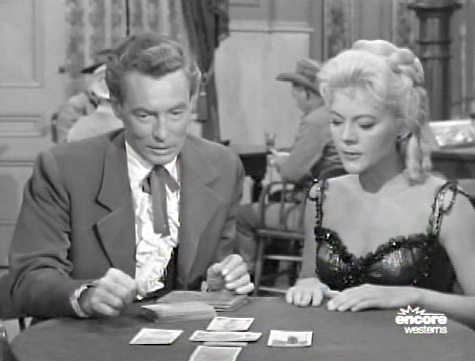
Lily: Did you bring the tarot cards, Joe?
Joe Wyatt ( Lily’s friend who has just arrived in town): Ever see me without them? (gets tarot cards out of a large cigarette case)
Johnny (the Lawman’s deputy): What kind of cards are they, Mr. Wyatt?
Joe Wyatt: Fortune telling cards. The gypsies had them when they wandered the ruins of Rome. These were old when the pyramids went up on the banks of the Nile. Or so they say. Nobody knows who made up the first tarot deck. Some say the Devil himself.
Lily: Tell my fortune, Joe. For old time’s sake.
Joe Wyatt: If you remember old times, Lily, you know I never tell individual fortunes. Makes for disappointment and unnecessary worry.
Lily: Please, Joe.
Joe Wyatt: Well, I suppose I could lay out the tarot deck for all of us, a kind of general fortune that might apply to any one of us here. Will the fair queen cut? (He lays out the cards in a six card cross, the first card, crossed under the Wheel of Fortune, is face down and is never turned up.)
5 of Cups – Somebody’s going to get some money.
The Juggler standing upright – Somebody’s going to take a trip.
The Wheel of Fortune beside the dark of the Moon – That’s kind of hard to figure, unless somebody’s going to sit up all night with a pot of gold.
Lily (looking at the final card): The Hanged Man.
Johnny: Well, what does that one mean?
Joe Wyatt: Oh, it’s not exactly the best card in the deck. Stay out of bad weather, bad company, something like that.
Johnny: Oh, I see.
Lily: You better tell him what it really means, Joe.
Joe Wyatt: If there were anything to this nonsense, it’d mean that somebody at this table is going to die.
(Much later after two of the four predictions come true . . . )
Joe Wyatt: If you keep looking you’ll find everything in the tarot cards, one way or another. It’s a carnival act from a circus.
(At the end, as Joe lays dying and all the predictions have come to pass, he gives the tarot to Lily):
Joe Wyatt: Might even make a man think there was something to all those cards. But don’t you pay any attention to them, Lily. They only tell you what you want them to tell you.
Joe Wyatt: Might even make a man think there was something to all those cards. But don’t you pay any attention to them, Lily. They only tell you what you want them to tell you.
Thanks to Paul Nagy I’m adding the Have Gun—Will Travel episode, “Everyman” from 1961 (Season 4, Ep 27) that starts with a Tarot reading featuring “The Drowned Sailor, the Phoenician” (the card is never shown, but according to A.E. Waite, it’s the true name of the Hanged Man). Could “Everyman” refer to the Fool?
Name that deck!
Learn more about an up-coming fictional documentary film about a mysterious deck of Tarot cards that reveals ancient alchemical secrets at this weekend’s Readers Studio at the New York LaGuardia Airport Marriott in New York. The art and video are by Andrea Aste, an Italian artist and film-maker.
The Book of Shadows: The Lost Code of the Tarot
A tarot deck was created for the 1998 movie Practical Magic with Sandra Bullock and Nicole Kidman. You can get a reading with it here (warning: an old form of flash is used and may not work on many computers). See a selection of the cards in this fan video:

According to the trailer, the new movie Sherlock Holmes 2: A Game of Shadows features a tarot card reader and an original Oswald Wirth tarot deck. (Thanks to Shelley for the heads-up.) Obviously Wirth and Holmes never meet, but wouldn’t that make a great story!!! For those who were blown away by Noomi Rapace as The Girl with the Dragon Tattoo (Swedish version), she is playing the gypsy fortune teller. I’m looking forward to seeing her in a different role. Check out Oswald Wirth’s tarot spread—a reclaimed classic.
Danish tarot collector and author, K. Frank Jensen shared with me the story of how an original Oswald Wirth deck came to be used in the movie:
“In August 2010, a British woman, Laura Tarrant-Brown, addressed a number of members of the ‘International Playing Card Society’, including me, about buying or hiring ‘the original full set of Tarot cards that Oswald Wirth re-drew for his master, Guaita Stanishas in 1889′. It should be used ‘in a film set in Paris/London 1890’. An alternative could be the 1926/27 version of Wirth’s images. Tarrant-Brown did, of course, not have any response on this enquiry except from me. As far as I know, only two decks are known, one in the possession of a Japanese collector (formerly from the R.C.Bell collection of games); the other belonged to the late Belgian collector, Hans Wesseling, whose widow wanted it sold. Guido Gillabel, likewise Belgian collector, took care of the sale. At the time of Tarrant-Brown’s request Gillabel was preparing listing the decks on ebay. I was aware that the Wirth deck was among them so I asked Gillabel if he wanted to sell the deck directly and at what price? Wesseling’s widow wanted EUR 1200.- for it. I would have liked to buy it myself, but don’t just have EUR 1200.- available here and now, and Tarrant-Brown didn’t hesitate. That’s how the deck ended up in the film, and I have been annoyed ever after that I didn’t just buy the deck.
“Tarrant-Brown couldn’t really accept that the 22 cards were a full set, even if I told her so twice. She wanted to search further for ‘the missing 56 cards’, likely mislead by the so-called “Oswald Wirth Tarot – The Original and only authorized Oswald Wirth Tarot Deck” published by USGS (1976). Wirth worked only with the majors, and USGS’s deck has nothing whatsoever to do with the original Wirth illustrations. (The 22 Major Arcana cards of the USGS edition are illustrated by a Michél Simeon. The booklet that comes with the deck states however, that the majors are “as designed by Wirth” while the minors are “newly created”.)
“Tarrant-Brown was not very communicative and later she told me that the film was a Sherlock Holmes production but didn’t answer my question whether Wirth and Guaita are characters in the film. She likewise never answered my question of what would happen to the deck once the film was finished.
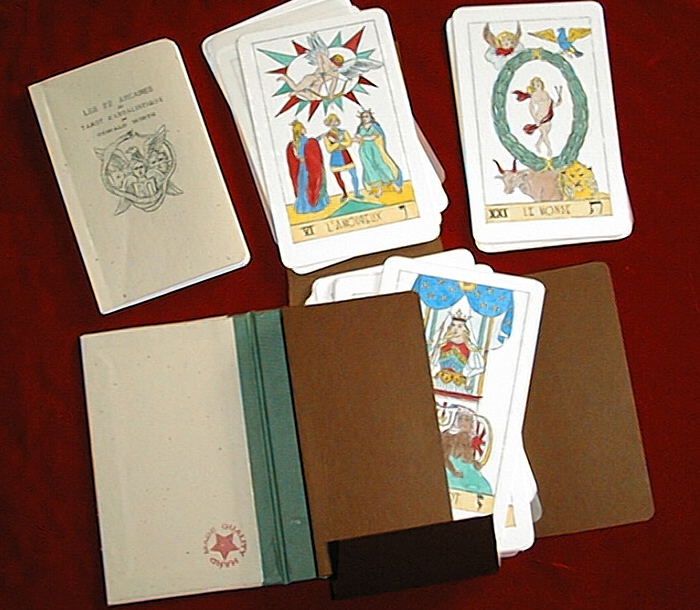
“Now I am at it: I’ve been working on a handcoloured Wirth deck. The line art are redrawings of Wirth’s illustrations by a probably German artist, the colours are based upon the pack in the Japanese collection. It will be a very limited edition. Three decks are finished and disposed of. Further 6 or 7 copies are in work. There won’t be more than those due to the time-consuming work.” (Below: extremely limited edition, K. Frank Jensen hand-colored 1889 Oswald Wirth deck.)
Jeanne Fiorini asks a great question on her video “TarotWorks Tarot Tip #10”:
Do you use your tarot as you would the Emergency Room, or do you use your tarot the way you would the Health Food Store?
Think about this for a moment before you watch her video:
Jeanne is a tarot maven, with creations ranging from tarot wrapping paper to bags to books to instructional videos—all found at TarotWorks. In addition to her youtube videos you’ll find lots of helpful advice in her book Tarot Spreads and Layouts, especially as it relates to tarot for personal insight. In some ways, the title is a misnomer in that this short but pithy book contains far more in terms of sensible advice and good reading skills than you get in most other books. How often, as I read her text, I found myself thinking, “I wish I had said that!” To give myself credit, occasionally I have, as Jeanne is not reinventing the wheel but succinctly describing methods that take years to discover otherwise—in a no nonsense and elegantly easy-to-understand way. In a recent article in the American Tarot Association newsletter, Tarot Reflections, you can learn how Jeanne has integrated her studies of Psychosynthesis with her approach to Tarot.
The spreads and layouts comprise almost two-thirds of the book, and what is truly unique here isn’t just the layouts or the different number of cards or the range of issues (which we also get), but that we are given:
- questions that will help us understand what a card means in a particular spread position,
- things to consider about how the cards might relate to each other,
- guidelines for expanding the layout,
- helpful hints and reminders about intention, focus and attitude.
Do you want to know how playing cards are actually made? Here are a series of videos that take you through the historical development of the major deck production techniques.
This video from the Victoria & Albert Museum in London shows how woodcut playing cards were created:
The Rider-Waite-Smith deck was produced by Lithography (technically chromolithography as several colors were involved). The process was similar to what’s shown here except with a really big stone, a big press, and a separate run for each color:
Cartamundi in Belgium, who have printed many modern tarot decks, demonstrate how they print their playing cards:
I really hesitated about including this video, as it breaks my heart, but, since so many tarot decks are now printed in China, I thought it important that we understand a little of what is involved in obtaining such cheap prices:
And for something a little more personal—
Check out these sites:
- Guides for Producing Small Editions of Hand-made Playing Cards,
- Arnell Ando’s Useful Notes on Making and Publishing Your Own Tarot Deck.
If you don’t want to design your own deck but like a bit of handwork and a deck that looks different and, in many cases, is more immediate in its impact, try cutting off the borders of one of your decks. Tarotforum has a page with pictures of hundreds of trimmed tarot decks—check out which ones work best here first. And, here’s a video by Donnaleigh on how to do it:
 Mary K. Greer has made tarot her life work. Check here for reports of goings-on in the world of tarot and cartomancy, articles on the history and practice of tarot, and materials on other cartomancy decks. Sorry, I no longer write reviews. Contact me
 Mary K. Greer's Tarot Blog
Recent Comments