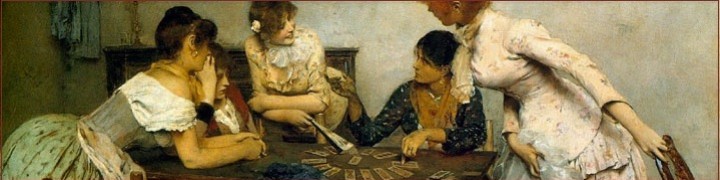
A tarot deck was created for the 1998 movie Practical Magic with Sandra Bullock and Nicole Kidman. You can get a reading with it here (warning: an old form of flash is used and may not work on many computers). See a selection of the cards in this fan video:
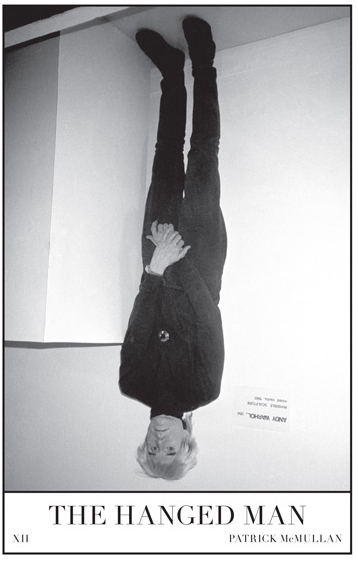 Stacy Engman asked a group of today’s most dynamic artists to submit a new work based on a tarot card personally assigned by her. It’s showing May 26 – August 7, 2011 at the The Andy Warhol Museum, Pittsburgh. Along with the original Tarot cards, the exhibit features Andy Warhol’s own Tarot card collection as well as a streaming video of “The Velvet Underground, Tarot Cards 1966,” which documents Warhol’s project from beginning to end. Catch it before it’s gone!
Read more and view the slideshow at warhol.org. And read this report from the Pittsburgh Post-Gazette.
Read an interview with Stacy Engman from last November at New York’s National Arts Club’s opening reception – here. With more card images here. (Thanks to Marlene.)
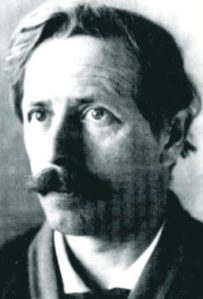
K. Frank Jensen just sent me fascinating information about the Oswald Wirth deck used in the movie, which I have added to my earlier post:
https://marygreer.wordpress.com/2011/07/15/oswald-wirth-meets-sherlock-holmes/
The photograph is of Wirth around the time he created his first set of cards.
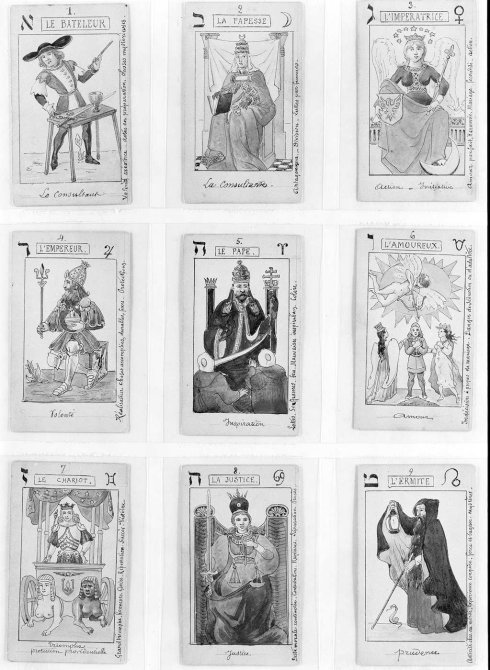
Here’s a selection of uncolored Wirth cards from the Yale University Library:
Updated: May 10, 2017
Here is the advice of 45 experienced reader and teachers of tarot and a few newbies. The contradictions are intended to foster respect and understanding for alternate views.
History is based on facts and therefore can express only what can be demonstrated with evidence or carefully deduced from an in-depth understanding of the facts, the culture, the period and the people. New facts can totally change what was formerly thought to be true.
Myths are false stories that reveal some kind of inner Truth. That Truth is often not what the myth conveys on its surface. Someone called them “the Great Imaginings behind this World.” However, they can lead us along paths that aren’t real or can even be harmful, for instance when they become “rules” that unnecessarily limit our experience.
It’s been said that history is true on the outside but a lie on the inside (for instance, we’ll never know what people actually felt and did). Whereas a myth is a lie on the outside and true on the inside (however, discerning the truth it points to can be tricky).
There are at least two kinds of tarot myths:
- Stories of tarot’s origins (mostly romantic and mystical stories with great inner significance),
- “Rules” that should be followed only if you find them helpful and meaningful.
We actually know quite a bit about tarot history:
It originated sometime between 1420 and 1440 in Northern Italy, probably in the court of Milan or Ferrara or possibly even Florence, amid other experiments in creating a suit of triumphal cards. We also know fairly precisely what the images signified in the “High Gothic”-to-early-Renaissance Italian culture. A trip to Northern Italy will confirm the ubiquitous nature of the allegorical images in the late 14th and early 15th centuries.
Playing cards (as shown below) appeared in Europe and spread quickly about 60-75 years before the Triumphs were added to the deck. For the first 350 years ‘Il Trionfos’ were known almost entirely for playing games similar to whist or bridge as attested to by several frescos and text references.

While there are are rare indications early on that both playing cards and tarot were used for divination and character delineations (in poems called Tarocchi Appropriati), true “reading” practices were not widely known until the late 18th century. This is when Antoine Court de Gébelin, Le Comte de Mellet, and Jean-Baptiste Alliette (Etteilla) wrote about tarot and fortune-telling and made up stories about their being brought to Europe by the gypsies from their mystical place of origin in Egypt (none of which has been substantiated in the slightest). Likewise, the idea of Tarot originating with either Jewish or Christian Kabbalists or with the Cathars has not a shred of evidence, even though both were known to exist in Milan during the period. Regarding the 22 Hebrew letters, early references always describe the Trumps as numbering 21, with a separate mention for the Fool (or ‘Excuse’) card.
There is still a lively debate about the etymology of the plural word Tarocchi for the deck and Tarocco for the game (which was shortened at least a hundred years later in central Europe to Tarot, Taroc or Tarock). My favorite origin story is that the root of Tarocchi is similar to that for the Sicilian Blood Orange, Tarocco, that has a pitted skin. This makes it look like the hammered gold leaf backgrounds of early court decks, from the Arabic word for ‘hammered’ (taraqa) describing a design technique used on gold and leather.
Please read Sherryl Smith’s Tarot History Chronology, TarotL History Information Sheet and my post: “Origins of Cartomancy (Playing Card Divination).” The serious student will want to check out trionfi.com, Cultural Association “Le Tarot”, the Tarot History Forum and Tarot History & Iconography at aeclectic, among others. Books are recommended on these sites and here.
The advice given here regarding the importance of history by our panel of tarot experts (and a few newbies) wasn’t easy to organize. I’ve done quite a bit of condensing and of merging of similar statements. Personally, I was originally intrigued by the myths as they supported my interest in esoteric studies and in doing readings. It was only later that I came to truly appreciate the vital importance of history and how it adds great depth my understanding of the meaning of the cards. Factual history adds to our knowledge; it doesn’t subtract from it.
Anti-History
• Just starting to read tarot? No, it’s not important to know tarot history and myth. All that’s important to know is that tarot is a divination tool.
• History is not necessary for newbies. Myths and archetypes work even if you don’t know how or what their history is. They are timeless, that is, relevant to all times. Newbies need the Magic first!
Over 60 experienced tarot readers offer their best advice for what every Newbie Tarot Reader should know. Not everyone will agree with everything. Add ideas you think belong, in the Comments. Feel free to post this anywhere, so long as you include the source and contributors (listed at the end).
The Rules
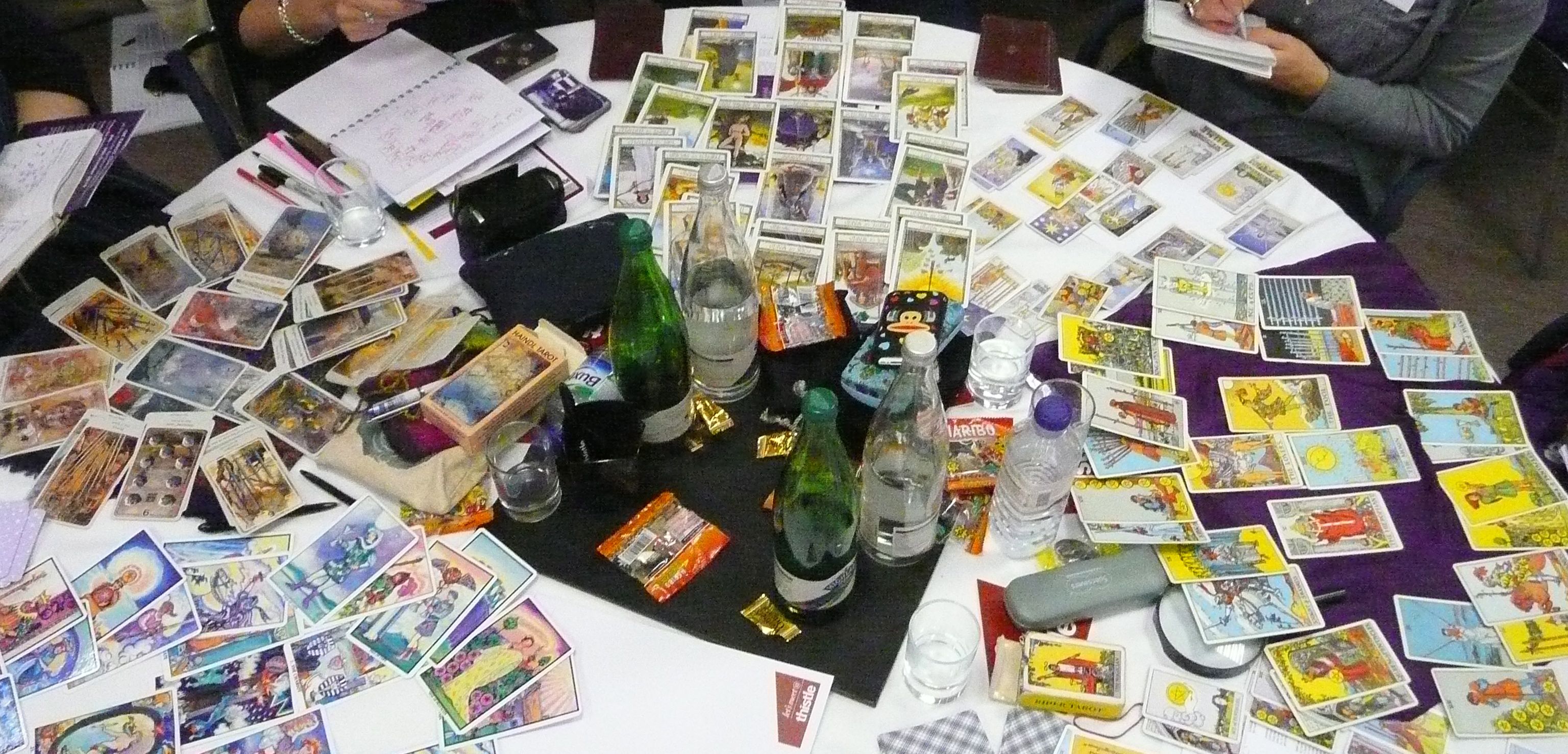
• There are no rules. All rules are made to be broken.
• You may hear and read a LOT about tarot, much of it contradictory. Listen, read, discuss, try, and decide for yourself. No one knows how you will read or work with the cards except you.
Learning Tarot
• The more you know, the more options you have.
• Read books, Lots of books.
• PUT THE BOOKS DOWN!
• There is nothing wrong with books. Knowledge gained from them gives you a fantastic starting point and framework and can lead to more assured reading.
• Try to read a card first, before you look it up. You will be surprised by how much of the gist of it you get.
• Get to know your deck – pull a card a day and/or go through your deck and take notes on each card. Write your thoughts and feelings about each card in a journal.
 I frequently hear questions on forums such as, “When the Magician (or Star or Emperor) comes up in the position of what someone wants, what does it mean?” Or, “What does the Three of Wands advise?” Or, as a response to “What does my boyfriend feel about me?,” students want to know “What does Justice (or the Knight of Pentacles or the Seven of Cups) feel?” I find these questions curious. For one thing, what the Magician wants in one life situation will be very different than what he or she wants in another. For another, the deck used will often change the attitude and feeling of the card.
Here’s my favorite way to get the most helpful responses to such questions: Simply ask the figure on the card!
Usually it’s the querent, not the reader, who can give voice to the most meaningful response. Sure, as a reader, I can easily come up with a bunch of possibilities, but if you want to hear a loud, resounding ring of truth, ask the querent what the figure on the card says.
It’s amazing how easily querents will come up with something consequential when I ask them for the first thing that comes to mind. I’ve asked thousands of querents, and I’ve rarely had anyone who couldn’t do it.
The answers are never random. In the majority of cases, you’ll be surprised at how significant the response will be—both in relation to the card and to the situation. If a querent doesn’t get how this relates to him, I have him repeat the statement once or twice until he does. Or, I ask the querent directly how this response relates to her situation.
Using this technique for yourself, you’ll find the cards in a spread form a committee, each with their own attitudes, agendas, feelings and advice. One may speak with the voice of your mother, another with your inner wild-child, and a third as your demanding boss. It’s not unusual for them to disagree with each other. The position in the spread will help you determine if theirs is a voice from the past, the urgings of a possible future, an obstructing adversary, or a helpful guide.
A technique that can make this even more powerful is for the querent (whether yourself or another) to assume the body posture of the figure on the card. Try to imitate it as exactly as possible and try moving as that figure would move, and taking on its tone. Then, speak as the figure, saying what that figure wants or feels or advises, or how it uses the various implements and symbols on the cards, and even what it thinks of the advice of other cards!
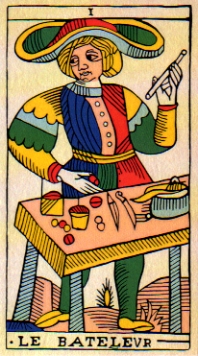
I invite you to come play with me. In the Comments section, speak with the voice of one or all three of the following Magicians and/or the one at top, and tell us what that Magician wants. Is it the same for all of them or different? From left to right you can call them: Wildwood Magician, Wizards Magician, Otherworld Magician (click for a larger image; sources below).
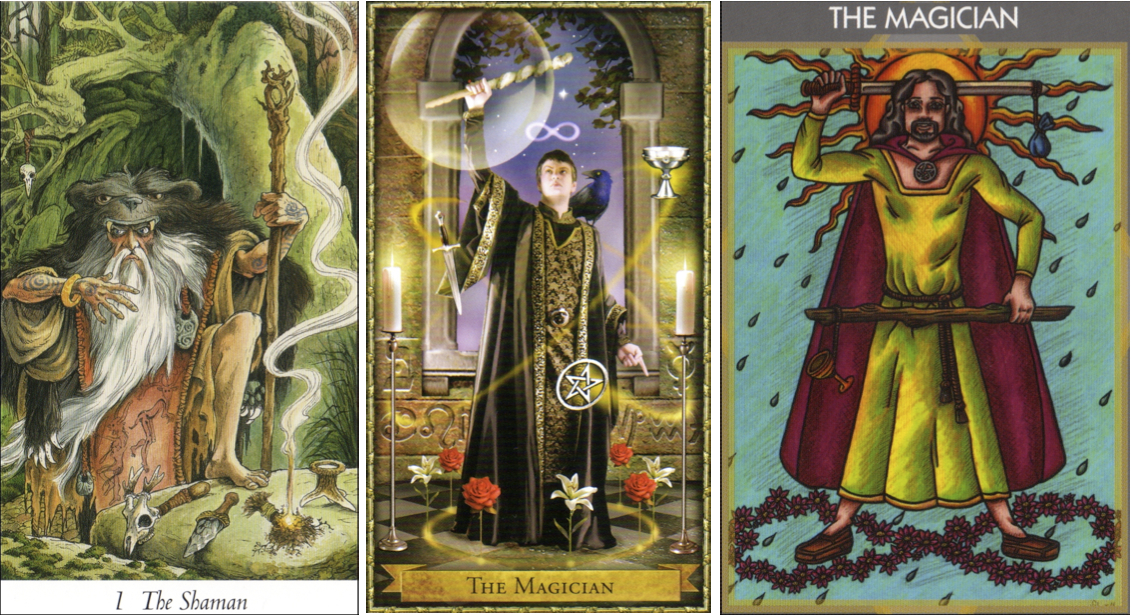
Top: Bateleur from the Tarot de Jean Dodal by Pablo Robledo. Left: Shaman from The Wildwood Tarot by Mark Ryan, John Matthews and Will Worthington. Middle: Magician from The Wizards Tarot by Corrine Kenner and John Blumen. Right: Magician from the Otherworld Tarot by Alison Williams and Sarah Nowell.

According to the trailer, the new movie Sherlock Holmes 2: A Game of Shadows features a tarot card reader and an original Oswald Wirth tarot deck. (Thanks to Shelley for the heads-up.) Obviously Wirth and Holmes never meet, but wouldn’t that make a great story!!! For those who were blown away by Noomi Rapace as The Girl with the Dragon Tattoo (Swedish version), she is playing the gypsy fortune teller. I’m looking forward to seeing her in a different role. Check out Oswald Wirth’s tarot spread—a reclaimed classic.
Danish tarot collector and author, K. Frank Jensen shared with me the story of how an original Oswald Wirth deck came to be used in the movie:
“In August 2010, a British woman, Laura Tarrant-Brown, addressed a number of members of the ‘International Playing Card Society’, including me, about buying or hiring ‘the original full set of Tarot cards that Oswald Wirth re-drew for his master, Guaita Stanishas in 1889′. It should be used ‘in a film set in Paris/London 1890’. An alternative could be the 1926/27 version of Wirth’s images. Tarrant-Brown did, of course, not have any response on this enquiry except from me. As far as I know, only two decks are known, one in the possession of a Japanese collector (formerly from the R.C.Bell collection of games); the other belonged to the late Belgian collector, Hans Wesseling, whose widow wanted it sold. Guido Gillabel, likewise Belgian collector, took care of the sale. At the time of Tarrant-Brown’s request Gillabel was preparing listing the decks on ebay. I was aware that the Wirth deck was among them so I asked Gillabel if he wanted to sell the deck directly and at what price? Wesseling’s widow wanted EUR 1200.- for it. I would have liked to buy it myself, but don’t just have EUR 1200.- available here and now, and Tarrant-Brown didn’t hesitate. That’s how the deck ended up in the film, and I have been annoyed ever after that I didn’t just buy the deck.
“Tarrant-Brown couldn’t really accept that the 22 cards were a full set, even if I told her so twice. She wanted to search further for ‘the missing 56 cards’, likely mislead by the so-called “Oswald Wirth Tarot – The Original and only authorized Oswald Wirth Tarot Deck” published by USGS (1976). Wirth worked only with the majors, and USGS’s deck has nothing whatsoever to do with the original Wirth illustrations. (The 22 Major Arcana cards of the USGS edition are illustrated by a Michél Simeon. The booklet that comes with the deck states however, that the majors are “as designed by Wirth” while the minors are “newly created”.)
“Tarrant-Brown was not very communicative and later she told me that the film was a Sherlock Holmes production but didn’t answer my question whether Wirth and Guaita are characters in the film. She likewise never answered my question of what would happen to the deck once the film was finished.
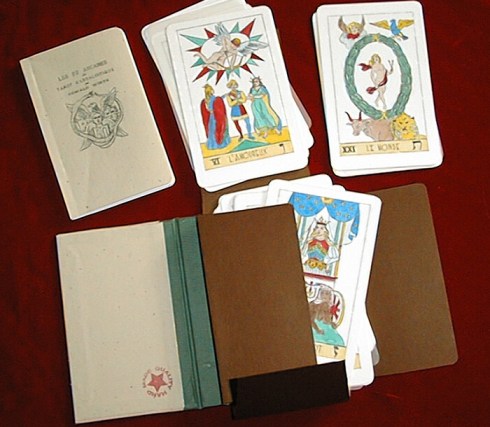
“Now I am at it: I’ve been working on a handcoloured Wirth deck. The line art are redrawings of Wirth’s illustrations by a probably German artist, the colours are based upon the pack in the Japanese collection. It will be a very limited edition. Three decks are finished and disposed of. Further 6 or 7 copies are in work. There won’t be more than those due to the time-consuming work.” (Below: extremely limited edition, K. Frank Jensen hand-colored 1889 Oswald Wirth deck.)
Jeanne Fiorini asks a great question on her video “TarotWorks Tarot Tip #10”:
Do you use your tarot as you would the Emergency Room, or do you use your tarot the way you would the Health Food Store?
Think about this for a moment before you watch her video:
Jeanne is a tarot maven, with creations ranging from tarot wrapping paper to bags to books to instructional videos—all found at TarotWorks. In addition to her youtube videos you’ll find lots of helpful advice in her book Tarot Spreads and Layouts, especially as it relates to tarot for personal insight. In some ways, the title is a misnomer in that this short but pithy book contains far more in terms of sensible advice and good reading skills than you get in most other books. How often, as I read her text, I found myself thinking, “I wish I had said that!” To give myself credit, occasionally I have, as Jeanne is not reinventing the wheel but succinctly describing methods that take years to discover otherwise—in a no nonsense and elegantly easy-to-understand way. In a recent article in the American Tarot Association newsletter, Tarot Reflections, you can learn how Jeanne has integrated her studies of Psychosynthesis with her approach to Tarot.
The spreads and layouts comprise almost two-thirds of the book, and what is truly unique here isn’t just the layouts or the different number of cards or the range of issues (which we also get), but that we are given:
- questions that will help us understand what a card means in a particular spread position,
- things to consider about how the cards might relate to each other,
- guidelines for expanding the layout,
- helpful hints and reminders about intention, focus and attitude.
Do you want to know how playing cards are actually made? Here are a series of videos that take you through the historical development of the major deck production techniques.
This video from the Victoria & Albert Museum in London shows how woodcut playing cards were created:
The Rider-Waite-Smith deck was produced by Lithography (technically chromolithography as several colors were involved). The process was similar to what’s shown here except with a really big stone, a big press, and a separate run for each color:
Cartamundi in Belgium, who have printed many modern tarot decks, demonstrate how they print their playing cards:
I really hesitated about including this video, as it breaks my heart, but, since so many tarot decks are now printed in China, I thought it important that we understand a little of what is involved in obtaining such cheap prices:
And for something a little more personal—
Check out these sites:
- Guides for Producing Small Editions of Hand-made Playing Cards,
- Arnell Ando’s Useful Notes on Making and Publishing Your Own Tarot Deck.
If you don’t want to design your own deck but like a bit of handwork and a deck that looks different and, in many cases, is more immediate in its impact, try cutting off the borders of one of your decks. Tarotforum has a page with pictures of hundreds of trimmed tarot decks—check out which ones work best here first. And, here’s a video by Donnaleigh on how to do it:
 Mary K. Greer has made tarot her life work. Check here for reports of goings-on in the world of tarot and cartomancy, articles on the history and practice of tarot, and materials on other cartomancy decks. Sorry, I no longer write reviews. Contact me
 Mary K. Greer's Tarot Blog
Recent Comments