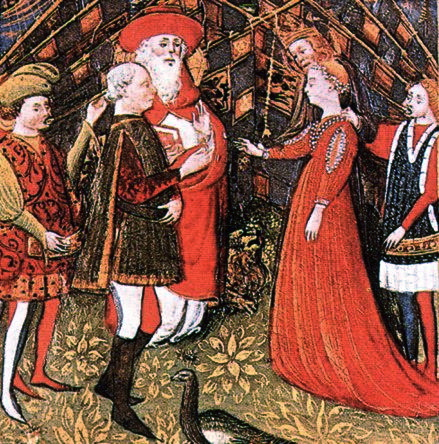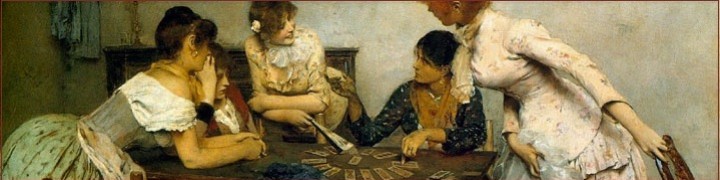
Who created the first tarot deck? For what purpose? No one really knows for sure. It is clear that tarot cards (il trionfos) were used for games almost from the beginning. Whether there was any other purpose in the mind of the artist or the person who commissioned the deck will probably never been known. What has emerged, though, is an image of cards as a social pasttime that may have been part of the courting rituals of the period. It presented an opportunity for young men and women to interact and flirt in a chaperoned environment. In fact, two oldest decks we have, the Visconti-Sforza and the Cary-Yale Visconti, were probably commissioned as wedding presents. One of the earliest of card players and the intended recipient of the Visconti-Sforza Tarot deck, was Bianca Maria Visconti (1425-1468), shown above at her wedding with Francesco Sforza (1441). The deck may have been a gift from her father, Filippo Maria Visconti (died 1447). Filippo Maria Visconti’s golden ducato is shown on the suit of Coins of the Visconti-Sforza deck (first noticed by Ross Caldwell, I believe):

A German historian of women in the Middle Ages and Renaissance and a recognized art expert, Maike Vogt-Luerssen, has written a book about Bianca Maria (unfortunately only in German) and has collected an astonishing array of paintings of members of the Visconti and Sforza families. Begin here and then continue your tour through this marvelous collection.

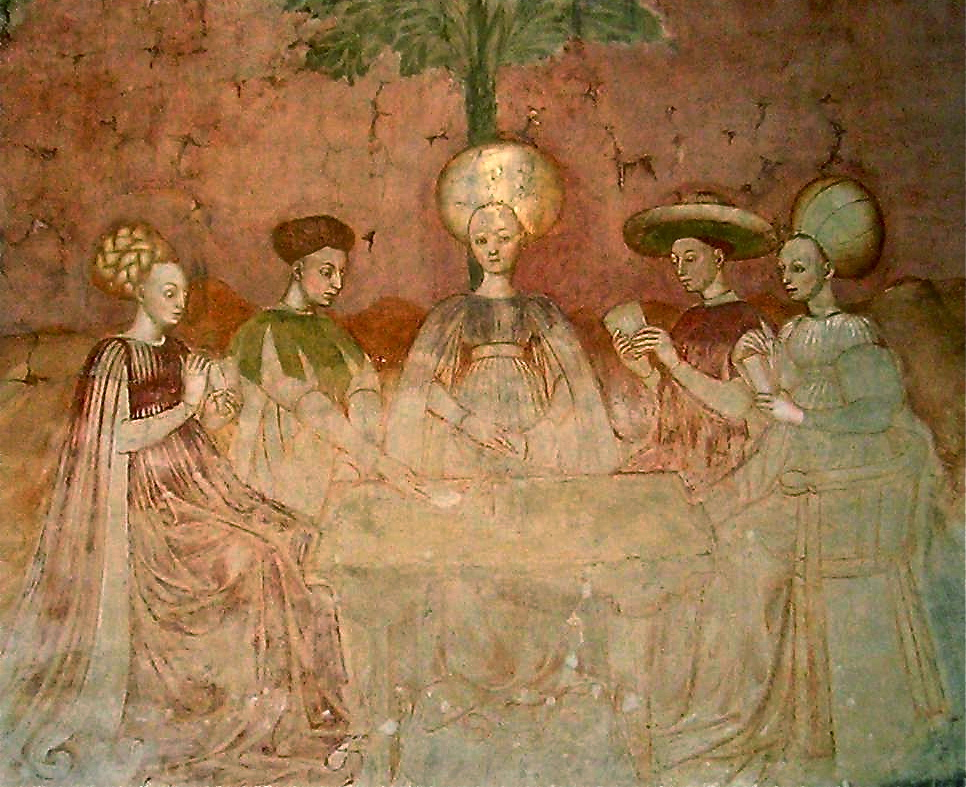
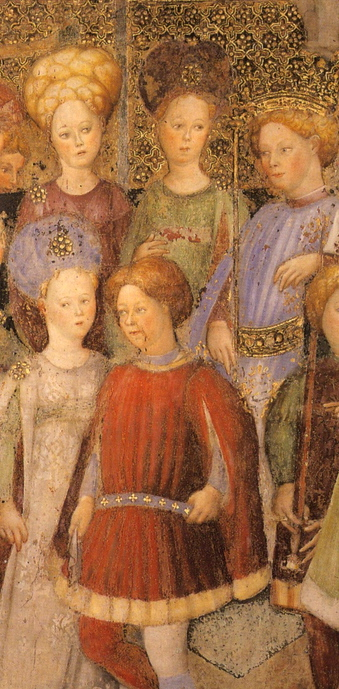
Maike Vogt-Luerssen has identified the woman on the left of this famous fresco from the Borromeo Palace in Milan as Bianca Maria Visconti, mentioning only the elaborate hair design as her reason.

Was the possibly later Cary-Yale Tarot cards, a deck with six court cards per suit and additional triumps, made for the marriage of

  • Filippo Maria Visconti and Marie of Savoy in 1428 (because it contains the Savoy device of a white cross on a red field), or for
  • Galeazzo Maria Sforza with Bona of Savoy in 1468 (because it contains the Sforza device of a fountain)?

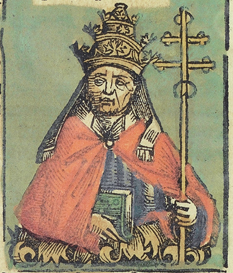
Marie of Savoy was the daughter of Amadeus VIII, Count of Savoy, who was elected as the Antipope Felix V by the Council of Basel-Ferrara-Florence, from November 1439 to April 1449 (the picture of Felix V on the right should be familiar to tarot aficionados):

There is a possibility that the Cary-Yale cards were painted not by Bonifacio Bembo (who was the most likely artist of the Visconti-Sforza deck) but by someone from the workshop of the Zavattari family (and here) who painted the frescos of Teodolinda in the Cathedral at Monza, near Milan.* The Bavarian and Christian Teodolinda married the Lombard king Authari in 589 (who was either an early heretic or a pagan) and when he died a year later, she married the Duke of Turin, Agilulf, who became the King of Italy, making Milan his seat. In the 15th century, the Zavattari family painted the story of Teodolinda, as she had founded a chapel on that spot and established Monza as her home. These frescos bear a striking resemblance both to the Borromeo frescos and to the Cary-Yale Tarot. Note especially the braided hair, slit sleeves, and the young man/page with his hand grasping his belt in both the Monza fresco (first), followed by four cards from the Cary-Yale deck.

Added: Tero Tynynen has done more research on the subject with lots of links and a couple of videos featuring the frescos of Monza and period music, for those who are interested in the possible artists of these earliest decks – here.

* The frescos in the Cathedral of Monza were painted between 1440 and 1446 by Franceschino Zavattari and his sons Gregorio and Giovanni in a style known as the “International (or Late) Gothic.” Another son, Ambrogio, may have been involved. Franceschino’s father, Cristoforo, participated in work on the Milan Cathedral in the early fifteenth century. Slight differences in style are probably due to different painters within the family as well as the difference between large wall frescos and small cards. It should be noted that I am not the first to see these similarities, as they’ve been noted by many commentators, but the information is not generally known among tarot readers.

For a really wild surmise regarding the story of Teodolinda, I can’t help wondering if the story of the Christian bride converting a pagan king named Authari (Arthur?) and being led by a dove to build a cathedral could have been at all related to the King Arthur legend, that became popular in 15th century Lombardy?

Lady luck is shining brightly on an archivist from the canton of Nidwalden [Switzerland]. While restoring the cover of a medieval court record last week, he uncovered 90 playing cards dating from 500 years ago. The chance find is only four cards shy of a complete set. And the discovery is one of only a handful to yield a group of so many cards of this vintage for a game seen as a predecessor to one of Switzerland’s national pastimes. . . . The cards probably date from 16th century Basel.

Read the article at World Radio Switzerland.

Paul Nagy interviews Enrique Enriquez about how and why he reads the tarot the way he does, beginning with some direct examples of how Enrique approaches reading the Marseille tarot. 

Enrique resides in Manhattan and is well known for his appreciation of historic tarot decks. His fresh and disciplined approach to the interpretation of this antique imagery bears only a superficial resemblance to the more synthetic ways tarot is usually read. Because of this distinctive approach to tarot reading, Paul thought an investigative interview designed to explain Enrique’s suppositions would make clear to the tarot reading community what he is does when he reads.

Read the interview at TAROLOYEAST (BETA).

Check out Paul Nagy’s on-going and free teleconference class “The Way to Tarot Wisdom” based on the works of Alejandro Jodorowsky, Marianne Costa and Rachel Pollack.

People regularly write me about where to take a class, so I want to remind everyone of exciting events taking place over the next couple of months. Going to a conference or workshop can be a turning point. As well as gaining new ideas and skills, some have made major life changes as a result of insights from readings and exercises, and many people become life-long friends. Since some people come back year after year, it’s a chance to reconnect and share your journey. More details are available on the EVENTS page.

Start off at the end of July with the Omega Tarot Conference, “Tarot: Fate & Free Will” (see the interviews with presenters on this blog).

Immediately following, at the beginning of August, Rachel Pollack and I will be teaching our annual five-day Workshop at Omega. This year the topic picked by Omega is The Art of Becoming a Great Tarot Reader. As always, this is the workshop for those who want to go deeply into the tarot reading process and push through to the next level. It’s all about opening to your true potential. You get lots of time to ask questions and just hang out. We combine accessing your intuition with learning secrets about the cards themselves.

August ends with the San Francisco Bay Area Tarot Symposium (BATS) at the Golden Gateway Holiday Inn (just around the corner from Fields Bookstore!). This year there will be two days of fabulous talks, great vendors, readings and lots of fun! Ed Buryn is bringing copies of his new edition of the William Blake Tarot of the Creative Imagination and I will be premiering my new book, Who Are You in the Tarot?.

At the end of September, the Association for Tarot Studies is having its TAROT CONVENTION “History & the Esoteric” at a castle in St. Suzanne, France, which is sure to be one of the most exciting tarot events of the year. While greatly saddened by the untimely death of deck creator and co-organizer, Jean-Claude Flornoy, the event will honor his memory and celebrate his tremendous achievements in resurrecting many of the earliest Marseilles-style decks. Many of the participants will be going on to Italy for the Tarot Tour (sorry, all booked up).

If you can’t travel, it’s no real problem. Take a look at the offerings at Global Spiritual Studies who are hosting a whole series of Courses and Webinars on Tarot and related subjects. I highly recommend Evelynne Joffe’s practical approach to the Kabbalah with “Living the Tree of Life” as well as webinars by both me and Rachel Pollack and many others.

Read Jason Pitzi-Waters’ report on “A Summer of Psychics” at The Wild Hunt. He begins with this CNN puff piece on psychic predictions about the economy and then examines why the media does these pieces when it’s obvious that other news commentators are going to sneer at their doing so. What’s interesting to us is that there were two tarot readers interviewed, one using a well-worn 1JJ deck and the other The Voyager Tarot.

You can view it here.

This is an interview with me by Rachel Pollack, as part of our series on the presenters at the Omega Institute Tarot Conference happening July 29-31st. You can read plenty about me right here on my blog, so let’s get on with it.

Rachel: Your work has featured endless ways people can develop their own style and ways of reading.  And yet, you are also steeped in Tarot knowledge and tradition.  How do you integrate these two sides in your teaching?

Mary: I am a life-long learner; I feel history can enhance anyone’s life, and that natural skills can be refined and augmented by study. I don’t fully integrate history and technique in my teaching, although I try to do so in my practice. Carl Jung advised that one should learn everything possible about symbols and then, when working with a dream, to forget it all. It’s a paradox involving an intelligent ‘forgetting’ that allows one to be fully present in the moment with a person’s own material. In actuality, all the learning forms a backdrop, which helps me recognize patterns that may elucidate the whole situation.

When it comes to reading tarot, you don’t need to know tarot history, just basic card interpretations and a few spreads. Some people are intuitive readers and don’t need book meanings to help people via the cards. I really try to honor this potential, so most of my class exercises are designed to develop a person’s natural abilities and insights—to help students discover how much they already know and what their own reading style is. But that’s really only a starting point.

Skill development and history are very useful when faced with crises, blocks and difficult situations. I believe it was George Santayana who said that those who do not know their history are bound to repeat it. We get stuck in old patterns of thinking and behaving, but models and techniques are available that can help us break out of these. Tarot is a kind of story-telling, and history consists of stories from the past. But, a study of history also teaches us how to evaluate these, for all stories are not equally relevant or helpful. In my longer, on-going classes I bring in quite a bit of history. I’m trying to find ways to make history more relevant to a workshop environment, because dry facts can be deadly when students are wanting and needing to experience tarot directly. It’s one of my current challenges.

Rachel: In recent years you have devoted yourself to the history of Tarot and fortune telling.  How does new knowledge of the past affect what we do with Tarot today?

Mary: History is accumulated, collective knowledge. It helps us meet challenges and opportunities that we may not have yet encountered on our own. Here’s a couple of examples.

The history of oracles and cartomancers gives me a sense of belonging to one of humanity’s oldest professions, present in every time and every culture. As an older woman I can see that this is a skill, that while practiced by men and women of all ages, has been a speciality of elder females, for which they have been revered, ignored, sought out, villanized and even killed. Caitlin Matthews expressed it eloquently at the last Readers Studio when she said, “We live on the edge for a reason, so that when people are on edge, they run towards us!” History makes us aware of just what that edge looks like, how others have met the challenges, and conditions under which an ‘edge’ existence becomes honored or dangerous. Knowing this, and seeing how other professions have improved their status, suggests possibilities for elevating this profession for myself and for those who come after.

A second example involves the Rider-Waite-Smith deck, where I have discovered that the Minor Arcana suits illustrate stories chosen by A.E. Waite. For example, Cups tells the story of one of the first Grail myths, and Swords is the foundation myth of the Freemasons. They lend a certain archetypal, psychic power to this deck that has been intuited by many who have copied the artwork, but not previously understood. More importantly, perhaps, is that when we recognize that we are living out elements of a great myth through getting cards in these suits, it gives a greater meaning to the experience and helps us to recognize possible outcomes and make clearer choices.

Rachel: You’ve worked with astrology and Tarot “birth constellations.”  Considering our theme of “Fate and Free Will,” do such structures suggest a more fixed fate than readings where we just shuffle the cards and see what happens?

Mary: There’s an old astrological axiom: “The stars impel, they do not compel.” Impel suggests an urging while compel is about being forced. I sometimes feel that life is like floating down a great river carried by a particular current made up of current events and our own character (or karma). I can go with the flow, enhance it, or fight it. I don’t think that Lifetime Cards tell us who we will become, or that Year Cards tell us what events will happen that year. I find that they have more to do with sensing the existing flow and then discerning the meaning those events can have for us. They reflect qualities that bring a sense of fulfillment—no matter what happens. Were we fated to be born on a certain day? I really don’t know, but I like to think that my Higher Self chose circumstances that would best facilitate my soul’s journey. When I live life as if that were true, then everything seems more vital, exciting and purposeful then when I don’t. Meaningful synchronicities abound, leading to ‘probability enhancement’—one of my favorite definitions of magic. In readings, I like mixing free will with considerations of chance, fate and destiny, which I hope we will do in my conference session.

See interviews with other presenters:

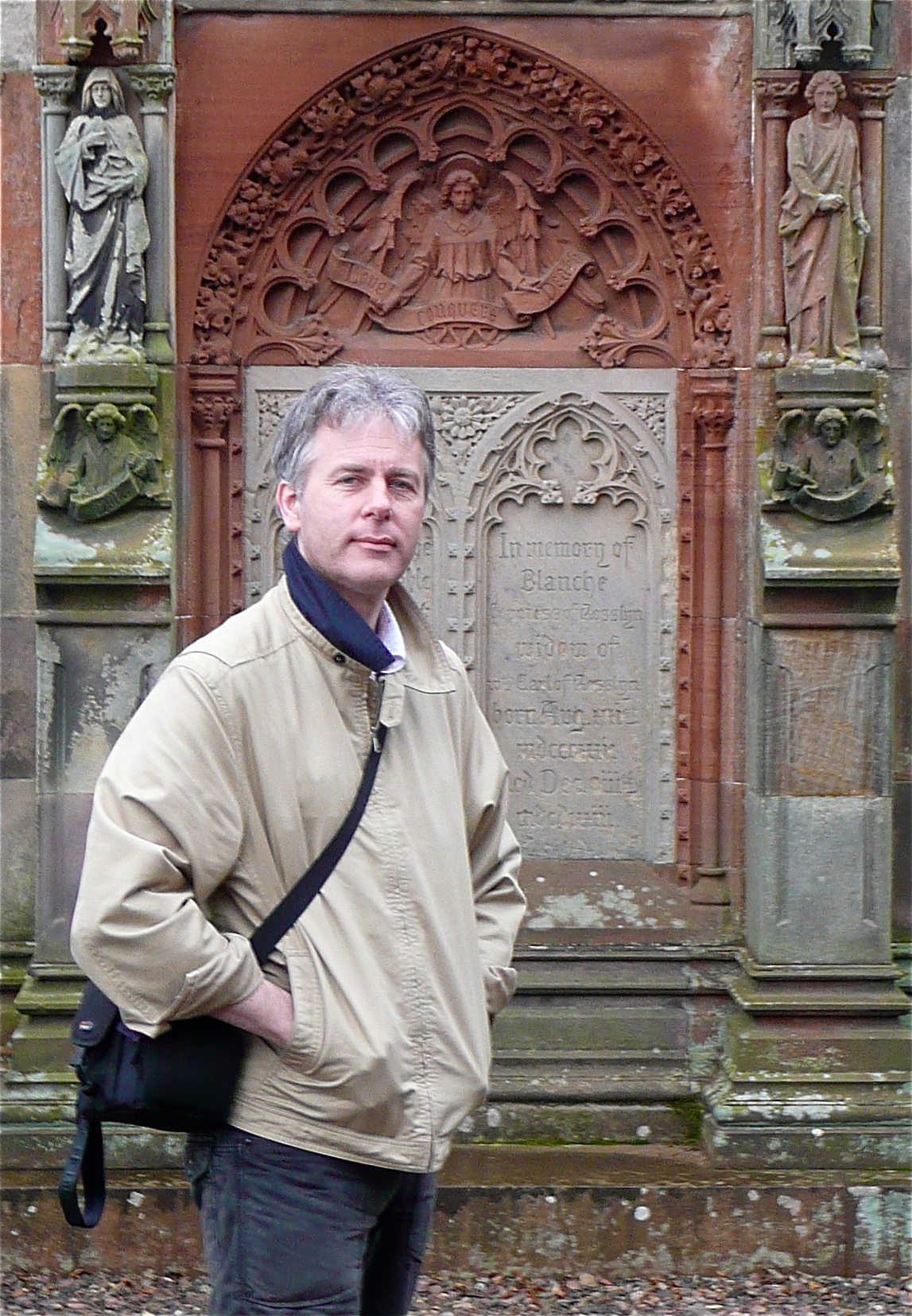
Marcus Katz is one of the fabulous presenters at this year’s Omega Institute Tarot Conference, July 29-31st. He lives in England’s beautiful Lake District, made famous by so many romantic poets like Wordsworth and Coleridge. Truly it is a place to inspire the soul. In addition to founding Tarot Professionals and Tarot Town, Marcus is the author of two books, Tarosophy and Tarot Flip, and a doctoral candidate in Western esotericism at the University of Exeter, where he earned his master’s degree. (Picture: Marcus at Rosslyn Chapel.)

Mary: How did you get into tarot and what motivated you to found the largest tarot organization in the world?

Marcus: When I was very young I asked what seemed to be unusual questions. When I turned 12, I was sure I had missed some important lesson at school, or teaching from my parents, that everyone else other than me seemed to have received. Everyone seemed to know what they were doing and what the world was about. Otherwise how did they know what to do, what was important, and why they should do anything? So when Tarot was taught in one of our rather spectacularly alternative lessons at the experimental school I was lucky enough to have joined at that age, I saw what Tali Goodwin, my co-author, calls a “Blank Bible”. A pictorial system in which I could make sense of the world, uniquely to my own experience. So within a weekend I had created my own deck (22 Majors only, pasted onto cardboard) and learnt enough to do readings for my friends at school. Since that time I estimate I’ve done easily over 10,000 face-to-face readings over 30 years – and am still learning.

I founded Tarot Professionals to bring full-time professionalism and consideration to the craft of Tarot study, reading and teaching. We aim to marry commercial common-sense with spiritual sensibility and now after two years are able to support other Tarot projects, such as Moti Zemelman’s Dancers Tarot and Chris Deleo’s tarot documentary, featuring Enrique Enriquez, as well as consulting on the ShindigTarot.com online video reading system. Our main ambition is to restore the spiritual dignity of Tarot. Our work to support World Tarot Day brought some 2,600+ people to the site on the day itself this year, up from 600 last year. As such we were also able to donate to two important charities, and create a positive vibe for Tarot to a wider audience. The Facebook group has gone up 840% because we invest our money back into advertising such events. For those who want to encounter Tarot in a supportive environment, we offer Tarot Town, currently approaching 6,000 members. All of these offer my own research and unique, often unpublished materials, including a rarely seen Crowley sketch from his original notebooks as one little part of the full 78-lesson course!

Mary: Your main focus seems to be on tarot education and professional support and development. What do you think a tarot reader most needs to learn in order to get the most from the cards for themselves? (Picture: me, Marcus and the Fool’s dog.)

Marcus: My main focus is indeed on education. Our Hekademia Tarot program is two-years long and now has two cohorts, totaling 50 students, on what aims to be the most comprehensive Tarot course in the world. The work that the students is producing is already astonishing us! We have a showcase of the first term’s work on the main site, where students produced “Wonder Cabinets” of Tarot, entire photographic decks and essays on the oracular tradition, all within the first two months of the course! We originally planned to have one cohort of 20 students per year, we are currently looking to fill a third enrolment in September of three such enrolments this first year!

To me, a Tarot reader needs to see the cards as a language. A language which can then express insight to them which could not otherwise be communicated. I see many students on my beginner courses who have “been reading 20 years” and yet don’t seem to have progressed beyond quite linear and mechanic readings, or “intuition”. I hope they leave my beginners course with a new excitement as to *why* they have been learning that language for so long without visiting the country in which that language is spoken, and what it can express and to what it can lead. It is not the learning of French that is useful, it is when you use the language to order a delicious meal in Paris, or get directions to a one-off music event in Geneva – that is what is useful about the language. I believe Tarot is a tool to engage life, not escape it. So every time your Tarot reading takes you to a new encounter, a meeting with a new person, an event you might not otherwise have attended, a place you might not otherwise have gone, this is Tarot teaching.

Mary: You are a trainer in Neurolinguistic Programming (NLP) and other communication and business techniques, what does tarot offer individuals that none of these others does as well?

Marcus: I work with clients using NLP on a weekly basis, ranging from such issues as insomnia, addictions, weight-issues, compulsive disorders, phobias, etc. I also coach clients in performance skills such as presentations, interviews, exams, etc. This is a wide spectrum of work and what strikes me is that many of my clients lose sight of their own unfolding story when afflicted with such issues. Whilst my work with them may help us undo their curse or weave a better spell, it does not fully open out into the mundus imaginalis, the world of wonder beyond that which is presented to us. The tarot enables this world to be accessed in so many different ways.

So I see the Tarot as a reflective tool, one arising and stabilizing in the same perceptual world we find ourselves in—and we find ourselves in Tarot as the blank bible which in turn is the truth of our encounter with what arises. Tarot is the picture of the Soul’s dance inside itself, the divine dance of the Fool. It transcends all material and transient nature in which business, communication and counseling all take place, each to their own world – important in their place, however only part of the full deck of possibilities.

If you look deeply into the Eye painted on the Tower card of the Thoth deck, and turn it on its side, you will see the 0 or black nothingness of the Fool in the centre. The outside of the eye now resembles the vesica piscis of the Universe/World card. And between them, vibrating in perfect harmony between the Nothing and the All, are 22 radiating lines of gold … our Tarot.

See interviews with other presenters:

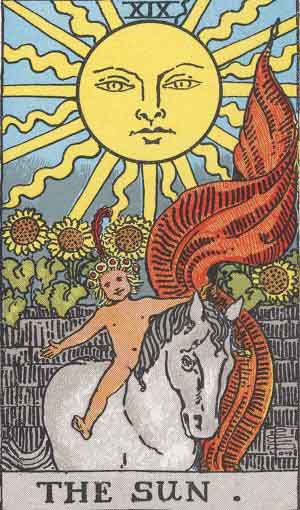
“With the Great Solstice Turning of the Seasons, we honor the spirit of the Tarot and all those, past, present and future, who unselfishly support its gifts of illumination, healing, and inspiration for all.”

Wherever you are, at High Noon (or whenever is convenient) tomorrow—June 21st—we ask you to take a moment to send these thoughts out into the world. See the Tarot and all who love it and all who love them, bathed in the light of the Sun. If you can’t do it on the 21st, then join us on the 22nd.

In Love and Luck and Light, may the Sun’s illumination awaken all to your best expression of Self,

Mary

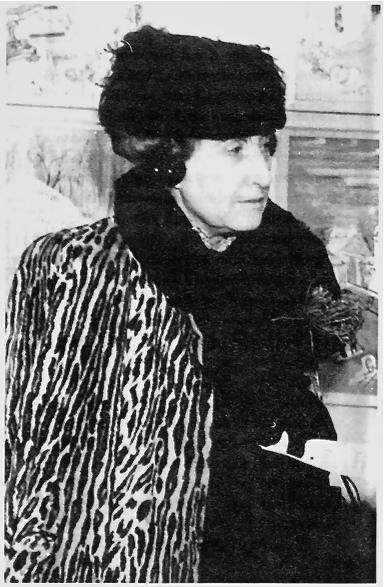
For everyone interested in the Crowley/Harris Thoth deck, there is an important article at Tero Hynynen’s blog Tarotpuu. He reproduces a 1942 lecture by Lady Harris at the Sesame Club in which she speaks in some detail about the artistic choices made in certain cards. The Sesame was one of the few fashionable clubs open to both men and women and had welcomed American poet Edith Sitwell only a few years earlier. According to Harris, Death “has to suggest the idea of reincarnation, as opposed to putrefaction, he is weaving with his scythe a geometrical web of new forms.” She explains that while Water and Cups “typifies compassionate, receptive soothing ideas, its plenty is an over-copious endowment which destroys effort and it leads to a luxuriousness in which creative self-consciousness is lost.” Finally, the Fool is supposed to be the Pierrot of the Commedia dell-Arte.

I mention these only to whet your appetite, for Tero’s post contains much much more, as well as a larger version of this rare portrait of Lady Harris. You can also find a short account of her 1945 lecture at the Tomorrow Club here.

One of the geniuses of the Rider-Waite-Smith deck is the story-telling qualities of the Minor Arcana. Each card can tell a story, but a sometimes overlooked factor is that the suits tell stories as you move from card to card. In classes I encourage students to write a tale based on each suit so that they can get a personalized feel for how one image changes into the next. Pamela Colman Smith was a trained book illustrator and story-teller, so she may have told her own stories, although I believe Waite gave her specific tales to illustrate (see here and here).

Whatever the original stories, this “tarot flow” perspective can be used in your own readings. Rather than looking at the Minor Arcana cards as static scenes, try seeing them as a moment that is only one step in a progression. Something happened just before this moment and it’s about to change into something else. It’s like individual tai chi gestures that should really only be part of a living, flowing, connected movement.

Many modern spreads, rather than focusing on a sequential development, favor single cards interpreted according to an individualized position: What helps you? What blocks you? How does your partner feel about you? I can guarantee that your partner doesn’t have only one feeling regarding you! If you see the cards in terms of a sequence, then you get more of the sense that on the way from one feeling to the next one, your partner, in regards to your question, is only temporarily dominated by the feeling shown by the card.

Let’s say you got the 5 of Pentacles. Your partner may be feeling emotionally cold and thinking that sticking with you, right now, is a hardship to be endured. That can be pretty depressing. But if you consider both the 4 and 6 of Pentacles, then you could consider whether your partner might have made a firm commitment to holding on to the relationship (4 of Pentacles) and is aware of a possible pay-off later (6 of Pentacles). It’s just that right now he or she is feeling hurt or going through a cold spell that might be only temporary. Do you see other possibilities for this sequence?

This kind of approach works very well with one of the reversed card techniques. This optional way to read a reversal says that an upside down card is an energy that is attempting to manifest, but there is still something to deal with in regards to the preceding card. That is, you need to revisit the prior card in the suit before you can fully take on or manifest the present one. In this example, if the 5 of Pentacles was reversed, then you might want to consider what needs to be held on to in times of scarcity, by reminding yourself what you both found so valuable (4 of Pentacles). Consider what your partner has always clung to. Is there some way you can be supportive of or honor that in order to be a true companion in difficult times?

In The Complete Book of Tarot Reversals, I opened most Minor Arcana card interpretations with a possible scenario of how the figures depicted on one card might have arrived there from the preceding one, seeking to link all the cards in a chain of actions and consequences. It’s worth taking a second to consider this perspective when doing a reading.

If you would like, in the Comments, also tell us your “tarot flow” story for the cards pictured below. How does the 8 of Cups card follow from the 7 and lead to the 9 of Cups? If the 8 of Cups is reversed, then how might you be better able to handle it by first revisiting the 7 of Cups?

These cards are from what’s been called the “Edith Waite” deck, that illustrates and accompanies El Tarot Universal de Waite.

About

Click HERE to subscribe to Mary K. Greer's Tarot Blog by Email

≈◊≈◊≈◊≈◊≈

Mary K. Greer has made tarot her life work. Check here for reports of goings-on in the world of tarot and cartomancy, articles on the history and practice of tarot, and materials on other cartomancy decks. Sorry, I no longer write reviews. Contact me HERE.

© Mary K. Greer All material on this site is copyrighted. If you use anything, be sure to include my name and a link back to this site. Thank you.

I truly appreciate donations to help me pay for additional space.

Donate any amount to keep this ad-free blog growing.

Archives