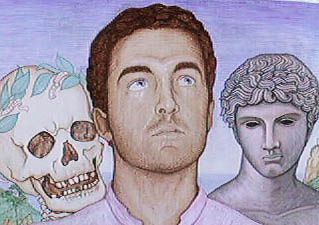
Here are a couple of clips from an independent feature length documentary on tarot by Chris Deleo and Kimmie Naughton that’s currently in process. It was inspired by Enrique Enriquez’s Tarology approach to the cards of the Marseilles deck that you see in this video. They will be filming other approaches to the tarot:

http://vimeo.com/21418482

Please, stop by the filmmakers’ IndieGoGo page to learn how you can contribute to their campaign and help make this film happen.

Here’s the Omega Institute faculty video of me discussing my research on cartomancers. It’s a preview of what I’ll be presenting in my upcoming webinar on the “History of Cartomancers.”

Go to the Events page for information on this summer’s Omega Tarot Conference and the five-day workshop with Rachel Pollack and myself.

http://vimeo.com/19276559

Much is made of how tarot cards can be interpreted through their images or symbols—especially modern decks that feature pictorial scenes with lots of  images on all the cards. This post is about how to combine and translate the language of imagery into statements, such that these statements can be more easily interpreted than the images by themselves.

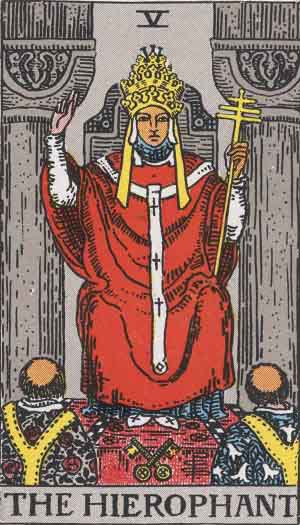
Many of us have spent fruitful hours pouring over symbol dictionaries in order to better understand each detail in the tarot. For instance, we might research and discover that a key, in addition to simply opening or locking a contained space, is seen as the means to unlock hidden meanings in symbols or doctrine. More specifically, in the Hierophant/Pope card, keys have a special meaning regarding the priesthood: the gold key represents mercy and absolution, and the silver key stands for judgment and penance. Furthermore, these keys refer back to the gospel of Matthew (16:19) in which Jesus tells Peter, “I will give you the keys to the kingdom of heaven. Whatever you bind on earth shall be bound in heaven; and whatever you loose on earth shall be loosed in heaven.” Going further, you will discover that Mercy and Judgment (the gold and silver keys) are the two columns on the Kabbalistic Tree of Life.

How many times have you mentioned any of the above references in an actual tarot reading?

Alternatively, a reader might try to discover the querent’s own, in-the-moment, personal associations with this image: “Oh, my gosh. Those are my car keys that I lost yesterday at church!” Or a reader will offer up his or her own projections and intuitions, as in, “As I’m seeing it right now, the keys are saying that your spiritual leader or tradition “holds the keys” to whether you should get a divorce.” These can certainly be rich ways to read the tarot, but they can sometimes get you sidetracked from the essential message of the card. Even the artist’s stated intention for a symbol can be so personal and idiosyncratic that it, too, misses the mark. I’m not saying that the following technique is the “best” method for interpreting images, but rather that it can be helpful and serve as a checkpoint to make sure you’ve touched on its roots.

What I offer here is a method that involves translations of the essential, objective meaning of an image—its denotative and connotative definitions and its core characteristics or functions (how the thing is used).

At the denotative level, a key is a small piece of metal shaped with parts that fit with parts in another mechanism (usually a lock) so that manipulation (turning) changes the latter mechanism’s function—usually to open or close things. The connotative meaning is that it binds or loosens, and a key often suggests gaining access to something. If we abstract it one more level, then it suggests obtaining the answer, solution or means to something crucial or important. Connotative meanings are more subjective and often convey pleasing or displeasing feelings about the word. [Note: I use ‘objective’ and ‘subjective’ here, not as absolutes, but as relative points along a continuum.]

Step 1

To try out this technique, you need to start with the most “objective” meanings and functions—what I often call the “literal” level of a symbol—rather than personal projections or mythic, occult, alchemical, astrological or psychological significances. In other words, try to use as little abstraction, impressionism or subjectivity as possible.

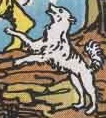
To try another example, the denotative level of the RWS dog in the Fool card is “a domesticated, four-legged, carnivorous mammal with an acute sense of smell.” The functional aspect is that it is tamed by humans to function as a companion, protector or hunter. A further, connotative abstraction includes ideas such as loyalty, instincts or, sometimes, a scoundrel or wretch. (In this process, we won’t consider the mythic associations of dogs with death, like Cerberus at the gates of Hell, nor the Egyptian dog-headed Anubis, nor the association of dogs with the Moon and Artemis, nor the dog of Odysseus, or that in alchemy a dog represents sulfur or primitive, material gold. Nor will we consider that god is dog spelled backwards.) When in doubt, think of a dictionary rather than a book of religion, mythology or literature. In fact, a dictionary is often a good place to start when translating images.

Step 2

Step 2 involves linking together the most essential definitions, functions and connotations of three to five core images from one card into a “literal translation” of these images.

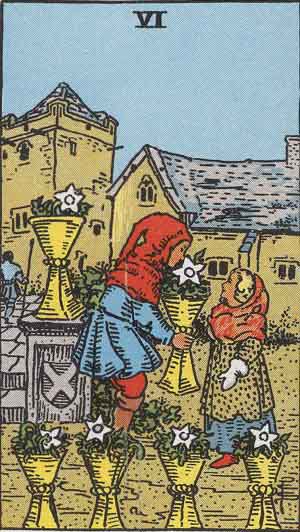
With the RWS Six of Cups as our example, let’s go through Steps 1 and 2. (We should also be aware that traditional meanings for this card often include gifts, pleasurable memories and emotions, nostalgia and old things.) Here are three dominant images from the picture created by Pamela Colman Smith:

Children – more than one pre-pubescent human being. Their key characteristics are small size, immaturity, innocence, vulnerability, playfulness, learning and development, and being a descendant or establishing a lineage.
Flowers – the reproductive organs of a plant, usually with characteristics (scent, shape and color) that attract fertilizing mechanisms.  Flowers are cultivated to function as decorations or gifts. Blooms suggest the flourishing peak of beauty, health and vigor.
Glove/mitten – a garment covering the hand. It protects or safeguards the hand to avoid discomfort, damage, disease or contamination of self, others or environment. It may also serve as a fashion ornament.

First we combine these individual images into a simple statement: “A larger child hands a flower to a smaller child wearing a mitten.”

To translate this, we substitute a key word or phrase for each image:
“A larger, innocent offers a gift of beauty and reproductive vigor to a smaller, innocent whose vulnerability has some safeguards.”

Let’s add two more images to see if this changes anything:

Courtyard – a private space surrounded by walls or buildings. It functions as a place of air, light, privacy, security and tranquility.
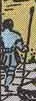
Guard – a person who keeps watch. He functions in a defensive manner to watch or protect what is vulnerable or to control access.

A very literal description might be: “In a private, guarded space, a child offers a gift of flowers to a another child.”

The next level of abstraction looks something like this:
“In a private, secure and guarded place, but with inattentive watchfulness, youthful innocence and vulnerability handle, with some safeguards, a gift of beauty and reproductive vigor.”

Step 3

Relate this translation back to the querent’s question or situation (via the spread position, if applicable). Now you interpret what the translated images in the cards add to the situation. Generating questions based on the translation is a good way to start.

Let’s add a keyword from the basic card meaning so that we have the following translation:
“A memory in which youthful innocence and vulnerability, in a private, secure and guarded place, but with inattentive protection, handle, with some safeguards, a gift of beauty and reproductive vigor.”

The following are example questions that emerged from the image translation:

Can you remember moments of former pleasure in which a mature, adult significance was not apparent at the time but may now be? Perhaps you were attracted to or given something that continues to reproduce emotional (Cups) reverberations in you? Have you been too guarded and naive to fully appreciate a gift given or received?

Alternatively, could a larger or more dominant self/person have offered something to a smaller self/person who covered up (gloved) her response as she wasn’t completely open to the experience?

Are some of your memories guarded? How do you protect yourself from what happened in the past? A worst case scenario suggests some kind of childhood abuse from which memory you’ve tried to protect yourself. There may be an element of seeing a difficult past through rose-colored glasses (and this card has had those difficult meanings on more than one occasion)—although, generally, it is a very good card.

In the Comments to this post you might want to try combining the image definitions into other translations, because even the most literal translations will vary. See where different translations take you. Feel free to explore this technique in your own way on your own blog or with others—just include a link back here.

Comparison with Cartomancy

It’s worth noting that readings with decks such as the Lenormand, Sybilla or Old Gypsy Fortune Telling Cards use a process similar to that above, in which each card represents a single image. The meanings of these cards have even more restricted parameters, but can be creatively combined. For instance, the card depicting a dog means loyalty and friendship. The child card can mean one or more children or anything small, young or innocent. A set of these cards are linked together in a fashion similar to what we’ve already done, although the result tends to be more mundane and may yield a single new image. For instance, Dog + Child can indicate a puppy, playmate, or childhood friend.

I’ve selected four cards from the Mlle. Lenormand deck (from Piatnik publishing) that are most similar to images in the Six of Cups just to see what happens if we use their meanings:

ChildLilyGardenCrossroads

Child: Child or children. Play. Anything small, immature. Naïve, innocent, trusting, sincere. Sometimes, gifts.
Lily: Mature, old, the elderly. Commitment. Peace, satisfaction, contentment. Wisdom, soul development. Social welfare.
Garden: Meetings, gatherings, parties, events, conferences. Social encounters and places for this. An audience. Outdoors.
Crossroads: Options, choices, alternatives. Decisions. Separation. Many of something.

The most simple statement we could make about these cards is: “Many wise children (or immature elders) gather together.” (The order of the cards in an actual reading would affect the interpretation.)

To expand on this idea, we could say:
It is about a social interaction involving young and old, innocent and wise (to play old-fashioned games?), and that a choice may be involved. Peace or wisdom could be gained from childhood choices or from an older sibling. An older person could be reconnecting with past friends or relatives (or grandchildren) or, simply, remembering them.

[Notes: Traditional playing card meanings are usually not part of the standard interpretations for these cards (although it is interesting that three Court Cards appear. Regarding modern interpretations: Garden+Crossroads is a perfect description of social networking, ala facebook and twitter.]

Some Final Thoughts

I use the “Image Translation Technique” as a checkpoint to keep me on track and to compare with other card possibilities including projections and intuitions. Studies of intuition show that intuitions are just as likely to be wrong as right, but you can often get to a right understanding faster and more accurately than through any other known means. What works best is to check your intuitions against ‘rules of thumb,’ or what I call ‘checkpoints.’  The true issue is sometimes precisely what is shown by juxtapositions among traditional meanings, literal translations and the reader’s and querent’s projections and intuitions, revealing the tension or conflict causing the unease at the core of a reading.

I want to reiterate that translations of tarot card images are only one level of working with  images (and some people prefer not to work with the pictorial images at all). But, even card keywords are images, and I believe that keeping in touch with the essential meaning of any image provides an important checkpoint for one’s intuition. I’d love to hear about how you work with these ideas and whether they are helpful to you or not.

Acknowledgements: Yoram Kaufmann’s book, The Way of the Image: The Orientational Approach to the Psyche, clarified and helped me to explain the technique I often use in readings. I’ve adopted a few, but not all, of his terms and methodology, and I’ve tried not to psychologize the above material too much (Kaufmann was writing about a Jungian approach to dreams). The concept of using “rules of thumb” with one’s intuition is discussed in Gerd Gigerenzer’s Gut Feelings: The Intelligence of the Unconscious. Sylvie Steinbach’s The Secrets of the the Lenormand Oracle was helpful in putting together the Lenormand interpretation. See my book 21 Ways to Read a Tarot Card for lots of other interpretation techniques.

From the Nelson Evening Mail (New Zealand) for 4 May 1907, in a column called “Weekly Whispers” we find this rare account of Pamela Colman Smith (thanks to LoRee):

“Miss Pamela Colman Smith, who made such a success in London a year or two ago as a storyteller, is now enchanting America with her quaint art. She recently entertained Mark Twain, and he was so delighted that he laughed like a child the whole time. In the weird dialect of the Jamaican negroes—a sort of cockney English with Spanish colouring, a rhythmic rising inflection at the end of each sentence, and barbaric words and idioms sprinkled through it that must have come directly from the voodoo worshippers of the African jungle—she tells fairy folk-tales of “de long ago before time, when Queen Victoria didn’t yet rule over we.”

“This is her story of “De Six Poach Eggs,” which tickled the author of “The Jumping Frog.”

“‘A man stop at a cookshop fe someting to eat, an’ dey bring him six poach eggs an’ he eat dem, an’ he say him don’t got any money to pay fe dem; but would come back an’ pay when he find him fortune. So after twelve years him stop an’ pay six-pence fe de eggs he had eat twelve years before. But de keeper of de cookshop say it was not enough, dat if de man had not eaten de eggs dey would have grown up to chickens, an’ de chickens would grow up to hens, an’ de hens would lay more eggs, an’ dey would grow to chickens, an’ dat de six eggs would be worth more dan sixty pounds, not six pennies! De man say he would not pay any more dan six-pence. An’ de cookshop-keeper say he mus’! An’ so he take de man to de judge, an’ de judge didn’t know what to say. While he was t’inkin’ a little boy came in de courthouse. An’ him hab a bag under him arm, an de judge say, ‘What you got?’ An’ de boy say, ‘Parch peas, sah.’ ‘What you goin’ to do wid it? An’ de boy say, ‘Plant it, sah.’ An’ de judge say, ‘But parch peas won’t grow.’ An’ de boy say, ‘An’ poach eggs won’t hatch!’ De man didn’t have to pay. De boy got him reward, though, an’ was rich before him go away with Death. Dis story prove that ‘No catchee, no habie.’” Miss Smith was born in London of American parents, and was brought up as a young girl in Kingston, Jamaica.”

See my collection of links to material by and about PCS – here.

I’m thrilled to announce that I’ll be teaching live “webinars” through Linda Marson’s Global Spiritual Studies program, beginning with a 2-part seminar on “Cartomancers in Western Art.” It features a power point presentation of the documentary evidence of 500 years of card fortune-telling—the best of my more than 300 picture collection on the subject. The talk will expand on the images with an analysis of  characteristics and themes and with accounts of the lives of professional readers. Our profession has a long history that has been hidden from view for too long. Participants can ask questions and make comments via text and possibly audio, and I can respond live in the seminar, so interaction is encouraged. This webinar format is designed to emphasize visual presentations, which is perfect for this particular talk. I look forward to learning what you see in these amazing images. This is an updated version of what has become one of my most popular presentations at conferences. I talk a little about my cartomancer’s research project in a video interview here.

  • Part one: Thursday, 31 March, 6pm-6.50pm, USA Pacific time

  • Part two: Thursday, 7 April, 6pm-6.50pm, USA Pacific time.

Other timezones:

  • USA East Coast: 9pm-9.50pm
  • Sydney Australia: 1pm-1.50pm, Friday 1 April  and 12 noon-12.50pm Friday 8 April
  • Perth Australia: 10am-10.50am, Friday 1 and 8 April
  • UK: 2am-2.50am, Friday 1 and 8 April.

Sign-up information is available here. Other tarot webinars are listed here.

Little is known about cartomancers before the 20th century: who were they, who were their clients, where did they practice, what decks were used? Written information is scarce beyond basic instruction books and accounts of Mlle. Lenormand, who was famous for doing predictive card readings for Napoleon and Josephine in the 17th century.

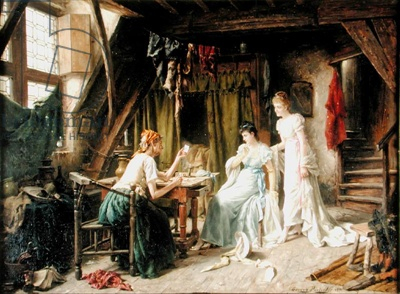
An historical record does exist in genre art that depicts ordinary people going about their everyday work and recreations. In this slide presentation and talk, Mary analyses the visual content of paintings, prints and postcards showing cartomancers from the 16th through early 20th century. She brings to light both the professional and recreational characteristics of those people who practised cartomancy and reveals their largely unseen and under-acknowledged role in everyday Western society.

It’s an empowering experience for card readers to see themselves as part of a long-lived profession that ultimately goes back to the oracles and diviners of ancient times.

Click here for a video clip which shows just a few of the many images I will be presenting and discussing.

All you need to participate in live webinars is a broadband connection. Only 23 places are available in the room, so sign up now to participate in the live sessions where you have the opportunity to ask questions or make comments through the room’s text chat function. Depending on the number of participants, audio interaction may be possible. If so, this requires you to have a headset and mic plugged in before you login into the room.

After exploring five hundred years of the moralization of playing cards in Part 1 and Part 2, we finally get to playing cards and, eventually, tarot, as a book of wisdom. I included this section under the theme of “moralization” because it shows a development of this theme into social-spiritual-political reform and a shift from an orthodox Christianity to a Humanism that arose in the Renaissance and Enlightenment. We see here that playing cards (and/or tarot) have been viewed, on occasion, as a book of the wise, teaching a timeless philosophy leading to the betterment of humankind. I’d like to preface this section with a reminder of the origins of the occult tarot.

Radical Social Reform and the Hieroglyphs of the Wise
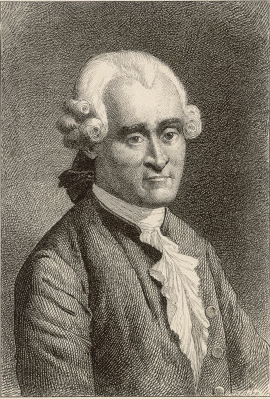
In 1781 Antoine Court de Gébelin (actually Antoine Court, from Gébelin), son of a famous Huguenot pastor, published an essay in his encyclopedic work, Le Monde Primitif, in which he declared the tarot came from Egypt and was related to the Hebrew letters. The text of Court’s essay and an accompanying one by Le Comte de M[ellet] has elements that suggest that these ideas about tarot did not originate with them, but were possibly based on materials available in French Masonic lodges (to which Etteilla also belonged). The early-19th century magician Eliphas Lévi hints at this:

“The true initiates, contemporaries of Etteilla, the Rosicrucians, for example, and the Martinists, who were in possession of the real Tarot . . . were far from protesting against the errors of Etteilla, and left him to re-veil, not reveal, the arcanum of the veritable claviculae of Solomon.” (Lévi, Mysteries of Magic, p. 270)

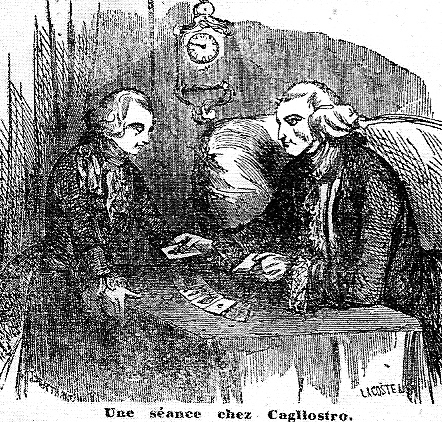
The fact that Egypt is given as the source of the tarot was not unexpected, because Court’s encyclopedia was an allegorical examination of ancient mythologies (which he believed began in agriculture). This led to a search for the origin of language and the remnants of original hieroglyphs that he saw as containing the symbolic and mystical knowledge of the wise. He attempted to catalog the universal mother tongue and grammar by deciphering all traces of the primal language still extant in the modern world. The tarot was, to his mind, one of these hieroglyphic languages. A powerful advocate of radical social reform, including freedom of religion and of independence in America, Court believed that reconstructing this proto-language would bring about social-regeneration through “a single grammar of physics and morality,” allowing “modern men nothing less than a chance to uncover the timeless, natural laws governing human happiness, and thereby to restore peace and prosperity on earth” (see Rosenfeld). In addition to the Masonic lodge of Les Neuf Sœurs (“Nine Sisters”), which he co-founded, Court was a prominent member of the Order of Philalethes (founded 1773), who, as scholarly ‘Searchers of Truth,’ were on a mission to track down everything that could be found on the occult sciences in Freemasonry. Another member was Cagliostro, famous for his institution of an Egyptian Rite in French Freemasonry. I’ve not found any written reference to Cagliostro and tarot, but he gained his reputation, in part, as a successful fortune-teller and was depicted in the following illustration as a cartomancer. Antoine Court de Gébelin was not the first to envision such a socio-political regeneration in which the tarot cards would play at least an oblique part.
The Italian Connection & The New-Found Politicke

In 1612, an Italian who reported on (and satirized) the political, moral and literary issues of the day and advocated religious tolerance, Trajano Boccalini (1556 –1613) published in Milan,  I Raggvagli di Parnasso (“Advertisements from Parnassus;” also De Ragguagli di Parnaso, see article by Andrea Vitali, in which he asserts that the game played was probably with ordinary playing cards, not tarot). Parnassus was the mountain of poets, an equivalent to the Olympus of the gods. First printed in Milan, the work was frequently translated and republished—first in England by John Florio and others who called it The New-Found Politicke (1626). It contained a chapter on cards, possibly tarot, although Vitali (above) identifies them as regular playing cards.

John Florio was born in England to an Italian father who had fled the persecution of the Waldenses in Florence. Florio was raised in both cultures, translating Italian ideas for English usage. Shakespeare’s reference to the card game of Triumph in Antony and Cleopatra is believed to have been inspired by Florio’s Second Frutes of 1591, whose Italian proverbs and figures of speech had a great influence on the literature of the period (or Shakespeare may even have been Florio, according to Jorge Louis Borges).

“Wrap Excellencie up never so much,
In Hierogliphicques, Ciphers, Caracters,
And let her speake never so strange a speech,
Her Genius yet findes apt discipherers.”

It was in Florio’s Italian-English dictionary of 1598 that the English learned that Tarocchi are “a kind of playing cards used in Italy, called terrestrial triumphs” and that taroccare means “to play at Tarocchi”; also “to play the froward gull or peevish ninnie” (that is, “to play the contrary fool or whining simpleton”). Frances Yates theorized in her book John Florio: the Life of an Italian in Shakespeare’s England (1934) that Florio acted as intermediary between Shakespeare and Giordano Bruno with his neoplatonic hermeticism. Florio worked under the patronage of the Earl of Southampton who was also Shakespeare’s patron and was under the patronage of both Archbishop Cranmer and Sir William Cecil—in whose house he lived for some time. These were both close friends of Hugh Latimer (see Part 1)—small world!

Getting back to Boccalini’s I Raggvagli di Parnasso (from the translation by Henry Cary, 1669): We find in the “2nd Advertisement” a short text from the start of a large work that might be thought to contain material that will inform the whole. It follows the same initial plot as the “Soldier’s Prayerbook” (see Part II) in which a young rapscallion is discovered with cards, taken before an authority to explain himself, at which time the deep mysteries of the cards are revealed, although in this case, it is the authority, Apollo, who discerns them. He explains that the game of Trumps (see Part 1) teaches hidden secrets and ‘a science necessary for all men to learn,’ a ‘true Court-Philosophy’ in that even the most worthless trump takes all the ‘beautiful figures.’ Later we will see that, to the masses, even the least-of-trifles trumps all the great wisdom of the sages. It is a satiric commentary that masks a deeper philosophy, just as to more modern tarot commentators, the triviality of tarot as a gambling game was believed to hide its higher truths.

The usual Guard of Parnassus having taken a Poetaster*, who had been banished [from] Parnassus, upon pain of death, found a paire of cards in his pocket; which when Apollo saw, he gave order that he should read the Game of Trump in the publick Schools [my italics].
*Poetaster, like rhymester or versifier, is a contemptuous name often applied to bad or inferior poets. Specifically, poetaster has implications of unwarranted pretentions to artistic value.

[The text concludes with:] Apollo asked this man, what game he used to play most at? Who answering, Trump, Apollo commanded him to play at it; which when he had done, Apollo penetrating into the deep mysteries thereof, cryed out, that the Game of Trump, was the true Court-Philosophy; a science necessary for all men to learn, who would not live blockishly. And appearing much displeased at the affront done this man, he first honoured him with the name of Vertuoso; and then causing him to be set at liberty, he commanded the Beadles, that the next morning a particular College should be opened, where with the salary of 500 crowns a year, for the general good, this rare man might read the most excellent Game of Trump; and commanded upon great penalty, that the Platonicks, Peripateticks, and all other the Moral Philosophers, and Vertuosi of Parnassus, should learn so requisite a science; and that they might not forget it, he ordered them to study that game one hour every day; and thought the more learned sort thought it very strange that is should be possible to gather anything that was advantagous for the life of man, from a base game, used only in ale-houses; yet knowing that his Majesty did never command anything which made not for the bettering of his Vertuosi, they so willingly obeyed him, as that school was much frequented. But when the Learned found out the deep mysteries, the hidden secrets, and the admirable cunning of the excellent Game of Trump, they extolled his Majestie’s judgement, even to the eighth heaven, celebrating and magnifying everywhere, that neither Philosophy, nor Poetry, nor Astrologie, nor any of the other most esteemed sciences, but only the miraculous Game of Trump, did teach (and more particularly, such as had business in Court) the most important secret, that even the least Trump, did take all the best Coat-Cards” [“che ogni cartaccia di Trionfo piglia tutte le più belle figure”].

The Rosicrucians and a Universal Reformation of the World
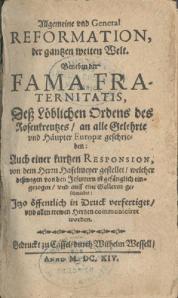
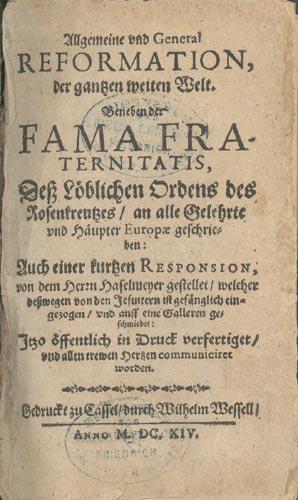
Meanwhile, in Kassel, Germany a revolutionary paper with far-reaching consequences was being written by a young Johann Valentin Andreae and friends who were part of a utopian brotherhood. The supposedly anonymous Fama Fraternitatis or Rosicrucian Manifesto was published in 1614 and had an impact that no one could have imagined. It tells the story of Christian Rosenkreutz who traveled to the Middle East where he met sages and mystics, learning from them esoteric wisdom and knowledge before returning to Europe where he founded the secret Brotherhood of the Rose Cross (the Rosicrucians). This secret order consists of men, dedicated to the well-being of humankind, who travel the world healing and teaching. It gives an account of their discovery of the hidden tomb of Rosenkreutz, whose body lies, in centre of the vault, perfectly preserved after the passing of over a century.

The Fama first appeared with a preface: “Advertisement 77” of Boccalini’s just published I Raggvagli di Parnasso that called for a “Universal Reformation of the World.” Although it doesn’t mention cards directly, we saw that an earlier chapter did. Its purpose regarding the Fama has been much debated because the follies of these reformers of the world are openly ridiculed. “Advertisement 77” depicts a fraternity of the world’s wisest men who debate many ideas about how to resolve the world’s conflicts. Despite their belief in the high principles of love and caritas, they conclude that the masses will always prefer relief of their immediate problems over the true reform of society. And so they lower the prices of essential foods—to great rejoicing—rather than enacting the lofty reforms they had just discussed. Boccalini despairs, not believing that intellectual enlightenment will prevail. As A. E. Waite describes it:

“They fixt the prices of sprats, cabbages, and pumpkins . . . for the rabble are satisfied with trifles, while men of judgment know that—as long as there be men there will be vices—that men live on earth not indeed well, but as little ill as they may, and that the height of human wisdom lies in the discretion to be content with leaving the world as they found it.” (Waite, The Real History of the Rosicrucians, 1887.)

One modern Freemason believes that Boccalini’s satire was making it “clear that the first step for the reformation of the world must necessarily be the reformation of the spirit.” Frances Yates suggests that the inclusion of Boccalini may, in part, have been an oblique reference to Giordano Bruno and certain “secret mystical, philosophical, and anti-Hapsburg currents of Italian origin.” She explains,

“Giordano Bruno as he wandered through Europe had preached an approaching general reformation of the world, based on return to the ‘Egyptian’ religion taught in the Hermetic treatises, a religion which was to transcend religious differences through love and magic, which was to be based on a new vision of nature achieved through Hermetic contemplative exercises.” [Yates, The Rosicrucian Enlightenment, p. 136.]

Others claim there is an alchemical interpretation for the text. Manly Palmer Hall attributes Boccalini’s chapter to Lord Verulam, Francis Bacon, known as ‘the Chancellor of Parnassus’ (his wife was a huge Bacon fan).

The Wise Men of Fez

Now, Paul Foster Case (who created the BOTA tarot) was well aware of the first edition of the Fama Fraternitatis, having written his own book on the Rosicrucian Manifesto. I also believe he was familiar with the whole Ragguagli as he seems to have blended Advertisements 2 and 77 into his tale of the origin of the tarot. According to Rosicrucian legend, Christian Rosenkreutz studied in Egypt and at length arrived in Fez, the holy city of Morocco that was, during the Middle Ages, one of the most famous centers of the alchemical arts. In The True and Invisible Rosicrucian Order, Case sets his own mythical origin of the tarot in Fez and places the wisdom of all the gathered sages into a deck of cards, whose pictures speak a thousand words, equally in all languages. He clearly wants his readers to believe that the tarot was one of the “many books and pictures sent forth” by the Rosicrucian Fraternity that could speak in many languages of their treasures: the secrets of spiritual alchemy that could bring about “general reformation both of divine and human things.” And, as Waite commented above, “as long as there be men there will be vices,” so that wisdom imparted through a tool of gambling would never be lost.

The Rosicrucians Come to France

Let us return now to France, where some believe that (in contrast to other European nations) Rosicrucianism failed to take hold. But, several scholars have noted that in 1623 a mysterious placard was affixed to the walls of Paris:

“We, the deputies of our chief college of the Brethren of the Rosy Cross, now sojourning, visible and invisible, in this town, do teach, in the name of the Most High, towards whom the hearts of the Sages turn, every science, without either books, symbols, or signs, and we speak the language of the country in which we tarry, that we may extricate our fellow-men from error and destruction.”

On the 23rd June 1623, “A general assembly of Rosicrucians was reported to have been held in Lyons” (G. Naudé, Instruction à la France sur la verité de l’histoire des Freres de la Roze-Croix, 1623, p. 31). A Rosicrucian lodge of Aureae Crucis Fraternitatis was founded in 1624. (Jean-Pascal Ruggiu, Rosicrucian Alchemy and the Hermetic Order of the Golden Dawn). By the late l8th century, the Order of Philalethes and some other Masonic lodges had instituted Rosicrucian grades.

Pure Speculation

There are few factual historical connections among all this material. Yet there seems to be a functional connection in which the deck of cards serves as a hidden reminder, manifesting through time in a variety of forms, of moral truths and spiritual teachings. Could explorations of the sources of the Rosicrucian Manifesto by the Order of Philalethes have turned up Boccalini’s entire Raggvagli with its chapter on the Trumps? Might the Italian Cagliostro have included tarot when he was teaching his Egyptian Rite to French Masons? Hopefully, this new information should excite speculation, perhaps bring to light some overlooked facts, and encourage us to explore questions about the role of cards as carriers of ideas in human culture and philosophy.

Le Grandprêtre Tarot

Were these cards created to illustrate the text of Antoine Court de Gébelin or did they inspire his text?

The cards in this deck, from the John Omwake Playing Card Collection, have many of the same titles that appear in Le Monde Primitif. They were attributed by Catherine Hargrave in A History of Playing Cards (1930) to early 18th century France. Stuart Kaplan in his Encyclopedia of Tarot, V.1 dates them 1720, but in V.2 he changes that to late 18th century, post-Le Monde Primitif (p. 336-7). Other than this deck, the first use of the terms High Priest and High Priestess (Grandprêtre and Grandprêtresse) instead of the Pope and Popess are in LMP.

The cards are 1-7/8″x3-3/8″ and were, according to Hargrave, made from copper plates and then hand-colored, so they must have had some distribution. There is no separate Fool card, but he appears in place of the Devil on card XV.

If influenced by Antoine Court why aren’t his card descriptions followed more closely? Could the originally estimated date possibly be correct?

We have tarot author and deck creator Corinne Kenner to thank for the first book edition of an illustrated story by Pamela Corinne Colman Smith called Susan and the Mermaid. It appeared in the Christmas 1912 edition of a U.S. fashion magazine, The Delineator, published by Butterick Publishing company (of sewing pattern fame) and has been redesigned as a children’s book. Corrine describes it as “the rediscovered tale of a magic ring, an underwater kingdom, and a wise old woman who knew how to make her granddaughter’s dreams come true.” It also contains one of the most lovely biographies of Smith that I’ve  read. If you are a PCS fan, this small book is a “must have.” There’s more information at Shuffle: Corrine Kenner’s Tarot Blog. Order your copy here.

Here’s Corinne’s video preview. Enjoy.

I stumbled onto this rather strange video presentation of Brian William’s Renaissance Tarot Deck. I have no idea where it came from although it mentions, at the beginning, “tarocon,” which was the name of Brian’s website:

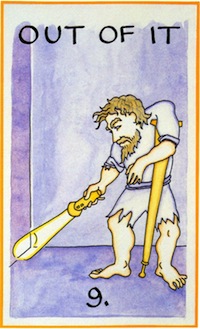
Brian died almost nine years ago. He was the creator of four tarot deck & book sets: the Renaissance, POMO, Minchiate and Ship of Fools, plus the Angel Journey cards and the book to Michael Goepferd’s Light and Shadow Tarot. I had also taken a tarot journey with him to Italy in 2000, and he’ll be coming along with us (in spirit) on the upcoming Italian Tarot Tour this September. During Brian’s memorial service I pulled a card from his POMO deck, seeking a message directly from him. He responded with The Hermit: 9-Out of It. Description: “The bearded old guy on card 9, ‘Out of It,’ points a flashlight into an empty corner,” thus confirming, to me, that Brian had moved on. On page 22 (an auspicious number) Brian had written about the card:

“Our character is Out of It, like all these venerable incarnations, but also out of the game, out of the loop. . . . There are consequences of absenting oneself from the world, from the scene, from the rat race: delightful consequences and otherwise. There is peace and quiet, inner calm, perspective, detachment.”

It was clear that Brian was letting us know that, although he was “out of the game,” he was more than okay.

Afterwards, over pizza and wine, about a dozen of us taroteers inaugurated our first Patron Saint of Tarot – Santo Briano (there is no such name as Brian in Italian – so that’s the name they made up for him in Italy). We also came up with the following prayer that contains many oblique references to his holy symbols and sacred acts. Eros and Thanatos (see below, also known as “the cabana boys”) were his imaginary sidekicks who kept him in as much trouble as possible.

Santo Briano, full of Grace,
To bring a blush to the Oracle’s face,
Tie us up in leather and lace.

Lying in the lap of Eros,
Surrendering to Thanatos,
You whom the angels hold close,

Guide us in wearing wisdom’s glove,
Look down on us from above,
Lead us to the door of love,

Living in a house of trees,
Tempting Mephistopholes,
Possessor of the handsome knees,

Delight in beauty, joy in pain,
Pour your blessings down like rain,
Santo Briano, tie me up again.

[And bless my oracular ejaculations.]


A short animation by Trepaned Productions in Flash featuring music from the Portland band Polly High. Just another example of what can be done.

This video by “Nisamohi” uses images from the Rider Waite Tarot deck, animated and brought to life using Adobe Aftereffects, to part of the song “Break the Spell” by Ellis.

About

Click HERE to subscribe to Mary K. Greer's Tarot Blog by Email

≈◊≈◊≈◊≈◊≈

Mary K. Greer has made tarot her life work. Check here for reports of goings-on in the world of tarot and cartomancy, articles on the history and practice of tarot, and materials on other cartomancy decks. Sorry, I no longer write reviews. Contact me HERE.

© Mary K. Greer All material on this site is copyrighted. If you use anything, be sure to include my name and a link back to this site. Thank you.

I truly appreciate donations to help me pay for additional space.

Donate any amount to keep this ad-free blog growing.

Archives