This video by “Nisamohi” uses images from the Rider Waite Tarot deck, animated and brought to life using Adobe Aftereffects, to part of the song “Break the Spell” by Ellis.
The Servant’s Almanac, Soldier’s Deck of Cards, or Cards Spiritualized
In Part 1, I gave examples from 1377, 1525 and 1529 of how playing cards were used for moral allegories. Sometime in the late 17th to early 18th century this trend gave birth to a popular storyline that has continued, little changed to this day. The story goes that, in order to justify carrying a pack of cards, a soldier (or a servant) explains that the deck reminds him of the calendar and of God. Some variation on this story quickly appeared throughout Europe and has continued to metamorphize in interesting ways. That the character usually mentioned is either a Richard Middleton or Richard Lee of Glasgow, suggests its origin was probably the British Isles.
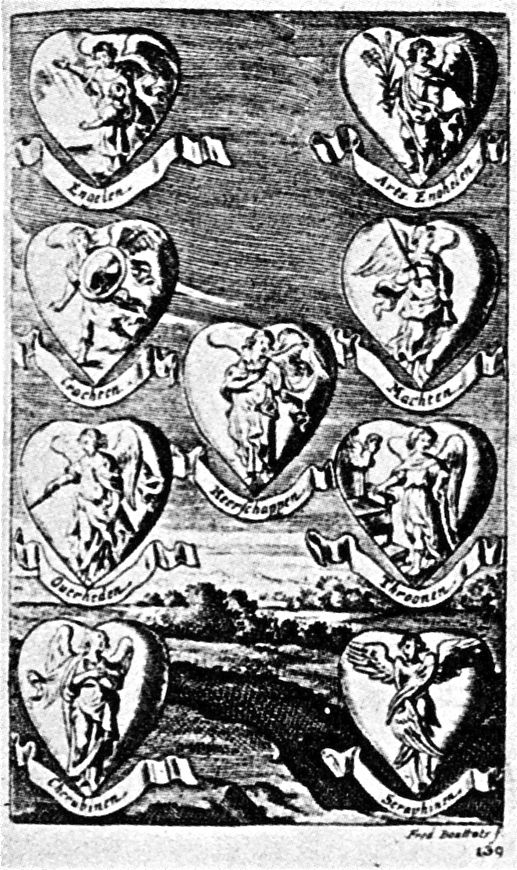 The oldest example of each number card being spiritualized is found in 1666 in Belgium, in a book illustrated by cards, called Het Geestelijck Kaertspel, “The Spiritual Card Game with Hearts Trumps, or the Game of Love,” by Joseph a Sancta Barbara in which each of the Hearts cards is equated with a Christian subject. The King references God the Father, the Queen is the Virgin Mary, the Knave shows the rich and mighty [made humble?] before the Crucified Christ, the ten shows the ten commandments. Then there are the nine choirs of angels [see at right], eight Christian virtues; seven works of mercy; six goals in life; five wounds of Christ; four last ends, the three members of the Holy Family; the worship of God the Father and Mary the Mother; and the one Truth that must reside in a Christian heart. (Hargraves, A History of Playing Cards, p. 161.)
If this sounds a little like “The Twelve Days of Christmas” you aren’t far off, since a similar catechism-type song, with religious imagery called “The Twelve Days” or “A New Dial” appeared in 1625.
The next example, known as “The Servant’s Almanac” is found in Brett’s Miscellany by Peter Brett, 1748, which I’ll quote in full as it contains the main elements found in the later versions:
A Certain Gentleman having two Servants, one Servant complained to his Master of his fellow-servant, that he was a great Player of Cards, which the Master would not allow in his family; he called for the Servant complained of, and tax’d him.
He knew not what Cards meant.
At which the Master was angry with the Complainer, and called him to hear what he could farther say; Who desired, he might be immediately searched, so he believed, he at that Time had a Pack in his Pocket. And accordingly he was searched and a Pack found in his Pocket; which he would not own to be Cards, but said: That it was his Almanack.
His Master asked him, How he made it appear to be his Almanack? His Answer was,
“There are in these Things you call Cards, as many Sorts as there are Quarters in the Year; that is four, Spades, Clubs, Hearts and Diamonds: There are as many Court Cards as there are Months in the Year, and as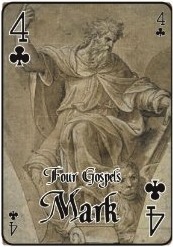 many Cards as there are weeks in the Year; and there are as many Pips as there are Days in the Year.”
At which his Master wondered; asking him, Did he make no other Use of them ? He answered thus :
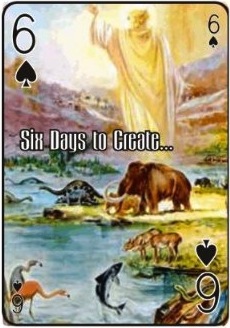
“When I see the King, it puts me in Mind of the Loyalty I owe to my Sovereign Lord the King; when I see the Queen, it puts me in mind of the same; when I see the Ten, it puts me in mind of the Ten Commandments; the Nine, of the Nine Muses; the Eight, of the Eight Beatitudes; the Seven, of the Seven liberal Sciences; the Six, of the Six Days we mould labour in; the Five, of the Five Senses; the Four, of the Four Evangelists; the Tray, of the Trinity; the Deuce, of the Two Sacraments; and the Ace, that we ought to worship but one God.”
Says the Master, “this is an excellent Use you make of them; but why did you not make mention of the Knave?”
“Sir, I thought I had no occasion to mention him, because he is here present,” clapping his Hand on his fellow-Servant’s shoulder.
By 1762, the version known as The Soldier’s Prayerbook is recorded in an account/common-place book belonging to Mary Bacon, a farmer’s wife. (Mary Bacon’s World. A farmer’s wife in eighteenth-century Hampshire, published by Threshhold Press (2010).) This seems to be the first mention of what became the best-known version.
 The most famous example is from 1776 in London Magazine: or, Gentleman’s monthly intelligencer (Vol. 45), which tells the story of Richard Middleton. It begins:
“One Richard Middleton, a soldier, attending divine service with the rest of the regiment in a church in Glasgow, instead of pulling out a bible, like his brother soldiers, to find the parson’s text, spread a pack of cards before him . . .” [He is taken before the Mayor and asked,] “What excuse have you to offer for this strange, scandalous behaviour?” (Follow the link above for the full story.)
Histoire du Jeu de Cartes du Grenadier Richard appeared in France in 1811, but is most often found bound with an even more interesting Explication morale du jeu de cartes from 1776 (see comments for more information & thanks for the correction, Ross). Marie-Anne-Adélaïde Lenormand published it as Almanach du bonhomme Richard in 1809, and later, in 1857, the Chevalier de Châtelain included it in his translation, Fables de [John] Gay & Beautés de la Poésie Anglaise. The English poet and playwright, John Gay (1685-1732), best known for the play, “The Beggar’s Opera,” did not include it in his two volumes of Fables (although a couple of his fables feature card-players), but it could be a lost work, printed originally in broadside.
By 1926 the story had metamorphized (considerably and without the moralizing) into a magician’s card trick called The Adventures of Diamond Jack, as advertised by Herman L. Weber (Namreh) in The Sphinx. It and The Perpetual Almanac or Gentleman Soldier’s Prayer Book appear near each other in Jean Hugard’s Encyclopedia of Card Tricks (1937), showing that they are considered to be of a similar type. Another irreverent version, called Sam the Bellhop has become popular through performances by Bill Malone and James Galea, as seen in the following youtube videos.
The next (and truer) metamorphosis was as a country song, “The Deck of Cards,” first made famous by T. Texas Tyler in 1948, written about the WWII North African Campaign in the little town called Casino. It’s been recorded by at least a dozen musicians including Phil Harris, Tex Ritter, Wink Martindale (on Ed Sullivan), Max Bygraves, Hank Williams, Prince Far I, John McNicholl, and many others that can be found on youtube, including the parody, “A Hillbilly’s Deck of Cards” by Simon Crum.
This song was updated with a twist for the Korean war as “The Red Deck of Cards” by Red River Dave McEnery in 1953 (which I first heard from labor organizer and folklorist U. Utah Phillips).
“It was during the last days of the prisoner exchange in Korea, I was there as they came through Freedom Gate. Shattered, sick and lame. There in a red cross tent as the weary group rested, a soldier broke out a deck of cards. A look of hate crossed the tired face of one boy as he sprang up—knocking the cards to the ground. As the cards lay around, many of them face up, he picked up the Ace and began.
“Fellows,” he said, “I’m sorry, but I hate cards. The commies tried to use them to teach us their false doctrine. They told us the “ACE”, meant that there’s one God, the state. We knew that to be untrue for we were religious boys.” “And the “DEUCE” meant there were two great leaders. Only two. Lenin and Stalin. And we couldn’t swallow that either . . . ”
There is, of course, a Vietnam version (by Red Sovine), the Gulf war (by Bill Anderson), the 2nd Iraq war (1-with photos & 2-Al Traynor), and an e-mail variation currently circulates featuring a soldier serving in Afghanistan:
“A young soldier was in his bunkhouse all alone one Sunday morning over in Afghanistan. It was quiet that day, the guns and the mortars, and land mines for some reason hadn’t made a noise. The young soldier knew it was Sunday, the holiest day of the week. As he was sitting there, he got out an old deck of cards and laid them out across his bunk . . .”
“What does this all have to do with tarot?” you may ask.
All the above variations center on storytelling (or “destiny narration” as Cynthia Giles called it) and advice giving, plus number symbolism. Number symbolism is one of the key techniques used in interpreting the cards, and tarot authors, in writing about the meaning of numbers, often point to the same religious motifs as sources of ideas used to interpret the cards. Like the illustrated “prayer cards” above—whether simply evoked in the mind or made into a deck—they suggest a book of signs that are meant to guide us in making the best decisions. They also serve as memonic aids (for instance, the song goes, “The ten reminds me of . . . “), and the tarot was originally thought to have served as part of the Ars Memoria. And, of course, the magicians doing magic tricks perfectly emulate the patter of the Bagatto, Montebank or Magician of the Major Arcana.
The sample cards above come from a deck illustrated to match The Soldier’s Prayerbook, and are available here.
[I’ve been wondering if this story might first be found in a book I haven’t been able to access from 1613: The Carde and Compasse of Life Containing Many Passages, Fit for These Times. and Directing All Men in a True, Christian, Godly and Ciuill Course, to Arrive at the Blessed and Glorious Harbour of Heaven, a manual of advice to the prince. By Richard Middleton. It’s a long shot, but if anyone has access to the libraries holding it, I’d love them to check it out.]
Check out Part 1 on the early moral allegories, and read Steve Winick’s discoveries that he has so generously contributed to the comments on this post.
Continue on to Part 3 on Social Reformation.
Melissa Weiss Steele’s Oracle of Initiation is a 66 card oracle deck, which, as Steele says, “speaks directly to the instinctual and archetypal impulses within the psyche.” Following the sudden death of her husband and a descent into despair, Steele began a journey of initiation and renewal by exploring alone the ancient desert landscape around Santa Fe, New Mexico. Merging with the land, she stripped off the trappings of civilization, painted herself with mud and took thousands of photographic self-portraits holding her camera at arm’s length, which she calls The Painted Body series. Slowly, she discovered the camera’s ability to capture movement and light emanations that echoed her own experience of the spirits and Ancestors of these places. None of these photographs have been altered or retouched in any way.
While the tarot is often described as the soul’s journey, the Oracle of Initiation, on the other hand, offers a journey of the Spirit. The images are haunting, spellbinding, intoxicating, instinctual. When working with them, you enter the immediacy of a timeless Now. Although solitary musings, they resonate with all our relations. Although seemingly personal, they touch both the ancient and universal in each of us. They are an eloquent reminder that the earth is Spirit-embodied and we are one with it. You can see a video deck review and sample reading at Donnaleigh’s blog.
Melissa asked a number of people to write their own impressions of selected cards for inclusion in the text to accompany the decks. This is what I wrote about the two cards I chose:
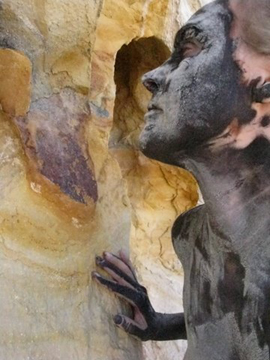 10 – Preparation
She stands at a threshold outside the cave entrance—womb of the mother. She sniffs dry dirt. Worshipful of opposites, she sees herself reflected in stone—blue darkness to golden light. She places her hand upon the rock, asking permission of the stone people before entering. She waits patiently for an answer. She wills the thrumming heartbeat of the ages to greet her with a pulse. She lets go of everything that came before. Touching stone, she waits for secret signs, a touchstone. She becomes rock, to enter rock.
It is important in the early stages to listen and feel if the way is clear, if the timing is right, if the self is properly attuned. When rocks, caves and minerals are the initiators—the doorkeepers—then one must prepare by slowing down, becoming solid as rock. True happiness is found in preparing well. Freedom is here for the asking. There is no turning aside, no time for impatience. Make ready, for Mystery lurks around the corner.
«∞»
 29 – Resonance
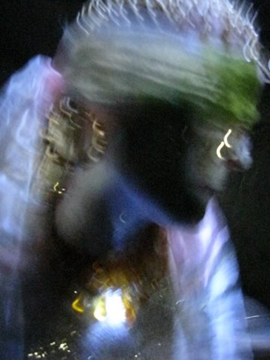
Eyes blindfolded, she goes deep within. Blue, new-moon throat chakra oversees a jeweled doorway, entrance to the inner light. Oh, to receive the message of the midnight sun! Vibration takes over. Sightless knowing that surrenders to not-knowing.
When one resonates deeply in sympathy with another or, even more, with the state of the world, an underlying meaning emerges in voiceless sound so intense it is beyond hearing. It bursts forth in radiant light: lash-light gleaming tears, electric brain-waves, an oscillating ruff leaving a luminous wake.
This is the sensation of wordless empathy—of feeling with others—before you even recognize what it is. Don’t look at the distracting particulars. Turn away. Reflect on it in humility. The cries of millions are a jewel. Hold it close. Become it. This is a compassion, a dark beauty, that makes waves.
 The Naked Man is a new book of poems celebrating both the Fool (as puer aeternus ) and all those who have loved him. Order it here.
The author, Christine Irving, tells us, “everything he encounters on his journey will conspire to destroy his innocence.” But, the Naked Man of Irving’s poems seems stuck at the beginning of his journey, unwilling to make a leap of faith . . . for somewhere the Devil lurks.
Women will recognize the Naked Man—he’s the one peeing on an oak tree—as he whom our friends and mothers have always warned us against. Men will remember those “almost” moments just before civilization reclaimed them.
There are plenty of allusions to the tarot. Can you recognize in yourself the tarot archetypes he cavorts among, upsetting all their plans? Luckily, Irving offers rituals & prophylactics to keep us safe—perhaps . . . But, what happens when Eros meets Kali—when the irresistible meets the devourer?
These poems will delight, making you laugh out loud. They may bring up longings you’d forgotten, or they may remind you who you really are. This is a book for Jungians, tarotists, pagans and lovers. Here’s one small sample:
hung over
stubble faced, dirty
scuffed and unbuffed
in a two-day shirt
stinking of dog
sweat and sake
the Naked Man
flops across my threshold
begging another poem
BOOK SIGNING PARTY
Christine Irving
Reads from her new book of poems
The Naked Man
Saturday, January 22, 2011
4-6 PM
Sierra Mountain Coffee Roasters
671 Maltman Drive, Grass Valley CA
(I’ll be speaking briefly on the Fool in the Tarot)
While there certainly have been plenty of prohibitions historically against playing cards, usually the focus was anti-gambling. There have also been laws allowing card playing, especially during certain times of the week or year and sometimes even allowing penny bets. Right from the beginning there have been those who saw cards as a popular artifact that could be used as much for moral purposes as immoral. The point that I want to make in this series of posts is that people have seen playing cards in terms of allegories that point them toward the best (or worst) ways in which to live their lives. There is something about these loose leaves that through shuffling allow ‘fate’ to herald triumph or loss that has always appealed both to the imagination and to our belief that we can be guided to a morality that will result in triumph.
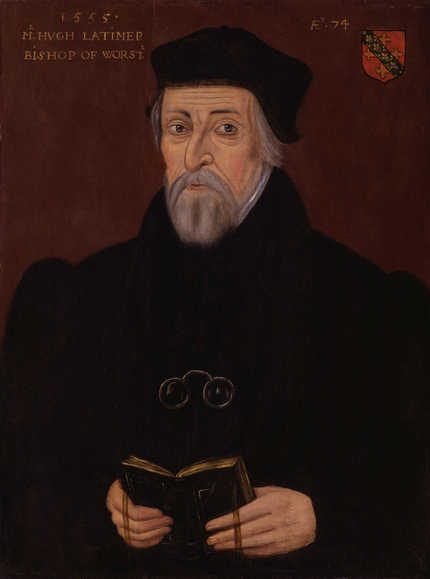 Those who have seen the Showtime production “The Tudors” might recognize the name Hugh Latimer. He was one of the foremost Reformation preachers in the courts of Henry VIII and Edward VI.
Hugh Latimer (c. 1490-1555) was said to have done more than anyone else to establish the principles of the English Reformation in the minds and hearts of the British people. His homely simplicity of style, practicality and humor made the zeal and wisdom of his sermons palatable to the masses. These sermons are still read today as a model of the craft.
When his two “sermons on the cards” resulted in a major controversy at Cambridge, Henry VIII came to his support, returning the favor of Latimer’s support for the annulment of Henry’s marriage to Katherine of Aragon. As court chaplain and an ardent promoter of reform, Latimer earned a brief excommunication by the pope. With the creation of the Church of England, he was named Bishop of Worcester although his path continued to have its ups and downs. Eventually he became chaplain to Catherine, Duchess of Suffolk, who was Catherine Parr’s close friend and, it was rumored, was being considered as Henry’s seventh wife. Under Edward VI, Latimer was court preacher, but upon the ascendancy of Queen Mary and the return of Catholicism, he was burned at the stake, becoming known as one of the Three Oxford Martyrs. Latimer appears as the chaplain of Catherine Parr in the recent TV series “The Tudors.”
The statutes of St. John’s College, Cambridge, following the usual practices of the time, forbade playing with dice or cards except at Christmas (excluding underclassmen). As this popular activity would obviously draw the holiday interest of university students, Hugh Latimer used the metaphor of ‘Christ’s cards’ in a game of Triumph for his Christmas sermons in 1529.
Trump or triumph was a 16th century British card-game, using a regular playing-card deck, based on earlier trick-taking games such the German Karnöffel. Their descendants include whist, hearts and bridge. Karnöffel was first described in Bavaria in 1426, and its name may have derived from the Persian Kanjifah and Indian Ganjifa, which speaks for the historical movement of playing cards from East to West (see discussion here). Karnöffel may even have been a precursor to the tarot in that certain cards, when played in particular ways, were given names: the Seven of Trump became the Devil when it was the first card played in a trick, the Six was the Pope and Two, the Kaiser.
In Triumph, twelve cards were dealt to each of four players with four cards left in a stock pile (sometimes called the ‘widow’). The top card of the stock was turned up for trumps.
SERMONS ON THE CARD AND OTHER DISCOURSES
by Hugh Latimer
The Tenor and Effect of Certain Sermons Made by Master Latimer in Cambridge, About the Year of Our Lord 1529
December, 1529, the Sunday before Christmas
The first sermon begins with the question “Who Art Thou?”* and Latimer answers that we are natural [beastial] man and woman, and therefore ‘the true inheritors of hell and working all towards hell,’ that is, until we are baptized and given ‘Christ’s rule.’ Latimer’s two sermons explain the key tenets of ‘Christ’s rule’ as viewed through an analogy with a card game in which all who follow this rule can win. [*The question “Who Art Thou?” reminds me of the Oracle of Delphi, who counseled “Know Thyself.” -mkg]
We’ll pick up in the middle of the first sermon:
“Now then, what is Christ’s rule? . . . And because I cannot declare Christ’s rule unto you at one time, as it ought to be done, I will apply myself according to your custom at this time of Christmas: I will, as I said, declare unto you Christ’s rule, but that shall be in Christ’s cards. And whereas you are wont to celebrate Christmas in playing at cards, I intend, by God’s grace, to deal unto you Christ’s cards, wherein you shall perceive Christ’s rule. The game that we will play at shall be called the triumph, which, if it be well played at, he that dealeth shall win; the players shall likewise win; and the standers and lookers upon shall do the same; insomuch that there is no man that is willing to play at this triumph with these cards, but they shall be all winners, and no losers.
Here Latimer makes the point that as opposed to ordinary card games where there is one winner, everyone who follows Christ’s rule wins.
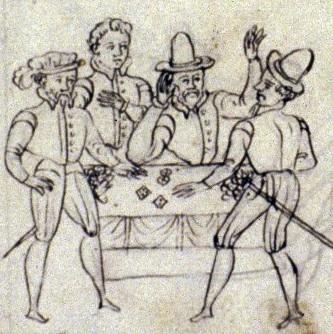 “Let therefore every christian man and woman play at these cards, that they may have and obtain the triumph: you must mark also that the triumph must apply to fetch home unto him all the other cards, whatsoever suit they be of. Now then, take ye this first card, which must appear and be shewed unto you as followeth: you have heard what was spoken to men of the old law, “Thou shalt not kill; whosoever shall kill shall be in danger of judgment: but I say unto you” of the new law, saith Christ, “that whosoever is angry with his neighbour, shall be in danger of judgment; and whosoever shall say unto his neighbour, ‘Raca,’ that is to say, brainless,” or any other like word of rebuking, “shall be in danger of council; and whosoever shall say unto his neighbour, ‘Fool,’ shall be in danger of hell-fire.” This card was made and spoken by Christ, as appeareth in the fifth chapter of St. Matthew.
“Now it must be noted, that whosoever shall play with this card, must first, before they play with it, know the strength and virtue of the same.
Latimer thus explains that the first card drawn determines trump and that this winning trump is the commandment “Thou shalt not kill.” Furthermore, that under the ‘new law’ of Christ, this extends to ‘killing’ a person with damaging feelings and words. When he continues, he characterizes such evil actions within us as ‘Turks,’ which can make us slaves. [If the word, Turks, used in this way, offends you, think of the intent as being evil genii or germs that affect our morals. See note at the end.]
“These evil-disposed affections and sensualities in us are always contrary to the rule of our salvation. What shall we do now or imagine to thrust down these Turks and to subdue them? It is a great ignominy and shame for a christian man to be bond and subject unto a Turk: nay, it shall not be so; we will first cast a trump in their way, and play with them at cards, who shall have the better. Let us play therefore on this fashion with this card. Whensoever it shall happen the foul passions and Turks to rise in our stomachs against our brother or neighbour, . . . we must say to ourselves, “What requireth Christ of a christian man?” Now turn up your trump, your heart (hearts is trump, as I said before), and cast your trump, your heart, on this card; and upon this card you shall learn what Christ requireth of a christian man—not to be angry, nor moved to ire against his neighbour, in mind, countenance, nor other ways, by word or deed. Then take up this card with your heart, and lay them together: that done, you have won the game of the Turk, whereby you have defaced and overcome him by true and lawful play. . . .
“Then, I say, you should understand, and know how you ought to play at this card, “Thou shalt not kill,” without any interruption of your deadly enemies the Turks; and so triumph at the last, by winning everlasting life in glory. Amen.
The Second Sermon
“Now you have heard what is meant by this first card, and how you ought to play with it, I purpose again to deal unto you another card, almost of the same suit; for they be of so nigh affinity, that one cannot be well played without the other. The first card declared, that you should not kill, which might be done divers ways; as being angry with your neighbour, in mind, in countenance, in word, or deed: it declared also, how you should subdue the passions of ire, and so clear evermore yourselves from them. And whereas this first card doth kill in you these stubborn Turks of ire; this second card will not only they should be mortified in you, but that you yourselves shall cause them to be likewise mortified in your neighbour, if that your said neighbour hath been through your occasion moved unto ire, either in countenance, word, or deed. Now let us hear therefore the tenor of this card [essentially, he speaks of reconciling with thy neighbor]. . . .
“The first card telleth thee, thou shalt not kill, thou shalt not be angry, thou shalt not be out of patience. This done, thou shalt look if there be any more cards to take up; and if thou look well, thou shalt see another card of the same suit, wherein thou shalt know that thou art bound to reconcile thy neighbour. Then cast thy trump upon them both, and gather them all three together, and do according to the virtue of thy cards; and surely thou shalt not lose.”
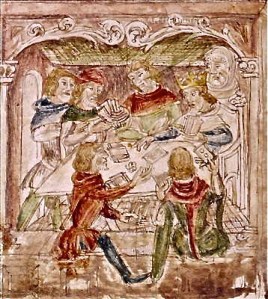 Johannes de Friburgo, 1377

The moralization of the Game of Cards did not begin with Latimer but with Johannes de Friburgo (also known as Johannes von Rheinfelden) in 1377, Basil, Switzerland. This work is one of the earliest mentions of playing cards in Europe and is known as: De Moribus et Disciplina Humane Conversationis, id est ludus cartularum “Of the Manners and the Instruction of Humane Conversation, that is the game of cards” (described by E. A. Bond in The Anthenaeum, Jan, 19, 1878).
Johannes proposed to “moralize the game, or teach noblemen the rule of life; and to instruct the people themselves or inform them of the way of labouring virtuously.” In other words, the game of cards, according to Johannes, can be used for teaching manners and humane conversation. He further writes: “Hence it is that a certain game, called the game of cards [ludus cartarum], has come to us. . . . In which game the state of the world as it now is is excellently described and figured.”
[See the discussions of this work by Michael J. Hurst and also at trionfi.com. The image is from Roman du Roy Meliadus de Leonnoys, c. 1352 (Naples).]
Martin Luther, 1525
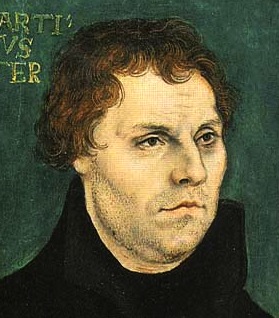 Martin Luther, who elsewhere spoke against gambling, declared himself to be God’s Ace who trumps the pope. Bells are a German suit-marker. He gives cards identities similar to those in Karnöffel in this quote from 1525, four years before Latimer’s sermon:
“If I were rich, I would have myself made a golden chess set and silver playing cards as a remembrance; for God’s chesspieces and cards are great and mighty princes, kings, and emperors; for He always trumps or overcomes one through another, that is lifts him off his feet and throws him down. N. [Ferdinand] is the four of bells, the pope the six of bells, the Turk [Devil] the eight of bells, and the Emperor is the king in the pack. Lastly, our Lord God comes, deals out the cards, and beats the pope with the Luther, which is His ace [Daus].”
[Tischreden 1:491-2, no 972, quoted in “Playing Cards and Popular Culture in Sixteenth-Century Nuremberg” by Laura A. Smoller, in The Sixteenth Century Journal, Vol. 17, no. 2, (Summer, 1986).]
NOTE on the word “Turk”: Both Hugh Latimer in England and Martin Luther in Germany used the word “Turk” as roughly synonymous to the Devil. Today this is, of course, not considered politically correct. In the 16th century the Turks were the boogey-men that all children were taught to fear. Constantinople had fallen to the Muslim Ottoman Turks in 1453, ending the Christian Byzantine Empire. Even more recently they had temporarily captured a part of Italy, and then, in 1529, after several earlier forays, the Turks sailed up the Danube and besieged Vienna. Although they were driven out, Europeans lived for a couple of hundred years with anxiety about an impeding invasion by the Turks. A helpful summary of the Ottoman Empire and its rapid spread can be found here.
Continue on to
There are only three days left to listen to a 20 minute BBC broadcast of a reading of the newly discovered tarot short-story by Anthony Burgess – here. Burgess wrote “Chance Would Be a Fine Thing” in the early 1960s but couldn’t find anyone willing to publish it. The story is about two middle-aged women and their ill-fated experiments with Tarot cards. Otherwise, you will have to wait for it to be published in 2013. Burgess appeared to have a deep interest in tarot, owning several decks and having designed one of his own. He is known to have read cards at a village fete in the 1950s disguised as ‘Professor Sosostris the famous clairvoyant’ (an obvious reference to T.S. Eliot’s poem “The Wasteland”). Read more about the story here. (Thanks to Fiona Blount.)
Many of you wishing to join us on the much anticipated Tarot Art & History Tour of Northern Italy (September 26th – October 7th 2011)—see my post here and on the EVENTS page—have asked for a ballpark figure of what it is expected to cost. Arnell sent me the following:
Going over the various expenses of the tour package with our Italian friends at the Tarot Museum, a reasonable estimate at this time is (USD) $2500 for those wanting double-occupancy hotel rooms (it will be $3000 for single-occupancy travelers). She can try to help people find a roommate. Air travel in and out of MXP Milan Malpensa Airport—or elsewhere— is not included.
As mentioned in Arnell’s webpage, all hotels will be 3-Star or above and will have private bathrooms. Breakfast will also be included. Dinners and special meals will be at fabulous restaurants (many of which are personal favorites from previous trips) and will be covered in the tour package (any alcoholic beverages are on you and could really add up fast! ha ha) All travel expenses within Italy during the tour will be covered as well as special events and admissions to the various places planned.
Let Arnell know by e-mail (arnell@arnellart.com) if you are interested in attending this tour. If you can no longer make the trek (but told her you would like to), also please drop her a line. When they get a more accurate head count of those that will join us on this wonderful adventure, Arnell will send those interested a request for a non-refundable deposit (in order to secure hotel rooms and discounts)—due at that time. The total amount for the package will be due March 25th, 2011 (6 months prior to the tour), but a discount will be offered to those that can pay the full amount by January 15th 2011.
If you are coming on the trip, let us know in the comments!
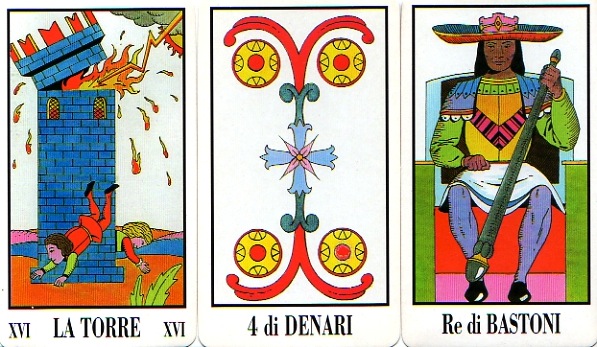
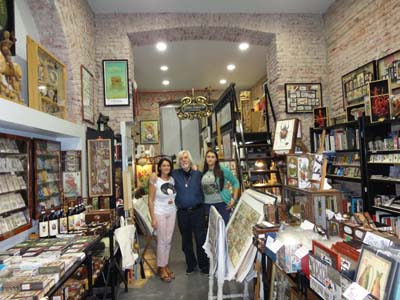 I’ve put all the info that Arnell sent me here because so many people have asked about it. I’m planning to go on this trip as I know it will be extraordinary. Anyone who is a serious teacher or researcher of tarot will discover insights into the tarot that can’t be gained any other way! Plus, the photos & the shopping !!!! You can buy tarot decks at corner tobacconists shops, and I’ve met several people who happened onto rare and unusual decks in at these simple shops. My favorite find was not so glamorous—a day-glo “Antico Tarocco Italiano” deck that I’ve never seen elsewhere (pictured below). And Osvaldo Menegazzi’s magical tarot shop (see above) is a place you will dream about.
I chose these cards from my very unique “Antico Tarocco Italiano” deck to give you the best overview of its wild colors, but I also hope the Tower will light a fire under you to get you all lit up and excited about this trip. By the way, you’ll see lots of towers—exactly like in the tarot—in every village and town we drive through.
The UK TAROT CONFERENCE is coming up very soon in London on the 8th & 9th of October. I’ll be doing a workshop and evening lecture on Friday and a workshop presentation on Saturday. Speakers include me, Kim Arnold, Hermann Haindl, Richard Abbot, Trudy Ashplant, Jonathan Dee, Laurent Langlais and Ina Cüsters-van Bergen. Hope to see lots of you there! Check out the full programme & registration form here.
<~><~><~>
I’m putting in a “surprise” guest appearance (guess it’s now not much of a surprise) at the TAROSOPHY TAROT Introduction Weekend Workshop taught by Marcus Katz on the 16th-17th October, in the UK Lake District, places available, contact tali@tarotprofessionals.com. If you are new to tarot or feel you could benefit from the basics as they are taught by two long-term lovers of the craft, then please join us.
I’ve received permission to reprint this article by Erik Davis. It’s a brilliant journey that elucidates the cultural value of esotericism in the face of science and historicity—as well as being a critical appraisal of the esoteric writings of Antoine Faivre. If you are wondering why I am printing an article that is not specifically tarot (hey, I can do anything I want on my blog!)—let me point you to Erik Davis’ insightful article on tarot at Pop Arcana (1): “The Comic Book of Thoth” at HiLoBrow—which led me to read his other work.
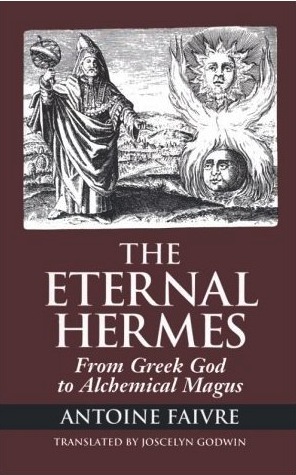 Hermes on the Seine
The Esoteric Scholarship of Antoine Faivre
by Erik Davis ( techgnosis.com )
A truncated version of this review appeared in Parabola, 1996
Imagine you’re a bookish paleface wandering through the stained and musty halls of Western civilization, sick to death of the endless tales of bloody conquests, heinous Churchman, and the ominous march of abstract and manipulative reason. Just when you’re ready to cash in you chips and join the barbarians and bodhisattvas at the gate, you stumble across some moldering sidedoor, thick with sigils and glyphs and glints of otherworldly light. The door opens unbeckoned, and you stumble past animated statues of Egyptian gods into basements packed with arcana: astrological diagrams, alchemical flowcharts, magical cook-books and Hermetic texts, organized not by the Dewey decimal system but by the blazing rainbow filing system of the Kabbalistic Tree of Life. Isaac Newton’s alchemical library is here, along with the hermetic troves of Breton and Blake, Walter Benjamin and Umberto Eco. You wander like a half-blind Argentinian sage through this iconic museum, each tome vibrating with its neighbors until the texts become a hieroglyphic hall of mirrors that reflect anew yourself and the world that made you.
For folks willing to dig beneath the newsprint horoscopes, esotericism appears not only as an underground history of Western ideas but as a broiling stream of consciousness that feeds and flows through everything from science to poetry to politics. Mercurial, fecund with imagery, yet propelled by a quite modern sense of psychological dynamics and individual experiment, esotericism is the West’s magic realism, a living metaphysical poetry grounded in the transformative potential of experience.
Check out Woody Allen’s new movie (opening the end of September) that features a tarot reader (even if she is bogus, it’s great humor). (Thanks to Jennifer SwampWitch Johnson).
 Mary K. Greer has made tarot her life work. Check here for reports of goings-on in the world of tarot and cartomancy, articles on the history and practice of tarot, and materials on other cartomancy decks. Sorry, I no longer write reviews. Contact me


Recent Comments