Recently, at PantheaCon (a huge pagan conference in San Jose, California), I led a “Tarot Intel Circle” with around a hundred people and was asked by several participants to provide a description so they could do it themselves. There are two forms of this process: the “Intel Circle” that can be done with any number of people from a dozen to over a hundred, and the “Tarot Council Circle” that works best with around 6 to 16 people. Each person in either circle gets to be both a Questioner and a Respondent. At most workshops the participants range from those who’ve never read a tarot card to professional readers and everything in between. Everyone gets something out of it, and it often provides a huge kick-start to one’s intuitive abilities—opening a door and switching something on in the psyche. It’s a good process to use at the beginning of a tarot course.

The Questioner usually focuses on one issue or situation about which they want to gather information, although they can change the issue at any time. In both Circles it is helpful to begin by asking, “What do I most need to look at around _(insert issue)_? It can be as specific as, “around the problem with the person at work who is driving me crazy” or as general as “around my life purpose.” As the process continues, Questioners can keep asking the same question or reframe it to focus on different aspects of the issue.

Questions should be brief and to the point. The Respondent draws a tarot card (more about this later) and, based on impressions from that card, responds to the question. Usually only a minute or so is allowed for each response before moving on to the next person and question. No response is right or wrong, but rather it offers information, options and possibilities, or layers of meaning. No card meaning is right or wrong. As a Respondent, you don’t have to fix anything!—which is my number one rule.

UPDATE: The germ of these processes was the “Tarot Game” created by Australian artist, Peter Rosson (1954-2002). Originally it involved a small circle of guests who were invited to explore right/left brain interaction, the creative process and the “profiling” of a personal issue using Tarot. May this seeding of Rosson’s creative brilliance continue to grow and flourish.

The Intel Circle

The Intel Circle consists of an inner and outer circle with the same number of people in each, facing each other. The outer circle stays in place (and those who need to sit can do so), while the inner circle stands and moves one person to the right for each question/response interaction. I call time, direct the movement, and I change the rules for each interaction (leaders: a mic and gong are very helpful with large groups). Before we begin, the Questioners draw five cards each from a mixed pool of several tarot decks and will keep these same cards as long as they are Questioners. These cards contain the keys to their issue. As each interaction begins, they ask their question, and the Respondent (across from them) draws one of their five cards, looks at it and responds to the question. Then I ring the bell, the card is returned, and the inner circle moves one person to the right, where a new interaction (with a new prompt) begins. Karen Krebser described her experience as “controlled chaos” with no time for self-doubt.

I’ve provided sample “prompts” for each interaction below. After six or seven interactions everyone switches roles, so that the Questioner can be the Respondent and vice-versa.

The Council Circle

For the smaller Council Circle everyone sits in a close circle (can be around a table) facing everyone else, with one or more decks in the center. The first person addresses their question to the person to their left, who pulls a card and responds. The Respondent then becomes Questioner, turns to the person to their left and asks their own question, that person responds, and so on clockwise around the circle. After responding to a question, people often need to be reminded to switch into asking/Questioner mode as it involves a right-brain/left-brain switch. It is worth becoming aware of how this switch operates in yourself. As leader, I change the “rules” or prompts with each round. After a couple of rounds we change direction (so the question is asked of the person to your right). If doing a long session of several hours, you can have everyone sit in a different seat after a break. In the Council Circle, the leader can also be a participant and usually starts and ends each round.

Towards the end of the whole process, have one person ask a question while each of the others draws a card with which to respond to the question. You can follow with another person asking a question, draw only one card for the whole group, and everyone responds in turn to that that one card. These final questions can be personal, but it’s also a good opportunity to explore spiritual, community and/or world issues. In the Council Circle much more group rapport is built as everyone hears each person’s questions and the responses.

I frequently remind participants that it is up to the questioner to determine what works for him or herself—that this is information-gathering from which they are to pick and choose what seems most meaningful and relevant to themselves. Handled well, it should end up with a deep bonding and a sense of being seen and supported by the whole.

The Leader

The leader is responsible for seeing that the pace moves briskly along, that no one challenges, harangues or criticizes another, and that no one tries to impose their views. The Respondent responds to, rather than “answers” the question. The responses may be possible actions for the questioner to consider but should never be insisted upon. Respondents should not be allowed to lecture or argue for their perspective, nor should other participants question someone’s interpretation. It can sometimes be wise to begin a response with: “If this were my issue, I’d . . .” Personally, I offer gentle but frequent reminders that as respondents, we “don’t have to fix anything,” as this is an essential theme for me. Always support the Questioner’s assessment, for the questioner is the final arbiter of his or her own life. The most relevant information tends to rise to the top. On the other hand, encourage everyone to open themselves to new possibilities.

What is said in the circle stays in the circle and should never be mentioned elsewhere. Trust is paramount, which is especially apparent in the Council Circle.

At the beginning and end, the leader should take a couple of minutes to ground, center and focus everyone, state the group intent, and open (or close) the relevant energy centers for intuitive work. If appropriate to the situation you can set wards and call in guides. An informal-style Council Circle can work in a quiet, supportive social environment without needing a ritual format, but the leader should still be in control and gently guide the process.

The Cards

It’s usually best to use decks that have story-telling images on all the cards. Respondents can draw from a single deck, a selection of decks, or a bunch of decks mixed in a “pool,” or a set of cards (or deck) held by the Questioner. It’s also okay to have the Questioner draw a card and hand it to the Respondent. Whatever works!

The Prompts

Most of the following prompts are for the Respondent, but a few require something from the Questioner. While I usually begin with the same first few, I vary the later prompts as my own intuition directs me. The Respondent should begin speaking immediately and for the entire time given, repeating thoughts, if necessary. When in doubt, simply describe the card! Each item below consists of one interaction lasting a brief one to two minutes. Indented items are part of the prior interaction and may require slightly more time. Occasionally ask the Questioner to summarize what they’ve learned so far (a few summary points are suggested below). For most of the interactions the Questioner remains silent except for asking the question. Note: it’s okay for the Questioner to see the card drawn.

After the Questioner asks their question, the Respondent draws a card and—

• responds with the first thing on the card that catches his or her eye.

• responds by literally describing the image on the card (no meanings or interpretation allowed).

-follow by prompting the Respondent to repeat everything they just said in the 2nd person, present tense (“You are . . .”).

• responds by describing what seems to be the emotions, feelings and attitude of the figure(s) on the card and the mood and atmosphere of the environment.

-follow by prompting the Respondent to repeat everything they just said in the 2nd person, present tense (“You are feeling . . .”).

• the Questioner thinks the question silently (not aloud) and the Respondent responds with something suggested by the card.

• responds with a question (that is, answer a question with a question based on the card drawn).

-Optional: Questioner says what the Respondent’s question brought up.

• responds by not looking at the card (draw one but don’t look at it).

• breathes in the card and then responds with ONE word.

-Optional: Questioner tells how that word is relevant to their question.

• responds with one or more metaphors, aphorisms or sayings based on the literal image (“Been down so long it looks like up to you.” “Beggars can’t be choosers.” “You’ve got the whole world in your hands.” “It’s like being stuck on a fence.”)

• responds with what the person “should do.” (The Questioner can be asked to phrase their question accordingly: “What should I do about . . . ?”)

• responds with what the person “shouldn’t do.” (Ditto. Have the “should/shouldn’t” prompts follow each other.)

• responds with a wild, crazy fairytale using the card as the illustration, and beginning “Once upon a time . . .”

-prompt the Respondent to repeat everything they just said in the 2nd person, present tense (“You are . . .”).

• responds with “The lesson of this card is . . .”

• responds with “The worst case scenario described by this card is . . .”

• responds with “The best case scenario is . . .” (Pair it with the preceding.)

• responds as if the Respondent were a figure on the card, by speaking as that figure.

• responds with “Yes, if  . . .” or “No, if . . .” or “Maybe, if . . .”.  (Have the Questioner ask a yes/no question.)

• Have the Questioner say how all these responses relate to their issue. (Can insert this whenever it seems appropriate—not too often, but definitely at the end.)

I sometimes end with each person creating an affirmation based on the qualities that they perceive in one of the cards that they most want to develop in themselves, and committing to an action that is in alignment with that.

For Further Development

Many more possibilities are suggested by the exercises in my book 21 Ways to Read a Tarot Card, which also presents techniques that will make you a more effective and empathic leader of this kind of group process. See especially Step 21 for the affirmation process and the “Traps and Solutions” in Appendix H.

James Wells’ reports on his experience when I taught this process at Readers Studio 2010.
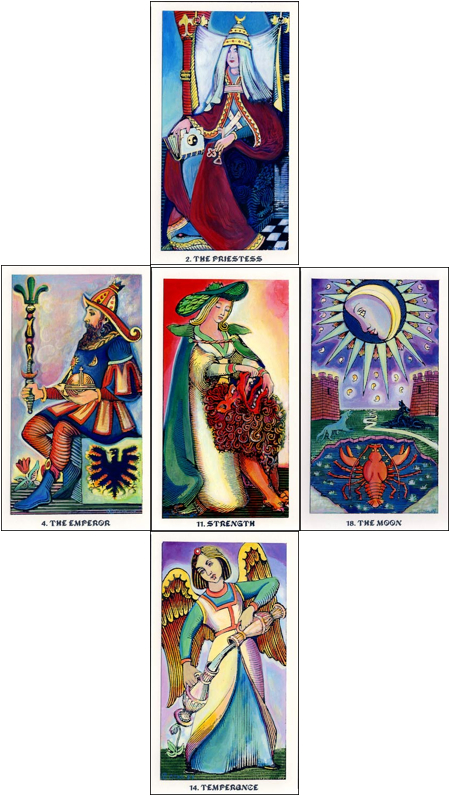
Tarot of the Magicians coverHere’s a classic “reclaimed spread” in the form of a five-card-cross that is most often found in French and continental Tarot books. The version I offer here is from Oswald Wirth’s Tarot of the Magicians, with an introduction by me (originally published as Le Tarot, des imagiers du moyen-age, 1926).  Wirth claims to have learned it from his teachers, Stanislas de Guaita and Joséphin Péladan (famous 19th century French occultists). It uses only the Major Arcana. Note that the card layout itself will probably be familiar as it has been adapted to many different kinds of readings, some of them focusing on the four elements or directions with the fifth-essence/situation/resolution in the center. The original spread is quite different. Note: This new edition of the book includes a reproduction of Wirth’s original 1889 Major Arcana!

What’s great about the Oswald Wirth version is that it’s based on the premise that your case is being considered in a court of law with the result being advice or direction for achieving success. The Major Arcana cards that turn up are characters in the resulting courtroom drama and should be seen as acting in a manner aligned with the card and presenting its unique attitudes and perspectives. Ham it up; imagine a scene from your favorite legal-eagle TV show.

Ask a specific question, and using only the Major Arcana, shuffle and cut. Then, taking cards from the top of the deck (*see alternate technique below), place them in the positions indicated.

The first two cards are the lawyers and the evidence presented by the two sides.

THE CARD ON THE LEFT is affirmative, showing what is in favor of (“for”) the situation. It points to what it is wise to do and those people or qualities on which one can depend.

THE CARD ON THE RIGHT is negative (the opposing counsel) and represents what is “against” it. It points to hostilities that should be avoided or feared: the fault, enemy, danger or the “pernicious temptation.”

THE CARD ABOVE is the judge who discusses the evidence, weighs the pros and cons, and may arbitrate between the for and against. The judge helps clarify the decision to be made and gives advice as to what’s required.

IN THE CARD BELOW the “sentence,” result or solution is pronounced. Taking into account the synthesis of the fifth card, this “voice” of the oracle offers a look into what comes from the decision. It may contain a “teaching” about what style, attitude or demeanor is ultimately to be aimed for.

THE CENTER CARD is determined by adding the numbers of the first four cards and reducing to 22 or less.** It is a synthesis of what has gone before, and points out what is of prime importance on which everything else depends. Although placed last, Wirth reads it first, since the situation or topic depends on it.

The Fool is considered 0 when adding or 22 when it is the result of the addition. The fifth/center card may be the same as one of the other four.

* Wirth suggests a special way of selecting the first four cards that you can use if you like. Shuffle the Major Arcana and then ask the querent for the first number between 1 and 22 that comes into her head. Count down that many cards and place the final card of the count in position one. Shuffle again and repeat for each of the next three positions.

** A much superior way of obtaining a reduced synthesis, numerologically speaking, is to add all the cards and then subtract 22 from any sum over that. This is the only way to get a true range of card possibilities as your synthesis. (Thanks to Steve Mangan, aka Kwaw, who did the math!)

In a sample interpretation Wirth asks “How should one advise a would-be diviner?” (That is, What advice should be given to a person who wants to become the best tarot reader possible?)

The cards received give an answer that you might find surprising. Please tell us your interpretation in the comments section, but here’s some direction from Wirth. He begins with the center card, stating that it shows what the divination depends on. He then contrasts the “for” (on the left) with the “against” (on the right): “the Emperor puts himself at the service of Strength to whom the Moon is detrimental, being against.” That is, the Emperor opposes (or reigns in) the Moon. Cards in positions three and four offer instruction. The Judge (above) shows what we must do and the Solution (below) shows what will come from doing that. What do you make of these cards?

This is the Radical Wirth Tarot painted by Carol Herzer, a beautiful, 22-card deck currently available in a limited edition, although perhaps not for much longer.


Two upcoming films have Tarot in them:

Wolfman (a remake) directed by Joe Johnson with Hugo Weaving, Joe Johnston, Benicio Del Toro, Anthony Hopkins, Emily Blunt, Geraldine Chaplin (as the gypsy tarot reader). England’s own Kim Arnold was the tarot consultant, tutoring Chaplin for the tarot scenes.

In The Imaginarium of Dr. Parnassus from Terry Gilliam with Heath Ledge, Johnny Depp, Colin Farrell, and Jude Law, the Hanged Man literally appears just as Dr. Parnassus pulls the card from his Tarot deck. For those who don’t mind spoilers here’s a hermeneutical review of the film. (Thanks to Bill Dalz.)

If anyone finds any clips of the tarot scenes please send them to me.

Dr. Flamstead’s and Mr. Patridge’s New Fortune-Book containing . . . Their new-invented method of knowing one’s fortune by a pack of cards appears to be the oldest book with instructions on fortune-telling-with-cards in the English language.  The first edition seems to be from 1729—well before Etteilla wrote his 1770 book on “cartonomancie” and contains a “lot” style method of divination in which the card chosen leads to a verse based on your choice from a list of pre-set questions. However we know from the 1730 play Jack the Gyant-Killer that multi-card spreads with meanings for each card were already current in England. (Thanks as always to Ross Caldwell for additional information and corrections.)At some point between 1750 and 1770 a new, much shorter book appeared called Patridge and Flamsted’s new and well Experienced Fortune Book, delivered to the world from the Astrologer’s Office in Greenwich Park, for the benefit of all young men, maids, wives, and widows. Who, by drawing Cards according to the direction of this Book, may know whether Life shall be long or short; whether they shall have the person desired; and every lawful question whatsoever. The signification of Moles in any part of the body; and the interpretation of Dreams, as they relate to good or bad fortune. Along with the change in author spelling there was a major change in the technique portrayed. For the first time we have instructions for a one-card spread and individual meanings given for each card (text appears below).

The individuals in the title are supposed to refer to Dr. John Flamsteed (1646 – 1719), the first Astronomer Royal, and Mr. John Partridge (1644-1715), a well-known writer of astrology books and almanacs and associate of the astrologer William Lilly. However, the names of both Partridge and Flamsteed were appropriated by others as documented by Adrian Johns in The Nature of the book: print and knowledge in the making, p. 619: “But did Flamsteed remain Flamsteed? The question of his identity had been a real one in his own time. Before him there had been no royal astronomical observer in England, and there is evidence that Flamsteed himself was represented by various contemporaries as a virtuoso, an astrologer, a rogue, pedagogue, and a pamphleteer.” He mentions, as an example, a pamphlet, purporting to be by Flamsteed, entitled Plemstadts most Strange and Wonderful Prophecy.

John Partridge was made famous by Jonathan Swift who, under the pseudonym Isaac Bickerstaff, wrote an April Fool’s prediction for the death of Partridge in a spoof astrological almanac (followed by an announcement of Partridge’s death on the date given), after which the name of the still-living-Partridge became legion, appearing on many spurious publications.

Whoever it was who wrote this book, we can be grateful for the first publication in English of playing card meanings. So, without further delay, the instructions and meanings according to Patridge and Flamsted’s new and well Experienced Fortune Book:

Directions whereby the Reader may be informed of the Rules in this Book.

Take a new pack of Cards. Shuffle them well together, Read the rest of this entry »

Check out this fabulous video by Caterina Paris on combining palmistry with the four suits of the tarot:

And check out Carrie’s other tarot videos here.

Everyone, I hope you can come to the Opening Reception of The Fool’s Journey Tarot Art Exhibit curated by Robert Place in Los Angeles.

Opening Reception

Saturday | January 23, 2010
6:00 PM – 9:00 PM

Admission: $10 Donation/ CAFAM Members Free RSVP to (323) 937-4230 x50 or rsvp@cafam.org

Curator’s Lecture for The Fool’s Journey with curator Robert M. Place

Learn more about the fascinating history of the Tarot and its roots in the Italian Renaissance with curator and scholar Robert M. Place.
Sunday | January 24, 3 pm
FREE with the cost of museum admission

Location: Craft and Folk Art Museum
Address: 5814 Wilshire Boulevard , Los Angeles, CA , 90036
Cross Streets: Wilshire / Curson
Region: Westside/Beverly Hills Area
Phone: (323) 937-4230
Food Services: Beverages (wine, beer) and appetizers
http://www.cafam.org/FoolsJourney.html

The Fool’s Journey: The History and Symbolism of the Tarot
January 24, 2010 – May 9, 2010

Curated by Robert M. Place

While known today primarily as a fortune telling or occult deck, the Tarot was born out of the intellectual and artistic developments of the Italian Renaissance. Links to the Tarot’s icons and symbology can be found in the popular arts and philosophy of this rich historic period. Influenced by alchemy, Hermetic mysticism and the concept of Anima Mundi (the fifth element of life), the Tarot became a conversation between mystics and artists that has lasted over five centuries. This exhibition will illuminate the 22 cards of the Tarot’s major arcana, from the Fool to the World, presenting historic examples from early decks and relating them to other works of art from that era. It will continue with historic examples of the French deck known as The Tarot of Marseilles and early occult decks that bloomed from this tradition. Popular twentieth century decks including the Waite-Smith Tarot, and works of art by modern Tarot artists will be featured to provide a deeper understanding of the Tarot’s artistic legacy and message of mystical transformation.

ABOUT THE CURATOR
Robert M. Place is an internationally known visionary artist, author, illustrator, and Tarot Designer, whose award winning works, in painting, sculpture, and jewelry, have been displayed in galleries and museums in America, Europe, and Japan and graced the covers and pages of numerous books and publications. He has written several volumes on the art and philosophy of Tarot including The Tarot: History, Symbolism and Divination, The Alchemical Tarot, The Tarot of the Saints and The Buddha Tarot. Robert is recognized throughout the world as an expert on and gifted teacher of the Western mystical tradition and the history and philosophy of the Tarot.

Come one, come all

11-13 June, 2010

The Omega Institute Tarot Conference: TAROT & INTUITION

in Rhinebeck NY.

We are delighted to announce the first Omega Tarot Conference featuring Juliet Sharman-Burke, Lon Milo DuQuette, Ruth Ann & Wald Amberstone, Mary K. Greer, and Rachel Pollack. Join us at this beautiful retreat in upstate New York for an incredible learning experience with some of the most exciting teachers in the field.

Intuition communicates primarily through symbols. Tarot is the Western World’s greatest symbol system for helping us find meaning in life events and for exploring future possibilities. In a Tarot reading we consider a person’s questions and then lay out the cards.  Along with the cards’ meanings it is really our intuition that allows us to see the patterns and messages that emerge from the questions and the images.

The Omega Institute is honored to bring you five world-renowned Tarot teachers and authors, from New York, California, and England.  Each an innovator and a scholar, they are also masters of the intuitive. Their hands-on workshops will help you discover your own ability to read the cards. While everyone is intuitive the conference faculty will give you specific tools to access your own intuition, refine it and trust it. Together we will experience the psychic, psychological, magical, symbolic and interactive aspects of today’s intuitive Tarot practices, making you a more well-rounded reader for yourself or others.

This conference is for all levels. Bring your favorite deck(s). Information available here.

Then stay for the five day Tarot Magic workshop with Rachel and Mary:

13-18 June, 2010 — TAROT MAGIC: Using the Power of Symbols and Images

at The Omega Institute, Rhinebeck NY, with Mary K. Greer and Rachel Pollack.

Stay after the conference or come separately to the famous five-day course with Rachel and Mary, which this year features a very special topic.

Through the Tarot we view what changes may happen in our lives.  But we can use Tarot to create change as well as describe it.  This is the magic of Tarot.  The great poet, W. B. Yeats–a dedicated magician–called magic “Truth evoked through symbols.”  In this workshop we will explore the Tarot’s symbolic truths–the meanings of the cards–and then discover how we can use those truths as keys to transformation.  Like the Tarot card The Magician, we will access the powers of the Trumps and four suits: Wands, Cups, Swords, and Pentacles.  And, lest we take ourselves too seriously, we will do this in the Fool’s spirit of adventure and play.

Join Rachel and Mary for five days of magical discovery.  Go beyond what is in the books to access your own power and develop your Tarot reading skills. Take the limits off your idea of Tarot and through the Tarot take the limits off your beliefs about creating change.

Suitable for all levels of experience.  Bring your Tarot deck(s). Information available here.

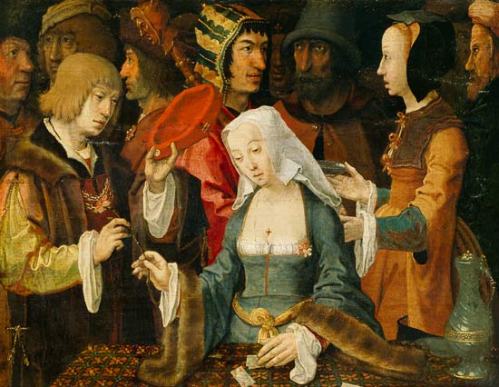
No one knows the story behind the painting “The Fortune-Teller” by Lucas van Leyden (1494-1533), so it is ripe for speculation. It was painted in 1508 when Lucas was only fourteen, marking him as one of the great painters of the age. This work is also considered to be the first “genre painting” that depicts everyday events in ordinary life. If what is shown is truly fortune-telling with cards then it is one of the earliest records of cards being used in this way (see Origins of Playing Card Divination).

I believe the cards in this picture represent the many turns of fortune, but it may be more of a metaphor than an actual card reading. Still, we know from research by Ross Caldwell that by 1450 playing cards were used in Spain for fortune-telling “puédense echar suertes en ellos á quién más ama cada uno, e á quién quiere más et por otras muchas et diversas maneras (“one can cast lots [tell fortunes] with them to know who each one loves most and who is most desired and by many other and diverse ways.”) And, as we will see, both of the main characters in the painting married into the Spanish royal family and spent time there.

fortune-teller-leyden

The central woman is thought by some to be Margarethe (Margaret) of Austria and Savoy (1480-1530) (see also here). Born in Flanders, she was daughter of the Holy Roman Emperor, Maximilian I and Mary, Duchess of Burgundy. Her step-mother was Bianca Maria Sforza, daughter of Galeazzo Maria Sforza, Duke of Milan, by his second wife, Bona of Savoy, and granddaughter of Bianca Maria Visconti (m. Francesco Sforza) for whom the Visconti-Sforza Tarot was made.

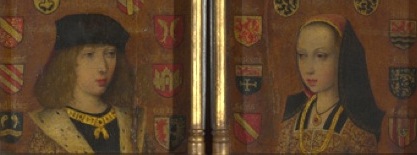
At three years of age Margarethe was betrothed to the Dauphin of France (later, Charles VIII), but at ten was returned to her family when he married someone else. In 1497, at seventeen, she and her brother, Philip ‘the Handsome’ (Archduke of Austria, ruler of Burgundy and the Netherlands, and in line to become Holy Roman Emperor), were married off in a double alliance to the Infante Juan and Infanta Juana, children of Ferdinand of Aragon and Isabella of Castile (who sent Columbus to America). (Pictures below are of Philip and Margarethe.)

Philip & Margaret

The Infante Juan died six months later and Margarethe’s child was stillborn. Margarethe was then married to Philibert (Phillip) of Savoy with whom she was very happy, but he died three years later. (He, by the way, actively supported the Milanese cause of the Sforzas against the French until offered a bribe by the French that he couldn’t refuse.) So, by the age of twenty-four she had already had a betrothal broken by France’s Charles VIII, lost a child, and was the widow of both the Infante Juan of Spain as well as of her much loved Philibert. Although her family tried to entice her into a marriage with Henry VII of England, she vowed never to remarry and took the motto: FORTUNE . INFORTUNE . FORT.UNE that has been translated as “Fortune, misfortune, and one strong to meet them.” I see it as both a reminder of her sad story and her claiming of the strength (forte) that such adversity had brought her.

BAG46217

felipeelhermoso

Meanwhile, in 1506, Margarethe’s beloved brother, Philip the Handsome, was named King of Spain, but he died that same year, his son becoming the next King of Spain (Carlos I) and eventually Holy Roman Emperor (Charles V). In 1507 Margarethe was named governor of the Habsburg Netherlands, in place of her brother, and guardian of his seven-year-old son. She went on to become a significant political figure and patron of the arts, negotiating treaties and continuing to rule the Netherlands at the behest of her father, Maximilian, and then her nephew.

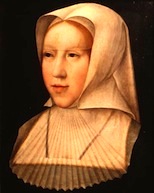
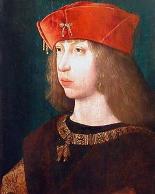
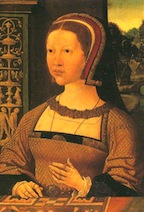
There is a possibility that Lucas van Leyden’s 1508 painting commemorates Margarethe of Austria’s ascendancy to the governorship of the Netherlands in 1507, following the death of her brother, Philip the Handsome. The flower being exchanged (a “pink” signifying loyalty in love?) could represent the passing on of the governorship and their love for the people of the Netherlands who could be the commoners pictured in the background witnessing the change-over. The daisy on the woman’s gown could be meant to identify her (a marguerite daisy). Philip the Handsome (portrait above left) wears a necklace and hat similar to those in “The Fortune Teller” where his doffed hat and sad eyes seem to illustrate his mortal leave-taking. The portrait on the right shows Margarethe in widow’s garb as she liked to be seen in the second half of her life. The Fool with his bauble (fool’s sceptre) may have been someone specific at the court or he may be a symbolic reminder of the foolishness of thinking that a high place and worldly honors will last. More people look at him than at anyone else. There are clearly three layers to the cards: Philip & Margarethe, the Fool and a lady-in-waiting(?), and a backdrop of commoners who may represent the people of the country who are unsure what is to become of them.

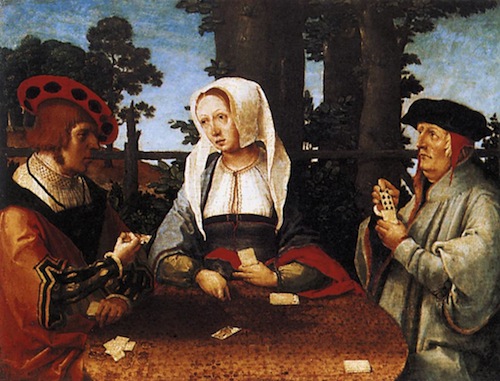
At least one other painting by van Leyden is said to show Margarethe’s involvement in political negotiations pictured as a card game (1525; see below). It is thought to refer to a  agreement between Emperor Charles V (left) and Cardinal Wolsey (right) to form a secret alliance between Spain and England against Francis I of France. Margarethe is known to have been involved in these negotiations. This painting would therefore refer back to the 1508 one where her position as regent of the Netherlands was commemorated.

von Leyden - card players

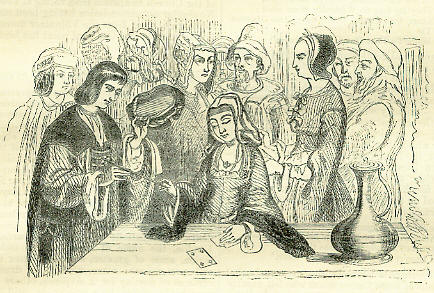
A nineteenth century etching based on the painting (the etching is from Le Magasin pittoresque, 1840) was identified as “The Archduke of Austria Consulting a Fortune-Teller” when reproduced in Chambers‘ article on card reading. It has often been depicted as proof of early playing card divination. As we’ve seen, that may be too simplistic a view. However it is interesting that Philip the Handsome was Archduke of Austria (and his sister became Archduchess of Austria after him).archdukefortuneteller

Here’s a couple more portraits of Margarethe. The one on the right has a similar neckline to the one in our painting (though slightly higher):

.

.

.

.

[Special thanks to Huck Meyer, Rosanne, and Alexandra Nagel—all who offered pieces of the puzzle.]

I was reminded in the previous post of people who ask what they need to do to become a professional tarot reader.  After you feel comfortable reading for self, friends, and friends-of-friends, here’s my number one suggestion for when you want to make the transition.

Your Rite of Passage

The ideal “rite of passage” is to volunteer for a full day (or better yet, a weekend) at a charity or benefit event and donate everything to the cause. If you keep the price reasonable ($5-20 or sliding scale depending on the length of reading and the venue) then your schedule should be filled. The point is to read non-stop (except for necessary breaks), even to the point of exhaustion (drink plenty of water!). There’s a point beyond which a part of you doesn’t care what you say anymore, and you totally let go. You’ll be surprised at what happens then and how accurate you become when you finally bypass your critic. I can’t even begin to list the number of things you will learn from such an experience, but here are a few:

  • Letting go of the critic and trusting the process.
  • Explaining what you do and/or don’t do in one short, concrete statement.
  • Guiding people efficiently through the question, shuffling, etc.
  • Learning to listen as well as speak.
  • Realizing you can’t “fix” someone & letting go of the need to do so.
  • Releasing the need to be “right.”
  • Getting your timing down (how many cards for the time allotted).
  • Learning how to end a reading (especially with a clingy or argumentative client).
  • Discovering the things you’ll need in a “reading kit.”
  • Arranging breaks, keeping hydrated, eating, etc.

Omega08-2

A few basic accoutrements for reading at fairs and events:

  • One or more tarot decks, appropriate to the clientele and occasion.
  • A spread cloth. (Busy designs can interfere with the card images.)
  • Business cards & promotional handouts.
  • Tissues!!!
  • Water! Plus an emergency snack—in case you can’t get away for a meal.
  • Clothing to put you and others in the mood, and in layers so you can adjust to temperature changes.
  • Knowledge of local laws! If necessary have the organization collect the donation and give the person a token for a free reading.
Extras:
  • Watch, clock or timer.
  • If outdoors, healing stones to keep the cards from blowing away (plus nice to have for the energy).
  • Flowers, statue, other decorations. Don’t overdo it.
  • Reading sign-up sheet on clipboard & pen.
  • Mailing list (if appropriate).
  • Cushion for folding chairs. This extra bit of comfort helps.
And, if you continue to do fairs:
  • A professional looking sign. This probably will not be necessary for your first charity event.
  • Code of Ethics written by you and to which you adhere. (Google for examples.)
  • Optional: Tent.
  • Optional: Tackle box with pens, permanent marker, index cards (for mini-signs), tape, tacks, clips, extension cord, etc.
  • Optional: A Recording device. It’s ideal if the client doesn’t have to write stuff down. Here’s a post on great ideas for recording in person & online.

After doing this myself and making this suggestion to others for more than 30 years, as well as doing mini-events like this with my students, I’ve gotten tons of feedback from people who said it was the best thing they ever did to catapult them into the beginnings of professional confidence and expertise. Please, anyone who wants to add to these lists (and I know there’s more to say), do so in the comments.

Here’s an inspiring video of tarot reader “Ocean” reading cards at the Deaf Hope Gala & Benefit in San Francisco. The reading begins about 30 seconds into the video:

You can read the transcript here. Ocean is an experienced reader and all the proceeds went to the cause. I loved seeing a reading interpreted in ASL.

About

Click HERE to subscribe to Mary K. Greer's Tarot Blog by Email

≈◊≈◊≈◊≈◊≈

Mary K. Greer has made tarot her life work. Check here for reports of goings-on in the world of tarot and cartomancy, articles on the history and practice of tarot, and materials on other cartomancy decks. Sorry, I no longer write reviews. Contact me HERE.

© Mary K. Greer All material on this site is copyrighted. If you use anything, be sure to include my name and a link back to this site. Thank you.

I truly appreciate donations to help me pay for additional space.

Donate any amount to keep this ad-free blog growing.

Archives