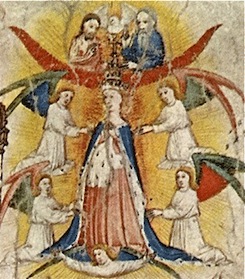
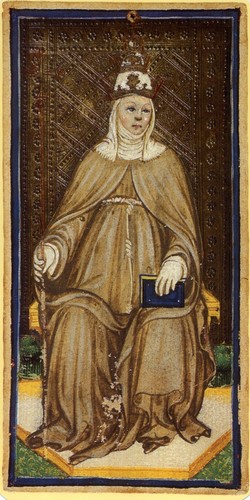
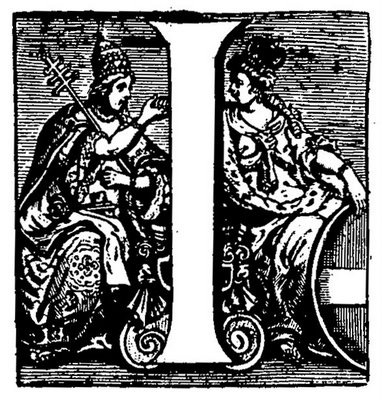
Visconti - PapessGertrude Moakley (The Tarot Cards Painted by Bonifacio Bembo, 1966) introduced the Tarot world to a possible original source of the Papess card: Maifreda (or Manfreda) Visconti da Pirovano was to be declared Pope in Milan on Easter 1300 in a new age of the Holy Spirit. Instead, Maifreda and others in the sect were, that year, burned at the stake, along with the disinterred body of Guglielma, who had inspired this new movement. Could Maifreda be depicted on the Tarot Popess card?

Maifreda was an Abbess in the Umiliati Order and first cousin to Matteo Visconti, the Ghibelline (anti-pope) ruler of Milan. Maifreda believed the Holy Spirit had manifested on earth in the form of Guglielma (d. 1281), a middle-aged woman with a grown son who claimed to be a daughter of Premysl Otakar,King of Bohemia, and, who on arriving in Milan in 1260, donned a “simple brown habit” and lived the life of a saint. To the Guglielmites, her arrival fulfilled a prophecy of St. Joachim de Fiore that a new age of the Holy Spirit would begin in 1260, “heralding the inauguration of an ecclesia spiritualis in which grace, spiritual knowledge and contemplative gifts would be diffused to all.” Although she vehemently denied it, “rumors of divinity already swirled around Guglielma during her lifetime.” And, “Her words about ‘the body of the Holy Spirit,’ together with her mysterious royal origins, Pentecostal birth, imputed healings and stigmata, coalesced to create a more-than-human mystique in the minds of her friends.” Immediately after her death dozens of portraits were painted and chapels were dedicated to Santa Guglielma. (Visconti-Sforza card on the right – her cross at top left is hard to see.)

Giotto FidesBarbara Newman (aka Mona Alice Jean Newman) presented the most complete account in English of the Guglielmites in her From Virile Woman to WomanChrist: Studies in Medieval Religion and Literature, but it is in her more recent paper, “The Heretic Saint: Guglielma of Bohemia, Milan and Brunate,” that we learn important details that make an attribution to Maifreda as Papess much stronger than previously thought (all quotes and information not otherwise attributed are from this article).

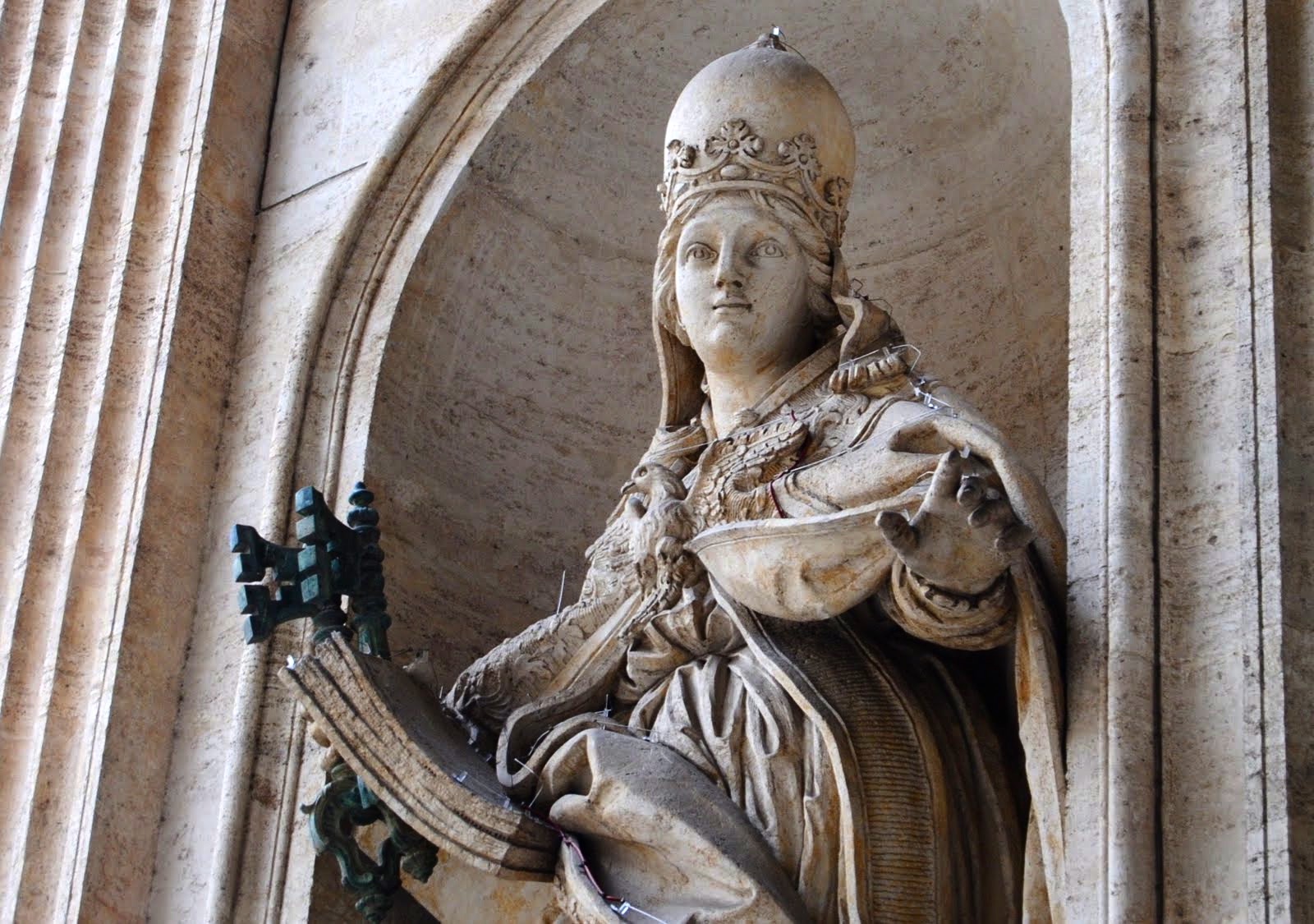
Many tarot scholars since Moakley have doubted Maifreda as source, nor do they give much credence to an older assumption that the card depicted Pope Joan (see article by Ross Caldwell). Instead, modern thinking proposes that it was always an allegorical image of Fides (Faith—see Giotto image to right), Sapientia (Wisdom), Ecclesia (Holy Mother Church) or the Papacy itself. Here’s an image from the Vatican itself:
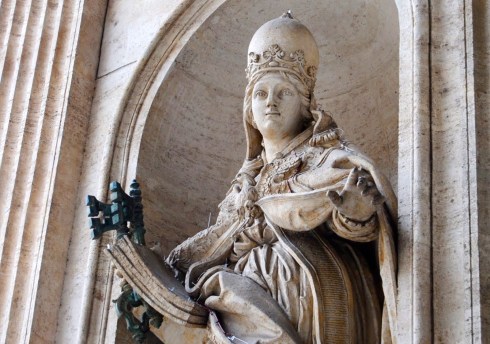
papacy statue st peters (2)

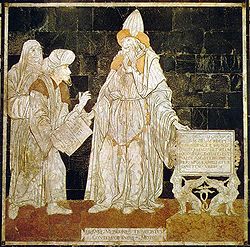
Alternately, she could be Isis (see below with Hermes Trismegistus & Moses by Pinturicchio in the Vatican), the Blessed Virgin Mary or a priestess of Venus (below) —see especially Bob O’Neill’s “Iconology of the Early Papess Cards” and Andrea Vitali’s essay on “The High Priestess.” Even Paul Huson in Mystical Origins of the Tarot finds it difficult to believe the Visconti family would memorialize a family member burned at the stake as a heretic.Isis & Hermes Pinturicchio 1494
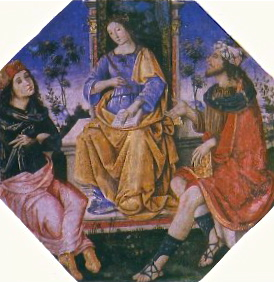
BVMPriestess of Venus

Certainly “Faith” and “Holy Mother Church” may be referenced in the Tarot image, but they were probably of a more heretical sort than the orthodox church has ever sanctioned. Andrea Vitali recounts a summary of the trial of Guglielma and her followers in which we find:
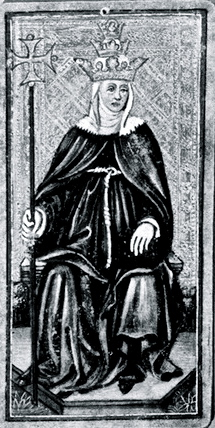
Papess028“As Christ was true God and true Man, in the same manner, she [Guglielma] claimed herself to be true God and true Man in the female sex, come to save the Jews, the Saracens and the false Christians, in the same way as the true Christians are saved by means of Christ.” [Tying her story in with the final cards of Judgment and the World, we find,] “She too claimed she would arise again with a human body in the female sex before the final resurrection, in order to rise to heaven before the eyes of her disciples, friends and devotees.”

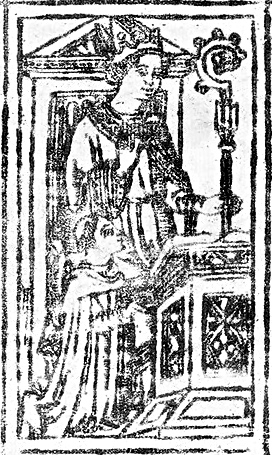
O’Neill objects that “beyond the deck specifically produced for the Visconti about 1450, the local Milanese phenomenon of Guglielmites is unlikely to be the source for the image on earlier decks, for example, the 1442 deck mentioned in an inventory of the Este estate in Ferrara.” But, as Newman’s paper points out, Matteo Visconti’s son, Galeazzo, married the Duke of Ferrara’s sister in 1300 and lived there from 1302-1310, so Ferrara had its own early connection to this saint. Furthermore, Guglielma’s story and veneration were popularized in Ferrara by 1425 through a hagiography (saint’s life) by Antonio Bonfadini, and in Florence through a popular late-15th century religious play by Antonia Pulci—although they garbled her history. (15th century deck on the right is known as the Fournier/Lombardy II.)

Matteo Visconti (first Duke of Milan and first cousin to Maifreda) had as an advisor his good friend, Cary-PapessFrancesco da Garbagnate—an ardent devotee of Guglielma. Matteo was at the center of his own long battle with the Church, having expelled the Papal Inquisitors in 1311, and being himself excommunicated in 1317, tried for sorcery and heresy in 1321, and having Milan placed under interdict in 1322. Matteo’s grandmother and uncle (archbishop of Milan) had earlier been named heretics. (Pope/Papess? card, left, is from the “Cary Sheet” found at the Sforza Castle, Milan.)
From Newman’s article, we learn that Maifreda’s convent was in Biassono, but she fails to note that Biassono is only five miles from the small town of Concorezzo that in 1299 was home to 1,500 Cathars. (I’ve since been told that this source is wrong and that most of the Concorezzo Cathars were burned as heretics or driven out by 1230). After the Albigensian crusade many small towns around Milan became refugee outposts of this faith, of which Concorezzo was a center, and may have inspired the order of nuns who called themselves the “humble” (umiliati)—[correction: the Cathar influence on other groups is not known.] Guglielma-Brunate close

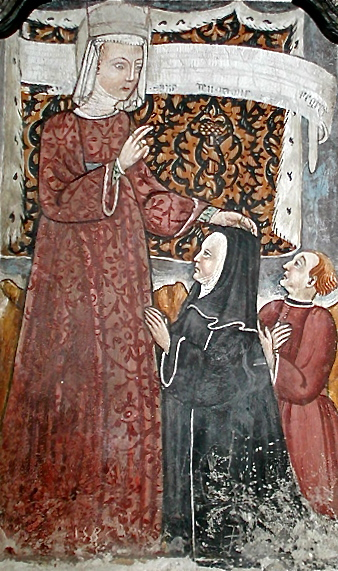
The most compelling bit of data making the attribution of the Papess card almost certain is that between 1440 and 1460 Bianca Maria Visconti, wife of Francesco Sforza and duchess of Milan, frequently visited Maddalena Albrizzi, Abbess of monasteries in Como and Brunate, and gave aid and gifts to the Order. (Brunate is just north of Milan with Biassono between them). Even the stones for the Como monastery were donated by Francesco Sforza. The Visconti-Sforza deck (first picture in post) was probably commissioned by or for Bianca Maria. Around 1450 (the same period as the deck) a cycle of frescos were painted in the Church of San Andrea at Brunate that recorded the story of Guglielma:

“How she left the house of her husband, came to Brunate, and lived a solitary life here, wearing a hairshirt and ordinary dress . . . in the company of a crucifix and an image of Our Lady.”

Only one of these frescos, ornately framed, remains today near the original chapel that had been dedicated to Saint Guglielma (see above). It depicts Guglielma with two figures kneeling before her. She appears to be giving a special blessing to a nun. Newman identifies the two as Maifreda and Andrea Saramita (he was the main promulgator of her divinity as the Holy Spirit). Others, more convincingly, claim them as Maddalena Albrizzi (founder of the monastery and candidate for sainthood) and her cousin Pietro Albrici who renovated the church. Even as late as the nineteenth century, Sir Richard Burton, author of The Arabian Nights, noted that “Santa Guglielma, worshipped at Brunate, works many miracles, chiefly healing aches of head.”

It seems reasonable to conclude that Bianca Maria Visconti may have had a special devotion to the woman whom, 150 years after being condemned by the Inquisition, so many Lombards venerated as a saint, and that she honored an earlier family member, Maifreda, who served as Guglielma’s Vicar—hiding her in plain sight as an allegory of Faith.

Popess as Babylon (1)Let’s ask the question about the source in a slightly different way: Would it have been possible for Bianca Maria Visconti to have not seen this card as Maifreda? Likewise, would it have been possible for a church reformer of the time, familiar with Maifreda and Pope Joan, to have not seen this card as an allegory of Heresy instead of Faith? For instance, a monk wrote in Sermones de Ludo Cum Aliis (c. 1450-1480) about La Papessa, “O wretched, it is what the Christian Faith denies.”

st_clare (1)I’d be remiss to not mention the very real possibility that the Popess represented St. Clare of the Poor Clares, the female branch of the Franciscans (right).

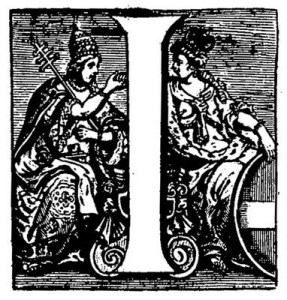
Or, perhaps she was simply the Church in contradistinction to the State as seen below in which a Popess and Empress represent each of these.
Popess-Empress2 (1)

Later Swiss, Germans and Belgians de-sacralized the deck, finding both Pope and Papess objectionable and substituting for them cards like Jupiter & Juno, Bacchus & the Spanish Captain, or the Moors. The Papess, it seems, has always been a mysterious and disturbing force, spreading anxiety instead of the calm assurance one might expect from Faith.

Acknowledgements: Huck Meyer pointed out this picture and Newman’s article at Aeclectic’s tarotforum last year – see discussion. I was then reminded of this material through reading Helen Farley’s fascinating book, A Cultural History of Tarot: From Entertainment to Esotericism. Check out Ross Caldwell’s webpage on the Papessa and Alain Bougearel’s post on Catharism and other heresies of the period here.
RS10-Logo1-small

I will be one of the three featured speakers, along with Robert Place and Elinor Greenberg, at the 2010 Readers Studio in New York. The website is now updated with all the information about this fabulous event. Hosted by Ruth Ann and Wald Amberstone from The Tarot School, Readers Studio is a unique event, geared to those who want practical techniques that will improve their reading skills. As a result, the 200+ attendees experience a community of tarot enthusiasts who share ideas, resources and connections. For instance, just the “give-away” table alone has hundreds of gems to swap, to say nothing of the seemingly “never-ending” raffle. The vendors tables offer books and decks that would be hard to find elsewhere and give you the opportunity to meet a deck artist or book author in person. Publishers send representatives to scout new book and deck possibilities and to give away freebies. Besides the main speakers you can choose among a variety of shorter evening lectures, the breakfast roundtables or get a reading from one of the luminaries. Several of the online tarot forums have found it a great place to meet other members. Come one, come all to a great event.

Tarot JigsawLike games? Check out these fun Tarot Jigsaw Puzzles based on the Rider-Waite-Smith deck.

Each puzzle consists of two cards back-to-back so you will have to flip some pieces over. This is a great way to examine the card’s symbolism and its placement of elements far more closely than you would have otherwise.

Check out the other games including Solitaire with the Rider-Waite Minor Arcana (tough because there are no colors to go by).

Here’s an intriguing quote from G.I. Gurdjieff, In Search of the Miraculous (1949), p. 100-101.

“In order to know the future it is necessary first to know the present in all its details, as well as to know the past. Today is what it is because yesterday was what it was. And if today is like yesterday, tomorrow will be like today. If you want tomorrow to be different you must make today different. If today is simply a consequence of yesterday, tomorrow will be a consequence of today in exactly the same way. . . .

“If a man wants to know his own future he must first of all know himself. . . . Knowing the future is worth while only when a man can be his own master. . . . In order to study the future one must learn to notice and to remember the moments when we really know the future and when we act in accordance with this knowledge.”

Any thoughts on this? It’s worth reading the whole section in Gurdjieff’s book (link to text above). How might these thoughts relate to our reading tarot?

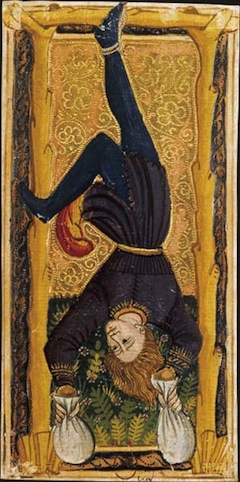
Charles VI - Hanged ManThere are thousands of good causes and I don’t want to make this a forum that addresses them. However, in the spirit of the Hanged Man in its original intention of a shame portrait, I want the 30 senators who voted against the anti-rape law to explain why they did so, and I’m willing to hang them in effigy until they produce some good reasons. The bags in the hands of the Hanged Man in the Charles VI Tarot (see right) are there as the mark of Judas and indicate the selling out of trust, honor and goodness. Who is hurt in this case? Hundreds or even thousands of women who work for American companies overseas. Their contracts prohibit them from  suing or speaking out. Instead, they are forced into secret arbitration and most of the perpetrators are never punished. More insidiously rape becomes a practice that “should be expected.” Company arbitration has not been effective at deterring rape among overseas workers. Laws have to be enforced and the consequences severe enough to protect the women. The companies have proved themselves unwilling to do this. This is explained in the video of Rachel Maddow interviewing Jamie Leigh Jones and her attorneyhere. You’ll find Jon Stewart’s commentary here, in which he points out that the Republican’ claim that it’s “political,” and that government should have no say regarding the company contracts of those hired by the government, is directly opposite to Republican arguments regarding other companies. By the way, the link to “Republicans for Rape” that pictures and names the 30 senators—with their phone numbers—is a spoof site, designed to show just how outrageous this situation actually is and to make it easy for you to contact the senators and tell them what you think.

nineofearthJoanna Powell Colbert’s full 78-card Gaian Tarot is now available in a limited edition in your choice of two sizes.  Both the deck and accompanying book are signed. In addition to a 20% discount, there are lots of extra goodies included if you order before Nov. 3rd. This deck has taken nine years to produce and it’s an amazing accomplishment. Llewellyn will be coming out with a commercial version in September 2011 (if you can wait that long), but Joanna’s limited edition will definitely be a collector’s item and the colors will probably be more vivid. See the cards here.

I asked Joanna some questions about her deck a couple of months ago. Here are her responses:

Mary: Is there a particular kind of question or issue that your deck is ideally suited to respond to?

Joanna: It’s designed for people who want to go into the depths of the issue at hand, and is not really a deck for superficial questions.  It’s for people who are walking a spiritual path, especially those who find sustenance through their connection with the natural world.  I’ve been told by readers who use the Majors-only deck with their clients that it cuts right to the heart of the matter at hand.  Because people recognize themselves in the figures on the cards, they also find inspiration in them and can envision solutions to their problems.

It also seems to lend itself quite well to Rachel Pollack’s “Wisdom Readings,” in which we ask about the larger issues of life.  Two readers that I know, James Wells and Carolyn Cushing, have developed Wisdom Questions for this deck that focus on what we can all do to heal the Earth in this time of global climate crisis.

Mary: If your deck could speak what would be its core message to the rest of us?

Joanna: To quote a familiar chant:

“The Earth is our Mother, She will take care of us.

The Earth is our Mother, we must take care of Her.”

Then it would ask us a series of questions:

– How can the wisdom of a particular card help you to heal yourself?

– How can the wisdom of a particular card help you to heal your community?

– How can the wisdom of a particular card help you to heal the Earth?

Self, Community, Planet: all are inextricably woven together.  Each one of us has a gift to give, and it’s our responsibility to discover that gift then bring it forth, for the good of the community and the planet.

Mary: Why no cities or city life?

Joanna: I think it’s partly because the cards are a reflection of my own rural island life, and partly because the cards are centered in the wisdom of the natural world.  As I meditated on each card before coming up with the concept for it, I asked myself: “Where is the voice of Nature in this card?”  Then ideas came to me.  I don’t think I consciously chose not to show cities; it was more intuitive than that.

Part of my ulterior motive in creating the deck is to encourage people who experience Nature mostly through metaphor and symbol to get outside and start experiencing Her directly.  If I remember the statistic correctly, most modern Americans spend less than an hour a day outside.  I’d like to encourage people to garden, to hike, to do field sketching, to spend more time with the Mother in whatever way works best for them.  I do believe that spending time in Nature heals us, and in return, we have a responsibility to heal Her.

Most of you have seen or used a spread with four positions based on the four suits of the Minor Arcana. Usually it describes what is going on at four levels: body, mind, emotions and spirit, or some similar quaternity. I sometimes lay out four aces from one deck as position holders and then lay cards from a second shuffled deck on top of each ace. Sometimes a fifth card/position integrates the whole or offers advice.

But, there’s a much more interesting way of using the four aces that also offers far more information.

Four Aces Spread Instructions

• Determine the Spread Intent before you begin (see chart below).

Shuffle your deck thoroughly, cut, restack and then turn cards over one at a time.

When you get to the first ace, take the ace and the three cards that follow and place them on the table in a row (left to right). Continue turning over cards until you get to the next ace and the three cards following it. Place them on the table below the first set. Continue with the next two aces until you have four rows of cards on the table.

Exception: if one ace follows another without three cards in between, then the first ace will have less than three cards in its row. The meaning of the short row will depend on what you intuit it to mean in the circumstances. Sometimes it strengthens the card(s) that did turn up. If there are no cards it could indicate that area is not involved in the situation being discussed (consider whether it should be).

Spread Intent: The overall meaning of each row is determined by the ace that leads it. Decide on one of the following sets of meanings (or your own) before you begin:

Four Aces2

The Order: The order in which each ace turns up is very important:

  1. 1st Ace: The Main Character. The primary focus of your attention and energies right now.
  2. 2nd Ace: The Complication. An area you have not been paying as much attention to but can interfere with what’s going on in the first row.
  3. 3rd Ace: The Sidekick/Guide. A secondary focus or emphasis. It may help you resolve tensions between 1 and 2, or suggest helpful actions.
  4. 4th Ace: The Upstart. Something new or “renewed” that will be assuming more importance, possibly as a result of your interactions in the other three areas.

Begin by considering just the four aces in terms of their order in the spread. For instance,

How are Love/Relationships the primary focus of your energies? How are issues around Money and Security interfering? How might focusing on Work and Creativity help? Will you soon need to think about Problem-solving to overcome a difficulty?

Then, read each row of three cards as a unit that describes what’s going on in that position. Ignore the Ace except as it sets that row’s meaning.

Special Cards: The Fool appearing in any row indicates that things are not like they seem; a trickster element is present. The highest Major Arcana in the spread trumps all. You can triumph best by paying special attention to the qualities and lessons of this card and its position.

Sample Reading

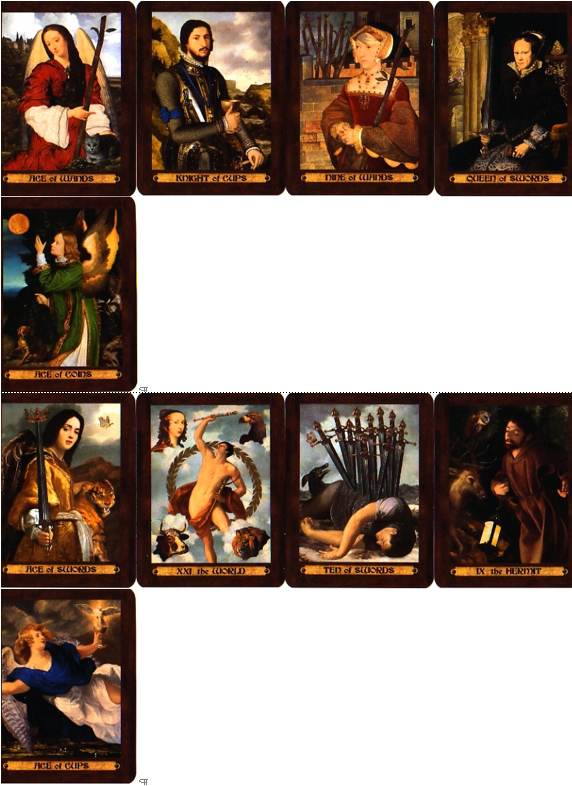
The sample reading I did was quite extraordinary. My intent was a “Life Sphere” reading. The deck is Kat Black’s gorgeous Touchstone Tarot (catch Kat Black’s interview about this deck on Tarot Connection). Notice that an angel designates each ace.

The Aces were, in order: Wands, Coins, Swords, Cups. The order tells me: Work & Creativity is the primary focus. I’m not paying attention to money (darn it!). I have some Problem-solving to do. Love & Relationships are upcoming—maybe (see comments below). Here’s the spread with a very brief commentary:

Touchstone-Spread

Row 1: I am feeling challenged and hemmed in (9 of Wands) by decisions I need to make (Queen of Swords) about the work I love (Knight of Cups).

Row 2: No cards! (The Ace of Swords followed immediately after the Ace of Coins.)

Row 3: I can successfully triumph (World) over the most extreme difficulties (10 of Swords) by calmly applying my wisdom and experience (Hermit) and by letting go of something that is not going anywhere (10 of Swords again).

Row 4: No cards! (The Ace of Cups was the last card in the deck.)

Summary: My overall feeling is that, in order to focus on the work that is most fulfilling to me I need to defend my choices of creative work (despite their not bringing in money) and weed out whatever I can from my list of obligations. If it’s a problem that can’t be solved then I shouldn’t continue trying to do so. While relationships are not at the forefront right now, they will eventually become important again. With the Queen of Swords as my standard Significator and the Hermit as my Soul Card, I’ve got two indications that this is more important than it may seem and the whole issue rests on my own decisions and clarity of purpose. The World as the highest Major Arcana suggests that I can triumph by eliminating what is not part of my Hermit path. Now’s not the time to worry about money or love—although I should be aware that what I’m doing is not helping either.

Tarosophist1-4The Tarosophist International: The Magazine of Tarosophy is a new journal put out by Tarot Professionals. The Special Annual Edition features the Thoth DeckIssue Four (1:4). It’s available in hardback and consists of 146 fully illustrated pages with articles by Rachel Pollack, Lon Milo DuQuette, Mary K. Greer, Richard Kaczynski, K. Frank Jensen, Marcus Katz. A must-have for anyone (beginner or expert) who wants to know more about the Thoth deck, Read the rest of this entry »

Hermes Trismegistus SienaA book called The Kybalion: A Study of the Hermetic Philosophy of Ancient Egypt and Greece by Three Initiates was published in Chicago in 1912. It presented seven fundamental working principles of Hermeticism. But, what is Hermeticism?

At the base of the occult tarot and especially the tarot of the Hermetic Order of the Golden Dawn and the Builders of the Adytum (BOTA) lies a philosophical system or religious philosophy. It derives from a series of anonymous writers who used the nom de plume Hermes Trismegistus (Thrice-Blessed), a composite of the Greek Hermes, Roman Mercury, and their Egyptian counterpart, Thoth. In the 2nd and 3rd centuries C.E., the set of writings known as the Corpus Hermeticum brought about a brief renaissance of pagan thought.  Read the rest of this entry »

Here’s an interview with Cyndi Lauper on her experience playing a tarot reader on the TV show Bones (Season 5, Episode 1) and on her own method of reading the cards. The role was well-written and tarot was treated respectfully (if with humor and despite the ubiquitous Death card scene). I love it that the first card drawn was Temperance – the first name of the main character, Temperance Brennan. It’s just the kind of “amazing coincidence” that I find happens so frequently in readings.

The opening tarot reading scene is especially good because it takes place in liminal (between the worlds) time—the eerie music, the park framed by trees as if peering into a magical space, and the fact that Temperance Brennan is just off the train, sleep-deprived, having been away on an extended trip and not yet re-connected with her ordinary world. The reading then recounts the events of the previous season’s finale and leads us into the new season. It’s a touch of magic carried over from the carnival episode and the dream-world that Bones and Booth also inhabit. [The video clip of this scene has been removed from youtube as it breached copyright.]

About

Click HERE to subscribe to Mary K. Greer's Tarot Blog by Email

≈◊≈◊≈◊≈◊≈

Mary K. Greer has made tarot her life work. Check here for reports of goings-on in the world of tarot and cartomancy, articles on the history and practice of tarot, and materials on other cartomancy decks. Sorry, I no longer write reviews. Contact me HERE.

© Mary K. Greer All material on this site is copyrighted. If you use anything, be sure to include my name and a link back to this site. Thank you.

I truly appreciate donations to help me pay for additional space.

Donate any amount to keep this ad-free blog growing.

Archives