You are currently browsing the tag archive for the ‘Tarot Cards’ tag.
In preparation for the July 2026 Omega Institute tarot workshop, “Wisdom of the Tarot,” I have been posting on Facebook multiple versions of Minor Arcana cards from 21st century tarot decks for comparison. I ask if any keywords or phrases work equally well for all the different decks – one of the themes for the upcoming workshop (stay tuned). My latest example was the 6 of Swords. [It should be noted that the vast majority of new decks are at least loosely based on the Rider-Waite-Smith (RWS) pictures.]
According to the Hermetic Order of Golden Dawn source works and their theory of numbers (c. 1888), derived, in part, from the Kabbalistic Tree of Life, the 6 of Swords, is found on the central sephira of Tiphareth (associated with the Sun). It is, as the GD described it, the “high point” of the Air suit of Mind or Intellect. Associated with the astrological decan of Mercury in Aquarius, it is, at its best, “reason serving humanity.” Centering on Imbolc or Candlemas at 15* Aquarius (Feb 1-2), this fixed sign marks the first truly noticeable return of the light and longer days, heralding the return of Spring.
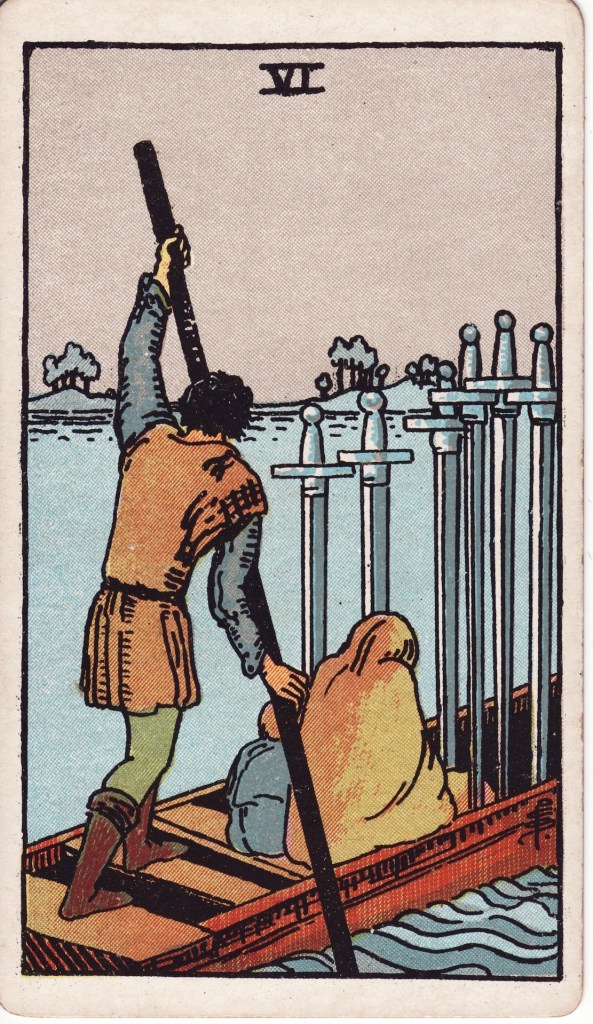
Pamela Colman Smith illustrated this by picturing people we could assume to be a mother and child in a boat poled by a ferryman moving away from rough and into smooth waters. Potential landfall can be seen in the distance. The figures face right, heads bowed so we don’t see their faces. Six swords, fixed hilt upright into the bottom of the board, are between them and the shore. Whether the swords are a barrier for protection or a threat is unsure.
Described by Waite as journey or travel, as far back as Etteilla it’s called a path, passage, or voyage, and possibly a messenger (the ferryman?). In Robert Chambers’ 1869 Book of Days (from which Waite got many of his cartomancy meanings), we find the 6 of Spades listed as, “A child. To the unmarried a card of caution.” Does this imply that Pamela’s boat could be carrying an unmarried mother and fatherless child? The Queen of Spades in this source is called a widowed woman. (Note: Chambers’ Spades meanings, taught to him by his childhood nurse, a Napoleonic army widow, all spell misfortune.)
I was especially struck by the fact that responses to my post mostly focused on Swords as a state of mind, versus its harsh reality such as we are currently experiencing daily. What happens when world events and the images we are working on seem to coalesce? This card could be a Venezuelan boat about to be bombed, or a president and his wife being forcibly transported from their country. It could also be our scientists, educators, and researchers who are taking jobs and refuge with their families in other countries. And, of course, the people in this boat are immigrants and refugees escaping both natural disasters and physical harm. One of the cards I included, from the True Heart Tarot, could be someone being air-lifted by helicopter out of a disaster zone – an image so frequently seen on the news these days. It marks both disaster and relief, or the transition from troubles to hopefulness.
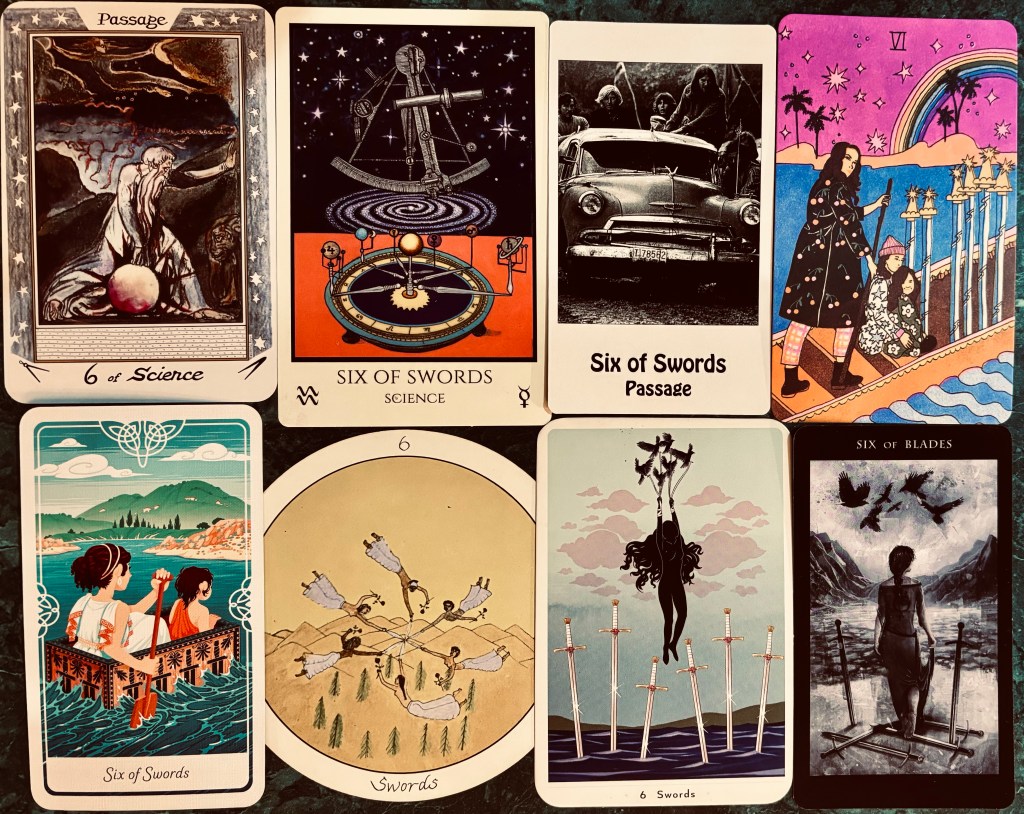
So let’s explore this card a little further. To complicate the issue, we have Aleister Crowley’s keyword: “Science.” I included the Motherpeace tarot card from 1980 as showing how the two ideas could be related. Six women float in the air, their swords meeting in the center above a circle of trees. Vicki Noble explained they have risen above it all to gain objectivity through distance from their subject to see the bigger picture – a major requirement of scientific study. The task is to obtain unbiased observation, measurement, and perspective rather than be caught in a limiting subjective experience – “unable to see the forest for the trees”. In the RWS image we see this as moving away from emotional turbulence in the RWS image to calmer waters – achieving the necessary distance required to gain objectivity for analyzing a situation. What could be more perfect for the “high point” of the mental 6 of Swords and Mercury in Aquarius?
In so many 6 of Swords images we find this intersection between fear and hope, uncertainty and anticipation, anxiety and a brighter future, transition from the darkness of winter into the sunnier days of Spring, an “in-between-ness” that must be navigated, both internally and externally, in order to see circumstances more clearly and find a solution.
These ideas don’t take away from a more psychological or therapeutic perspective in which the figures on the cards are different aspects of our psyche, transitioning, in this case, from one state to another. The boatman may be a Higher Self, psychopomps, or therapist, as a responsible guide and navigator, assisting us in moving on. Our masculine, feminine and child selves are all in it together. The boat is our bridge over troubled waters or any mental crossing. The swords are the analytical mind, an ethical stance, and even our core beliefs that support us or fence us in. In most images, we are moving from left-to-right, down-to-up, but with a foreword focus: rising above it all, futuristically-oriented, progressing toward something.
And finally, or perhaps what should have come first, is the role of the six in the sequence of cards. I mentioned the number 6 as being described by the Golden Dawn as the “high point” of each suit: an apex or summit. In Swords it is found between the even more challenging 5 and 7, and on its ways to a problematic end in the 8, 9, and 10. But, let’s just look at these central three Aquarian cards. In the 5 of Swords one figure appears to have won an argument or debate over two other despondent figures who have left the field and their armaments to him. Readers like to warn, “he won the battle but maybe not the war.” Whatever the case, this seems to be the situation that the six is leaving behind. The 7 of Swords could be what occurs after landing on the distant shore.
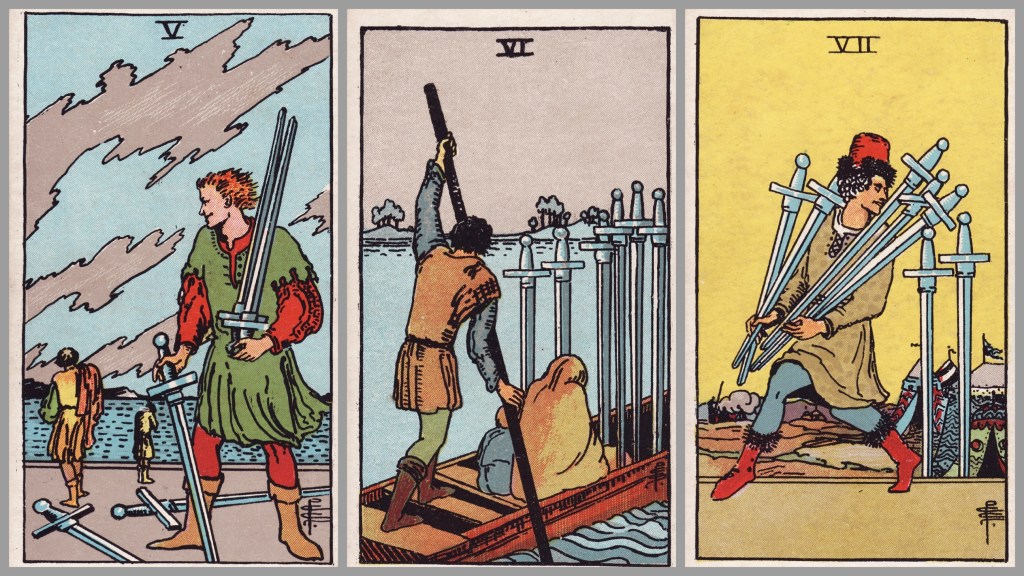
In my imagination, I call the 7 of Swords the “James Bond 007 card”. Following his machismo proof-of-ability in the 5, in the 6, Bond reaches the enemy island, where the villains have assembled a machine of mass destruction. In the 7, he strategically disarms it, winning the day. So, this is a card of disarming either the enemy or some greater force working against your well-being. Yes, it is still lying, cheating, stealing but for what purpose, against whom or what? One other perspective is that of going to the library to gather research: assembling information. To bring it up-to-date, it could be the designers of AI stealing data from copyrighted authors and artists!
Maybe it’s time for pure swordness to move on to another suit? Enough for now. Be sure to share your perspectives in the comments.
This is an adaptation of an article I wrote quite a few years ago while in the midst of my studies of alchemy in the Crowley-Harris Thoth deck.
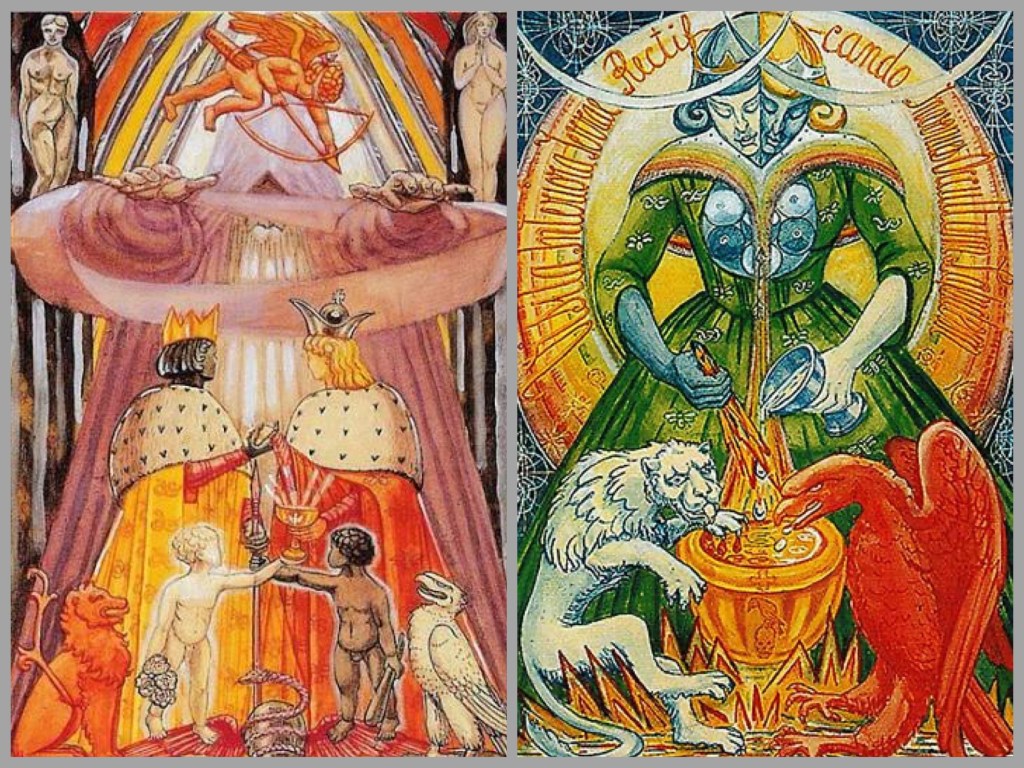
Aleister Crowley wrote little directly about alchemy, but his Thoth deck is full of alchemical symbolism. Alchemy is the transformation of base matter into gold, whether physically in the outer world or psychically in the inner. The transformation process consists of a series of stages (described variously as three or seven or twelve or more) that are often depicted through word-less picture books known as mutus liber in which the ideas are hidden within the image.
Crowley taught that magick is “the science and art of causing change to occur in conformity with will.” In Magick in Theory and Practice (hereafter, Magick) he declares that alchemical transformation is a branch of magick. Furthermore, the “Great Work” of alchemy is the culmination of all magick. It is “the attainment of the Summum Bonum, true Wisdom and perfect Happiness.” Crowley continues, “The Alchemist is to take a dead thing, impure, valueless, and powerless, and transform it into a live thing, active, invaluable and thaumaturgic [able to work wonders] . . . to bring each substance to the perfection of its own proper nature.” Crowley compares alchemy to initiation, for both works isolate the product from its accretions, returning it to the essence of its own nature. In the aspirant to initiation these “accretions” are “the complexes which have corrupted” the aspirant and must be purified.
As Crowley further explains in Magick, all the Major Arcana (Crowley’s “Atu”) are alchemical. The Fool begins the Great Work (“the first matter is a man . . . a perishable parasite”) and the Universe card ends it, being a glyph of its completion (“the pure and perfect Individual originally inherent in the substance chosen”). Crowley does not specify the alchemical action taking place in each Atu, giving only vague hints. The Priestess, Empress and Emperor are philosophic mercury, salt and sulphur, respectively, and are “modes of action [rather] than actual qualities . . . the apparatus of communication between the planes.” Strength is “distillation, operated by internal ferment, and the influence of the sun and moon.” In the Hermit, the philosophic or Orphic Egg is fertilized (this being a solitary act in which the energy raised goes into the Great Work). Death is putrefaction, “the series of chemical changes which develops the final form of life from the original latent seed in the Orphic egg.” Thus, the middle cards depict the breaking up of these accretions or “coagulations of impurity.” As the First Matter blackens and putrefies, along with the aspirant’s agonized reluctance to their elimination, he plunges into “such ordeals that he seems to turn from a noble and upright man into an unutterable scoundrel.”
XIV. Art/Temperance
For this article we will examine the most overtly alchemical card of the Thoth deck. Following the Death card we arrive at Temperance, which Crowley renames ART, signifying what is called the “alchemical art,” to tell us that this is where the most active and defining alchemical act takes place—“the mingling of the contradictory elements in a cauldron.” As we saw earlier, Crowley defined magick as “ the science and art of causing change to occur in conformity with will.” The ART card portrays the art of change, the synthesis or the creative process through which something new emerges that is far more than the sum of its parts.
The stage of the great Work shown in the ART card consists of the mingling of all the elements in the cauldron, so that all contraries are united.
Art, the Lovers and the Egg
The whole of ART is the hidden content of the Egg seen in the earlier Lovers and Hermit cards, which in ART appears as the egg opened into the pearlescent oval behind the Alchemist. Art is the content of the Egg fulfilled. In a modern, post-Crowleyan world (since 1951), this card depicts the moment when the separate DNA strands, carried in the sperm of the father and the egg of the mother, fuse into new DNA (an “assimilation of its equal and opposite”). Art is the solution to the problem introduced in the Lovers where the Two strive to become One. Together these two cards move from analysis and choice in the Lovers to synthesis and transformation in Art. This coming together of the two to create the One can be seen in the cells multiplying in the blue background of the card.
The Red Lion found in the Lovers card appears again, but drained of its last drops of blood, becoming white, and the former White Eagle of the Lovers is now in full menstrual flood. Water from a silver cup joins with a fiery brand and with animal secretions in a golden cauldron. On the lip of the cauldron is a cross, showing that the mixing has occurred, while at the bottom of the cauldron we see a raven on a skull, the caput mortuum or “dead-head” putrified dross that has separated from the elixir. Crowley reminds us that this is also fallow earth.
The Alchemical Child
Crowley tells us that the figure in the Art card is an hermaphrodite, whose name is literally Hermes-Aphrodite (or Mercury-Venus). Here we see a two-headed being whose faces and arms have counterchanged in color since the Lovers. Grillot De Givry in A Pictorial Anthology of Witchcraft, Magic and Alchemy quotes Nicolas Flamel:
“In the second operation thou hast two conjoined and married natures, the masculine and feminine, and they are fashioned in one sole body, which is the androgyne of the ancients, formerly called likewise the raven’s head or element transformed.”
The alchemical child has assimilated the opposites of its parents, and, as is said in The Emerald Tablet it is an admixture of the four elements: “The Sun is its Father, the Moon its Mother, the Wind carries it in its belly; its nurse is the Earth.”
The Emperor and Empress along with the Brothers (Crowley’s alternate name for the Lovers or Gemini card) are here united into a single entity, wearing a robe decorated with the snake of the Emperor and bee of the Empress and in the color green of new vegetable growth. For Crowley this signifies that the first problem of alchemy, which was to raise mineral to vegetable life, has been achieved. The Alchemist is now at work on perfecting the next stage—the animal life. The green can be likened to the vigor viriditas or green energy of Hildegard of Bingen and the “force that through the green fuse drives the flower” of Dylan Thomas’ alchemical poem of opposites (that could have been written with this card in mind).
The Archer
Astrologically, ART is Sagittarius (the Archer) and the zodiacal opposite of the LOVERS Gemini (the Brothers), “and therefore, ‘after another manner,’ one with it,” since both cards feature archers. The arrow of Sagittarius represents creative aspiration.
In “The Fifth Aethyr” of Crowley’s The Vision and the Voice we are told that the arrow’s feathers are Ma’at (divine truth) and “the arrow persists for it is the direction of Energy, the Will [Thelema] that createth all Becoming.” In the Hebrew Kabbalah as applied to the tarot where each Atu corresponds to a Hebrew letter, Sagittarius/ART is on the middle pillar of the Tree of Life, connecting the Sun of Tiphareth to the Moon of Yesod (“the sphere which formulates Existence”)—Sol et Luna! The arrow, pointed up, aspires to Tiphareth, habitation of the Holy Guardian Angel.
The Rainbow
The arrow pierces a rainbow called Qesheth in Hebrew (the bow that propels the arrow), for the Hebrew letters Qoph, Shin and Tav that make up the word are the three paths connecting Malkuth (Foundation) to the Tree above it. Crowley points out that alchemically, “at a certain period, as a result of putrefaction, there is observed a phenomenon of many-coloured lights, the ‘coat of many colours’ said to have been worn by Joseph and Jesus, in the ancient legends.” Thus a rainbow, coloring everything we see, separates the heavenly bodies in the Tree above from the physical plane of Malkuth below. It is called the Cauda pavonis or Peacock’s Tail and is, alchemically speaking, a kind of iridescent shimmer that forms on top of the solution at this stage.
In “Absinthe: The Green Goddess,” Crowley talks a little more about this:
“Originally in the . . . legend of the Hebrews, the rainbow is mentioned as a sign of salvation. The world has been purified by water, and was ready for the revelation of Wine. God would never again destroy His work, but ultimately seal its perfection by a baptism of fire. Now, in this analogue also falls the coat of many colors which was made for Joseph, a legend which was regarded as so important that it was subsequently borrowed for the romance of Jesus. The veil of the Temple, too, was of many colors. . . . In western Mysticism, . . . the middle grade initiation is called Hodos Camelioniis, the Path of the Chameleon. There is here evidently an allusion to this same mystery. We also learn that the middle stage in Alchemy is when the liquor becomes opalescent. Finally, we note among the visions of the Saints one called the Universal Peacock, in which the totality is perceived thus royally appareled.”
The Arrows
Crowley explains in Magick that the arrow is “Temperance in the Taro [sic]; it is a life equally balanced and direct which makes our work possible; yet this life itself must be sacrificed!” In a footnote Crowley adds, “Note that there are two arrows: the Divine shot downward, the human upward. The former is the Oil, the latter the Incense, or rather the finest part of it.” In the Art card, like incense, the rainbow forms an airy cloud ascending from the cauldron and its combined fire and water, blood and gluten, sperm and menstrual blood. This iridescent shimmery incense rises with the arrow as the aspiration of the human spirit toward the Divine. At the very bottom of the card flames shoot up out of what looks like water but may represent the oil or chrism with which the Divine blesses the world below.
Crowley equates the Alchemist with the many breasted moon-goddess Artemis, also known as Diana the Huntress with her rainbow bow. In fact, the Alchemist has integrated not only the King and Queen but also the Brothers and Eros into an insignia of life-force energy. The multiple breasts symbolize Diana at Ephesus. However, if they are considered as six circles (one unseen) tangential to a central seventh, then it points to ART as the culmination of the second of three rows of seven cards in which the Trumps are often presented. As five circles, alternating dark and light plus a central circle of both dark and light, it represents the Alchemist having integrated the all the opposites within itself.
V.I.T.R.I.O.L.
When alchemical mercury, salt and sulphur perfectly combine they form what is called the “universal solvent,” Vitriol. V.I.T.R.I.O.L. is an acronym standing for the Latin phrase on the Art card, written along the inside edge of the egg: “Visita Interiora Terrae Rectificando Invenies Occultum Lapidem,” which translates as “Visit the interior of the earth; by rectification you shall find the hidden stone.” The “hidden stone” is the universal medicine or panacea. In Magick, Crowley explained that “the Universal Medicine will be a menstruum of such subtlety as to be able to penetrate all matter and transmute it in the sense of its own tendency, while of such impartial purity as to accept perfectly the impression of the Will of the Alchemist.”
Rectification means both “repeated distillation” but also “the means to finding a straight line that is equal in length to a curved [or crooked] line (the shaft of the arrow).” Crowley says, “it implies the right leading of the new living substance in the path of the True Will.” It is apparent that ART, being on the middle pillar, is the straight line to the Divine.
In alchemical psychology V.I.T.R.I.O.L. implies that we must re-enter the Mother’s body (or egg) from whence we came. That is, we must descend to the deepest cave of the unconscious and the most material world of the next Tarot card, the Devil (the Jungian “Shadow”), in order to put everything we discover about ourselves through the alchemical solve et coagula process. In this way we make straight whatever has become crooked within us. The seven letters also represent the seven planets and their metals, which represent those specific energies and emotions within the self that need to be freed from the “dross” so that they can function according to their true nature.
Divine Tantric Instruction
In Crowley’s appendix to the Book of Thoth, called the “General Characteristics of the Trumps” (also in “The Heart of the Master”) this verse describes the ART card:
Pour thine all freely from the Vase in thy right
hand, and lose no drop. Hath not thy left hand a vase?
Transmute all wholly into the Image of thy will,
Bringing each to its true token of Perfection.
Dissolve the Pearl in the Wine-cup; drink, and
Make manifest the Virtue of that Pearl.
First of all, this is a sexual or tantric instruction. It requires etherealizing the energies raised in the sexual act, followed by the focus of this energy on an “image of thy will.” Secondly, Cleopatra, in the name of health, drinks a pearl dissolved in wine to show how easily she absorbs the worth of a whole province, while Shakespeare has Hamlet’s father (calling the pearl a Union) similarly drink the value of four kingdoms. Remember, the pearl is the iridescent character of the alchemical egg, the perfection that remains once the dross has been separated out.
I believe Crowley drew for some of his imagery on Canto II of Dante’s Paradiso, in which Beatrice proposes an alchemical experiment to determine the true source of dark and light. She tells Dante that, should he do this experiment, it will “set him free.” In 148 short lines, Dante invokes Minerva (Diana), travels to the Moon with the speed of an arrow to ask whether the dark spots on the Moon are due to the sins of Cain. He describes being on the Moon as entering into a luminous cloud or an eternal pearl, as “water accepts a ray of sunlight,” and how one dimension absorbing another is as a longing for unity. In the experiment, light is thrown back by the hidden layer of lead [base matter] beneath a glass. Finally, each angelic intelligence and its diverse virtue makes a different alloy within each precious body that it quickens, and these combine within a person. This is the formative principle that produces, according to its worth, dark and bright.
Our Angel Adept
In looking for the highest level of this card it serves us now to turn to Lon Milo DuQuette’s commentary on Crowley’s “Liber Samekh” (from the Hebrew letter corresponding to this card, which means a “prop or tent support”). It is a ritual suggesting how Samekh signifies a prop or support through communion with the Holy Guardian Angel, residing in Tiphareth, to which the ART card aspires. It’s worth remembering that the Alchemist is pictured as an angel on other tarot decks. Lon Milo DuQuette explains in The Magick of Aleister Crowley:
“This then is the true aim of the Adept in this whole operation, to assimilate himself to his Angel by continual conscious communion. For his Angel is an intelligible image of his own true Will, to do which is the whole of the law of his Being. . . . His Angel is the Unity which expresses the sum of the Elements of that Self, that his normal consciousness contains alien enemies introduced by the accidents of environment, and that his Knowledge and Conversation of His Holy Guardian Angel destroys all doubts and delusions, confers all blessings, teaches all truth, and contains all delights.”
Alchemy is the means by which the “alien enemies introduced by the accidents of environment” are refined out of ourselves so that our will and that of the Holy Guardian Angel (“the sum of the Elements of that Self”) may operate in unity from the essence of one’s own true nature.
* * *
BIBLIOGRAPHY:
NOTE: Unless otherwise stated, all quotes come from Crowley’s Book of Thoth.
Akron and Hajo Banzhaf. The Crowley Tarot: The Handbook to the Cards (U.S. Games, 1995).
Anonymous. The Emerald Tablet (various versions).
Crowley, Aleister. “Absinthe: The Green Goddess” in The International (XII:2, Feb 1918).
________. The Book of Thoth: A Short Essay on the Tarot of the Egyptians Being the Equinox Volume III No. V (various editions).
________. “Fifth Aethyr,” in The Vision and the Voice (Weiser, 1999).
________. The Heart of the Master & Other Papers, edited by Hymenaeus Beta (Thelema Media, 1992).
________. Magick, edited by John Symonds and Kenneth Grant (Samuel Weiser, 1974). Otherwise published as Book 4 Part III: Magick in Theory and Practice.
Dante, Paradiso (various translations and editions).
DuQuette, Lon Milo. “Liber Samekh” in The Magick of Aleister Crowley: A Handbook of the Rituals of Thelema (Weiser, 2003).
________. Understanding Aleister Crowley’s Thoth Tarot (Weiser, 2003).
Lévi,Eliphas. The Key of the Mysteries, translated by Aleister Crowley (Weiser, 2001).
Snuffin, Michael. The Thoth Companion: The Key to the True Symbolic Meaning of the Thoth Tarot (Llewellyn, 2007).
About This Compendium
“What does he or she think and/or feel about me?”
This is the most asked question in Facebook practice tarot groups and at psychic fairs and many other tarot venues. In practice reading groups, readers will post wildly different interpretations even though responding to the same set of cards drawn. So who is right? I decided to try an experiment.
This question crosses ethical lines as it seeks to invade a third person’s most intimate inner life. However, for the querent who seeks some reassurance of the unknown, it may serve as a guide to their next step. I worked extensively with ChatGPT to come up with meanings that reflect both thoughts and feelings, multiple options, and are based on the most classical tarot interpretations from both the Marseille and Rider-Waite-Smith traditions, rather than my own perspectives. They are limited to 30-50 words (leaving out a lot of possibilities). There’s a 60% emphasis on romantic feelings, with a 40% focus on friends, acquaintances, co-workers.
Please try out these meanings to see if and how they work for you. Feel free to modify them or make your own compendium by changing anything and everything to reflect your own personal understanding of this question and what each card might say individually. And, of course, the other cards in the spread will modify, support or contradict each other, or they reveal a range of sensations experienced by the person in question. Play with this idea. Have fun. Let me know if you find these possibilities helpful or not.
MAJOR ARCANA — Archetypes of Thought and Feeling
These cards show love and perception on the mythic scale—how we project ideals, confront truth, and transform through encounter.
The Fool:
The person asked about experiences you, the querent, as awakening spontaneity and curiosity. They sense freedom with you yet fear looking foolish. There’s excitement, attraction to risk, and uncertainty about direction. Emotion hovers between naïve hope and avoidance of responsibility.
The Magician:
They’re intrigued and alert in your presence—half-admiring, half-calculating. You inspire their creativity and desire to impress. They may test how real the connection is, shaping perception through charm. Feeling is mixed with self-control.
The High Priestess:
You’re a mystery they can’t decipher. They sense depth and silence that invites projection. Emotion feels private, even sacred, yet also distant. They wonder if you know more than you say—or if you see through them.
The Empress:
They feel warmth and sensual appreciation. You represent comfort, beauty, and abundance. Their feelings may blur into longing for nurture or admiration of your self-possession. Attraction here feels natural but could become complacent.
The Emperor:
Respect dominates; affection expresses as protection or control. They might admire your strength yet wish to define the terms. Feeling is restrained, filtered through duty or pride—security valued over vulnerability.
The Hierophant:
You evoke familiarity, trust, or tradition. They may see you as a guide, partner, or moral touchstone. Emotion forms through respect and expectation rather than passion. They wonder if stability outweighs freedom.
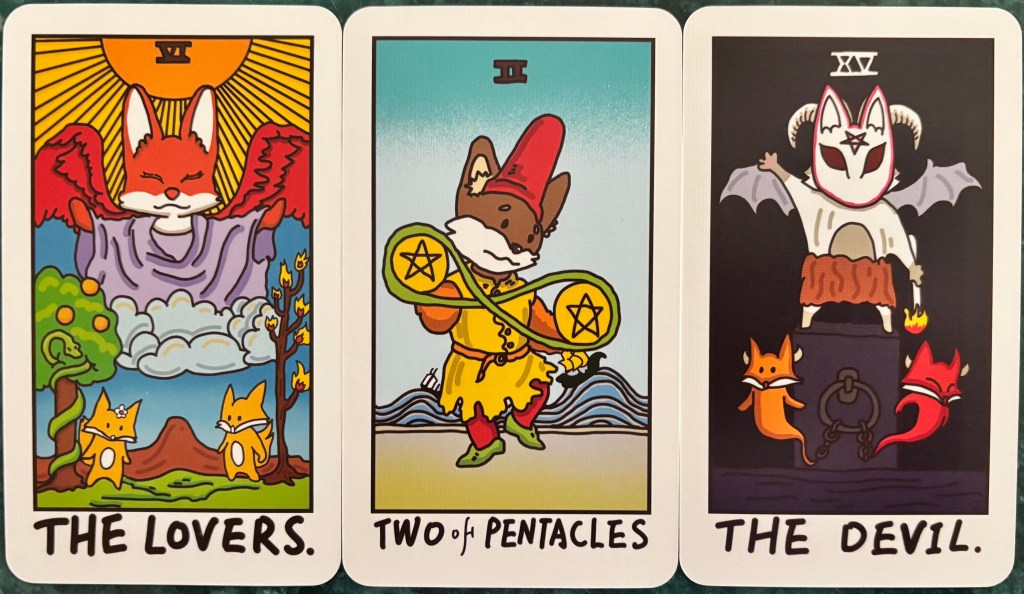
The Lovers:
Connection is undeniable—heart and choice entwined. They feel drawn and confronted at once, sensing that intimacy will change them. Emotion is alive but undecided; desire and conscience share the same breath.
The Chariot:
They feel compelled to move toward you yet fear losing control. You challenge their willpower. Emotion becomes a test of direction: pursuit versus restraint. Admiration tinged with competition.
Strength:
You soothe and steady them. They feel safe and slightly undone by your quiet power. Attraction arises from trust and curiosity about your composure. Their emotion deepens when they sense you won’t exploit it.
The Hermit:
They think of you often but from distance. You represent wisdom, introspection, or absence. Feeling is contemplative—perhaps loneliness mixed with respect. They may love the idea of you more than contact itself.
Wheel of Fortune:
You feel fated, unpredictable, cyclical. Their emotions rise and fall with circumstance. They sense possibility but little control. Hope alternates with resignation; connection feels larger than choice.
Justice:
They analyze rather than surrender. You make them weigh fairness, commitment, or consequence. Emotion is present yet measured, shaped by conscience. They seek equilibrium before vulnerability.
The Hanged Man:
You suspend them between feeling and inaction. They don’t know what to do but can’t detach. Emotion deepens through waiting; surrender may lead to clarity—or drift into passivity.
Death:
You mark an ending or irreversible change. Feelings linger as transformation rather than attachment. They may mourn, resist, or secretly hope for renewal. Emotion is intense, rarely comfortable.
Temperance:
They feel calmed by you. You bring balance after extremes. Emotion here is healing, cautious, integrating differences. Desire softens into harmony; attraction seeks longevity, not drama.
The Devil:
They feel trapped or magnetized. Desire is strong, unsettling, possibly obsessive. They sense pleasure mixed with loss of control. Emotion alternates between indulgence and shame, attraction and fear.
The Tower:
You disrupt their defenses. Feelings erupt suddenly—shock, revelation, liberation. They may blame you for upheaval or thank you for truth. Emotion raw, cleansing, but rarely simple.
The Star:
You represent hope and renewal. They feel inspired, gently optimistic, perhaps idealizing you. Emotion is tender, distant like starlight—guiding but not graspable. Healing rather than possession.
The Moon:
You stir uncertainty and fascination. They can’t separate imagination from reality. Emotion waxes and wanes, colored by fear, fantasy, intuition. They sense depth but question what’s true.
The Sun:
You make them feel open and alive. Joy, pride, and recognition fill their thoughts. Emotion here is uncomplicated warmth—though they might overlook subtler needs. Attraction through happiness.
Judgment:
They reflect on the past with you in mind. You evoke accountability, forgiveness, or a call to reconnect. Emotion is awakening—half guilt, half gratitude. Renewal possible, closure uncertain.
The World:
They see you as whole, accomplished, perhaps beyond reach. Emotion blends admiration with finality. You complete a chapter in their psyche; whether they return or move on depends on readiness for a new cycle.
THE MINOR ARCANA
The four suits together show the emotional spectrum of relationship questions:
- Wands: ignition and pursuit — the spark and struggle of desire.
- Cups: feeling and longing — the ebb and flow of connection.
- Swords: thought and tension — honesty tested by fear and distance.
- Pentacles: grounding and care — love as something built and sustained.
THE SUIT OF WANDS — Passion, Initiative, and the Dance of Pursuit
This suit speaks to attraction in motion—how desire seeks expression, recognition, and purpose. It reveals when warmth becomes impatience, when confidence masks insecurity, and when shared fire either fuels creation or burns too hot to hold.
Ace of Wands:
They feel a sudden ignition—a pulse of attraction or creative surge when they think of you. It may be physical, sexual, or simply vital energy seeking expression. Emotion flares with possibility: the thrill of being awakened, not yet knowing where it will lead.
Two of Wands:
Interest has formed but remains strategic. They picture possibilities, testing how you might fit into their future. Attraction is tempered by planning; enthusiasm meets hesitation. You live in their “what if,” not yet their “yes.”
Three of Wands:
They sense potential taking shape but still at a distance. Hope and expectation mix with patience. You may feel their attention without immediate action. Emotion is quietly confident, waiting for a sign that the connection will unfold.
Four of Wands:
Their feelings turn joyful and inclusive. They imagine celebration, belonging, or reunion. You represent warmth, acceptance, perhaps a vision of “home.” The mood is positive, though comfort may dull curiosity if taken for granted.
Five of Wands:
You stir both excitement and competition. They test boundaries, unsure whether play or conflict dominates. Attraction may express through teasing or argument. Beneath the noise lies a wish to stand out and be acknowledged by you.
Six of Wands:
They want to impress you—or be recognized by you. Emotion feels proud, performative, buoyed by attention. Admiration is genuine yet filtered through ego. If you applaud, they soar; if you don’t, they question their worth.
Seven of Wands:
They feel challenged or defensive around you. You push them to clarify what they truly want. Attraction survives through effort; fear of losing ground competes with longing. Emotion shows as resistance that secretly values the contest.
Eight of Wands:
Feelings accelerate—sudden messages, impulsive plans, an urge to close distance. You’re on their mind constantly. Excitement is real but may lack reflection. Whether this becomes love or burnout depends on timing and follow-through.
Nine of Wands:
They care but tread carefully. Past wounds make them guarded. You evoke both desire and fatigue; they want connection but fear repetition. Emotion endures quietly, testing if trust can outlast weariness.
Ten of Wands:
They feel burdened—by responsibility, secrecy, or the effort to keep feelings contained. Attraction persists but weighs heavy. They may love yet feel unable to carry the relationship further without relief or shared support.
Page of Wands:
Their interest is bright, youthful, and exploratory. They flirt through enthusiasm rather than depth. Emotion flickers—sincere in curiosity, untested by time. They wonder what adventure you might bring.
Knight of Wands:
They feel bold, restless, hungry for experience. You excite them, but patience is scarce. Emotion burns fast, often fading once pursuit turns to routine. Connection thrives on movement, not maintenance.
Queen of Wands:
They see you as magnetic and self-possessed. You awaken admiration mixed with awe. Emotion is confident but cautious—they want your light yet fear your discernment. Attraction rooted in respect and fascination.
King of Wands:
They view you as equal in strength and vision. Feelings come with ambition: they want partnership that expands both lives. Emotion is passionate, goal-oriented, occasionally dominating. Warmth remains if power stays balanced.
THE SUIT OF CUPS — Love, Longing, and the Emotional Mirror
Cups reveal how the heart moves—its tides of connection, nostalgia, fantasy, and loss. They show the inner weather of intimacy: when affection flows, when it stagnates, and when imagination replaces truth.
Ace of Cups:
They feel an opening of the heart—tender, hopeful, a swell of emotion that surprises them. This could be first love, renewal, or forgiveness. Feeling is genuine but fragile: it needs reciprocation to take form.
Two of Cups:
They sense harmony and mutuality. You mirror what they long for. Emotion feels balanced, affectionate, potentially romantic. It’s the desire to meet halfway, though equilibrium can tip quickly toward dependency or idealization.
Three of Cups:
Their feelings are friendly, playful, or social. They enjoy your company but may not define it as deep commitment. Emotion here is joyful and shared yet easily diffused by other interests or people.
Four of Cups:
They’ve withdrawn inward; affection lies dormant beneath introspection or fatigue. They may care yet feel uninspired. Emotion is muted—not gone, just numbed by uncertainty or overthinking.
Five of Cups:
Regret colors their heart. They replay what’s been lost or unsaid. Emotion turns toward sorrow and self-reproach, but healing waits in the background. They can’t see what still remains until they lift their gaze.
Six of Cups:
You evoke nostalgia, comfort, and innocence. They feel warmth rooted in memory rather than current reality. Emotion is sincere but filtered through longing for simpler times or what once felt safe.
Seven of Cups:
They’re caught between fantasies—many emotions, little clarity. You may inhabit their dreams more than their plans. Attraction is strong yet unstable, shaped by projection and wishful thinking.
Eight of Cups:
They feel distance growing within themselves. Caring persists, but something essential feels absent. Emotion withdraws not from indifference but from searching for deeper meaning. Departure here is contemplative, not cruel.
Nine of Cups:
You please them; you satisfy a personal wish. Emotion is contented yet self-referential—they enjoy how they feel around you more than they explore who you are. Pleasure dominates sincerity; fulfillment may plateau.
Ten of Cups:
They imagine emotional completeness with you. You represent shared happiness, family, or enduring love. Feeling here is idealized, sometimes utopian. Reality may not yet have tested the dream.
Page of Cups:
Their affection is tender, uncertain, and easily startled. They may reach out with shy curiosity or creative gestures. Emotion is exploratory, youthful, open to wonder but vulnerable to misunderstanding.
Knight of Cups:
They’re drawn to you through romance and imagination. Feeling is genuine yet shaped by ideals of love more than its realities. They pursue beauty and connection but may drift if disillusioned.
Queen of Cups:
Their emotions toward you are deep, receptive, and intuitive. They feel seen at the level of soul but fear exposure. Sensitivity runs high; they respond to your moods more than to words. Love here listens more than speaks.
King of Cups:
They care with maturity and restraint. Emotion flows beneath calm surface—stable, protective, occasionally distant. They balance affection with control; sincerity is strong, expression subtle.
THE SUIT OF SWORDS — Thought, Tension, and Truth Under Pressure
Swords trace how intellect cuts through emotion: where honesty, fear, or conflict exposes what the heart prefers to hide.
Ace of Swords:
They’re thinking sharply, seeking clarity about you. A realization—pleasant or painful—has pierced confusion. Emotion is filtered through logic; they need truth before trust.
Two of Swords:
They’re conflicted and avoid deciding. You stir emotions they can’t reconcile with reason. Their heart waits behind mental defenses. Peace on the surface conceals tension.
Three of Swords:
Their feelings ache; separation or misunderstanding cuts deeply. They may relive words that hurt or fear repeating old wounds. Emotion is raw but honest.
Four of Swords:
They’ve retreated to recover. Emotion lies dormant, resting after conflict or exhaustion. They think of you quietly but resist re-engagement.
Five of Swords:
They recall arguments or power struggles. Pride mixes with guilt. They may feel they “won” but lost connection. Emotion is defensive, circling regret.
Six of Swords:
Their thoughts drift toward calm and distance. They may wish to resolve things or simply move on. Emotion is subdued—tender but practical.
Seven of Swords:
They hide feelings behind strategy. Something about you makes them cautious or self-protective. Attraction exists but is masked by calculation.
Eight of Swords:
They feel trapped—by circumstance or overthinking. You occupy their mind, yet they see no safe move. Emotion is anxious, not indifferent.
Nine of Swords:
You haunt their thoughts. Worry, shame, or imagined loss keeps them awake. Emotion is obsessive, looping through “what ifs.”
Ten of Swords:
They believe something between you has ended. Emotion collapses under exhaustion yet releases tension: a strange peace after heartbreak.
Page of Swords:
They’re curious, observant, a little guarded. You’re often in their thoughts, but they approach indirectly—watching, questioning.
Knight of Swords:
Their feelings express through urgency. They want to speak truth or defend a position. Emotion and intellect race together; patience is scarce.
Queen of Swords:
They see you—or themselves—as discerning and self-reliant. Affection exists beneath analysis, restrained by caution.
King of Swords:
They think rather than feel, weighing facts before sentiment. You prompt respect, not impulsive warmth. Emotion is measured, loyal, understated.
THE SUIT OF PENTACLES — Security, Value, and the Material Language of Care
Pentacles translate emotion into tangible form—what love looks like when expressed through patience, effort, and daily gesture.
Ace of Pentacles:
They sense something real could grow with you. Feeling is practical yet hopeful—a seed of trust. You awaken a wish to invest slowly, to see if emotion can take root in reality.
Two of Pentacles:
They’re juggling feelings and priorities. You matter, but life pulls them in competing directions. Emotion is adaptable but scattered.
Three of Pentacles:
They think of partnership as shared work. You inspire cooperation and respect. Emotion shows through effort: showing up, contributing, building.
Four of Pentacles:
They hold back or hold on. Possession and protection mingle. The clasped coins reveal fear beneath affection—a wish to keep control.
Five of Pentacles:
They feel left out or fearful of rejection. Emotion persists through hardship; it seeks warmth in the cold.
Six of Pentacles:
They think about balance—who gives, who receives. Emotion takes the shape of fairness; generosity mixes with pride.
Seven of Pentacles:
They pause to evaluate what’s grown. You’re part of their long-term reflections. Emotion feels patient yet uncertain.
Eight of Pentacles:
They show care through diligence. You motivate focus or reliability. Emotion expressed in doing rather than words.
Nine of Pentacles:
They admire your independence. Emotion is tinged with awe and distance. They find your self-sufficiency beautiful yet intimidating.
Ten of Pentacles:
They imagine permanence: shared home, family, legacy. Emotion grounded in belonging and continuity.
Page of Pentacles:
They feel earnest curiosity—a wish to understand and prove themselves. Emotion is sincere and careful.
Knight of Pentacles:
They feel steadily devoted but slow to reveal it. Reliability defines their affection; emotion grows through trust.
Queen of Pentacles:
They see you as nurturing and grounded. Feeling is affectionate, sensual in quiet ways. Love manifests through care and steadiness.
King of Pentacles:
They think of you with admiration and desire for stability. Emotion is loyal and protective—devotion expressed through tangible support.
CLOSING REFLECTION
Read side by side, these interpretations offer not fixed answers but a moving landscape of human need: attraction seeking safety, mind negotiating heart, spirit anchoring in form.
Experiment. There is so much more that can be expressed by each card.
Created by Mary K. Greer and ChatGPT, 2025. Make of it what you will.
What is a “transparent reading style” in tarot? I use this term to describe one element of what I do in a reading. First, it is a continuum and not an absolute. Essentially, it is including acknowledgement of where/how I’m getting information and meaning from the cards and from my interaction with the querent.
You might say it is anti-magic, except that I’m really all about magic. So I might even point out what I perceive as moments of magic. Basically, I’ll tell someone when and how their body language or something they said has clued me in to a facet of the reading. I might note that their observation about a card is contradictory to the traditional meaning and then ask them to explore how their contradiction or both are true. I might get a sense of something not in the cards and will make clear I don’t know where it is coming from. Or I will ‘trick’ someone into their personal realization and then let them know what I just did.
I find that briefly revealing my own “perception bias,” for instance a choice I naturally gravitate towards, lifestyle beliefs, or a knee-jerk reaction on my part is important. By briefly mentioning my own bias it helps me let go of that thought. It somehow relieves me of any urges that bias carries so I can be fully present to the querent’s needs and situation.
I want the client to be able to see through the wizard’s curtain (as in Oz) so that the illusion of power doesn’t stick to me, so that the querent can see me as a temporary companion on their journey and can begin to trust their own insights and volition more.
Of course I keep these transparencies minimal to not get in the way of the importance of the reading itself. And I want to keep the focus on the client and not on me.
How transparent are you in a reading? Do you assume that the cards are all-knowing? Do you assume an aura of importance to lend credence to your intuitions? Does it even help a client to pull back the curtain? Or does it make the experience less significant to a client? I admit my transparency doesn’t always work for some clients, especially those who want surety.
What do you think and do in relation to this concept? How transparent are you as a reader?
Do you feel somewhat alone in your tarot practice? Want to make friends at the same level and with shared interests? Are you looking for inspiration and to up your tarot skills whether reading for yourself or others? And would you just like to have fun with tarot?
Come to one or both Omega Institute Tarot events (discount available for both) in August in beautiful Rhinebeck NY! Omega is a wellness retreat and spiritual summer camp where I have been teaching for 38 years, most of those along with the late great Rachel Pollack.
We start with a 5-day class on August 4-9, Wisdom of the Tarot (click link to go to the Omega info & sign-up page) taught this year by Mary Greer, Carolyn Cushing, and Terry Iacuzzo. It is perfect for all levels, including absolute beginners. The emphasis is on experiencing the cards, starting with an introduction to the Majors, Minors and Courts – always with an excitingly fresh perspective. While we teach the things we love most, we also have the grace, with five days, to tailor many of the processes and topics to the specific interests and needs of this group of participants. Check out this “sneak peek” YouTube video in which Benebell Wen interviewed us about who we are and what we’ll be doing, plus we look at a draw of the cards.
August 9-11 is the weekend Masters of the Tarot Conference, where top teachers, authors, podcast hosts, and deck creators, Nancy Antenucci, Jaymi Elford, Michelle Welch, and Mary Greer share their knowledge and take you on journeys into depth experiences that will transform your tarot practice and perhaps your life. Please come to our FREE Facebook live event, “Tarot Fun in the New Summer Sun” (sign-up here), which will be on Thurs., June 20th (Summer Solstice) and will give you a taste of what you can expect. Magic happens here as you’ll stretch your awareness of what tarot has to offer. While many of our participants focus on tarot as a creativity and personal insight tool, the class also presents ways you can enhance or move into reading for others.

James Redfield’s book The Celestine Prophecy recently came up in a discussion.
I read the book when Redfield first self-published it (he couldn’t find a publisher at the time), as he had given a copy to my brother-in-law. I saw it as a parable consisting of “new age” lessons made palatable through its story form. None of the ideas were new to me and the story was nothing more than a teaching device, but I enjoyed being reminded of things that I had experienced myself when “in the flow.” Reading it reminded me of how it is possible to live in that kind of “reality” (at least for short periods) and what magic can arise from it.
Flying home from a trip to visit my then-husband’s parents, as I read the book on the plane, I was especially intrigued by one section. Having just seen his parents, I asked my husband the same series of questions that the protagonist had been asked about his parents. As a result, Ed and I had one of the most deeply meaningful discussions ever about his life purpose or quest (as revealed through his beliefs about his parents).
When I got home I turned the process into a tarot spread that I’ve since used in many tarot workshops and occasional private consultations (always giving credit). I found it far more powerful to do with Tarot, since the cards suggest what may be, at first, a confusing possibility that, once comprehended, can contain a major breakthrough. This spread/process has resulted in significant insights for people. And, for siblings, and those who never knew one or both parents, it has fostered some remarkable healings.
Part One
For each question draw two cards—placing them in two parallel columns: one for your father and one for your mother (keep face down). Turn over and read the cards for one parent first and only after that for the other parent.
The key is to realize that this is not about your actual parents but about your perception of them. The interpretative process should be more about brainstorming possibilities than about applying set meanings. What memories or associations do the cards trigger?
Cards 1 & 2: What did your father(1) / mother(2) stand for and believe in?
Cards 3 & 4: In what way(s) did your father(3) / mother(4) achieve this?
Cards 5 & 6: What kept your father(5) / mother(6) from doing it perfectly?
Cards 7 & 8: What meaning or truth did YOU learn from the above experiences of your father(7) / mother(8)?
Cards 9 & 10: What would you have changed about your father(9) / mother(10) that would have enabled him or her to have a better life?
Part Two
Use the same cards received above (moving them to their own area of the table) and apply the same conclusions you’ve already drawn (although feel free to add new ones). You’ll be looking at these cards from a different perspective.
Cards 7 & 8 (from Part One): What is the Higher Synthesis or Truth for YOU based on what you learned from your parents? You derive this by blending Cards 7 & 8 along with the insights you had about them.
For instance, a summary of your earlier insights might be: My Higher Synthesis or Truth is that I believe in 7:”standing up for” 8:”the beauty of life.”
Cards 9 & 10 (from Part One): What do you want to find out how to do? This is based on your being able to integrate and do what you believe your father and mother SHOULD have done to live a better life.
Summarize this as:
My Life Quest is to find out how to ________. Combine 9 & 10 into a statement reflecting what you think they each should have done.
For instance, My Life Quest is to find out how to 9:”live my own truth” while 10:”caring deeply for others.” This might also be stated as, “. . . know the truth in myself about caring for and being sensitive to others.”
From this perspective, your Life Quest is to fulfill what you perceive as lacking in your parent’s lives—what you see as their unfulfilled potential or destiny. You combine these perceptions, deriving from the combination something that is unique to you. Thus, it is a kind of spiritual DNA.
As Carl Jung noted: “What usually has the strongest psychic effect on the child is the life which the parents . . . have not lived.” (The Red Book)
I’ll always be grateful to James Redfield and The Celestine Prophecy for this process.
 Here’s a classic “reclaimed spread” in the form of a five-card-cross that is most often found in French and continental Tarot books. The version I offer here is from Oswald Wirth’s Tarot of the Magicians, with an introduction by me (originally published as Le Tarot, des imagiers du moyen-age, 1926). Wirth claims to have learned it from his teachers, Stanislas de Guaita and Joséphin Péladan (famous 19th century French occultists). It uses only the Major Arcana. Note that the card layout itself will probably be familiar as it has been adapted to many different kinds of readings, some of them focusing on the four elements or directions with the fifth-essence/situation/resolution in the center. The original spread is quite different. Note: This new edition of the book includes a reproduction of Wirth’s original 1889 Major Arcana!
What’s great about the Oswald Wirth version is that it’s based on the premise that your case is being considered in a court of law with the result being advice or direction for achieving success. The Major Arcana cards that turn up are characters in the resulting courtroom drama and should be seen as acting in a manner aligned with the card and presenting its unique attitudes and perspectives. Ham it up; imagine a scene from your favorite legal-eagle TV show.
Ask a specific question, and using only the Major Arcana, shuffle and cut. Then, taking cards from the top of the deck (*see alternate technique below), place them in the positions indicated.
The first two cards are the lawyers and the evidence presented by the two sides.
THE CARD ON THE LEFT is affirmative, showing what is in favor of (“for”) the situation. It points to what it is wise to do and those people or qualities on which one can depend.
THE CARD ON THE RIGHT is negative (the opposing counsel) and represents what is “against” it. It points to hostilities that should be avoided or feared: the fault, enemy, danger or the “pernicious temptation.”
THE CARD ABOVE is the judge who discusses the evidence, weighs the pros and cons, and may arbitrate between the for and against. The judge helps clarify the decision to be made and gives advice as to what’s required.
IN THE CARD BELOW the “sentence,” result or solution is pronounced. Taking into account the synthesis of the fifth card, this “voice” of the oracle offers a look into what comes from the decision. It may contain a “teaching” about what style, attitude or demeanor is ultimately to be aimed for.
THE CENTER CARD is determined by adding the numbers of the first four cards and reducing to 22 or less.** It is a synthesis of what has gone before, and points out what is of prime importance on which everything else depends. Although placed last, Wirth reads it first, since the situation or topic depends on it.
The Fool is considered 0 when adding or 22 when it is the result of the addition. The fifth/center card may be the same as one of the other four.
* Wirth suggests a special way of selecting the first four cards that you can use if you like. Shuffle the Major Arcana and then ask the querent for the first number between 1 and 22 that comes into her head. Count down that many cards and place the final card of the count in position one. Shuffle again and repeat for each of the next three positions.
** A much superior way of obtaining a reduced synthesis, numerologically speaking, is to add all the cards and then subtract 22 from any sum over that. This is the only way to get a true range of card possibilities as your synthesis. (Thanks to Steve Mangan, aka Kwaw, who did the math!)
In a sample interpretation Wirth asks “How should one advise a would-be diviner?” (That is, What advice should be given to a person who wants to become the best tarot reader possible?)
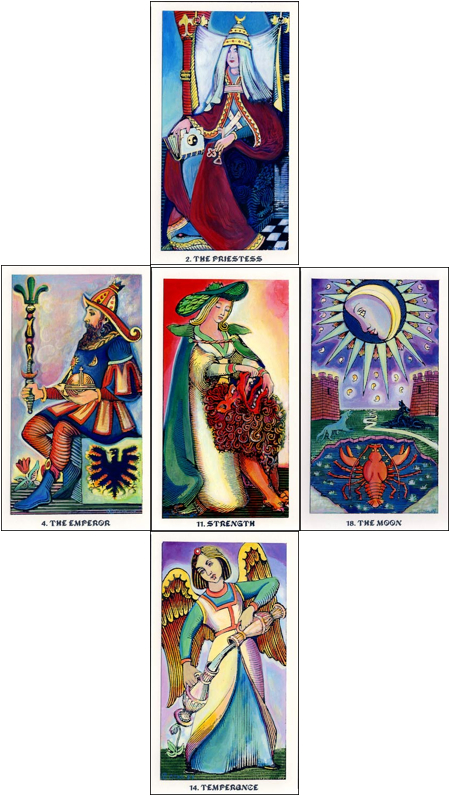
The cards received give an answer that you might find surprising. Please tell us your interpretation in the comments section, but here’s some direction from Wirth. He begins with the center card, stating that it shows what the divination depends on. He then contrasts the “for” (on the left) with the “against” (on the right): “the Emperor puts himself at the service of Strength to whom the Moon is detrimental, being against.” That is, the Emperor opposes (or reigns in) the Moon. Cards in positions three and four offer instruction. The Judge (above) shows what we must do and the Solution (below) shows what will come from doing that. What do you make of these cards?
This is the Radical Wirth Tarot painted by Carol Herzer, a beautiful, 22-card deck currently available in a limited edition, although perhaps not for much longer.
Two upcoming films have Tarot in them:
Wolfman (a remake) directed by Joe Johnson with Hugo Weaving, Joe Johnston, Benicio Del Toro, Anthony Hopkins, Emily Blunt, Geraldine Chaplin (as the gypsy tarot reader). England’s own Kim Arnold was the tarot consultant, tutoring Chaplin for the tarot scenes.
In The Imaginarium of Dr. Parnassus from Terry Gilliam with Heath Ledge, Johnny Depp, Colin Farrell, and Jude Law, the Hanged Man literally appears just as Dr. Parnassus pulls the card from his Tarot deck. For those who don’t mind spoilers here’s a hermeneutical review of the film. (Thanks to Bill Dalz.)
If anyone finds any clips of the tarot scenes please send them to me.
Dr. Flamstead’s and Mr. Patridge’s New Fortune-Book containing . . . Their new-invented method of knowing one’s fortune by a pack of cards appears to be the oldest book with instructions on fortune-telling-with-cards in the English language. The first edition seems to be from 1729—well before Etteilla wrote his 1770 book on “cartonomancie” and contains a “lot” style method of divination in which the card chosen leads to a verse based on your choice from a list of pre-set questions. However we know from the 1730 play Jack the Gyant-Killer that multi-card spreads with meanings for each card were already current in England. (Thanks as always to Ross Caldwell for additional information and corrections.) At some point between 1750 and 1770 a new, much shorter book appeared called Patridge and Flamsted’s new and well Experienced Fortune Book, delivered to the world from the Astrologer’s Office in Greenwich Park, for the benefit of all young men, maids, wives, and widows. Who, by drawing Cards according to the direction of this Book, may know whether Life shall be long or short; whether they shall have the person desired; and every lawful question whatsoever. The signification of Moles in any part of the body; and the interpretation of Dreams, as they relate to good or bad fortune. Along with the change in author spelling there was a major change in the technique portrayed. For the first time we have instructions for a one-card spread and individual meanings given for each card (text appears below).

The individuals in the title are supposed to refer to Dr. John Flamsteed (1646 – 1719), the first Astronomer Royal, and Mr. John Partridge (1644-1715), a well-known writer of astrology books and almanacs and associate of the astrologer William Lilly. However, the names of both Partridge and Flamsteed were appropriated by others as documented by Adrian Johns in The Nature of the book: print and knowledge in the making, p. 619: “But did Flamsteed remain Flamsteed? The question of his identity had been a real one in his own time. Before him there had been no royal astronomical observer in England, and there is evidence that Flamsteed himself was represented by various contemporaries as a virtuoso, an astrologer, a rogue, pedagogue, and a pamphleteer.” He mentions, as an example, a pamphlet, purporting to be by Flamsteed, entitled Plemstadts most Strange and Wonderful Prophecy.
John Partridge was made famous by Jonathan Swift who, under the pseudonym Isaac Bickerstaff, wrote an April Fool’s prediction for the death of Partridge in a spoof astrological almanac (followed by an announcement of Partridge’s death on the date given), after which the name of the still-living-Partridge became legion, appearing on many spurious publications.
Whoever it was who wrote this book, we can be grateful for the first publication in English of playing card meanings. So, without further delay, the instructions and meanings according to Patridge and Flamsted’s new and well Experienced Fortune Book:
Directions whereby the Reader may be informed of the Rules in this Book.
Take a new pack of Cards. Shuffle them well together, Read the rest of this entry »
 Mary K. Greer has made tarot her life work. Check here for reports of goings-on in the world of tarot and cartomancy, articles on the history and practice of tarot, and materials on other cartomancy decks. Sorry, I no longer write reviews. Contact me
 Mary K. Greer's Tarot Blog
Recent Comments