You are currently browsing the tag archive for the ‘tarot’ tag.
James Redfield’s book The Celestine Prophecy recently came up in a discussion.
I read the book when Redfield first self-published it (he couldn’t find a publisher at the time), as he had given a copy to my brother-in-law. I saw it as a parable consisting of “new age” lessons made palatable through its story form. None of the ideas were new to me and the story was nothing more than a teaching device, but I enjoyed being reminded of things that I had experienced myself when “in the flow.” Reading it reminded me of how it is possible to live in that kind of “reality” (at least for short periods) and what magic can arise from it.
Flying home from a trip to visit my then-husband’s parents, as I read the book on the plane, I was especially intrigued by one section. Having just seen his parents, I asked my husband the same series of questions that the protagonist had been asked about his parents. As a result, Ed and I had one of the most deeply meaningful discussions ever about his life purpose or quest (as revealed through his beliefs about his parents).
When I got home I turned the process into a tarot spread that I’ve since used in many tarot workshops and occasional private consultations (always giving credit). I found it far more powerful to do with Tarot, since the cards suggest what may be, at first, a confusing possibility that, once comprehended, can contain a major breakthrough. This spread/process has resulted in significant insights for people. And, for siblings, and those who never knew one or both parents, it has fostered some remarkable healings.
Part One
For each question draw two cards—placing them in two parallel columns: one for your father and one for your mother (keep face down). Turn over and read the cards for one parent first and only after that for the other parent.
The key is to realize that this is not about your actual parents but about your perception of them. The interpretative process should be more about brainstorming possibilities than about applying set meanings. What memories or associations do the cards trigger?
Cards 1 & 2: What did your father(1) / mother(2) stand for and believe in?
Cards 3 & 4: In what way(s) did your father(3) / mother(4) achieve this?
Cards 5 & 6: What kept your father(5) / mother(6) from doing it perfectly?
Cards 7 & 8: What meaning or truth did YOU learn from the above experiences of your father(7) / mother(8)?
Cards 9 & 10: What would you have changed about your father(9) / mother(10) that would have enabled him or her to have a better life?
Part Two
Use the same cards received above (moving them to their own area of the table) and apply the same conclusions you’ve already drawn (although feel free to add new ones). You’ll be looking at these cards from a different perspective.
Cards 7 & 8 (from Part One): What is the Higher Synthesis or Truth for YOU based on what you learned from your parents? You derive this by blending Cards 7 & 8 along with the insights you had about them.
For instance, a summary of your earlier insights might be: My Higher Synthesis or Truth is that I believe in 7:”standing up for” 8:”the beauty of life.”
Cards 9 & 10 (from Part One): What do you want to find out how to do? This is based on your being able to integrate and do what you believe your father and mother SHOULD have done to live a better life.
Summarize this as:
My Life Quest is to find out how to ________. Combine 9 & 10 into a statement reflecting what you think they each should have done.
For instance, My Life Quest is to find out how to 9:”live my own truth” while 10:”caring deeply for others.” This might also be stated as, “. . . know the truth in myself about caring for and being sensitive to others.”
From this perspective, your Life Quest is to fulfill what you perceive as lacking in your parent’s lives—what you see as their unfulfilled potential or destiny. You combine these perceptions, deriving from the combination something that is unique to you. Thus, it is a kind of spiritual DNA.
As Carl Jung noted: “What usually has the strongest psychic effect on the child is the life which the parents . . . have not lived.” (The Red Book)
I’ll always be grateful to James Redfield and The Celestine Prophecy for this process.
Recently, at PantheaCon (a huge pagan conference in San Jose, California), I led a “Tarot Intel Circle” with around a hundred people and was asked by several participants to provide a description so they could do it themselves. There are two forms of this process: the “Intel Circle” that can be done with any number of people from a dozen to over a hundred, and the “Tarot Council Circle” that works best with around 6 to 16 people. Each person in either circle gets to be both a Questioner and a Respondent. At most workshops the participants range from those who’ve never read a tarot card to professional readers and everything in between. Everyone gets something out of it, and it often provides a huge kick-start to one’s intuitive abilities—opening a door and switching something on in the psyche. It’s a good process to use at the beginning of a tarot course.
The Questioner usually focuses on one issue or situation about which they want to gather information, although they can change the issue at any time. In both Circles it is helpful to begin by asking, “What do I most need to look at around _(insert issue)_?“ It can be as specific as, “around the problem with the person at work who is driving me crazy” or as general as “around my life purpose.” As the process continues, Questioners can keep asking the same question or reframe it to focus on different aspects of the issue.
Questions should be brief and to the point. The Respondent draws a tarot card (more about this later) and, based on impressions from that card, responds to the question. Usually only a minute or so is allowed for each response before moving on to the next person and question. No response is right or wrong, but rather it offers information, options and possibilities, or layers of meaning. No card meaning is right or wrong. As a Respondent, you don’t have to fix anything!—which is my number one rule.
UPDATE: The germ of these processes was the “Tarot Game” created by Australian artist, Peter Rosson (1954-2002). Originally it involved a small circle of guests who were invited to explore right/left brain interaction, the creative process and the “profiling” of a personal issue using Tarot. May this seeding of Rosson’s creative brilliance continue to grow and flourish.
The Intel Circle
The Intel Circle consists of an inner and outer circle with the same number of people in each, facing each other. The outer circle stays in place (and those who need to sit can do so), while the inner circle stands and moves one person to the right for each question/response interaction. I call time, direct the movement, and I change the rules for each interaction (leaders: a mic and gong are very helpful with large groups). Before we begin, the Questioners draw five cards each from a mixed pool of several tarot decks and will keep these same cards as long as they are Questioners. These cards contain the keys to their issue. As each interaction begins, they ask their question, and the Respondent (across from them) draws one of their five cards, looks at it and responds to the question. Then I ring the bell, the card is returned, and the inner circle moves one person to the right, where a new interaction (with a new prompt) begins. Karen Krebser described her experience as “controlled chaos” with no time for self-doubt.
I’ve provided sample “prompts” for each interaction below. After six or seven interactions everyone switches roles, so that the Questioner can be the Respondent and vice-versa.
The Council Circle
For the smaller Council Circle everyone sits in a close circle (can be around a table) facing everyone else, with one or more decks in the center. The first person addresses their question to the person to their left, who pulls a card and responds. The Respondent then becomes Questioner, turns to the person to their left and asks their own question, that person responds, and so on clockwise around the circle. After responding to a question, people often need to be reminded to switch into asking/Questioner mode as it involves a right-brain/left-brain switch. It is worth becoming aware of how this switch operates in yourself. As leader, I change the “rules” or prompts with each round. After a couple of rounds we change direction (so the question is asked of the person to your right). If doing a long session of several hours, you can have everyone sit in a different seat after a break. In the Council Circle, the leader can also be a participant and usually starts and ends each round.
Towards the end of the whole process, have one person ask a question while each of the others draws a card with which to respond to the question. You can follow with another person asking a question, draw only one card for the whole group, and everyone responds in turn to that that one card. These final questions can be personal, but it’s also a good opportunity to explore spiritual, community and/or world issues. In the Council Circle much more group rapport is built as everyone hears each person’s questions and the responses.
I frequently remind participants that it is up to the questioner to determine what works for him or herself—that this is information-gathering from which they are to pick and choose what seems most meaningful and relevant to themselves. Handled well, it should end up with a deep bonding and a sense of being seen and supported by the whole.
The Leader
The leader is responsible for seeing that the pace moves briskly along, that no one challenges, harangues or criticizes another, and that no one tries to impose their views. The Respondent responds to, rather than “answers” the question. The responses may be possible actions for the questioner to consider but should never be insisted upon. Respondents should not be allowed to lecture or argue for their perspective, nor should other participants question someone’s interpretation. It can sometimes be wise to begin a response with: “If this were my issue, I’d . . .” Personally, I offer gentle but frequent reminders that as respondents, we “don’t have to fix anything,” as this is an essential theme for me. Always support the Questioner’s assessment, for the questioner is the final arbiter of his or her own life. The most relevant information tends to rise to the top. On the other hand, encourage everyone to open themselves to new possibilities.
What is said in the circle stays in the circle and should never be mentioned elsewhere. Trust is paramount, which is especially apparent in the Council Circle.
At the beginning and end, the leader should take a couple of minutes to ground, center and focus everyone, state the group intent, and open (or close) the relevant energy centers for intuitive work. If appropriate to the situation you can set wards and call in guides. An informal-style Council Circle can work in a quiet, supportive social environment without needing a ritual format, but the leader should still be in control and gently guide the process.
The Cards
It’s usually best to use decks that have story-telling images on all the cards. Respondents can draw from a single deck, a selection of decks, or a bunch of decks mixed in a “pool,” or a set of cards (or deck) held by the Questioner. It’s also okay to have the Questioner draw a card and hand it to the Respondent. Whatever works!
The Prompts
Most of the following prompts are for the Respondent, but a few require something from the Questioner. While I usually begin with the same first few, I vary the later prompts as my own intuition directs me. The Respondent should begin speaking immediately and for the entire time given, repeating thoughts, if necessary. When in doubt, simply describe the card! Each item below consists of one interaction lasting a brief one to two minutes. Indented items are part of the prior interaction and may require slightly more time. Occasionally ask the Questioner to summarize what they’ve learned so far (a few summary points are suggested below). For most of the interactions the Questioner remains silent except for asking the question. Note: it’s okay for the Questioner to see the card drawn.
After the Questioner asks their question, the Respondent draws a card and—
• responds with the first thing on the card that catches his or her eye.
• responds by literally describing the image on the card (no meanings or interpretation allowed).
-follow by prompting the Respondent to repeat everything they just said in the 2nd person, present tense (“You are . . .”).
• responds by describing what seems to be the emotions, feelings and attitude of the figure(s) on the card and the mood and atmosphere of the environment.
-follow by prompting the Respondent to repeat everything they just said in the 2nd person, present tense (“You are feeling . . .”).
• the Questioner thinks the question silently (not aloud) and the Respondent responds with something suggested by the card.
• responds with a question (that is, answer a question with a question based on the card drawn).
-Optional: Questioner says what the Respondent’s question brought up.
• responds by not looking at the card (draw one but don’t look at it).
• breathes in the card and then responds with ONE word.
-Optional: Questioner tells how that word is relevant to their question.
• responds with one or more metaphors, aphorisms or sayings based on the literal image (“Been down so long it looks like up to you.” “Beggars can’t be choosers.” “You’ve got the whole world in your hands.” “It’s like being stuck on a fence.”)
• responds with what the person “should do.” (The Questioner can be asked to phrase their question accordingly: “What should I do about . . . ?”)
• responds with what the person “shouldn’t do.” (Ditto. Have the “should/shouldn’t” prompts follow each other.)
• responds with a wild, crazy fairytale using the card as the illustration, and beginning “Once upon a time . . .”
-prompt the Respondent to repeat everything they just said in the 2nd person, present tense (“You are . . .”).
• responds with “The lesson of this card is . . .”
• responds with “The worst case scenario described by this card is . . .”
• responds with “The best case scenario is . . .” (Pair it with the preceding.)
• responds as if the Respondent were a figure on the card, by speaking as that figure.
• responds with “Yes, if . . .” or “No, if . . .” or “Maybe, if . . .”. (Have the Questioner ask a yes/no question.)
• Have the Questioner say how all these responses relate to their issue. (Can insert this whenever it seems appropriate—not too often, but definitely at the end.)
I sometimes end with each person creating an affirmation based on the qualities that they perceive in one of the cards that they most want to develop in themselves, and committing to an action that is in alignment with that.
For Further Development
Many more possibilities are suggested by the exercises in my book 21 Ways to Read a Tarot Card, which also presents techniques that will make you a more effective and empathic leader of this kind of group process. See especially Step 21 for the affirmation process and the “Traps and Solutions” in Appendix H.
James Wells’ reports on his experience when I taught this process at Readers Studio 2010.
 Here’s a classic “reclaimed spread” in the form of a five-card-cross that is most often found in French and continental Tarot books. The version I offer here is from Oswald Wirth’s Tarot of the Magicians, with an introduction by me (originally published as Le Tarot, des imagiers du moyen-age, 1926). Wirth claims to have learned it from his teachers, Stanislas de Guaita and Joséphin Péladan (famous 19th century French occultists). It uses only the Major Arcana. Note that the card layout itself will probably be familiar as it has been adapted to many different kinds of readings, some of them focusing on the four elements or directions with the fifth-essence/situation/resolution in the center. The original spread is quite different. Note: This new edition of the book includes a reproduction of Wirth’s original 1889 Major Arcana!
What’s great about the Oswald Wirth version is that it’s based on the premise that your case is being considered in a court of law with the result being advice or direction for achieving success. The Major Arcana cards that turn up are characters in the resulting courtroom drama and should be seen as acting in a manner aligned with the card and presenting its unique attitudes and perspectives. Ham it up; imagine a scene from your favorite legal-eagle TV show.
Ask a specific question, and using only the Major Arcana, shuffle and cut. Then, taking cards from the top of the deck (*see alternate technique below), place them in the positions indicated.
The first two cards are the lawyers and the evidence presented by the two sides.
THE CARD ON THE LEFT is affirmative, showing what is in favor of (“for”) the situation. It points to what it is wise to do and those people or qualities on which one can depend.
THE CARD ON THE RIGHT is negative (the opposing counsel) and represents what is “against” it. It points to hostilities that should be avoided or feared: the fault, enemy, danger or the “pernicious temptation.”
THE CARD ABOVE is the judge who discusses the evidence, weighs the pros and cons, and may arbitrate between the for and against. The judge helps clarify the decision to be made and gives advice as to what’s required.
IN THE CARD BELOW the “sentence,” result or solution is pronounced. Taking into account the synthesis of the fifth card, this “voice” of the oracle offers a look into what comes from the decision. It may contain a “teaching” about what style, attitude or demeanor is ultimately to be aimed for.
THE CENTER CARD is determined by adding the numbers of the first four cards and reducing to 22 or less.** It is a synthesis of what has gone before, and points out what is of prime importance on which everything else depends. Although placed last, Wirth reads it first, since the situation or topic depends on it.
The Fool is considered 0 when adding or 22 when it is the result of the addition. The fifth/center card may be the same as one of the other four.
* Wirth suggests a special way of selecting the first four cards that you can use if you like. Shuffle the Major Arcana and then ask the querent for the first number between 1 and 22 that comes into her head. Count down that many cards and place the final card of the count in position one. Shuffle again and repeat for each of the next three positions.
** A much superior way of obtaining a reduced synthesis, numerologically speaking, is to add all the cards and then subtract 22 from any sum over that. This is the only way to get a true range of card possibilities as your synthesis. (Thanks to Steve Mangan, aka Kwaw, who did the math!)
In a sample interpretation Wirth asks “How should one advise a would-be diviner?” (That is, What advice should be given to a person who wants to become the best tarot reader possible?)
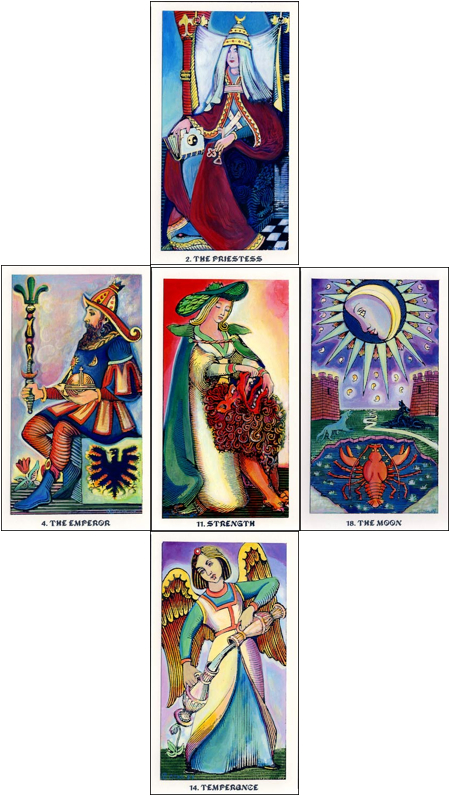
The cards received give an answer that you might find surprising. Please tell us your interpretation in the comments section, but here’s some direction from Wirth. He begins with the center card, stating that it shows what the divination depends on. He then contrasts the “for” (on the left) with the “against” (on the right): “the Emperor puts himself at the service of Strength to whom the Moon is detrimental, being against.” That is, the Emperor opposes (or reigns in) the Moon. Cards in positions three and four offer instruction. The Judge (above) shows what we must do and the Solution (below) shows what will come from doing that. What do you make of these cards?
This is the Radical Wirth Tarot painted by Carol Herzer, a beautiful, 22-card deck currently available in a limited edition, although perhaps not for much longer.
Two upcoming films have Tarot in them:
Wolfman (a remake) directed by Joe Johnson with Hugo Weaving, Joe Johnston, Benicio Del Toro, Anthony Hopkins, Emily Blunt, Geraldine Chaplin (as the gypsy tarot reader). England’s own Kim Arnold was the tarot consultant, tutoring Chaplin for the tarot scenes.
In The Imaginarium of Dr. Parnassus from Terry Gilliam with Heath Ledge, Johnny Depp, Colin Farrell, and Jude Law, the Hanged Man literally appears just as Dr. Parnassus pulls the card from his Tarot deck. For those who don’t mind spoilers here’s a hermeneutical review of the film. (Thanks to Bill Dalz.)
If anyone finds any clips of the tarot scenes please send them to me.
Dr. Flamstead’s and Mr. Patridge’s New Fortune-Book containing . . . Their new-invented method of knowing one’s fortune by a pack of cards appears to be the oldest book with instructions on fortune-telling-with-cards in the English language. The first edition seems to be from 1729—well before Etteilla wrote his 1770 book on “cartonomancie” and contains a “lot” style method of divination in which the card chosen leads to a verse based on your choice from a list of pre-set questions. However we know from the 1730 play Jack the Gyant-Killer that multi-card spreads with meanings for each card were already current in England. (Thanks as always to Ross Caldwell for additional information and corrections.) At some point between 1750 and 1770 a new, much shorter book appeared called Patridge and Flamsted’s new and well Experienced Fortune Book, delivered to the world from the Astrologer’s Office in Greenwich Park, for the benefit of all young men, maids, wives, and widows. Who, by drawing Cards according to the direction of this Book, may know whether Life shall be long or short; whether they shall have the person desired; and every lawful question whatsoever. The signification of Moles in any part of the body; and the interpretation of Dreams, as they relate to good or bad fortune. Along with the change in author spelling there was a major change in the technique portrayed. For the first time we have instructions for a one-card spread and individual meanings given for each card (text appears below).

The individuals in the title are supposed to refer to Dr. John Flamsteed (1646 – 1719), the first Astronomer Royal, and Mr. John Partridge (1644-1715), a well-known writer of astrology books and almanacs and associate of the astrologer William Lilly. However, the names of both Partridge and Flamsteed were appropriated by others as documented by Adrian Johns in The Nature of the book: print and knowledge in the making, p. 619: “But did Flamsteed remain Flamsteed? The question of his identity had been a real one in his own time. Before him there had been no royal astronomical observer in England, and there is evidence that Flamsteed himself was represented by various contemporaries as a virtuoso, an astrologer, a rogue, pedagogue, and a pamphleteer.” He mentions, as an example, a pamphlet, purporting to be by Flamsteed, entitled Plemstadts most Strange and Wonderful Prophecy.
John Partridge was made famous by Jonathan Swift who, under the pseudonym Isaac Bickerstaff, wrote an April Fool’s prediction for the death of Partridge in a spoof astrological almanac (followed by an announcement of Partridge’s death on the date given), after which the name of the still-living-Partridge became legion, appearing on many spurious publications.
Whoever it was who wrote this book, we can be grateful for the first publication in English of playing card meanings. So, without further delay, the instructions and meanings according to Patridge and Flamsted’s new and well Experienced Fortune Book:
Directions whereby the Reader may be informed of the Rules in this Book.
Take a new pack of Cards. Shuffle them well together, Read the rest of this entry »
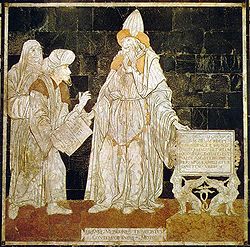 A book called The Kybalion: A Study of the Hermetic Philosophy of Ancient Egypt and Greece by Three Initiates was published in Chicago in 1912. It presented seven fundamental working principles of Hermeticism. But, what is Hermeticism?
At the base of the occult tarot and especially the tarot of the Hermetic Order of the Golden Dawn and the Builders of the Adytum (BOTA) lies a philosophical system or religious philosophy. It derives from a series of anonymous writers who used the nom de plume Hermes Trismegistus (Thrice-Blessed), a composite of the Greek Hermes, Roman Mercury, and their Egyptian counterpart, Thoth. In the 2nd and 3rd centuries C.E., the set of writings known as the Corpus Hermeticum brought about a brief renaissance of pagan thought. Read the rest of this entry »
Part I: Skeptics, Mentalists and Tarot Readers
 For purposes of this article let us assume that there is no paranormal or spiritual aspect to tarot readings. Let’s pretend, for the moment, that all tarot readings have a rational basis in easily explained normal human skills.
Skeptics and mentalists reduce tarot reading to just this level. Mentalists utilize skills to make money in public performances, while skeptics denounce any tarot or psychic readings that don’t acknowledge they are merely mental tricks. They claim “pseudo-psychics” exploit human weaknesses and take advantage of the desire to easily gain benefit from something. Pseudo-psychic readings are seen as “too-good-to-be-true” and as giving false hope just to make money. Skeptics claim that psychic and tarot readings can be explained by techniques gathered under the terms Cold and Hot Readings. We will ignore hot readings (that fraudulently use information obtained ahead of time) as our purpose is to examine readings where nothing prior is known about the client. Read the rest of this entry »
I no longer update this post, but you’ll find a lot of old information about Tarot in movies and Tarot on TV. Please post in the comments when you see one so we can keep a running list in the comments. The more info the better.
See especially Richard Kaczynski’s wonderful list of Thoth Sightings in film and TV.
TV
 Read the rest of this entry »
The Hermetic Order of the Golden Dawn introduced what I consider the most extensive and elegant set of correspondences among the tarot and other magical systems. Here is a permutation I hadn’t seen before. It’s from The Magical Writings of Ithell Colquhoun edited by Steve Nichols. Colquhoun was an artist, magician and the biographer of MacGregor Mathers (Sword of Wisdom-o.p.). Magical Writings contains over a hundred pages of text on the Major Arcana (material on the last five cards added by Steve Nichols), plus reproductions of pages from Colquhoun’s tarot notebooks. It’s a treasure-trove for the discerning reader.
THE PLANETARY TRIPLICITIES – based on correspondences to the planets and the signs they rule.
MERCURY: Magus, Lovers, Hermit (Mercury, Gemini, Virgo)
MOON: Priestess, Chariot, Hanged Man (Moon, Cancer, Elemental Water)
VENUS: Empress, Hierophant, Justice (Venus, Taurus, Libra)
SUN: Sun, Strength, Judgment (Sun, Leo, Elemental Fire)
MARS: Tower, Emperor, Death (Mars, Aries, Scorpio)
JUPITER: Wheel, Temperance, Moon (Jupiter, Sagittarius, Pisces)
SATURN: World, Devil, Star (Saturn, Capricorn, Aquarius)
(Fool = Elemental Air)
These groupings can be very handy in a reading where the occurrence of two or three cards from one of the triplicities indicates a strong influence by that planetary energy. Mythically, it suggests the presence of that God/dess messing around in one’s life.
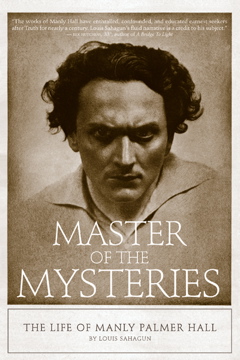
Last night I went to a lecture and book signing by Louis Sahagun, author of a biography of Manly Palmer Hall called Master of the Mysteries. Sahagun is a journalist at the Los Angeles Times and was working night duty on September 2, 1990 when the call came in that Hall had died at 89 years of age. Knowing nothing about the man, Sahagun looked him up in the files, finding little until he got back to the 1930s and 40s when he stumbled onto stacks of clippings. He wrote a brief obituary that didn’t begin to touch on the accomplishments of this internationally known metaphysician and occult scholar who eventually was a victim of extreme elder-abuse and probable murder.
Sahagun became fascinated by Hall’s story, was given access to several archives, interviewed dozens of people who had known Hall, and examined the police and medical reports on what is still an open suspicious-death investigation.
Hall is of interest to those of us in the Tarot world for his creation of what’s known as the Knapp-Hall Tarot deck, first published in 1929 by artist J. Augustus Knapp, illustrator of two of Hall’s first books, including the famous The Secret Teachings of All Ages (the latest edition is in its 16th printing).
I’ll leave you to read the fascinating details of the book from this article in the L.A. Times or listen to this podcast interview with Sahagun.
I want to talk here about the conversation I had with Louis Sahagun about the cult status of spiritual teachers. During his research Sahagun discovered an amazing but flawed human being—someone who married disastrously, fell behind the times and finally succumbed to the machinations of a conman. Despite this, Sahagun felt that he had found a man of immense talents and great personal integrity who warned against putting teachers on a pedestal. It is apparent that Hall’s scholarship left something to be desired (he had only a 6th grade education but a photographic memory), but it’s hard for many to accept that Hall could have been less than perfect. Sahagun was struck by the number of followers who seemed to do nothing with their lives but slavishly espouse the teachings. On the other hand, hundreds of people—mostly in the arts—creatively integrated Hall’s metaphysical principles into their work—making it their own. These included such diverse people as an L.A. mayor, a governor of California, Elvis Presley and Bela Lugosi.
Personally, I’ve been struck by the number of people who discover lies, misconduct or incorrect facts in the lives and work of their heroes and respond by either completely rejecting the teacher and work or by rejecting any evidence of a problem. Typical is a comment about the book from someone who regularly attended Hall’s lectures: “I wasn’t aware of any controversy surrounding Mr. Hall’s death either…. It was natural causes—and I suppose natural causes for an author to claim controversy.” This person has no desire to examine the evidence before claiming that the biographer must be lying.
When writing my biography of four original members of the Hermetic Order of the Golden Dawn, Women of the Golden Dawn: Rebels and Priestesses, I believed it vitally important to examine their flaws as well as their strengths. How are we to learn from someone’s story if we don’t see how that person navigated the difficulties of life? How can we evaluate a work if we aren’t willing to explore what’s true and what isn’t and what ‘works’ and what doesn’t? It’s important to realize that everyone is human. Just before I completed the biography, an acquaintance sent my text involving a different spiritual teacher, now deceased, to that person’s organization. I received a phone call asking me to remove quotes from letters that included accusations of an affair with someone he later married. It was felt this might harm the public perception of him as a great and good man. I ask, how are we ever to develop discrimination if we believe that spiritual teachers are somehow more perfect than the rest of us or that everything they write is Divine Truth?
The way I see it, there are three unacknowledged magical “initiations.” The first is when we come across a teaching or practice and have to determine if it contains a truth or way to which we want to commit ourselves. The second initiation is when we discover we’ve been betrayed by ‘lies’ and we have to decide to leave or continue the work. The third initiation is when we discover that the lie itself contains a greater truth. The second initiation is betrayal and until we have confronted betrayal and moved through it we will never encounter the third initiation. We experience these three initiations all the time, although a fourth is proposed that takes us beyond the world of truth and lies.
 Mary K. Greer has made tarot her life work. Check here for reports of goings-on in the world of tarot and cartomancy, articles on the history and practice of tarot, and materials on other cartomancy decks. Sorry, I no longer write reviews. Contact me
 Mary K. Greer's Tarot Blog
Recent Comments