
You are currently browsing the yearly archive for 2008.
In my talk at the Los Angeles Tarot Symposium (LATS) this past weekend, I asked participants to draw three cards that would predict something specific that would happen to them within the next week. They were to get suggestions regarding what this might be from other tarot readers at the symposium and write these down. Then I asked that they watch what actually happens and what most relates to these three cards over the next two or more weeks (timing is not one of tarot’s best features), and report back here in the comments section of this post.
I invite anyone else who wants to “play” to comment here. Please state:
- what three cards you drew,
- the specific prediction made for the following week,
- and then tell us how these three cards most relate to what actually happens.
Feel free to come back later and add anything else to the comments section that seems relevant down the road.

Thanks to Barbara Rapp-Geerling and The Crystal Cave in Costa Mesa CA for making this event possible.
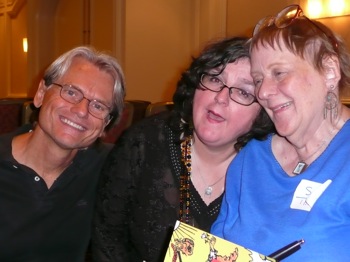
Here’s a photo showing one of the moments missed if you didn’t attend this year’s LATS (please come next year). A great time was had by all with many talks on the theme of happiness. From the left: James Ricklef (see his self-published deck Tarot of the Masters), Thalassa, and Sandra Thomson (read an interview with her) click on their names to find out more about what they’ve contributed to tarot.
When does a traveler stand concurrently at both the beginning and the end of his journey . . . ready to embark, yet puzzled by the dust of travel already on his shoes?
from The Last Days of Madame Rey: A Stephan Raszer Investigation by A. W. Hill.
The answer can be found in the comments section. Don’t look until you think you’ve got the answer.
Went to hear Coleman Barks read poetry last night. It was food for the soul! I was especially struck by the first poem he read—“The Water You Want”—from Rumi. It began
“Someone may be clairvoyant, able to see the future, and yet have very little wisdom,”
which, of course, caught my attention.
The poem speaks of a man who sees water in a dream and, still in the dream, convinces others to follow him toward this mirage, when all along he is sleeping next to a river of pure water (ultimately no further than the blood in his veins). This points up how we live in a dream, and we are advised to:
“Give up subtle thinking, the twofold, threefold multiplication of mistakes. Listen to the sound of waves within you.”
To me this speaks of the paradox inherent in reading tarot, where we miss seeing the, often simple, import; we miss the sound of waves within. Nevertheless, I sometimes let myself wander in the dream, drawn by a mirage or two or three. In the case of The Best Cities for Singles reading, I even encouraged several people to wander along with me. Yet, there is a point when I wake to the rhythmic pulse of the water within (of which such poetry serves to remind me).
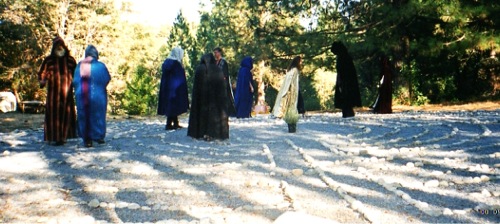
Without the dream and without the peregrinations, I may never have come to know the pure water for what it is. The tarot takes me through a labyrinth, a winding in and out, back and forth, to reach a center that is no further than the next heartbeat, yet known all the better for the journey to it. Yes, I lie next to the water I want, but I value it more for having followed the mirage, and knowing that, too, for what it is. Photo: Walking a Chartres-style labyrinth with friends.
You have two chances coming up on the West Coast to take part in tarot workshops; meet people; hear about and see decks in the creation phase; find a teacher; buy new, unusual and hard-to-get tarot paraphernalia, and have an all’round great time.
Saturday, September 27, 2008, 8:30 am to 6:30 pm. The Los Angeles Tarot Symposium (LATS)
The Los Angeles Tarot Symposium (LATS) was started by Barbara Rapp-Geerling of The Crystal Cave, with the help of Thalassa (BATS). It gives a chance for Southern California tarotists to meet on their home turf, although people come fom all over the country. This year it’s happening in Irvine (Orange County).
Correction: October 4-5, 2008. The Bay Area Tarot Symposium (BATS)
The San Francisco Bay Area Tarot Symposium (BATS) took over where an earlier tarot conference series, begun in 1979, left off and as an off-shoot of the infamous Tarot Network News. Thalassa and Daughters of Divination* have done a great job of keeping it going when all else failed, carrying on a venue where tarotists from all over the US have been gathering for almost 30 years. It’s through connections made at BATS that numerous decks and books have been sold to publishers, and people have formed important support and friendship networks. The symposium is one-day but for those who choose to stick around there is a more informal Tarot Salon on Sunday at the hotel just around the corner.
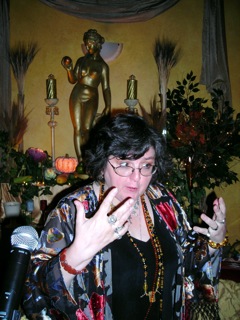
Do yourself a favor by attending a symposium at one or both of these venues to experience cutting-edge tarot at its best and in the making. They are scheduled only a week apart so that travelers can attend one in LA, take a week to drive up the fabulous coast road, and then attend the second in SF. You’ll find more information on the EVENTS page. Photo: Thalassa speaking at LATS.
[* Even guys can be a Daughter of Divination.]
I’ve found those see-through organza bags to be perfect for displaying decks that come in huge boxes. I put the box in storage and the deck in my bookcase where I can identify it easily without having to take it out of its bag. Corrine Kenner has a link to a site with great prices on packages of 30 single color bags – or get together with a couple of friends and buy several colors to mix-and-match. While at Corrine’s blog, check out the latest on her upcoming book Tarot for Writers, which is sure to be a hit.
Bright Idea: I bought “Smokey Blue” organza bags. I’ll bring them to LATS and BATS to trade colors with those who bought other colors. I’ll also have my knitted tarot cases for sale.
Added: I’ve been told these bags are available very inexpensively at Dollar & gift stores. My local stores don’t sell the right size, but I’ve been told others do. Anyway—I have a shelf full of Llewellyn books and decks and found it was the best way to keep the decks so I could find them easily.
What does it say that I’ve lived in five of the top 12 “Best Cities for Singles” (according to Forbes Magazine), and I have visited another five (of the top 11) in the past seven years (all tarot related trips) yet haven’t dated since my divorce?

I was struck by the oddity of this coincidence (since among the other 28 cities I’ve only lived in one and visited three). [I admit D.C. was a bit of a cheat since we lived in Falls Church though we were there because my father worked in D.C.]
I drew three cards (no spread positions) to answer my question and got (in the order I drew them):
The King of Wands, Five of Pentacles and King of Swords. 
I suppose the cities could be pure coincidence, but it doesn’t feel like it, and the spread seems very odd—like something I don’t really want to know. Since, there are times when we all need someone else’s opinion I’d like to ask for help in understanding this. Please comment. Feel free to be wild with your thoughts—don’t hold back. I should mention—I lived in three of these cities as an army brat (King of Swords?). I’ve always loved the travel and no hardship was involved, so it’s hard to see the Five of Pentacles as referring to anything external.
I see this as an example of how the silliest of seeming coincidences can be a catalyst that takes us deep into the hidden realms of ourselves if we bother to look. The question at the top was what popped into my head spontaneously as I looked at the list. I decided to take the question seriously and see what came up.
ADDED: The comments have taken me on an incredible journey of insight that has reached so many levels. However, the most immediately significant thing for me is that my father (identified above as possibly the King of Swords) died on Thursday (9/11-Patriot Day) at a military nursing home. He had worn an electronic buzzer (see bell around cripple’s neck) that would go off whenever he tried to get out of his wheel chair. This seems like a foreshadowing similar to that mentioned in my post on Prediction or Insight. After all, my inquiry arose in the first place because I couldn’t understand why that silly list wouldn’t let me go. I phrased the question in the only way that made sense to me at that time. [BTW, I originally posted this on 9/9 (my time zone was incorrect).]
On September 3, 2008, the Seattle Weekly printed a story regarding a county agency discriminating against a Tarot card reader who wished to offer her services for a charity event.
The American Tarot Association (ATA) has issued a response in the form of a letter to King County Executive Ron Sims, along with a Press Release regarding the discriminatory actions of the King County Solid Waste Division.
You’ll find more information and lots of links at aeclectic’s tarotforum – here.
 Scholarly-oriented readers will appreciate a paper on Tarot by Inna Semetsky called “Simplifying Complexity: Know Thyself…and Others” in Complicity: An International Journal of Complexity and Education, 2008, Vol. 5, No. 1 (click on the title and it will download as a pdf). Dr. Semetsky is a Research Academic with the Institute of Advanced Study for Humanity, University of Newcastle, Australia who has been writing scholarly papers on tarot for many years. Drawing on semiotics, systems theory, and ideas about meaning and synchronicity (among others), she posits that Tarot “can be considered an education tool contributing to our learning and, respectively, the evolution of the human mind situation in the larger, both cultural and natural, context.”
In relation to my earlier post on Arcana in the Adytum, I found Semetsky’s description of arcanum to be especially interesting:
Arcanum (or arcana, plural) . . . is the ever present potential catalyst . . . that, when actualized and brought to consciousness, elicits transformations at the levels of thoughts, affects, and actions so that an individual becomes fruitful and creative in his/her possible endeavours. If and when discovered – that is, made manifest at the level of conscious awareness – it becomes a powerful motivational force to facilitate a change for the better at the emotional, cognitive, and/or behavioral levels and thus to accomplish important educational and ethical objectives.
Semetsky also talks about reading tarot as pattern-recognition and the identifying of probabilities of what is likely to happen rather than making fixed predictions. You can read her academic profile here, find more of her publications here and listen to her talk about tarot on La Trobe Philosophy Radio show here.
The discerning reader will want to compare this paper with a response by James Anthony Whitson (same link above) who appeals to Wittgenstein to determine whether it is even seemly to be “effing . . . the ineffable.” (Love that technical jargon!)
Thanks to Jean-Michel David and the latest issue of the Association for Tarot Studies (ATS) Journal for drawing attention this article.
“The unknowable lives in a pack of cards after it has been fairly shuffled but before it has been dealt, when all the possibilities are open, and when each possibility matters.”
—from Freedom & Necessity by Steven Brust and Emma Bull (NY: Tor, 1997), p. 60. [Note: really good novel but read reviews first to see if it is your cup of tea.]
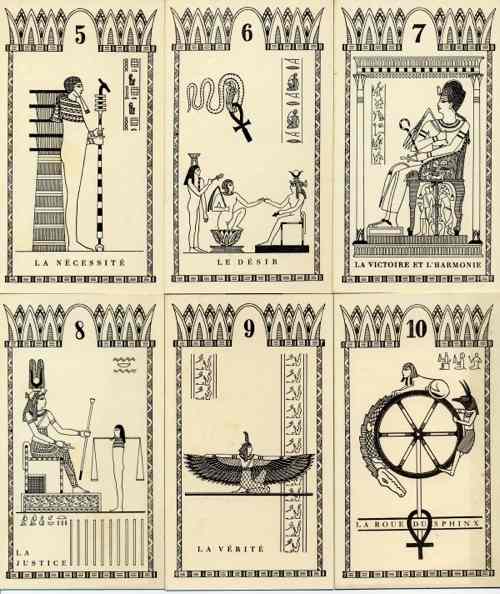
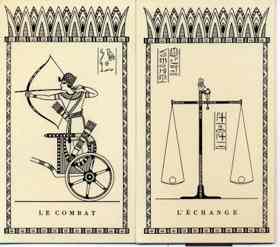
Some of you may know of the twenty-year long study of the Temple of Luxor by the Egyptologist René Schwaller de Lubicz (see bio). Before that Schwaller was a Theosophist, esotericist and alchemist who worked for many years with Fulcanelli. In the 1920s, René and his wife Isha moved to Switzerland and established Suhalia, a center for research into scientific and alchemical studies. While there he developed a motor that ran on vegetable oil.
According to the above internet biography by Gary Lachman:
“In 1936, on a visit to the tomb of Rameses IX in Alexandria, Schwaller had a kind of revelation. A picture represented the pharaoh as a right-angle triangle with the proportions 3:4:5, his upraised arm adding another unit. Schwaller thought it demonstrated the Pythagorean theorem, centuries before Pythagoras was born. From the picture it was clear to him that the knowledge of the medieval masons had its roots in ancient Egypt. For the next fifteen years, until 1951, Schwaller de Lubicz remained in Egypt, investigating the evidence for what he believed was an ancient system of psychological, cosmological, and spiritual knowledge.”
Although I’ve read several books by Schwaller I never knew that he had created his own tarot deck until sent these cards by Christian Dumolard (who documented the Château des Avenières Tarot mosaics of Assan Dina). Information on Schwaller’s tarot interests can be found in Schwaller de Lubicz by H. Dossier and Emmanuel Dufour-Kowalski. You may want to compare the Schwaller de Lubicz Tarot with that of Falconnier and Wegener (see History of Egyptian Tarot Decks). He was obviously considering some notable differences. Enjoy.



 Mary K. Greer has made tarot her life work. Check here for reports of goings-on in the world of tarot and cartomancy, articles on the history and practice of tarot, and materials on other cartomancy decks. Sorry, I no longer write reviews. Contact me
 Mary K. Greer's Tarot Blog
Recent Comments