You are currently browsing the category archive for the ‘For Beginners’ category.
In preparation for the July 2026 Omega Institute tarot workshop, “Wisdom of the Tarot,” I have been posting on Facebook multiple versions of Minor Arcana cards from 21st century tarot decks for comparison. I ask if any keywords or phrases work equally well for all the different decks – one of the themes for the upcoming workshop (stay tuned). My latest example was the 6 of Swords. [It should be noted that the vast majority of new decks are at least loosely based on the Rider-Waite-Smith (RWS) pictures.]
According to the Hermetic Order of Golden Dawn source works and their theory of numbers (c. 1888), derived, in part, from the Kabbalistic Tree of Life, the 6 of Swords, is found on the central sephira of Tiphareth (associated with the Sun). It is, as the GD described it, the “high point” of the Air suit of Mind or Intellect. Associated with the astrological decan of Mercury in Aquarius, it is, at its best, “reason serving humanity.” Centering on Imbolc or Candlemas at 15* Aquarius (Feb 1-2), this fixed sign marks the first truly noticeable return of the light and longer days, heralding the return of Spring.
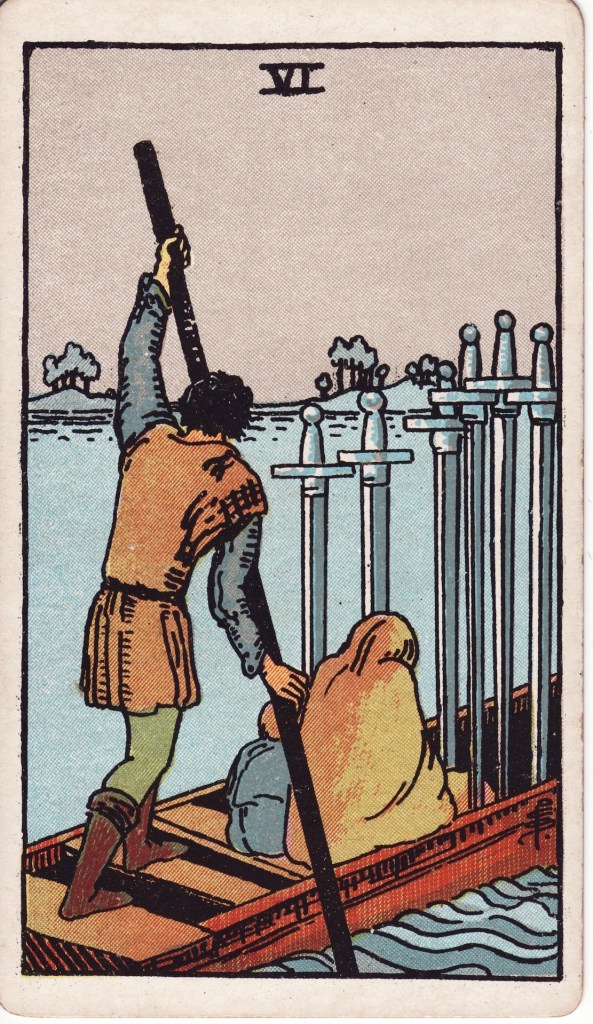
Pamela Colman Smith illustrated this by picturing people we could assume to be a mother and child in a boat poled by a ferryman moving away from rough and into smooth waters. Potential landfall can be seen in the distance. The figures face right, heads bowed so we don’t see their faces. Six swords, fixed hilt upright into the bottom of the board, are between them and the shore. Whether the swords are a barrier for protection or a threat is unsure.
Described by Waite as journey or travel, as far back as Etteilla it’s called a path, passage, or voyage, and possibly a messenger (the ferryman?). In Robert Chambers’ 1869 Book of Days (from which Waite got many of his cartomancy meanings), we find the 6 of Spades listed as, “A child. To the unmarried a card of caution.” Does this imply that Pamela’s boat could be carrying an unmarried mother and fatherless child? The Queen of Spades in this source is called a widowed woman. (Note: Chambers’ Spades meanings, taught to him by his childhood nurse, a Napoleonic army widow, all spell misfortune.)
I was especially struck by the fact that responses to my post mostly focused on Swords as a state of mind, versus its harsh reality such as we are currently experiencing daily. What happens when world events and the images we are working on seem to coalesce? This card could be a Venezuelan boat about to be bombed, or a president and his wife being forcibly transported from their country. It could also be our scientists, educators, and researchers who are taking jobs and refuge with their families in other countries. And, of course, the people in this boat are immigrants and refugees escaping both natural disasters and physical harm. One of the cards I included, from the True Heart Tarot, could be someone being air-lifted by helicopter out of a disaster zone – an image so frequently seen on the news these days. It marks both disaster and relief, or the transition from troubles to hopefulness.
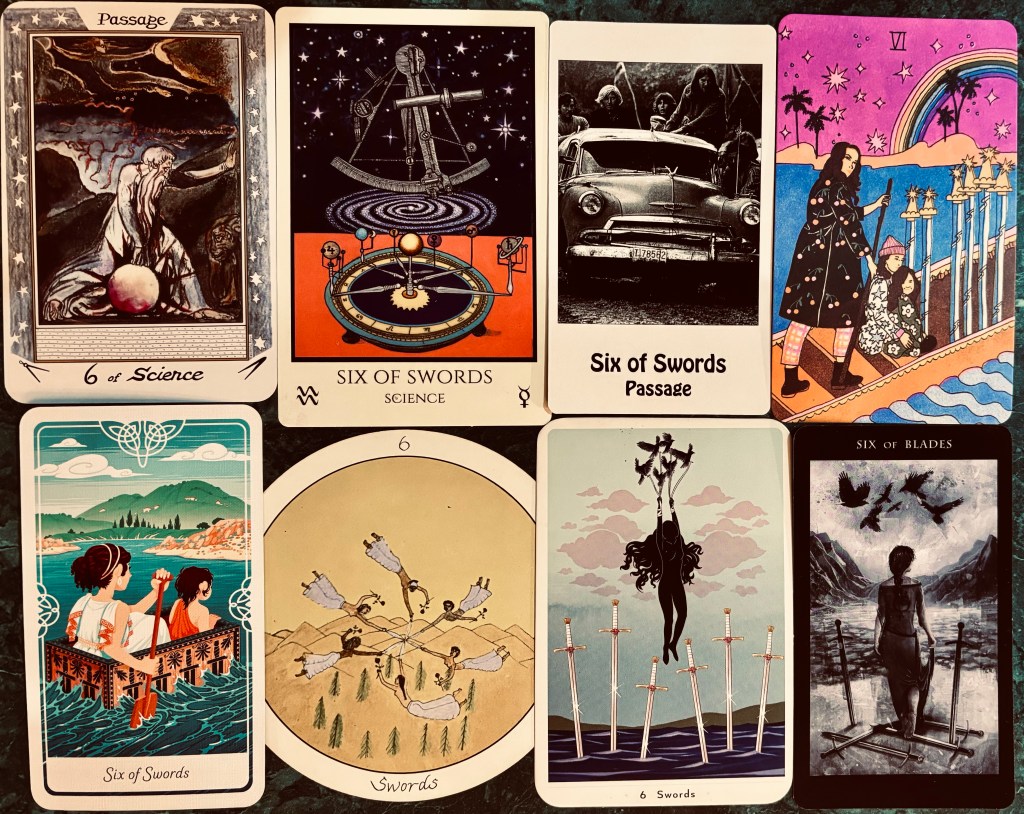
So let’s explore this card a little further. To complicate the issue, we have Aleister Crowley’s keyword: “Science.” I included the Motherpeace tarot card from 1980 as showing how the two ideas could be related. Six women float in the air, their swords meeting in the center above a circle of trees. Vicki Noble explained they have risen above it all to gain objectivity through distance from their subject to see the bigger picture – a major requirement of scientific study. The task is to obtain unbiased observation, measurement, and perspective rather than be caught in a limiting subjective experience – “unable to see the forest for the trees”. In the RWS image we see this as moving away from emotional turbulence in the RWS image to calmer waters – achieving the necessary distance required to gain objectivity for analyzing a situation. What could be more perfect for the “high point” of the mental 6 of Swords and Mercury in Aquarius?
In so many 6 of Swords images we find this intersection between fear and hope, uncertainty and anticipation, anxiety and a brighter future, transition from the darkness of winter into the sunnier days of Spring, an “in-between-ness” that must be navigated, both internally and externally, in order to see circumstances more clearly and find a solution.
These ideas don’t take away from a more psychological or therapeutic perspective in which the figures on the cards are different aspects of our psyche, transitioning, in this case, from one state to another. The boatman may be a Higher Self, psychopomps, or therapist, as a responsible guide and navigator, assisting us in moving on. Our masculine, feminine and child selves are all in it together. The boat is our bridge over troubled waters or any mental crossing. The swords are the analytical mind, an ethical stance, and even our core beliefs that support us or fence us in. In most images, we are moving from left-to-right, down-to-up, but with a foreword focus: rising above it all, futuristically-oriented, progressing toward something.
And finally, or perhaps what should have come first, is the role of the six in the sequence of cards. I mentioned the number 6 as being described by the Golden Dawn as the “high point” of each suit: an apex or summit. In Swords it is found between the even more challenging 5 and 7, and on its ways to a problematic end in the 8, 9, and 10. But, let’s just look at these central three Aquarian cards. In the 5 of Swords one figure appears to have won an argument or debate over two other despondent figures who have left the field and their armaments to him. Readers like to warn, “he won the battle but maybe not the war.” Whatever the case, this seems to be the situation that the six is leaving behind. The 7 of Swords could be what occurs after landing on the distant shore.
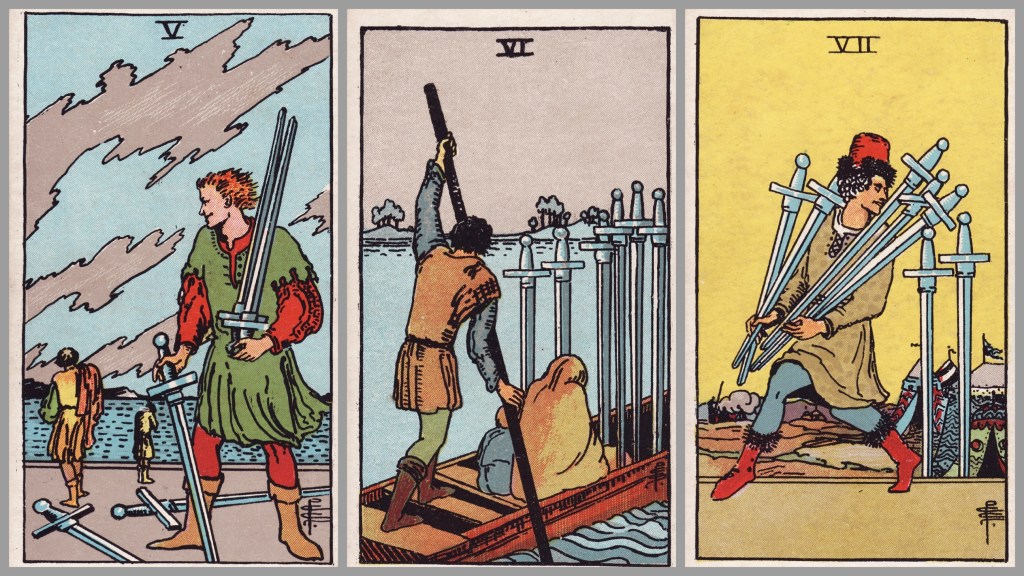
In my imagination, I call the 7 of Swords the “James Bond 007 card”. Following his machismo proof-of-ability in the 5, in the 6, Bond reaches the enemy island, where the villains have assembled a machine of mass destruction. In the 7, he strategically disarms it, winning the day. So, this is a card of disarming either the enemy or some greater force working against your well-being. Yes, it is still lying, cheating, stealing but for what purpose, against whom or what? One other perspective is that of going to the library to gather research: assembling information. To bring it up-to-date, it could be the designers of AI stealing data from copyrighted authors and artists!
Maybe it’s time for pure swordness to move on to another suit? Enough for now. Be sure to share your perspectives in the comments.
Do you feel somewhat alone in your tarot practice? Want to make friends at the same level and with shared interests? Are you looking for inspiration and to up your tarot skills whether reading for yourself or others? And would you just like to have fun with tarot?
Come to one or both Omega Institute Tarot events (discount available for both) in August in beautiful Rhinebeck NY! Omega is a wellness retreat and spiritual summer camp where I have been teaching for 38 years, most of those along with the late great Rachel Pollack.
We start with a 5-day class on August 4-9, Wisdom of the Tarot (click link to go to the Omega info & sign-up page) taught this year by Mary Greer, Carolyn Cushing, and Terry Iacuzzo. It is perfect for all levels, including absolute beginners. The emphasis is on experiencing the cards, starting with an introduction to the Majors, Minors and Courts – always with an excitingly fresh perspective. While we teach the things we love most, we also have the grace, with five days, to tailor many of the processes and topics to the specific interests and needs of this group of participants. Check out this “sneak peek” YouTube video in which Benebell Wen interviewed us about who we are and what we’ll be doing, plus we look at a draw of the cards.
August 9-11 is the weekend Masters of the Tarot Conference, where top teachers, authors, podcast hosts, and deck creators, Nancy Antenucci, Jaymi Elford, Michelle Welch, and Mary Greer share their knowledge and take you on journeys into depth experiences that will transform your tarot practice and perhaps your life. Please come to our FREE Facebook live event, “Tarot Fun in the New Summer Sun” (sign-up here), which will be on Thurs., June 20th (Summer Solstice) and will give you a taste of what you can expect. Magic happens here as you’ll stretch your awareness of what tarot has to offer. While many of our participants focus on tarot as a creativity and personal insight tool, the class also presents ways you can enhance or move into reading for others.


Among the Tarot cards determined by adding the numbers in your birth date, I find most intriguing the Constellation of the Emperor, which consists of the Major Arcana cards whose numbers add up to four: the Emperor (4), Death (13 = 1+3=4), and the Fool (the un-numbered 22nd card of the Majors; 2+2=4). Many people don’t include the Fool in this set. I made the decision to do so based on teaching stories such as King Lear, The Emperor’s New Clothes, and the Sufi Nasruddhin tales that portray the strikingly rich interactions between a ruler and a fool or innocent. Looking further we find in the Greek play, Oedipus Rex a young man who, while running away from home, kills a King at a crossroads. In fairy tales it is often the youngest, most foolish son who ends up solving a problem, killing a monster, and marrying the princess to become the king.
When the power of an established ruler is subverted by madness or the situation becomes untenable by his becoming a puppet or tyrant, it is apparent that what is ruling us must die. The result may be a new king or a return to an original state of innocence: both are major themes of this Constellation.
These cards depict the principle of life force and realization of power. The constellation encompasses the poles of birth and death and the step between: of manifesting oneself on the physical plane. The Emperor is the hallmark of reason and logic. He seeks to own, build and do things that have a lasting effect. Death is the necessity to release and let go for the sake of renewal. It cuts away whatever is stagnant or no longer truly vital and alive. The Fool is the soul freed from all constraints. It is said that a new way of perceiving the world never fully takes hold until all adherents to the old way have died.
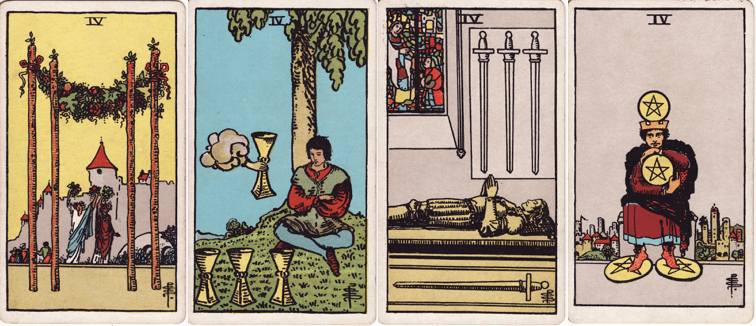
The Minor Arcana Fours
The 4 of Wands points out that community involves rites of passage for each stage/season of life. The 4 of Cups tells us we need to awaken to life’s hidden gifts to relieve stagnation. The 4 of Swords says to stay true to our dreams through stress and afflictions. And the 4 of Pentacles reminds us that true stability is about moving from our center (core, chi, hara) rather than holding fast to material things.
The Emperor/Fool/Death in Contemporary Music
A recent rap music video provides a modern perspective on this age-old theme by including the Emperor, Fool and Death in a powerful archetypal story. “Daechwita” was written, performed and produced by Min Yoongi aka Suga aka Agust D of the Kpop group BTS. It is based on a Korean historical tale that is a perfect expression of the Emperor/Fool constellation. Synchronistically the MV was released on May 22, 2020 – double 22s! Also of significance: the MV refers to Carl Jung’s theory of the Persona, Ego and Shadow, for two of BTS’s recent albums were based on Jung’s “Map of the Soul” (see the book by Murray Stein).
Furthermore, Min Yoongi, in his BTS Persona, Suga, performed a solo for the second Jung-based album, “Interlude: Shadow”, that I’ll also refer to.
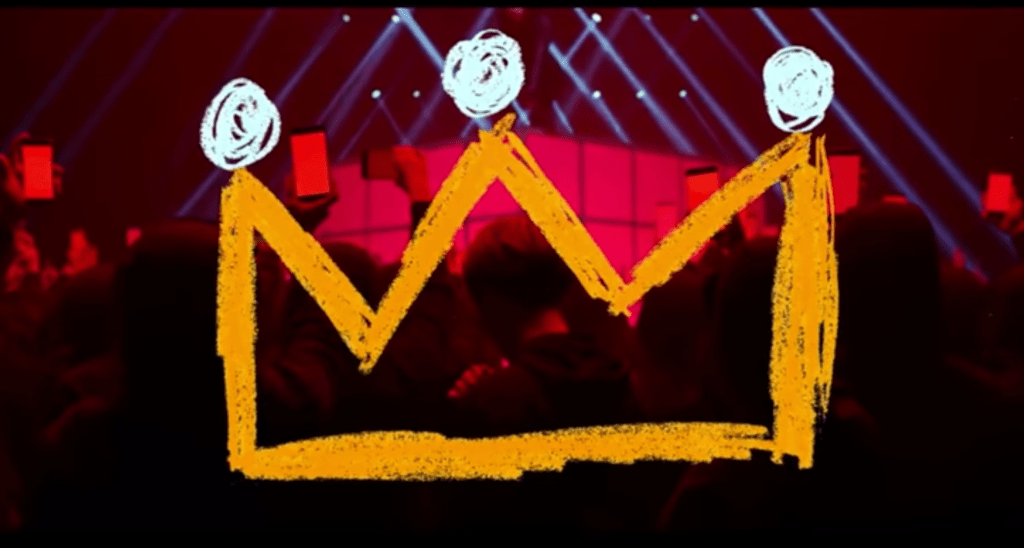
He raps, “I want to be rich, I want to be famous, I want to be the King” while also claiming, like the Fool, “My leap can be my fall,” just like the Fool who leaps from a cliff edge.
He sings, “I want to be rich, I want to be famous, I want to be the King.” While claiming, like the Fool, “My leap can be my fall.”
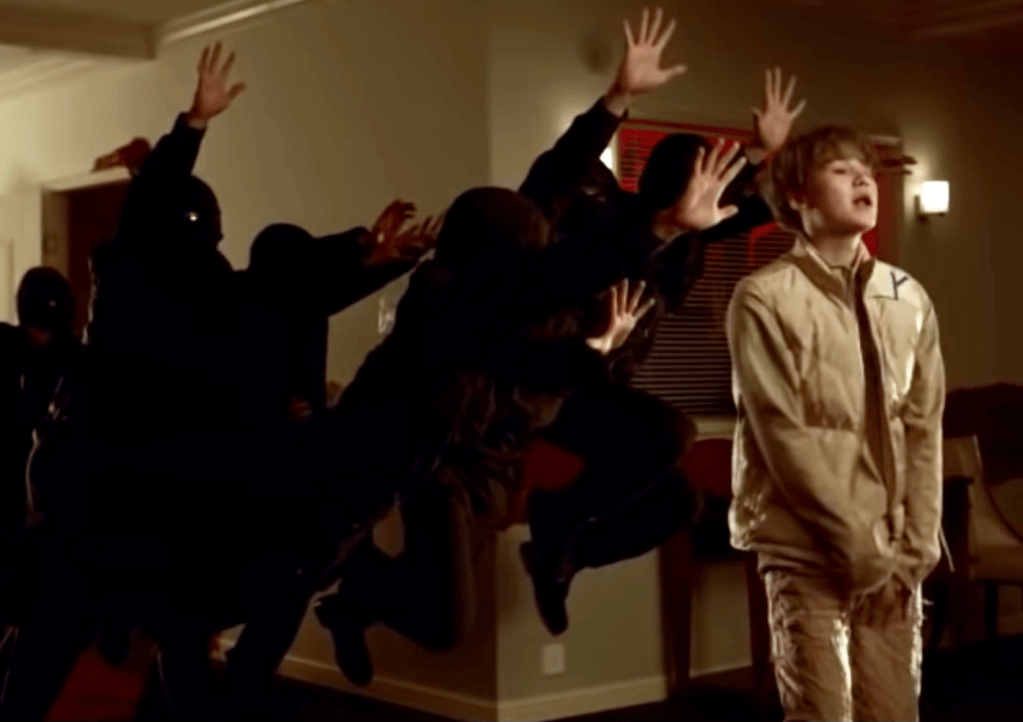
Regarding the recent explosion of BTS on the world stage, Suga explained that he aspired to reach the 12th floor [of fame] only to find himself on the 60th floor. “The moment I’m flying high as I wished, my shadow grows larger, beat down upon by that light. Please don’t let me shine. Don’t let me down. Don’t let me fly.”
The other song, Daechwita by Agust D, is a rap song and cinematic music video, written and directed by Yoongi, based on the story of King Gwanghae as portrayed in the S Korean film, Masquerade, and the 2019 TV Kdrama, The Crowned Clown (available on Netflix). Daechwita means “procession of the King” from words referring to the wind and percussion folk instruments used in royal and military parades. The music video set is one famously used in many historical dramas featuring a real palace and an historically recreated town.
In the historically-based story King Gwanghae fears assassination and so murders all his rivals ushering in a reign of terror. He searches for a body double who can take his place if needed. An exact double is found in a peasant street comedian who has been using his resemblance to make fun of the king. The king is poisoned or goes mad and, while recovering, the double takes the place of the King, “the clown with this face is playing as this country’s ruler.” This fool commits himself to be used as bait to bring out the traitors and eventually to die in place of the real king,“If a clown is picky about making his move, that’s the same thing as dying.” But he proves to be a compassionate ruler who truly cares for the people.
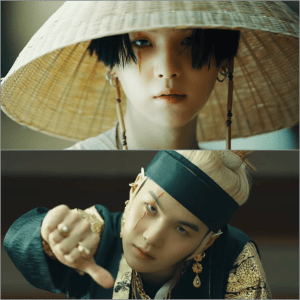
In Daechwita Agust D first appears as a dark-haired peasant or slave (a Fool) walking through the street and briefly stopping to talk with a butcher at a stall. The scene cuts to the courtyard of a palace and a white-haired tyrant (a King) who raps as he leaps on the backs of prostrate subjects. Both the fool and the king have a scar running down the right eye making it clear that Agust D is both characters. The King is killing his subjects and we see three bagged heads on display that may represent three Korean entertainment companies that kept BTS off the airwaves and mistreated them publicly. (BTS has now achieved world recognition greater than any prior Asian celebrities.) But where does that leave the pure, innocent and very idealistic underground rapper who headed off to Seoul (Soul) to follow his dream of making his mark in music in the face of the overwhelming odds against him?
As we look further we see that a Jungian interpretation helps to elucidate the Birth Card constellation. It portrays the inner battle among the various parts of oneself. The Fool is Agust D’s innocent yet rebellious Self, while the King, who was meant to be a public Persona of rulership and success, becomes a Shadow-self who descends into madness.
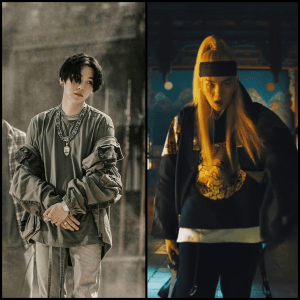
As the King becomes a dangerously tyrannical Shadow-figure surrounded by dragon imagery and severed heads, we see the Fool as an endangered Ego. In fact, Min Yoongi comes from a very poor family yet is included in the formal list of direct descendants of the last queen of Korea. He then debuted with an upstart entertainment company that had no resources and was shunned by most media outlets: “Born a slave but now a King.” Like King Gwanghae, who began as a warrior, Yoongi had to overcome struggles with family, disapproving underground rappers, and haters before achieving success. “Rags to riches, that’s the way I live.”
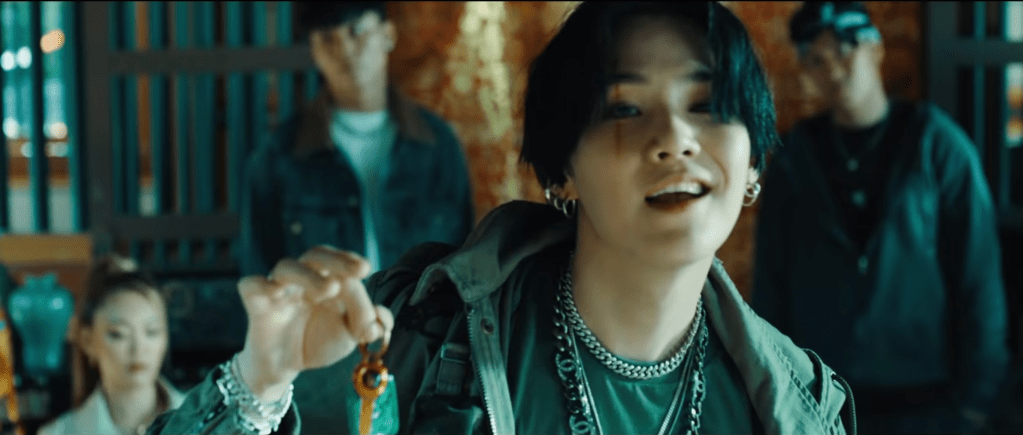
The only girl in the video gives the peasant-rebel a key to a car. She is Jung’s idea of an Anima or inspiratrix/muse and also represents the BTS fans known as ARMY. She supports and encourages him by giving him the key to his destiny and access to his personal development, i.e., the Individuation Process. A sign above has a quote from Confucius: “a classical scholar doesn’t value treasure,” reminding Agust D of the value of knowledge over riches as implied by the 4 of Pentacles. But his dream turns into a nightmare through the tyrant King: “The Shadow is born out of light” (fame’s shadow grows as the spotlight becomes brighter).
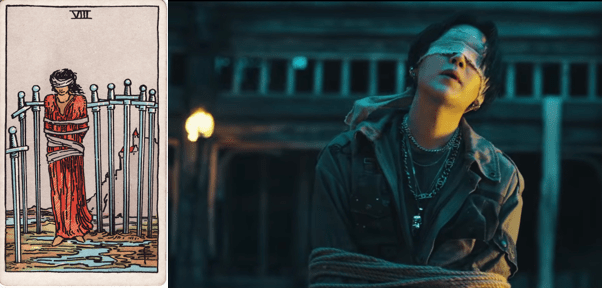
The Peasant is imprisoned and condemned to death by the murderous King: “Who’s the King who’s the Boss. Everyone knows my name.” This scene shows Agust D bound and blindfolded like the figure in the 8 of Swords.
The tension between the idealistic Min Yoongi, who had to choose between eating or bus fare, and the famous Suga who flies the world in chartered plans and plays to multiple sold out nights in the world’s largest stadiums, is huge but comes at a cost, “my growing shadow swallows me and becomes a monster.” He fears he will forget who he really is. So Yoongi invents yet another Persona in addition to Suga: Agust D, to remind him of his true passion for music with roots in hip hop and rap.
The executioner (who was the butcher in the marketplace), a revolutionary co-conspirator, is an aspect of Yoongi’s growing consciousness which frees him from prison and death. Yoongi has talked frankly about his own issues with depression and social anxiety. In the lyrics he says he’s putting his past in a rice chest – a reference to a mad prince who was killed by his father by being confined in a rice chest until he starved to death. “I trap the past in a rice chest. I’ll take mine and eat them all.” So Agust D vows to consume his own past trauma and live.
At the moment of death the Executioner frees the Peasant/Fool who rises up against tyranny and shoots the King with an antique pistol known as a “Colt ARMY” (BTS’s fans are called ARMY).
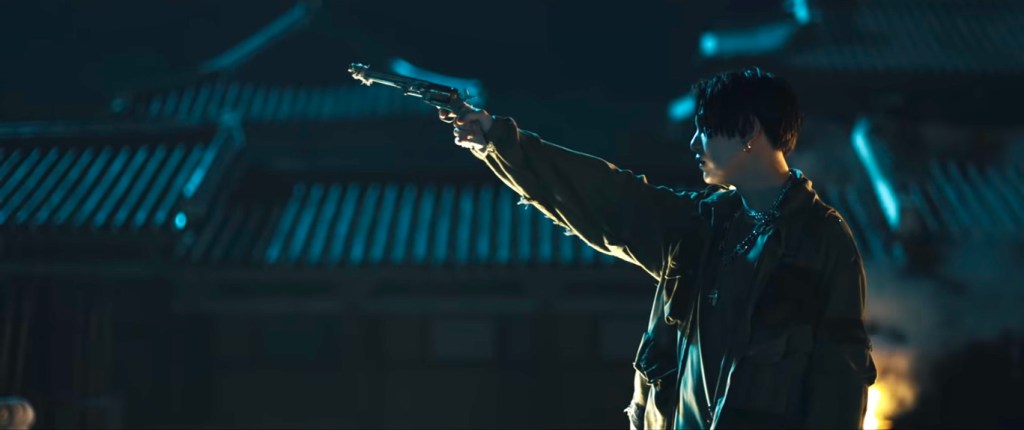
But it isn’t really that simple, for that other song, “Interlude: Shadow”, concludes with the voice of the Shadow,
“Yeah, I’m you and you’re me, do you get it now? We’re one body, and sometimes we will crash. You will never be able to take me off of you, you get it, right?…Success or failure, wherever you are, you can’t escape, wherever you go.”
At this point it is essential to remember that BTS stands for “Bulletproof Boy Scouts” (Bangtan Sonyeondan) and, as their early performances of “We Are Bulletproof” depict, they can’t be killed by mere bullets shot by haters.
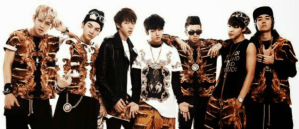
From a Jungian standpoint the Shadow is not to be killed off. It is an essential part of the Self. A key task of consciousness and the Ego is to bring the Persona and Shadow (the ideal and repressed selves) into relationship as is beautifully pictured in “Interlude: Shadow”.
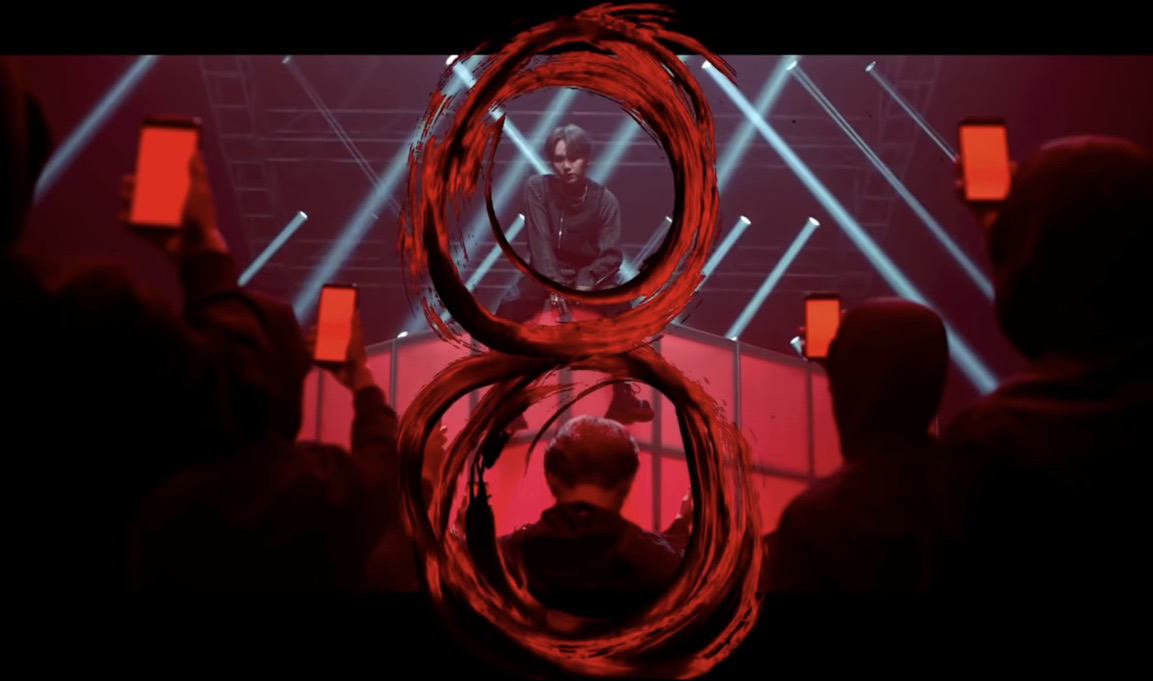
For now Min Yoongi has achieved success and has everything he previously desired, yet he still experiences the post-passion let down (Korean Hunyta or Shakespeare’s “little death”) in which one wonders “is that all there is?” before picking himself back up and doing what he does best—making music.

For those wanting to understand this Constellation, we see the death of the old King and crowning of the new King in the ever changing cycles of our lives—”The King is dead; long live the King!” We sometimes talk about earlier stages of life as our “past lives” acknowledging that they ran their course until graduation, a move, a marriage or divorce or pandemic ended one way of being and we stepped off a cliff into a new unknown. One of the lessons here is that it is not about being either the Fool or the Emperor but rather about keeping both in our lives: the crazy Fool leaping into the unknown and the responsible King restricting freedom with rules and boundaries in a constant cycle of lives and deaths.
Given the ‘Storming of the U.S. Capitol’ on January 6, 2021 – a day after I posted this – I can’t avoid the current political dimensions of this archetypal theme. Culturally speaking Trump is the mad King. We have so many candidates for the role of Fool, among which are the comedy talk-show hosts who regularly point out that Trump is wearing no clothes: that is his “Big Lie” (there is no widespread election fraud, among all the other lies). Washington D..C. erupts in violence and five die, marking the end of Trump’s tenure in office. Meanwhile 3,500 people are dying per day in the U.S. alone from COVID.
Here’s Suga in Times Square, optimistically counting down New Year’s 2020 shortly before the global pandemic hit, reminding us all that death is closer than we think. We currently rely on restrictions and laws to keep us safe while we stand on the cliff edge of a new, yet unknown, world.

How to write from your heart with tarot:
– Breathe (ground/center if applicable).
– Connect with your future reader (including if you will be your only reader). Try to get a specific image in mind and open your heart to that person(s)—real or imaginary.
– Begin your writing with where you are right now at this moment, being as concrete and present as possible (even if you will edit this out later).

Photo by Aaron Burden on Unsplash
– State your intention (even though you may find yourself going elsewhere in your writing).
– At this point, if not before, draw a tarot card from your shuffled deck. It may serve as the focus or direction for your next bit of writing or simply confirm it. Use keywords and imagery suggested by the card. To what thoughts, emotions, memories or desires does this card bring you? Integrate your reaction immediately as an integral part of what you are writing. Try to keep writing rather than pondering the meaning of the card.
– Breathe. Keep writing.
– Draw a new card whenever you come to a new phase or turning point in your writing. (I tend to draw around 5 cards for around 500 words/2 pages, but it could be more or less.) Just don’t let this distract you from your writing. You have to commit to be honest about whatever comes up.
– At the end, ask if there is any last message or thing you need to know or include.
– Take a moment to experience gratitude for what you’ve been through in this process.
– Optional Spread: line up the cards you drew and examine them as you would a spread. You might want to do this the next day or even later.
Examples:
I draw the 10 of Cups and mention the joy and responsibilities of family. The 9 of Wands are my defenses: I need to reveal what and why I initially held back. The Moon has me writing about emerging from an underworld journey through depression, which I probably would not otherwise have acknowledged. You may find yourself using metaphors arising from a card’s imagery.
Try using this method when writing a review or a paper for school or blog post or a letter/email to a friend.
The cards can push you beyond your comfort zone but isn’t that what writing from the heart is really about? Magic is moving beyond the limits or boundaries of our everyday experience.
Have fun with tarot this summer at the Omega Institute “Masters of Tarot Conference” in Rhinebeck, New York, July 19-21.
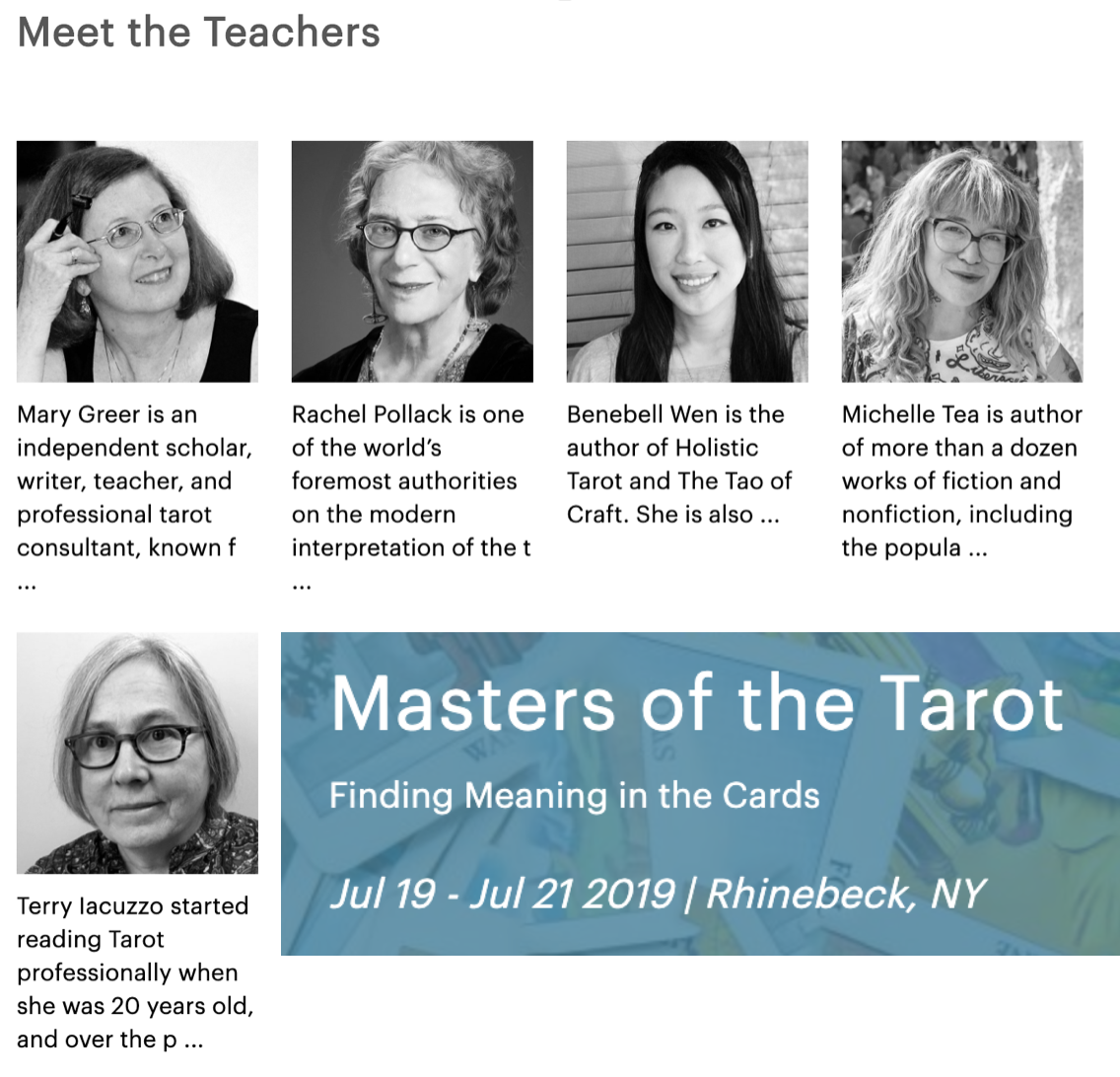
Then deepen your experience by staying on for Rachel and Mary’s 5-day “Wisdom of the Tarot” workshop July 21-26. Discount available if you register for both.
While everyone who regularly uses the Celtic Cross Spread adapts it to their own understanding, I am going to reveal the underlying richness of the traditional “Hopes and Fears” or 9th position* of this classic spread.
*I’m not counting the Significator.
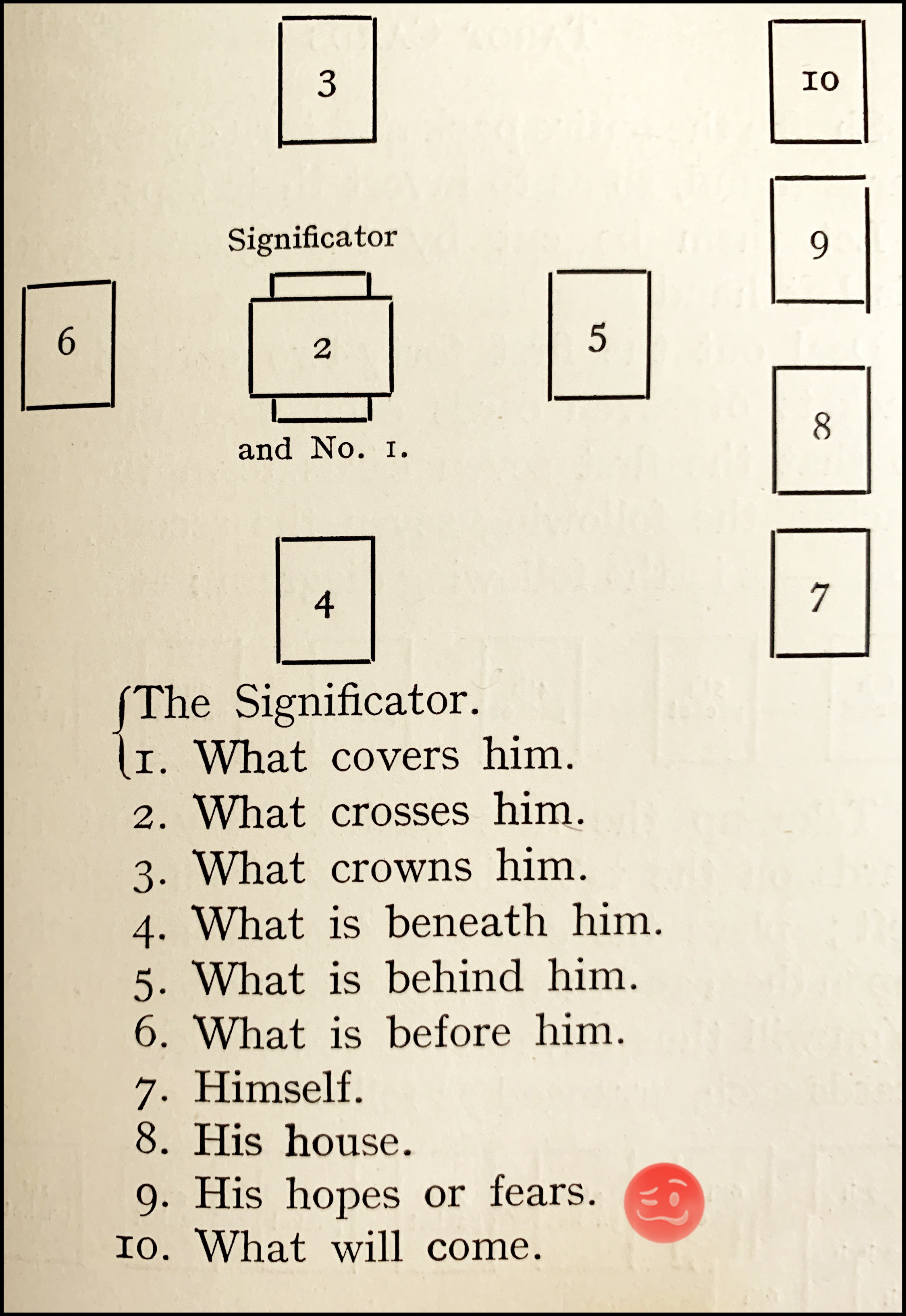
“An Ancient Celtic Method” in Waite’s Pictorial Key to the Tarot
Both/And
Early in my tarot reading career, I interpreted whatever card landed in this next-to-last position from both the perspective of what querents hoped and what they feared. For instance, with the 10 of Cups querents might hope for a happy home or family life. Yet they simultaneously fear: either that this is an illusion (the rainbow in some decks) or that they will be constrained in some way by family needs and concerns. This points to how our anticipations affect outcome (position 10). Thus, this card can provide an extremely valuable look into the quandary experienced by querents regarding their issue. Note that it doesn’t say whether the hopes and fears are right or not. They aren’t predictions. Therefore, what are they?
After extensive work on the emotions expressed by the cards in the RWS deck, including a research project I did involving almost 100 people, I came to look at this position more broadly as simply one’s emotions in the situation being described. Hope and fear or attraction and repulsion form the core polarity found in emotion: physiologically experienced as pleasure or pain/distress.
Empedocles’ Love & Strife
The 5th century BC Greek philosopher, Empedocles, first defined this core polarity as “Love and Strife” or attraction and separation, which combine in different ways to form all matter in the universe as well as in our psyches. Emotions can be placed along a grid with two axises: pleasure—pain and mild | intense. For instance, annoyance–anger-rage express a range, from mild to intense, of an emotion we tend to avoid as being painful.
The fact is, as Empedocles recognized, we always experience some combination of emotions—which is where we get all those feeling experiences and the emotion words we use to describe them. This is why interpreting the 9th card from different perspectives can, in itself, describe the stressful push-pull which is pictured in the central conflict revealed by the first two cards of the Celtic Cross Spread.
Motivation
As I researched emotion I came to understand that they are our primary motivating factors. What Motivates Getting Things Done by Mary Lamia has recently added to my level of understanding how this relates to the 9th card. Lamia is a clinical psychologist and researcher specializing in emotional awareness. (This book is about procrastination, which happens to be a particular issue of mine.)
In Chapter 3, Lamia points out how situations stimulate emotions that, in turn, direct our attention. We care about the situation because we feel something. So, whether we feel distress or interest, the feeling motivates us to take action. “The emotional importance we give to a stimulus influences how we will attend to it.” These emotions (along with associated thoughts and memories) script our present behavior.* One person may notice unwashed dishes and feel compelled to immediately do something about them, while another person may not even notice them.
*As tarot readers, it is vital that we become aware of such differences in people’s responses. For, if we assume our own bias to be the only response, it can skew the reading.*
Scripts
For Lamia, “Scripts are based on the repetitive activation of a given emotion or emotions consistently activated by a particular stimulus.” They form an implicit set of rules that help us make sense of our lives: “Depending on how well we learn, scripted responses can either help or hinder us as we interpret, evaluate, and make predictions in our experiences.”

Photo by Stephen Leonardi on unsplash.com.
The Role of the 9th Card
While our own scripts speak to our interpretative abilities as readers, scripts also point to the role of the 9th position card in a querent’s reading (either for oneself or another). “In consciousness, feeling and thinking always arise together,” with thoughts (that are actually conjectures) being “the best information your mind has available.” It is the underlying emotion (at root, the physiological affect or gut response) that most motivates human behavior. Furthermore, “emotions can be impervious to thought,” which is why a reader‘s informing someone of an outcome or best action—no matter how ‘right’ the reader is—is not as effective as when a querent emotionally “gets it.”
The Interactive Tarot Reading
The value of an interactive approach to tarot reading lies in the querent describing a card or speaking of what most draws their attention. At that point the attendant memories and the emotions associated with those images arise. By dialoguing with the querent about what arises the reader can help the querent evaluate how relevant these responses are to the actual situation and therefore which options and goals, indicated by the other cards, generate the most interest in the querent and/or promise the most relief from distress.
Summary
Emotional responses motivate us. Positive emotions give us energy and drive. Negative emotions result in a desire for relief. Both positive and negative emotions may be described by the card in position 9, although sometimes one clearly predominates over the other(s). Recognizing that this card describes one’s motivating factor(s) can help querents become aware how their history (i.e., their scripts) are affecting the outcome.
The Benefits
As with the other cards in the spread, emotional responses depicted in position 9 are not totally fixed. A consciously aware reader can help a client align themselves with their highest goals and recognize their options. Furthermore, energizes are vibrational and thus, by aligning oneself with the higher vibrations and lessons offered in the situation, and bringing consciousness to the emotional roots of the situation, a client can experience an emotional shift within the sacred space of the reading and thus change the way they meet the perceived outcome.
Please, try these ideas and let me know if this makes a difference in your own experience of the spread. Or, leave a comment on how you interpret and work with the 9th or “Hopes and Fears” position in the Celtic Cross Spread.
Linda Marson, author of the groundbreaking Ticket, Passport and Tarot Cards brings us her new multi-media package for personal guidance and insight using TarotNav: A GPS for Life.
 TarotNav arrives in the form of a flash drive/memory stick or you can direct download the files to your computer or device. Through videos, personal stories, and text, Linda offers an excitingly innovative learning experience that will help you gain deep meaning from life experiences and get direction for future endeavors.
Imagine a world in which everything has a meaning, your adventures serve a deeper purpose and Spirit speaks directly to you through a set of picture cards. Each day becomes its own adventure. Discover what way to go when your path forks. Know that detours present challenges to strengthen resolve and reveal things you might have missed along the way. Examine your baggage to see what can be discarded. Find your destiny in your goals.
Linda speaks from her own vast experience. She has been making travel films and leading spiritual journeys around the globe for nearly 20 years. If anyone is said to “follow their intuition” it is Linda. As former President of the Australian Tarot Guild she focused on making connections among teachers, students and professional readers nationally and internationally. More recently she has brought all her interests together through activities featured at her Global Spiritual Studies website. You’ll find courses taught by the best teachers in their fields, and tours to sacred sites that will transform your life.
TarotNav literally shows how to use tarot as a guidance system. The multi-media package contains a set of 22 short videos with example readings based on real journeys, an e-book of card meanings, a sheet for recording your readings, and an extra video on the Celtic Cross Spread. The card meanings focus on life as a journey from new beginnings to goal completions and letting go. Reversed cards show where there may be resistance and where issues haven’t been fully resolved.
I highly recommend this program as a way to learn how Tarot can be a guide on your personal journey and a key to turn your daily life into a spiritual adventure. Get information here, where you’ll find sample videos and a look at the whole package.
Join us August 3-5, 2018 for the Masters of the Tarot conference at the Omega Institute in Rhinebeck New York. This year Rachel Pollack and I join with three outstanding Tarot teachers for a weekend of fun and deep learning: Melissa Cynova, Liz Dean and George Koury. Watch for our interviews with everyone over the next two weeks.
 I am pleased to begin with Melissa Cynova. She is the author of a recent book that has made quite a splash, Kitchen Table Tarot, and has a popular website and blog at Little Fox Tarot. We are so excited to have her as one of our presenters.
Mary: What is it about Tarot that most intrigued you and first got you hooked?
Melissa: When I was little, I always felt like a weirdo. I would wander around in the woods by myself, looking for fairies (like you do). I was constantly reading fantasy books about witches and wizards and magic. When tarot came along at 14, it felt like an active, alive piece of magic that I could hold in my hands. I was still weird! But this was a weird that I could learn and make choices with. It gave me a way to connect to people, and still be myself. Also, it was really cool!
Mary: Weirdly cool!—I agree. Your website and blog at LittleFoxTarot.com is very popular and earned you a loyal following even before your book Kitchen Table Tarot came out. It seems to me that Tarot has been going through some pretty radical shifts over the recent 10-20 years. What shifts have you noticed and what do you think is most important for both newbies and experienced readers to know and learn in order to take advantage of what’s happening now?
Melissa: I’ve been playing with the cards for almost 30 years, and the thing that I’ve noticed the most is that it used to be shrouded in some kind of secrecy. “Don’t buy your first deck, it has to be gifted. You have to put the cards under your pillow to absorb their full meaning. You have to shuffle three times into your left hand!” There were all of these whispered rules that followed it around. Since I didn’t know better, I followed them. I thought that you had to achieve a certain level of woo-woo mysticism to read cards, and follow the “old traditions”. I think that the advent of the internet showed us that most of those whispered secrets are complete nonsense. I know tarot readers who shoplifted their first deck back in the day, rather than risk buying it. Most of my clients today buy them online and look for decks that appeal to them.
I love that level of freedom and accessibility. Anyone can pick up any deck of cards and get started on this path. You can shuffle into whatever hand you want (or not at all) and your readings are still valid. I think it lends confidence to the new reader, which will then translate into their readings. Fantastic.
Mary: Just before my mother died she mentioned her grandmother read playing cards for visitors at their kitchen table in New Orleans. I love that you wrote a book about your kitchen table experiences teaching and reading tarot. No fuss, perhaps a bit of muss – of the best kind! What would you like to bring from your kitchen table into the Masters of Tarot Omega weekend to turn it into a similarly welcoming and supportive environment?
Melissa: It’s so funny that you asked that! I was talking about the book with my friend, Terry Iacuzzo, and she told me that her mother used to read playing cards at their kitchen table in New York! She said that I reminded her of her mom—making tarot accessible and easy to understand—just like we were sitting at the table and talking. It was the best compliment I think I’ve ever received, professionally, and inspired the title of the book.
At Omega, I’m going to be talking about ways to simplify the questions that people bring to the cards, and teach some simple spreads to help them interpret the answers. I want folks to come out of our class confident that they—and they alone—can hit a reset button on any part of their life that needs it.
Mary: Thank you so much, Melissa. It’s been an honor talking with you. I can hardly wait for your common sense and de-mystifying presentation and exercises at Omega in August. I know they’ll be a hit.
Follow up with a 5-day intensive workshop with just Rachel and Mary: The Neverending Tarot. Discount available when you sign up for both. Info here.
Read a recent interview with another one of our presenters, Liz Dean, at The Wild Hunt Pagan News featuring a discussion of her new Game of Thrones Tarot.
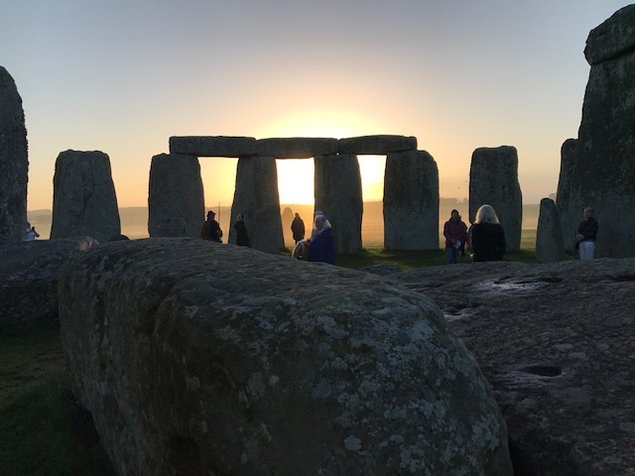
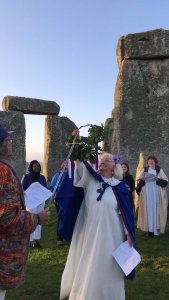
Announcing two Tarot Tours this coming summer in the British Isles. Last year’s trip, Tarot Magic in Merlin’s Britain, sold out early. We are doing it again, with a Tarot trip to Sacred Scotland preceeding it, and a discount if you go on both. Don’t let these journeys pass you by! Sign up before the November 30th deadline. Above is a photo of our private full moon sunrise ceremony in the circle at Stonehenge.
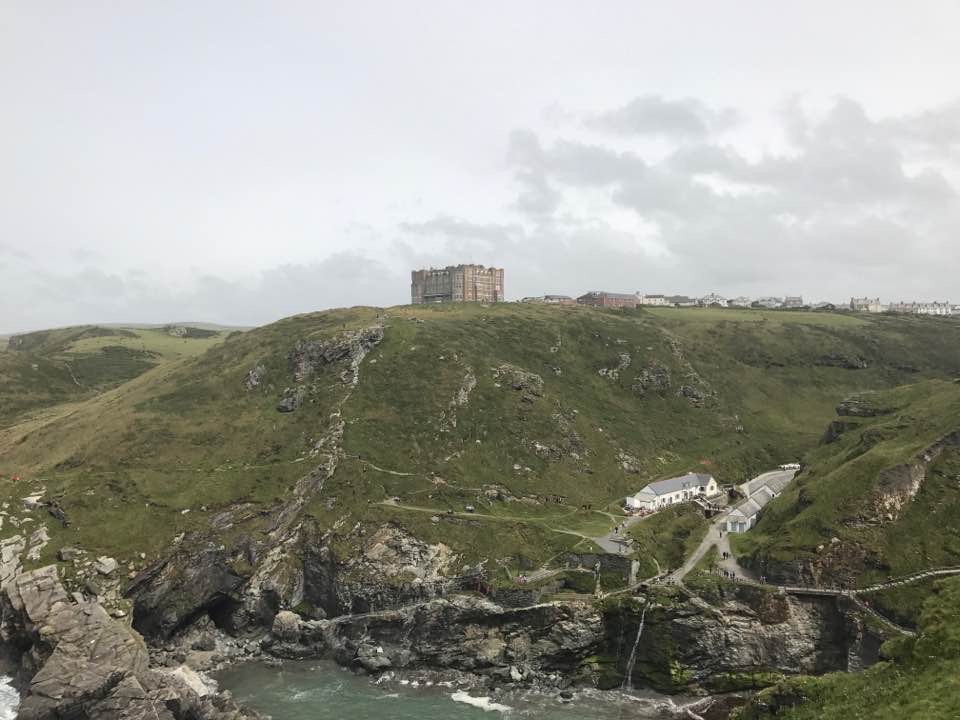
Just two weeks ago I discovered that the hotel where we stayed while searching for Tarot artist Pamela Colman Smith’s burial place, was a hotel she actually stayed at as a young woman. It was in 1897, the year King Arthur’s Castle Hotel opened, with its magnificent roundtable at which we did readings, that Pamela met Henry Irving of the Lyceum Theatre fame. Subsequently she toured with the Lyceum Theatre and designed costumes and sets, getting her nickname, Pixie, from her foster mother, the actress Ellen Terry. Here is what is now called the Camelot Castle Hotel in Tintagel, with Merlin’s Cave in the far bottom right.
I can’t begin to tell you all the amazing things we encountered on our journey: sacred wells in out of the way locations; stone circles, several of which we had to ourselves; the special fairy glen; a ritual on a hilltop labyrinth; Glastonbury Tor and Chalice Well where Dion Fortune made her home.  One of the most magical moments was our using dowsing rods to find what we believed was Pixie Smith’s unmarked grave. Linda dropped her pendulum, hearing it fall. We searched for it in vain, only to have the bus driver when we returned ask who had dropped a pendulum on the bus. It was Linda’s. That night at the Camelot Castle Hotel we used the pendulum to ask Pixie questions about her life – and it was months later that I discovered from one of her letters that she had probably drunk her favorite “Opal Hush” drink in that same bar 120 years before.
The Tarot Magic in Sacred Scotland Tour is
14-23 May 2018
and will feature Tarot readings in sacred sites for gaining insight into your own spiritual journey…readings whose messages will continue to unfold for years to come. Experience:
- Inverness and surrounding area – Prehistoric Clava Cairns and standing stones, Rosemarkie Fairy Glen, Loch Ness
- Orkney – Skara Brae, Maes Howe, Stones of Stennes, Ring of Brodgar, archaeological dig on the Ness of Brodgar
- Iona – Abbey, Nunnery, St Columba’s Chapel
- Standing stones at Kilmartin.
More information: https://globalspiritualstudies.com/travel/sacred-scotland/
The Tarot Magic in Merlin’s Britain Tour immediately follows on
23 May – 1 June 2018
and takes us to:
- Stonehenge
- Avebury and West Kennet long barrow
- Glastonbury and surrounding area – Chalice Well, the Tor, Glastonbury Abbey, Cadbury/Camelot
- Tintagel and surrounding area – Tintagel Castle, Merlin’s Cave, St Nectan’s Glen
- Boscastle – Museum of Witchcraft and Magic
- South Cornwall – Boscowen-un stone circle, Merry Maidens stone circle, holy wells of Madron and Sancreed.
More information: https://globalspiritualstudies.com/travel/avalon-to-camelot/
Watch this video of our trip, created by Linda Marson, to catch just a little of the magic:
“What does he (or she) think (or feel) about me?” In the whole field of card divination this is one of the most asked questions online and one of my least favorite. In my experience people are a hotbed of conflicting thoughts and feelings that change from moment to moment and circumstance to circumstance. To say nothing of one’s head and heart giving us different messages! You think of your sweetie with longing as you anticipate going out with him that evening, then he calls to say he’ll be watching a game with his buddies instead. Suddenly you think he’s a scumbag and plan how you won’t be available when he wants some. Meanwhile, you’re facing an evening at home alone. Or, “he hasn’t called in a week—not since . . .” Or, “I want to ask her out, but am unsure if she sees me as anything other than an annoying co-worker.”
An old booklet from the 1890s might have just the spread for you. Taken from the Livre du Destin or Book of Destiny card deck printed by Grimaud in Paris, this simple layout may be exactly what you need. Furthermore, it may have been an inspiration for the core of the original Celtic Cross spread. I’ve included some clarifying remarks in brackets.
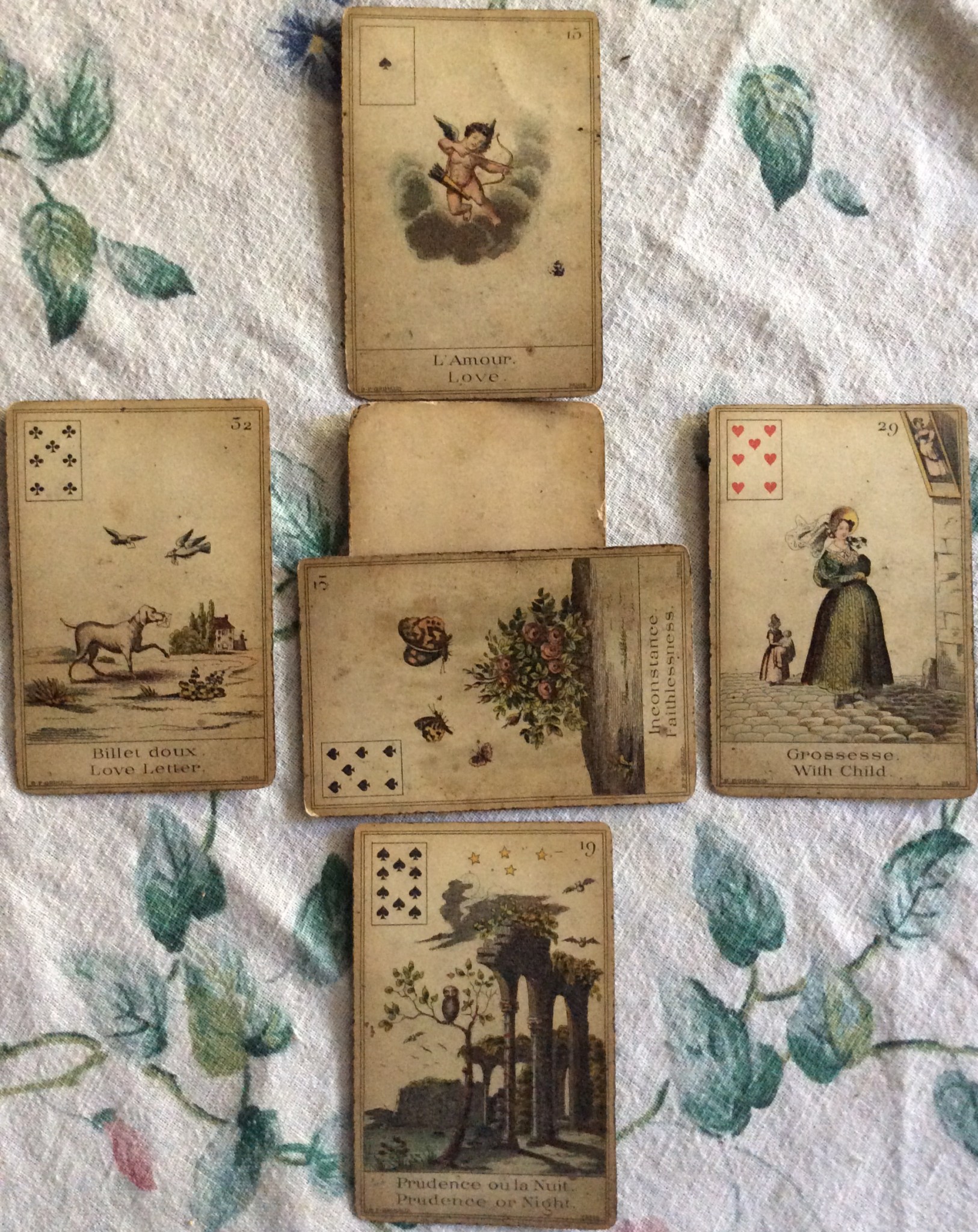
Livre du Destin (Chartier-Marteau & Boudin/Grimaud), 1890.
“How To Read Somebody’s Thoughts”
“After shuffling and cutting the cards, ask the person to choose any five of them, and lay them down as follows:
“The first is laid across the blank one, which represents the person whose thoughts you are reading.” [Choose a Significator for that person. Next, fan the shuffled deck, and have the querent choose a card which you lay across the Significator.] “This shows what his heart is feeling.”
“A second one is laid at the top, and shows his thoughts.”
[These first two cards—following the Significator—depict what is consciously going on in the person’s heart and head.]
“Another is placed at the bottom, and represents what he tramples under foot.” [This is “beneath him”—the more unconscious feelings or thoughts that he (or she) is squelching or ignoring.]
“On the left is what he is fond of and on the right what he cares nothing for.” [That is, what he likes and dislikes in the querent. Or, possibly, a person he likes and a person he dislikes?]
Try this with your favorite divination deck and let us know, in the comments, how it works for you.
 Mary K. Greer has made tarot her life work. Check here for reports of goings-on in the world of tarot and cartomancy, articles on the history and practice of tarot, and materials on other cartomancy decks. Sorry, I no longer write reviews. Contact me
 Mary K. Greer's Tarot Blog
Recent Comments