You are currently browsing the category archive for the ‘RWS Tarot’ category.
Exciting News! U.S. Games has announced a new tarot deck set celebrating the 100th Anniversary of the Rider-Waite Deck, and honoring the artistry of Pamela Colman Smith. Read my review here.
The deluxe set will include the Smith-Waite Centennial Tarot Deck (reproduced from the original 1909 deck – hey, it’s about time, thank you very much!) and two books:
- The Artwork and Times of Pamela Colman Smith, by Stuart R. Kaplan, with over one hundred examples of her non-tarot art.
- The Pictorial Key to the Tarot by Arthur Edward Waite, in a new format.
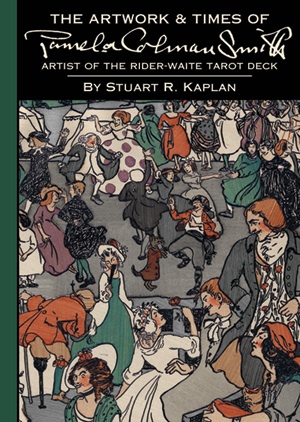
The set also includes two prints of Pamela Colman Smith, one photo and one self-portrait, both 5” X 7” suitable for framing; six color postcards of artwork by Pamela Colman Smith; and Spread Sheet Guide. Everything is attractively packaged in a deluxe keepsake case. Price: $35.00
I believe it is expected for May 2009 unless there are delays. See the U.S. Games promotional information here.
♥
Pamela Colman Smith (Pixie to her friends) has her own MySpace page, complete with reproductions of drawings she did to music—while that music plays in the background. You can see it and become her friend here.
(Thanks to Malcolm Muckle who told me about this page.)
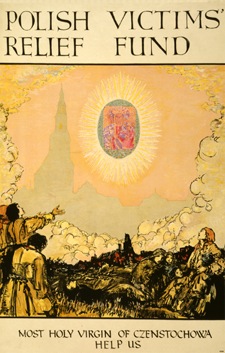 A reproduction of a poster by Pamela Colman Smith is available at ebaystores:
POLISH RELIEF FUND POSTER VIRGIN OF CZESTOCHOWA 1008 or here.

Pixie’s initials can be seen in the lower left corner and the similarity to several of her cards is apparent.
The poster is from 1915. Pixie was a friend of the Honorary Secretary of this Fund, Miss Laurence Alma Tadema (daughter of the artist).
The reproduction is 10.5″ x 16.5″ and printed on 100 lb. glossy stock—suitable for framing.
Thanks to Holly Voley for telling me about this at BATS.
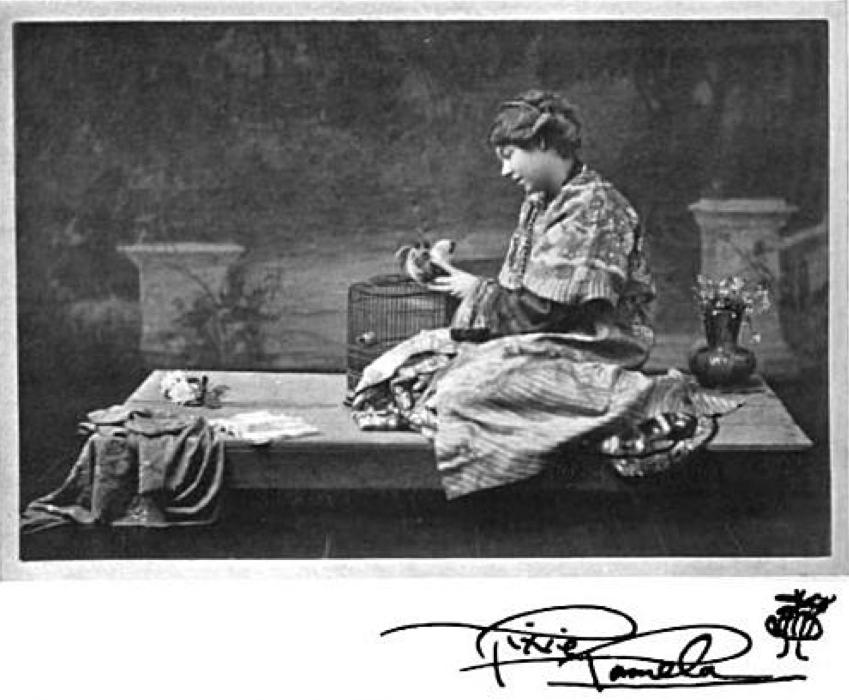
Pamela Colman Smith never became well-known as an artist and, without the Tarot deck she illustrated, she may have fallen into total obscurity. Stuart Kaplan, president of U.S. Games, Inc. says he could have made her a millionaire.
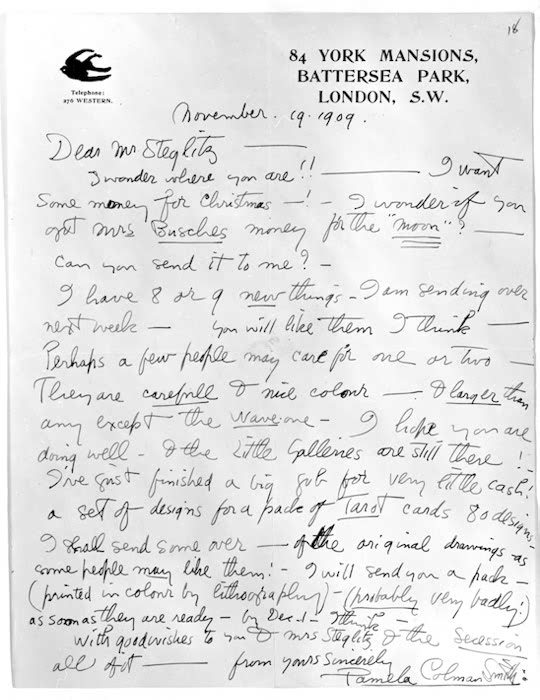 The only comment from Pixie Smith about the creation of the tarot deck was in a letter to her mentor Alfred Stieglitz (click on the letter to see a larger version).
You can see much of the artwork of Pamela Colman Smith at these sites (thanks especially to Roppo and Holly Voley for their efforts to make Pixie’s work available to the rest of us):
• Roppo’s The Works of Pamela Colman Smith – page 1
• Roppo’s The Works of Pamela Colman Smith – page 2
• A Portrait of William Butler Yeats by PCS
• The Shakespeare’s Heroines Poster
• A Variety of Works by Pamela Colman Smith from Holly Voley’s site
Including my own copy of her book Chim-Chim: Folk Stories from Jamaica
• Susan and the Mermaid, an illustrated children’s story by PCS, republished by Corinne Kenner
• Tales for Philip and Peter, illustrated by PCS
• The Pamela Colman Smith Collection at Bryn Mawr
• Paintings at the Beinecke Rare Book and Manuscript Library – search on Pamela+Smith, and while you are there, see their collection of 15th century Tarot cards by searching on Tarot.
• K. Frank Jensen’s Waite-Smith Tarot Research
• Here’s an outstanding website by Phil Norfleet devoted to PCS with a lot of biographical information not found anywhere else.
• “‘We Disgruntled Devils Don’t Please Anybody’: Pamela Colman Smith, The Green Sheaf, and Female Literary Networks” article by Elizabeth Foley O’Connor in the South Carolina Review.
• See Pixie’s artwork archived at Ellen Terry’s home, Smallhythe – here.
Articles by and about PCS can be found by searching The Craftsman – here (search on her name).
• Pamela Colman Smith & “De Six Poach Eggs” (story)
• Secrets of the Waite-Smith Tarot by Marcus Katz and Tali Goodwin.
Video by the Japanese collector of the works of Pamela Colman Smith, Roppo (see links above):
Correction to video: I don’t know of any evidence that suggests that PCS was adopted by her parents. However, she did become the foster daughter of the great actress, Ellen Terry.
See my post on Pixie’s instructions for reading the cards here. Let me know if I’ve missed anything and I’ll add it to the above list.
First, I need to be forthcoming and let you know that despite my 1,000+ collection of tarot decks, the Rider-Waite-Smith (RWS) Tarot is my all-time favorite (not that I don’t like and use many others). I’ll talk about the reasons another time. Now I just want to offer up this tidbit of publishing history.
This deck, first published in December 1909 simply as “Tarot Cards,” was available more-or-less continually from 1910 until 1939 when Rider appears to have ceased publication. This may have been because of the WWII bombings when paper was scarce and the printing plates destroyed. French and Italian decks had never been easily available in England as such imports were heavily taxed. The Waite-Smith Tarot Cards were not officially republished until 1971 when the publisher/importer Waddington Playing Card Co Ltd. and U.S. Games, under a license from Rider & Co., jointly began publishing a version printed by A. G. Mueller in Switzerland.
I was always curious why such a popular deck was out-of-print for so long, until I came across this autobiography by one-time London bookseller Albert Meltzer called I Couldn’t Paint Golden Angels (Oakland CA: AK Press, 1996) and online here. As Meltzer tells it:
One of the minor curiosities I found when bookselling [he owned a bookstore on Gray’s Inn Rd.] was that one was constantly asked for tarot cards. For years these had been illegal — the ‘devil’s bible’ — and imports were banned. Any pretext that it was ‘only a game’ was dismissed by Customs. Tarot readers lined up at Bow Street every Monday, to be fined with the prostitutes, palm readers and graphologists (the latter have since blossomed out as forensic scientists).
Then the post-war Labour Government abolished the Witchcraft Act in 1946 [the actual year was 1951]. It was a favour to the journalist Hannen Swaffer* who had campaigned in the mainstream press for the Labour Party for years but refused an offer of the Lords. He merely asked for political relief to be given to the spiritualists. They were banned under the Witchcraft Act, and it was such medieval nonsense one could not amend it so it was abolished and so incidentally dream interpreters, psychics, tarot readers and soothsayers were legalised. Thus Britain emerged officially from the Dark Ages. . . .
It was in order, therefore, to import Tarot cards but they were taxed ‘as a game’. For years it had been insisted they were not a game. If they were religious appurtenances even of witchcraft, now legal, or at least not illegal, they could not incur tax. I tried fighting the Customs on this, but with no success. I could never afford to sue them, but tried to persuade the main importers, John Waddington, to do so. They, however, preferred paying tax and having it kept as a ‘game’. It is curious how this nonsense upset the police. The bookshop was actually raided to see if I had imported Tarot cards and not paid tax on them. The police were quite apologetic. When I explained about the Witchcraft Act they were not sure if I was being sarcastic or not. Neither was I.
So, from 1939 until 1951 (the year Pixie Smith died) it appears that fortune-telling cards were considered, in England, to be illegal under the Witchcraft Act, and no one was willing to take this issue to court. After 1951 and until the late sixties they were probably simply thought strange and old fashioned. The gap was filled for a while by Rolla Nordic who issued her own version of a Marseille tarot. Then, some old works on tarot were republished, and new works began to appear in the United States.
Meanwhile, in the U.S., University Books began publishing its own version of the deck in the early sixties (followed by Merrimack and Frankie Albano’s Tarot Productions), ceasing when U.S. Games started enforcing a copyright in 1971. Read my discussion of the 1969 Tarot Renaissance here.
*Slightly off-topic but to fill in some gaps in the quote above: In Great Britain, in 1951 the Fraudulent Mediums Act replaced the 1735 Witchcraft Act, which had increasingly been applied to Spiritualists and mediums. The last person to be convicted under the Witchcraft Act was Helen Duncan who in 1943, during a séance in Portsmouth, channeled a young man who told the gathering, which included his mother, that his ship had been sunk. The mother contacted the War Office asking for details. An investigation was launched into Duncan’s activities prompted by this revelation of top-secret information during war time. Supposedly the authorities became concerned that the medium might make pronouncements about the D-Day plans. Helen Duncan was tried and convicted in 1944, serving nine months in prison. The journalist and ghost-hunter Harry Price had investigated Helen Duncan’s ectoplasmic mediumship years before, and he claimed to have proven her a fraud. The British Society of Paranormal Studies and Duncan’s granddaughter recently have been petitioning the government for a pardon.
As a result of his own interests in Spiritualism and spurred on by the conviction of Helen Duncan, the popular journalist Hannen Swaffer (who was influential in and for the Labour Party), asked for restrictions on Spiritualism to be lifted as a reward for his services. To do so, the Government had to abolish the medieval Witchcraft Act. Three years later Spiritualism was officially recognized as a religion.
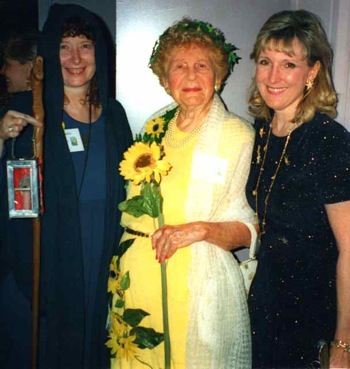
Eden Gray at the ’97 International Tarot Congress, dressed as the Sun, standing between Mary Greer as the Hermit and Barbara Rapp, organizer of the Los Angeles Tarot Symposiums.
Eden Gray (born June 9, 1901) began life as Priscilla Pardridge, Chicago debutante and second cousin to Princess Engalitcheff, wife of the Russian vice counsel. Still in her teens, Priscilla decided to become a stage actor. Despite her family’s owning Chicago’s Garrick Theatre (as well as a major department store), her father “snatched her from the footlights,” so she took a menial job in another department store. Before long she slipped off to New York where, at nineteen years of age, and without her parents’ knowledge, she married fellow-Chicago poet, novelist and screenwriter Lester Cohen (who wrote the screenplay for Of Human Bondage among others).
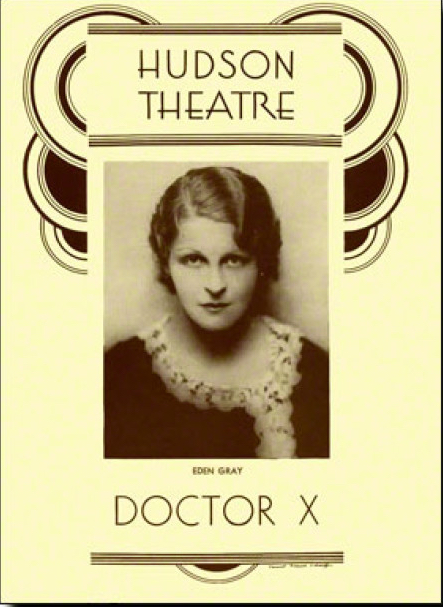
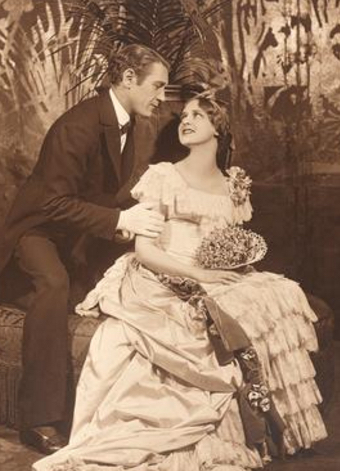 Adopting the stage name, Eden Gray, from 1920-1933 she was in a series of Broadway plays, including Edith Wharton’s The Age of Innocence, at New York’s Empire Theatre in 1928 (photo on right), and Doctor X on Broadway (see poster). She also performed supporting roles in three movies, being best known as Pamela Gordon in the 1925 film Lovers in Quarantine, and appearing as late as 1942 with Ronald Reagan in King’s Row (despite only a fleeting glimpse of her at a window in the film, she and Reagan shared an interest in positive thinking and astrology). In addition to all this she took a several year trip with her husband, which he described in his book, Two Worlds: An Account of a Journey around the World. During World War II, she put her acting career on hold to become a lab technician with the Women’s Army Corps.
After living in Pennsylvania, Virginia, Indiana, Paris and London and working in radio and on the London stage, Gray moved back to New York. She earned a doctorate of divinity degree from the First Church of Religious Science and then lectured and taught classes in Science of Mind. Gray also got to know librarian Gertrude Moakley who, since the early 1950s, had been researching tarot’s origins in Renaissance Italy (see bio of Moakley here).
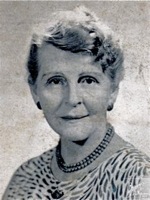 Eden Gray ran a bookstore and publishing company called “Inspiration House,” one of the few places where a person could buy tarot cards and take tarot classes in the late 1950s and ’60s. Her customers complained that the available books were not easy to understand, so she spent weekends in the country coming up with a more accessible way of approaching the cards.
Eden Gray self-published her first book, Tarot Revealed: A Modern Guide to Reading the Tarot Cards in 1960 to which she applied her “New Thought” perspective (see my earlier post here). She followed up her first success with two more tarot books: A Complete Guide to the Tarot (1970) and Mastering the Tarot: Basic Lessons in an Ancient, Mystic Art (1971). All feature graphics by her artist son Peter Gray Cohen. These books have remained continuously in print and are still among the best-selling tarot books today.
My personal favorite is Mastering the Tarot, as the card meanings are the richest of the three, and it gives practical demonstrations of interpreting the cards through sample readings. Lesson 18, “The Use and Misuse of the Tarot,” is a small gem of “New Thought” philosophy and positive thinking applied to the cards. Gray advises:
“So watch for the pitfalls when you read the cards; recognize how very suggestible everyone is—and then go ahead and use the cards for good. . . . Give those for whom you read encouragement to strive for their highest ideals. The seeds you plant can blossom into lovely flowers of accomplishment.”
Along with various editions of the Rider-Waite-Smith deck (de Laurence, University Books, Albano-Waite, Merrimack, U.S. Games, Inc.), Eden Gray’s tarot books formed the main impetus to the hippie adoption of the Tarot as spiritual guide for navigating a world-turned-on-its-head, leading directly to the booming Tarot Renaissance that began in 1969 and continues to this day.
It was Eden Gray to whom we owe the term “Fool’s Journey,” appearing as the title of the Epilogue in A Complete Guide to the Tarot. She explained:
“The Fool represents the soul of everyman, which, after it is clothed in a body, appears on earth and goes through the life experiences depicted in the 21 cards of the Major Arcana, sometimes thought of as archetypes of the subconscious. Let each reader use his imagination and find here his own map of the soul’s quest, for these are symbols that are deep within each one of us.”
In 1960 she had already alluded to the idea, saying that the Fool “must pass through the experiences suggested in the remaining 21 cards, to reach in card 21 the climax of cosmic consciousness or Divine Wisdom”—an idea that resonated deeply with the hippies—and that Gray probably picked up from A.E. Waite who wrote about the “soul’s progress through the cards.”
 In 1971, Gray moved to Vero Beach, Florida, where she focused on her art and spiritual ministry. She was a member of the Vero Beach Art Club and Riverside Theater and Theater Guild. In the 1990s several people contacted her about her earlier work in tarot, including Ron Decker and Janet Berres of the International Tarot Society. Berres honored Gray at their third International Tarot Congress in 1997 in Chicago with the Tarot Lifetime Acheivement Award. It was here that Eden Gray learned to her great astonishment just how truly revered she was for her seminal tarot books.
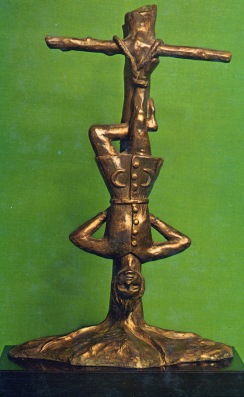
(I received this bronze statue of the Hanged Man created by Eden Gray (see right) from Barbara Rapp at the Los Angeles Tarot Symposium for recognition of my work in tarot. Read about it’s significance while writing my Tarot Reversals book here. Read more about Eden Gray here.)
This adventurous, pioneering woman, and “Godmother of the Modern American Tarot Renaissance” died peacefully in her sleep at 97 years of age, on January 14, 1999 in Vero Beach, having driven herself to the hospital following a minor heart attack.
Her books (with first publication date):
- Tarot Revealed (1960)
- Recognition: Themes on Inner Perception (1969)
- A Complete Guide to the Tarot (1970)
- Mastering the Tarot (1971)
- The Harvest Home Natural Grains Cookbook with Mary Beckwith Cohen (1972)
- The Harvest Home Fresh Vegetables Cookbook with Mary Beckwith Cohen (1972)
- Marbling on Fabric with Daniel and Paula Cohen (1990)
You can hear her briefly in this replay of a Long John Nebel talk radio program from New York in 1964 (thanks to Kim). Be warned that she only gets in a couple of sentences in a show totally dominated by Walter Martin who wrote an anti-cult/occult book from a Christian perspective. Supposedly she appeared on other Nebel shows but I can’t find them on the net.
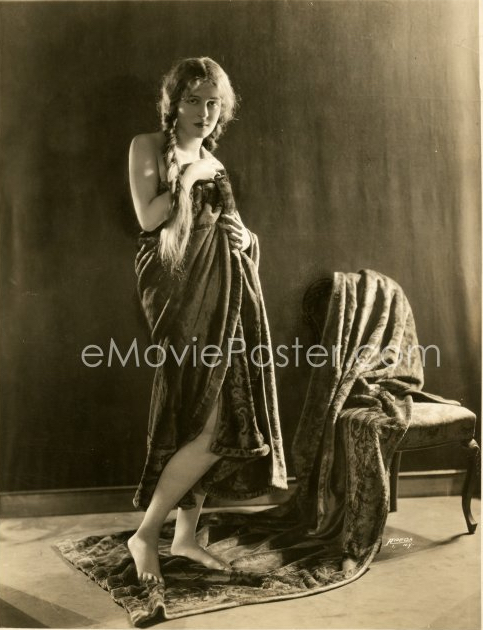
Just found: Eden Gray as “Angela” in The Firebrand,1924-25. She played the model of the Renaissance artist Benvenuto Cellini. The play was described as: “a modern farce masquerading in the trappings of the Renaissance, or a comedy of the sixteenth century “jazzed up” to delight a 1925 audience.” You can also see another photograph of her here.
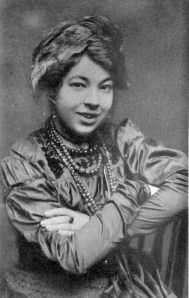
Pamela Colman Smith (also known as Pixie), artist of the Rider-Waite (Smith) Tarot deck, wrote nothing about the deck she created except in a letter to her mentor, Alfred Stieglitz, “I just finished a big job for very little cash!” She did tell us, however, in an article called “Should the Art Student Think?,” what must have been her own approach to reading the cards. This is the core of my own reading style.
“Note the dress, the type of face; see if you can trace the character in the face; note the pose. . . . First watch the simple forms of joy, of fear, of sorrow; look at the position taken by the whole body. . . . After you have found how to tell a simple story, put in more details. . . . Learn from everything, see everything, and above all feel everything! . . . Find eyes within, look for the door into the unknown country.”*
Essentially, she’s suggesting the following steps:
- Describe the card literally.
- Describe what seem to be the emotions, style and attitudes of the people on the card.
- Physically embody the card—act it out.
- Make up a story about what’s happening and turn it into a first person account (so you are feeling everything yourself).
- In your mind’s eye, step over the border of the card (through the door).
- Enter into that world, seeing beyond the borders to things you never knew were there.
In my opinion, this is the best way to discover what these cards mean for you in any situation.
*“Should the Art Student Think?” by Pamela Colman Smith in The Craftsman 14:4 (July 1908), pp. 417-19. Read the article here. See also my post on the Art of Pamela Colman Smith.
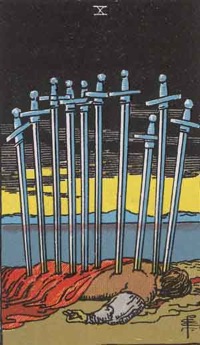 We were discussing the Ten of Swords on AeclecticTarot’s forum so I thought I’d summarize my thoughts here. A person lies on land by a body of water with hills blue in the distance. I usually think of the water as a lake because there’s no movement indicated—the water looks placid or even lifeless. The sky is black overhead but, above the mountains, the darkness breaks to reveal a slit of yellow sky.
Contrary to their attributed qualities of Air and Mind, Swords both depict and evoke in the viewer very strong, mostly disturbing, emotions. I once did a Tarot and Emotions Research Project in response to this fact.
Here are the emotion words for the Ten of Swords (times the number of respondents who picked the word):
hopeless (x15)
overwhelmed (x12)
despair (x11)
exhausted (x5)
hatred (x5)
pity (x3)
Waite says very little about this card in his Pictorial Key to the Tarot (PKT):
“A prostrate figure, pierced by all the swords belonging to the card. Divinatory Meanings: Whatsoever is intimated by the design; also pain, affliction, tears, sadness, desolation. It is not especially a card of violent death.”
His additional meanings include imprisonment and treason on the part of friends—which I interpret as ‘stabbed in the back.’
Waite was always very precise with his vocabulary. The key word in his description above is “prostrate,” which means “to cast (oneself) face down on the ground in humility, submission, or adoration; to overthrow, overcome, or reduce to helplessness.” For me, it emphasizes submission to something overwhelming either by choice (humility) or by being overcome. Victimization is a possibility.
He also uses “pierce,” meaning to penetrate or cut through, “by all the swords,” which correspond with mind and intellect. This suggests a kind of ultimate penetration, reaching the end of thought or an idea. This can also indicate pinning ideas down.
Waite’s main emotions are sadness and desolation. Of the latter, the Random House Dictionary says: “The desolate person is deprived of human consolation, relationships, or presence.” Is that why three people gave pity as their emotion in my research project? Has hatred of him by others rendered him desolate?
I have a copy of PKT that once belonged to a priest, whose notes are often enlightening. He points to Rev. 19:15: “And out of his mouth goeth a sharp sword, that with it he should smite the nations: and he shall rule them with a rod of iron: and he treadeth the winepress of the fierceness and wrath of Almighty God.” The poor guy looks like he could be both the grapes that were pressed and the nation that was smited.
This priest also refers to Waite’s book The Holy Kabbalah, where we find: “The Flaming Sword which turned every way signifies angels set over the chastisement of man in this world.” This is in a section on the Fall of Man and the Legend of the Deluge [Flood] in which Waite talks about both Eve and Noah having pressed grapes into wine. “The fact that Noah pressed the grapes—as Eve is said also to have done—partook of the juice and so became drunken, is affirmed to contain a mystery of wisdom. . . . [Noah], having set himself to fathom that sin which had caused the fall of the first man, . . . raised a corner of the veil concerning that breach of the world which ought always to remain secret.” Waite then refers to the dangers of some kinds of knowledge. Could this be chastisement for knowing too much? To “chastise” comes from roots meaning “to make pure.” Are limiting thoughts being pressed from him so that what’s left are pure “spirits”?
In the Grail and Masonic Mysteries that Waite used when devising the Minor Arcana (see my article in Llewellyn’s Tarot Reader 2006), this card refers specifically to the death of the Masonic ‘Master Builder’ (murdered treasonously by his brethern), as well as the death of the many knights who perished on the Grail Quest. In the Welsh Perceval, it is the “Sword which broke and was rejoined, [and] in the stress of the last trial, was shattered beyond recovery.”
Waite specifically tells us in PKT that the Knight of Swords is Galahad (who was girded with the Sword of David). He explains how the Quest of Galahad tells how “the Warden of the Mysteries together with the Holy Things [the four suits/Grail Hallows], was removed once and for all . . . [because] the world was not worthy.” And, “The death pictured in the Mysteries is therefore in no sense physical, but is mystical, like the resurrection which follows it” (Waite, The Hidden Church of the Holy Grail). Remember that in PKT, he said: “It is not especially a card of violent death.”
This is the suit of Swords taken to an extreme—”to the nth degree.” Yet in reaching its ultimate conclusion, nothing further can be done in that direction through either thought or aspiration. Now there’s room for a new possibility to emerge [the rising of the black clouds revealing yellow light]—though it has to come from a new and different place. It is an ending that clears the way for new opportunity, but it is only when the ending is fully accepted that the opportunity can emerge. This card is about being pinned down and stuck and finding the blessing in that (note that his hand makes the Hierophant’s sign of benediction). Otherwise the new potential, the Ace (which is the sum of 1+0) cannot be perceived, much less appreciated.
Nevertheless, each of the cards is so rich that a single meaning can’t be the sum total of any card, including this one. I always go with how the querent sees the card at the moment of the reading. Some never see the hand of benediction, while others focus on it right away. Some are very frightened by the card. They think it means the absolute end of something they don’t want to let go of. Or they think it will hurt. Or that they’ll be stuck here forever. Alternatively, they ignore everything except the yellow light.
If I ask a querent to lay down on the floor in the exact position of the figure on the RWS card, something else always happens. Often there’s a feeling of relief and surrender. Some people find it’s like the “deadman’s pose” at the end of a strenuous yoga session, a position from which few want to move because it feels so-o-o good. It’s nice not to have to fight things any more. Others find that the sensation is like acupuncture that awakens the meridians or like the paralysis of spinal injury that numbs.
Essentially, I believe in understanding as deeply as possible the state and sensations depicted on the card as it is, before one rushes on to the yellow light that breaks through the dark clouds. As hard as it is, it is only by knowing the true state and feelings of the person on this card that we having any chance of knowing its blessings.
If you want to understand what motivates the “secret teachings of the Tarot” as characterized by the mid-to-late-20th century approach to the Rider-Waite-Smith Tarot deck, it helps to look not only at the Anglo-American creators of that deck (Waite & Smith) but also at the hugh, but unacknowledged, influence of the uniquely-American New Thought movement and particularly William Walker Atkinson.
Those who have watched the video The Secret or read any of the works on the “Law of Attraction” by Abraham/Hicks and many, many others, may not be aware that this “think-and-grown-rich” concept is a direct descendant (with relatively little updating) of the 19th century American New Thought movement. It began, some say, with Phineas Parkhurst Quimby (1802-1866), a practitioner of mesmerism or mental healing, and forms the basic tenets of the Unity Church and the Church of Religious Science. One of its branches drew heavily upon Theosophy and helped popularize Hindu yogic practices in the U.S.
One of the most prolific authors in the New Thought movement was William Walker Atkinson (1862-1932), editor of New Thought magazine, and author of Thought Vibration or the Law of Attraction in the Thought World (1906) in which can be found the basic tenets found in The Secret, including the use of positive thinking and affirmations. Atkinson used many pseudonyms, including Yogi Ramacharaka whose work Mystic Christianity features a chapter on “The Secret Doctrine” in which he quotes from Eliphas Levi and A.E. Waite. Here he reveals the mystical side of the “Secret”—that there is an Inner Teaching—from which organized religion has departed. This hidden spiritual message is
“the constant Mystic Message regarding the existence of the Spirit within the soul of each individual—that Something Within, to which all can turn, in time of pain and trouble—that Guide and Monitor which stands ever-ready to counsel, advise and direct if one opens himself to the Voice.”
Atkinson, through his hundreds of books and articles, taught that the “Key to the Mysteries” were methods to be used to listen to the still, silent voice within. He believed that “The Truth is the same, no matter under what name it is taught or who teaches it.” So, under his various pseudonyms, he presented it in the form of mystic christianity, hindu yogic practices, and hermetic wisdom, culminating in a book called The Kybalion by “Three Initiates,” outlining the seven Hermetic principles making up the “Law of Attraction,” which may in turn have been based on the Hermetic writings of Anna Kingsford who inspired the founders of the Hermetic Order of the Golden Dawn.
What’s interesting to us as tarot readers is the close ties that Atkinson’s brand of New Thought has to Tarot. The trail actually begins with Quimby’s belief in mesmerism, something in which Antoine Court de Gébelin also firmly believed (dying during a treatment by Mesmer himself). Then there is the obvious influence that Eliphas Lévi and A.E. Waite had on Atkinson who began as a mental healer and ended up as a promulgator of Hermetic and Rosicrucian Wisdom. Atkinson was also “Magus Incognito” who wrote The Secret Doctrine of the Rosicrucians, which includes a set of “seven cosmic principles” almost identical to those in The Kybalion. (Under the names Swami Bhakta Vishita and Swami Panchadasi, he wrote extensively on divination and seership.)
A couple of people found themselves drawn to Atkinson through their shared interests, culminating in several works. Both L.W. de Laurence (best remembered for plagarizing Waite’s Pictorial Key to the Tarot and the RWS deck) and Paul Foster Case (founder of the Builders of the Adytum) moved to Chicago and collaborated with Atkinson (Psychomancy and Crystal Gazing was co-written with de Laurence). A well-established rumor has it that Case was one of the “Three Initiates” who wrote The Kybalion, using its principles as the basis of his Tarot correspondence course. Those who look for New Thought methods in this course will find them aplenty.
The whole concept of Vibration, made popular (if hackneyed) through the Hippie term “vibes,” is descriptive of the mental resonance experienced by those who use the Tarot, and especially by those who see the Tarot as a tool for deliberately making one’s life better rather than simply mirroring or predicting character and events. A reading of the above mentioned works will convince anyone of the direct connection between the modern American approach to Tarot and the New Thought movement.
Atkinson’s Thought Vibration or the Law of Attraction in the Thought World is available here.
Added: Just found this comment by P.F.Case from his 1936 newsletter The Wheel of Life, in which he gave a list of “fellow builders” whose work he recommended to seekers: “Pioneers in the New Thought, like Helen Wilmans, William Walker Atkinson, Elizabeth Towns, Henry Wood and Judge Troward have all made valuable contributions.” Other recommendations include scientists such as Einstein and Jung; Manly Hall, Alice Bailey, and Marc Edmund Jones (astrologer).
The New Thought movement also deeply influenced the tarot perspective of Eden Gray, author of a series of books that made tarot reading readily accessible to the American youth of the 1960s and 70s (and are still popular today). See my bio of Eden Gray here.
 Mary K. Greer has made tarot her life work. Check here for reports of goings-on in the world of tarot and cartomancy, articles on the history and practice of tarot, and materials on other cartomancy decks. Sorry, I no longer write reviews. Contact me
 Mary K. Greer's Tarot Blog
Recent Comments