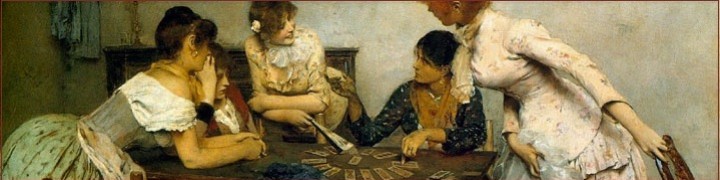
I don’t like to criticize someone else’s reading as tarot card meanings are not fixed, and it is an art, not a science—but there’s a lot of confusion in the four minute reading for Whoopi Goldberg on The View—watch it here. I thought I’d clear up what I can. Read the rest of this entry »
On the August 17th episode of The View, Whoopi Goldberg received a tarot reading from Sandy Anastasi. See my comments on the reading here.
Thanks to Steve Schreiber for pointing this out to me. Check out my TV & Movie Watch List.
♥
Charles San introduced the 1973 Causeway Books edition of Waite’s Pictorial Key to the Tarot with an essay, “How to Read the Cards,” in which he recommended this Major Arcana-only spread. It features an interesting way of selecting the cards and, when I first tried it, the cards themselves suggested a way to give the reading additional definition and depth. Here is the spread with my own modifications. (San did not state where to place each card except that they circle around the Significator.)
- Shuffle the Major Arcana and deal out six cards face down on top of each other. Turn the seventh card face up and place it in the middle of the reading area. This is the Significator and represents a starting point for the reading. Return the other six to the bottom of the deck.
- Deal two cards face down and turn one card up, placing this third card at the 10 o’clock position (relative to the Significator). Do this seven times placing every third card in a counterclockwise circle around the Significator [this order is added by me as a result of the example spread that follows]. You will end up with seven cards circling the card drawn in step 1.
- Optional: if unsatisfied that these cards suffice, deal three more cards from the remaining thirteen, taking the third, tenth and thirteen cards, and place them above the circle.
San says you are to build a vision of the “present place in the ebb and flow of one’s life,” as “the individual cards and the combining of them provides one with the reading.” You can read this spread for yourself or one friend, but if three people are present then “the reading that results concerns all three as part of the society in which they live and work.”
Here is my spread using the Golden Dawn / Whare Ra Majors: Read the rest of this entry »

 I’ve been gathering pictures of cartomancers for a future gallery and in the process came across this poem written by Mary Darby Robinson (1758-1800; pictured above and on right). The poem is about a young man and woman who go to a gypsy fortune-teller to get their destinies foretold—with an unexpected twist at the end. Unfortunately we don’t get to see the technique used by the gypsies, but this story fits very well with some of the paintings I’ve found from the period, which suggest palmstry as the most likely method used. Mary Robinson, known as “Perdita,” was a notorious woman—an actress, author and mistress to the Prince of Wales, as well as being painted by Gainsborough (see right). While she was born into the “Georgian” period of George III, her affair was with his son, George IV, who ushered in the “Regency” period (made infamous by Jane Austen and modern Romance writers). Robinson’s writing—dealing as it did with matters not welcomed by the subsequent Victorians—was soon forgotten. Robinson was a contemporary of Antoine Court de Gébelin and Etteilla who started the modern occult tarot movement (although she lived across the channel in England). Hope someone makes a movie about her. If so, they should have Count Cagliostro (who spent time with Freemasons in both France and England) do a reading for her with the Etteilla deck. Read the rest of this entry »
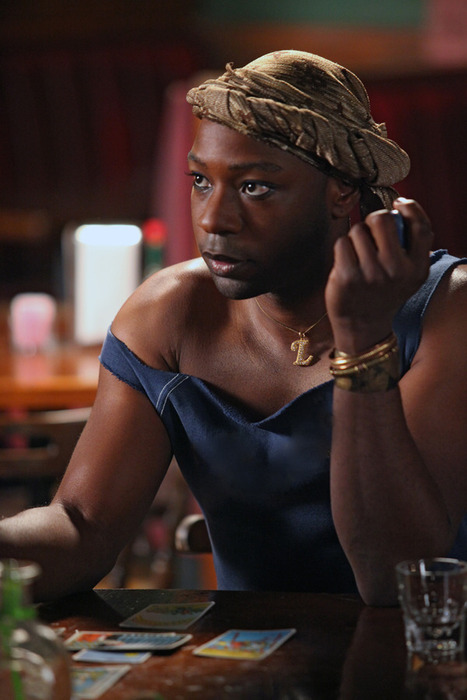
The latest episode of “True Blood” on HBO has a tarot reading at Merlotte’s Bar by Lafayette (yes he’s gorgeous) for Tara. (Season 2, Episode 8: “Timebomb.”)
For those who are not fans – this is a vampire series based on the supernatural mystery novels (Southern Vampire series) of Charlaine Harris that I’ve been following since they began. It’s a great series for those who are into the genre. The TV production is shockingly full of sex and violence, easily glossed over when reading Harris’ humorous writing style, but the show and books are as addicting as vampire blood is rumored to be.
Check out the TV & Movie Watch List for more tarot appearances in the media.
♥
Announcing a website, now in English, for The Cultural Association “Le Tarot” whose president, Andrea Vitali, is one of the major researchers and writers of tarot history. Vitali has overseen many museum exhibitions of tarot and related artifacts – examples of which can now be viewed at this beautifully designed website. Vitali’s illustrated essays on the 22 Triumphs are essential for understanding the culture and ideas out of which the tarot arose (see Essays). This site, promoting tarot’s religious, philosophical, anthropological and artistic history, is filled with useful information including links to international websites—many of which you may not have heard.
To get the English translation click on the British flag on the top right.
♥
Updates: 2/8/11: Another law threatens that Romanian readers may be fined if their predictions don’t come true! See here. Even The New Republic featured a thoughtful article on the legislation issues—calling it Voodoo Economics.
1/11/11: The law taxing witches and tarot readers has been passed and the lawmakers are being cursed as promised, according to this BBC account and video report. Other Romanian witches see the tax as an official acknowledgement of their profession. [Thanks to Vicki.]
9/9/10: The law mentioned below did not pass as lawmakers feared getting cursed reports CBS News.
From the English language Al Jazeera TV comes this report on a controversy in Romania regarding gypsy fortune-tellers (who also call themselves white witches). Madame Radika reads the tarot in Part 1 and Part 2 for two young women. Can you name the deck? The program discusses the new laws against the advertising of fortune-telling as well as the typical escalation of costs for removing curses (that make the practitioners wealthy). Part 2 shows a second reading and a Midsummer Night Ritual intended to help the young women through love spells (warning – graphic chicken sacrifice included in Part 2). All-in-all it is a fairly unjudgmental reporting of practices that some may find disturbing and exploitive, nevertheless the practices are comparable with indigenous magico-spiritual and shamanic techniques in other parts of the world. Read the rest of this entry »
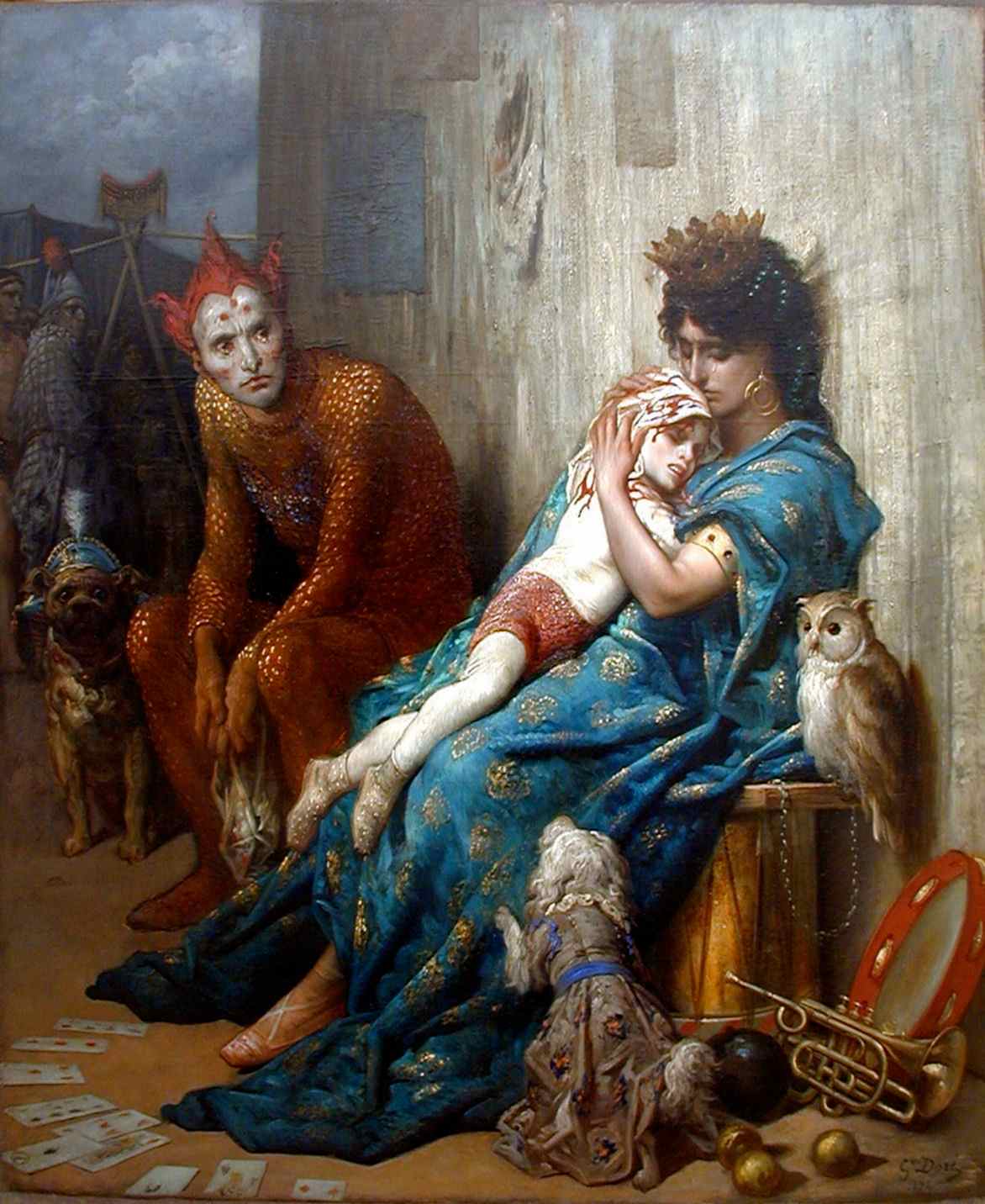
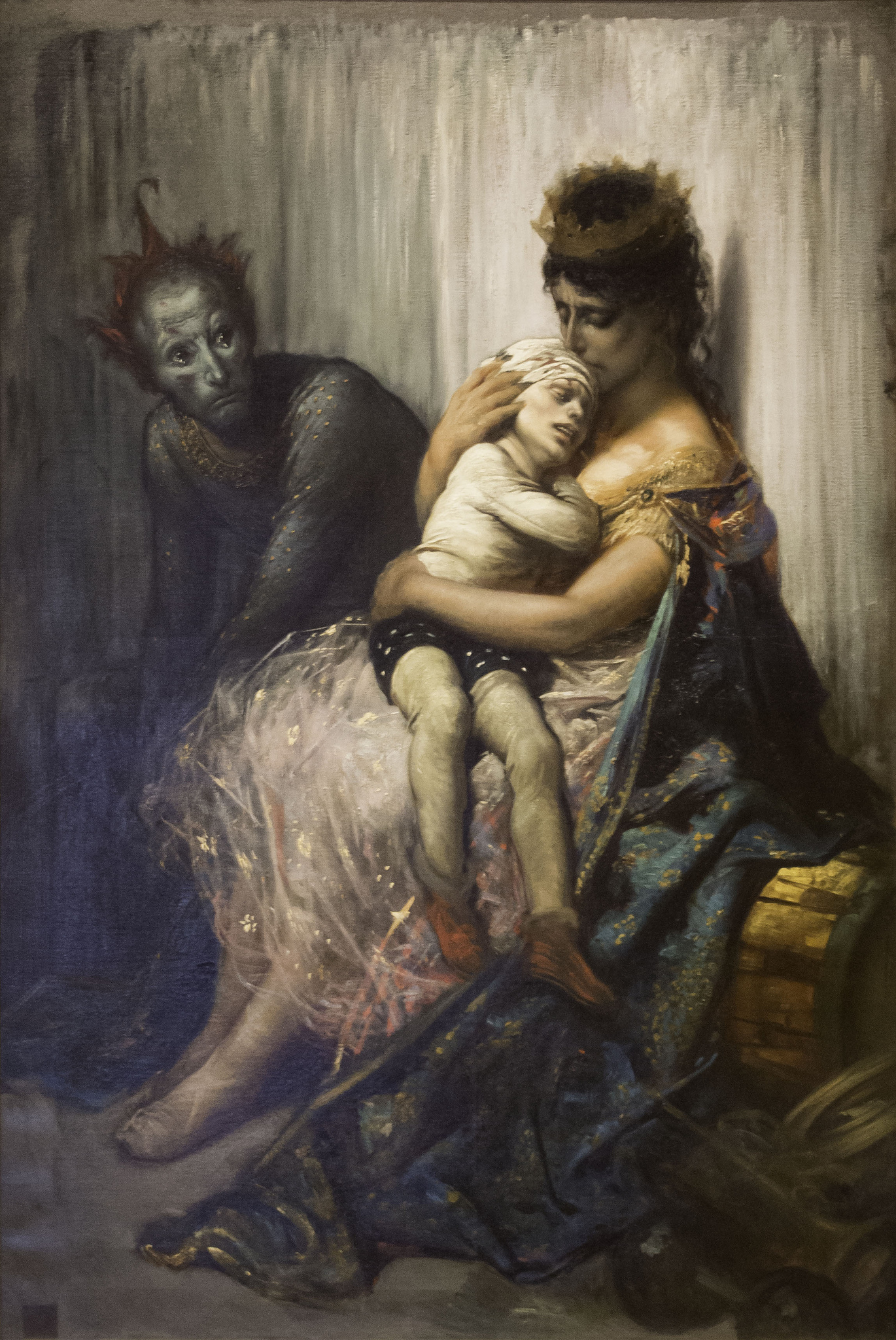
Gustave Doré (1832-1883) – Les Saltimbanques (Entertainers), 1874
Updated.
Several paintings of card readers tell fascinating stories. As tarot readers we work with the images in pictures as rich symbols of the human condition. It would be interesting to hear what story you see in this powerful and heartbreaking painting by Gustave Doré. Use the “Comments” to share with us what you think has just happened and what message the artist may have had. Refer to as many of the symbols as you can to tell us what their story is. As noted above, Saltimbanque, while a French word, is from the Italian saltare in banco, “jumping on a platform,” and signifies “tumbler, performer, entertainer.” Saltimbanques are a subset of acrobats, performing only on the ground. I understand the word has a slightly perjorative connotation that includes buffoonery and charlatanism. Marilee reports in the Comments that the painting is also called “The Injured Child,” which suggests that all hope might not be lost. (Click on the picture to make it larger and then click again for one more zoom.)
UPDATE: In an 1874 interview with Gustave Doré for Appleton’s Journal (in England), Doré made his own intentions for this painting clear to the interviewer (this was the same year in which he painted the work):
[Interviewer:] Turning to that picture of ‘The Mountebanks,’ which had so struck me, I asked if the poor wounded child were going to die.
“Yes,” answered M. Doré, “he is dying. I wished to depict the tardy awakening of nature in those two hardened almost brutalized beings. To gain money they have killed their child and in killing him they have found out that they had hearts. . . . The English engraver wishes me to call it ‘Behind the Scenes’ but its French title will be I think simply ‘Agonie.'”
Why do you think the artist included playing cards in this scene? What do they represent? Read this original story by ‘Helen’ inspired by the painting, which includes a brief reading of the cards.
Added: Here’s an enhanced close-up of the cards for those who would like to try reading them: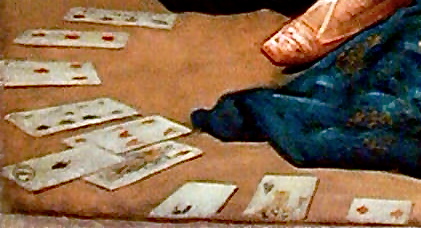
See this post for a couple of animoto videos of this picture.
Denver Museum of Art painting on the same subject.
Here the child is clearly dead, no animals are present, the cards are missing, and the father looks like an underworld denison—a demon from the depths. Striped down to raw emotion, Doré is letting the family themselves tell the story rather than through the symbolic accoutrements of the other work. The Virgin Mary-style robe of sky blue and gold stars of the prior painting has been cast aside to reveal a filmy dress of youthful, blossom-pink. It’s as if the child were posed between dawn and night. It seems that Doré himself trained as an acrobat and had a life-long fascination with common street performers. He was struck by a report of just such an accident in the papers and not only produced one of his scarce paintings, but actually poured himself into two versions, seeking to capture that moment of unspeakable grief.
This version of the painting (curgently held by the Denver Art Museum) seems to have been executed first in 1873. It may be the painting that is referred to in the interview quoted above as the “agonie” is even more apparent. See also a preliminary drawing for the painting, found in the comments section.
Several cards printed with curious effigies tumbled onto the floor. The first corresponded to a woman wearing the Franciscan habit, a triple crown on her head, a cross like that of Saint John the Baptist in her right hand and a closed book in her left. . . . “You’ll never open the priestess’ book,” the pilgrim said.
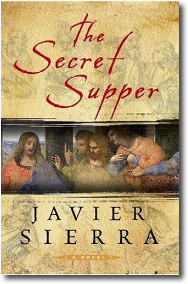
Javier Sierra’s novel The Secret Supper tells the story of Leonardo da Vinci’s painting of “The Last Supper” (or more properly the “Cenacolo“—a circle of companions who meet together). The novel takes us through an experience like that advised by Leonardo himself: Read the rest of this entry »
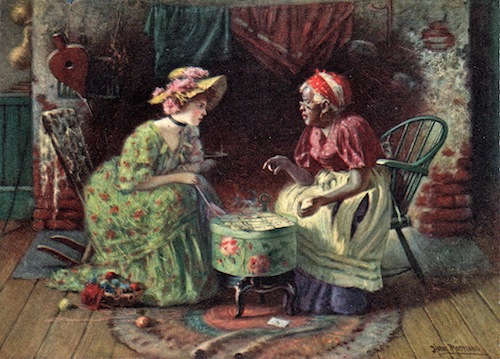
The most significant painter of American cartomancy is probably Harry Herman Roseland (c.1867—1950). He was born and died in Brooklyn and was most known for depicting the lives of African-Americans, especially black women reading tea leaves, palms and cards for white women. Oprah Winfrey has stated that her favorite picture in her own collection is, ironically, Roseland’s wrenching portrayal of “a woman who is about to be sold into slavery and separated from her young daughter,” To the Highest Bidder. (Oprah has two more of Roseland’s paintings in her library.) See more of Roseland’s work here and here. Compare the works below with the images of cartomancers from Russia, France, England and Italy found here. And read “Aunt B’s” cultural analysis of these paintings here.
 Mary K. Greer has made tarot her life work. Check here for reports of goings-on in the world of tarot and cartomancy, articles on the history and practice of tarot, and materials on other cartomancy decks. Sorry, I no longer write reviews. Contact me


Recent Comments