You are currently browsing the category archive for the ‘Tarot Tips & Techniques’ category.
Updated 7/18/11: See Mic update at the end and helpful recommendations in the Comments.
Imagine that a client comes to you for a premium reading. They spend an hour and a lot of money, but when they get home they can hardly remember a word of the deep wisdom and insights they just received. I like to trust that their subconscious is making use of it, but I know from experience the value that comes from reviewing a reading in depth. What to do?—No one uses audio cassettes anymore.
I got myself an iPad 2 and it’s one of the best things I’ve ever done. I’ve been waiting a year for the next generation and I’m thrilled to have it. One of my main intentions was to use it as a fancy digital recorder for tarot consultations. And by fancy, I mean FaNcY! Nothing else offers the bells and whistles this does [except the iPhone, which can do most of these things, too].
In one, relatively small package, you can record a reading, take notes on it, create an annotated sketch of a personalized layout, and include photos of the completed tarot spread and even of the grinning querent and reader. And, at the end of the session, you can instantly email the reading to clients so it’s waiting for them on their computer when they get home (or on their iPhone or iPad for their immediate viewing and listening pleasure). Talk about moving into the 21st century! Now, there can be a few glitches in this otherwise perfect scenario. Occasionally an app crashes. Audio files can get really big and cause problems with mail. And one app even caused my whole iPad to crash (boy, is that app going to get a thumbs down!). Additionally, you can’t email unless there’s a WiFi connection or you have G3, but even if you have to send the file later that’s hardly a deal breaker. Here’s a couple of apps that make the whole process irresistable.
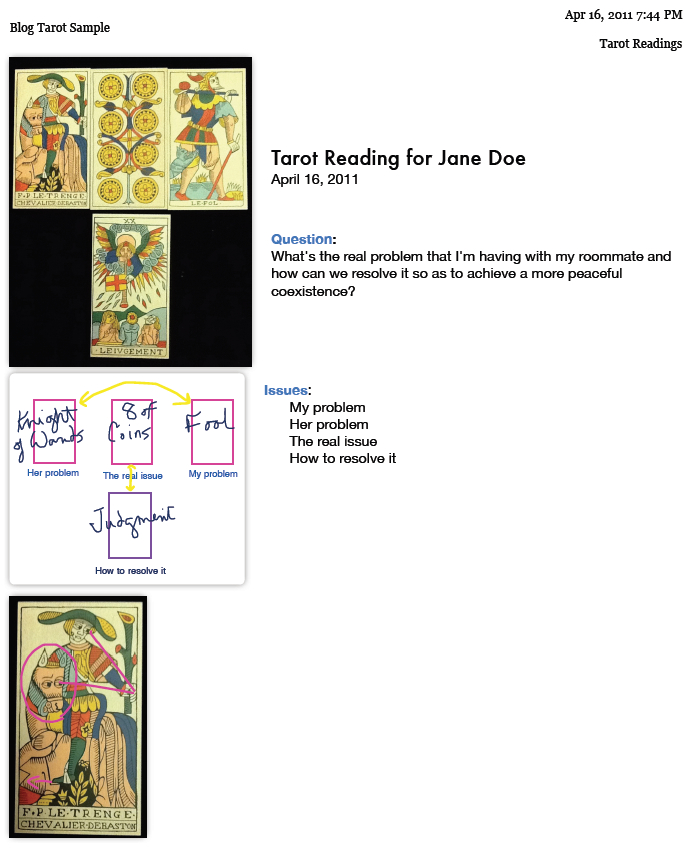
Click for larger image
NOTABILITY – This app does it all and the new price of $2.99 is a still a steal. Since I originally wrote this post, Notability has been upgraded, and they added all the features I asked for (thank you very much!).
- Type notes such as the question or subject of the reading, aspects of the issue that could be the basis of a personalized spread, recommended resources. You can use a variety of fonts & colors and can indent to create outlines.
- Record the conversation. The audio recording will continue even while you perform other functions within the app and outside of it, and you can pause it.*
- Insert a photo of the actual spread. You can resize the image and move it on the page and now place images side-by-side.
- Create a sketch of the spread or layout (basic shapes included as well as freehand drawing and text). You can also draw on a photo to circle important symbols or lines of sight and emphasis. No other app that I know includes all these features.
- The Send options are excellent since you can mail as a zipped PDF + separate Audio file; or, to other Macs only as an RTFD (opens in TextEdit). It also works with Dropbox (cloud computing).
*If you are recording your own readings—talking to yourself as you look at a card or spread—this app can be fantastic. Just type a few keywords as you speak to indicate ideas you want to return to, then, when playing back the audio, if you tap on one of those keywords or phrases, the audio will jump forward or backward to that part of the recording! This would be a great way to journal the exercises in 21 Ways to Read a Tarot Card!
AUDIO MEMOS 2 – Free for the basic app, which is adequate; pay for upgrades.
This is a professional level audio voice recorder. You won’t get the photos or the notes, but you will get great recordings even with only the built-in mic (either .wav or for smaller files – .aac). You can do button or voice activated recordings and you can pause and restart. You can also do some basic editing. When played back on Audio Memos it can jump to annotatable position markers that you set when recording. Unfortunately, the position markers don’t work if you playback via a different application. End the recording and email it in seconds (if you are net-connected) or save it to mail later. CONS: Photos and sketches have to be created in another app and sent separately; you can only mail up to 15mb and the best quality files are BIG. You should be able to record an hour on .aac setting. If you want .wav use the included timer and start a new recording when the file gets too big. You can export to Dropbox or Evernote.
GARAGEBAND – $4.99. I don’t use this myself as I find it overkill for simple recording, but others love it. Great editing features.
EVERNOTE – Free with limited space on its server; a monthly charge for more space.

This note-taking app saves everything on its own server, making it accessible to you from any computer or mobile. You can also give others access to some of your files. You can type, record and take a photo without leaving the app and it’s designed to easily insert webclips (like a spread from tarot.com). CONS: You can’t sketch; if you stop the recording you have to start a new one; the emailer crashed the app and froze my iPad! PROS: I discovered, after recording a Skype interview with someone in Italy, that I could transfer the giant AudioMemos .wav file to Evernote and then access it through my Evernote web account on my home computer and mail it via SendThisFile—problem solved.
Added: A MUST HAVE for Professional Tarot Readers who do face-to-face or phone readings is a Credit Card App (PayPal works well for internet consultations). A credit card app will work with both the iPhone and the iPad. It allows you to accept charges and the money is then deposited in your bank account (or a check can be mailed to you). The most handy and reasonable app, that has no hidden fees or monthly charges, is Square, which is perfect for those who only need to take credit cards occasionally. See recommendations in the Comments section by people who have used it.
There are other Notes+Audio apps that I haven’t checked out yet like AudioNote, SoundNote, Sundry Notes, ClassNotes, PaperDesk, some of which may be better if you prefer handwriting and sketching to typing. If anyone has any suggestions, please let us know in the comments. Added: My Notebook! app has all the functions I’ve recommended, including a great handwriting/sketching option—smooth & with the best arrangement for color choosing I’ve seen. But the interface is unnecessarily complicated and the free Lite version has quite a few limitations, like not being able to try out any of the many Send features.
And, of course, iPad/Phone comes with FaceTime, which, like Skype, gives you the option of face-to-face calls for readings at a distance. Read suggestions for Skype recording in the Comments.
UPDATED note on External Mics:

Under most circumstances the little mic in the iPad will do okay for face-to-face readings if you don’t mind the hollow tone and a bit of a lisp in your voice. Don’t speak directly into it.
If you want an external, portable mic, then I highly recommend the Samson Go Mic. It’s very small (though surprisingly heavy), clips onto your iPad or stands alone, and works with the iPad USB camera connector. You can also plug headphones directly into the mic. It’s good enough for podcasts-on-the-go, although a pop-filter helps for optimum sound when in uni-directional mode. This video review is very helpful for understanding the three sound settings and hearing it in action.
Some Blue USB Microphones work through the iPad USB camera connection kit. The Blue Yeti is supposed to be the best of its class (+/-$125) but requires a powered USB hub. The Snowball and Snowflake are cheaper, more portable and don’t require the powered hub, but the quality goes down. If you are doing podcasts then go with the Blue Yeti (I would). I understand Blue is working on more portable mic solutions for the iPad/Phone.
See the Comments for other great suggestions for recording, including internet video and audio recording via Skype and Conference Calls.
Much is made of how tarot cards can be interpreted through their images or symbols—especially modern decks that feature pictorial scenes with lots of images on all the cards. This post is about how to combine and translate the language of imagery into statements, such that these statements can be more easily interpreted than the images by themselves.
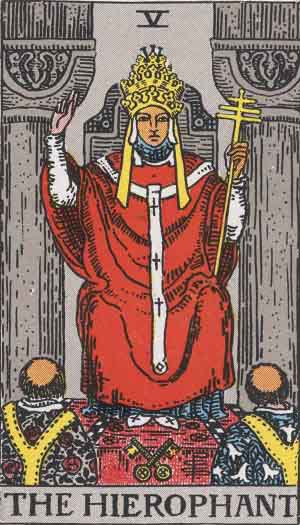
Many of us have spent fruitful hours pouring over symbol dictionaries in order to better understand each detail in the tarot. For instance, we might research and discover that a key, in addition to simply opening or locking a contained space, is seen as the means to unlock hidden meanings in symbols or doctrine. More specifically, in the Hierophant/Pope card,  keys have a special meaning regarding the priesthood: the gold key represents mercy and absolution, and the silver key stands for judgment and penance. Furthermore, these keys refer back to the gospel of Matthew (16:19) in which Jesus tells Peter, “I will give you the keys to the kingdom of heaven. Whatever you bind on earth shall be bound in heaven; and whatever you loose on earth shall be loosed in heaven.” Going further, you will discover that Mercy and Judgment (the gold and silver keys) are the two columns on the Kabbalistic Tree of Life.
 How many times have you mentioned any of the above references in an actual tarot reading?
Alternatively, a reader might try to discover the querent’s own, in-the-moment, personal associations with this image: “Oh, my gosh. Those are my car keys that I lost yesterday at church!” Or a reader will offer up his or her own projections and intuitions, as in, “As I’m seeing it right now, the keys are saying that your spiritual leader or tradition “holds the keys” to whether you should get a divorce.” These can certainly be rich ways to read the tarot, but they can sometimes get you sidetracked from the essential message of the card. Even the artist’s stated intention for a symbol can be so personal and idiosyncratic that it, too, misses the mark. I’m not saying that the following technique is the “best” method for interpreting images, but rather that it can be helpful and serve as a checkpoint to make sure you’ve touched on its roots.
What I offer here is a method that involves translations of the essential, objective meaning of an image—its denotative and connotative definitions and its core characteristics or functions (how the thing is used).
At the denotative level, a key is a small piece of metal shaped with parts that fit with parts in another mechanism (usually a lock) so that manipulation (turning) changes the latter mechanism’s function—usually to open or close things. The connotative meaning is that it binds or loosens, and a key often suggests gaining access to something. If we abstract it one more level, then it suggests obtaining the answer, solution or means to something crucial or important. Connotative meanings are more subjective and often convey pleasing or displeasing feelings about the word. [Note: I use ‘objective’ and ‘subjective’ here, not as absolutes, but as relative points along a continuum.]
Step 1
To try out this technique, you need to start with the most “objective” meanings and functions—what I often call the “literal” level of a symbol—rather than personal projections or mythic, occult, alchemical, astrological or psychological significances. In other words, try to use as little abstraction, impressionism or subjectivity as possible.
To try another example, the denotative level of the RWS dog in the Fool card is “a domesticated, four-legged, carnivorous mammal with an acute sense of smell.” The functional aspect is that it is tamed by humans to function as a companion, protector or hunter. A further, connotative abstraction includes ideas such as loyalty, instincts or, sometimes, a scoundrel or wretch. (In this process, we won’t consider the mythic associations of dogs with death, like Cerberus at the gates of Hell, nor the Egyptian dog-headed Anubis, nor the association of dogs with the Moon and Artemis, nor the dog of Odysseus, or that in alchemy a dog represents sulfur or primitive, material gold. Nor will we consider that god is dog spelled backwards.) When in doubt, think of a dictionary rather than a book of religion, mythology or literature. In fact, a dictionary is often a good place to start when translating images.
Step 2
Step 2 involves linking together the most essential definitions, functions and connotations of three to five core images from one card into a “literal translation” of these images.
With the RWS Six of Cups as our example, let’s go through Steps 1 and 2. (We should also be aware that traditional meanings for this card often include gifts, pleasurable memories and emotions, nostalgia and old things.) 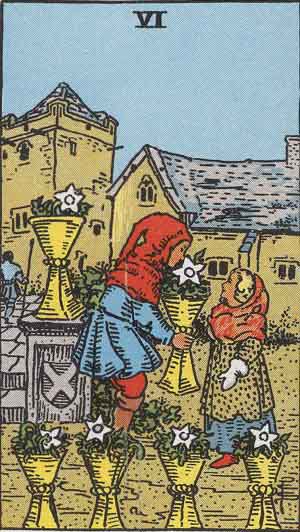 Here are three dominant images from the picture created by Pamela Colman Smith:
• Children – more than one pre-pubescent human being. Their key characteristics are small size, immaturity, innocence, vulnerability, playfulness, learning and development, and being a descendant or establishing a lineage.
• Flowers – the reproductive organs of a plant, usually with characteristics (scent, shape and color) that attract fertilizing mechanisms. Flowers are cultivated to function as decorations or gifts. Blooms suggest the flourishing peak of beauty, health and vigor.
• Glove/mitten – a garment covering the hand. It protects or safeguards the hand to avoid discomfort, damage, disease or contamination of self, others or environment. It may also serve as a fashion ornament.
First we combine these individual images into a simple statement: “A larger child hands a flower to a smaller child wearing a mitten.”
To translate this, we substitute a key word or phrase for each image:
“A larger, innocent offers a gift of beauty and reproductive vigor to a smaller, innocent whose vulnerability has some safeguards.”
Let’s add two more images to see if this changes anything:
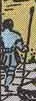 • Courtyard – a private space surrounded by walls or buildings. It functions as a place of air, light, privacy, security and tranquility.
• Guard – a person who keeps watch. He functions in a defensive manner to watch or protect what is vulnerable or to control access.
A very literal description might be: “In a private, guarded space, a child offers a gift of flowers to a another child.”
The next level of abstraction looks something like this:
“In a private, secure and guarded place, but with inattentive watchfulness, youthful innocence and vulnerability handle, with some safeguards, a gift of beauty and reproductive vigor.”
Step 3
Relate this translation back to the querent’s question or situation (via the spread position, if applicable). Now you interpret what the translated images in the cards add to the situation. Generating questions based on the translation is a good way to start.
Let’s add a keyword from the basic card meaning so that we have the following translation:
“A memory in which youthful innocence and vulnerability, in a private, secure and guarded place, but with inattentive protection, handle, with some safeguards, a gift of beauty and reproductive vigor.”
The following are example questions that emerged from the image translation:
Can you remember moments of former pleasure in which a mature, adult significance was not apparent at the time but may now be? Perhaps you were attracted to or given something that continues to reproduce emotional (Cups) reverberations in you? Have you been too guarded and naive to fully appreciate a gift given or received?
Alternatively, could a larger or more dominant self/person have offered something to a smaller self/person who covered up (gloved) her response as she wasn’t completely open to the experience?
Are some of your memories guarded? How do you protect yourself from what happened in the past? A worst case scenario suggests some kind of childhood abuse from which memory you’ve tried to protect yourself. There may be an element of seeing a difficult past through rose-colored glasses (and this card has had those difficult meanings on more than one occasion)—although, generally, it is a very good card.
In the Comments to this post you might want to try combining the image definitions into other translations, because even the most literal translations will vary. See where different translations take you. Feel free to explore this technique in your own way on your own blog or with others—just include a link back here.
Comparison with Cartomancy
It’s worth noting that readings with decks such as the Lenormand, Sybilla or Old Gypsy Fortune Telling Cards use a process similar to that above, in which each card represents a single image. The meanings of these cards have even more restricted parameters, but can be creatively combined. For instance, the card depicting a dog means loyalty and friendship. The child card can mean one or more children or anything small, young or innocent. A set of these cards are linked together in a fashion similar to what we’ve already done, although the result tends to be more mundane and may yield a single new image. For instance, Dog + Child can indicate a puppy, playmate, or childhood friend.
I’ve selected four cards from the Mlle. Lenormand deck (from Piatnik publishing) that are most similar to images in the Six of Cups just to see what happens if we use their meanings:

Child – Lily – Garden – Crossroads
• 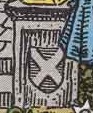 Child: Child or children. Play. Anything small, immature. Naïve, innocent, trusting, sincere. Sometimes, gifts.
• Lily: Mature, old, the elderly. Commitment. Peace, satisfaction, contentment. Wisdom, soul development. Social welfare.
• Garden: Meetings, gatherings, parties, events, conferences. Social encounters and places for this. An audience. Outdoors.
• Crossroads: Options, choices, alternatives. Decisions. Separation. Many of something.
The most simple statement we could make about these cards is: “Many wise children (or immature elders) gather together.” (The order of the cards in an actual reading would affect the interpretation.)
To expand on this idea, we could say:
It is about a social interaction involving young and old, innocent and wise (to play old-fashioned games?), and that a choice may be involved. Peace or wisdom could be gained from childhood choices or from an older sibling. An older person could be reconnecting with past friends or relatives (or grandchildren) or, simply, remembering them.
[Notes: Traditional playing card meanings are usually not part of the standard interpretations for these cards (although it is interesting that three Court Cards appear. Regarding modern interpretations: Garden+Crossroads is a perfect description of social networking, ala facebook and twitter.]
Some Final Thoughts
I use the “Image Translation Technique” as a checkpoint to keep me on track and to compare with other card possibilities including projections and intuitions. Studies of intuition show that intuitions are just as likely to be wrong as right, but you can often get to a right understanding faster and more accurately than through any other known means. What works best is to check your intuitions against ‘rules of thumb,’ or what I call ‘checkpoints.’ The true issue is sometimes precisely what is shown by juxtapositions among traditional meanings, literal translations and the reader’s and querent’s projections and intuitions, revealing the tension or conflict causing the unease at the core of a reading.
I want to reiterate that translations of tarot card images are only one level of working with images (and some people prefer not to work with the pictorial images at all). But, even card keywords are images, and I believe that keeping in touch with the essential meaning of any image provides an important checkpoint for one’s intuition. I’d love to hear about how you work with these ideas and whether they are helpful to you or not.
Acknowledgements: Yoram Kaufmann’s book, The Way of the Image: The Orientational Approach to the Psyche, clarified and helped me to explain the technique I often use in readings. I’ve adopted a few, but not all, of his terms and methodology, and I’ve tried not to psychologize the above material too much (Kaufmann was writing about a Jungian approach to dreams). The concept of using “rules of thumb” with one’s intuition is discussed in Gerd Gigerenzer’s Gut Feelings: The Intelligence of the Unconscious. Sylvie Steinbach’s The Secrets of the the Lenormand Oracle was helpful in putting together the Lenormand interpretation. See my book 21 Ways to Read a Tarot Card for lots of other interpretation techniques.
Recently, at PantheaCon (a huge pagan conference in San Jose, California), I led a “Tarot Intel Circle” with around a hundred people and was asked by several participants to provide a description so they could do it themselves. There are two forms of this process: the “Intel Circle” that can be done with any number of people from a dozen to over a hundred, and the “Tarot Council Circle” that works best with around 6 to 16 people. Each person in either circle gets to be both a Questioner and a Respondent. At most workshops the participants range from those who’ve never read a tarot card to professional readers and everything in between. Everyone gets something out of it, and it often provides a huge kick-start to one’s intuitive abilities—opening a door and switching something on in the psyche. It’s a good process to use at the beginning of a tarot course.
The Questioner usually focuses on one issue or situation about which they want to gather information, although they can change the issue at any time. In both Circles it is helpful to begin by asking, “What do I most need to look at around _(insert issue)_?“ It can be as specific as, “around the problem with the person at work who is driving me crazy” or as general as “around my life purpose.” As the process continues, Questioners can keep asking the same question or reframe it to focus on different aspects of the issue.
Questions should be brief and to the point. The Respondent draws a tarot card (more about this later) and, based on impressions from that card, responds to the question. Usually only a minute or so is allowed for each response before moving on to the next person and question. No response is right or wrong, but rather it offers information, options and possibilities, or layers of meaning. No card meaning is right or wrong. As a Respondent, you don’t have to fix anything!—which is my number one rule.
UPDATE: The germ of these processes was the “Tarot Game” created by Australian artist, Peter Rosson (1954-2002). Originally it involved a small circle of guests who were invited to explore right/left brain interaction, the creative process and the “profiling” of a personal issue using Tarot. May this seeding of Rosson’s creative brilliance continue to grow and flourish.
The Intel Circle
The Intel Circle consists of an inner and outer circle with the same number of people in each, facing each other. The outer circle stays in place (and those who need to sit can do so), while the inner circle stands and moves one person to the right for each question/response interaction. I call time, direct the movement, and I change the rules for each interaction (leaders: a mic and gong are very helpful with large groups). Before we begin, the Questioners draw five cards each from a mixed pool of several tarot decks and will keep these same cards as long as they are Questioners. These cards contain the keys to their issue. As each interaction begins, they ask their question, and the Respondent (across from them) draws one of their five cards, looks at it and responds to the question. Then I ring the bell, the card is returned, and the inner circle moves one person to the right, where a new interaction (with a new prompt) begins. Karen Krebser described her experience as “controlled chaos” with no time for self-doubt.
I’ve provided sample “prompts” for each interaction below. After six or seven interactions everyone switches roles, so that the Questioner can be the Respondent and vice-versa.
The Council Circle
For the smaller Council Circle everyone sits in a close circle (can be around a table) facing everyone else, with one or more decks in the center. The first person addresses their question to the person to their left, who pulls a card and responds. The Respondent then becomes Questioner, turns to the person to their left and asks their own question, that person responds, and so on clockwise around the circle. After responding to a question, people often need to be reminded to switch into asking/Questioner mode as it involves a right-brain/left-brain switch. It is worth becoming aware of how this switch operates in yourself. As leader, I change the “rules” or prompts with each round. After a couple of rounds we change direction (so the question is asked of the person to your right). If doing a long session of several hours, you can have everyone sit in a different seat after a break. In the Council Circle, the leader can also be a participant and usually starts and ends each round.
Towards the end of the whole process, have one person ask a question while each of the others draws a card with which to respond to the question. You can follow with another person asking a question, draw only one card for the whole group, and everyone responds in turn to that that one card. These final questions can be personal, but it’s also a good opportunity to explore spiritual, community and/or world issues. In the Council Circle much more group rapport is built as everyone hears each person’s questions and the responses.
I frequently remind participants that it is up to the questioner to determine what works for him or herself—that this is information-gathering from which they are to pick and choose what seems most meaningful and relevant to themselves. Handled well, it should end up with a deep bonding and a sense of being seen and supported by the whole.
The Leader
The leader is responsible for seeing that the pace moves briskly along, that no one challenges, harangues or criticizes another, and that no one tries to impose their views. The Respondent responds to, rather than “answers” the question. The responses may be possible actions for the questioner to consider but should never be insisted upon. Respondents should not be allowed to lecture or argue for their perspective, nor should other participants question someone’s interpretation. It can sometimes be wise to begin a response with: “If this were my issue, I’d . . .” Personally, I offer gentle but frequent reminders that as respondents, we “don’t have to fix anything,” as this is an essential theme for me. Always support the Questioner’s assessment, for the questioner is the final arbiter of his or her own life. The most relevant information tends to rise to the top. On the other hand, encourage everyone to open themselves to new possibilities.
What is said in the circle stays in the circle and should never be mentioned elsewhere. Trust is paramount, which is especially apparent in the Council Circle.
At the beginning and end, the leader should take a couple of minutes to ground, center and focus everyone, state the group intent, and open (or close) the relevant energy centers for intuitive work. If appropriate to the situation you can set wards and call in guides. An informal-style Council Circle can work in a quiet, supportive social environment without needing a ritual format, but the leader should still be in control and gently guide the process.
The Cards
It’s usually best to use decks that have story-telling images on all the cards. Respondents can draw from a single deck, a selection of decks, or a bunch of decks mixed in a “pool,” or a set of cards (or deck) held by the Questioner. It’s also okay to have the Questioner draw a card and hand it to the Respondent. Whatever works!
The Prompts
Most of the following prompts are for the Respondent, but a few require something from the Questioner. While I usually begin with the same first few, I vary the later prompts as my own intuition directs me. The Respondent should begin speaking immediately and for the entire time given, repeating thoughts, if necessary. When in doubt, simply describe the card! Each item below consists of one interaction lasting a brief one to two minutes. Indented items are part of the prior interaction and may require slightly more time. Occasionally ask the Questioner to summarize what they’ve learned so far (a few summary points are suggested below). For most of the interactions the Questioner remains silent except for asking the question. Note: it’s okay for the Questioner to see the card drawn.
After the Questioner asks their question, the Respondent draws a card and—
• responds with the first thing on the card that catches his or her eye.
• responds by literally describing the image on the card (no meanings or interpretation allowed).
-follow by prompting the Respondent to repeat everything they just said in the 2nd person, present tense (“You are . . .”).
• responds by describing what seems to be the emotions, feelings and attitude of the figure(s) on the card and the mood and atmosphere of the environment.
-follow by prompting the Respondent to repeat everything they just said in the 2nd person, present tense (“You are feeling . . .”).
• the Questioner thinks the question silently (not aloud) and the Respondent responds with something suggested by the card.
• responds with a question (that is, answer a question with a question based on the card drawn).
-Optional: Questioner says what the Respondent’s question brought up.
• responds by not looking at the card (draw one but don’t look at it).
• breathes in the card and then responds with ONE word.
-Optional: Questioner tells how that word is relevant to their question.
• responds with one or more metaphors, aphorisms or sayings based on the literal image (“Been down so long it looks like up to you.” “Beggars can’t be choosers.” “You’ve got the whole world in your hands.” “It’s like being stuck on a fence.”)
• responds with what the person “should do.” (The Questioner can be asked to phrase their question accordingly: “What should I do about . . . ?”)
• responds with what the person “shouldn’t do.” (Ditto. Have the “should/shouldn’t” prompts follow each other.)
• responds with a wild, crazy fairytale using the card as the illustration, and beginning “Once upon a time . . .”
-prompt the Respondent to repeat everything they just said in the 2nd person, present tense (“You are . . .”).
• responds with “The lesson of this card is . . .”
• responds with “The worst case scenario described by this card is . . .”
• responds with “The best case scenario is . . .” (Pair it with the preceding.)
• responds as if the Respondent were a figure on the card, by speaking as that figure.
• responds with “Yes, if . . .” or “No, if . . .” or “Maybe, if . . .”. (Have the Questioner ask a yes/no question.)
• Have the Questioner say how all these responses relate to their issue. (Can insert this whenever it seems appropriate—not too often, but definitely at the end.)
I sometimes end with each person creating an affirmation based on the qualities that they perceive in one of the cards that they most want to develop in themselves, and committing to an action that is in alignment with that.
For Further Development
Many more possibilities are suggested by the exercises in my book 21 Ways to Read a Tarot Card, which also presents techniques that will make you a more effective and empathic leader of this kind of group process. See especially Step 21 for the affirmation process and the “Traps and Solutions” in Appendix H.
James Wells’ reports on his experience when I taught this process at Readers Studio 2010.
Check out this fabulous video by Caterina Paris on combining palmistry with the four suits of the tarot:
And check out Carrie’s other tarot videos here.
I was reminded in the previous post of people who ask what they need to do to become a professional tarot reader. After you feel comfortable reading for self, friends, and friends-of-friends, here’s my number one suggestion for when you want to make the transition.
Your Rite of Passage
The ideal “rite of passage” is to volunteer for a full day (or better yet, a weekend) at a charity or benefit event and donate everything to the cause. If you keep the price reasonable ($5-20 or sliding scale depending on the length of reading and the venue) then your schedule should be filled. The point is to read non-stop (except for necessary breaks), even to the point of exhaustion (drink plenty of water!). There’s a point beyond which a part of you doesn’t care what you say anymore, and you totally let go. You’ll be surprised at what happens then and how accurate you become when you finally bypass your critic. I can’t even begin to list the number of things you will learn from such an experience, but here are a few:
- Letting go of the critic and trusting the process.
- Explaining what you do and/or don’t do in one short, concrete statement.
- Guiding people efficiently through the question, shuffling, etc.
- Learning to listen as well as speak.
- Realizing you can’t “fix” someone & letting go of the need to do so.
- Releasing the need to be “right.”
- Getting your timing down (how many cards for the time allotted).
- Learning how to end a reading (especially with a clingy or argumentative client).
- Discovering the things you’ll need in a “reading kit.”
- Arranging breaks, keeping hydrated, eating, etc.

A few basic accoutrements for reading at fairs and events:
- One or more tarot decks, appropriate to the clientele and occasion.
- A spread cloth. (Busy designs can interfere with the card images.)
- Business cards & promotional handouts.
- Tissues!!!
- Water! Plus an emergency snack—in case you can’t get away for a meal.
- Clothing to put you and others in the mood, and in layers so you can adjust to temperature changes.
- Knowledge of local laws! If necessary have the organization collect the donation and give the person a token for a free reading.
Extras:
- Watch, clock or timer.
- If outdoors, healing stones to keep the cards from blowing away (plus nice to have for the energy).
- Flowers, statue, other decorations. Don’t overdo it.
- Reading sign-up sheet on clipboard & pen.
- Mailing list (if appropriate).
- Cushion for folding chairs. This extra bit of comfort helps.
And, if you continue to do fairs:
- A professional looking sign. This probably will not be necessary for your first charity event.
- Code of Ethics written by you and to which you adhere. (Google for examples.)
- Optional: Tent.
- Optional: Tackle box with pens, permanent marker, index cards (for mini-signs), tape, tacks, clips, extension cord, etc.
- Optional: A Recording device. It’s ideal if the client doesn’t have to write stuff down. Here’s a post on great ideas for recording in person & online.
After doing this myself and making this suggestion to others for more than 30 years, as well as doing mini-events like this with my students, I’ve gotten tons of feedback from people who said it was the best thing they ever did to catapult them into the beginnings of professional confidence and expertise. Please, anyone who wants to add to these lists (and I know there’s more to say), do so in the comments.
Here’s an intriguing quote from G.I. Gurdjieff, In Search of the Miraculous (1949), p. 100-101.
“In order to know the future it is necessary first to know the present in all its details, as well as to know the past. Today is what it is because yesterday was what it was. And if today is like yesterday, tomorrow will be like today. If you want tomorrow to be different you must make today different. If today is simply a consequence of yesterday, tomorrow will be a consequence of today in exactly the same way. . . .
“If a man wants to know his own future he must first of all know himself. . . . Knowing the future is worth while only when a man can be his own master. . . . In order to study the future one must learn to notice and to remember the moments when we really know the future and when we act in accordance with this knowledge.”
Any thoughts on this? It’s worth reading the whole section in Gurdjieff’s book (link to text above). How might these thoughts relate to our reading tarot?
“If you’re interested in deepening your understanding of the Tarot, forming a personal bond with your deck, or enhancing your abilities as a reader, 21 Ways to Read a Tarot Card is an excellent experiential guide for connecting with the cards.” —Janet Boyer
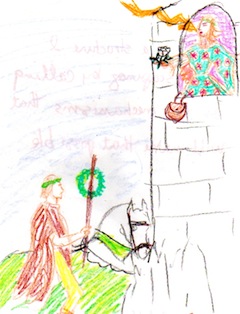
A 3-card drawing that helped me escape an untenable situation (see below).
Are you looking for a way to enliven your tarot practice and expand your skills? Then I urge you to try Mary K. Greer’s 21 Ways to Read a Tarot Card. This is a shameless plug for my latest book. I wrote it, in part, to help you discover what reading style you most resonate with but also to push the boundaries of what you thought was possible in a tarot reading. It’s all about how to discover meaning for yourself. It’s also where I reveal all my tarot reading “secrets.”
I first read Victor Frankl’s Man’s Search for Meaning a very long time ago. As an army brat who had lived in post-War Japan and Germany I was interested in Frankl’s concentration camp story and how he not only survived but transformed his experience into gold. What stuck with me was his belief that “Everything can be taken . . . [except for] the last of the human freedoms—to choose one’s attitude in any given set of circumstances, to choose one’s own way.” Read the rest of this entry »
I don’t like to criticize someone else’s reading as tarot card meanings are not fixed, and it is an art, not a science—but there’s a lot of confusion in the four minute reading for Whoopi Goldberg on The View—watch it here. I thought I’d clear up what I can. Read the rest of this entry »
Charles San introduced the 1973 Causeway Books edition of Waite’s Pictorial Key to the Tarot with an essay, “How to Read the Cards,” in which he recommended this Major Arcana-only spread. It features an interesting way of selecting the cards and, when I first tried it, the cards themselves suggested a way to give the reading additional definition and depth. Here is the spread with my own modifications. (San did not state where to place each card except that they circle around the Significator.)
- Shuffle the Major Arcana and deal out six cards face down on top of each other. Turn the seventh card face up and place it in the middle of the reading area. This is the Significator and represents a starting point for the reading. Return the other six to the bottom of the deck.
- Deal two cards face down and turn one card up, placing this third card at the 10 o’clock position (relative to the Significator). Do this seven times placing every third card in a counterclockwise circle around the Significator [this order is added by me as a result of the example spread that follows]. You will end up with seven cards circling the card drawn in step 1.
- Optional: if unsatisfied that these cards suffice, deal three more cards from the remaining thirteen, taking the third, tenth and thirteen cards, and place them above the circle.
San says you are to build a vision of the “present place in the ebb and flow of one’s life,” as “the individual cards and the combining of them provides one with the reading.” You can read this spread for yourself or one friend, but if three people are present then “the reading that results concerns all three as part of the society in which they live and work.”
Here is my spread using the Golden Dawn / Whare Ra Majors: Read the rest of this entry »
Part 2: Hijacking What It Means to Be Human
(Read Part 1 to learn about mentalists, skeptics and cold reading.)
Imagine my surprise when I discovered there are at least a half-dozen extremely expensive books marketed by mentalists on tarot, of which I’d never heard in my forty-plus years collecting tarot books. And, they were written by and for professional tarot readers that I didn’t even know existed as a self-identified group. Of course, I was aware there are fraudulent tarot readers who deliberately used cold reading techniques to con their marks. Naively, I had assumed, though, that cold reading was used mostly by fake mediums and clairvoyants (as in the 19th century) and by mentalist entertainers. I had no idea that tarot was regularly taught as a scam except among some phone psychics and those storefront psychics who used it to extort money for removing curses, etc.—a whole different, albeit related, enterprise. [Note: some mentalists are also ethical tarot readers, and not all mentalists deny the paranormal. I am also not referring, in most of what follows, to ethical mentalists who are honest about using mental tricks.] Read the rest of this entry »
 Mary K. Greer has made tarot her life work. Check here for reports of goings-on in the world of tarot and cartomancy, articles on the history and practice of tarot, and materials on other cartomancy decks. Sorry, I no longer write reviews. Contact me
 Mary K. Greer's Tarot Blog
Recent Comments